

What do you think?

Jail Diary and Other Writings
Together in one place, this is a collection of most important works of Bhagat Singh, the Indian communist revolutionary who was executed by the British colonizers in 1931 at the age of 23. Bhagat Singh wrote this diary in the last two years of his young life while he was awaiting execution by the British rulers of India. His jail diary was handed over, along with other belongings to his father, Sardar Kishan Singh after his execution.
144 pages, Hardcover
First published January 1, 2007
About the author
Bhagat Singh
82 books380 followersBhagat Singh was an Indian socialist considered to be one of the most influential revolutionaries of the Indian independence movement. He is often referred to as "Shaheed Bhagat Singh", the word "Shaheed" meaning "martyr" in a number of South Asian and Middle Eastern languages. Born into a Sikh family which had earlier been involved in revolutionary activities against the British Raj, as a teenager Singh studied European revolutionary movements and was attracted to anarchist and Marxist ideologies. He became involved in numerous revolutionary organisations, and quickly rose through the ranks of the Hindustan Republican Association (HRA) to become one of its main leaders, eventually changing its name to the Hindustan Socialist Republican Association (HSRA) in 1928.
Ratings & Reviews
Friends & Following
Create a free account to discover what your friends think of this book!
Community Reviews
Displaying 1 - 30 of 62 reviews

March 8, 2015
The Jail Notebook, the sole surviving written scripts by Shaheed Bhagat Singh while he was in jail - he actually wrote 4 books while he was in the jail of which unfortunately none survives - which is full of notes and his musings shows us the voracious reader he was. An extremely well-read man with a brilliant mind, that is the persona of Bhagat Singh which will be revealed to the reader while reading his Jail Notebook.
Apart from his jail notebook, this title has some of his other papers and letters too. Papers like 'Why I am an Atheist', 'To young political workers' The letter to the Punjab Governor titled 'No Hanging, Please Shoot Us' etc are real inspiring to read.
While reading about these heroes i always wonder what would have been the political scene of Independent India if leaders like Shaheed Bhagat Singh - who were firm, brave and full of conviction about what they wanted to do, who never thought twice in taking those ideals that drove them to their grave rather than watering down their beliefs for personal profits - survived till the end of the war of Independence.
Apart from his jail notebook, this title has some of his other papers and letters too. Papers like 'Why I am an Atheist', 'To young political workers' The letter to the Punjab Governor titled 'No Hanging, Please Shoot Us' etc are real inspiring to read.
While reading about these heroes i always wonder what would have been the political scene of Independent India if leaders like Shaheed Bhagat Singh - who were firm, brave and full of conviction about what they wanted to do, who never thought twice in taking those ideals that drove them to their grave rather than watering down their beliefs for personal profits - survived till the end of the war of Independence.

April 12, 2020
The book is essentially a collection of most of the letters he wrote while in the jail. The most astonishing thing for me is the maturity level showcased by Comrade Bhagat Singh. One must remember that he was only 23 years old when got sentenced to death.
The initial letters focus on the explanation or one must say the justification given by Bhagat Singh.
" We are next to none in our love for humanity. Far from having any malice against any individual, we hold human life sacred beyond words. We are neither perpetrators of dastardly outrages, and, therefore, a disgrace to the country, as the pseudo-socialist Dewan. Chaman Lal is reported to have described us, nor are we ‘Lunatics’ as The Tribune of Lahore and some others would have it believed."
" Our sole purpose was “to make the deaf hear” and to give the heedless a timely warning."
The most insightful lessons are provided in the letter where bhagat singh talks about the revolution and clarifies all the misconceptions.
“Revolution” does not necessarily involve sanguinary strife nor is there any place in it for individual vendetta. It is not the cult of the bomb and the pistol. By “Revolution” we mean that the present order of things, which is based on manifest injustice, must change. By “Revolution”, we mean the ultimate establishment of an order of society which may not be threatened by such breakdown, and in which the sovereignty of the proletariat should be recognized and a world federation should redeem humanity from the bondage of capitalism and misery of imperial wars.Revolution is an inalienable right of mankind. Freedom is an imperishable birth right of all".
The letter Bhagat Singh wrote to his father clearly showcases the ideological clarity Bhagat Singh had over his actions and motives.
" Inspite of all the sentiments and feelings of a father, I don’t think you were at all entitled to make such a move on my behalf without even consulting me. You know that in the political field my views have always differed with those of yours. I have always been acting independently without having cared for your approval or disapproval. You know that we have been pursuing a definite policy in this trial. Every action of mine ought to have been consistent with that policy, my principle and my programme. My life is not so precious, at least to me, as you may probably think it to be. It is not at all worth buying at the cost of my principles.In the end, I would like to inform you and my other friends and all the people interested in my case, that I have not approved of your move. I am still not at all in favour of offering any defence. Even if the court had accepted that petition submitted by some of my co-accused regarding defence, etc., I would have not defended myself.
Another letter which needs to be read by everyone is " Why I am an Atheist". This writing also showcases the clarity of thought bhagat singh had.
Whatever issues Bhagat Singh had raised still exists in nations. Many nations might have got the independence but the exploitation of the marginalized continues in one form or other. One may not agree with all his observations but one surely cannot ignore him or his ideas.
The initial letters focus on the explanation or one must say the justification given by Bhagat Singh.
" We are next to none in our love for humanity. Far from having any malice against any individual, we hold human life sacred beyond words. We are neither perpetrators of dastardly outrages, and, therefore, a disgrace to the country, as the pseudo-socialist Dewan. Chaman Lal is reported to have described us, nor are we ‘Lunatics’ as The Tribune of Lahore and some others would have it believed."
" Our sole purpose was “to make the deaf hear” and to give the heedless a timely warning."
The most insightful lessons are provided in the letter where bhagat singh talks about the revolution and clarifies all the misconceptions.
“Revolution” does not necessarily involve sanguinary strife nor is there any place in it for individual vendetta. It is not the cult of the bomb and the pistol. By “Revolution” we mean that the present order of things, which is based on manifest injustice, must change. By “Revolution”, we mean the ultimate establishment of an order of society which may not be threatened by such breakdown, and in which the sovereignty of the proletariat should be recognized and a world federation should redeem humanity from the bondage of capitalism and misery of imperial wars.Revolution is an inalienable right of mankind. Freedom is an imperishable birth right of all".
The letter Bhagat Singh wrote to his father clearly showcases the ideological clarity Bhagat Singh had over his actions and motives.
" Inspite of all the sentiments and feelings of a father, I don’t think you were at all entitled to make such a move on my behalf without even consulting me. You know that in the political field my views have always differed with those of yours. I have always been acting independently without having cared for your approval or disapproval. You know that we have been pursuing a definite policy in this trial. Every action of mine ought to have been consistent with that policy, my principle and my programme. My life is not so precious, at least to me, as you may probably think it to be. It is not at all worth buying at the cost of my principles.In the end, I would like to inform you and my other friends and all the people interested in my case, that I have not approved of your move. I am still not at all in favour of offering any defence. Even if the court had accepted that petition submitted by some of my co-accused regarding defence, etc., I would have not defended myself.
Another letter which needs to be read by everyone is " Why I am an Atheist". This writing also showcases the clarity of thought bhagat singh had.
Whatever issues Bhagat Singh had raised still exists in nations. Many nations might have got the independence but the exploitation of the marginalized continues in one form or other. One may not agree with all his observations but one surely cannot ignore him or his ideas.

April 14, 2012
Although it is only a minimalistic fragment of the genius inscribed into the mind of Shaheed Bhagat Singh, this jail notebook & other letters written by him opens up a whole new and extremely gigantic (in proportions) territory for everyone to see. As mentioned in this book, Bhagat Singh apparently wrote 4 books on different topics (ranging from Socialism to the history of Mankind, things required to do be done in India & what not) while he was in the Lahore Jail but to our great loss, those 4 manuscripts got lost withing the pages of History.
Although, his jail notebook survived in which he used to pen down the various thoughts, quotes & views about every topic he might have covered in his books. Being only 23 years old & battling a court case with as much force & fervor as he did, one can't possibly comprehend as to how he actually got time to work on these projects. The only possible & valid explanation is that he was - in the words of Lenin, which Bhagat Singh had quoted in his notebook - "a professional revolutionary". He was devoted to the cause of Socialism & freedom of our motherland in the most absolute manner hence he never ever wasted even a second of his short life.
At the end, I would just like to say that whoever wants to read about Bhagat Singh should go through this book & I guarantee that you would be amazed by all the things you didn't know about him prior to reading this book.
Lest we forget what Bhagat Singh said, "Inquilab Zindabad"
Although, his jail notebook survived in which he used to pen down the various thoughts, quotes & views about every topic he might have covered in his books. Being only 23 years old & battling a court case with as much force & fervor as he did, one can't possibly comprehend as to how he actually got time to work on these projects. The only possible & valid explanation is that he was - in the words of Lenin, which Bhagat Singh had quoted in his notebook - "a professional revolutionary". He was devoted to the cause of Socialism & freedom of our motherland in the most absolute manner hence he never ever wasted even a second of his short life.
At the end, I would just like to say that whoever wants to read about Bhagat Singh should go through this book & I guarantee that you would be amazed by all the things you didn't know about him prior to reading this book.
Lest we forget what Bhagat Singh said, "Inquilab Zindabad"
June 25, 2021
Atheist, communist, revolutionary
Specifically like the revolution article addressed to young politicians
Got to know specific events around the revolutionary
His level of knowledge at that time and the art of writing is appreciable.
Specifically like the revolution article addressed to young politicians
Got to know specific events around the revolutionary
His level of knowledge at that time and the art of writing is appreciable.

September 1, 2018
With Bhagat Singh as frequently used by so called nationalists as cow rheoteric, this book is must read

August 15, 2021
While I disagree with Bhagat Singh's views on suicide, atheism, violence, and a couple of other issues, there is a great deal of wisdom to be gleaned from these pages. The best review is Bhagat Singh's own words:
I strongly recommend this book to young men in particular, but with a warning. Please do not read it to follow blindly and take for granted what is written in it. Read it, criticise it, think over it, try to formulate your own ideas with its help.
Quotes I liked:
1.
Hunger
“It is desirable for a ruler that no man should suffer from cold and hunger under his rule. Man cannot maintain his standard of morals when he has no ordinary means of living.”
2.
Martyrs
The man who flings his whole life into an attempt, at the cost of his own life, to protest against the wrongs of his fellow-men, is a saint compared to the active and passive up-holders of cruelty and injustice, even if his protest destroys other lives besides his own. Let him who is without sin in society cast the first stone at such an one.
3.
New Gospel
“Society can overlook murder, adultry or swindling; it never forgives the preaching of a new gospel.”
4.
Charity is twice cursed—it hardens him that gives and softens him that takes. It does more harm to the poor than exploitation, because it makes them willing to be exploited. It breeds slavishness which is moral suicide. The only thing Jesus would permit a swollen fortune to do was to give itself to revolutionary propaganda, in order that swollen fortunes might be forever after impossible . . .
5.
Immortality of Soul
For you know if you can once get a man believing in immortality, there is nothing more left for you to desire; you can take everything in the world he owns—you can skin him alive if you please—and he will bear it with perfect good humour.
6.
Death and Suffering of a Child
‘A child was born. He committed consciously neither bad nor good actions. He fell ill, suffered much and long, until he died in terrible agony. Why? Wherefore? It is the eternal riddle for the philosopher.’
7.
Wastes of Capitalism
Economic estimate about Australia by Theodore Hertzka (1886) 58
Every family = 5-roomed 40 ft. sq. House to last for 50 years.
Workers’ workable age: 16-50.
So we have 5,000,000.
Labour of 615,000 workers is sufficient to produce food for 22,000,000 people = 12.3% of labour.
Including labour cost of transport, lunuries need only 315,000 = 6.33% workers’ labour.
That amounts to this-that 20% of the available labour is enough for supporting the whole of the continent. The rest 80% is exploited and wasted due to capitalist order of society.
8.
The Impatient Idealists
The impatient idealist—and without some impatience, a man will hardly prove effective—is almost sure to be led into hatred by the oppositions and disappointments which he encounters in his endeavour to bring happiness to the world.
9.
Leader
“No time need have gone to ruin” writes Carlyle, “could it have found a man great enough, a man wise and good enough; wisdom to discern truly what the time wanted, valour to lead it on the right road thither; these are the salvation of any time.”
10.
Party
But it has become clear that no revolution is possible unless there is a party able to lead the revolution. (p. 15, Lessons of October, 1917). A party is the instrument indispensable to a proletarian revolution.
11.
The Inefficient Leaders
. . . There are two kinds of leaders who incline to drag the party back at the moment when it should go fastest. One kind always tends to see overwhelming difficulties and obstacles in the way of revolution, and looks at them—consciously or unconsciously—with the desire of avoiding them. They alter Marxism into a system, for explaining why revolutionary action is impossible.
The other kind are mere superficial agitators. They see never any obstacles until they break their heads against them. They think they can avoid real difficulties by floods of oratory. They look at everything with supreme optimism, and, naturally, change right over when something has actually to be done.
12.
Preface to Les Miserables
So long as there shall exist, by virtue of law and custom, a social damnation artificially creating hells in the midst of civilisation, and complicating thedestiny which is divine with a fatality which is human; so long as three problems of the age—the degradation of man through poverty, the ruin of woman through hunger, the crippling of children through ignorance—are not solved; so long as in certain regions, social asphyxia is possible—in other words, and from a still wider point of view,—so long as ignorance and wretchedness exist on the earth, books like this cannot be useless.
13.
Justification of Capital Punishment
We hang murderers not merely that it may deter others, but for the same reason for which we kill snakes, namely because it is better for us that they should be out of the world than in it.
14.
Citizen and Man
The Spartan Pedarctes presented himself for admission to the council of the Three Hundred and was rejected; he went away rejoicing that there were 300 Spartans better than himself. I suppose he was in earnest, there is no reason to doubt it,
That was a citizen.
A Spartan mother had five sons with the army. A Helot arrived; trembling she asked his news. “Your five sons are slain.”
“Vile slave, was that what I asked thee?”
“We have won the victory”. She hastened to the temple to render thanks to the gods.
That was a citizen.
15.
Teach him to live rather than to avoid death! Life is not breath, but action! The use of our senses, our mind, our faculties, every part of ourselves which makes us conscious of our being. Life consists less in length of days than in keen sense of living . A man may be buried at a hundred and may never have lived at all. He would have fared better had he died young.
16.
Desire Vs. Contentment
A conscious being whose powers were equal to his desires would be perfectly happy . . . The mere limitation of our desires is not enough, for if they were less than our powers, part of our faculties would be idle, and we should not enjoy our whole being, neither is the mere extension of our powers, enough, for if our desires were also increased, we should only be the more miserable. True happiness consists in decreasing the difference between our desires and our powers.
17.
Aim of Life
“The aim of life is no more to control mind, but to develop it harmoniously, not to achieve salvation hereafter, but to make the best use of it here below, and not to realise truth, beauty and good only in contemplation, but also in the actual experience of daily life; social progress depends not upon the ennoblement of the few but on the enrichment of the many; and spiritual democracy or universal brotherhood can be achieved only when there is an equality of opportunity in the social, political and industrial life.”
18.
Death
If we were immortal we should all be miserable; no doubt it is hard to die, but is sweet to think that we shall not live for ever.
19.
Marx on Insurrection
Firstly: “Never play with insurrection, if there is no determination to drive it to the bitter end (literally—to face all the consequence of this play) An insurrection is an equation with very indefinite magnitudes, the value of which may change every day. The forces to be opposed have all the advantages of organisation, discipline and traditional authority.
“If the rebels cannot bring great forces to bear against their antagonists, they will be smashed and destroyed.
Secondly: “The insurrection once started, it is necessary to act with the utmost determination and pass over to the offensive. The defensive is the death of every armed rising; it perishes before it has measured forces with the enemy. The antagonists must be surprised while their soldiers are still scattered, and new successes, however small, must be attained daily; the moral ascendancy given by the first success, must be kept up. One must rally to the side of insurrection the vacillating elements, which always follow the stronger, and which always look out for the safer side . . . In one word, act according to the words of Danton—the greatest master of Revolutionary policy yet known
—Audacity. . . audacity. . . and yet again audacity!”
20.
I am condemned to death, but you are sentenced to transportation for life. You will live and, while living, you will have to show to the world that the revolutionaries not only die for their ideals but can face every calamity. Death should not be a means to escape the worldly difficulties. Those revolutionaries who have by chance escaped the gallows, should live and show to the world that they cannot only embrace gallows for the ideal but also bear the worst type of tortures in the dark dingy prison cells.
22.
The thing that I wanted to point out was that compromise is an essential weapon which has to be wielded every now and then as the struggle develops. But the thing that we must keep always before us is the idea of the movement. We must always maintain a clear notion as to the aim for the achievement of which we are fighting. That helps us to verify the success and failures of our movements and we can easily formulate the future programme. Tilak’s policy, quite apart from the ideal, i.e. his strategy, was the best. You are fighting to get sixteen annas from your enemy, you get only one anna. Pocket it and fight for the rest. What we note in the moderates is of their ideal. They start to achieve one anna and they can’t get it. The revolutionaries must always keep in mind that they are striving for a complete revolution. Complete mastery of power in their hands. Compromises are dreaded because the conservatives try to disband the revolutionary forces after the compromise. But able and bold revolutionary leaders can save the movement from such pitfalls. We must be very careful at such junctures to avoid any sort of confusion of the real issues, especially the goal.
23.
The function of an organised party is to utilise any such opportunity offered by these circumstances. And to prepare the masses and organise the forces for the revolution is a very difficult task. And that requires a very great sacrifice on the part of the revolutionary workers. Let me make it clear that if you are a businessman or an established worldly or family man, please don’t play with fire. As a leader you are of no use to the party. We have already very many such leaders who spare some evening hours for delivering speeches. They are useless. We require—to use the term so dear to Lenin—the “professional revolutionaries”. The whole-time workers who have no other ambitions or life-work except the revolution. The greater the number of such workers organised into a party, the greater the chances of your success.
24.
Letter to the Second Lahore Conspiracy
Case Convicts
March 22, 1931
Comrades,
The desire to live is natural. It is in me also. I do not want to conceal it. But it is conditional. I don’t want to live as a prisoner or under restrictions. My name has become a symbol of Indian revolution. The ideal and sacrifices of the revolutionary party have elevated me to a height beyond which I will
never be able to rise if I live.
Today people do not know my weaknesses. If I escape gallows those weaknesses will come before them and the symbol of revolution will get tarnished or perhaps it may vanish altogether. On the other hand, if I mount the gallows boldly and with a smile, that will inspire Indian mothers and
they will aspire that their children should also become Bhagat Singh. Thus the number of persons ready to sacrifice their lives for the freedom of our country will increase enormously. It will then become impossible for imperialism to face the tide of the revolution, and all their might and their
satanic efforts will not be able to stop its onward march.
Yes, one thing pricks me even today. My heart nurtured some ambitions for doing something for humanity and for my country. I have not been able to fulfill even one thousandth part of those ambitions. If I live I might perhaps get a chance to fulfill them. If ever it came to my mind that I should not die, it came from this end only.
I am proud of myself these days and I am anxiously waiting for the final test. I wish the day may come nearer soon.
Your comrade
Bhagat Singh
I strongly recommend this book to young men in particular, but with a warning. Please do not read it to follow blindly and take for granted what is written in it. Read it, criticise it, think over it, try to formulate your own ideas with its help.
Quotes I liked:
1.
Hunger
“It is desirable for a ruler that no man should suffer from cold and hunger under his rule. Man cannot maintain his standard of morals when he has no ordinary means of living.”
2.
Martyrs
The man who flings his whole life into an attempt, at the cost of his own life, to protest against the wrongs of his fellow-men, is a saint compared to the active and passive up-holders of cruelty and injustice, even if his protest destroys other lives besides his own. Let him who is without sin in society cast the first stone at such an one.
3.
New Gospel
“Society can overlook murder, adultry or swindling; it never forgives the preaching of a new gospel.”
4.
Charity is twice cursed—it hardens him that gives and softens him that takes. It does more harm to the poor than exploitation, because it makes them willing to be exploited. It breeds slavishness which is moral suicide. The only thing Jesus would permit a swollen fortune to do was to give itself to revolutionary propaganda, in order that swollen fortunes might be forever after impossible . . .
5.
Immortality of Soul
For you know if you can once get a man believing in immortality, there is nothing more left for you to desire; you can take everything in the world he owns—you can skin him alive if you please—and he will bear it with perfect good humour.
6.
Death and Suffering of a Child
‘A child was born. He committed consciously neither bad nor good actions. He fell ill, suffered much and long, until he died in terrible agony. Why? Wherefore? It is the eternal riddle for the philosopher.’
7.
Wastes of Capitalism
Economic estimate about Australia by Theodore Hertzka (1886) 58
Every family = 5-roomed 40 ft. sq. House to last for 50 years.
Workers’ workable age: 16-50.
So we have 5,000,000.
Labour of 615,000 workers is sufficient to produce food for 22,000,000 people = 12.3% of labour.
Including labour cost of transport, lunuries need only 315,000 = 6.33% workers’ labour.
That amounts to this-that 20% of the available labour is enough for supporting the whole of the continent. The rest 80% is exploited and wasted due to capitalist order of society.
8.
The Impatient Idealists
The impatient idealist—and without some impatience, a man will hardly prove effective—is almost sure to be led into hatred by the oppositions and disappointments which he encounters in his endeavour to bring happiness to the world.
9.
Leader
“No time need have gone to ruin” writes Carlyle, “could it have found a man great enough, a man wise and good enough; wisdom to discern truly what the time wanted, valour to lead it on the right road thither; these are the salvation of any time.”
10.
Party
But it has become clear that no revolution is possible unless there is a party able to lead the revolution. (p. 15, Lessons of October, 1917). A party is the instrument indispensable to a proletarian revolution.
11.
The Inefficient Leaders
. . . There are two kinds of leaders who incline to drag the party back at the moment when it should go fastest. One kind always tends to see overwhelming difficulties and obstacles in the way of revolution, and looks at them—consciously or unconsciously—with the desire of avoiding them. They alter Marxism into a system, for explaining why revolutionary action is impossible.
The other kind are mere superficial agitators. They see never any obstacles until they break their heads against them. They think they can avoid real difficulties by floods of oratory. They look at everything with supreme optimism, and, naturally, change right over when something has actually to be done.
12.
Preface to Les Miserables
So long as there shall exist, by virtue of law and custom, a social damnation artificially creating hells in the midst of civilisation, and complicating thedestiny which is divine with a fatality which is human; so long as three problems of the age—the degradation of man through poverty, the ruin of woman through hunger, the crippling of children through ignorance—are not solved; so long as in certain regions, social asphyxia is possible—in other words, and from a still wider point of view,—so long as ignorance and wretchedness exist on the earth, books like this cannot be useless.
13.
Justification of Capital Punishment
We hang murderers not merely that it may deter others, but for the same reason for which we kill snakes, namely because it is better for us that they should be out of the world than in it.
14.
Citizen and Man
The Spartan Pedarctes presented himself for admission to the council of the Three Hundred and was rejected; he went away rejoicing that there were 300 Spartans better than himself. I suppose he was in earnest, there is no reason to doubt it,
That was a citizen.
A Spartan mother had five sons with the army. A Helot arrived; trembling she asked his news. “Your five sons are slain.”
“Vile slave, was that what I asked thee?”
“We have won the victory”. She hastened to the temple to render thanks to the gods.
That was a citizen.
15.
Teach him to live rather than to avoid death! Life is not breath, but action! The use of our senses, our mind, our faculties, every part of ourselves which makes us conscious of our being. Life consists less in length of days than in keen sense of living . A man may be buried at a hundred and may never have lived at all. He would have fared better had he died young.
16.
Desire Vs. Contentment
A conscious being whose powers were equal to his desires would be perfectly happy . . . The mere limitation of our desires is not enough, for if they were less than our powers, part of our faculties would be idle, and we should not enjoy our whole being, neither is the mere extension of our powers, enough, for if our desires were also increased, we should only be the more miserable. True happiness consists in decreasing the difference between our desires and our powers.
17.
Aim of Life
“The aim of life is no more to control mind, but to develop it harmoniously, not to achieve salvation hereafter, but to make the best use of it here below, and not to realise truth, beauty and good only in contemplation, but also in the actual experience of daily life; social progress depends not upon the ennoblement of the few but on the enrichment of the many; and spiritual democracy or universal brotherhood can be achieved only when there is an equality of opportunity in the social, political and industrial life.”
18.
Death
If we were immortal we should all be miserable; no doubt it is hard to die, but is sweet to think that we shall not live for ever.
19.
Marx on Insurrection
Firstly: “Never play with insurrection, if there is no determination to drive it to the bitter end (literally—to face all the consequence of this play) An insurrection is an equation with very indefinite magnitudes, the value of which may change every day. The forces to be opposed have all the advantages of organisation, discipline and traditional authority.
“If the rebels cannot bring great forces to bear against their antagonists, they will be smashed and destroyed.
Secondly: “The insurrection once started, it is necessary to act with the utmost determination and pass over to the offensive. The defensive is the death of every armed rising; it perishes before it has measured forces with the enemy. The antagonists must be surprised while their soldiers are still scattered, and new successes, however small, must be attained daily; the moral ascendancy given by the first success, must be kept up. One must rally to the side of insurrection the vacillating elements, which always follow the stronger, and which always look out for the safer side . . . In one word, act according to the words of Danton—the greatest master of Revolutionary policy yet known
—Audacity. . . audacity. . . and yet again audacity!”
20.
I am condemned to death, but you are sentenced to transportation for life. You will live and, while living, you will have to show to the world that the revolutionaries not only die for their ideals but can face every calamity. Death should not be a means to escape the worldly difficulties. Those revolutionaries who have by chance escaped the gallows, should live and show to the world that they cannot only embrace gallows for the ideal but also bear the worst type of tortures in the dark dingy prison cells.
22.
The thing that I wanted to point out was that compromise is an essential weapon which has to be wielded every now and then as the struggle develops. But the thing that we must keep always before us is the idea of the movement. We must always maintain a clear notion as to the aim for the achievement of which we are fighting. That helps us to verify the success and failures of our movements and we can easily formulate the future programme. Tilak’s policy, quite apart from the ideal, i.e. his strategy, was the best. You are fighting to get sixteen annas from your enemy, you get only one anna. Pocket it and fight for the rest. What we note in the moderates is of their ideal. They start to achieve one anna and they can’t get it. The revolutionaries must always keep in mind that they are striving for a complete revolution. Complete mastery of power in their hands. Compromises are dreaded because the conservatives try to disband the revolutionary forces after the compromise. But able and bold revolutionary leaders can save the movement from such pitfalls. We must be very careful at such junctures to avoid any sort of confusion of the real issues, especially the goal.
23.
The function of an organised party is to utilise any such opportunity offered by these circumstances. And to prepare the masses and organise the forces for the revolution is a very difficult task. And that requires a very great sacrifice on the part of the revolutionary workers. Let me make it clear that if you are a businessman or an established worldly or family man, please don’t play with fire. As a leader you are of no use to the party. We have already very many such leaders who spare some evening hours for delivering speeches. They are useless. We require—to use the term so dear to Lenin—the “professional revolutionaries”. The whole-time workers who have no other ambitions or life-work except the revolution. The greater the number of such workers organised into a party, the greater the chances of your success.
24.
Letter to the Second Lahore Conspiracy
Case Convicts
March 22, 1931
Comrades,
The desire to live is natural. It is in me also. I do not want to conceal it. But it is conditional. I don’t want to live as a prisoner or under restrictions. My name has become a symbol of Indian revolution. The ideal and sacrifices of the revolutionary party have elevated me to a height beyond which I will
never be able to rise if I live.
Today people do not know my weaknesses. If I escape gallows those weaknesses will come before them and the symbol of revolution will get tarnished or perhaps it may vanish altogether. On the other hand, if I mount the gallows boldly and with a smile, that will inspire Indian mothers and
they will aspire that their children should also become Bhagat Singh. Thus the number of persons ready to sacrifice their lives for the freedom of our country will increase enormously. It will then become impossible for imperialism to face the tide of the revolution, and all their might and their
satanic efforts will not be able to stop its onward march.
Yes, one thing pricks me even today. My heart nurtured some ambitions for doing something for humanity and for my country. I have not been able to fulfill even one thousandth part of those ambitions. If I live I might perhaps get a chance to fulfill them. If ever it came to my mind that I should not die, it came from this end only.
I am proud of myself these days and I am anxiously waiting for the final test. I wish the day may come nearer soon.
Your comrade
Bhagat Singh
This entire review has been hidden because of spoilers.

June 30, 2021
Considering that the age of this writing is almost 100 years old today, the eloquence in the writing of Bhagat Singh is nothing short of sheer brilliance. There are certain portions which gave me chills, and i could not help but admire the bravado of this great man.
November 15, 2021
"Bhagat Singh’s Jail Notebook was first published as A Martyr’s Notebook, edited and pressented by BhupenderHooja, Jaipur: Indian Book Chronicle, 1994. The annotations in that edition have been updated and revised in the current edition, with the permission of BhupenderHooja. The text of the Notebook is reproduced from “Jail Diary of Shaheed Bhagat Singh”, accession no. 7422, National Archives of India, New Delhi.
"“Statement Before the Session Court” reproduced from the original statement, accession no. 246, Crown vs. Bhagat Singh and B.K. Dutta, National Archives of India, New Delhi.
"The other writings of Bhagat Singh compiled here are from Selected Writings of Shaheed Bhagat Singh, edited with an Introduction by Shiv Verma, New Delhi: National Book Centre, 1986.
"Appendices 1 and 2 are from the National Archives of India, acquired through Chaman Lal."
................................................................................................
................................................................................................
................................................
................................................
November 14, 2021 - November 14, 2021.
................................................
................................................
................................................................................................
................................................................................................
................................................................................................
................................................................................................
Contents
Introduction
Bhagat Singh’s Jail Notebook by Chaman Lal
The Jail Notebook Annotated by Bhupender Hooja And Other Writings
Statement Before the Session Court
To Make the Deaf Hear
Message to Punjab Students’ Conference
On the Slogan “Long Live Revolution”
Regarding Suicide
Letter to Father
Letter to B.K. Dutta
Letter to Jaidev Gupta
Introduction to Dreamland
To Young Political Workers
Why I am an Atheist
No Hanging, Please Shoot Us
Letter to the Second Lahore Conspiracy Case Convicts
Appendices
Appendix 1
Labour Gov’t Executes 3 Indian Rebels
Appendix 2
75 Killed; 500 Hurt by Labour Gov’t Soldiers
Appendix 3
Editorial, Kudi Arasu, by Periyar E.V. Ramasami
*****
Review
*****
Introduction
Bhagat Singh’s Jail Notebook
by Chaman Lal
"Bhagat Singh dead, will be more dangerous to the British enslavers than Bhagat Singh alive. After I am hanged, the fragrance of my revolutionary ideas will permeate the atmosphere of this beautiful land of ours. It will intoxicate the youth and make him mad for freedom and revolution, and that, will bring the doom of the British imperialists nearer. This is my firm conviction.
"Bhagat Singh, quoted by Shiv Verma
"Introduction to The Selected Writings of Bhagat Singh"
*****
This chapter is, as titled, an introduction, written by Chaman Lal, to Bhagat Singh's jail notebook. It's a good introduction to life of Bhagat Singh, except for the opportunistic use thereof for a strident political diatribe, delivered by Chaman Lal - who uses this introduction to life and works of a freedom fighter of India, to deliver some vitrol against India. At the very outset, the strident tone startles, more about its being so unreal, so out of sync with reality, than mere being a leftist diatribe.
"The threat of imperialism, led by the United States in the company of the United Kingdom and Israel, looms large over the entire world. In Afghanistan, Iraq and Lebanon, this threat has taken a direct military form over the past few years. Countries like Iran and North Korea are being bullied daily, while others like Cuba and Venezuela have faced conspiracies of various kinds over the last several years. Several other nations, India included, face pressure to frame domestic and international policies in line with what the imperialist master dictates. ... "
It fits, of course, the false discourse set up by a ridiculous front comprising of supposedly leftist politics in India - ridiculous, because it disdain majority of India and seeks to divide and destroy it a la Macaulay policy that suits everyone who claims heritage of invading, colonizing conquistadores of last millennium and half - and when this front claims to be secular in attacking not only majority of India, but also all minorities with exception of those aligned with the said colonial rulers of yore, then it's clear they are neither leftist nor secular, but merely flag bearers of anyone outside India who could claim to have ruled India.
By the same logic, they are virulent, as Chaman Lal is above, against Israel, whose major sin is one shared by India, in being not converted to either of the two major conversionist abrahmic religions.
In this they ignore all possible human right violations of the state's they champion, including all atrocities towards at least half of humanity - to which their own mother's belong - and others, often minorities in lands where being not converted is a crime that could get one executed.
Chaman Lal is championing rights of one such state, above. If he is living, now, he might just be championing Taliban about diktats issued a few weeks ago, about females being not required to do anything other than serving them, Taliban, in every physical need - and demanding handover of all females of reproductive age, for the purpose.
*****
Bhagat Singh, one doubts would approve of any of this - of females treated like reproductive robots who must hide unless escorted by a male legal relative, for example. This does not leave them free to have food, much less medical services, unless they serve a male legally in their reproductive capacity, incidentally. Execution by public stone pelting has been known meted out to those stepping out.
But this so called left, so self labelled secular, front couldn't care less - they'd use name of Bhagat Singh for purposes he wouldn't, couldn't, have approved, and when faced with Taliban or other jihadi atrocities, their strategy is to step up virulent attacks against India, mostly via false accusations, to cover up reality. This has gone on now for over three decades, in fact much longer, but more since a genocide forced an exodus of Hindus and other minorities from Kashmir, an exodus dictated by terrorists jubilant about their victory in, what they've since claimed continuously, breaking up USSR.
*****
" ... In these difficult and challenging times, one’s thoughts turn to Bhagat Singh and Che Guevara, who both fought against colonialism and imperialism uncompromisingly. Both were fearless and unflinching in their dedication to the cause of the oppressed. ... "
Minds like this author, Chaman Lal, aren't capable of dealing with complexity, much less outright contradictions, that exist in humans and human societies. They forget Bhagat Singh speaks of a political party in India that aspired to bring a U.S. style democracy after freeing India from yoke of colonial rule; that whatever role of U.S. in southern hemisphere, as far as India was concerned, U.S. was benefic, especially when FDR was president of U.S., as it was when JFK saved India in 1962 - not USSR.
A Churchill could be callous to the point of openly stating that starvation of millions to death in India was unimportant if caused due to British stealing harvest, but he was the main reason world did not fall to nazis, on the other hand, when rest of Europe was occupied and USSR was in cahoots before being turned on; this complexity would be beyond the likes of Chaman Lal- and of anyone with a colonial slave mindset, including those who are deliberately rude to anyone wearing a saree when they are in an alliance francaise, because a saree isn't secular enough for French law! That the alliance francaise is on Indian soul, is either irrelevant or considered a misfortune, to be corrected by converting, and being apologetic.
As for Che Guevara, that story was post WWII, FDR was no more, and a resurgence of those in sympathy with fascist and Nazi political views were winning by stealth, whether at home in U.S. or in Europe, from giving refuge to war criminals instead of prosecuting them, to encouraging Germany to report on Russia; neither Truman nor Ike were fooled completely, but were unable to correct it; and the Kennedy administration, which did attempt more successfully to do so, ended in a brutal assassination perpetrated to put a stop to reforms initiated by the brothers. Che Guevara persecution and assassination happened somewhere along those years. But fact remains that values such as universal franchise and human rights were established in U.S. before even in France, and while corrections much needed do keep getting struggled for, Chaman Lal is abusing an Israel that is endangered simply for being out of sync with the neighbourhood that allows no other religion to exist, for most part.
" ... The slogans they shouted, ‘Inqilab Zindabad’ (‘Long Live Revolution’) and ‘Down with Imperialism’, caught the imagination of the Indian people. The slogans themselves arose out of a qualitative change in the nature of the anti-colonial movement, with the entry, on a mass scale, of the working people and the poor. The new slogans replaced ‘Bande Mataram’ (‘Mother, I Bow to Thee’), from the earlier phase of the national movement. This was a change not simply at the linguistic level, from a Sanskritic slogan to Hindustani-English, but at the level of consciousness itself, from a kind of proto Hindu nationalism to a more inclusive secular and socialist consciousness. ... "
It's unclear if Chaman Lal pouring vitriol on an Indian identity, as opposed to an acceptance of a millennium and half of servitude by giving up India and bending under yoke of colonial rule and conversion to the latest abrahmic faith and denying existence of anything not of West Asia origin, is to be considered either secular or leftist. But that his politics is viciously anti Indian is indubitable, as is the said politics being baseless. For why throw out a British rule with abusive epithets, only go be equally or far more abusive to majority of India, culture of India and her ancient living tradition, all in favour of a colonial servitude towards erstwhile colonial rulers who identified themselves with Turks or Arabs as people, and coveted India only as a possession, but hated being part of it, so much so they aspired tombs abroad, and divided the nation rather than be part of a democracy on par with Hindu majority?
Bhagat Singh certainly woukdnt sympathise with partition, much less with those of JNU who chant slogans to the tune of wishing pieces of India, and victory to her enemies.
As for the linguistic preference shown by Chaman Lal, he seems to not have read the expose by Bhagat Singh regarding Punjab linguistic problems. But then Chaman Lal shows hatred of Sanskrit, the only language that unifies India, while preferring a slavery to foreign languages such as Arabic, Turkish and Persian, and calling their droppings in India Hindostani instead of recognising that they are, if anything, at least as foreign as English.
*****
"Bhagat Singh was born on September 28, 1907 at Chak no. 105 of Lyallpur Banga, now in Pakistan. The day of his birth brought good news: his father Kishan Singh and two uncles, the revolutionary Ajit Singh and young Swarn Singh, incarcerated in British jails, were released. Swarn Singh had contracted tuberculoses in jail, and died shortly after his release, at the age of 24. Ajit Singh was the founder of the Bharat Mata Society (‘Mother India Society’) along with Lala Lajpat Rai. Ajit Singh was also a peasant organizer, and was forced to leave the country in 1909, when Bhagat Singh was a child of two. Ajit Singh returned to India a full 38 years later, as India was on the verge of independence. In fact, he died in Dalhousie the day India became independent, on August 15, 1947. Ajit Singh had spent his intervening years in exile, mostly in Latin America, working with networks of Indian revolutionaries abroad. Ajit Singh was aware of his young nephew’s revolutionary activities, and tried to persuade him to leave the country. The veteran Ghadarite revolutionary Baba Bhagat Singh Bilga, who lived in Argentina in the 1930s, told the present writer that Ajit Singh had three letters of Bhagat Singh with him. These letters, given to someone for safe custody, were lost – as indeed were other documents sent from jail by Bhagat Singh prior to his execution.
"The anecdotes and stories around Bhagat Singh’s childhood have passed into legend. As a child of four, he told well-known freedom fighter Mehta Anand Kishore that he would sow rifles in the fields, so that trees would yield weapons, with which the British could be driven away. In April 1919, as a boy of 12, he visited the Jallianwala Bagh where the British police had massacred thousands of unarmed Indians only days before, and came back with blood soaked earth. In 1921, at age 14, he was telling his grandfather about the preparations being made by railway men to go on strike. The same year, on February 4, more than 140 devout Sikhs had been killed by Mahant Narain Dass in collaboration with the British at Gurudwara Nankana Sahib. When Akali workers protested this massacre, Bhagat Singh was at the forefront of welcoming the protestors in his village. Bhagat Singh joined National College Lahore at the age of 15. Around this time, he learnt Punjabi language and the Gurumukhi script. This may seem strange today, given that he was born a Sikh. However, his grandfather, S. Arjan Singh, was a staunch Arya Samajist, and he emphasized learning Sanskrit. So young Bhagat Singh learnt Sanskrit, in addition to Urdu, English and Hindi."
Chaman Lal makes it sound strange. But he doesn't question Bhagat Singh learning Urdu. This is an attitude imposed artificially in favour of an anti Hindu, pro Muslim stance. It takes time go realise that thus us fraudulent, and intended to cut off roots of India, so India woukd fall prey to a conversion finally.
But fact is, learning Sanskrit was as natural in an Indian home with any education at all, as would be knowledge of Greek and Latin in an English public school.
"It is well-known that Bhagat Singh’s father wanted to marry the boy off, so that he stayed away from revolutionary activities. However, Bhagat Singh was gripped by patriotic fervour. He was also very sensitive to the plight of the two women in the house who lived without their husbands – the dead Swarn Singh’s widow, and the exiled Ajit Singh’s wife – and was determined not to let the same happen to any girl who might marry him. He was particularly attached to Ajit Singh’s wife, Harnam Kaur. According to Bhagat Singh’s classmate Jaidev Gupta, whose reminiscences are available at the Nehru Memorial Museum and Library in Delhi, Bhagat Singh was given to Harnam Kaur as a surrogate son, since she herself was childless. Bhagat Singh felt himself close to Ajit Singh, whose ideas on India’s freedom were far more advanced than those of the Congress, although he had never lived with him. Ajit Singh argued for organizing the peasantry on an anti-feudal, anti-colonial platform. In one sense, Bhagat Singh’s development on the Marxist path was a logical next step to this.
"Already at 15, Bhagat Singh was debating with his father Mahatma Gandhi’s decision to withdraw the Non-Cooperation Movement after the Chauri Chaura deaths in 1922. Withdrawal of Non-Cooperation had disillusioned many youth all over India. In the coming years as well, none of the revolutionaries maintained close contact with Gandhi; in fact most of them polemicized against him. Including, as a matter of fact, Chandrasekhar Azad, who had earlier received punishment by flogging because he shouted the slogan ‘Mahatma Gandhi ki Jai’ (‘Victory to Mahatma Gandhi’). Years later, as they awaited execution, Bhagat Singh’s comrade Sukhdev had written a letter to Gandhi, which reached him only after the execution. As a result, Young India carried Gandhi’s response to it when it was too late."
*****
"Alarmed at Bhagat Singh’s impact on the youth, the Lahore police arrested him in May 1927 for his involvement in the October 1926 Dussehra bomb case. He was kept in jail for about five weeks, and finally released on bail bond of Rs 60,000. Soon after this, the infamous Simon Commission came to India. The Naujawan Bharat Sabha decided to oppose the Commission. Even though Bhagat Singh and his associates had voiced their criticism on Lala Lajpat Rai in public for his association with communal elements like the Hindu Mahasabha, they still asked him to lead the protest demonstration, because there was no leader of his stature in Lahore. The demonstration was planned for October 30, 1928. Though Bhagat Singh himself was not present at the demonstration, NBS activists had formed a cordon around the Lala. In spite of this, when the lathi charge began, it was so brutal that the veteran leader could not be protected. The Superintendent of Police, Lahore, Scott, ordered the lathi charge which his deputy Saunders led personally. Lala Lajpat Rai was grievously hurt, and he died on November 17.
"This led to the famous Saunders murder. The HSRA decided to avenge the death of Lala Lajpat Rai by assassinating Scott, who had ordered the lathi charge. Jai Gopal was to identify the target, Bhagat Singh and Rajguru were to be the actual shooters, and Chandrashekhar Azad was to provide cover. Jai Gopal mistakenly identified Saunders instead of Scott, and even though it was decided that Bhagat Singh would shoot first, Rajguru, never one to be left out of the action for long, shot first. Bhagat Singh realized that they had got the wrong man, and in fact shouted this out to Azad, but when he realized that Rajguru had already shot Saunders, he pumped 3 or 4 more bullets into the fallen body, to make sure that he did not survive. The following morning, the revolutionaries put up posters in Lahore owning up the act.
""Azad was already underground for his involvement in the Kakori rail dacoity case. Immediately following Saunder’s assassination, Bhagat Singh, Rajguru and Sukhdev also went underground. Bhagat Singh escaped to Calcutta with Durga Bhabhi. Here he established contact with some Bengal revolutionaries, including Jatindra Nath, who subsequently went to Lahore to train others in bomb-making. ....
"“Statement Before the Session Court” reproduced from the original statement, accession no. 246, Crown vs. Bhagat Singh and B.K. Dutta, National Archives of India, New Delhi.
"The other writings of Bhagat Singh compiled here are from Selected Writings of Shaheed Bhagat Singh, edited with an Introduction by Shiv Verma, New Delhi: National Book Centre, 1986.
"Appendices 1 and 2 are from the National Archives of India, acquired through Chaman Lal."
................................................................................................
................................................................................................
................................................
................................................
November 14, 2021 - November 14, 2021.
................................................
................................................
................................................................................................
................................................................................................
................................................................................................
................................................................................................
Contents
Introduction
Bhagat Singh’s Jail Notebook by Chaman Lal
The Jail Notebook Annotated by Bhupender Hooja And Other Writings
Statement Before the Session Court
To Make the Deaf Hear
Message to Punjab Students’ Conference
On the Slogan “Long Live Revolution”
Regarding Suicide
Letter to Father
Letter to B.K. Dutta
Letter to Jaidev Gupta
Introduction to Dreamland
To Young Political Workers
Why I am an Atheist
No Hanging, Please Shoot Us
Letter to the Second Lahore Conspiracy Case Convicts
Appendices
Appendix 1
Labour Gov’t Executes 3 Indian Rebels
Appendix 2
75 Killed; 500 Hurt by Labour Gov’t Soldiers
Appendix 3
Editorial, Kudi Arasu, by Periyar E.V. Ramasami
*****
Review
*****
Introduction
Bhagat Singh’s Jail Notebook
by Chaman Lal
"Bhagat Singh dead, will be more dangerous to the British enslavers than Bhagat Singh alive. After I am hanged, the fragrance of my revolutionary ideas will permeate the atmosphere of this beautiful land of ours. It will intoxicate the youth and make him mad for freedom and revolution, and that, will bring the doom of the British imperialists nearer. This is my firm conviction.
"Bhagat Singh, quoted by Shiv Verma
"Introduction to The Selected Writings of Bhagat Singh"
*****
This chapter is, as titled, an introduction, written by Chaman Lal, to Bhagat Singh's jail notebook. It's a good introduction to life of Bhagat Singh, except for the opportunistic use thereof for a strident political diatribe, delivered by Chaman Lal - who uses this introduction to life and works of a freedom fighter of India, to deliver some vitrol against India. At the very outset, the strident tone startles, more about its being so unreal, so out of sync with reality, than mere being a leftist diatribe.
"The threat of imperialism, led by the United States in the company of the United Kingdom and Israel, looms large over the entire world. In Afghanistan, Iraq and Lebanon, this threat has taken a direct military form over the past few years. Countries like Iran and North Korea are being bullied daily, while others like Cuba and Venezuela have faced conspiracies of various kinds over the last several years. Several other nations, India included, face pressure to frame domestic and international policies in line with what the imperialist master dictates. ... "
It fits, of course, the false discourse set up by a ridiculous front comprising of supposedly leftist politics in India - ridiculous, because it disdain majority of India and seeks to divide and destroy it a la Macaulay policy that suits everyone who claims heritage of invading, colonizing conquistadores of last millennium and half - and when this front claims to be secular in attacking not only majority of India, but also all minorities with exception of those aligned with the said colonial rulers of yore, then it's clear they are neither leftist nor secular, but merely flag bearers of anyone outside India who could claim to have ruled India.
By the same logic, they are virulent, as Chaman Lal is above, against Israel, whose major sin is one shared by India, in being not converted to either of the two major conversionist abrahmic religions.
In this they ignore all possible human right violations of the state's they champion, including all atrocities towards at least half of humanity - to which their own mother's belong - and others, often minorities in lands where being not converted is a crime that could get one executed.
Chaman Lal is championing rights of one such state, above. If he is living, now, he might just be championing Taliban about diktats issued a few weeks ago, about females being not required to do anything other than serving them, Taliban, in every physical need - and demanding handover of all females of reproductive age, for the purpose.
*****
Bhagat Singh, one doubts would approve of any of this - of females treated like reproductive robots who must hide unless escorted by a male legal relative, for example. This does not leave them free to have food, much less medical services, unless they serve a male legally in their reproductive capacity, incidentally. Execution by public stone pelting has been known meted out to those stepping out.
But this so called left, so self labelled secular, front couldn't care less - they'd use name of Bhagat Singh for purposes he wouldn't, couldn't, have approved, and when faced with Taliban or other jihadi atrocities, their strategy is to step up virulent attacks against India, mostly via false accusations, to cover up reality. This has gone on now for over three decades, in fact much longer, but more since a genocide forced an exodus of Hindus and other minorities from Kashmir, an exodus dictated by terrorists jubilant about their victory in, what they've since claimed continuously, breaking up USSR.
*****
" ... In these difficult and challenging times, one’s thoughts turn to Bhagat Singh and Che Guevara, who both fought against colonialism and imperialism uncompromisingly. Both were fearless and unflinching in their dedication to the cause of the oppressed. ... "
Minds like this author, Chaman Lal, aren't capable of dealing with complexity, much less outright contradictions, that exist in humans and human societies. They forget Bhagat Singh speaks of a political party in India that aspired to bring a U.S. style democracy after freeing India from yoke of colonial rule; that whatever role of U.S. in southern hemisphere, as far as India was concerned, U.S. was benefic, especially when FDR was president of U.S., as it was when JFK saved India in 1962 - not USSR.
A Churchill could be callous to the point of openly stating that starvation of millions to death in India was unimportant if caused due to British stealing harvest, but he was the main reason world did not fall to nazis, on the other hand, when rest of Europe was occupied and USSR was in cahoots before being turned on; this complexity would be beyond the likes of Chaman Lal- and of anyone with a colonial slave mindset, including those who are deliberately rude to anyone wearing a saree when they are in an alliance francaise, because a saree isn't secular enough for French law! That the alliance francaise is on Indian soul, is either irrelevant or considered a misfortune, to be corrected by converting, and being apologetic.
As for Che Guevara, that story was post WWII, FDR was no more, and a resurgence of those in sympathy with fascist and Nazi political views were winning by stealth, whether at home in U.S. or in Europe, from giving refuge to war criminals instead of prosecuting them, to encouraging Germany to report on Russia; neither Truman nor Ike were fooled completely, but were unable to correct it; and the Kennedy administration, which did attempt more successfully to do so, ended in a brutal assassination perpetrated to put a stop to reforms initiated by the brothers. Che Guevara persecution and assassination happened somewhere along those years. But fact remains that values such as universal franchise and human rights were established in U.S. before even in France, and while corrections much needed do keep getting struggled for, Chaman Lal is abusing an Israel that is endangered simply for being out of sync with the neighbourhood that allows no other religion to exist, for most part.
" ... The slogans they shouted, ‘Inqilab Zindabad’ (‘Long Live Revolution’) and ‘Down with Imperialism’, caught the imagination of the Indian people. The slogans themselves arose out of a qualitative change in the nature of the anti-colonial movement, with the entry, on a mass scale, of the working people and the poor. The new slogans replaced ‘Bande Mataram’ (‘Mother, I Bow to Thee’), from the earlier phase of the national movement. This was a change not simply at the linguistic level, from a Sanskritic slogan to Hindustani-English, but at the level of consciousness itself, from a kind of proto Hindu nationalism to a more inclusive secular and socialist consciousness. ... "
It's unclear if Chaman Lal pouring vitriol on an Indian identity, as opposed to an acceptance of a millennium and half of servitude by giving up India and bending under yoke of colonial rule and conversion to the latest abrahmic faith and denying existence of anything not of West Asia origin, is to be considered either secular or leftist. But that his politics is viciously anti Indian is indubitable, as is the said politics being baseless. For why throw out a British rule with abusive epithets, only go be equally or far more abusive to majority of India, culture of India and her ancient living tradition, all in favour of a colonial servitude towards erstwhile colonial rulers who identified themselves with Turks or Arabs as people, and coveted India only as a possession, but hated being part of it, so much so they aspired tombs abroad, and divided the nation rather than be part of a democracy on par with Hindu majority?
Bhagat Singh certainly woukdnt sympathise with partition, much less with those of JNU who chant slogans to the tune of wishing pieces of India, and victory to her enemies.
As for the linguistic preference shown by Chaman Lal, he seems to not have read the expose by Bhagat Singh regarding Punjab linguistic problems. But then Chaman Lal shows hatred of Sanskrit, the only language that unifies India, while preferring a slavery to foreign languages such as Arabic, Turkish and Persian, and calling their droppings in India Hindostani instead of recognising that they are, if anything, at least as foreign as English.
*****
"Bhagat Singh was born on September 28, 1907 at Chak no. 105 of Lyallpur Banga, now in Pakistan. The day of his birth brought good news: his father Kishan Singh and two uncles, the revolutionary Ajit Singh and young Swarn Singh, incarcerated in British jails, were released. Swarn Singh had contracted tuberculoses in jail, and died shortly after his release, at the age of 24. Ajit Singh was the founder of the Bharat Mata Society (‘Mother India Society’) along with Lala Lajpat Rai. Ajit Singh was also a peasant organizer, and was forced to leave the country in 1909, when Bhagat Singh was a child of two. Ajit Singh returned to India a full 38 years later, as India was on the verge of independence. In fact, he died in Dalhousie the day India became independent, on August 15, 1947. Ajit Singh had spent his intervening years in exile, mostly in Latin America, working with networks of Indian revolutionaries abroad. Ajit Singh was aware of his young nephew’s revolutionary activities, and tried to persuade him to leave the country. The veteran Ghadarite revolutionary Baba Bhagat Singh Bilga, who lived in Argentina in the 1930s, told the present writer that Ajit Singh had three letters of Bhagat Singh with him. These letters, given to someone for safe custody, were lost – as indeed were other documents sent from jail by Bhagat Singh prior to his execution.
"The anecdotes and stories around Bhagat Singh’s childhood have passed into legend. As a child of four, he told well-known freedom fighter Mehta Anand Kishore that he would sow rifles in the fields, so that trees would yield weapons, with which the British could be driven away. In April 1919, as a boy of 12, he visited the Jallianwala Bagh where the British police had massacred thousands of unarmed Indians only days before, and came back with blood soaked earth. In 1921, at age 14, he was telling his grandfather about the preparations being made by railway men to go on strike. The same year, on February 4, more than 140 devout Sikhs had been killed by Mahant Narain Dass in collaboration with the British at Gurudwara Nankana Sahib. When Akali workers protested this massacre, Bhagat Singh was at the forefront of welcoming the protestors in his village. Bhagat Singh joined National College Lahore at the age of 15. Around this time, he learnt Punjabi language and the Gurumukhi script. This may seem strange today, given that he was born a Sikh. However, his grandfather, S. Arjan Singh, was a staunch Arya Samajist, and he emphasized learning Sanskrit. So young Bhagat Singh learnt Sanskrit, in addition to Urdu, English and Hindi."
Chaman Lal makes it sound strange. But he doesn't question Bhagat Singh learning Urdu. This is an attitude imposed artificially in favour of an anti Hindu, pro Muslim stance. It takes time go realise that thus us fraudulent, and intended to cut off roots of India, so India woukd fall prey to a conversion finally.
But fact is, learning Sanskrit was as natural in an Indian home with any education at all, as would be knowledge of Greek and Latin in an English public school.
"It is well-known that Bhagat Singh’s father wanted to marry the boy off, so that he stayed away from revolutionary activities. However, Bhagat Singh was gripped by patriotic fervour. He was also very sensitive to the plight of the two women in the house who lived without their husbands – the dead Swarn Singh’s widow, and the exiled Ajit Singh’s wife – and was determined not to let the same happen to any girl who might marry him. He was particularly attached to Ajit Singh’s wife, Harnam Kaur. According to Bhagat Singh’s classmate Jaidev Gupta, whose reminiscences are available at the Nehru Memorial Museum and Library in Delhi, Bhagat Singh was given to Harnam Kaur as a surrogate son, since she herself was childless. Bhagat Singh felt himself close to Ajit Singh, whose ideas on India’s freedom were far more advanced than those of the Congress, although he had never lived with him. Ajit Singh argued for organizing the peasantry on an anti-feudal, anti-colonial platform. In one sense, Bhagat Singh’s development on the Marxist path was a logical next step to this.
"Already at 15, Bhagat Singh was debating with his father Mahatma Gandhi’s decision to withdraw the Non-Cooperation Movement after the Chauri Chaura deaths in 1922. Withdrawal of Non-Cooperation had disillusioned many youth all over India. In the coming years as well, none of the revolutionaries maintained close contact with Gandhi; in fact most of them polemicized against him. Including, as a matter of fact, Chandrasekhar Azad, who had earlier received punishment by flogging because he shouted the slogan ‘Mahatma Gandhi ki Jai’ (‘Victory to Mahatma Gandhi’). Years later, as they awaited execution, Bhagat Singh’s comrade Sukhdev had written a letter to Gandhi, which reached him only after the execution. As a result, Young India carried Gandhi’s response to it when it was too late."
*****
"Alarmed at Bhagat Singh’s impact on the youth, the Lahore police arrested him in May 1927 for his involvement in the October 1926 Dussehra bomb case. He was kept in jail for about five weeks, and finally released on bail bond of Rs 60,000. Soon after this, the infamous Simon Commission came to India. The Naujawan Bharat Sabha decided to oppose the Commission. Even though Bhagat Singh and his associates had voiced their criticism on Lala Lajpat Rai in public for his association with communal elements like the Hindu Mahasabha, they still asked him to lead the protest demonstration, because there was no leader of his stature in Lahore. The demonstration was planned for October 30, 1928. Though Bhagat Singh himself was not present at the demonstration, NBS activists had formed a cordon around the Lala. In spite of this, when the lathi charge began, it was so brutal that the veteran leader could not be protected. The Superintendent of Police, Lahore, Scott, ordered the lathi charge which his deputy Saunders led personally. Lala Lajpat Rai was grievously hurt, and he died on November 17.
"This led to the famous Saunders murder. The HSRA decided to avenge the death of Lala Lajpat Rai by assassinating Scott, who had ordered the lathi charge. Jai Gopal was to identify the target, Bhagat Singh and Rajguru were to be the actual shooters, and Chandrashekhar Azad was to provide cover. Jai Gopal mistakenly identified Saunders instead of Scott, and even though it was decided that Bhagat Singh would shoot first, Rajguru, never one to be left out of the action for long, shot first. Bhagat Singh realized that they had got the wrong man, and in fact shouted this out to Azad, but when he realized that Rajguru had already shot Saunders, he pumped 3 or 4 more bullets into the fallen body, to make sure that he did not survive. The following morning, the revolutionaries put up posters in Lahore owning up the act.
""Azad was already underground for his involvement in the Kakori rail dacoity case. Immediately following Saunder’s assassination, Bhagat Singh, Rajguru and Sukhdev also went underground. Bhagat Singh escaped to Calcutta with Durga Bhabhi. Here he established contact with some Bengal revolutionaries, including Jatindra Nath, who subsequently went to Lahore to train others in bomb-making. ....
June 16, 2026
JAIL NOTEBOOK
“…and if some of the things seem to the reader the mere unchaining of furies, I would say, let him not blame the faithful anthologist, let him not blame even the writer—let him blame himself, who has acquiesced in the existence of conditions
which have driven his fellowmen to extremes of madness and despair.”
“I am a man, and all that affects mankind concerns me.”
“The combination of steel and fire, which man has produced and called a machine, must be ever the servant, never the master of man. Neither the machine nor the machine owner may rule the human race.”
“Morality and religion are but words to him who fishes in gutters for the means of sustaining life, and crouches behind barrels in the street for shelter from the cutting blasts of a winter night.”
“If there is anything that cannot bear free thought, let it crack.”
“Surely oppression maketh a wise man mad.”
“We consider it horrible that people should have their heads cut off, but we have not been taught to see the horror of life-long death which is inflicted upon a whole population by poverty and tyranny.”
LETTER TO FATHER
“My life is not so precious, at least to me, as you may probably think it to be. It is not at all worth buying at the cost of my principles.”
LETTER TO BK DUTT
“DEAR BROTHER,
The judgment has been delivered. I am condemned to death. In these cells, besides myself, there are many others prisoners who are waiting to be hanged. The only prayer of these people is that somehow or other they may escape the noose. Perhaps I am the only man amongst them who is anxiously waiting for the day when I will be fortunate enough to embrace the gallows for my ideal.
I will climb the gallows gladly and show to the world as to how bravely the revolutionaries can sacrifice themselves for the cause.”
NO HANGING, PLEASE SHOOT US (LETTER ADDRESSED TO THE GOVERNOR OF PUNJAB)
“As to the question of our fate, please allow us to say that when you have decided to put us to death, you will certainly do it. You have got the power in your hands and the power is the greatest justification in the world. We know the maxim “Might is right” serves as your guiding motto. The whole of our trial was just a proof of that.
What we wanted to point out was that according to the verdict of your court we had waged war and we are therefore war prisoners. And we claim to be treated as such, i.e. we claim to be shot dead instead of being hanged. It rests with you to prove that you really meant what your court has said”
LETTER TO THE SECOND LCC CONVICTS
[On March 22, one day prior to his execution, the Second Lahore Conspiracy Case convicts, who were locked up in Ward Number 14 (near condemned cells), sent a slip to Bhagat Singh asking if he would like to live. This letter was in reply to that slip.]
“March 22, 1931
COMRADES,
The desire to live is natural. It is in me also. I do not want to conceal it. But it is conditional. I don’t want to live as a prisoner or under restrictions. My name has become a symbol of Indian revolution. The ideal and the sacrifices of the revolutionary party have elevated me to a height beyond which I will never be able to rise if I live.
Today people do not know my weaknesses. If I escape gallows those weaknesses will come before them and the symbol of revolution will get tarnished or perhaps it may vanish altogether. On the other hand, if I mount the gallows boldly and with smile, that will inspire Indian mothers and they will aspire that their children should also become Bhagat Singh. Thus the number of persons ready to sacrifice their lives for the freedom of our country will increase enormously. It will then become impossible for imperialism to face the tide of the revolution, and all their might and their satanic efforts will not be able to stop its onward march.
Yes, one thing pricks me even today. My heart nurtured some ambitions for doing something for humanity and for my country. I have not been able to fulfil even one thousandth part of those ambitions. If I live I might perhaps get a chance to fulfil them. If ever it came to my mind that I should not die it came from this end only.
I am proud of myself these days and I am anxiously waiting for the final test. I wish the day may come nearer soon.
Your comrade
Bhagat Singh”
“…and if some of the things seem to the reader the mere unchaining of furies, I would say, let him not blame the faithful anthologist, let him not blame even the writer—let him blame himself, who has acquiesced in the existence of conditions
which have driven his fellowmen to extremes of madness and despair.”
“I am a man, and all that affects mankind concerns me.”
“The combination of steel and fire, which man has produced and called a machine, must be ever the servant, never the master of man. Neither the machine nor the machine owner may rule the human race.”
“Morality and religion are but words to him who fishes in gutters for the means of sustaining life, and crouches behind barrels in the street for shelter from the cutting blasts of a winter night.”
“If there is anything that cannot bear free thought, let it crack.”
“Surely oppression maketh a wise man mad.”
“We consider it horrible that people should have their heads cut off, but we have not been taught to see the horror of life-long death which is inflicted upon a whole population by poverty and tyranny.”
LETTER TO FATHER
“My life is not so precious, at least to me, as you may probably think it to be. It is not at all worth buying at the cost of my principles.”
LETTER TO BK DUTT
“DEAR BROTHER,
The judgment has been delivered. I am condemned to death. In these cells, besides myself, there are many others prisoners who are waiting to be hanged. The only prayer of these people is that somehow or other they may escape the noose. Perhaps I am the only man amongst them who is anxiously waiting for the day when I will be fortunate enough to embrace the gallows for my ideal.
I will climb the gallows gladly and show to the world as to how bravely the revolutionaries can sacrifice themselves for the cause.”
NO HANGING, PLEASE SHOOT US (LETTER ADDRESSED TO THE GOVERNOR OF PUNJAB)
“As to the question of our fate, please allow us to say that when you have decided to put us to death, you will certainly do it. You have got the power in your hands and the power is the greatest justification in the world. We know the maxim “Might is right” serves as your guiding motto. The whole of our trial was just a proof of that.
What we wanted to point out was that according to the verdict of your court we had waged war and we are therefore war prisoners. And we claim to be treated as such, i.e. we claim to be shot dead instead of being hanged. It rests with you to prove that you really meant what your court has said”
LETTER TO THE SECOND LCC CONVICTS
[On March 22, one day prior to his execution, the Second Lahore Conspiracy Case convicts, who were locked up in Ward Number 14 (near condemned cells), sent a slip to Bhagat Singh asking if he would like to live. This letter was in reply to that slip.]
“March 22, 1931
COMRADES,
The desire to live is natural. It is in me also. I do not want to conceal it. But it is conditional. I don’t want to live as a prisoner or under restrictions. My name has become a symbol of Indian revolution. The ideal and the sacrifices of the revolutionary party have elevated me to a height beyond which I will never be able to rise if I live.
Today people do not know my weaknesses. If I escape gallows those weaknesses will come before them and the symbol of revolution will get tarnished or perhaps it may vanish altogether. On the other hand, if I mount the gallows boldly and with smile, that will inspire Indian mothers and they will aspire that their children should also become Bhagat Singh. Thus the number of persons ready to sacrifice their lives for the freedom of our country will increase enormously. It will then become impossible for imperialism to face the tide of the revolution, and all their might and their satanic efforts will not be able to stop its onward march.
Yes, one thing pricks me even today. My heart nurtured some ambitions for doing something for humanity and for my country. I have not been able to fulfil even one thousandth part of those ambitions. If I live I might perhaps get a chance to fulfil them. If ever it came to my mind that I should not die it came from this end only.
I am proud of myself these days and I am anxiously waiting for the final test. I wish the day may come nearer soon.
Your comrade
Bhagat Singh”

October 21, 2016
A must read for any Indian. It totally changed my opinion of Bhagat Singh. Contrary to popular portrayal of a revolutionary, he was a great thinker as well. The arguments which he puts forwards supporting equality, student agitations & atheism are truly amazing. I wish this was part of our academic curriculum. But knowing the content I know why it isn't.

June 3, 2018
I never had so many highlights in a book. Bhagat singh reminded me a line I read somewhere.
"மேதமைக்கும், அற்ப ஆயுளுக்கும் உள்ள தொடர்பு உலகெங்கும் ஒன்று போலவே இருக்கின்றது"
Definitely the book to be read multiple times in the future.
"மேதமைக்கும், அற்ப ஆயுளுக்கும் உள்ள தொடர்பு உலகெங்கும் ஒன்று போலவே இருக்கின்றது"
Definitely the book to be read multiple times in the future.
August 11, 2021
It's hard to know where to begin. Bhagat Singh has been known to every child of India sooner or later, sooner if one grows up closer to Punjab, and to see his most famous photograph with a hat worn stylishly at a slant is to be aware that he was educated, erudite and more - those things are somehow absorbed in atmosphere.
But to read this, it becomes startlingly clear just how much the politics ruling India mist of decades post independence was unjust to these freedom warriors of India, solely so as to push under rug, if not completely wipe off, everyone from memory of India, only to keep one or two names elevated, and one family in power, not only in the ruling party but in the country.
Bhagat Singh was a thinker, very erudite and very well educated, once a senior colleague - who was a professor of mathematics at a research institute and a mentor - had said; he said he'd been unaware of it, due to the ruling party politics. I'd not only agreed with the part about Bhagat Singh, but thought it was known generally, while being not as specifically aware about the political part about clouding his memory in India being intentional, which now is obvious. Same was done to other great freedom fighters, after all, from Lokamaanya Tilak to Subash Chandra Bose and Sardar Patel, and far greater personae. They were mentioned along with other names, in history books, is all.
But reading this brings alive a mind that's not just educated in normal stuff taught commonly in schools and colleges - he died at age of 23! - but far more. He was very aware of various world happenings, of world history and literature, politics and more, and his stance of revolution was based on a personality firmly rooted in thought and awareness, self giving, and national concerns that were neither based on negative views of others nor in desire of personal glory, kudos, fame, power or gain.
He writes of politics, history and literature, of not just his native Punjab, not just of England- that would be after all part of school curriculum during British rule - but of Russian political figures and of Russian literature, those of italy and Ireland, knowledge that wasn't part of curriculum- after all, British weren't about to teach revolution to India!
And then, suddenly, he writes of spiritual matters, not as a preacher, but as a normal person and a revolutionary!
If the British rulers had any brains, they could hsve used such minds as Bhagat Singh and Subash Chandra Bose to help them, not with keeping India down, but far more and far better objectives. As it is, the choices made by the Brits had consequences for England, too, that were neither pleasant nor wanted.
And a goosebumps moment is reading here when Bhagat Singh predicts this!
"As revolutionaries, we do not believe that there can be any sudden change in the attitude of our rulers, particularly in the British race. Such a surprising change is impossible without through sustained striving, sufferings and sacrifices. And it shall be achieved."
It took WWII, particularly the early years after fall of France, when nazis occupied most of Europe - all of West and North, certainly - and London blitz, Coventry and more!
*****
The Problem of Punjab’s Language and Script
"Perhaps Garibaldi could not have succeeded in mobilising the army with such ease if Mazzini had not invested his thirty years in his mission of cultural and literary renaissance. The revival of Irish language was attempted with the same enthusiasm along with the renaissance in Ireland."
*****
"The main reason behind this is the unfortunate communalisation of language in our province, in other provinces, we find that Muslims have fully adopted their provincial languages."
"Punjab should have been the language of Punjab, like other provinces, but since this has not happened, as this question is a spontaneous question, Muslims have adopted Urdu. Muslims totally lack Indianness, therefore they want to propagate Arabic script and Persian language. While failing to understand the importance of Indianness in the whole of India, they fail to understand the importance of one language, which could only be Hindi. That is why they keep repeating the demand for Urdu like a parrot and take an isolated position."
"The urdu script cannot be called a perfect one and the most important point is that it is based on the Persian language. The flights of imagination of urdu poets – even if they are Hindi (Indian) – reach the saaqis (bar-maids) of Persia and date palms of the Arbs countries. Kazi Nazrul-Islam’s poems refer to Dhurjate, Vishwamitra and Durvasa quite frequently, but our Punjabi Hindi-Urdu poets could not even think of them. Is it not a matter which makes one sad? Their ignorance of Indianness and Indian literature is the main reason of this. When they cannot imbibe Indianness, how can their literature make us Indian? Students confined to the study of urdu cannot attain the knowledge of the classical literature of India. It is not that these texts cannot be translated into a literary language like urdu, but it will be useful only to a Persian in his pursuit concerning Indian literature."
*****
"Beware, Ye Bureaucracy
"[A handwritten leaflet explaining the reasons for Saunders’ murder, written on December 18, 1928 on Mozang House den and pasted at several places on the walls of Lahore in the night between the 18th and 19th. A copy in Bhagat Singh’s handwriting was produced as an exhibit in the Lahore Conspiracy Case.]
"Hindustan Socialist Republican Army Notice
"J.P. Sunders is dead; Lala Lajpat Rai is avenged Really it is horrible to imagine that so lowly and violent hand violent hand of an ordinary Police Official, J.P. Saunders could ever dare to touch in such an insulting way the body of one so old, so revered and so loved by 300 millions of people of Hindustan and thus cause his death. The youth and manhood of India was challenged by blows hurled down on the head of the India’s nationhood."
"Beware, Ye Tyrants; Beware Do not injure the felling of a downtrodden and oppressed country. Think twice before perpetrating such diabolical deed"
*****
The Red Pamphlet
"“LONG LIVE THE REVOLUTION”!
"Sorry for the death of a man. But in this man has died the representative of an institution which is so cruel, lowly and so base that it must be abolished. In this man has died an agent of the British authority in India – the most tyrannical of Govt. of Govts. In the world.
"Sorry for the bloodshed of a human being; but the sacrifice of individuals at the altar of the Revolution that will bring freedom to all and make the exploitation of man by main impossible, is inevitable."
*****
Letter to Shaheed Sukhdev
"This letter deals with the views of Bhagat Singh on the question of love and sacrifice in the life of a revolutionary. It was written on April 5, 1929 in Sita Ram Bazar House, Delhi. The letter was taken to Lahore by Shri Shiv Verma and handed over to Sukhdev. It was recovered from him at the time of his arrest on April 13 and was produced as one of the exhbits in Lahore Conspiracy Case."
*****
Joint Statement
"3 This document was primarily written by Bhagat Singh. On April 8, 1929, Bhagat Singh and Batukeshwar Dutt showered copies of the leaflet on the floor of Central Assembly Hall in New Delhi after tossing two bombs into the Assembly Hall corridors.
"4 This phrase (translated from “Inquilab Zindabad!”)became one of the most enduring slogans of the Indian Independence Movement. Bhagat Singh and Batukeshwar Dutta repeated the slogan at their June 1929 trial on charges related to the bomb-throwing incident.
"5 “Balraj” was the pen name for the Commander-in-chief of the Hindustan Socialist Republican Army, Chander Shekhar Azad."
*****
"When we were told by some of the police officers, who visited us in jail that Lord Irwin in his address to the joint session of the two houses described the event as an attack directed against no individual but against an institution itself, we readily recognized that the true significance of the incident had been correctly appreciated." ... "
*****
"We despise hypocrisy, Our practical protest was against the institution, which since its birth, has eminently helped to display not only its worthlessness but its far-reaching power for mischief. They more we have been convinced that it exists only to demonstrate to world Indian’s humiliation and helplessness, and it symbolizes the overriding domination of an irresponsible and autocratic rule. Time and again the national demand has been pressed by the people’s representatives only to find the waste paper basket as its final destination.
"Attack on Institution
"Solemn resolutions passed by the House have been contemptuously trampled underfoot on the floor of the so called Indian Parliament. Resolution regarding the repeal of the repressive and arbitrary measures have been treated with sublime contempt, and the government measures and proposals, rejected as unacceptable buy the elected members of the legislatures, have been restored by mere stroke of the pen. In short, we have utterly failed to find any justification for the existence of an institution which, despite all its pomp and splendour, organized with the hard earned money of the sweating millions of India, is only a hollow show and a mischievous make-believe. Alike, have we failed to comprehend the mentality of the public leaders who help the Government to squander public time and money on such a manifestly stage-managed exhibition of Indian’s helpless subjection.
*****
"We have only marked the end of an era of Utopian non-violence, of whose futility the rising generation has been convinced beyond the shadow of doubt."
"The elimination of force at all costs in Utopian, and the mew movement which has arisen in the country, and of that dawn we have given a warning, is inspired by the ideal which guided Guru Gobind Singh and Shivaji, Kamal Pasha and Riza Khan, Washington and Garibaldi, Lafayette and Lenin."
*****
"Despite the evidence of the Government Expert, the bombs that were thrown in the Assembly Chamber resulted in slight damage to an empty bench and some slight abrasions in less than half a dozen cases, while Government scientists and experts have ascribed this result to a miracle, we see nothing but a precisely scientific process in all this incident. Firstly, the two bombs exploded in vacant spaces within the wooden barriers of the desks and benches, secondly, even those who were within 2 feet of the explosion, for instance, Mr. P. Rau, Mr. Shanker Rao and Sir George Schuster were either not hurt or only slightly scratched. Bombs of the capacity deposed to by the Government Expert (though his estimate, being imaginary is exaggerated), loaded with an effective charge of potassium chlorate and sensitive (explosive) picrate would have smashed the barriers and laid many low within some yards of the explosion.
"Again, had they been loaded with some other high explosive, with a charge of destructive pellets or darts, they would have sufficed to wipe out a majority of the Members of the Legislative Assembly. Still again we could have flung them into the official box which was occupied by some notable persons. And finally we could have ambushed Sir John Simon whose luckless Commission was loathed by all responsible people and who was sitting in the President’s gallery at the time. All these things, however, were beyond our intention and bombs did no more than they were designed to do, and the miracle consisted in no more than the deliberate aim which landed them in safe places."
*****
"We wanted to emphasize the historical lesson that lettres de cachets and Bastilles could not crush the revolutionary movement in France. Gallows and the Siberian mines could not extinguish the Russian Revolution. Bloody Sunday, and Black and Tans failed to strangle the movement of Irish freedom. Can ordinances and Safety Bills snuff out the flames of freedom in India?"
*****
"(Bhagat Singh was asked in the lower court what he meant by word “Revolution”. In answer to that question, he said:) “Revolution” does not necessarily involve sanguinary strife nor is there any place in it for individual vendetta. It is not the cult of the bomb and the pistol. By “Revolution” we mean that the present order of things, which is based on manifest injustice, must change. Producers or labourers in spite of being the most necessary element of society, are robbed by their exploiters of the fruits of their labour and deprived of their elementary rights. The peasant who grows corn for all, starves with his family, the weaver who supplies the world market with textile fabrics, has not enough to cover his own and his children’s bodies, masons, smiths and carpenters who raise magnificent palaces, live like pariahs in the slums. The capitalists and exploiters, the parasites of society, squander millions on their whims. These terrible inequalities and forced disparity of chances are bound to lead to chaos. This state of affairs cannot last long, and it is obvious, that the present order of society in merry-making is on the brink of a volcano.
"The whole edifice of this civilization, if not saved in time, shall crumble. A radical change, therefore, is necessary and it is the duty of those who realize it to reorganize society on the socialistic basis. Unless this thing is done and the exploitation of man by man and of nations by nations is brought to an end, sufferings and carnage with which humanity is threatened today cannot be prevented. All talk of ending war and ushering in an era of universal peace is undisguised hypocrisy."
*****
Hunger-Strikers’ Demands Letter to I.G. (Prisons), Punjab Mianwali Jail
""WE, BHAGAT SINGH AND B. K. DUTT, WERE SENTENCED to life in the Assembly Bomb Case, Delhi the 19th April, 1929. As long as we were under trial prisoners in Delhi Jail, we were accorded a very good treatment,; since transportation from that jail to the Mianwali and Lahore Central Jails respectively, we wrote an application to the higher authorities asking for better diet and a few other facilities, and refused to take the jail diet.
"Our demands were as follows:
"We, as political prisoners, should be given better diet and the standard of our diet should at least be the same as that of European prisoners. (It is not the sameness of dietary that we demand, but the sameness of standard of diet.)
"We shall not be forced to do any hard and undignified labours at all.
All books, other than those proscribed, along with writing materials, should be allowed to us without any restriction.
"At least one standard daily paper should be supplied to every political prisoner.
"Political prisoners should have a special ward of their own in every jail, provided with all necessities as those of the Europeans. And all the political prisoners in one jail must be kept together in that ward.
"Toilet necessities should be supplied.
"Better clothing."
*****
"The Jail authorities told us one day that the higher authorities have refused to comply with our demands.
"Apart from that, they handle us very roughly while feeding us artificially, and Bhagat Singh was lying quite senseless on the 10th June, 1929, for about 15 minutes, after the forcible feeding, which we request to be stopped without any further delay."
*****
Hunger-Strikers’ Demands
Letter to I.G. (Prisons),
Punjab Mianwali Jail
"17 June, 1929
"To
"The Inspector-General (Jails),
"Punjab Jails
"Dear Sir,
"Despite the fact that I will be prosecuted along with other young men arrested in Saunders shooting case, I have been shifted to Mianwali Jail from Delhi. The hearing of the case is to start from 26 June, 1929. I am totally unable to understand the logic behind this kind of shifting. Whatever it be, justice demands that every under trial should be given all those facilities which help him to prepare and contest the case. How can I appoint any lawyer while I am here? It is difficult to keep on the contact with my father and other relatives. This place is quite isolated, the route is troublesome and it is very far from Lahore.
"I request you that you order my immediate transfer to Lahore Central Jail so that I get an opportunity to prepare my case. I hope that it will be given the earliest consideration.
"Yours truly
"Bhagat Singh"
*****
Message to Punjab Students’ Conference
"October 19, 1929
"[The Second Punjab Students’ Conference was held at Lahore on October 19, 1929, under the persidentship of Subhash Chandra Bose. Bhagat Singh grabbed the opportunity and sent this message asking the students to plunge whole-heartedly into the coming movement of 1930-31 and carry the message of revolution to the remotest corners of the country. It was jointly signed with B. K. Dutt. The message was read in the open session. It received a thunderous applause from the students with the slogans of Bhagat Singh Zindabad!]"
*****
On the slogan of ‘Long Live Revolution’
"6. Shri Ramanand Chaterji the editor of Modern Review, ridiculed the slogan of ‘Long Live Revolution’ through an editorial note and gave an entirely wrong interpretation. Bhagat Singh wrote a reply and handed it over to the trying magistrate to be sent to Modern Review. This was published in The Tribune of December 24, 1929."
*****
Statement before the Lahore High Court Bench
"Nineteen centuries have passed since then. Have we not progressed during this period? Shall we repeat that mistake again? It that be so, then we shall have to admit that all the sacrifices of the mankind and all the efforts of the great martyrs were useless and it would appear as if we are still at the same place where we stood twenty centuries back."
*****
"Take the example of General Dyer. He resorted to firing and killed hundreds of innocent and unarmed people. But the military court did not order him to be shot. It gave him lakhs of rupees as award."
*****
"The facts regarding our case are very simple. We threw two bombs in the legislative Assembly on April 8, 1929. As a result of the explosion, a few persons received minor scratches. There was pandemonium in the chamber, hundreds of visitors and members of the Assembly ran out. Only my friend B.K. Dutt and myself remained seated in the visitors’ gallery and offered ourselves for arrest. We were tried for attempt to murder, and convicted for life. ... The Sessions Judge admitted that we could have very easily escaped, had we had any intention like that. We accepted our offence and gave a statement explaining our position. We are not afraid of punishment. But we do not want that we should be wrongly understood."
*****
But to read this, it becomes startlingly clear just how much the politics ruling India mist of decades post independence was unjust to these freedom warriors of India, solely so as to push under rug, if not completely wipe off, everyone from memory of India, only to keep one or two names elevated, and one family in power, not only in the ruling party but in the country.
Bhagat Singh was a thinker, very erudite and very well educated, once a senior colleague - who was a professor of mathematics at a research institute and a mentor - had said; he said he'd been unaware of it, due to the ruling party politics. I'd not only agreed with the part about Bhagat Singh, but thought it was known generally, while being not as specifically aware about the political part about clouding his memory in India being intentional, which now is obvious. Same was done to other great freedom fighters, after all, from Lokamaanya Tilak to Subash Chandra Bose and Sardar Patel, and far greater personae. They were mentioned along with other names, in history books, is all.
But reading this brings alive a mind that's not just educated in normal stuff taught commonly in schools and colleges - he died at age of 23! - but far more. He was very aware of various world happenings, of world history and literature, politics and more, and his stance of revolution was based on a personality firmly rooted in thought and awareness, self giving, and national concerns that were neither based on negative views of others nor in desire of personal glory, kudos, fame, power or gain.
He writes of politics, history and literature, of not just his native Punjab, not just of England- that would be after all part of school curriculum during British rule - but of Russian political figures and of Russian literature, those of italy and Ireland, knowledge that wasn't part of curriculum- after all, British weren't about to teach revolution to India!
And then, suddenly, he writes of spiritual matters, not as a preacher, but as a normal person and a revolutionary!
If the British rulers had any brains, they could hsve used such minds as Bhagat Singh and Subash Chandra Bose to help them, not with keeping India down, but far more and far better objectives. As it is, the choices made by the Brits had consequences for England, too, that were neither pleasant nor wanted.
And a goosebumps moment is reading here when Bhagat Singh predicts this!
"As revolutionaries, we do not believe that there can be any sudden change in the attitude of our rulers, particularly in the British race. Such a surprising change is impossible without through sustained striving, sufferings and sacrifices. And it shall be achieved."
It took WWII, particularly the early years after fall of France, when nazis occupied most of Europe - all of West and North, certainly - and London blitz, Coventry and more!
*****
The Problem of Punjab’s Language and Script
"Perhaps Garibaldi could not have succeeded in mobilising the army with such ease if Mazzini had not invested his thirty years in his mission of cultural and literary renaissance. The revival of Irish language was attempted with the same enthusiasm along with the renaissance in Ireland."
*****
"The main reason behind this is the unfortunate communalisation of language in our province, in other provinces, we find that Muslims have fully adopted their provincial languages."
"Punjab should have been the language of Punjab, like other provinces, but since this has not happened, as this question is a spontaneous question, Muslims have adopted Urdu. Muslims totally lack Indianness, therefore they want to propagate Arabic script and Persian language. While failing to understand the importance of Indianness in the whole of India, they fail to understand the importance of one language, which could only be Hindi. That is why they keep repeating the demand for Urdu like a parrot and take an isolated position."
"The urdu script cannot be called a perfect one and the most important point is that it is based on the Persian language. The flights of imagination of urdu poets – even if they are Hindi (Indian) – reach the saaqis (bar-maids) of Persia and date palms of the Arbs countries. Kazi Nazrul-Islam’s poems refer to Dhurjate, Vishwamitra and Durvasa quite frequently, but our Punjabi Hindi-Urdu poets could not even think of them. Is it not a matter which makes one sad? Their ignorance of Indianness and Indian literature is the main reason of this. When they cannot imbibe Indianness, how can their literature make us Indian? Students confined to the study of urdu cannot attain the knowledge of the classical literature of India. It is not that these texts cannot be translated into a literary language like urdu, but it will be useful only to a Persian in his pursuit concerning Indian literature."
*****
"Beware, Ye Bureaucracy
"[A handwritten leaflet explaining the reasons for Saunders’ murder, written on December 18, 1928 on Mozang House den and pasted at several places on the walls of Lahore in the night between the 18th and 19th. A copy in Bhagat Singh’s handwriting was produced as an exhibit in the Lahore Conspiracy Case.]
"Hindustan Socialist Republican Army Notice
"J.P. Sunders is dead; Lala Lajpat Rai is avenged Really it is horrible to imagine that so lowly and violent hand violent hand of an ordinary Police Official, J.P. Saunders could ever dare to touch in such an insulting way the body of one so old, so revered and so loved by 300 millions of people of Hindustan and thus cause his death. The youth and manhood of India was challenged by blows hurled down on the head of the India’s nationhood."
"Beware, Ye Tyrants; Beware Do not injure the felling of a downtrodden and oppressed country. Think twice before perpetrating such diabolical deed"
*****
The Red Pamphlet
"“LONG LIVE THE REVOLUTION”!
"Sorry for the death of a man. But in this man has died the representative of an institution which is so cruel, lowly and so base that it must be abolished. In this man has died an agent of the British authority in India – the most tyrannical of Govt. of Govts. In the world.
"Sorry for the bloodshed of a human being; but the sacrifice of individuals at the altar of the Revolution that will bring freedom to all and make the exploitation of man by main impossible, is inevitable."
*****
Letter to Shaheed Sukhdev
"This letter deals with the views of Bhagat Singh on the question of love and sacrifice in the life of a revolutionary. It was written on April 5, 1929 in Sita Ram Bazar House, Delhi. The letter was taken to Lahore by Shri Shiv Verma and handed over to Sukhdev. It was recovered from him at the time of his arrest on April 13 and was produced as one of the exhbits in Lahore Conspiracy Case."
*****
Joint Statement
"3 This document was primarily written by Bhagat Singh. On April 8, 1929, Bhagat Singh and Batukeshwar Dutt showered copies of the leaflet on the floor of Central Assembly Hall in New Delhi after tossing two bombs into the Assembly Hall corridors.
"4 This phrase (translated from “Inquilab Zindabad!”)became one of the most enduring slogans of the Indian Independence Movement. Bhagat Singh and Batukeshwar Dutta repeated the slogan at their June 1929 trial on charges related to the bomb-throwing incident.
"5 “Balraj” was the pen name for the Commander-in-chief of the Hindustan Socialist Republican Army, Chander Shekhar Azad."
*****
"When we were told by some of the police officers, who visited us in jail that Lord Irwin in his address to the joint session of the two houses described the event as an attack directed against no individual but against an institution itself, we readily recognized that the true significance of the incident had been correctly appreciated." ... "
*****
"We despise hypocrisy, Our practical protest was against the institution, which since its birth, has eminently helped to display not only its worthlessness but its far-reaching power for mischief. They more we have been convinced that it exists only to demonstrate to world Indian’s humiliation and helplessness, and it symbolizes the overriding domination of an irresponsible and autocratic rule. Time and again the national demand has been pressed by the people’s representatives only to find the waste paper basket as its final destination.
"Attack on Institution
"Solemn resolutions passed by the House have been contemptuously trampled underfoot on the floor of the so called Indian Parliament. Resolution regarding the repeal of the repressive and arbitrary measures have been treated with sublime contempt, and the government measures and proposals, rejected as unacceptable buy the elected members of the legislatures, have been restored by mere stroke of the pen. In short, we have utterly failed to find any justification for the existence of an institution which, despite all its pomp and splendour, organized with the hard earned money of the sweating millions of India, is only a hollow show and a mischievous make-believe. Alike, have we failed to comprehend the mentality of the public leaders who help the Government to squander public time and money on such a manifestly stage-managed exhibition of Indian’s helpless subjection.
*****
"We have only marked the end of an era of Utopian non-violence, of whose futility the rising generation has been convinced beyond the shadow of doubt."
"The elimination of force at all costs in Utopian, and the mew movement which has arisen in the country, and of that dawn we have given a warning, is inspired by the ideal which guided Guru Gobind Singh and Shivaji, Kamal Pasha and Riza Khan, Washington and Garibaldi, Lafayette and Lenin."
*****
"Despite the evidence of the Government Expert, the bombs that were thrown in the Assembly Chamber resulted in slight damage to an empty bench and some slight abrasions in less than half a dozen cases, while Government scientists and experts have ascribed this result to a miracle, we see nothing but a precisely scientific process in all this incident. Firstly, the two bombs exploded in vacant spaces within the wooden barriers of the desks and benches, secondly, even those who were within 2 feet of the explosion, for instance, Mr. P. Rau, Mr. Shanker Rao and Sir George Schuster were either not hurt or only slightly scratched. Bombs of the capacity deposed to by the Government Expert (though his estimate, being imaginary is exaggerated), loaded with an effective charge of potassium chlorate and sensitive (explosive) picrate would have smashed the barriers and laid many low within some yards of the explosion.
"Again, had they been loaded with some other high explosive, with a charge of destructive pellets or darts, they would have sufficed to wipe out a majority of the Members of the Legislative Assembly. Still again we could have flung them into the official box which was occupied by some notable persons. And finally we could have ambushed Sir John Simon whose luckless Commission was loathed by all responsible people and who was sitting in the President’s gallery at the time. All these things, however, were beyond our intention and bombs did no more than they were designed to do, and the miracle consisted in no more than the deliberate aim which landed them in safe places."
*****
"We wanted to emphasize the historical lesson that lettres de cachets and Bastilles could not crush the revolutionary movement in France. Gallows and the Siberian mines could not extinguish the Russian Revolution. Bloody Sunday, and Black and Tans failed to strangle the movement of Irish freedom. Can ordinances and Safety Bills snuff out the flames of freedom in India?"
*****
"(Bhagat Singh was asked in the lower court what he meant by word “Revolution”. In answer to that question, he said:) “Revolution” does not necessarily involve sanguinary strife nor is there any place in it for individual vendetta. It is not the cult of the bomb and the pistol. By “Revolution” we mean that the present order of things, which is based on manifest injustice, must change. Producers or labourers in spite of being the most necessary element of society, are robbed by their exploiters of the fruits of their labour and deprived of their elementary rights. The peasant who grows corn for all, starves with his family, the weaver who supplies the world market with textile fabrics, has not enough to cover his own and his children’s bodies, masons, smiths and carpenters who raise magnificent palaces, live like pariahs in the slums. The capitalists and exploiters, the parasites of society, squander millions on their whims. These terrible inequalities and forced disparity of chances are bound to lead to chaos. This state of affairs cannot last long, and it is obvious, that the present order of society in merry-making is on the brink of a volcano.
"The whole edifice of this civilization, if not saved in time, shall crumble. A radical change, therefore, is necessary and it is the duty of those who realize it to reorganize society on the socialistic basis. Unless this thing is done and the exploitation of man by man and of nations by nations is brought to an end, sufferings and carnage with which humanity is threatened today cannot be prevented. All talk of ending war and ushering in an era of universal peace is undisguised hypocrisy."
*****
Hunger-Strikers’ Demands Letter to I.G. (Prisons), Punjab Mianwali Jail
""WE, BHAGAT SINGH AND B. K. DUTT, WERE SENTENCED to life in the Assembly Bomb Case, Delhi the 19th April, 1929. As long as we were under trial prisoners in Delhi Jail, we were accorded a very good treatment,; since transportation from that jail to the Mianwali and Lahore Central Jails respectively, we wrote an application to the higher authorities asking for better diet and a few other facilities, and refused to take the jail diet.
"Our demands were as follows:
"We, as political prisoners, should be given better diet and the standard of our diet should at least be the same as that of European prisoners. (It is not the sameness of dietary that we demand, but the sameness of standard of diet.)
"We shall not be forced to do any hard and undignified labours at all.
All books, other than those proscribed, along with writing materials, should be allowed to us without any restriction.
"At least one standard daily paper should be supplied to every political prisoner.
"Political prisoners should have a special ward of their own in every jail, provided with all necessities as those of the Europeans. And all the political prisoners in one jail must be kept together in that ward.
"Toilet necessities should be supplied.
"Better clothing."
*****
"The Jail authorities told us one day that the higher authorities have refused to comply with our demands.
"Apart from that, they handle us very roughly while feeding us artificially, and Bhagat Singh was lying quite senseless on the 10th June, 1929, for about 15 minutes, after the forcible feeding, which we request to be stopped without any further delay."
*****
Hunger-Strikers’ Demands
Letter to I.G. (Prisons),
Punjab Mianwali Jail
"17 June, 1929
"To
"The Inspector-General (Jails),
"Punjab Jails
"Dear Sir,
"Despite the fact that I will be prosecuted along with other young men arrested in Saunders shooting case, I have been shifted to Mianwali Jail from Delhi. The hearing of the case is to start from 26 June, 1929. I am totally unable to understand the logic behind this kind of shifting. Whatever it be, justice demands that every under trial should be given all those facilities which help him to prepare and contest the case. How can I appoint any lawyer while I am here? It is difficult to keep on the contact with my father and other relatives. This place is quite isolated, the route is troublesome and it is very far from Lahore.
"I request you that you order my immediate transfer to Lahore Central Jail so that I get an opportunity to prepare my case. I hope that it will be given the earliest consideration.
"Yours truly
"Bhagat Singh"
*****
Message to Punjab Students’ Conference
"October 19, 1929
"[The Second Punjab Students’ Conference was held at Lahore on October 19, 1929, under the persidentship of Subhash Chandra Bose. Bhagat Singh grabbed the opportunity and sent this message asking the students to plunge whole-heartedly into the coming movement of 1930-31 and carry the message of revolution to the remotest corners of the country. It was jointly signed with B. K. Dutt. The message was read in the open session. It received a thunderous applause from the students with the slogans of Bhagat Singh Zindabad!]"
*****
On the slogan of ‘Long Live Revolution’
"6. Shri Ramanand Chaterji the editor of Modern Review, ridiculed the slogan of ‘Long Live Revolution’ through an editorial note and gave an entirely wrong interpretation. Bhagat Singh wrote a reply and handed it over to the trying magistrate to be sent to Modern Review. This was published in The Tribune of December 24, 1929."
*****
Statement before the Lahore High Court Bench
"Nineteen centuries have passed since then. Have we not progressed during this period? Shall we repeat that mistake again? It that be so, then we shall have to admit that all the sacrifices of the mankind and all the efforts of the great martyrs were useless and it would appear as if we are still at the same place where we stood twenty centuries back."
*****
"Take the example of General Dyer. He resorted to firing and killed hundreds of innocent and unarmed people. But the military court did not order him to be shot. It gave him lakhs of rupees as award."
*****
"The facts regarding our case are very simple. We threw two bombs in the legislative Assembly on April 8, 1929. As a result of the explosion, a few persons received minor scratches. There was pandemonium in the chamber, hundreds of visitors and members of the Assembly ran out. Only my friend B.K. Dutt and myself remained seated in the visitors’ gallery and offered ourselves for arrest. We were tried for attempt to murder, and convicted for life. ... The Sessions Judge admitted that we could have very easily escaped, had we had any intention like that. We accepted our offence and gave a statement explaining our position. We are not afraid of punishment. But we do not want that we should be wrongly understood."
*****

May 26, 2021
“The reading of all good books is like conversation with the finest men of past centuries.” René Descartes
This books is a classic example which demonstrates this statement. Bhagat Singh’s level of intelligence and maturity which is reflected on each topic under discussion is way beyond the comprehension of any youngster of that age. Most of the letters and essays were written during 1929 -1931 (when Bhagat Singh was 20 -23 years) but the essay which he wrote when he was 13-14 years gives more insights about his knowledge levels; this essay where he discuss about the importance of language and creation of new literature because without which it’s impossible to have a “Revolution” not just he even discusses on the idea of Global Nation , which really shows that from tender age Bhagat Singh was nourished with the histories of revolutions in European nations and ideas from the revolutions.
If an essay which was written when he was just 13-14 years of age can such an insight, just think about the ones which he has written in the later stages of his life. (Be mindful he was sentenced to death when he was 23 years old.)
Some of his thoughts :
Ideas
"…it is easy to kill individuals but you cannot kill the Ideas… Bombs and pistols do not make revolution. The sward of revolution is sharpened on the whettening-stone of ideas."
Freedom
“man being the source of all the authorities, no individual or govt. can be entitled to any authority unless and until it is directly derived from the people.”
Imperialism
“Imperialism is the last stage of development of insidious exploitation of man by man and nation by nation.”
Justice
“As soon as the law ceases to corresponded to the popular social needs, it becomes the means for perpetration of injustice and tyranny”
Reason
“Reasoning is the guiding principle of his life.”
Love
“Love always elevates the character of a man. It never lowers him, provided love be love…..Its natural. And I may tell you that a young man and a girl can love each other, and with the aid of their love they can overcome the passion themselves and can maintain purity."
Not just his thoughts , till the last moment of this life he was raising his voice against British.
A fearless socialist revolutionary whom India missed.
We should have more details about his life in Indian school syllabus.

February 18, 2022
A great book! Bhagat Singh was ahead of his age and era! That clarity of thinking and ability to predict future at such a young age!
A must read in this book is "Why am I an atheist?"
That's most impactful stuff that I have read in last 2-3 years.
It's not an autobiography but collections of his writing on various matter (mostly related to India and Indians at the time). He is very philosophical and able to present his thoughts with rationality. The book has letters he wrote from jail, his eassay, and his writing in jail notebook.
A must read for anyone who likes Bhagat Singh based on anecdotes taught in school and dramatized version of Bhagat Singh portrayed in movies. They don't even scratch the surface. He was much beyond those things...
A must read in this book is "Why am I an atheist?"
That's most impactful stuff that I have read in last 2-3 years.
It's not an autobiography but collections of his writing on various matter (mostly related to India and Indians at the time). He is very philosophical and able to present his thoughts with rationality. The book has letters he wrote from jail, his eassay, and his writing in jail notebook.
A must read for anyone who likes Bhagat Singh based on anecdotes taught in school and dramatized version of Bhagat Singh portrayed in movies. They don't even scratch the surface. He was much beyond those things...
January 15, 2020
A firebrand Revolutionary
At that young age how could he have gained so much knowledge and experience to envisage the future course of revolutionary movement ? His vision of free India was really amazing! He didn't want just a politically free India but the one free from exploitation of all sorts. He was truly and sincerely an internationalist in that he dreamt of a world got rid of the cursed imperialism !
At that young age how could he have gained so much knowledge and experience to envisage the future course of revolutionary movement ? His vision of free India was really amazing! He didn't want just a politically free India but the one free from exploitation of all sorts. He was truly and sincerely an internationalist in that he dreamt of a world got rid of the cursed imperialism !

April 6, 2020
This book contains various letters and articles written by Bhagat Singh. It's really amazing to see the thought process that he developed at such young age. His idea about the revolution and freedom is fantastic. He is a man of logic . He backs up all the statements that he made with very convincing logic. It's a must read for this generation to have an insight to a true revolutionary's life.
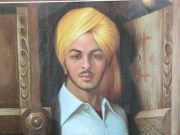
April 2, 2013
Should be read..

July 24, 2016
The Letters written by Shaheed Bhagat Singh open ups a new insight that everyone should know, a must read!!
May 12, 2021
Good read
Got to know the opinions and thinking of one of the greatest revolutionaries of indian freedom struggle. Long live Revolution. Long live Bhagat Singh.
Got to know the opinions and thinking of one of the greatest revolutionaries of indian freedom struggle. Long live Revolution. Long live Bhagat Singh.
August 11, 2021
It's hard to know where to begin. Bhagat Singh has been known to every child of India sooner or later, sooner if one grows up closer to Punjab, and to see his most famous photograph with a hat worn stylishly at a slant is to be aware that he was educated, erudite and more - those things are somehow absorbed in atmosphere.
But to read this, it becomes startlingly clear just how much the politics ruling India mist of decades post independence was unjust to these freedom warriors of India, solely so as to push under rug, if not completely wipe off, everyone from memory of India, only to keep one or two names elevated, and one family in power, not only in the ruling party but in the country.
Bhagat Singh was a thinker, very erudite and very well educated, once a senior colleague - who was a professor of mathematics at a research institute and a mentor - had said; he said he'd been unaware of it, due to the ruling party politics. I'd not only agreed with the part about Bhagat Singh, but thought it was known generally, while being not as specifically aware about the political part about clouding his memory in India being intentional, which now is obvious. Same was done to other great freedom fighters, after all, from Lokamaanya Tilak to Subash Chandra Bose and Sardar Patel, and far greater personae. They were mentioned along with other names, in history books, is all.
But reading this brings alive a mind that's not just educated in normal stuff taught commonly in schools and colleges - he died at age of 23! - but far more. He was very aware of various world happenings, of world history and literature, politics and more, and his stance of revolution was based on a personality firmly rooted in thought and awareness, self giving, and national concerns that were neither based on negative views of others nor in desire of personal glory, kudos, fame, power or gain.
He writes of politics, history and literature, of not just his native Punjab, not just of England- that would be after all part of school curriculum during British rule - but of Russian political figures and of Russian literature, those of italy and Ireland, knowledge that wasn't part of curriculum- after all, British weren't about to teach revolution to India!
And then, suddenly, he writes of spiritual matters, not as a preacher, but as a normal person and a revolutionary!
If the British rulers had any brains, they could hsve used such minds as Bhagat Singh and Subash Chandra Bose to help them, not with keeping India down, but far more and far better objectives. As it is, the choices made by the Brits had consequences for England, too, that were neither pleasant nor wanted.
And a goosebumps moment is reading here when Bhagat Singh predicts this!
"As revolutionaries, we do not believe that there can be any sudden change in the attitude of our rulers, particularly in the British race. Such a surprising change is impossible without through sustained striving, sufferings and sacrifices. And it shall be achieved."
It took WWII, particularly the early years after fall of France, when nazis occupied most of Europe - all of West and North, certainly - and London blitz, Coventry and more!
............
The Problem of Punjab’s Language and Script
"Perhaps Garibaldi could not have succeeded in mobilising the army with such ease if Mazzini had not invested his thirty years in his mission of cultural and literary renaissance. The revival of Irish language was attempted with the same enthusiasm along with the renaissance in Ireland."
.......
"The main reason behind this is the unfortunate communalisation of language in our province, in other provinces, we find that Muslims have fully adopted their provincial languages."
"Punjab should have been the language of Punjab, like other provinces, but since this has not happened, as this question is a spontaneous question, Muslims have adopted Urdu. Muslims totally lack Indianness, therefore they want to propagate Arabic script and Persian language. While failing to understand the importance of Indianness in the whole of India, they fail to understand the importance of one language, which could only be Hindi. That is why they keep repeating the demand for Urdu like a parrot and take an isolated position."
"The urdu script cannot be called a perfect one and the most important point is that it is based on the Persian language. The flights of imagination of urdu poets – even if they are Hindi (Indian) – reach the saaqis (bar-maids) of Persia and date palms of the Arbs countries. Kazi Nazrul-Islam’s poems refer to Dhurjate, Vishwamitra and Durvasa quite frequently, but our Punjabi Hindi-Urdu poets could not even think of them. Is it not a matter which makes one sad? Their ignorance of Indianness and Indian literature is the main reason of this. When they cannot imbibe Indianness, how can their literature make us Indian? Students confined to the study of urdu cannot attain the knowledge of the classical literature of India. It is not that these texts cannot be translated into a literary language like urdu, but it will be useful only to a Persian in his pursuit concerning Indian literature."
............
"Beware, Ye Bureaucracy
"[A handwritten leaflet explaining the reasons for Saunders’ murder, written on December 18, 1928 on Mozang House den and pasted at several places on the walls of Lahore in the night between the 18th and 19th. A copy in Bhagat Singh’s handwriting was produced as an exhibit in the Lahore Conspiracy Case.]
"Hindustan Socialist Republican Army Notice
"J.P. Sunders is dead; Lala Lajpat Rai is avenged Really it is horrible to imagine that so lowly and violent hand violent hand of an ordinary Police Official, J.P. Saunders could ever dare to touch in such an insulting way the body of one so old, so revered and so loved by 300 millions of people of Hindustan and thus cause his death. The youth and manhood of India was challenged by blows hurled down on the head of the India’s nationhood."
"Beware, Ye Tyrants; Beware Do not injure the felling of a downtrodden and oppressed country. Think twice before perpetrating such diabolical deed"
............
The Red Pamphlet
"“LONG LIVE THE REVOLUTION”!
"Sorry for the death of a man. But in this man has died the representative of an institution which is so cruel, lowly and so base that it must be abolished. In this man has died an agent of the British authority in India – the most tyrannical of Govt. of Govts. In the world.
"Sorry for the bloodshed of a human being; but the sacrifice of individuals at the altar of the Revolution that will bring freedom to all and make the exploitation of man by main impossible, is inevitable."
............
Letter to Shaheed Sukhdev
"This letter deals with the views of Bhagat Singh on the question of love and sacrifice in the life of a revolutionary. It was written on April 5, 1929 in Sita Ram Bazar House, Delhi. The letter was taken to Lahore by Shri Shiv Verma and handed over to Sukhdev. It was recovered from him at the time of his arrest on April 13 and was produced as one of the exhbits in Lahore Conspiracy Case."
............
Joint Statement
"3 This document was primarily written by Bhagat Singh. On April 8, 1929, Bhagat Singh and Batukeshwar Dutt showered copies of the leaflet on the floor of Central Assembly Hall in New Delhi after tossing two bombs into the Assembly Hall corridors.
"4 This phrase (translated from “Inquilab Zindabad!”)became one of the most enduring slogans of the Indian Independence Movement. Bhagat Singh and Batukeshwar Dutta repeated the slogan at their June 1929 trial on charges related to the bomb-throwing incident.
"5 “Balraj” was the pen name for the Commander-in-chief of the Hindustan Socialist Republican Army, Chander Shekhar Azad."
.......
"When we were told by some of the police officers, who visited us in jail that Lord Irwin in his address to the joint session of the two houses described the event as an attack directed against no individual but against an institution itself, we readily recognized that the true significance of the incident had been correctly appreciated." ... "
.......
"We despise hypocrisy, Our practical protest was against the institution, which since its birth, has eminently helped to display not only its worthlessness but its far-reaching power for mischief. They more we have been convinced that it exists only to demonstrate to world Indian’s humiliation and helplessness, and it symbolizes the overriding domination of an irresponsible and autocratic rule. Time and again the national demand has been pressed by the people’s representatives only to find the waste paper basket as its final destination.
"Attack on Institution
"Solemn resolutions passed by the House have been contemptuously trampled underfoot on the floor of the so called Indian Parliament. Resolution regarding the repeal of the repressive and arbitrary measures have been treated with sublime contempt, and the government measures and proposals, rejected as unacceptable buy the elected members of the legislatures, have been restored by mere stroke of the pen. In short, we have utterly failed to find any justification for the existence of an institution which, despite all its pomp and splendour, organized with the hard earned money of the sweating millions of India, is only a hollow show and a mischievous make-believe. Alike, have we failed to comprehend the mentality of the public leaders who help the Government to squander public time and money on such a manifestly stage-managed exhibition of Indian’s helpless subjection.
.......
"We have only marked the end of an era of Utopian non-violence, of whose futility the rising generation has been convinced beyond the shadow of doubt."
"The elimination of force at all costs in Utopian, and the mew movement which has arisen in the country, and of that dawn we have given a warning, is inspired by the ideal which guided Guru Gobind Singh and Shivaji, Kamal Pasha and Riza Khan, Washington and Garibaldi, Lafayette and Lenin."
.......
"Despite the evidence of the Government Expert, the bombs that were thrown in the Assembly Chamber resulted in slight damage to an empty bench and some slight abrasions in less than half a dozen cases, while Government scientists and experts have ascribed this result to a miracle, we see nothing but a precisely scientific process in all this incident. Firstly, the two bombs exploded in vacant spaces within the wooden barriers of the desks and benches, secondly, even those who were within 2 feet of the explosion, for instance, Mr. P. Rau, Mr. Shanker Rao and Sir George Schuster were either not hurt or only slightly scratched. Bombs of the capacity deposed to by the Government Expert (though his estimate, being imaginary is exaggerated), loaded with an effective charge of potassium chlorate and sensitive (explosive) picrate would have smashed the barriers and laid many low within some yards of the explosion.
"Again, had they been loaded with some other high explosive, with a charge of destructive pellets or darts, they would have sufficed to wipe out a majority of the Members of the Legislative Assembly. Still again we could have flung them into the official box which was occupied by some notable persons. And finally we could have ambushed Sir John Simon whose luckless Commission was loathed by all responsible people and who was sitting in the President’s gallery at the time. All these things, however, were beyond our intention and bombs did no more than they were designed to do, and the miracle consisted in no more than the deliberate aim which landed them in safe places."
.......
"We wanted to emphasize the historical lesson that lettres de cachets and Bastilles could not crush the revolutionary movement in France. Gallows and the Siberian mines could not extinguish the Russian Revolution. Bloody Sunday, and Black and Tans failed to strangle the movement of Irish freedom. Can ordinances and Safety Bills snuff out the flames of freedom in India?"
.......
"(Bhagat Singh was asked in the lower court what he meant by word “Revolution”. In answer to that question, he said:) “Revolution” does not necessarily involve sanguinary strife nor is there any place in it for individual vendetta. It is not the cult of the bomb and the pistol. By “Revolution” we mean that the present order of things, which is based on manifest injustice, must change. Producers or labourers in spite of being the most necessary element of society, are robbed by their exploiters of the fruits of their labour and deprived of their elementary rights. The peasant who grows corn for all, starves with his family, the weaver who supplies the world market with textile fabrics, has not enough to cover his own and his children’s bodies, masons, smiths and carpenters who raise magnificent palaces, live like pariahs in the slums. The capitalists and exploiters, the parasites of society, squander millions on their whims. These terrible inequalities and forced disparity of chances are bound to lead to chaos. This state of affairs cannot last long, and it is obvious, that the present order of society in merry-making is on the brink of a volcano.
"The whole edifice of this civilization, if not saved in time, shall crumble. A radical change, therefore, is necessary and it is the duty of those who realize it to reorganize society on the socialistic basis. Unless this thing is done and the exploitation of man by man and of nations by nations is brought to an end, sufferings and carnage with which humanity is threatened today cannot be prevented. All talk of ending war and ushering in an era of universal peace is undisguised hypocrisy."
.......
Hunger-Strikers’ Demands Letter to I.G. (Prisons), Punjab Mianwali Jail
""WE, BHAGAT SINGH AND B. K. DUTT, WERE SENTENCED to life in the Assembly Bomb Case, Delhi the 19th April, 1929. As long as we were under trial prisoners in Delhi Jail, we were accorded a very good treatment,; since transportation from that jail to the Mianwali and Lahore Central Jails respectively, we wrote an application to the higher authorities asking for better diet and a few other facilities, and refused to take the jail diet.
"Our demands were as follows:
"We, as political prisoners, should be given better diet and the standard of our diet should at least be the same as that of European prisoners. (It is not the sameness of dietary that we demand, but the sameness of standard of diet.)
"We shall not be forced to do any hard and undignified labours at all.
All books, other than those proscribed, along with writing materials, should be allowed to us without any restriction.
"At least one standard daily paper should be supplied to every political prisoner.
"Political prisoners should have a special ward of their own in every jail, provided with all necessities as those of the Europeans. And all the political prisoners in one jail must be kept together in that ward.
"Toilet necessities should be supplied.
"Better clothing."
.......
"The Jail authorities told us one day that the higher authorities have refused to comply with our demands.
"Apart from that, they handle us very roughly while feeding us artificially, and Bhagat Singh was lying quite senseless on the 10th June, 1929, for about 15 minutes, after the forcible feeding, which we request to be stopped without any further delay."
.......
Hunger-Strikers’ Demands
Letter to I.G. (Prisons),
Punjab Mianwali Jail
"17 June, 1929
"To
"The Inspector-General (Jails),
"Punjab Jails
"Dear Sir,
"Despite the fact that I will be prosecuted along with other young men arrested in Saunders shooting case, I have been shifted to Mianwali Jail from Delhi. The hearing of the case is to start from 26 June, 1929. I am totally unable to understand the logic behind this kind of shifting. Whatever it be, justice demands that every under trial should be given all those facilities which help him to prepare and contest the case. How can I appoint any lawyer while I am here? It is difficult to keep on the contact with my father and other relatives. This place is quite isolated, the route is troublesome and it is very far from Lahore.
"I request you that you order my immediate transfer to Lahore Central Jail so that I get an opportunity to prepare my case. I hope that it will be given the earliest consideration.
"Yours truly
"Bhagat Singh"
.......
Message to Punjab Students’ Conference
"October 19, 1929
"[The Second Punjab Students’ Conference was held at Lahore on October 19, 1929, under the persidentship of Subhash Chandra Bose. Bhagat Singh grabbed the opportunity and sent this message asking the students to plunge whole-heartedly into the coming movement of 1930-31 and carry the message of revolution to the remotest corners of the country. It was jointly signed with B. K. Dutt. The message was read in the open session. It received a thunderous applause from the students with the slogans of Bhagat Singh Zindabad!]"
.......
On the slogan of ‘Long Live Revolution’
"6. Shri Ramanand Chaterji the editor of Modern Review, ridiculed the slogan of ‘Long Live Revolution’ through an editorial note and gave an entirely wrong interpretation. Bhagat Singh wrote a reply and handed it over to the trying magistrate to be sent to Modern Review. This was published in The Tribune of December 24, 1929."
.......
Statement before the Lahore High Court Bench
"Nineteen centuries have passed since then. Have we not progressed during this period? Shall we repeat that mistake again? It that be so, then we shall have to admit that all the sacrifices of the mankind and all the efforts of the great martyrs were useless and it would appear as if we are still at the same place where we stood twenty centuries back."
.......
"Take the example of General Dyer. He resorted to firing and killed hundreds of innocent and unarmed people. But the military court did not order him to be shot. It gave him lakhs of rupees as award."
.......
"The facts regarding our case are very simple. We threw two bombs in the legislative Assembly on April 8, 1929. As a result of the explosion, a few persons received minor scratches. There was pandemonium in the chamber, hundreds of visitors and members of the Assembly ran out. Only my friend B.K. Dutt and myself remained seated in the visitors’ gallery and offered ourselves for arrest. We were tried for attempt to murder, and convicted for life. ... The Sessions Judge admitted that we could have very easily escaped, had we had any intention like that. We accepted our offence and gave a statement explaining our position. We are not afraid of punishment. But we do not want that we should be wrongly understood."
............
But to read this, it becomes startlingly clear just how much the politics ruling India mist of decades post independence was unjust to these freedom warriors of India, solely so as to push under rug, if not completely wipe off, everyone from memory of India, only to keep one or two names elevated, and one family in power, not only in the ruling party but in the country.
Bhagat Singh was a thinker, very erudite and very well educated, once a senior colleague - who was a professor of mathematics at a research institute and a mentor - had said; he said he'd been unaware of it, due to the ruling party politics. I'd not only agreed with the part about Bhagat Singh, but thought it was known generally, while being not as specifically aware about the political part about clouding his memory in India being intentional, which now is obvious. Same was done to other great freedom fighters, after all, from Lokamaanya Tilak to Subash Chandra Bose and Sardar Patel, and far greater personae. They were mentioned along with other names, in history books, is all.
But reading this brings alive a mind that's not just educated in normal stuff taught commonly in schools and colleges - he died at age of 23! - but far more. He was very aware of various world happenings, of world history and literature, politics and more, and his stance of revolution was based on a personality firmly rooted in thought and awareness, self giving, and national concerns that were neither based on negative views of others nor in desire of personal glory, kudos, fame, power or gain.
He writes of politics, history and literature, of not just his native Punjab, not just of England- that would be after all part of school curriculum during British rule - but of Russian political figures and of Russian literature, those of italy and Ireland, knowledge that wasn't part of curriculum- after all, British weren't about to teach revolution to India!
And then, suddenly, he writes of spiritual matters, not as a preacher, but as a normal person and a revolutionary!
If the British rulers had any brains, they could hsve used such minds as Bhagat Singh and Subash Chandra Bose to help them, not with keeping India down, but far more and far better objectives. As it is, the choices made by the Brits had consequences for England, too, that were neither pleasant nor wanted.
And a goosebumps moment is reading here when Bhagat Singh predicts this!
"As revolutionaries, we do not believe that there can be any sudden change in the attitude of our rulers, particularly in the British race. Such a surprising change is impossible without through sustained striving, sufferings and sacrifices. And it shall be achieved."
It took WWII, particularly the early years after fall of France, when nazis occupied most of Europe - all of West and North, certainly - and London blitz, Coventry and more!
............
The Problem of Punjab’s Language and Script
"Perhaps Garibaldi could not have succeeded in mobilising the army with such ease if Mazzini had not invested his thirty years in his mission of cultural and literary renaissance. The revival of Irish language was attempted with the same enthusiasm along with the renaissance in Ireland."
.......
"The main reason behind this is the unfortunate communalisation of language in our province, in other provinces, we find that Muslims have fully adopted their provincial languages."
"Punjab should have been the language of Punjab, like other provinces, but since this has not happened, as this question is a spontaneous question, Muslims have adopted Urdu. Muslims totally lack Indianness, therefore they want to propagate Arabic script and Persian language. While failing to understand the importance of Indianness in the whole of India, they fail to understand the importance of one language, which could only be Hindi. That is why they keep repeating the demand for Urdu like a parrot and take an isolated position."
"The urdu script cannot be called a perfect one and the most important point is that it is based on the Persian language. The flights of imagination of urdu poets – even if they are Hindi (Indian) – reach the saaqis (bar-maids) of Persia and date palms of the Arbs countries. Kazi Nazrul-Islam’s poems refer to Dhurjate, Vishwamitra and Durvasa quite frequently, but our Punjabi Hindi-Urdu poets could not even think of them. Is it not a matter which makes one sad? Their ignorance of Indianness and Indian literature is the main reason of this. When they cannot imbibe Indianness, how can their literature make us Indian? Students confined to the study of urdu cannot attain the knowledge of the classical literature of India. It is not that these texts cannot be translated into a literary language like urdu, but it will be useful only to a Persian in his pursuit concerning Indian literature."
............
"Beware, Ye Bureaucracy
"[A handwritten leaflet explaining the reasons for Saunders’ murder, written on December 18, 1928 on Mozang House den and pasted at several places on the walls of Lahore in the night between the 18th and 19th. A copy in Bhagat Singh’s handwriting was produced as an exhibit in the Lahore Conspiracy Case.]
"Hindustan Socialist Republican Army Notice
"J.P. Sunders is dead; Lala Lajpat Rai is avenged Really it is horrible to imagine that so lowly and violent hand violent hand of an ordinary Police Official, J.P. Saunders could ever dare to touch in such an insulting way the body of one so old, so revered and so loved by 300 millions of people of Hindustan and thus cause his death. The youth and manhood of India was challenged by blows hurled down on the head of the India’s nationhood."
"Beware, Ye Tyrants; Beware Do not injure the felling of a downtrodden and oppressed country. Think twice before perpetrating such diabolical deed"
............
The Red Pamphlet
"“LONG LIVE THE REVOLUTION”!
"Sorry for the death of a man. But in this man has died the representative of an institution which is so cruel, lowly and so base that it must be abolished. In this man has died an agent of the British authority in India – the most tyrannical of Govt. of Govts. In the world.
"Sorry for the bloodshed of a human being; but the sacrifice of individuals at the altar of the Revolution that will bring freedom to all and make the exploitation of man by main impossible, is inevitable."
............
Letter to Shaheed Sukhdev
"This letter deals with the views of Bhagat Singh on the question of love and sacrifice in the life of a revolutionary. It was written on April 5, 1929 in Sita Ram Bazar House, Delhi. The letter was taken to Lahore by Shri Shiv Verma and handed over to Sukhdev. It was recovered from him at the time of his arrest on April 13 and was produced as one of the exhbits in Lahore Conspiracy Case."
............
Joint Statement
"3 This document was primarily written by Bhagat Singh. On April 8, 1929, Bhagat Singh and Batukeshwar Dutt showered copies of the leaflet on the floor of Central Assembly Hall in New Delhi after tossing two bombs into the Assembly Hall corridors.
"4 This phrase (translated from “Inquilab Zindabad!”)became one of the most enduring slogans of the Indian Independence Movement. Bhagat Singh and Batukeshwar Dutta repeated the slogan at their June 1929 trial on charges related to the bomb-throwing incident.
"5 “Balraj” was the pen name for the Commander-in-chief of the Hindustan Socialist Republican Army, Chander Shekhar Azad."
.......
"When we were told by some of the police officers, who visited us in jail that Lord Irwin in his address to the joint session of the two houses described the event as an attack directed against no individual but against an institution itself, we readily recognized that the true significance of the incident had been correctly appreciated." ... "
.......
"We despise hypocrisy, Our practical protest was against the institution, which since its birth, has eminently helped to display not only its worthlessness but its far-reaching power for mischief. They more we have been convinced that it exists only to demonstrate to world Indian’s humiliation and helplessness, and it symbolizes the overriding domination of an irresponsible and autocratic rule. Time and again the national demand has been pressed by the people’s representatives only to find the waste paper basket as its final destination.
"Attack on Institution
"Solemn resolutions passed by the House have been contemptuously trampled underfoot on the floor of the so called Indian Parliament. Resolution regarding the repeal of the repressive and arbitrary measures have been treated with sublime contempt, and the government measures and proposals, rejected as unacceptable buy the elected members of the legislatures, have been restored by mere stroke of the pen. In short, we have utterly failed to find any justification for the existence of an institution which, despite all its pomp and splendour, organized with the hard earned money of the sweating millions of India, is only a hollow show and a mischievous make-believe. Alike, have we failed to comprehend the mentality of the public leaders who help the Government to squander public time and money on such a manifestly stage-managed exhibition of Indian’s helpless subjection.
.......
"We have only marked the end of an era of Utopian non-violence, of whose futility the rising generation has been convinced beyond the shadow of doubt."
"The elimination of force at all costs in Utopian, and the mew movement which has arisen in the country, and of that dawn we have given a warning, is inspired by the ideal which guided Guru Gobind Singh and Shivaji, Kamal Pasha and Riza Khan, Washington and Garibaldi, Lafayette and Lenin."
.......
"Despite the evidence of the Government Expert, the bombs that were thrown in the Assembly Chamber resulted in slight damage to an empty bench and some slight abrasions in less than half a dozen cases, while Government scientists and experts have ascribed this result to a miracle, we see nothing but a precisely scientific process in all this incident. Firstly, the two bombs exploded in vacant spaces within the wooden barriers of the desks and benches, secondly, even those who were within 2 feet of the explosion, for instance, Mr. P. Rau, Mr. Shanker Rao and Sir George Schuster were either not hurt or only slightly scratched. Bombs of the capacity deposed to by the Government Expert (though his estimate, being imaginary is exaggerated), loaded with an effective charge of potassium chlorate and sensitive (explosive) picrate would have smashed the barriers and laid many low within some yards of the explosion.
"Again, had they been loaded with some other high explosive, with a charge of destructive pellets or darts, they would have sufficed to wipe out a majority of the Members of the Legislative Assembly. Still again we could have flung them into the official box which was occupied by some notable persons. And finally we could have ambushed Sir John Simon whose luckless Commission was loathed by all responsible people and who was sitting in the President’s gallery at the time. All these things, however, were beyond our intention and bombs did no more than they were designed to do, and the miracle consisted in no more than the deliberate aim which landed them in safe places."
.......
"We wanted to emphasize the historical lesson that lettres de cachets and Bastilles could not crush the revolutionary movement in France. Gallows and the Siberian mines could not extinguish the Russian Revolution. Bloody Sunday, and Black and Tans failed to strangle the movement of Irish freedom. Can ordinances and Safety Bills snuff out the flames of freedom in India?"
.......
"(Bhagat Singh was asked in the lower court what he meant by word “Revolution”. In answer to that question, he said:) “Revolution” does not necessarily involve sanguinary strife nor is there any place in it for individual vendetta. It is not the cult of the bomb and the pistol. By “Revolution” we mean that the present order of things, which is based on manifest injustice, must change. Producers or labourers in spite of being the most necessary element of society, are robbed by their exploiters of the fruits of their labour and deprived of their elementary rights. The peasant who grows corn for all, starves with his family, the weaver who supplies the world market with textile fabrics, has not enough to cover his own and his children’s bodies, masons, smiths and carpenters who raise magnificent palaces, live like pariahs in the slums. The capitalists and exploiters, the parasites of society, squander millions on their whims. These terrible inequalities and forced disparity of chances are bound to lead to chaos. This state of affairs cannot last long, and it is obvious, that the present order of society in merry-making is on the brink of a volcano.
"The whole edifice of this civilization, if not saved in time, shall crumble. A radical change, therefore, is necessary and it is the duty of those who realize it to reorganize society on the socialistic basis. Unless this thing is done and the exploitation of man by man and of nations by nations is brought to an end, sufferings and carnage with which humanity is threatened today cannot be prevented. All talk of ending war and ushering in an era of universal peace is undisguised hypocrisy."
.......
Hunger-Strikers’ Demands Letter to I.G. (Prisons), Punjab Mianwali Jail
""WE, BHAGAT SINGH AND B. K. DUTT, WERE SENTENCED to life in the Assembly Bomb Case, Delhi the 19th April, 1929. As long as we were under trial prisoners in Delhi Jail, we were accorded a very good treatment,; since transportation from that jail to the Mianwali and Lahore Central Jails respectively, we wrote an application to the higher authorities asking for better diet and a few other facilities, and refused to take the jail diet.
"Our demands were as follows:
"We, as political prisoners, should be given better diet and the standard of our diet should at least be the same as that of European prisoners. (It is not the sameness of dietary that we demand, but the sameness of standard of diet.)
"We shall not be forced to do any hard and undignified labours at all.
All books, other than those proscribed, along with writing materials, should be allowed to us without any restriction.
"At least one standard daily paper should be supplied to every political prisoner.
"Political prisoners should have a special ward of their own in every jail, provided with all necessities as those of the Europeans. And all the political prisoners in one jail must be kept together in that ward.
"Toilet necessities should be supplied.
"Better clothing."
.......
"The Jail authorities told us one day that the higher authorities have refused to comply with our demands.
"Apart from that, they handle us very roughly while feeding us artificially, and Bhagat Singh was lying quite senseless on the 10th June, 1929, for about 15 minutes, after the forcible feeding, which we request to be stopped without any further delay."
.......
Hunger-Strikers’ Demands
Letter to I.G. (Prisons),
Punjab Mianwali Jail
"17 June, 1929
"To
"The Inspector-General (Jails),
"Punjab Jails
"Dear Sir,
"Despite the fact that I will be prosecuted along with other young men arrested in Saunders shooting case, I have been shifted to Mianwali Jail from Delhi. The hearing of the case is to start from 26 June, 1929. I am totally unable to understand the logic behind this kind of shifting. Whatever it be, justice demands that every under trial should be given all those facilities which help him to prepare and contest the case. How can I appoint any lawyer while I am here? It is difficult to keep on the contact with my father and other relatives. This place is quite isolated, the route is troublesome and it is very far from Lahore.
"I request you that you order my immediate transfer to Lahore Central Jail so that I get an opportunity to prepare my case. I hope that it will be given the earliest consideration.
"Yours truly
"Bhagat Singh"
.......
Message to Punjab Students’ Conference
"October 19, 1929
"[The Second Punjab Students’ Conference was held at Lahore on October 19, 1929, under the persidentship of Subhash Chandra Bose. Bhagat Singh grabbed the opportunity and sent this message asking the students to plunge whole-heartedly into the coming movement of 1930-31 and carry the message of revolution to the remotest corners of the country. It was jointly signed with B. K. Dutt. The message was read in the open session. It received a thunderous applause from the students with the slogans of Bhagat Singh Zindabad!]"
.......
On the slogan of ‘Long Live Revolution’
"6. Shri Ramanand Chaterji the editor of Modern Review, ridiculed the slogan of ‘Long Live Revolution’ through an editorial note and gave an entirely wrong interpretation. Bhagat Singh wrote a reply and handed it over to the trying magistrate to be sent to Modern Review. This was published in The Tribune of December 24, 1929."
.......
Statement before the Lahore High Court Bench
"Nineteen centuries have passed since then. Have we not progressed during this period? Shall we repeat that mistake again? It that be so, then we shall have to admit that all the sacrifices of the mankind and all the efforts of the great martyrs were useless and it would appear as if we are still at the same place where we stood twenty centuries back."
.......
"Take the example of General Dyer. He resorted to firing and killed hundreds of innocent and unarmed people. But the military court did not order him to be shot. It gave him lakhs of rupees as award."
.......
"The facts regarding our case are very simple. We threw two bombs in the legislative Assembly on April 8, 1929. As a result of the explosion, a few persons received minor scratches. There was pandemonium in the chamber, hundreds of visitors and members of the Assembly ran out. Only my friend B.K. Dutt and myself remained seated in the visitors’ gallery and offered ourselves for arrest. We were tried for attempt to murder, and convicted for life. ... The Sessions Judge admitted that we could have very easily escaped, had we had any intention like that. We accepted our offence and gave a statement explaining our position. We are not afraid of punishment. But we do not want that we should be wrongly understood."
............
August 13, 2021
It's hard to know where to begin. Bhagat Singh has been known to every child of India sooner or later, sooner if one grows up closer to Punjab, and to see his most famous photograph with a hat worn stylishly at a slant is to be aware that he was educated, erudite and more - those things are somehow absorbed in atmosphere.
But to read this, it becomes startlingly clear just how much the politics ruling India mist of decades post independence was unjust to these freedom warriors of India, solely so as to push under rug, if not completely wipe off, everyone from memory of India, only to keep one or two names elevated, and one family in power, not only in the ruling party but in the country.
Bhagat Singh was a thinker, very erudite and very well educated, once a senior colleague - who was a professor of mathematics at a research institute and a mentor - had said; he said he'd been unaware of it, due to the ruling party politics. I'd not only agreed with the part about Bhagat Singh, but thought it was known generally, while being not as specifically aware about the political part about clouding his memory in India being intentional, which now is obvious. Same was done to other great freedom fighters, after all, from Lokamaanya Tilak to Subash Chandra Bose and Sardar Patel, and far greater personae. They were mentioned along with other names, in history books, is all.
But reading this brings alive a mind that's not just educated in normal stuff taught commonly in schools and colleges - he died at age of 23! - but far more. He was very aware of various world happenings, of world history and literature, politics and more, and his stance of revolution was based on a personality firmly rooted in thought and awareness, self giving, and national concerns that were neither based on negative views of others nor in desire of personal glory, kudos, fame, power or gain.
He writes of politics, history and literature, of not just his native Punjab, not just of England- that would be after all part of school curriculum during British rule - but of Russian political figures and of Russian literature, those of italy and Ireland, knowledge that wasn't part of curriculum- after all, British weren't about to teach revolution to India!
And then, suddenly, he writes of spiritual matters, not as a preacher, but as a normal person and a revolutionary!
If the British rulers had any brains, they could hsve used such minds as Bhagat Singh and Subash Chandra Bose to help them, not with keeping India down, but far more and far better objectives. As it is, the choices made by the Brits had consequences for England, too, that were neither pleasant nor wanted.
And a goosebumps moment is reading here when Bhagat Singh predicts this!
"As revolutionaries, we do not believe that there can be any sudden change in the attitude of our rulers, particularly in the British race. Such a surprising change is impossible without through sustained striving, sufferings and sacrifices. And it shall be achieved."
It took WWII, particularly the early years after fall of France, when nazis occupied most of Europe - all of West and North, certainly - and London blitz, Coventry and more!
*****
The Problem of Punjab’s Language and Script
"Perhaps Garibaldi could not have succeeded in mobilising the army with such ease if Mazzini had not invested his thirty years in his mission of cultural and literary renaissance. The revival of Irish language was attempted with the same enthusiasm along with the renaissance in Ireland."
*****
"The main reason behind this is the unfortunate communalisation of language in our province, in other provinces, we find that Muslims have fully adopted their provincial languages."
"Punjab should have been the language of Punjab, like other provinces, but since this has not happened, as this question is a spontaneous question, Muslims have adopted Urdu. Muslims totally lack Indianness, therefore they want to propagate Arabic script and Persian language. While failing to understand the importance of Indianness in the whole of India, they fail to understand the importance of one language, which could only be Hindi. That is why they keep repeating the demand for Urdu like a parrot and take an isolated position."
"The urdu script cannot be called a perfect one and the most important point is that it is based on the Persian language. The flights of imagination of urdu poets – even if they are Hindi (Indian) – reach the saaqis (bar-maids) of Persia and date palms of the Arbs countries. Kazi Nazrul-Islam’s poems refer to Dhurjate, Vishwamitra and Durvasa quite frequently, but our Punjabi Hindi-Urdu poets could not even think of them. Is it not a matter which makes one sad? Their ignorance of Indianness and Indian literature is the main reason of this. When they cannot imbibe Indianness, how can their literature make us Indian? Students confined to the study of urdu cannot attain the knowledge of the classical literature of India. It is not that these texts cannot be translated into a literary language like urdu, but it will be useful only to a Persian in his pursuit concerning Indian literature."
*****
"Beware, Ye Bureaucracy
"[A handwritten leaflet explaining the reasons for Saunders’ murder, written on December 18, 1928 on Mozang House den and pasted at several places on the walls of Lahore in the night between the 18th and 19th. A copy in Bhagat Singh’s handwriting was produced as an exhibit in the Lahore Conspiracy Case.]
"Hindustan Socialist Republican Army Notice
"J.P. Sunders is dead; Lala Lajpat Rai is avenged Really it is horrible to imagine that so lowly and violent hand violent hand of an ordinary Police Official, J.P. Saunders could ever dare to touch in such an insulting way the body of one so old, so revered and so loved by 300 millions of people of Hindustan and thus cause his death. The youth and manhood of India was challenged by blows hurled down on the head of the India’s nationhood."
"Beware, Ye Tyrants; Beware Do not injure the felling of a downtrodden and oppressed country. Think twice before perpetrating such diabolical deed"
*****
The Red Pamphlet
"“LONG LIVE THE REVOLUTION”!
"Sorry for the death of a man. But in this man has died the representative of an institution which is so cruel, lowly and so base that it must be abolished. In this man has died an agent of the British authority in India – the most tyrannical of Govt. of Govts. In the world.
"Sorry for the bloodshed of a human being; but the sacrifice of individuals at the altar of the Revolution that will bring freedom to all and make the exploitation of man by main impossible, is inevitable."
*****
Letter to Shaheed Sukhdev
"This letter deals with the views of Bhagat Singh on the question of love and sacrifice in the life of a revolutionary. It was written on April 5, 1929 in Sita Ram Bazar House, Delhi. The letter was taken to Lahore by Shri Shiv Verma and handed over to Sukhdev. It was recovered from him at the time of his arrest on April 13 and was produced as one of the exhbits in Lahore Conspiracy Case."
*****
Joint Statement
"3 This document was primarily written by Bhagat Singh. On April 8, 1929, Bhagat Singh and Batukeshwar Dutt showered copies of the leaflet on the floor of Central Assembly Hall in New Delhi after tossing two bombs into the Assembly Hall corridors.
"4 This phrase (translated from “Inquilab Zindabad!”)became one of the most enduring slogans of the Indian Independence Movement. Bhagat Singh and Batukeshwar Dutta repeated the slogan at their June 1929 trial on charges related to the bomb-throwing incident.
"5 “Balraj” was the pen name for the Commander-in-chief of the Hindustan Socialist Republican Army, Chander Shekhar Azad."
*****
"When we were told by some of the police officers, who visited us in jail that Lord Irwin in his address to the joint session of the two houses described the event as an attack directed against no individual but against an institution itself, we readily recognized that the true significance of the incident had been correctly appreciated." ... "
*****
"We despise hypocrisy, Our practical protest was against the institution, which since its birth, has eminently helped to display not only its worthlessness but its far-reaching power for mischief. They more we have been convinced that it exists only to demonstrate to world Indian’s humiliation and helplessness, and it symbolizes the overriding domination of an irresponsible and autocratic rule. Time and again the national demand has been pressed by the people’s representatives only to find the waste paper basket as its final destination.
"Attack on Institution
"Solemn resolutions passed by the House have been contemptuously trampled underfoot on the floor of the so called Indian Parliament. Resolution regarding the repeal of the repressive and arbitrary measures have been treated with sublime contempt, and the government measures and proposals, rejected as unacceptable buy the elected members of the legislatures, have been restored by mere stroke of the pen. In short, we have utterly failed to find any justification for the existence of an institution which, despite all its pomp and splendour, organized with the hard earned money of the sweating millions of India, is only a hollow show and a mischievous make-believe. Alike, have we failed to comprehend the mentality of the public leaders who help the Government to squander public time and money on such a manifestly stage-managed exhibition of Indian’s helpless subjection.
*****
"We have only marked the end of an era of Utopian non-violence, of whose futility the rising generation has been convinced beyond the shadow of doubt."
"The elimination of force at all costs in Utopian, and the mew movement which has arisen in the country, and of that dawn we have given a warning, is inspired by the ideal which guided Guru Gobind Singh and Shivaji, Kamal Pasha and Riza Khan, Washington and Garibaldi, Lafayette and Lenin."
*****
"Despite the evidence of the Government Expert, the bombs that were thrown in the Assembly Chamber resulted in slight damage to an empty bench and some slight abrasions in less than half a dozen cases, while Government scientists and experts have ascribed this result to a miracle, we see nothing but a precisely scientific process in all this incident. Firstly, the two bombs exploded in vacant spaces within the wooden barriers of the desks and benches, secondly, even those who were within 2 feet of the explosion, for instance, Mr. P. Rau, Mr. Shanker Rao and Sir George Schuster were either not hurt or only slightly scratched. Bombs of the capacity deposed to by the Government Expert (though his estimate, being imaginary is exaggerated), loaded with an effective charge of potassium chlorate and sensitive (explosive) picrate would have smashed the barriers and laid many low within some yards of the explosion.
"Again, had they been loaded with some other high explosive, with a charge of destructive pellets or darts, they would have sufficed to wipe out a majority of the Members of the Legislative Assembly. Still again we could have flung them into the official box which was occupied by some notable persons. And finally we could have ambushed Sir John Simon whose luckless Commission was loathed by all responsible people and who was sitting in the President’s gallery at the time. All these things, however, were beyond our intention and bombs did no more than they were designed to do, and the miracle consisted in no more than the deliberate aim which landed them in safe places."
*****
"We wanted to emphasize the historical lesson that lettres de cachets and Bastilles could not crush the revolutionary movement in France. Gallows and the Siberian mines could not extinguish the Russian Revolution. Bloody Sunday, and Black and Tans failed to strangle the movement of Irish freedom. Can ordinances and Safety Bills snuff out the flames of freedom in India?"
*****
"(Bhagat Singh was asked in the lower court what he meant by word “Revolution”. In answer to that question, he said:) “Revolution” does not necessarily involve sanguinary strife nor is there any place in it for individual vendetta. It is not the cult of the bomb and the pistol. By “Revolution” we mean that the present order of things, which is based on manifest injustice, must change. Producers or labourers in spite of being the most necessary element of society, are robbed by their exploiters of the fruits of their labour and deprived of their elementary rights. The peasant who grows corn for all, starves with his family, the weaver who supplies the world market with textile fabrics, has not enough to cover his own and his children’s bodies, masons, smiths and carpenters who raise magnificent palaces, live like pariahs in the slums. The capitalists and exploiters, the parasites of society, squander millions on their whims. These terrible inequalities and forced disparity of chances are bound to lead to chaos. This state of affairs cannot last long, and it is obvious, that the present order of society in merry-making is on the brink of a volcano.
"The whole edifice of this civilization, if not saved in time, shall crumble. A radical change, therefore, is necessary and it is the duty of those who realize it to reorganize society on the socialistic basis. Unless this thing is done and the exploitation of man by man and of nations by nations is brought to an end, sufferings and carnage with which humanity is threatened today cannot be prevented. All talk of ending war and ushering in an era of universal peace is undisguised hypocrisy."
*****
Hunger-Strikers’ Demands Letter to I.G. (Prisons), Punjab Mianwali Jail
""WE, BHAGAT SINGH AND B. K. DUTT, WERE SENTENCED to life in the Assembly Bomb Case, Delhi the 19th April, 1929. As long as we were under trial prisoners in Delhi Jail, we were accorded a very good treatment,; since transportation from that jail to the Mianwali and Lahore Central Jails respectively, we wrote an application to the higher authorities asking for better diet and a few other facilities, and refused to take the jail diet.
"Our demands were as follows:
"We, as political prisoners, should be given better diet and the standard of our diet should at least be the same as that of European prisoners. (It is not the sameness of dietary that we demand, but the sameness of standard of diet.)
"We shall not be forced to do any hard and undignified labours at all.
All books, other than those proscribed, along with writing materials, should be allowed to us without any restriction.
"At least one standard daily paper should be supplied to every political prisoner.
"Political prisoners should have a special ward of their own in every jail, provided with all necessities as those of the Europeans. And all the political prisoners in one jail must be kept together in that ward.
"Toilet necessities should be supplied.
"Better clothing."
*****
"The Jail authorities told us one day that the higher authorities have refused to comply with our demands.
"Apart from that, they handle us very roughly while feeding us artificially, and Bhagat Singh was lying quite senseless on the 10th June, 1929, for about 15 minutes, after the forcible feeding, which we request to be stopped without any further delay."
*****
Hunger-Strikers’ Demands
Letter to I.G. (Prisons),
Punjab Mianwali Jail
"17 June, 1929
"To
"The Inspector-General (Jails),
"Punjab Jails
"Dear Sir,
"Despite the fact that I will be prosecuted along with other young men arrested in Saunders shooting case, I have been shifted to Mianwali Jail from Delhi. The hearing of the case is to start from 26 June, 1929. I am totally unable to understand the logic behind this kind of shifting. Whatever it be, justice demands that every under trial should be given all those facilities which help him to prepare and contest the case. How can I appoint any lawyer while I am here? It is difficult to keep on the contact with my father and other relatives. This place is quite isolated, the route is troublesome and it is very far from Lahore.
"I request you that you order my immediate transfer to Lahore Central Jail so that I get an opportunity to prepare my case. I hope that it will be given the earliest consideration.
"Yours truly
"Bhagat Singh"
*****
Message to Punjab Students’ Conference
"October 19, 1929
"[The Second Punjab Students’ Conference was held at Lahore on October 19, 1929, under the persidentship of Subhash Chandra Bose. Bhagat Singh grabbed the opportunity and sent this message asking the students to plunge whole-heartedly into the coming movement of 1930-31 and carry the message of revolution to the remotest corners of the country. It was jointly signed with B. K. Dutt. The message was read in the open session. It received a thunderous applause from the students with the slogans of Bhagat Singh Zindabad!]"
*****
On the slogan of ‘Long Live Revolution’
"6. Shri Ramanand Chaterji the editor of Modern Review, ridiculed the slogan of ‘Long Live Revolution’ through an editorial note and gave an entirely wrong interpretation. Bhagat Singh wrote a reply and handed it over to the trying magistrate to be sent to Modern Review. This was published in The Tribune of December 24, 1929."
*****
Statement before the Lahore High Court Bench
"Nineteen centuries have passed since then. Have we not progressed during this period? Shall we repeat that mistake again? It that be so, then we shall have to admit that all the sacrifices of the mankind and all the efforts of the great martyrs were useless and it would appear as if we are still at the same place where we stood twenty centuries back."
*****
"Take the example of General Dyer. He resorted to firing and killed hundreds of innocent and unarmed people. But the military court did not order him to be shot. It gave him lakhs of rupees as award."
*****
"The facts regarding our case are very simple. We threw two bombs in the legislative Assembly on April 8, 1929. As a result of the explosion, a few persons received minor scratches. There was pandemonium in the chamber, hundreds of visitors and members of the Assembly ran out. Only my friend B.K. Dutt and myself remained seated in the visitors’ gallery and offered ourselves for arrest. We were tried for attempt to murder, and convicted for life. ... The Sessions Judge admitted that we could have very easily escaped, had we had any intention like that. We accepted our offence and gave a statement explaining our position. We are not afraid of punishment. But we do not want that we should be wrongly understood."
*****
But to read this, it becomes startlingly clear just how much the politics ruling India mist of decades post independence was unjust to these freedom warriors of India, solely so as to push under rug, if not completely wipe off, everyone from memory of India, only to keep one or two names elevated, and one family in power, not only in the ruling party but in the country.
Bhagat Singh was a thinker, very erudite and very well educated, once a senior colleague - who was a professor of mathematics at a research institute and a mentor - had said; he said he'd been unaware of it, due to the ruling party politics. I'd not only agreed with the part about Bhagat Singh, but thought it was known generally, while being not as specifically aware about the political part about clouding his memory in India being intentional, which now is obvious. Same was done to other great freedom fighters, after all, from Lokamaanya Tilak to Subash Chandra Bose and Sardar Patel, and far greater personae. They were mentioned along with other names, in history books, is all.
But reading this brings alive a mind that's not just educated in normal stuff taught commonly in schools and colleges - he died at age of 23! - but far more. He was very aware of various world happenings, of world history and literature, politics and more, and his stance of revolution was based on a personality firmly rooted in thought and awareness, self giving, and national concerns that were neither based on negative views of others nor in desire of personal glory, kudos, fame, power or gain.
He writes of politics, history and literature, of not just his native Punjab, not just of England- that would be after all part of school curriculum during British rule - but of Russian political figures and of Russian literature, those of italy and Ireland, knowledge that wasn't part of curriculum- after all, British weren't about to teach revolution to India!
And then, suddenly, he writes of spiritual matters, not as a preacher, but as a normal person and a revolutionary!
If the British rulers had any brains, they could hsve used such minds as Bhagat Singh and Subash Chandra Bose to help them, not with keeping India down, but far more and far better objectives. As it is, the choices made by the Brits had consequences for England, too, that were neither pleasant nor wanted.
And a goosebumps moment is reading here when Bhagat Singh predicts this!
"As revolutionaries, we do not believe that there can be any sudden change in the attitude of our rulers, particularly in the British race. Such a surprising change is impossible without through sustained striving, sufferings and sacrifices. And it shall be achieved."
It took WWII, particularly the early years after fall of France, when nazis occupied most of Europe - all of West and North, certainly - and London blitz, Coventry and more!
*****
The Problem of Punjab’s Language and Script
"Perhaps Garibaldi could not have succeeded in mobilising the army with such ease if Mazzini had not invested his thirty years in his mission of cultural and literary renaissance. The revival of Irish language was attempted with the same enthusiasm along with the renaissance in Ireland."
*****
"The main reason behind this is the unfortunate communalisation of language in our province, in other provinces, we find that Muslims have fully adopted their provincial languages."
"Punjab should have been the language of Punjab, like other provinces, but since this has not happened, as this question is a spontaneous question, Muslims have adopted Urdu. Muslims totally lack Indianness, therefore they want to propagate Arabic script and Persian language. While failing to understand the importance of Indianness in the whole of India, they fail to understand the importance of one language, which could only be Hindi. That is why they keep repeating the demand for Urdu like a parrot and take an isolated position."
"The urdu script cannot be called a perfect one and the most important point is that it is based on the Persian language. The flights of imagination of urdu poets – even if they are Hindi (Indian) – reach the saaqis (bar-maids) of Persia and date palms of the Arbs countries. Kazi Nazrul-Islam’s poems refer to Dhurjate, Vishwamitra and Durvasa quite frequently, but our Punjabi Hindi-Urdu poets could not even think of them. Is it not a matter which makes one sad? Their ignorance of Indianness and Indian literature is the main reason of this. When they cannot imbibe Indianness, how can their literature make us Indian? Students confined to the study of urdu cannot attain the knowledge of the classical literature of India. It is not that these texts cannot be translated into a literary language like urdu, but it will be useful only to a Persian in his pursuit concerning Indian literature."
*****
"Beware, Ye Bureaucracy
"[A handwritten leaflet explaining the reasons for Saunders’ murder, written on December 18, 1928 on Mozang House den and pasted at several places on the walls of Lahore in the night between the 18th and 19th. A copy in Bhagat Singh’s handwriting was produced as an exhibit in the Lahore Conspiracy Case.]
"Hindustan Socialist Republican Army Notice
"J.P. Sunders is dead; Lala Lajpat Rai is avenged Really it is horrible to imagine that so lowly and violent hand violent hand of an ordinary Police Official, J.P. Saunders could ever dare to touch in such an insulting way the body of one so old, so revered and so loved by 300 millions of people of Hindustan and thus cause his death. The youth and manhood of India was challenged by blows hurled down on the head of the India’s nationhood."
"Beware, Ye Tyrants; Beware Do not injure the felling of a downtrodden and oppressed country. Think twice before perpetrating such diabolical deed"
*****
The Red Pamphlet
"“LONG LIVE THE REVOLUTION”!
"Sorry for the death of a man. But in this man has died the representative of an institution which is so cruel, lowly and so base that it must be abolished. In this man has died an agent of the British authority in India – the most tyrannical of Govt. of Govts. In the world.
"Sorry for the bloodshed of a human being; but the sacrifice of individuals at the altar of the Revolution that will bring freedom to all and make the exploitation of man by main impossible, is inevitable."
*****
Letter to Shaheed Sukhdev
"This letter deals with the views of Bhagat Singh on the question of love and sacrifice in the life of a revolutionary. It was written on April 5, 1929 in Sita Ram Bazar House, Delhi. The letter was taken to Lahore by Shri Shiv Verma and handed over to Sukhdev. It was recovered from him at the time of his arrest on April 13 and was produced as one of the exhbits in Lahore Conspiracy Case."
*****
Joint Statement
"3 This document was primarily written by Bhagat Singh. On April 8, 1929, Bhagat Singh and Batukeshwar Dutt showered copies of the leaflet on the floor of Central Assembly Hall in New Delhi after tossing two bombs into the Assembly Hall corridors.
"4 This phrase (translated from “Inquilab Zindabad!”)became one of the most enduring slogans of the Indian Independence Movement. Bhagat Singh and Batukeshwar Dutta repeated the slogan at their June 1929 trial on charges related to the bomb-throwing incident.
"5 “Balraj” was the pen name for the Commander-in-chief of the Hindustan Socialist Republican Army, Chander Shekhar Azad."
*****
"When we were told by some of the police officers, who visited us in jail that Lord Irwin in his address to the joint session of the two houses described the event as an attack directed against no individual but against an institution itself, we readily recognized that the true significance of the incident had been correctly appreciated." ... "
*****
"We despise hypocrisy, Our practical protest was against the institution, which since its birth, has eminently helped to display not only its worthlessness but its far-reaching power for mischief. They more we have been convinced that it exists only to demonstrate to world Indian’s humiliation and helplessness, and it symbolizes the overriding domination of an irresponsible and autocratic rule. Time and again the national demand has been pressed by the people’s representatives only to find the waste paper basket as its final destination.
"Attack on Institution
"Solemn resolutions passed by the House have been contemptuously trampled underfoot on the floor of the so called Indian Parliament. Resolution regarding the repeal of the repressive and arbitrary measures have been treated with sublime contempt, and the government measures and proposals, rejected as unacceptable buy the elected members of the legislatures, have been restored by mere stroke of the pen. In short, we have utterly failed to find any justification for the existence of an institution which, despite all its pomp and splendour, organized with the hard earned money of the sweating millions of India, is only a hollow show and a mischievous make-believe. Alike, have we failed to comprehend the mentality of the public leaders who help the Government to squander public time and money on such a manifestly stage-managed exhibition of Indian’s helpless subjection.
*****
"We have only marked the end of an era of Utopian non-violence, of whose futility the rising generation has been convinced beyond the shadow of doubt."
"The elimination of force at all costs in Utopian, and the mew movement which has arisen in the country, and of that dawn we have given a warning, is inspired by the ideal which guided Guru Gobind Singh and Shivaji, Kamal Pasha and Riza Khan, Washington and Garibaldi, Lafayette and Lenin."
*****
"Despite the evidence of the Government Expert, the bombs that were thrown in the Assembly Chamber resulted in slight damage to an empty bench and some slight abrasions in less than half a dozen cases, while Government scientists and experts have ascribed this result to a miracle, we see nothing but a precisely scientific process in all this incident. Firstly, the two bombs exploded in vacant spaces within the wooden barriers of the desks and benches, secondly, even those who were within 2 feet of the explosion, for instance, Mr. P. Rau, Mr. Shanker Rao and Sir George Schuster were either not hurt or only slightly scratched. Bombs of the capacity deposed to by the Government Expert (though his estimate, being imaginary is exaggerated), loaded with an effective charge of potassium chlorate and sensitive (explosive) picrate would have smashed the barriers and laid many low within some yards of the explosion.
"Again, had they been loaded with some other high explosive, with a charge of destructive pellets or darts, they would have sufficed to wipe out a majority of the Members of the Legislative Assembly. Still again we could have flung them into the official box which was occupied by some notable persons. And finally we could have ambushed Sir John Simon whose luckless Commission was loathed by all responsible people and who was sitting in the President’s gallery at the time. All these things, however, were beyond our intention and bombs did no more than they were designed to do, and the miracle consisted in no more than the deliberate aim which landed them in safe places."
*****
"We wanted to emphasize the historical lesson that lettres de cachets and Bastilles could not crush the revolutionary movement in France. Gallows and the Siberian mines could not extinguish the Russian Revolution. Bloody Sunday, and Black and Tans failed to strangle the movement of Irish freedom. Can ordinances and Safety Bills snuff out the flames of freedom in India?"
*****
"(Bhagat Singh was asked in the lower court what he meant by word “Revolution”. In answer to that question, he said:) “Revolution” does not necessarily involve sanguinary strife nor is there any place in it for individual vendetta. It is not the cult of the bomb and the pistol. By “Revolution” we mean that the present order of things, which is based on manifest injustice, must change. Producers or labourers in spite of being the most necessary element of society, are robbed by their exploiters of the fruits of their labour and deprived of their elementary rights. The peasant who grows corn for all, starves with his family, the weaver who supplies the world market with textile fabrics, has not enough to cover his own and his children’s bodies, masons, smiths and carpenters who raise magnificent palaces, live like pariahs in the slums. The capitalists and exploiters, the parasites of society, squander millions on their whims. These terrible inequalities and forced disparity of chances are bound to lead to chaos. This state of affairs cannot last long, and it is obvious, that the present order of society in merry-making is on the brink of a volcano.
"The whole edifice of this civilization, if not saved in time, shall crumble. A radical change, therefore, is necessary and it is the duty of those who realize it to reorganize society on the socialistic basis. Unless this thing is done and the exploitation of man by man and of nations by nations is brought to an end, sufferings and carnage with which humanity is threatened today cannot be prevented. All talk of ending war and ushering in an era of universal peace is undisguised hypocrisy."
*****
Hunger-Strikers’ Demands Letter to I.G. (Prisons), Punjab Mianwali Jail
""WE, BHAGAT SINGH AND B. K. DUTT, WERE SENTENCED to life in the Assembly Bomb Case, Delhi the 19th April, 1929. As long as we were under trial prisoners in Delhi Jail, we were accorded a very good treatment,; since transportation from that jail to the Mianwali and Lahore Central Jails respectively, we wrote an application to the higher authorities asking for better diet and a few other facilities, and refused to take the jail diet.
"Our demands were as follows:
"We, as political prisoners, should be given better diet and the standard of our diet should at least be the same as that of European prisoners. (It is not the sameness of dietary that we demand, but the sameness of standard of diet.)
"We shall not be forced to do any hard and undignified labours at all.
All books, other than those proscribed, along with writing materials, should be allowed to us without any restriction.
"At least one standard daily paper should be supplied to every political prisoner.
"Political prisoners should have a special ward of their own in every jail, provided with all necessities as those of the Europeans. And all the political prisoners in one jail must be kept together in that ward.
"Toilet necessities should be supplied.
"Better clothing."
*****
"The Jail authorities told us one day that the higher authorities have refused to comply with our demands.
"Apart from that, they handle us very roughly while feeding us artificially, and Bhagat Singh was lying quite senseless on the 10th June, 1929, for about 15 minutes, after the forcible feeding, which we request to be stopped without any further delay."
*****
Hunger-Strikers’ Demands
Letter to I.G. (Prisons),
Punjab Mianwali Jail
"17 June, 1929
"To
"The Inspector-General (Jails),
"Punjab Jails
"Dear Sir,
"Despite the fact that I will be prosecuted along with other young men arrested in Saunders shooting case, I have been shifted to Mianwali Jail from Delhi. The hearing of the case is to start from 26 June, 1929. I am totally unable to understand the logic behind this kind of shifting. Whatever it be, justice demands that every under trial should be given all those facilities which help him to prepare and contest the case. How can I appoint any lawyer while I am here? It is difficult to keep on the contact with my father and other relatives. This place is quite isolated, the route is troublesome and it is very far from Lahore.
"I request you that you order my immediate transfer to Lahore Central Jail so that I get an opportunity to prepare my case. I hope that it will be given the earliest consideration.
"Yours truly
"Bhagat Singh"
*****
Message to Punjab Students’ Conference
"October 19, 1929
"[The Second Punjab Students’ Conference was held at Lahore on October 19, 1929, under the persidentship of Subhash Chandra Bose. Bhagat Singh grabbed the opportunity and sent this message asking the students to plunge whole-heartedly into the coming movement of 1930-31 and carry the message of revolution to the remotest corners of the country. It was jointly signed with B. K. Dutt. The message was read in the open session. It received a thunderous applause from the students with the slogans of Bhagat Singh Zindabad!]"
*****
On the slogan of ‘Long Live Revolution’
"6. Shri Ramanand Chaterji the editor of Modern Review, ridiculed the slogan of ‘Long Live Revolution’ through an editorial note and gave an entirely wrong interpretation. Bhagat Singh wrote a reply and handed it over to the trying magistrate to be sent to Modern Review. This was published in The Tribune of December 24, 1929."
*****
Statement before the Lahore High Court Bench
"Nineteen centuries have passed since then. Have we not progressed during this period? Shall we repeat that mistake again? It that be so, then we shall have to admit that all the sacrifices of the mankind and all the efforts of the great martyrs were useless and it would appear as if we are still at the same place where we stood twenty centuries back."
*****
"Take the example of General Dyer. He resorted to firing and killed hundreds of innocent and unarmed people. But the military court did not order him to be shot. It gave him lakhs of rupees as award."
*****
"The facts regarding our case are very simple. We threw two bombs in the legislative Assembly on April 8, 1929. As a result of the explosion, a few persons received minor scratches. There was pandemonium in the chamber, hundreds of visitors and members of the Assembly ran out. Only my friend B.K. Dutt and myself remained seated in the visitors’ gallery and offered ourselves for arrest. We were tried for attempt to murder, and convicted for life. ... The Sessions Judge admitted that we could have very easily escaped, had we had any intention like that. We accepted our offence and gave a statement explaining our position. We are not afraid of punishment. But we do not want that we should be wrongly understood."
*****

May 14, 2020
In the notebook can be found the source of his fearlessness:
"Tujhe zabaah karne ki khushi, mujhe marne ka shauq,
Meri bhi marzi wohi hai, jo mere sayyad ki hai"
(You delight in slaughter, i have a craving for death,
i have the same wish as my executioner)
"Ah! Not for idle hatred, not
For Honour, fame, nor self applause,
But for the glory of the cause,
You did, what will not be forgotten"
In the notebook can be found his indignation against the authorities and establishments:
"Great are great,
because we are on our knees,
let us rise"
"Don't ask for rights,
take them.
And don't let anyone give them to you.
A right that is handed to you for nothing has something the matter with it. It's more than likely, it is only a wrong turned inside out."
In the notebook can be found his keen observation of the society around him:
"Marriage itself remained, as before, the legally recognized form, the official cloak, of prostitution.
We are now approaching a social revolution, in which the old economic foundations of monogamy will disappear just as surely as those of its complement prostitution."
"The present social order is a ridiculous mechanism... we see each class in society desire, from interest, the misfortune of the other classes... The lawyer wishes litigation and suits, the physician desires sickness, the soldier wants a war... monopolist and forestallers want famine, the architect, the mason, want conflagration that will burn down a hundred houses."
In the notebook can be found the depth of his studies:
"It is one of the illusions of each generation that the social institutions in which it lives are, in some peculiar sense "natural", unchangeable and permanent."
"Good government can never be a substitute for self government "
"Democracy is theoretically a system of political and legal equality. But in concrete and practical operation it is false, for there can be no equality, not even in politics and before the law, so long as there is glaring inequality in economic power.... so long as lawyers are private practitioners who sell their skill to the highest bidder, and litigation is technical and costly, so long will the nominal equality before the law will be hollow mockery."
This is what Paash had to say (to all of us) about this man, which hits like a bullet and one is filled with shame and disgust, on realizing that the Indian youth has failed him!:
"Indian youth needed to read the next page of the book that Bhagat Singh closed as he went to meet his death."
Far from reading what Bhagat Singh had read, I hope every Indian at least reads what Bhagat Singh himself had written!
"Tujhe zabaah karne ki khushi, mujhe marne ka shauq,
Meri bhi marzi wohi hai, jo mere sayyad ki hai"
(You delight in slaughter, i have a craving for death,
i have the same wish as my executioner)
"Ah! Not for idle hatred, not
For Honour, fame, nor self applause,
But for the glory of the cause,
You did, what will not be forgotten"
In the notebook can be found his indignation against the authorities and establishments:
"Great are great,
because we are on our knees,
let us rise"
"Don't ask for rights,
take them.
And don't let anyone give them to you.
A right that is handed to you for nothing has something the matter with it. It's more than likely, it is only a wrong turned inside out."
In the notebook can be found his keen observation of the society around him:
"Marriage itself remained, as before, the legally recognized form, the official cloak, of prostitution.
We are now approaching a social revolution, in which the old economic foundations of monogamy will disappear just as surely as those of its complement prostitution."
"The present social order is a ridiculous mechanism... we see each class in society desire, from interest, the misfortune of the other classes... The lawyer wishes litigation and suits, the physician desires sickness, the soldier wants a war... monopolist and forestallers want famine, the architect, the mason, want conflagration that will burn down a hundred houses."
In the notebook can be found the depth of his studies:
"It is one of the illusions of each generation that the social institutions in which it lives are, in some peculiar sense "natural", unchangeable and permanent."
"Good government can never be a substitute for self government "
"Democracy is theoretically a system of political and legal equality. But in concrete and practical operation it is false, for there can be no equality, not even in politics and before the law, so long as there is glaring inequality in economic power.... so long as lawyers are private practitioners who sell their skill to the highest bidder, and litigation is technical and costly, so long will the nominal equality before the law will be hollow mockery."
This is what Paash had to say (to all of us) about this man, which hits like a bullet and one is filled with shame and disgust, on realizing that the Indian youth has failed him!:
"Indian youth needed to read the next page of the book that Bhagat Singh closed as he went to meet his death."
Far from reading what Bhagat Singh had read, I hope every Indian at least reads what Bhagat Singh himself had written!

January 27, 2020
How do you rate or review a book which is essentially a compilation of a personal notebook of a larger than life Freedom Fighter, Hero, Revolutionary whatever adjective comes to mind? You can't! Everyone in Punjab knows who Bhagat Singh was, perhaps a lot of people in India recognize his name and his contributions to the fight for the nation's freedom. I idolized him during my childhood as do many others because of the Bollywood movies around his life not because the history books cover much on the person he was. I feel like I bridged that gap in my knowledge through his notebook.
Three fourths of the book are Bhagat Singh's notations from his various influencers- Socialistic leaders like Karl Marx and Lenin, Irish writers, English Theologians, American Presidents, French and Italian Revolutionaries, Statesmen, Journalists and Politicians. But that's not all, he also read Dostoyevsky, Jack London, Shakespeare, Charles Dickens, Upton Sinclair, poetry by Lord Byron, Rabindranath Tagore, Tennyson and Mirza Ghalib to name a few. Not names-dropping but the range of his reading (and I didn't even include the notations he had from ancient Greek philosophers like Socrates, Pluto and Aristotle) but just deriving from the fact that he was all of 23 years old when he as martyred and he was not being tutored by British teachers nor did he go to Oxford like some elite Indians of those times- this was just on his own, getting books from libraries or requesting from friends who had access to these books.
The latter one fourth of the book has his writings, some letters and essays, this is where the diamond of his intellect, vision, principles, discipline and integrity shine through. This is where you discover the true "Bhagat Singh". Not an enigma that is portrayed by his black and white picture of a handsome face, piercing eyes, neat mustache and fedora but the thought process behind all he did and stood for. The essay "Why I am an Atheist" alone requires a couple readings if not more. Another piece worth paying extra attention to his definition of revolution in the "Statement Before the Session Court"- "I would say that Revolution does not necessarily involve sanguinary strife, nor is there any place in it for individual vendetta. It is not the cult of of the bomb and the pistol. By revolution we mean that the present order of things which is based on manifest injustice must change."
Such an extraordinary mind and a great revolutionary in the true sense of word, his life extinguished too early. I wondered as I read what would Bhagat Singh's views of the world today be and specifically what would he say about the Independent India?
Three fourths of the book are Bhagat Singh's notations from his various influencers- Socialistic leaders like Karl Marx and Lenin, Irish writers, English Theologians, American Presidents, French and Italian Revolutionaries, Statesmen, Journalists and Politicians. But that's not all, he also read Dostoyevsky, Jack London, Shakespeare, Charles Dickens, Upton Sinclair, poetry by Lord Byron, Rabindranath Tagore, Tennyson and Mirza Ghalib to name a few. Not names-dropping but the range of his reading (and I didn't even include the notations he had from ancient Greek philosophers like Socrates, Pluto and Aristotle) but just deriving from the fact that he was all of 23 years old when he as martyred and he was not being tutored by British teachers nor did he go to Oxford like some elite Indians of those times- this was just on his own, getting books from libraries or requesting from friends who had access to these books.
The latter one fourth of the book has his writings, some letters and essays, this is where the diamond of his intellect, vision, principles, discipline and integrity shine through. This is where you discover the true "Bhagat Singh". Not an enigma that is portrayed by his black and white picture of a handsome face, piercing eyes, neat mustache and fedora but the thought process behind all he did and stood for. The essay "Why I am an Atheist" alone requires a couple readings if not more. Another piece worth paying extra attention to his definition of revolution in the "Statement Before the Session Court"- "I would say that Revolution does not necessarily involve sanguinary strife, nor is there any place in it for individual vendetta. It is not the cult of of the bomb and the pistol. By revolution we mean that the present order of things which is based on manifest injustice must change."
Such an extraordinary mind and a great revolutionary in the true sense of word, his life extinguished too early. I wondered as I read what would Bhagat Singh's views of the world today be and specifically what would he say about the Independent India?

March 24, 2026
Opening Bhagat Singh’s Jail Notebooks is a jarring experience; it shatters the one-dimensional image of a simple "militant" and replaces it with a scholar of staggering brilliance. It is profoundly humbling to read the words of a 23-year-old who, while facing a death sentence under British occupation, possessed a more nuanced grasp of global politics than many modern university graduates. His writings are not merely the reflections of a prisoner, but a rigorous masterclass in self-education. He didn't just fight for a change of rulers; he fought for a total intellectual awakening, proving that the sharpest weapon in any revolution is a well-refined idea.
The breadth of his subject matter is what truly catches the reader off guard. Singh pivots effortlessly from deeply personal ruminations on love and the ethics of suicide to dense, analytical critiques of Russian literature and international socialist struggles. To see a young man in 1929 deconstructing the machinery of British Imperialism with such surgical precision is nothing short of mind-blowing. His "Jail Notebooks" serve as a reminder that real-world experience, fueled by an insatiable hunger for truth, can produce a level of political sophistication that no formal curriculum in the heart of England could ever truly replicate.
Perhaps the most haunting aspect of this work is Singh’s historical foresight. He understood his role with a clarity that borders on the prophetic, viewing himself as the initial "seed" that would eventually yield the fruit of independence nearly two decades later. It is a tragedy of history that this literature is not more widely studied in the global discourse on freedom and human rights. Bhagat Singh was far ahead of his time, and his jail writings remain a vital, disruptive force, a testament to a brilliant mind that the British Empire tried, and ultimately failed, to silence
The breadth of his subject matter is what truly catches the reader off guard. Singh pivots effortlessly from deeply personal ruminations on love and the ethics of suicide to dense, analytical critiques of Russian literature and international socialist struggles. To see a young man in 1929 deconstructing the machinery of British Imperialism with such surgical precision is nothing short of mind-blowing. His "Jail Notebooks" serve as a reminder that real-world experience, fueled by an insatiable hunger for truth, can produce a level of political sophistication that no formal curriculum in the heart of England could ever truly replicate.
Perhaps the most haunting aspect of this work is Singh’s historical foresight. He understood his role with a clarity that borders on the prophetic, viewing himself as the initial "seed" that would eventually yield the fruit of independence nearly two decades later. It is a tragedy of history that this literature is not more widely studied in the global discourse on freedom and human rights. Bhagat Singh was far ahead of his time, and his jail writings remain a vital, disruptive force, a testament to a brilliant mind that the British Empire tried, and ultimately failed, to silence

March 29, 2018
An absolute delightful and awakening read. Prior to reading this book, I have to admit that I had very little knowledge of Bhagat Singh and his contribution to the Indian freedom struggle - the usual bit that is imparted in schools and stories heard from here and there. But what an eye opener this book is!
More important than his acts, the jail book tells us about Bhagat Singh as a person, as a comrade, as a voracious reader which he was, as a guide for the youth and as a just human being who could define his doings through reason and knew the consequences likewise. The Other Writings section, especially the essay 'Why I am an atheist?' is my favorite. After reading the book, I might not still understand and agree with the revolutionary road of actions, but i surely can place my full faith and trust in a person like Bhagat Singh.
The wide arena of studies he covered/tried to cover in order to frame his decisions present a stark contrast to the generation of his present followers who misconstrue his actions for something else entirely. A must read for such people and the general public alike.
More important than his acts, the jail book tells us about Bhagat Singh as a person, as a comrade, as a voracious reader which he was, as a guide for the youth and as a just human being who could define his doings through reason and knew the consequences likewise. The Other Writings section, especially the essay 'Why I am an atheist?' is my favorite. After reading the book, I might not still understand and agree with the revolutionary road of actions, but i surely can place my full faith and trust in a person like Bhagat Singh.
The wide arena of studies he covered/tried to cover in order to frame his decisions present a stark contrast to the generation of his present followers who misconstrue his actions for something else entirely. A must read for such people and the general public alike.

February 18, 2025
almost entirely read on my train commute. i was surprised to find that the "jail notebook" portion was just a series of excerpts that Bhagat Singh pulled from a wide range of texts he read, from poetry to political philosophy, from liberalism to marxism leninism. that portion was a bit hard for me to get through, just because i think i have trouble getting into that style. but i understood the point, which was Bhagat Singh's political and intellectual development through wrestling with and encountering a variety of theory and work. what i enjoyed most was his political writings, which is what i really came for. reading "why i am an atheist" was hard for me, but i feel it was a very vulnerable yet meticulous essay. and that's what Bhagat Singh seemed to be, very meticulous but possessing those qualities you find in freedom fighters of national liberation struggles-- tenacious, sincere, full of spirit and full of love, for nation, for land, and for its people. this man was a marxist leninist through and through.

July 21, 2025
Sadly, we don’t give the same recognition to #BhagatSinghJayanti.
Shaheed Bhagat Singh, one of India’s greatest freedom fighters, has very few photographs and only a small percentage of people are aware of his biography and letters.
It was Bhagat Singh who first introduced the revolutionary idea of complete independence (Purna Swaraj) — an idea later adopted by the Congress. At that time, even #MahatmaGandhi was advocating for Dominion Status, not full freedom.
The freedom we enjoy today is largely because of the sacrifices of #ShaheedBhagatSingh. He not only fought for independence, but also for the rights of labourers, farmers, and prisoners — causes that later shaped the principles of our Constitution and justice system.
Let us not forget him. Keep reading about his life, his thoughts, and his unmatched courage.
#RememberingShaheedBhagatSingh
#TrueHero
#PurnaSwaraj
#JusticeForAll
Shaheed Bhagat Singh, one of India’s greatest freedom fighters, has very few photographs and only a small percentage of people are aware of his biography and letters.
It was Bhagat Singh who first introduced the revolutionary idea of complete independence (Purna Swaraj) — an idea later adopted by the Congress. At that time, even #MahatmaGandhi was advocating for Dominion Status, not full freedom.
The freedom we enjoy today is largely because of the sacrifices of #ShaheedBhagatSingh. He not only fought for independence, but also for the rights of labourers, farmers, and prisoners — causes that later shaped the principles of our Constitution and justice system.
Let us not forget him. Keep reading about his life, his thoughts, and his unmatched courage.
#RememberingShaheedBhagatSingh
#TrueHero
#PurnaSwaraj
#JusticeForAll

April 22, 2023
Bhagat Singh the legendary freedom fighter, an intellectual of highest order, a visionary who knew that only freedom from British is not going to free the people but freedom from social evil, feudal system and 'brown sahibs' is also important for the betterment of India.
Bhagat Singh wrote two books in Jail, but the person he intrusted them with got scared and burned them, the only thing that remained were his notes that he jotted down in his diary, this book reproduces that diary. For the mere fact that it gives a insight in the mind of one of the greatest forefathers of modern India this book is a must read.
This book can't be reviewed on the standard of a normal book, this is a historical document. Some notes that he made from books he was reading, some thoughts that occurred to him are part of this book. A must read, I will give it 5 salutes.
Bhagat Singh wrote two books in Jail, but the person he intrusted them with got scared and burned them, the only thing that remained were his notes that he jotted down in his diary, this book reproduces that diary. For the mere fact that it gives a insight in the mind of one of the greatest forefathers of modern India this book is a must read.
This book can't be reviewed on the standard of a normal book, this is a historical document. Some notes that he made from books he was reading, some thoughts that occurred to him are part of this book. A must read, I will give it 5 salutes.

March 13, 2018
“Whoaa!”. This is exactly how you feel after reading this unbelievable yet true account of views/perspective from one of the most popular freedom fighters of India. The enormous sense of balanced thought and profound views just by a mere 22 year old or so is hard to fathom. Page by page you just get blown away and even if you try and avoid, you are bound to compare the youth in the era or pre-and-post independence and ponder whether does anyone even now has an iota of method into the madness in their love for the nation and nationalism!
This book is even more relevant at times such as now and a must read.
This book is even more relevant at times such as now and a must read.

September 9, 2020
I only wish the 4 books that he wrote while in prison hadn't been destroyed in fear of a police raid and imperial punishments. Bhagat Singh stands alone like no other in Indian History, his writings and ambitions relevant to this day. His belief in the revolution bearing its fruits only when the existing social order be replaced by a socialist one. His extraordinary excellence at literature, revolutions from French to Russian. His fearless writings on Fascism, Gandhi and every relevant person and event during his times. The conviction with which he waited for his execution are all so powerful, unwavering in what it all stands for to this date. Wow!!
This entire review has been hidden because of spoilers.
Displaying 1 - 30 of 62 reviews