In Craven House, among the shifting, uncertain world of the English boarding house, with its sad population of the shabby genteel on the way down – and the eternal optimists who would never get up or on – the young Patrick Hamilton, with loving, horrified fascination, first mapped out the territory that he would make, uniquely, his own.
Although many of Hamilton's lifelong interests are here, they are handled with a youthful brio and optimism conspicuously absent from his later work. The inmates of Craven House have their foibles, but most are indulgently treated by an author whose world view has yet to harden from scepticism into cynicism.
The generational conflicts of Hamilton's own youth thread throughout the narrative, with hair bobbing and dancing as the battle lines. That perennial of the 1920s bourgeoisie, the 'servant problem', is never far from the surface, and tensions crescendo gradually to a resolution one climactic dinnertime.
Librarian Note: There is more than one author in the Goodreads database with this name.
He was born Anthony Walter Patrick Hamilton in the Sussex village of Hassocks, near Brighton, to writer parents. Due to his father's alcoholism and financial ineptitude, the family spent much of Hamilton's childhood living in boarding houses in Chiswick and Hove. His education was patchy, and ended just after his fifteenth birthday when his mother withdrew him from Westminster School.
After a brief career as an actor, he became a novelist in his early twenties with the publication of Monday Morning (1925), written when he was nineteen. Craven House (1926) and Twopence Coloured (1928) followed, but his first real success was the play Rope (1929, known as Rope's End in America).
The Midnight Bell (1929) is based upon Hamilton's falling in love with a prostitute, and was later published along with The Siege of Pleasure (1932) and The Plains of Cement (1934) as the semi-autobiographical trilogy 20,000 Streets Under the Sky (1935).
Hamilton disliked many aspects of modern life. He was disfigured badly when he was run over by a car in the late 1920s: the end of his novel Mr. Stimpson and Mr. Gorse (1953), with its vision of England smothered in metal beetles, reflects his loathing of the motor car. However, despite some distaste for the culture in which he operated, he was a popular contributor to it. His two most successful plays, Rope and Gas Light (1938, known as Angel Street in the US), made Hamilton wealthy and were also successful as films: the British-made Gaslight (1940) and the 1944 American remake, and Alfred Hitchcock's Rope (1948).
Hangover Square (1941) is often judged his most accomplished work and still sells well in paperback, and is regarded by contemporary authors such as Iain Sinclair and Peter Ackroyd as an important part of the tradition of London novels. Set in Earls Court where Hamilton himself lived, it deals with both alcohol-drinking practices of the time and the underlying political context, such as the rise of fascism and responses to it. Hamilton became an avowed Marxist, though not a publicly declared member of the Communist Party of Great Britain. During the 1930s, like many other authors, Hamilton grew increasingly angry with capitalism and, again like others, felt that the violence and fascism of Europe during the period indicated that capitalism was reaching its end: this encouraged his Marxism and his novel Impromptu in Moribundia (1939) was a satirical attack of capitalist culture.
During his later life, Hamilton developed in his writing a misanthropic authorial voice which became more disillusioned, cynical and bleak as time passed. The Slaves of Solitude (1947), was his only work to deal directly with the Second World War, and he preferred to look back to the pre-war years. His Gorse Trilogy—three novels about a devious sexual predator and conman—are not generally well thought of critically, although Graham Greene said that the first was 'the best book written about Brighton' and the second (Mr. Stimpson and Mr. Gorse) is regarded increasingly as a comic masterpiece. The hostility and negativity of the novels is also attributed to Hamilton's disenchantment with the utopianism of Marxism and depression. The trilogy comprises The West Pier (1952); Mr. Stimpson and Mr. Gorse (1953), dramatized as The Charmer in 1987; and in 1955 Hamilton's last published work, Unknown Assailant, a short novel much of which was dictated while Hamilton was drunk. The Gorse Trilogy was first published in a single volume in 1992.
Hamilton had begun to consume alcohol excessively while still a relatively young man. After a declining career and melancholia, he died in 1962 of cirrhosis of the liver and kidney failure, in Sheringham, Norfolk.
One should read Craven House to its end before judging it.
At the book’s beginning I was not comfortable with the characters. They didn’t interest me. When I came to understand how events in their lives had shaped them, my interest grew. The book focuses on a group of people, about ten, who live in a boarding house in west London. The story begins in 1911 and ends about fifteen years later. It covers the time before, during and after the First World War. The war is not the central theme. The central theme is instead the characters, their relationships and the life lived in a boarding house. Life in a boarding house shapes its inhabitants. Brought in close to each other with little room for escape, privacy is at a minimum. To survive one must accommodate to each other and meld one’s self into the rules and social norms of the group. We watch each one’s different way of doing this.
There is an underlying grim view of humanity drawn in this book.
The writing is heavy with irony. I didn’t laugh at the start. I was laughing often by the book’s end. The humor comes to the fore in dialogues. Repetition of words and repartees will have you smiling. As I came closer and closer to the characters, I chuckled alongside them rather than at them. A Russian woman, a boarder for a short interval, had me laughing out loud.
The dialogues, the banter, the boarders’ repartee capture well the characters’ diverse personalities. On closing the book, I realized how very appropriate were the characters’ actions, behavior and manner of speech. All together what had been drawn felt genuine and realistic. Not particularly sweet and happy, but not devoid of happiness either. Those meek and shoved down have glorious moments of revolt. There is a balanced mix of the good and the bad.
The boarding house becomes an identity in itself. A bush taps on the window. The residents are gone. The life they spent there has shaped them forever.
I didn’t like this book at the start. I did very much by its end.
Charles Armstrong narrates the audiobook very well. He captures each character’s personality and the dialogues are marvelously ping-ponged back and forth. Quarrels and outbursts of anger, as well as meekness and jocularity, are rendered genuinely. Yep, the narration is very well done; I have given it four stars.
This is the seventh Patrick Hamilton novel I have read and the score is SIX 4-star ratings and one three-star. That’s a fantastic track record. I was hesitating over this one for a long time because Patrick was only 21 when he wrote it, and come on, that’s just ridiculous. Who can write a good novel at 21? Impossible. But it turns out that it’s possible because he did it.
The set up is the same as in all his other bittersweet comedies : a guest house (or sometimes a pub) and its inhabitants are put under the microscope. Much cringing ensues. Here he is on the joys of married life :
The undressing of Mr and Mrs Spicer bears all the naturally furtive embarrassment of two strangers compelled, as part of a compact resulting from a limited amount of words breathed over them seven years ago, to undress in the same room and in front of each other’s eyes for life – an embarrassment rendered less poignant by time and its own inevitability… Having removed his shirt and vest, Mr Spicer would lay his night-shirt over the bed, dive, and emerge with a swimmer’s action – having shaken the thing well down, would perform the ensuing phases of disrobement quietly under its flowing and voluminous cover – the trousers and socks thus shed not appearing until he stepped away.
This is English humour, fans of the William Brown books of Richmal Crompton and classic sitcoms such as Fawlty Towers and Peep Show should love Patrick Hamilton.
He was a great comedy writer and he also wrote plays, two of which you will probably know as they were freakish hits – Rope (about the Leopold and Loeb case) and Gaslight (whence the term gaslighting). He made a ton of money in his writing career and drank it all, he was a hopeless alcoholic, and when he died in 1962 aged 58 he’d been almost completely forgotten.
Yes, Hangover Square and The Slaves of Solitude are Patrick Hamilton's masterpieces however this book is every bit as enjoyable. Playful, jaunty, and very sentimental, it is interesting to read Hamilton in a more positive mood - before the cynicism and darkness really took hold.
Craven House, published in 1926, was the first major novel by Patrick Hamilton and captures that moment when, following World War 1, the certainties of the Edwardian way of life eroded until English society was changed for ever. Hamilton's own family experienced their own slow, inexorable slide down the social scale throughout Patrick Hamilton's childhood.
The Craven House of the title is a boarding house in west London, similar to the one Hamilton's own family lived in at Chiswick. The setting allows Hamilton to explore the shifting, uncertain world of the English boarding house. The characters that populate this house are lovingly chronicled with horrified fascination. On the surface each is well mannered and genteel. Scratch the surface and there is much more going on. As with other books by this wonderful writer, his acute powers of observation enrich all the characters with little phrases and idiosyncrasies that are clearly drawn from real life and so authentically evoke a sense of time and place, and are all described in Hamilton's gloriously atmospheric prose.
There is barely disguised tension between the occupants of Craven House, in addition to an intergenerational conflict being slowly fought between the young people and their elders. Like a slow pressure cooker, the tale slowly and inexorably builds to a memorable conclusion over the fifteen years that the story takes place (1911-1926). Patrick Hamilton was a master, and this book, whilst not regarded as one of his more significant works, is funny, absurd, poignant, and downright wonderful.
English boarding houses seem to be a rich topic for authors to explore, given the fact that many different ages and personalities are thrown together because, let's face it, they have no where else to go. Patrick Hamilton, one of my new favorite author discoveries (thank you, Doug) seems to be a master at this. This is his first novel, written when he was 21, and is so much fun to read that it's almost a shame. Many laugh out loud moments, such great dialogue, done in a most original way, and a pretty perfect ending, made this a much needed escape for me. I loved every word.
My first Patrick Hamilton book was "Slaves of Solitude", also set in a boarding house, with darker themes, but also lots of humor. Now I can't wait to read more, although I understand that he gets deeper into noir in his later novels. No matter, I'm hooked now. Do yourself a favor and discover him for yourself.
Film lovers who are mystery / suspense fans may know the name of Patrick Hamilton by way of certain screen classics made from his work: 'Rope', 'Gaslight' (both originally stage plays); 'Hangover Square' (a novel). But Hamilton didn't write just in the melodramatic vein.
His 1947 novel 'The Slaves of Solitude', for example, runs along the line of much more ordinary domestic drama - set as it is in a boarding house. There's tension but no terror. And, if the atmosphere is ordinary, the writing is extra~. So far, 'TSOS' seems to be my favorite work by Hamilton, but then I've not read everything yet.
That brings me to 'Craven House', published when the writer was 21 (!) - and it was his second novel (!), the first having been published the year before. For someone so young, the accomplishment needs to be defined by a word stronger than 'remarkable' - but that will have to suffice.
I can't offhand bring to mind the names of many who, so young, took the world by storm. In fact, I can only think of Carson McCullers - who published the stunner 'The Heart is a Lonely Hunter' at age 23.
'Craven House' may be somewhat lighter in tone than what McCullers fashioned but it also holds a decidedly icy quality, at times feeling like the work of a jaded adult residing in a much younger man's body. I was amazed at how well Hamilton seemed to size up human nature. ~ as though nothing at all surprised him because he'd witnessed the whole cyclical thing before.
Even so, all that would be as nothing without the command of language on display in this novel. How had he mastered such vocabulary?!
Like 'TSOS' (though not necessarily a dry run for it), 'CH' is also set in a boarding house, taking us from pre- to post-WWI. We're among people who may or may not like each other but are nevertheless skilled in the 'making do' department of getting along (esp. in snug-fit quarters). Politeness is maintained... until it can't be. It's a study in quiet desperation. And it's marvelously observed.
My favorite section of the novel deals with young Elsie and her growing attraction to young Master Wildman, completely unaware of his own feelings until they make him aware of them. I believe that happens the night he charmingly tells Elsie a made-up bedtime story, to distract her troubled spirit. He succeeds to a mutually beneficial degree.
Published in 1926, this is the second novel by Patrick Hamilton. I have not read all of Hamilton’s work, but I loved, “The Slaves of Solitude,” and “Hangover Square,” and was keen to try one of his earlier books. This edition contains a preface by Hamilton, when this book was initially republished, in which he stated there was little he would change and that he was content to leave it, more or less, as it was and hoped it would be read and enjoyed on its own merits. This is not as dark as his later novels, but there is so much to enjoy here and I am delighted to have discovered it.
The novel revolves around Craven House, from 1911, through WWI and beyond. This is a story of a group of assorted characters in a boarding house and of the undercurrents which run through it. It is a novel about the relationships between the people who live there; of unspoken desires, jealousies, anger and regrets. Although this is an early work, there are shades of brilliance here and of his developing skills as a writer. Also, despite the fact that there is much that is darkly humorous here, there is also touching pathos and, underlying everything, a love story which – perhaps in a later work would not end as touchingly as it does here.
From the wonderfully named Audrey Custard, to the beleaguered, abused little Elsie, and Mr Wildman, and his attempts to become a great playwright and woo the uninterested Miss Cotterill, this is a charming novel. These characters will stay with me and I am so pleased that I have other novels by Patrick Hamilton still left to read.
This novel was a joy to read and read like it was a joy for Hamilton to write. I'd give it five stars for pure enjoyment, but I'm ranking it a shade below The Slaves of Solitude and Hangover Square because they're even better.
Patrick Hamilton is one of my favorite writers and I'd never even heard of him before last year. Apparently you have to join Goodreads and stumble upon rave reviews in order to discover him.
How could such a great writer seemingly slip into relative obscurity? Unless it's just bad cover design and general snoozing amongst modern publishers, I have no idea. I'm sure Hamilton himself would be Quite Baffled. In his honor, I humbly suggest that the Drowsy Publishers wake up and adopt some Emergency Measures.
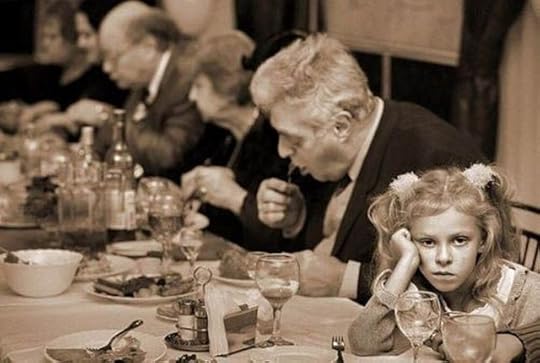
First, the title. "Craven House" is the name of the boarding house where the novel is set, but it might be too quiet a title for modern readers. It also doesn't at all foreshadow what happens when the fainthearted inhabitants of Craven House finally grow a pair and Completely Loose It.
New Title Suggestions:
The Great Paying Guest Do-Out
or
They've Come Undone, Innit
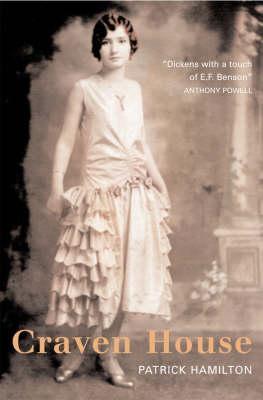
Next, the cover art. The original edition cover is Just Awful and the second edition cover is also Just Awful. The only thing that might be slightly More Awful would be this:
What are the existing covers trying to say about the contents? This is not 'A Guide to Etiquette' by Millicent Von Poshenpropper, nor is it a story about a young girl slowly dying of tuberculosis. It's a British comedy of manners, GODDAMMIT!
New Cover Suggestion:
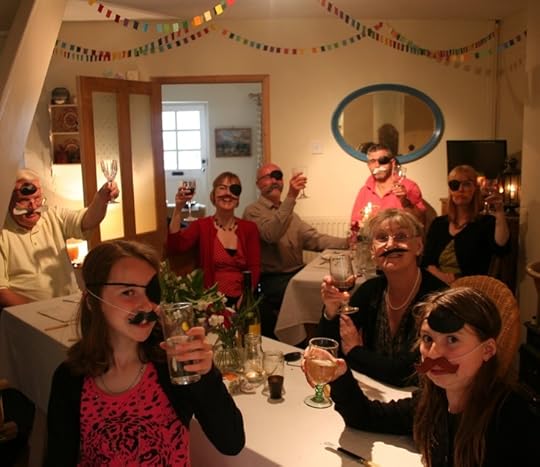
Okay, I admit that there are no pirates in this novel. But there is a parrot and some drinking and lots of people in a tight space. Whatever, it's still a better cover.
As some of you may know, I have fondness for books featuring the great British boarding house – an interest sparked by novels such as Of Love and Hunger by Julian Maclaren-Ross, The Boarding-House by William Trevor, and perhaps the greatest of them all, The Slaves of Solitude by Patrick Hamilton.
Craven House, a fledgling novel by the aforementioned Hamilton, fits right into this groove, set as it is in a West London boarding house during the early part of the 20th century. While Craven isn’t as polished as Hamilton’s later work – he was only twenty-two when the book was first published in 1926 – there is still much to enjoy here, particularly in the use of the setting as a vehicle for fiction.
In some ways, Craven House could be thought of as a collection of character studies, an exploration of the lives and traits of the somewhat disparate group of individuals who inhabit this dwelling. While very little actually happens in the way of plot – the book reads like a sequence of episodes or occurrences – there is much to treasure in the characterisation, especially in relation to the younger residents of the house.
Craven House is the story of a genteel London boarding house and its inhabitants in the first two decades of the twentieth century – a sort of early practice piece for the later The Slaves of Solitude.
Hamilton was only 21 when he wrote this early novel, so he had good reason to be pretty pleased with himself. It does show, however. The writing is a bit arch, to put it mildly, and too frequently employs a slightly smug, orotund style more usually associated with late nineteenth-century humorists – the sort of writers who penned over-long captions for Punch cartoons.
Fortunately, there is still a lot to like in Craven House. The young Hamilton had already developed his ear for everyday speech and mannerisms, and these are skillfully deployed at boarding house meal times – an agony of respectability – and in the rather sparse society below stairs. Poor Audrey Custard (the maid who Answered Back) is a figure from a later novel – and perhaps the most sympathetic character in the whole book. And, of course, there is always the background of Patrick Hamilton’s London – and “the sound of all London, beating faintly yet incessantly, like the roar of a waveless sea, upon the inured ears of the inhabitants.”
I seriously love Patrick Hamilton. This wasn't as "dark" as Twenty Thousand Streets or Hangover Square, but it nonetheless captured the deep, resounding sadness that each of his characters harbors, generally about how they feel inadequate in some capacity. He manages to craft a page-turner out the lives of 7-8 Londoners who live in a house together and are BEYOND ordinary, it's almost painful to imagine these people in real life. By the end of the novel, you feel like you've known them forever and you're just an unnamed tenant of Craven House.
I also am just desperately in love this period of time; Hamilton makes sure to cover pre-WWI, WWI, and post-WWI through the eyes of his characters. I think what I love about Hamilton's writing the most is that although his books and plays are surrounded by war, rarely, if ever, do we actually SEE the war. Rather, we are told of its effects on survivors and family back home in London. I've found this period of time fascinating since being introduced to the war poetry of the mid WWI & WWII era in college by a Brit Lit professor who was actually British! what a concept!
To think I have gotten this far in life without reading this book is alarming. How does a writer who produced such gems as "Craven House" and "The Slaves of Solitude" fade from the collective memory? It is a Travesty.
Craven House, like the Slaves of Solitude, is about a boarding house and the tenants living therein. Both books are very funny and very sad. The difference between them is that Craven House is about the promise and hope of youth; The Slaves is about the dissipation and despair of ageing. They are both phenomenally Good Reading.
In Craven House, Patrick Hamilton has captured the essence of a place: the memories contained within its walls, the echoes still heard in its empty rooms after the people have gone; the nostalgia of shared days and years within a house.
In his preface to the 1943 edition (the book was originally published in 1926), the author mentions two flaws in the book: "congestion" of style, and sentimentality. You have to read his books to understand what the congestion of style means, but in his own words, this style is what gives his books "gusto and high spirits". It's true and anyone who would want him to change it was crazy. As for the sentimentality, I personally loved it and it gave the ending just the right touch.
The last thing the author worries about in the new edition is that the story will be dated after 16 years. It goes without saying that to readers of almost 100 years in the future, stories like these are a glimpse into a bygone era of which we cannot know anything except through reading such books, and to us they are essential.
Starting just before WWI and finishing in the mid-twenties, this is the story of a cast of characters living in an English boarding house. Not my usual type of book as I’m very much a plot person, and this is literally a moment (albeit fifteen years) in the lives of a group of characters – among them a quiet middle-aged couple, a major with a braggarting boy, an abusive domineering mothering with a daughter looking for love, plus lots of prim, thin upper-lipped English disapproval. Hamilton is a masterly writer whose observances of character, deed and setting are acute. There is much humour, sadness, tension and event here. Don’t let the lack of a strong narrative plot put you off, as Hamilton’s novel is a rollercoaster of emotions, and every so often he builds crescendos and climaxes, revealing the quiet, smoldering seething under the English reserve, which every once in a while completely cracks and descends into outright clashes.
An altogether gripping account of an antiquated lifestyle. Patrick Hamilton’s love of Dickens is very much in evidence in a novel full of characters with their funny and idiosyncratic ways, their aspirations, and their relationships with one another.
Patrick Hamilton died in 1962 and mainly due to his novel Hangover Square, and plays Gaslight and Rope (all filmed), has never disappeared. But such is the brilliance of his writing and observation, which never strains for effect, his star should be brighter than it is. I can’t wait to read ‘The Slaves of Solitude’ and ‘Twenty Thousand Streets Under The Sky.’
I was a bit worried when I started reading this book, because I love Patrick Hamilton so my expectations were high, and for the first hundred pages I was a little disappointed. It read like a series of well-drawn character studies and their interactions in stifled, polite social situations; all very funny but not much of the characters' underlying emotions and turmoil was expressed here, so I wasn't as engaged as I have been previously.
Then it started to get going and this book feels like a practice run for his darker, later novels and his themes of unrequited love, prostitutes, drink and spinsters. There was still something missing and I would've prefered less of the detached reporting of the foibles of the inhabitants of Craven house and more of their inner lives. Mrs Nixon, Miss Hatt and Mrs Spicer are prime examples of characters I would've liked to have known more about and their internal lives, and it may have explained their circumstances and behaviour somewhat. It was nice to see a happy ending of sorts though. This is more of a 3.5 stars for me.
It is sometimes interesting to discover the evolution of a significant author and CRAVEN HOUSE provides such an opportunity for those interested in the growing literary acclaim of the late Patrick Hamilton (1904-62). Although most widely known for plays GASLIGHT and ROPE (adapted for the screen), the hard-drinking and earthy British author captured interwar and wartime Britain with sympathetic characters, precise dialogue, vivid descriptions, and fast-paced narratives reminiscent of a modern Dickens. His tales are not for the squemish as, for example, his mature novel. HANGOVER SQUARE follows the path of a man determined to win the (unworthy) woman he loves...even if it kills her. (The 1945 film is far less effective than the book.) More recently, TWENTY THOUSAND STREETS UNDER THE SKY: A LONDON TRILOGY and THE SLAVES OF SOLITUDE, have been published by the New York Review of Books and demonstrate Hamilton's mastery over narrative structure, character development, and vivid description.
The present volume does none of these things well and would disappoint a first-time reader of Hamilton. However, it does demonstrate his initial efforts to develop a distinctive voice that reveals much about the sociological environment of London in the Edwardian and early post-World War I era. It uses the familiar London boarding house scenario to introduce a typical environment of upstairs-downstairs occupants who interact in a world that is rapidly changing. Hamilton attempts to be droll and satirical with the limited success of an ingenue author imitating Noel Coward and even lapses into experiements in stream-of-consciousness Joycean style. His failed efforts, however, reveal how he would develop as an author of works of literary significance and social commentary in subsequent years. CRAVEN HOUSE is but Hamilton's early gateway to greener mansions in the literary world.
This one's warmer and more conventional perhaps than the Hamilton Blockbusters, but still gorgeous. It's worth noting too for how autobiographical it probably is (Chiswick, early career, boarding houses, disappearing fathers). Master Wildman's schooldays should sit alongside Copperfield's for the accuracy and comedy of that picture. The dialogue between him and Elsie - trying ever so hard to be dismissive and clever - is just perfect. I know it's a cliche, but I always love a nineteen thirties capitalised Observation About Something Trite (I'll Trite You, young lady).
At his best, it's like a timeless classic British sitcom (Diary of a Nobody meets a better-run Fawlty Towers), complete with a playful, meddling narrator. Hamilton does a terrific buffoon. He has a sublime ear for pomposity and duffers' idiom. He does lower middle class and working class smalltalk with more empathy than the best Eastenders writer.
These are outwardly small, banal lives - but what heart. That remembered moment where Wildman junior doesn't return his father's searching look for approval. Unforgettable. And, for once, an ending we Absolutely, Definitely Wanted.
Setting: London; 1911-1926. I have read and enjoyed several other books by this author - this is actually one of his earlier works, written in 1926 when the author was just 21. The book is set in a London boarding house called Craven House, run by the inimitable Miss Hatt. As the story begins, Mrs Hatt is about to welcome her latest guest, Major Wildman and his young son, who is referred to as Master Wildman throughout the book, even when he is grown into a young man - which makes me wonder if, like some of his other books, they are semi-autobiographical, the sections where Master Wildman first starts at his new school and the antics of his peers raising particular empathy for the young character. The tale is largely about Master Wildman and Elsie, the daughter of resident Mrs Nixon, who develops an unrequited infatuation for Master Wildman and is very much under the thumb of her dominant and sometimes abusive mother. But there are also several other larger-than-life characters featured, not only residents but also Miss Hatt and her two domestics, Ethel and Audrey. This was a beautifully-written tale of Britain in the immediately post-Victorian era where some of the formerly genteel middle-class suddenly found themselves financially less stable and having to stay in, or run, guest houses. Eventually, the pressure of having to pander to, and suffer the abuse from, her guests and staff begins to tell on Miss Hatt.... Yet again with this author's work, which I only really discovered just over a year ago, I found the descriptions of the people and the era in which they lived thoroughly engrossing and also liked the ending. Strangely, although the story spanned World War One, there was little about the war and its effects on the residents, apart from the one resident, a middle-aged married man, who goes off to fight. However, another great read from this author - 8.5/10.
Once the characters were introduced the pace picked up. It’s in the style of Dickens at his lightest, with detailed descriptions. Not a fast moving story until near the end, but a well written pleasant take.
This was Patrick Hamilton’s first novel and it shows a little in the rather ponderous whimsical style of humour he employs. Once you get past this particularly dated style that even he came to decry it is a very good and readable comedy of manners depicting the demise of the boarding house. A peculiar British institution where guests lived long-term taking their meals together and where the boarding house owner ruled supreme. Underneath the polite public façade lurks a less savoury reality in Craven House as it spans the years of WW1. Tensions build until the most uproariously farcical breakdown of manners at the novel’s explosive climax which signals the end of Craven House. It captures a turning point in social history marvellously with an array of outlandish characters: the strict owner Miss Hatt with her ‘no nonsense brooked’ attitude, the happy married couple Mr & Mrs Spicer (he likes to go for long walks without his wife), the Major and his young son Master Wildman who becomes an orphan and grows to manhood in the boarding house, and Mrs Nixon who every so strictly is ‘bringing up’ poor little Elsie (with the aid of a good beating or two). Both orphan and abused find comfort in each other’s companionship as they grow up until Elsie brings home her good-looking modern siren of a friend Miss Cotterell. Romance is in the air but who if anyone will get lovelorn Master Wildman?
Having said, at some point early on in my London publishing days, that most novelists are only worth reading once, I did come to find it a useful little rule of thumb. Well, rules are there to be broken and Patrick Hamilton is the very author for whom to break your rules.
This is one of his early works and it shows but somehow the over-writing seems to add to the effect, rendering the later parts of the work that much more an experience in Hamiltonian splendour - Will Self mentions the "mechanics of obsession", others highlight "trapped characters", while Laura Thompson describes prose with the "painstaking quality of a drunk walking in a straight line," to which I'd add something about a dark nostalgia.
All said, I will read anything by Patrick Hamilton. Mark me a stan.
I came to this recently, after having read a good deal of Patrick Hamilton, beginning with NYRB's Twenty Thousand Streets Under the Sky. I was delighted to locate the Black Spring Press 2008 Edition, along with Through a Glass Darkly, a Hamilton biography.
My review consists simply of this: There is a finesse in this book, a seamless, a blend of domestic horror and absurdist comedy. If allowed, I would ask each reader to sample the chapter describing the Russian lady's inaugural dinner.
I was not surprised to find humor in his early work, but I was delighted to find myself laughing aloud at the almost screwball comedy of this scene. The playwright is evident.
It's a bit of a slog at first. Hamilton and his editor both acknowledged that, but Hamilton didn't want to rewrite it extensively because he couldn't recapture the energy, style and intent of his 21-year-old self. Anyway, stick with it. I nearly gave up but it's Patrick Hamilton so I stayed the course and about a quarter of the way in comes the hint that all this set-up has been worth it to reach a state of communitas. Characters who we've only seen as acquaintances and then friends become something closer and more complex, and by the end their stories have become genuinely moving.
Although this book had its moments, I found it to overall be a frustrating read. Although a relatively short book (250 pages), it took me a while to read as at times I found I could only read a few pages at a time. The arch manner in which Hamilton writes begins to grate after a bit and one wishes he'd just get on with the story. But alas! 'tis not to be, and so, with the exception of a few scenes that are quite good, the book itself comes off as an example of style over substance, and not a particularly winning style. I've only read one other Patrick Hamilton book before, The Slaves of Solitude, and I recommend reading that one and giving this a miss.
I'm so taken with Patrick Hamilton's writing I can scarcely approach the end of one of his books without worrying it'll be the last one I haven't yet read. He writes like Elizabeth Taylor (no, the novelist, not the actor) with a generous topping of (usually) gentle humour. Understated, introspective, brilliantly observed and, to me, unputdownable. I wish I had known him.
(Before I start with the novel itself, my Abacus copy of Craven House is yet another book that has spontaneously grown an inexplicable, and unintelligible Will Self introduction.)
Craven House is Patrick Hamilton’s second novel, written in his early twenties and yet maps out many of the territories which he will later master, including the boarding house, self-destructive pub crawls, falling in love with an unsuitable woman and includes the first depiction of ‘the bore’, a character-type he is the master of. Lighter than his later work (especially those written after a speeding car disfigured him) it is actually more hopeful than his first novel Monday Morning.
Miss Hatt owns a large house she shares with Mr and Mrs Spicer. The three have been a unit since their school days and, in Miss Hatt’s opinion, it was only a fluke that she was not Mrs Spicer. She decides to rent out the large house to other people, not because she needs the money (though she does) but because the three of them have run out of conversation. Judging by the stiltedness of many of the conversations in the novel, more people doesn’t necessarily lead to more conversation.
The first people that the house is rented out to is Mrs Nixon and her young daughter Elsie and a little later they are joined by Major Wildman and his slightly older son (referred to as Master Wildman). The Wildman’s have a very good relationship, there’s a sweet moment when the boy pretends to be asleep and feels his father kisses him on the forehead and he thrills to being loved. Poor old Elsie is in a different position. She is described as ‘a victim of bringing up’, fearing the overbearing raising of her mother, especially the ultimate sanction of The Stick. While Master Wildman is realising his father loves him, Elsie is sent to bed early, where she has to undress with extreme neatness, prays on her knees and goes to an unwarmed bed as “a little white bundle of self-chastened original sin.”
Mr and Mrs Spicer, despite being a married couple have little in the way of intimacy or a relationship. Mr Spicer uses his nightshirt to hide his undressing and the two simply lay alongside each other, tussling over the sheet. Occasionally, Mr Spicer goes on a little ‘Trudge’ which he often returns from a little tottery. We join him on once of these when a sailor asks if he is lonely and joins him for a drink, I was seriously expecting this scene to develop into a gay pickup but it never quite does although I do wonder if that is Hamilton’s intention.
The first (and my favourite) section of the book sets up these characters and shows their routines and interactions before the advent of World War One. The section ends with Elsie having to face The Stick for a misdemeanour and as very sweet chapter where Master Wildman comforts her with a story he makes up on the spot.
The second section is the shortest and deals with the war, Mr Spicer’s small involvement in it, and the slightly lost feeling of those left at home. In this section Major Wildman dies in a very poignant scene.
The third section is about the differences in the post war world. The two children have grown up, Master, now Mr, Wildman gets a job, falls in love and writes a play. Poor Elsie is stuck in the same position, a hanger-on of a mother who controls her and treats her like a child. There’s a moment after she invites a friend round where she is sent to bed because it’s past her bedtime and she watches out of her window as Wildman and her friend linger and flirt by the front door. This friend is Wildman’s first love and she is of-course unsuitable for him, declaring many times that she doesn’t feel for him at all.
There’s an instability in the post-war section, the servants dare to answer back, Mrs Spicer finds out exactly what Mr Spicer does on his trudges (leading to the wonderful line, “Mr Spicer limply requests not to be punched in the face.”), Elsie finally stands up to her mother and Miss Hatt has enough and kicks them all out.
The last chapter, with Wildman and Elsie saying goodbye to the old house and the past, to move on to a shared future is probably the most unambiguously happy of Patrick Hamilton’s endings and I left the book very satisfied indeed.
It’s not a perfect book, as Hamilton himself said in a preface for a later edition. There’s a strange attempt to give characterisation to the streetlamp outside the house that should have either been expanded upon or dropped. There’s also the typical Hamilton thing of capitalising things. A person in the book works in ‘Rum’, or in ‘Galvanised Sheet Metal Tanks’; Mr Spicer has ‘Ideas’, ‘Little Thoughts’ or ‘Notions’, Elsie is ruled by ‘The Stick’. While it is a neat and funny little trick which Hamilton uses in most of his work, it’s leaned on a little too heavily. That said, it’s a thoroughly enjoyable book and I particularly felt for Elsie and was rooting for her to escape and was delighted when she does.
Read this knowing I am not reviewing the book, but rather leaving notes and asides to remind me of my readings year to year. Much has been lost in terms of childhood on, but perhaps today’s children can use the tools now available and be more vigorous in their record keeping.
There was a time when Patrick Hamilton's name was well-known to the English speaking world. He was a prolific writer, wrote screen treatments (Hitchcock) and plays, but today, Ozymandias, he is long forgotten. I have been seeking out as many books as I can using an interlibrary loan system. Craven House was his first novel, and I read the British re-publish from 1943--WWII years meaning cheap printing cheap everything. The author has written a preface for the then new edition and in the publisher's seeking to reprint the book, in a letter to the author he notes, "It is much more congested in the earlier chapters than I remember." I would agree. So did the author, but he decided to leave the 1926 text intact saying, "I re-read the book after not looking at it for over ten years. I found that less could be done about these faults of style than I hoped." With that he left the book intact thinking, "It seemed to me that any attempt to remedy this in a really thoroughgoing manner would destroy the very things which give the book it's quality, it's gusto, it's freshness and it's high spirits, which, perhaps, were only able to express themselves in this rather uncouth way."
Is the book dated? Yes. It's one hundred years old. Is it for everyone? No. When I read an author I like to read their work chronologically and hopefully see growth in their talents. That's not always the case. I just remembered an event from my own past. I was in a bookshop on Cape Cod in Massachusetts, and since I knew the owners, we were chatting while I browsed. The wife asked what I was reading these days, and I told her I had just finished reading ALL of Phoebe Atwood Taylor's work, the creator of a Cape Cod detective starting in the 1920's, much like Mr. Hamilton, and I read the books in chronological order. They were dreadful. Do not waste your time with this. I keep passing through years of books, then decades, and it never got any better. So while talking to the shop owner....when I told her this about Ms. Taylor, she said, humorously, but generally puzzled, "WHY?!?" Good question, and I didn't have an answer. Because they were, like Everest, there? A challenge. That I hoped for the best and there would be noticeable improvement? Drop Phoebe Atwood Taylor's name in a social setting. I guarantee, you will hear crickets.
About Craven House. It's set in a rooming house in London, with a broad social spectrum of "types." The servants are included in the author's musings. There is heartbreak, there is humor. The author does improve over time. You'll still get crickets if you drop his name at a cocktail party. At least with Mr. Hamilton, with some effort, you can still find his work. I only found Miss Phoebe's work because I had full access to the Library of Congress then, and I used it.