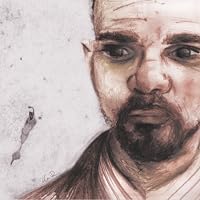
Young Adolf was published in 1978 and was Beryl Bainbridge’s first and only historical novel until the 1990s. Many its characters are inspired by real people: besides the protagonist Adolf Hitler, there is his half-brother Alois, Alois’ English wife Bridget and their baby Pat. Some other names mentioned in the novel - mainly those of relatives of the future dictator, such as his brother Edwin or his half-sister Angela - are also those of real historical people. Other important but fictional characters are Meyer, the Jewish landlord and future friend of Adolf, Mary O’Leary, another tenant, Dr Kephalus, a somewhat mysterious doctor and friend of Meyer’s, Mr Dupont, a guest at the Adelphi Hotel, and the “bearded man”, who is in fact Mrs O’Leary’s husband. The story itself was largely inspired by a memoir of Bridget Hitler, published in 1941 and recounting Adolf Hitler’s alleged stay in Liverpool between summer 1912 and spring 1913 where she and Alois Hitler really lived at that time. Although no one has ever been able to prove Bridget Hitler’s assertion, Beryl Bainbridge found herself rather intrigued and inspired by this story.
Dame Beryl Margaret Bainbridge DBE was an English writer from Liverpool. She was primarily known for her works of psychological fiction, often set among the English working classes. Bainbridge won the Whitbread Award twice and was nominated for the Booker Prize five times. In 2008, The Times newspaper named Bainbridge among their list of "The 50 greatest British writers since 1945".
Introducing Adolf Hitler: a sullen, loafing twenty-three year old and hot mess express extraordinaire. Rejected from the Academy of Fine Arts in Vienna, with a mother dead of cancer, he is living as a pauper and his last name just happens to be Hitler. He isn't yet synonymous with the murder of six million Jews. THAT Hitler is so much the embodiment of pure evil, that Bainbridge should at least be credited with the extraordinary accomplishment of humanizing him, albeit as a German Holden Caulfield temporarily living in wrong side of the tracks (Bainbridge's forte) Liverpool. How did such an unremarkable deadbeat (how much of this characterization is accurate?) become one of the most powerful men in the world? But perhaps this is the secret to becoming a politician.
Reading this odd novel with historical hindsight, there are moments of almost heavyhanded foreboding: numbers tattooed on forearms, the gift of an odd brown shirt; Adolf resolving to grow a mustache or having his hair combed a certain way or railing against impure blood. Several later chapters seem to have been written for the sole purpose of having a reason to include the following:
"Let the minority act with enough authority, and the majority will walk like lambs to the slaughter."
Calling this novel hilarious creates an expectation I don't think it meets, although it isn't unenjoyable. Had the art world only been kinder to this artist would the world have been spared the Holocaust? Who knows? Perhaps.
(Corrections made to improve how it read in April 2024).
This is a wonderful gem by a uniquely wonderful writer whose sharp, picante and penetrating novels dissect history, what it means and we look at it with a simplicity that is so subtle and complex that it is only when you stand back that you understand what a formidable and inimitable talent she is.
Before I review and, maybe, before you read it, if you have read nothing by her, you should read either Bainbrige's 'Master Georgie' or 'Every Man for himself'. The first is a fiction of the Crimean War the other of a fiction of the Titanic - and I do mean fiction you will not find general Pierre Francis Bosquet mouthing off 'C'est magnifique, mais ce n'est pas la guerre; c'est de la folie' in 'Cousin Georgie' nor Solomon Guggenheim spouting 'We've dressed up in our best and are prepared to go down like gentlemen' as his valet stood silently at his side (I often wonder was that the first time he actually acknowledged that a servant was the same as he?). But 'Cousin Georgie' and 'Every Man for Himself' say more truths while avoiding historical fact than any other work on their subjects and that is what Bainbridge does for Hitler.
There is as much acute psychological insight in this brilliant novel as can be found in Ian Kershaw's vast 'Nemesis'(though you will pass no exams by referencing Ms. Bainbridge's novel). There are those who find this novel uncomfortable because its 23 year old Hitler is not a monster - well Hitler wasn't a monster then (it can be debated if he ever was 'a monster' or simply a man capable of monstrous things. I would say the later - monsters are exceptional to the point of non existence so it is easy to fool ourselves that 'we' are not monsters). There is plenty of foreshadowing of what is to come but Bainbridge reminds us that there was a Hitler before 'Hitler'.
'In ancient shadows and twilights Where childhood had strayed, The world's great sorrows were born And its heroes were made. In the lost boyhood of Judas Christ was betrayed.'
We don't know how or why or when Hitler became 'Hitler' and Bainbridge isn't going to tell you all she does is tell you that at 23 Hitler was a man clearly destined '...to never amount to anything'. That thought should be more than enough food to keep anyone awake at night.
* It is from the poem 'Germinal' the Irish writer AE - I know no one knows who that is so google it - AE deserves some visitors.
Long before he was leader of the National Socialist German Workers' Party, German Chancellor, Fuhrer of the Third Reich and a murderous megalomaniac, Adolf Hitler was a failed, penniless artist lay-a-bout good for nothing, sleeping in the streets and sponging of anyone who would spare him a crust.
He had been somewhat peripatetic in his early twenties, but did he really come to Liverpool on a faked passport tand stay with his half-brother Alois? The wife of Alois, Bridget, said he did, asserting it in the mid-1930s after he had risen to power.
Hitler himself was tight-lipped on the subject.
Either way, it's a an irresistible piece of scouse-lore tailor made for the Liver Bird of Liverpool letters, Beryl Bainbridge. She duly has some fun at the young Adolf's expense, subjecting him to series of pratfalls and humiliations more in line with those associated with his comic lookalike, Charlie Chaplin.
The boastful and vain Alois is hardly happy to see the lazy Adolf foisted on him, but he doesn't expect any issues: "We won't have any trouble from him," he said, nodding in the direction of the front room. "Obviously he responds to aurthority."
Overly sensitive, prone to tantrums and shamelessly idle, Adolf mopes around for a few months, eventually finds some employment, ignorantly gets embroiled in some scouse skullduggery and generally exasperates his adoptive family to the point of distraction.
You can't help looking out for any ironic foreshadowing of the monstrous career to follow, and Bainbridge duly obliged, giving the Fuhrer his first brown shirt, floppy fringe and mustache. The origins of the latter was particularly amusing.
By making the main character of this short novel a comical figure, and a pathetic one too, Beryl Bainbridge made me pity him. The fact that this character is none other than Adolf Hitler renders this a questionable artistic choice.
Young Adolf is set in Edwardian Liverpool in 1912 and explores the social conditions of the working classes. Young Adolf finds himself there on account of his half-brother and sister-in-law. He associates with petty criminals and effete revolutionaries, some of whom have Jewish names.
Almost incidentally we see Hitler acquire his first ever brown shirt, black boots, trademark side parting and also vow to grow a moustache. None of this is particularly well woven into the insubstantial plot. Frankly, I am surprised there was ever a readership for Hitlerian Easter-egg-type tidbits.
Making light of dictators does not offend me in the slightest, provided the result is funny or the satire is skewering. This was neither.
What a strange story! Young Adolf Hitler allegedly arrives in Liverpool at the end of 1912 to spend time with his half brother, Alois. Adolf is disturbed, self-centred and unpleasant but at this young age one is still able to see the reason for his faults. This book is based on an apocryphal truth, but Bainbridge obviously guesses at the personalities of the people involved. She drops a number of hints of what is to come in Hitler's life, but not so many as to be obvious. As such, this is a subtle and deceptively simple book, which would definitely stand a re-read.
I enjoyed this book mainly for the comedy at the expense of Adolph. In the story he comes over to live with his older step-brother Alois,' Alois' Irish wife Bridget and their baby, always referred to as 'darling Pat'. Alois, named after his father is a vicious bully with a very short fuse, his own father also called Alois is described as a truly awful man. He was physically and mentally cruel to his sons and the apple does not fall far from the tree. Bridget is unhappy in her marriage and having her brother-in-law Adolph sleeping on the sofa day and night is driving her to breaking point. Adolph is portrayed as a figure of fun, I chuckled on quite a few occasions at the misfortunes that he undergoes. He comes across as a sulky, over sensitive and even rather effete little coward, he does however have the same streak of brutality and uncontrollable temper as the other men in his family. As I read I kept getting visions of what we know the future Hitler to be, the fanatic, screaming and spitting out his words to his audiences of thousands of people and it made me shudder. I was really amused by the way Bainbridge slipped in the origins of Adolph's mannerisms and how he came to have his own particular appearance. Keep your eyes open for these as they are funny. I felt almost guilty for finding this funny, knowing the real Hitler that was to emerge from the slime of his early insignificant life. I did however come to terms with that because all the comedy is at the expense of Adolph and his vile brother Alois.
Poor young Mr. Hitler. Beryl's depiction is of a young man with some severe psychiatric problems who finds the Irish/Jewish population of 1912 Liverpool, all a bit much for the failed art student. However we do discover why and where brown shirts, grey uniforms, moustaches and comb over hair cuts would play such an important part in his later development. It is a funny novel although it is hard to laugh at a character even in a pastiche, who would later become a monster of the 20th Century.
i didn’t completely hate it because i liked how it was set in liverpool and i knew all the streets and stuff which was fun, but when the main character is adolf hitler i’m obviously not gonna root for him so i didn’t care what he was doing, not that there seemed to be any clear direction for him through literally the whole book anyway. it was probably supposed to be funny but it was kind of boring and took forever considering it was less that 200 pages long. in conclusion, I’m glad it’s over and i’m looking forward to slating it in my seminar next week
Young Adolf was another book that I read for the Vibes & Scribes book club, and frankly, I struggled to work my way through it. Apparently, this book was Bainbridge's first historical novel, and according to her own remarks, she intended the book to be an homage of sorts to her native Liverpool. If this was the case, her anti-hero protagonist overshadows and renders irrelevant the setting. He is the young Adolf Hitler who, beset by paranoid delusions that he is being pursued, comes to stay with his older brother in Liverpool. Lazy, arrogant, and shiftless, Adolf imagines himself a frustrated, misunderstood artist who is oppressed by all kinds of pollutants, inferior minds and sensibilities among them. As such, Adolf is a pathetic character although, because we know he will become Adolf Hitler, this portrayal is a dramatically ironic one, and the one on which the novel's so-called “comedy” turns. We are treated to various atmospheres as Adolf loafs his way around Liverpool. Were he not to become Hitler, his uselessness almost earns him our sympathy. Nothing much happens to him until at the very end, his main delusion, a bearded man, catches up to him, dressed as a woman behind a stage, and we're still not sure if Adolf is interacting with reality or not. At that point, we really don't care.
The book group, including myself, universally slated this book. Even its surrealistic pretensions could not salvage it from the moral complexities that arise from Bainbridge's controversial choice of protagonist. As a work of art, the novel's central irony would not work if its protagonist was someone other than Adolf Hitler. As social and historical artifact, the novel has a questionable moral value given that it is a fictional work about a man who was the main architect of the greatest act of genocide in human history. In my estimation, it failed on both counts.
I don't recommend this book. If you want to learn more about the young Adolf, look him up on Wikipedia.
This is the first of Miss Bainbridge´s historical novels, published in 1978 originally, and it takes as its premise that a certain A. Hitler visited Liverpool as a young man and stayed there with family.
The book is not a history - it´s not even clear if Hitler was ever in Liverpool. If it´s anything it´s a wry farce, just putting this strange, nervy, easily-riled man in smokey pubs and upstairs in cold bathrooms and draughty houses
If it´s anything it´s a homage to Liverpool, the city, the city, specifically of Ms Bainbridge´s youth. The writing is affectionate and warm and it´s all described with wit and no little nostalgia.
Placing a character like Hitler in Liverpool and in Bainbridge´s hands is asking for trouble, and trouble is what Adolf gets.
—this one’s a romp! Published in 1978, it’s a novel that conjurs Adolph You-Know-Who at the age of 16 going to Liverpool to visit his half-brother. He’s shy, awkward, rude, socially inept, and in the course of the story we’re given excrutiating scenarios about how he might possibly have done some of the things he did. Numbers on wrists, for example. The forward-combed forelock. It’s fiction, of course, but really, how could you (and why would you) make up a character like him? This is the third Bainbridge I’ve read this trip and I just ordered Every Man for Himself which is about the Titanic. How she manages to load so much into every word is beyond me.
An interesting premise that sees a young Adolf Hitler arrive in Liverpool in 1912 to pay a visit to his brother, married to a local and working at the Adelphi Hotel. In this, it proved to be a departure for Bainbridge towards the historical fiction that dominated her later work. We feel sorry for Hitler as a gauche outsider who is ill-treated by his sibling but is nonetheless as badly behaved as you would expect - but a more interesting exercise would have required a deeper psychological study. This is just a bit too playful and feels more like an experimental skit. The period detail of working class life as is the highlight as is the Adelphi - now very much in the faded glory category.
Schokkende ontdekking: Hitler heb ook een moeder. Leuke herinnering is de mondelinge overhoring van mijn klasgenoot Fai. Dat deed de docent klassikaal zodat we van elkaar konden leren lees om zijn krenking publiekelijk en dus dieper te laten zijn. In een (dappere doch vruchteloze) poging tot humor vatte Fai het boek samen als : 'Hitler is crazy', een woedeuitbarsting van de belligerent ghoul tot gevolg hebbend. Terwijl hij stond te tieren, vloog achter zijn rug het kerststukje op zijn bureau in de fik. De klas keek glimlachend toe. He found a way to make us smile.
After reading this, I was confused as to...what I just read. It was presented to me as a humorous story but it really wasn't, apart from a few moments where Adolf's outburts [saying this in the voice of a corny sitcom commercial narrator] gets him in to some sticky situations! My major gripe is that this story really could've been about any young lazy kid, but it's only interesting because it's Hitler.
With that said I can't say I hated it since I read it through and some parts made for a good story, but by the time I was done my response to the whole novel was, "meh".
This novel is historical fiction only in the loosest sense. Adolf Hitler had an older half-brother Alois who immigrated to England, married an Irish girl and lived for a time in Liverpool. In her memoirs, Alois's wife Bridget claimed that young Adolf lived with them in Liverpool between 1912 and 1913. Whether or not he actually did is beside the point. Bainbridge fills in these skeletal details to render an imaginative, darkly humorous picture of young Adolf and his misadventures in the grim industrial city of Liverpool in 1912.
What made Hitler evil? Some people ask. I never ask. But Beryl Bainbridge did back in 1978. The author takes the apocryphal story that in 1912 a 23-year Hitler visited his half-brother, wife, and entourage in Liverpool, England. (This claim can easily be disproved by checking immigration records.) Bainbridge sees that Hitler became a genocidal dictator, not in spite of being a shy, eccentric loner but because of those qualities. He was not, unlike his future henchmen, banal, rather more of a proud failure.
A strange brew indeed! Adolf Hitler meets a real Liverpool welcome! (no they didn't steal his long-johns!)...& the wacky Scousers - such as they are! - see him off to pastures new...to devastating effect! Thanks again!. Seriously, this is an intriguing surmise by Beryl Bainbridge's on Hitler's alleged visit to his half-brother Alois in the city of culture that is the holy city of Liverpool! (All saints..no sinners!).Pity they didn't steal Adolf's hub-caps & big end!
This book is frosty, and not particularly engaging, though I can't say I disliked it, either. Portraying the young Hitler as someone who ran around and fell down a lot is interesting, but I feel like more could have been done with a real-ish story about a part of the dictator's life that nobody knows anything about.
About the few weeks that Adolf Hitler was meant to have spent in Liverpool prior to the first world war. Would actually have been funny if you did not realise what he was to do a few decades down the line. Some of the other charecters in the book almost make him look sane. One or two sentences give chilling hints as to where he was to get some of his ideas from.
A novel that portrays the German Dictator Adolf Hitler's youth. Plagued by paranoia and fear of what seems like people who are out to take him, this provides a little insight of what Hitler's early years may be. But one things for sure, I was a bit thrown of by the oddness and almost comical circumstances in which the characters were placed.
Oh, how I wanted to love this. Adolf Hitler's alleged 1910s-ish summer holiday in Liverpool with his brother and sister-in-law? Surprisingly flat, but I'm planning on giving it another go at some point... still hoping I'm off-base.
Wasn't that impressed with this one. It was an interesting take on a young Adolf Hitler and had some good parts to the book, but overall I found it just alright. It is a quick read and thankfully the chapters are short.