Ils avaient si longtemps mené des vies séparées, se rencontrant seulement à la surface des choses, qu’il fut stupéfait de surprendre ce regard si tendre, si inquiet. V. S.-W. À l’instigation de Rose, sa femme, Walter Mortibois invite son frère, sa belle-soeur, son beau-frère et leur fils, ainsi qu’une excentrique lady, à passer le week-end dans leur splendide demeure d’Anstey. Toutefois, il leur préfère la compagnie de Svend, son berger allemand adoré... Rien d’étonnant chez cet esthète d’une froideur de glace, qui, depuis des décennies, ignore jusqu’à sa propre femme – malgré les efforts désespérés de Rose, obstinément amoureuse. Ce n’est pas l’irruption d’invités engoncés dans leurs petits égoïsmes qui risque d’y changer grand-chose ! Jusqu’à ce que, brusquement, un double drame vienne brouiller les cartes et (enfin) réchauffer les coeurs.
Novels of British writer Victoria Mary Sackville-West, known as Vita, include The Edwardians (1930) and All Passion Spent (1931).
This prolific English author, poet, and memoirist in the early 20th century lived not so privately. While married to the diplomat Harold Nicolson, she conducted a series of scandalous amorous liaisons with many women, including the brilliant Virginia Woolf. They had an open marriage. Both Sackville-West and her husband had same-sex relationships. Her exuberant aristocratic life was one of inordinate privilege and way ahead of her time. She frequently traveled to Europe in the company of one or the other of her lovers and often dressed as a man to be able to gain access to places where only the couples could go. Gardening, like writing, was a passion Vita cherished with the certainty of a vocation: she wrote books on the topic and constructed the gardens of the castle of Sissinghurst, one of England's most beautiful gardens at her home.
She published her first book Poems of East and West in 1917. She followed this with a novel, Heritage, in 1919. A second novel, The Heir (1922), dealt with her feelings about her family. Her next book, Knole and the Sackvilles (1922), covered her family history. The Edwardians (1930) and All Passion Spent (1931) are perhaps her best known novels today. In the latter, the elderly Lady Slane courageously embraces a long suppressed sense of freedom and whimsy after a lifetime of convention. In 1948 she was appointed a Companion of Honour for her services to literature. She continued to develop her garden at Sissinghurst Castle and for many years wrote a weekly gardening column for The Observer. In 1955 she was awarded the gold Veitch medal of the Royal Horticultural Society. In her last decade she published a further biography, Daughter of France (1959) and a final novel, No Signposts in the Sea (1961).
The Easter Party si trasforma nel titolo italiano Il signore scostumato, presumo per flirtare con l’altro romanzo della Sackville-West, sempre nella versione italiana, The Edwardians diventato appunto La signora scostumata. Tralascio i miei commenti sulla “fantasia” italiota.
Questo è ambientato negli anni Cinquanta del secolo scorso, quell’altro vent’anni prima. L’ambientazione e la trama di questo non potrebbe essere più inglese: un ristretto gruppo di persone della classe agiata si raduna per il weekend pasquale in campagna nella bella casa di Walter e Rose Mortibois, Anstey. E quindi, è facile aspettarsi i soliti rituali intorno a pasti, tè, aperitivi, digestivi, fumo, le passeggiate in campagna, i dialoghi frizzanti, I pochi ospiti sono: Lucy, la sorella di Rose, col marito Dick e il figlio ventiduenne Robin – il fratello del padrone di casa, Gilbert, e l’effervescente Lady Juliet Quarles, che sa gestire flirt e conversazione con la stessa abilità.
Il castello di Sissinghurst.
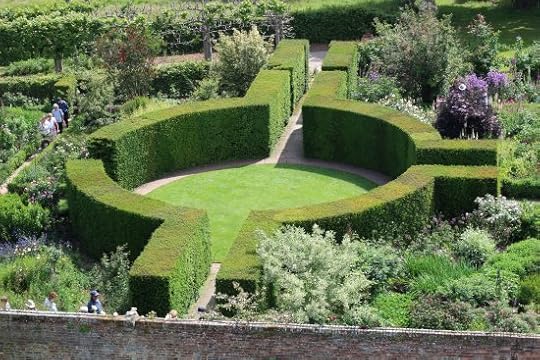
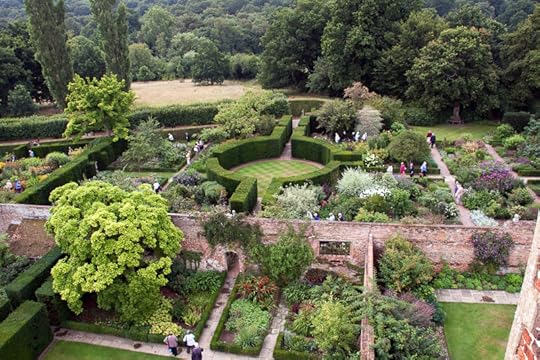
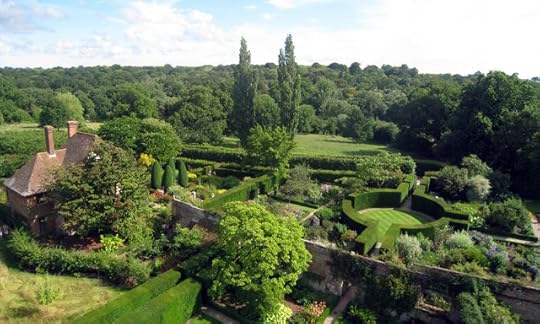
Immancabile il maggiordomo che nell’animo è comunista, ma si reprime per ligio attaccamento al suo incarico. Immancabile il cane, il giardino, il laghetto perfino arredato da finto tempietto greco. La passione di Vita Sackville-West per i giardini meriterebbe un racconto a parte: aveva una rubrica di giardinaggio sull’Observer e il giardino del castello che acquistò con suo marito, Sissinghurst, è tuttora il più visitato d’Inghilterra.
Le due sorelle hanno situazioni matrimoniali a dir poco opposte: mentre la padrona di casa ha sposato un uomo che del matrimonio considera solo l’aspetto sociale, pubblico, e alla consorte preferisce decisamente il suo cane alsaziano Svend, Lucy è invece felicemente sposata, e nonostante la lunga unione (il figlio Robin ha più di vent’anni), i due coniugi sono teneri e innamorati come il primo giorno, senza mai diventare sdolcinati. Ma la sorella più infelice, Rose, vive nel massimo agio, l’altra abita in una casa con un solo bagno: la prima è innamorata della casa di famiglia di suo marito, quella che ospita il weekend per intenderci, l’altra ha ben più tenue legame col suo appartamento cittadino.
Echi della Grande Signorina, come Alberto Arbasino ha battezzato Ivy Compton-Burnett. Vita Sackville-West dispiega ironia e talento nel costruire e descrivere le situazioni per nulla eccezionali, le conversazioni, le passeggiate. Brilla particolarmente nei momenti botanici, il giardino della villa riesce a diventare coprotagonista. Ma sa essere appassionata quando si avvicina al segreto dei padroni di casa: Walter ha messo ben in chiaro le cose sin dal principio, non vuole riprodursi, ed evidentemente rifiuta anche i contraccettivi, per cui il matrimonio non è mai stato consumato e la moglie è tuttora vergine.
Forse non arte letteraria, ma sicuramente ottimo artigianato.
Forgive me for a moment, but I feel as though I should wax lyrical about my beautiful copy of The Easter Party. It is a lovely peach hardcover from 1955, which I spotted quite by chance in a quaint little Cambridge bookshop and clutched to my chest immediately. I was like a little girl with a birthday cake. Here was a book by an author whom I treasure, which I didn’t even know until that point was in existence. That, to me, was wonderful.
As can be expected with a book printed in the mid-1950s, The Easter Party features no blurb, so I wasn’t quite sure what to expect from it. I wasn’t too worried about this as I’ve very much enjoyed all of Sackville-West’s novels which I’ve read to date, but I must admit that I wasn’t expecting to be disappointed with it.
There is not much by way of plot in The Easter Party. The novel follows two sisters, Rose and Lucy, and their entirely different marriages. Rose, the rich one, lives a life in which she dreams of leaving Walter, her indifferent husband in nothing but name. Lucy, who envies Rose’s home and stature, doesn’t actually realise that her own happy marriage should surely be the envy of her own discontented sister. Sadly, some of the conversations feel a little too saturated and reveal very few details in the grand scheme of things. It is as though they have been used merely to fill up empty space. Throughout, I felt detached from the characters, and thus it was hard to identify with any of them. Whilst I like the way in which the tale is told, over just one Easter weekend, it is certainly my least favourite Sackville-West.
Le rythme du livre était ultra saccadé, parfois je me perdais entre qui disait quoi et qui pensait quoi. J’ai pas réussi à m’attacher aux personnages donc même les révélations étaient insipides. Assez déçu !
I usually love Sackville-West, who writes like a cross between Wharton and Waugh, but this was an awful story. Two sisters and their husbands congregate in the country. The book is mostly a contrast of the two marriages and a dig into the psyche of one of the characters. He is a frigid, rigidly controlled man who has never had sex with his wife and loves only two things: his noble dog and his ancestral home. Various characters confront him about his lack of love and human connection in the course of this short novel, and at last his younger brother pretends he needs the dog for medical research and pretends to kill him. Then the ancestral home randomly burns down. The book suddenly ends there, without actually telling the reader what happens to the now bereft man. The whole thing feels like the author is flinging people and situations at her main character, for no purpose I could determine.
My first Vita Sackville-West! Choosing to read this book was a bit of a shot in the dark as I found it in an Oxfam in Oxford and decided to buy it on a whim, predominantly due to the appropriate title for this time of year.
The book details a gathering of family and friends at a country house over the period of the Easter weekend. Sackville-West draws fairly obvious and stark comparisons between the two sisters, Rose and Lucy, Rose who is the lady of the house and shares a cold and sexless marriage with the successful lawyer Walter, whilst Lucy has made a less financially successful but far more affectionate marriage to Dick. Accompanying the two sisters and their partners for the weekend is Walter's brother, Gilbert, Lucy and Dick's son Robin who has just returned from a stint abroad, and Juliet, a wayward and troubled friend of Rose and Walter.
Although I wouldn't say that I loved this book, I did find it to be an enjoyable reading experience as the characters were well fleshed out and the emotional journey of Walter was interesting and insightfully written. I thought the scene of the fire was beautifully described, perhaps giving a glimpse of what I am missing in Sackville-West's more popular and successful books!
Not one of Lady Nicolson's better efforts. I'll admit to losing interest and setting this aside for a number of months before I finished it. I'm thinking that some of the ideas about human nature are those of the writer, and as such represent her own experiences - she came from affluence and property - but the common man may find the proceedings a bit forced and the ending a bit false and contrived.
This is the first Vita book I’ve ever read — I don’t think this is one of her most popular, but I enjoyed her writing style and the social observations she makes about her characters. I’ll definitely read more of her work.
This book did exactly what I needed it to as I was reading it: an engagingly written novel, admittedly as a palette cleanser between reading two other rather intense works. The ending was quite unsatisfying I think, I would have liked the novel to last a little longer after the events so we can see their impact. I understand it was a creative decision to end where it did but I would have just preferred a little more! Definitely enjoyed though, the characters are all well-fleshed out and passages like the fire are so gorgeously written.
This is one of my favourite books by Vita it is full of surprises and lovable characters, despite one of the protagonists being a dog. (Don’t let that put you off). It had what I thought was a sad ending, but slightly predictable. No spoilers here, but definitely worth reading if you can get hold of a copy. I borrowed the book from my local library, but I was lucky as they have an extensive archive.
L’action de ce roman assez court se passe uniquement sur ce week-end de Pâques, du vendredi au mardi, dans la propriété des Mortibois, Anstey, qui fait la fierté de la famille par la beauté de son immense parc. Pendant ces quelques jours, l’auteur fait ressortir les tensions entre chacun, dans les deux couples, que tout oppose, situation matrimoniale et financière, entre les deux sœurs, Rose et Lucy, où flotte encore les souvenirs d’une enfance pas tout à fait enfouie, ou encore entre deux vieux amis comme sir Walter et lady Quarles, qui ne se connaissent que trop bien. Encore une fois, j’ai été surprise par l’auteur : sous la légèreté apparente des discussions et des personnages se dévoile petit à petit une profondeur insoupçonnée. Je ne peux m’empêcher d’admirer, malgré l’étrangeté de sa situation avec sa femme, sir Walter, sa droiture, sa constance aux principes de vie qu’il s’est fixés, mais aussi son flegme qui lui permet de rebondir même lorsqu’il perd tout ce qu’il a, autant de petites choses qui en font un parfait sujet Britannique. Au final, j’ai eu pendant toute ma lecture un sourire sur les lèvres. On reste sur sa faim, sur bien des points, mais c’est tout le talent de l’auteur que d’utiliser ces zones d’ombre pour mieux entraîner le lecteur dans l’esprit de ses personnages. Oui, j’aime la délicatesse, la sensibilité, le parfum des convenances tout autant que l’excentricité de Vita Sackville-West !