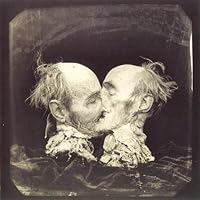
In this, his fifth novel in English (and its first paperback edition), the acclaimed French-born writer and poet, Raymond Federman, has given us the bittersweet tale of Moinous and Sucette who fall in love "across a smile" in Washington Square. Smiles on Washington Square is a charming and complex novel. With the masterful ease of a tightrope walker, Federman plays with our sense of time and space as he creates, with extraordinary compassion, a tale that makes us see our own vulnerability and worthiness. Stylistically, his links to Beckett are evident in the stripped down prose, the remarkable symbolism and word games, and in his focus on the downtrodden and inarticulate cast-aways of an industrialized world. Ultimately, Smiles on Washington Square is a book that teaches us there is no easy story, no safe entrance, no line of action not fraught with obstacles and humiliation; but finally, in the face of the inevitable disappointment of the human condition, Federman shows us how sweet possibility is.
Raymond Federman was a French–American novelist and academic, known also for poetry, essays, translations, and criticism. He held positions at the University at Buffalo from 1973 to 1999, when he was appointed Distinguished Emeritus Professor. Federman was a writer in the experimental style, one that sought to deconstruct traditional prose. This type of writing is quite prevalent in his book Double or Nothing, in which the linear narrative of the story has been broken down and restructured so as to be nearly incoherent. Words are also often arranged on pages to resemble images or to suggest repetitious themes.
Why do I covet metafiction so much? Why do I nurture a style that David Foster Wallace purportedly exploded in the late 1980s, that is derided by most literary theorists as passé, that people tend to agree serves no worldly, moral purpose other than to draw attention to the writer’s own navel? Because, dammit, metafiction is relevant to today, more than it ever was in the 1960/70s when it “peaked” with Federman and Sorrentino’s novels. Metafiction frees fiction from its slavish boundaries, by accepting the fourth wall as a fact of art and life, as a necessity in a time when the separation between art and artist is being phaser-lasered and when the content of a book is as relevant to Joe Reader as what the author thinks about disabled access to orgies. This merging of the paratexts with the text-itself is a metafictional conceit, to the extent one could argue the humble breastseller is inherently metafictional—parametafictional—from the minute the media dissemination begins until the text is “read” (ingested) by the reader. Also, this is the age of me-me-me, but enough about me, let’s talk about me. The metafictional allows for multiple dimensions of comment (not always self-involved), as mastered in Federman’s novels where the reader, narrator, and writer all merge into the fray, all part of the same fiction. Plus, metafiction is used in numerous sanitised commerical works that strip the intelligence behind the device and deploy as a gimmick—it has never left us, only the theorists have condemned it to the passé bin. I want to see more novels that accept and integrate the paratextual matter into their design without this fear of reprisal or accusations of derivativeness. Federman’s innovations were not pieces of performance art to be applauded and forgotten—these were airtight theories for the novel that few people respected as visionary and essential. As Zappa once asked, Who are the brain police?
What do I do.? The reader who read the book before left notes. Confused by the plot they have gotten lost in the shifts of time and space. Their notes stopped midway through. I best leave the book open in case they are still caught and found no way out. Daring since the book may seep into the passages of my home.
Federman turns his suffering into prose unbound by gravity, sweeping us to peeking in on a reality we did not know existed while wedged in what we thought was real with all its claims of futility.
Look, if ya don't know by now ya 'aint neva gonna.
Read more Ray. --Moinous
Pretty simple. A pretty short book. A pretty charming story.
Truthfully yet another candidate for perfect novel. Without any jim-jam about what does and does not constitute perfection and novel. But this is one that should be on every creative writing syllabus if only because every student could write one of these, really learn some craft from it, and none of them would be cliche. Or imitative.
In other words, if you thought The New Sincerity came after postmodernism and metafiction, then you don’t know Ray.
Look, if ya don't know by now ya 'aint neva gonna.
Read more Ray.
This one is for those of you who like romance and the mocking of romance, those who believe in Love and those who think it all an illusion.
Sex and cigarettes and one-legged pigeons.
I don't know how this would read as your first Ray - not knowing the importance of certain key phrases and echoes, it being your first meeting with Moinous, or your first time in the stream of Ray's fictionaltruth. I wonder if it would just bounce off ya?
Anyway...if you are already a Federmanian then this should be high on your TBR list.
I’ll cop to the truth right out of the gate: the first chapter—which is to say almost the first third—of Washington Square did very little for me. I am preternaturally disinterested in love stories of almost any stripe, and this one starts out fairly conventionally: meet-cute, star-crossed, Frenchman-American gal, &c. Surely it was written fantastically—those short, declarative Federman sentences and asides that seem less a winking eye than a swift elbow in the ribs. Due to my respect of a friend’s taste and his trenchant love of this book, I braved onward. Thank God I did.
Beginning immediately in Chapter 2, the book begins to unfold itself like the most complex origami to ever astonish the Edo. With each unfurl a new petal (to mix metaphors) is revealed to astonish and surprise, until a most impossible flowers’ blooming delights your head’s gray jelly. Linearity and fact/fiction become fluid, our narrator increasingly unreliable. Time shifts in the most delightful of ways, and the reader is never sure whether Federman’s ground is solid enough to support any weight. The flux between past-present-future and the solubility of the fourth wall are chippity-chopped as the novel simultaneously expands and contracts its foci. In other words, it gets absolutely tremendous. Not unlike McElroy’s Ancient History, Smiles' own ‘paraphases’ question the authority of experience and the possibility of reality as interchangeable and permeable. Aspect and POV dictate reality insofar as the individual is concerned, so, of course, every person’s version of the same is unlike any other’s. Tell me, can love conquer the illusory?
Hell if I know! Hey—it’s short as shit, so your investment is really very small. Read it and gain Insta-Meta cred that will impress approximately 12.4 people on Goodreads. Go ahead. I’ll still respect you in the morning while the milkblue smoke of Gauloises gathers above our alcoved bed.
Astonishingly beautiful. More human, more real, more devastating than Stoner. A stunner of a novel. I have not been this blown away by such simplicity for some time. Easily one of my favorites this year.
A great autobiographical metafictional love story -- more or less perfect, so coolly structured with past and present (and fictional) stories interlooping. More tomorrow.
Don't know if it's just this edition but the alignment on first page of each chapter is in the shape of a penis. Circumcised, at a cursory glance. Un- if you consider the 3 lines below the chapter number as folds of the foreskin. Anyhow...
great recommendation timmerman. i finished this book around 2 in the morning and churned about it for another hour after i'd finished. probably one of the best i've read this year. at first seemed like a creative exercise for the writer but then quickly morphed into this crazy love/fantasy story about two strangers who happen to smile across washington square. pretty damn brilliant.
Although the blurb of the Hungarian edition quite mercilessly tells you the whole “story”, I will not go into details. Suffice it to say that the novel tells the story of a love affair. The protagonists, Moinous and Sucette go through all the usual stages of a relationship from the first tentative glances and smiles until the bitter end.
But this is only the beginning, and in fact, the story is almost insubstantial, so it would not be worthwhile to read the novel just because of that, even less so because this is not a novel to get lost in: Federman makes sure that you're aware that this is fiction, not the faithful depiction of reality.
What actually makes it worth while to read this book is its style, its constant shifts between past and present, its playfulness, its irony and the way it depicts the influence of reality, fiction and imagination on one another. For instance: Moinous and Sucette first meet at a political rally on Washington Square, smile at each other but do not speak a word. After the rally Sucette goes home and incorporates the stranger with the nice smile into the autobiographic short story she is writing: she imagines that he must be French, she devises his whole past and personality and finally names him Moinous. And when Moinous and Sucette meet again in “reality”, the girl tells the boy about her short story, and Moinous says that he would go by the name of Moinous then, and would not tell Sucette his real name.
This is only one example of how the novel blends together the different layers of reality, fiction, and reality within fiction. However, Federman goes even further than this: he puts the whole story into the conditional, and makes the reader question the credibility of even the simplest of events. The only thing which is certain is the afternoon in March (or is it February?) when Moinous and Sucette smile at each other, then go on their different ways.
By the way I think it is extremely smart and ironic that despite the emphatic fictitiousness, the pervasive feeling that perhaps nothing happened after all, and the constant shifts between past and present we still manage to learn every important (and sometimes quite unimportant) detail of the protagonists’ past, personality and the way their relationship develops: for example we know that at the beginning of their affair, Sucette was not willing to have sex with Moinous for 42 days; we see their first argument and also the birthdays they celebrate together.
It seems that Federman attempted to write an excessively textual text, and in the process he also created an absolutely banal, everyday (but still - a very human and lovely) love story, the pieces of which he scattered in the novel – but if someone is only interested in the romantic story, they can easily find and put together the pieces, and ignore the irony.
It's because of novels like this that I like postmodern: Smiles on Washington Square gives you the freedom of several different interpretations, it reflects on the world and itself, it is very playful and seemingly simple, but in fact it demands great attention – and gives great delight in return.
In 1985 I went to the University of Buffalo to finish my graduate degree in creative writing. Raymond Federman headed up the program and that year “Smiles on Washington Square” was published.
This novel was my introduction to metafiction, or experimental fiction, or whatever you want to call it–and I was blown away. My world expanded. The definition of a novel expanded.
It’s hard to describe this novel, other than to say it is a love story between Moinous and Sucette, two characters who pass and smile at each other on Washington Square in New York City during a protest against Senator McCarthy and his Communist witch hunt in the 1950s.
She’s from a wealthy New England family. He’s a poor ex-soldier from France. But whether Moinous and Sucette ever actually meet is a mystery. They might be figments of each other’s imagination. Moinous might be a character in a short story that Sucette writes for her class. The conditional, present, and past tenses are mixed. What happened may not have happened in this looping and contradictory narrative.
And yet the story is simple and easy to follow. At 145 pages, it’s short, sweet, and stunning. I believe it belongs on the top ten of the Most Important Novels in My Life. It opened my eyes. It influenced me as a writer. Early on, I tried to imitate (with zero success) Federman’s style.
“Smiles on Washington Square” is one of those novels I would recommend to everyone, even though only a few will likely appreciate its subtlety, grace, and originality.
A bittersweet tale of Moinous and Sucette who fall in love "across a smile" in Washington Square. It is a charming and complex novel. With the masterful ease of a tightrope walker, Federman plays with our sense of time and space as he creates, with extraordinary compassion, a tale that makes us see our own vulnerability and worthiness.
Federman does a favor to the reader as he involves her/him in the story more actively than anticipated.
The novel kaleidoscopically combines elements of reality and fiction, thus offering different ways of perceiving, while observing the same storyline components. Federman makes the reader question the credibility of all steps taken in this love story, but the first one - the afternoon in March (or perhaps February?) when Moinous and Sucette first encounter, smiling at each other.
The resolution of the questioning itself is left upon the reader to make.