What do you think?
Rate this book


Hardcover
First published January 1, 1990
Unlike the French, the Irish or the English peasant, the Russian peasant had a safety net. He was entitled to land, and the possibility therefore of making an income. If he died, his widow and young children would become the responsibility of the commune and ultimately of the landowner if he was a serf, and would not be cast out on the world, though they might suffer great poverty. In the event of famine the landowner was bound in law to supply his peasants. The real hardship of the peasant serf lay not in his poverty but in his vulnerability. One bad season could bring famine with all its attendant horrors. And always there hovered above him and his family the threat implicit to his servile status, of being taken off the land, sold, sent into the army, or to settlement in Siberia, brutally punished, whether innocent or guilty, abused, beaten or even killed. With a good landlord, life might be quite bearable. But even a good landlord could be unjust, and a change of owner could lead to the introduction of new customs, new demands, fear and distrust. (p. 155)
The primacy accorded to agriculture is reflected in one of the earliest policies systematically followed by Catherine, namely the promotion of immigration into hitherto uninhabited lands. (...) Catherine herself had from the beginning of her reign been aware that Russia was underpopulated. This was the reason why she had no objection to polygamy in Moslem [sic] or pagan areas. Soon after her accession she had taken steps to attract foreign settlers. (p. 177)
“She was also responsible for one of the landmarks of the capital, namely the great statue of Peter the Great, the bronze horseman of Push kin's poem. A French sculptor, Falconet, was recommended to her, and worked on it for a number of years. The huge granite pedestal was brought from Finland, and finally in 1781 the statue was unveiled with its austere dedication: 'To Peter I from Catherine II’.” ~Chapter 8: Catherine’s Influence on Russian Cultural Life, page 102.
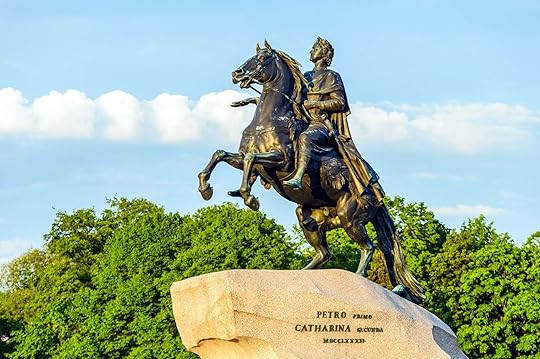
The Bronze Horseman statue (An equestrian statue of Peter the Great) commissioned by Catherine the Great and sculpted by Étienne Maurice Falconet. The inscription (both Latin and Russian) imbibed on the stone is “Catherine the Second to Peter the First, 1782”.