Jump to ratings and reviews
Rate this book

The Mysteries of Udolpho

Rate this book
Book by Ann Radcliffe

699 pages, Paperback

First published January 1, 1794

1943 people are currently reading
55073 people want to read

About the author

Ann Radcliffe

579 books712 followers
Ann Ward Radcliffe of Britain wrote Gothic novels, including The Mysteries of Udolpho (1794).

This English author pioneered.

William Radcliffe, her father and a haberdasher, moved the family to Bath to manage a china shop in 1772. Radcliffe occasionally lived with her uncle, Thomas Bentley, in Chelsea in partnership with a fellow Unitarian, Josiah Wedgwood. Although mixing in some distinguished circles, Radcliffe seemingly made little impression in this society, and Wedgwood described her as "Bentley's shy niece."

In 1787, she married William Radcliffe, the Oxford graduate and journalist. He often came home late, and to occupy her time, she began to write and read her work when he returned. They enjoyed a childless but seemingly happy marriage. Radcliffe called him her "nearest relative and friend". The money she earned from her novels later allowed them to travel together, along with their dog, Chance.

She published The Castles of Athlin and Dunbayne in 1789. It set the tone for the majority of her work, which tended to involve innocent, but heroic young women who find themselves in gloomy, mysterious castles ruled by even more mysterious barons with dark pasts.

Her works were extremely popular among the upper class and the growing middle class, especially among young women. Her works included A Sicilian Romance (1790), The Romance of the Forest (1791), The Mysteries of Udolpho (1794), and The Italian (1796). She published a travelogue, A Journey Through Holland and the Western Frontier of Germany in 1795.

The success of The Romance of the Forest established Radcliffe as the leading exponent of the historical Gothic romance. Her later novels met with even greater attention, and produced many imitators, and famously, Jane Austen's burlesque of The Mysteries of Udolpho in Northanger Abbey, as well as influencing the works of Sir Walter Scott.

Stylistically, Radcliffe was noted for her vivid descriptions of exotic and sinister locales, though in reality the author had rarely or never visited the actual locations. Shy by nature, she did not encourage her fame and abandoned literature as a pursuit.

She died on February 7, 1823 and was buried in Saint George's Church, Hanover Square, London.

Ratings & Reviews

What do you think?
Rate this book

Friends & Following

Create a free account to discover what your friends think of this book!

Community Reviews

5 stars
3,127 (18%)
4 stars
4,946 (28%)
3 stars
5,909 (34%)
2 stars
2,288 (13%)
1 star
816 (4%)
Displaying 1 - 30 of 1,704 reviews
Profile Image for Bill Kerwin.
Author 2 books84.3k followers
November 5, 2021

This mammoth, prolix book--the first wildly popular gothic novel--is indifferently written, poorly planned, and inconsistent in purpose and tone. Radcliffe's style is irritating, filled with continual redundancies, superfluous commas and dialogue that is often stilted and improbable. The plot doesn't even get in gear until a third of the way through(two hundred pages!), and it loses its focus and dissipates its power in the last one hundred and fifty pages or so when Radcliffe introduces some pallid new characters and orchestrates a few second-rate thrills that--in their similarities to events of the earlier narrative--verge on self-parody.

Yet the novel has an undeniable power and charm. A lot of this is due to Emily, the virtuous and loving (but never stuffy) young lady protagonist who would certainly become a model for Austen (as well as a source of parody) not only because of her sensible moral nature and highly developed sensibility but also because of her willingness to modify her often mistaken judgments when confronted with more reliable information.

The villain Montoni is also memorable, the prototype of Heathcliffe, Rochester, de Winter and many more. He is not really evil so much as thoroughly selfish, completely arrogant, convinced of the absolute privilege of patriarchy and nobility. He is believable, and therefore infuriating, a worthy ancestor of a long line of gothic villains.

A great deal of the charm of this book, however, comes from the characters' appreciation of the beauty and power of landscapes: fathers educate daughters through landscapes,lovers gaze and comment upon landscapes to each other, evaluate the sincerity and subtlety of one another's character and consciousness based on their reaction to landscapes, and later, when circumstances have forced them apart, they will comfort themselves with the solitary contemplation of landscapes. The villains show no interest in landscapes whatsoever, and the good people, when oppressed and harried by evil, cease to be moved even by the beauties of nature, no matter how sublime they may be. Besides, I believe one of the reasons the book shifts from France to Italy--in addition to signaling a shift in narrative from pastoral simplicity to Machiavellian malice--is in order that the heroine may move from contemplating the tranquil landscapes of Claude Lorrain to surveying the craggier and threatening vistas of Salvator Rosa. "Landscape as character" is as important to "The Mysteries of Udolpho" as it is to "Wuthering Heights" or any Anthony Mann western. If you pay close attention to the landscapes of "Udolpho" (and Emily and Montoni as well) you just might enjoy--as I did--this unwieldy and often infuriating novel.
Profile Image for Justin Tate.
Author 7 books1,456 followers
December 27, 2020
I rarely read the same author back-to-back, but after devouring A Sicilian Romance and The Romance of the Forest I haven't wanted a break from Ann Radcliffe. Her writing is breezy and enthralling—uncommon for 18th century literature. Perfect for the 2020 bookshelf, when there's no better distraction from a gloomy world than pastoral romance and haunted dwellings.

The Mysteries of Udolpho is considered Radcliffe's most enduring literary achievement. At nearly 700 pages it's certainly her longest. As such, and because I'm usually juggling several books, I decided to blog my review over time. This way I can capture a range of emotion experienced in the duration of such a sprawling epic.

Here’s how it all went down...

11/16/2020 Update - Seventy pages in and I can tell Radcliffe is doing something different this time. The mystery element mulls more beneath the surface than usual and pacing is far more luxuriant. Gorgeous scenery is crucial to the Radcliffe formula, but she really stops to smell the roses. Not a bad thing, as her travel writing skills have improved from her earlier novels. Here's one lovely example:

From Beaujeu the road had constantly ascended, conducting the travellers into the higher regions of the air, where immense glaciers exhibited their frozen horrors, and eternal snow whitened the summits of the mountains. They often paused to contemplate these stupendous scenes, and, seated on some wild cliff, where only the ilex or the larch could flourish, looked over dark forests of fir, and precipices where human foot had never wandered, into the glen—so deep, that the thunder of the torrent, which was seen to foam along the bottom, was scarcely heard to murmur.

Passages such as these are the primary focus of the first several chapters. Characters go up and down mountainscapes with much frequency. It was a wise move, I think, to read her earlier novels first. Knowing that soon there will be intrigue and terror, I can enjoy these pleasant moments and pick up on subtle clues of disaster yet to come. Were this my first exposure to her writing, I might struggle to get into the story.

Even still, she doesn't wait too long for action to start. By Chapter VII we've already met likely villains, a possible love interest, encountered unexplainable ghost music in a remote forest, and killed off one significant character. With all that setup, and the picturesque scenery behind us, I feel these next chapters will launch the story into mystery and danger.

12/04/2020 Update - Another hundred pages in and we have a deathbed confession/mystery (a favorite technique of Radcliffe) but no haunted castles yet (bummer). Instead we’re further introduced to the handsome love interest, who’s now much more than a possible love interest, and our leading lady is subjected to the unfair torments of her wicked auntie.

Valancourt is my favorite man candy from Radcliffe’s novels thus far. Like all of her men, he is relentless in his pursuit. This level of devotion would ordinarily turn-off Radcliffian women, but his love for landscapes and the outdoors—nevermind a hunky countenance—make his stalking sweet rather than psycho. Possibly there’s a twist and Valancourt will prove to be crazy soon. A rival suitor has just been introduced. Maybe he’s the real love interest?

Meanwhile, Emily's aunt is the familiar picture of old-fashioned female guardians. She calls Emily a wanton slut (paraphrase) for talking to Valancourt without a chaperone, but then she finds out he's from a wealthy family and suddenly she's all like you better marry him right this second! It makes for some snappy dialogue and light-hearted drama, similar to what you'd expect from Jane Austen. Of course Austen was a Radcliffe superfan so it's likely this novel had an oversized influence on her.

I took a peek at some reviews and am not surprised by the occasional harsh reaction. Compared to the sleek, constant thrills of Romance of the Forest, Udolpho is coming across bloated thus far. If I hadn't read her earlier novels and developed a trust that she's going to deliver, I would be annoyed. At this point I feel comfortable saying that if you want to try Ann Radcliffe, don't start here. Go in order of publication beginning with A Sicilian Romance.

To be clear, however, I'm still enjoying myself. The writing is fabulous, the dialogue flawless, characters lively, but at 200 pages it's disappointing that there's only been hints at gothic things to come.

Let's see how my opinion changes over the next 100 pages...

12/07/2020 Update - Slow clap.

How foolish I was to doubt! Ann Radcliffe is a master and knows what she's doing. Volume 2, Chapter 5. That's when all the build-up—all the seemingly low-stakes drama—compound to form a nuclear bomb.

As is customary in gothic literature, our sweet Emily is confined within a horrific castle. Wet stone walls, flickering shadows, hidden passageways and constant terror are now her surroundings. Are her fears the manifestation of an active imagination, or is there truth to the accounts of murder and ghastly spirits?

Radcliffe is the architect of numerous creepy castles in her earlier novels, but Udolpho is without question her most iconic setting yet. I'm beginning to understand why this novel is often considered her finest achievement.

Still a shame that it took some 240 pages to get to this point, but it was not in vain! Mysteries within the set-up are already proving necessary and interconnected to new mysteries introduced in the gothic castle. Going from light conflict to this oppressive gloom is also a clever contrast. In A Sicilian Romance, for example, the characters generally flee from one haunted castle to the next. Not as effective. We need the mundane to fully experience the sublimity of the gothic.

Furthermore, the destitute family history segments show us that Emily is as much imprisoned by her social situation as she is by the crumbling architecture. Her personal woes, and the rise of her tormentors, needed fleshing out before we could consider them a legitimate threat. Again, Mrs. Radcliffe, I apologize for ever doubting your brilliance!

Admittedly, there are 400 pages still to go. I suppose it’s possible the book could turn mundane again...but I don’t think so. After winding the spindle taut, it’s time to let it all spin out in horrific fashion. Can't wait!

12/16/2020 Update - No updates in a while because I've been reading nightly with breathless intrigue, too filled with suspense to stop and ponder. So much has happened in the last two hundred pages that it's difficult to analyze it all.

After Emily is confined to Udolpho's gloomy walls, there is no shortage of the gothic delights we came to expect. Mysterious paintings, unexplainable voices, hidden dungeons, and the constant threat of death are only a few examples. The ever-cruel Monsieur Montoni becomes increasingly dastardly and is the most memorable Radcliffe villain yet.

But Emily, too, is shaping up to be more significant than the usual fainting heroine. No longer crying at the drop of a pin, she’s showing tiredness for being bullied. There’s evidence of backbone when facing off against her odious male foes; drunkard, whoring men who constantly refer to her as the weaker sex. Her passion is not enough to cause much damage, mind you—she's still a product of her time—but I admire her determination and plotting.

Of course Emily is still a damsel in distress and her innocence is not so easily dispelled. Rather than coming across cheesy, as is a frequent within this genre, I actually find her charming.

In one delicious scene she stumbles into a torture chamber. At the sight of a chair with straps and other sinister confinements, she falls so ill as to collapse onto the chair itself! Then, realizing what she'd done, she jolts out of the chair and falls further faint by the experience. It's a double-whammy of gothic melodrama that surely had Mrs. Radcliffe laughing out loud as she penned the fabulous sequence.

With the story firmly in the gothic element now, I imagine Radcliffe having fun with every scene. She purposely teases mysteries, interrupts resolution and delays gratification, knowing full well what obsession it creates in her readers. The shadowy spookiness of the castle is exponentialized at every opportunity. If it's an excessive amount of spooky, I have not reached that level yet. She can go on and on describing those haunted chambers and leaking prison cells all day, and she knows it.

War has also become significant to the plot, proving once again that a gothic setting can always be made more gothic. Soldiers linger about the castle and the constant fear of rape or an enemy attack amplify tensions.

Finally, I'll say that the body count is surprisingly high. No character is safe from death, which is new. I can't recall any significant characters dying in A Sicilian Romance or The Romance of the Forest, but in Udolpho many already have and there are still 250 pages to go. I like this uncertainty. Though I'm confident our heroine will make it out alive, there are charming side characters who I'm less certain about—and that unease pushes me closer yet to the edge of my chair. If Radcliffe pushes any further, I might faint myself!

12/26/2020 Update - Finis. What a journey! Novellas are my reading preference, but nothing tops the experience of reaching the last page of a brilliant epic. Like reaching the summit of a glorious mountain compared to taking a pleasant walk. As the poet Miley Cyrus once said, it’s the climb.

Looking back, I appreciate everything. The boring parts, the thrilling parts, and everything in between. Could Radcliffe have cut 100 pages somewhere along the way? Sure, probably. But as a complete picture, I struggle to pinpoint where. Even those lengthy travel writing sequences prove necessary to cement our understanding of Emily's feelings toward Valancourt. And once the stage shifts to Udolpho? From that point, nary a word is superfluous.

I won’t spoil anything about the dramatic conclusion, but I will say that mystery, adventure and romance fill every page until the very last. The many loose threads are tied up cleanly, but also unexpectedly. I’ve read enough books that usually I can guess twists with some ease, but Radcliffe’s careful clues, subtle misdirection and brilliant sleight of hand had me fooled. Though the result of the conclusion occurs pretty much as anticipated, how it all comes about is fresh until the final reveal.

Though I have mad love for The Romance of the Forest, which was Radcliffe’s best-reviewed publication in her lifetime, the literary weight of Udolpho is a more impressive achievement. It’s as though I just read something monumental that will stick with me forever, like Les Misérables, Don Quixote or The Stand. I don’t think Forest deserves that level of praise, even if it is superb entertainment.

Will I like The Italian even better? That’s the next Radcliffe novel on my list and I can’t wait to get started. So far her literary chops have improved with each consecutive effort. Let's see if that trend sticks!
Profile Image for Jeffrey Keeten.
Author 5 books252k followers
July 3, 2019
“A well-informed mind is the best security against the contagion of folly and vice. The vacant mind is ever on the watch for relief, and ready to plunge into error, to escape from the languor of idleness. Store it with ideas, teach it the pleasure of thinking; and the temptations of the world without, will be counteracted by the gratifications derived from the world within.”

 photo CastleUdolpho_zps3d98bdeb.jpg
Castle Udolpho

Emily St. Aubert has done her best to prepare her mind for the outside world, but when both her parents suddenly succumb to a sickness she finds herself at the mercy of “charity”. Her aunt, the sister of her father, reluctantly takes her in. Her aunt is, well, difficult.

”Madame Montoni was not of a nature to bear injuries with meekness, or to resent them with dignity: her exasperated pride displayed itself in all the violence and acrimony of a little, or at least of an ill-regulated mind. She would not acknowledge, even to herself, that she had in any degree provoked contempt by her duplicity, but weakly persisted in believing, that she alone was to be pitied….”

The only source of comfort that Emily has is a young man by the name of Valancourt, totally unsuitable as a marriage match because he is unfortunately the second son and primogenitary is still the law of the land in France in 1584. He will have to make his fortune by other means than inheritance. When the husband of her aunt, the dastardly, scheming, brooding, perfectly conceived gothic villain Montoni wants to spirit them back to his native land of Italy, Valancourt tries to get Emily to run away with him.

She of course refuses otherwise the novel could not have been titled Mysteries of Udolpho.

Emily wants her marriage to Valancourt to be validated. She does not want to be one of those women who is the main subject of gossip for the rest of her life. She believes that reason and her own stubbornness will win out.

 photo Udolpho2_zpse701e3e3.jpg

Ann Radcliffe devouts many passages describing the romantic scenery of France and Italy. Emily is a contemplative person, given herself over to many long sighs, and indulging in pleasurable melancholy about her future.

”The spiral summits of the mountains, touched with a purple tint, broken and steep above, but shelving gradually to their base; the open valley, marked by no formal lines of art; and the tall groves of cypress, pine and poplar, sometimes embellished by a ruined villa, whose broken columns appeared between the branches of a pine, that seemed to droop over their fall.”

They go to Venice which is when Emily finds out Montoni’s true intentions toward her virtue. He plans to marry her to one of his friends Count Morano.

“But she avoided even naming Count Morano, much more the declaration he had made, since she well knew how tremblingly alive to fear is real love, how jealously watchful of every circumstance that may affect its interest; and she scrupulously avoided to give Valancourt even the slightest reason for believing he had a rival.”

But when Montoni’s luck at the gaming tables of Venice abandon him he is forced to flee to his castle in the Apennines Mountains...Castle Udolpho.

Morano is left high and dry (mostly dry, but slightly damp it is Venice after all), with flowers in hand, wondering where his bride to be has been taken.

The plot really picks up at Udolpho. The book starts to feel more like a gothic horror than a gothic romance.

”She saw herself in a castle, inhabited by vice and violence, seated beyond the reach of law or justice, and in the power of a man, whose perseverance was equal to every occasion, and in whom passions, of which revenge was not the weakest, entirely supplied the place of principles.”

 photo UdolphoIllustration_zpsc20ad7ef.jpg

The quotes from Shakespeare start to come fast and furious.

”Unnatural deeds Do breed unnatural troubles: infected minds To their deaf pillows will discharge their secrets. More needs she the divine, than the physician.” MACBETH



So there are unusual noises, ball lightening dancing along iron spear heads, mysterious phantom figures, a veiled portrait that when seen renders our heroine insensible, Italian bandits, a siege, cold damp walls, secret passageways and haunting music. Emily does not get a full nights sleep the whole time she is imprisoned at Udolpho.

She begins her mental jousting with Montoni. He is interested in her estates. She is interested in her freedom, but she does not want it bought too dearly.

”Emily, as she observed him in silence, saw, that his countenance was darker and sterner than usual. ‘O could I know,’ said she to herself, ‘what passes in that mind; could I know the thoughts, that are known there, I should no longer be condemned to this torturing suspense!’”

Montoni is heartless, cruel, and unprincipled. He is feral in his desire for self-preservation. He sneers at the weak and feels justified in his criminal behavior.

”His character also, unprincipled, dauntless, cruel and enterprising, seemed to fit him for the situation. Delighting in the tumult and in the struggles of life, he was equally a stranger to pity and to fear; his very courage was a sort of animal ferocity; not the noble impulse of a principle, such as inspirits the mind against the oppressor, in the cause of the oppressed; but a constitutional hardiness of nerve, that cannot feel, and that, therefore, cannot fear.”

 photo Montoni_zps78c44848.jpg
Oh yes...that...is...Montoni!

Emily must survive the twists and turns of the plot as she tries to defeat a Goliathan opponent. She discovers in the process that she has more spine than she would have ever dreamed possible buoyed by her own sense of the injustice of her circumstances and her desire to return to Valancourt.

”‘You may find, perhaps, Signor,’ said Emily, with mild dignity, ‘that the strength of my mind is equal to the justice of my cause; and that I can endure with fortitude, when it is in resistance of oppression.’”

I couldn’t help thinking about all the women across Europe in 1793 who were stealing time away from their other duties to read this book. It was a phenomenal best seller, in fact, mentioned in some places as the truly first best selling novel. Ann Radcliffe was not the first gothic novelist, but she was the first to legitimize the genre. Imitators were soon flooding the market with gothic romances to a public that had an insatiable addiction for the combination of thwarted love, dastardly villains, and crumbling castles.

 photo AnnRadcliffe2_zps10bf1c46.jpg
Ann Radcliffe lost in her own gothic world.

Radcliffe herself was a recluse, rarely venturing outside away from her writing. I can only speculate that she made her ivory castle and cared little for a real life that was beyond her control. Wouldn’t we all like to lose ourselves in the world of our own making? The book dragged in the beginning for this reader, but gains momentum after Montoni enlivens the plot with his ingenious, scheming, larger-than-life personality.

If you wish to see more of my most recent book and movie reviews, visit http://www.jeffreykeeten.com
I also have a Facebook blogger page at:https://www.facebook.com/JeffreyKeeten
Profile Image for Henry Avila.
558 reviews3,370 followers
October 10, 2020
Emily St. Aubert has it all, loving parents a nice little charming estate she lives on in southern France, Anno Domini 1584. The young gentlewoman adores walking around her father's land looking at the nearby exotic Pyrenees Mountains, watching the calm Garonne River flow by hearing it making soft noises as it goes along. The lady likes playing an instrument, singing songs to her affectionate father and mother while sitting on a hill with a great view an enchanting moment, never forgotten. The Chateau is located in the province of Gascany a beautiful area, the Atlantic Ocean a short distance from their home away from the tumultuous politics and battles of Paris, meeting her beloved Monsieur Valancourt the perfect life, but the world keeps spinning and not always in the right direction. Emily soon loses both her parents, medicine being very primitive back then, Aunt Cheron her father's unkind sister takes Emily to her home, the cold aunt promptly marries an evil Italian Signor Montoni, who wants to take Emily and her aunt to his mysterious Castle of Udolpho, a remote valley in Italy. Faithful Valancourt warns the teenager not to go and instead marry him immediately, he has heard things! And very unfavorable to Signor Montoni however Emily promised her dying father to stay with his sister until she comes of age, do I have to tell you she makes a big, big , mistake?... Climbing the treacherous yet alluring Alps Mountains by stagecoach to get over to Italy, afraid of the much feared banditti active there, the small party arrives after a long, dull journey at there intended destination without incident. First stop the incomparable, Venice a dream in the middle of the ocean , Emily starts to have fun here moonlight gondola trips , after Luna rises out of the beautiful sea, paradise on liquid still it will not last. Reality shows its ugly face both to aunt and niece, soon they are held captive by her new uncle in the strange , dismal Udolpho Castle, the party's final undesirable stop he needs their estates ( because of money troubles) and doesn't take no for an answer. Montoni has a little gambling addiction of course Uncle Montoni is the chief of the bandits here also, raiding the local noblemen and the rich, oblivious, travelers in the area. The gloomy castle is haunted too, they say apparitions are seen at night, weird sounds heard coming from thin air, odd tales are told about the previous owner, she disappeared one night in the woods and was never seen alive again, people say her ghost comes back at midnight, seeking vengeance but against who? Poor beautiful, fragile Emily always fainting, fleeing an unwanted persistent suitor where can she get help? Valancourt is back in the army far away in France, she fears for her safety the place is full of murderers, riots and fighting between themselves are nightly occurrences, her room's door can't be locked, if only she had taken her admirer's advice... One of the best Gothic novels ever written.
Profile Image for Carolyn Marie.
409 reviews9,578 followers
July 11, 2021
If I could describe this book using only two words, they would be verbose and melancholy!
Ann Radcliffe’s writing is breathtaking and enchanting! At first I was swept away by the lyricism of each scene, but after a while the repetition and continuation of these long descriptions started to take me out of the story.
The first few “melancholy’s” set the tone, but after reading this word countless times, it lost its affect.
The story itself and it’s characters are intriguing and hilariously dramatic, which I always love in classics!
I found myself laughing in moments I knew I wasn’t supposed to be, but it was such a joy! I just kept imagining Jane Austen reading this book, thinking how silly the characters were behaving, and making a parody of it in Northanger Abbey! (Which I can’t wait to read very soon!)
It was very interesting to read this story knowing how many other “classic” authors were inspired by it! I kept thinking of Daphne du Maurier in particular, and imagining all the story ideas it must have given her!

Overall, it was a melancholy (😉) joy to read!
Profile Image for Sasha.
Author 15 books5,029 followers
September 19, 2018
"'You speak like a heroine,' said Montoni, contemptuously; 'we shall see if you can suffer like one.'"

And if all the sentences in this book were half as good as that one, we'd be looking at a five-star book here, but sadly the rest of it is just hella boring. You might be reading a lame book if you have this thought: "Oh great, it's one of the heroine's long, shitty poems; that's three fewer pages I'll have to actually read." And if you think Montoni's threat means that the torture device you briefly glimpsed 50 pages ago is going to make a second, more exciting appearance, you are wrong.

Mysteries of Udolpho is the second classic Gothic novel, the first being Horace Walpole's Castle of Otranto (1763), which is better mostly because it's much shorter. And Radcliffe pours on the Gothic stuff; this is like a master class in the Rules Of Gothicness, and here's a Gothic drinking game (which I fleshed out quite a bit here): drink for each of the following plot devices:

- Spooky castles
- Ghosts, vampires or other monsters
- Nasty weather
- Overwrought language
- Ancient family curses
- Damsels in distress
- (distress of losing their chastity)
- in nightgowns
- who faint a lot
- Byronic men
- with secrets

If you find yourself drunk you are reading a Gothic novel. Or watching Scooby Doo.


                                                           ^ Damsel

Anyway there are like two or three spooky castles in Mysteries of Udolpho, I lost count, and who knows how many lengthy descriptions of unpleasant weather, and not a small amount of fainting.


Image is from this terrific piece on Gothic novels, which is just about my favorite thing ever.

And she manages to make all that just spectacularly boring, which is really sortof an achievement, but not one to be proud of.

Here's one of the things about Ann Radcliffe: she really liked landscape paintings, and she didn't get out much, and what that means is that she sets the scene by spending paragraph upon paragraph describing paintings she likes, and that's exactly as boring as it sounds. Here's a painting by her favorite guy, Claude Lorrain:


"Shepherds and shit," is probably what this is called

She's made an effort to create a twisty, mysterious plot, but she's hilariously terrible at big reveals - plot twists happen with the impact of your grandfather telling an anti-Semitic joke at Thanksgiving, everyone saw it coming and no one liked it - and basically none of it works. Two stars because that one sentence I quoted above is fucking amazing; no more stars because most of the suffering was done by me. 'Cause I was so bored. This is the second classic Gothic novel, but The Monk (1797) is still the first good one.
Profile Image for Sara.
Author 1 book934 followers
December 27, 2016
3.5 rounded up.

Ye Gads! I started this book back in July, had to table it, and started over the first week in December. Still took me a month to finish. I have to say, what Ms. Radcliffe could have used the most in her writing career was the services of a good editor. I can appreciate long descriptive passages, but how many in depth descriptions of someone collapsing into tears does one need. By halfway through the book, she could have just said "Emily wept" and I would have known she was collapsed on the floor and near fainting.

It is hard to put a finger on why this twisting, convoluted, over-populated work works, but it does. By the time the characters finally reached Udolpho, I was hooked and wanted to see where it was going and how on earth Radcliffe was going to tie up all these loose ends. There were so many threads, it was hard to keep track of which Baron, Count or Chevalier was being followed or accused. There were all the likely Gothic contrivances, castles with corridors beyond end and parts of houses not seen in 20 years, ghosts populating the peasant minds, mysterious music, hidden villainies and secrets. There was Snidely Whiplash, poor little Nell and Dudley Do-Right, ugh I mean Montoni, Emily and Valencourt. Perhaps knowing it was the first time made these stereotypes a little more palatable.

In any case, I did enjoy it once I was fully committed and I am glad to have it checked off my list of books I want/need to read. If you are thinking of reading it, I caution you to settle in for a story that can be laborious at times, thrilling at times, and funny in places that it clearly does not intend to be. Enjoy.
Profile Image for Mika (Hiatus).
589 reviews85 followers
October 18, 2025
Quick Recommendation
The Mysteries of Udolpho is a long and slow-paced gothic book about an orphan girl who is trapped in the isolated castle Udolpho. This mysterious castle with a hidden past creates a suspenseful atmosphere. Mysterious music, a black veil and a secret passage are all supernatural occurrences in the old and spooky castle which creates a gothic atmosphere. It creates a sense of terror through the use of mysterious encounters and a suspenseful plot. The characters are emotionally overwhelmed by love and sorrow but also melancholy, greed and haughty attitudes. The ending leaves the reader wondering whether the supernatural occurrences were actually happening or just somebody's wild imagination. It explores the power of imagination and fantasy but also the fear of the unknown.

This book can be very tiresome for people who want to read something fast and quick. The author describes the landscape in great detail, includes often times long poems in each chapter and also shows a preference of tell than show. The Mysteries of Udolpho can be enjoyable for people who like to analyse poems (they all have a message they want to convey which are always connected to the current plot point). A remarkable example includes ‘The Minstrel’ which not only is used to enhance the plot but also to understand the characters better. It highlights the romantic aspects of this novel which is sometimes told in a melancholic tone. Another reason one could enjoy this novel is for the overly dramatic and often times funny moments and also for being dark, scary and for being one of the earliest gothic tales to be told.

Themes
Supernatural occurrences, castle life and escape, power and gender dynamics, inheritance, family fortune, power of the imagination, fear of the unknown, greed, desire for wealth and great reputation, wealth vs human relationships and conflict between sense and sensibility.

Writing Style

Gothic elements
What bothered me the most is that it takes 200+ pages to finally introduce the gothic elements (when they arrive at the Udolpho castle) and also about 200 more for it to vanish again. In the end all my fantasy and theories about what was happening was forcefully ripped of me by such a dull explanation. I didn't actually wanted to know, to be honest. I expected a mystery which was barely served to me and in the end the explanation is not only presented to me in a dull tone but it also made me disappointed. By that I felt like I was the lunatic all along even though some of the characters in this novel were way more of a lunatic than me (Signor Montoni and Madame Cheron).

Descriptions
The descriptions were also making me go bonkers, it was just too much! At first it really set the tone and the atmosphere but after just a short while I actually wanted it to stop, but it never did. The author seems to be kinda lost in their own fantasy world while writing their books which isn't really bad per-se, but not as interesting for the reader as the author might initially thought. There were also some stanzas that were way too long to convey a message that could have been shorter.

Characters
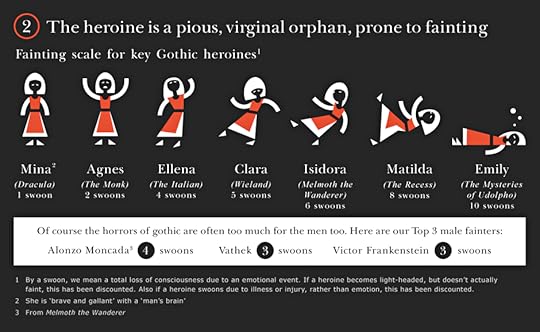
I found a chart where Emily is supposedly the most fainted female character from all classic gothic novels. She was more busy fainting than actually doing anything. Can you believe this? I couldn't either. After just a short while I got used to her fainting which made me actually gasp when I found out how often she actually fainted due to emotional distress. 10 times! That girl was in more distress in life than I ever was. I pity her a bit, but I'm also mad for what she did in chapter XIV (14).

Plot
The story was so overly dramatic which made it very ridiculous, not just at times. All the time. Not only did our innocent and (unfortunately) passiv main girl faint at any opportunity given but she also cries a lot. How dramatic. Emily can be both irritating for being so stereotypical and boring, but also funny as she frequently faints and makes stupid decisions that can be perceived as funny too. The plot was even more hilarious. There were 'coincidences' that were just too obvious the making of the author. The randomness included in it made it so funny.

Outroduction
The Mysteries of Udolpho is not a bad book. Unfortunately it dragged a lot 'cause of the long unnecessary descriptions, but it still can be a joyful ride. For me it was funny and also a bit spooky (though the spooky part didn't last long). Ann Radcliffe knows how to create an eerie atmosphere with unsettling and mysterious events unravelling. The isolated castle and the thereof isolating life in it gave a certain dark tone to it too.

My takeaway from reading this is that one shouldn't take this novel too serious while reading but rather read it like it's a satire of something. A satire of gothic horror if you will. Perhaps one should re-name The Mysteries of Udolpho to The Satires of Udolpho. Was there really a mystery? The only real mystery presented to me is how Emily could faint as often as someone in their final stage of a terminal illness and cry more than her small body would even be capable of.

StoryGraph review
Profile Image for Michael.
Author 3 books1,490 followers
April 18, 2018
I'm reading this book again to get back in touch with some of the early English gothic novels. I'm struck, in these early pages, by the extreme romanticization and lush description of nature. The natural world has a sort of earthy goodness that draws Emily and her father in. By contrast, the characters who are more urbane are invariably depicted as manipulative and ruthless.
Profile Image for Magrat Ajostiernos.
724 reviews4,876 followers
Read
November 13, 2017
No puedo puntuarlo porque lo abandoné en la página 500 más o menos (de 800)
La verdad que me estaba pareciendo un libro interesante, me encantan esas descripciones a lo Romanticismo alemán, y la segunda parte en el castillo me gustó mucho (la primera se me hizo bastante más pesada) pero llegado a cierto punto perdí el interés, y esta lectura requiere una constancia y unas ganas de las que carezco ahora mismo.

Entiendo que sea la cumbre la literatura gótica, ha sido too much gótica para mi xD

NO RECOMENDADO PARA QUIEN NO ESTÉ ACOSTUMBRADO A LOS CLÁSICOS
Profile Image for Paul.
1,471 reviews2,167 followers
June 10, 2021
A hefty slice of eighteenth century gothic famously satirised by Jane Austen in Northanger Abbey. It is set in the late sixteenth century and follows the fortunes (and misfortunes) of Emily St Aubert. It is set in southern France and northern Italy and there are lots of descriptions of majestic landscapes, all of which came from travel books as Radcliffe never went to the areas she described. Here’s a description of a castle, which looks, well, very castley:
“Emily gazed with melancholy awe upon the castle, which she understood to be Montoni’s; for, though it was now lighted up by the setting sun, the gothic greatness of its features, and its mouldering walls of dark grey stone, rendered it a gloomy and sublime object. As she gazed, the light died away on its walls, leaving a melancholy purple tint, which spread deeper and deeper, as the thin vapour crept up the mountain, while the battlements above were still tipped with splendour. From those, too, the rays soon faded, and the whole edifice was invested with the solemn duskiness of evening. Silent, lonely, and sublime, it seemed to stand the sovereign of the scene, and to frown defiance on all, who dared to invade its solitary reign. As the twilight deepened, its features became more awful in obscurity, and Emily continued to gaze, till its clustering towers were alone seen, rising over the tops of the woods, beneath whose thick shade the carriages soon after began to ascend.”
There is a significant cast of characters with suitably villainous villains and the noble and good are very much so. There are plenty of crumbling castles with hidden corridors and tunnels, gloomy tombs aplenty, a few humble cottages (populated by humble cottagers), sinister portraits, nuns, a touch of what might be the supernatural (although as Radcliffe herself says it is more terror than horror). Theses bits I am afraid reminded me a little of a cartoon series from my youth called Scooby Doo. Emily’s servant Annette provides the comic relief. There is a bit of redemption for the villainous female characters, but most of the male villains meet nasty ends.
There are strong female characters here, even though Emily spends a significant proportion of the novel crying and fainting away and as always good triumphs, eventually. The male lead Valancourt is certainly the most irritating character. It has often been said that it is easy to create flawed characters and difficult to create convincing good ones.
One piece of advice, skip the poetry. Although if you do you will miss the immortal line:
“Hail! Mildly pleasing solitude!”
There is a certain entertainment value to this, but it is very long. I recognise that it was ground-breaking and there were strong female characters, but I do understand why Jane Austen parodied it.
Profile Image for Christmas Carol ꧁꧂ .
963 reviews834 followers
November 12, 2018
2.5★

Every author and aspiring author should read this book. Not because it is a great book (it really wasn't) but because they will look at their proofreaders, copy editors and beta readers with a whole new appreciation!

Another reader I know decided to read the audio version - & fell asleep. When she awoke (a few hours later) Emily & her father were still endlessly travelling through Europe. A ruthless, modern day editor would have halved this book in size - & would have produced a far better book. The imaginative descriptions of the scenery were lovely - it's just there was so much of it.

While Emily was a very brave heroine, she also cried, sobbed, trembled, shuddered, sighed & above all fainted


through most of the story. The book's worst fault was that some of the most important actions happened off page. By 80% I was in skim mode - & I'm amazed it took me that long.

An important read for Northanger Abbey fans - but I wouldn't recommend it for anyone else.
Profile Image for Alain Gomez.
Author 62 books17 followers
March 7, 2011
"I believe that memory is responsible for nearly all these three-volume novels"
-Oscar Wilde

One thing I will say for this book is that it made Oscar Wilde's plays even more entertaining for me. I now know what he was talking about when he trashes books of "unusually revolting sentimentality." And what he says is very true. I am absolutely certain that Ann Radcliffe wrote this book as a sort of extended journal for her travels. At least half of it is devoted to scenery descriptions. Now this is not a bad thing in itself. I read "classics" all the time and I understand/appreciate that books tended to be more long winded due to the limited amounts of solo activities available at the time. But this is ridiculous.

I should point out that the full title of this book is "The Mysteries of Udolpho, A Romance; interspersed with some pieces of poetry by Ann Radcliffe." SOME pieces?!? Give me a break. She throws in her poetry every chance she gets. Her prose is neither creative or inspired. Every single verse is cheesy, lacking good poetic structure and ALWAYS about nature. This quickly gets redundant and I found myself skipping over her longer ones which can last for pages.

I have seen a few reviewers compare this book as the predecessor to Jane Austen. I beg to differ. I have read every single one of Jane Austen's books and these authors are separated by one very crucial fact: Jane Austen is a good writer and Ann Radcliffe is not. Radcliffe's writing style is extremely difficult to follow. Commas seem to be a critical plot point with her. Any kind of sentence and/or dialogue will read something like this:

"Emily, called, as she had requested, at an early hour, awoke, little refreshed by sleep, for uneasy dreams had pursued her, and marred the kindest blessing of the unhappy, but, when she opened her casement, looked out upon the woods, bright with the morning sun, and inspired the pure air, her mind was soothed."

Yes, that is all one sentence. I am almost positive that I've heard William Shatner talk more fluidly.

Despite all my griping about this book, I think the thing that annoyed me the most was that I really just didn't care about Emily. She struck me as very spoiled and sheltered. She cries nonstop and is constantly wallowing in self pity. In reality, none of the characters (not even her "evil" uncle) really abuse her. They are strict and worldly, nothing more. In one especially nauseating scene she is driving in a carriage with her aunt and uncle, wallowing in self pity as usual, and sees some peasants playing instruments. She then thinks to herself how lovely it would be to be a peasant because then she could spend the whole day doing whatever she wanted and not be controlled by an evil aunt and uncle. Umm... what?!? Last time I checked, peasants did NOT live a charmed life.

In contrast to Emily and Valancourt, I found myself actually liking her "evil" stepuncle, Montoni. He was pretty much the only character with ANY kind of common sense.

To sum up, save yourself a painful +/- 700 page read. If you want a cute and light romance I suggest checking out books by Georgette Heyer. Or go to the Bronte sisters if you want something more Gothic and substantial.
Profile Image for Debbie Zapata.
1,980 reviews57 followers
March 14, 2015
I chose to read this book the same way many other people did. I was reading the Jane Austen novel Northanger Abbey as part of a group read, and the topic of 'The Horrid Novels' came up. The Mysteries Of Udolpho was the only one I had access to, so it was the one I read.

This is a long book, old-fashioned in style (naturally, being published in 1794) but I enjoyed it very much, even though I had my doubts going in because I lost my taste for the Gothic genre years ago. I expected to give up on it, but I was intrigued by Emily and her life, and found myself more and more curious about what would happen next with each page I read.

I also had fun with this book, as I try to do with anything I read. I learned new words like IZARD, MASSY, and DINGLE. I actually have wild dingles close to me and never knew it until I looked up the definition to see why they seemed to make Emily so nervous.

But it was when I read this sentence that I became more curious about Ann Radcliffe herself: "Her present life appeared like the dream of a distempered imagination, or like one of those frightful fictions, in which the wild genius of the poets sometimes delighted."

I was impressed by the incredible phrase "like the dream of a distempered imagination"; and the entire sentence made me wonder if perhaps Radcliffe had read something which inspired her to write Udolpho....some frightful fiction (aka 'horrid novel') that set her to conjuring up all sorts of ghostly ideas that led to this book.

So I looked her up at Wiki and found.....not a whole lot. She was a very private person and apparently there simply is not enough material about her life for a proper biography to be written. But it is known that she did not believe that the Gothic genre was developing the way she thought it should. In an essay her husband published after her death "she states that terror aims to stimulate readers through imagination and perceived evils while horror closes them off through fear and physical dangers."

She saw writers of Gothic novels emphasizing horror as opposed to terror and it is believed that the frustration she felt over this change in focus is what made her quit writing. Imagine the difference between an Alfred Hitchcock movie that will scare the daylights out of you with its suspense, and one of those Chainsaw Massacre things that just go for the shock value of blood and guts everywhere. Radcliffe and Hitchcock would have seen eye to eye.

I was happy with the way all the Mysteries of Udolpho were explained in the final chapters: every loose end that I kept wondering about was eventually tied neatly into a satisfying package, and all the explanations made sense to me. I am looking forward to reading more of Radcliffe's work in the future.

There is just one question that does not get resolved, unless I missed it somehow. If anyone reads The Mysteries Of Udolpho and finds out what happened to Manchon, please let me know....thanks!
Profile Image for Ellie Hamilton.
255 reviews476 followers
October 10, 2025
Quite a niche book but if you like descriptive, enthralling Gothic books, I highly recommend it! Definitely will get others by her x
Profile Image for A.E. Chandler.
Author 5 books251 followers
March 13, 2021
Published in 1794, the pacing of this novel is different from what 21st century readers will expect. Once I got into the book, it was definitely enjoyable. Written over two hundred years ago, and only seventy-five years after the first novel was published (and went largely unnoticed by the literary in-crowd), The Mysteries of Udolpho is structured for a late 18th century audience, and needs to be approached that way – this isn’t the way 21st century authors write, which is part of what makes it a classic.

This is a pioneering piece of Gothic literature – or romance, as Ann Radcliffe labels it – incorporating a medieval-ish setting, and seemingly supernatural events. Radcliffe chooses to give logical explanations to her supernatural mysteries - a feature more often found in Gothic fiction by female authors - but one that doesn’t lessen their drama as long as they remain unsolved. Stereotypes of the medieval period as “brutish,” which have persisted throughout the modern era, are visible, but can be easily forgiven because this story is such an obvious piece of fantasy, with little relation to anyone’s reality.

Emily’s main conflict in the novel is maintaining a rational mindset and conduct, when circumstances are conspiring to make her fall into the trap of sensibility (being ruled by whims and feelings) and mentally fall apart. She carries the courage of her convictions with her into all of the fantastic difficulties that confront her. Emily succeeds better than her male love interest, who faints more times (until I lost track) and breaks down crying more often (adjusted for pages spent in the spotlight) than she does. Emily makes her choice of suitor based on having spent a good length of time together discussing mutual interests, and shared values, which is not something most people would expect from a Gothic novel. Overall, though, I found the servant Ludovico to be the more likable character, despite his propensity early on for locking Emily’s maid Annette in various rooms “to keep her safe,” over her protests.
Profile Image for Werner.
Author 4 books718 followers
October 5, 2023
Note, Oct. 5, 2023: I've just edited this review slightly, to re-word one sentence.

As British literary scholar Bonamy Dobree notes at the outset of his introduction to the 1966 Oxford Univ. Press edition of this late 18th-century classic, Radcliffe's best-known novel held its place in the canon of British literature for half a century. It was subsequently eclipsed by more accomplished works, and by changing stylistic tastes; but its historical prominence and influence testify to some literary strengths which merit attention for it even today in its own right, as well as for its historical interest. (Some modern readers' curiosity about it is also excited by Jane Austen's mention of it in Northanger Abbey as one of a number of "horrid novels" --"horrid" in terms of their morbid and frightening subject matter, not necessarily of their literary quality!-- that one of the Gothics-loving heroine's friends recommends to her; but I haven't read that particular Austen novel yet, and it wasn't a source of my interest.) The novel had long been on my to-read shelf; so I took advantage of an invitation to take part in a common read of it in one of my Goodreads groups. I'm glad to have gratified my curiosity about it and to have experienced Radcliffe's work for myself, though my appreciation for it didn't rise above mild liking.

Its faults will strike most readers more readily than its positives. Radcliffe's style is convoluted and wordy (this is a 672-page tome, that demands quite a commitment of time). To a degree, this is a general characteristic of Romantic fiction in the author's era, and doesn't bother me as such (though it will many modern readers). But while contemporary writers like Scott and Fenimore Cooper are also prolix, they aren't usually repetitive; they use a lot of sentences, but each of them contributes something to the literary edifice they're raising. Radcliffe, however, has a tendency towards repetitive overwriting; that is to say, she often belabors an idea (usually "Woe is me!" angst) by restating it over and over in the same paragraph --or two or three paragraphs-- to make sure we get it. (The principle of "less is more" was not one that she understood.) She also experiments here with interspersing poems nominally composed by the characters in several places in the text. Only one of these, "Stanzas," is IMO a pretty fair narrative poem; the rest are trite and conventional examples of mediocre Romantic lyric poetry, which remind me of why I usually don't like the latter. (There's a good reason why she's remembered as a novelist, rather than as a poet.)

Her characterizations are not particularly sharp --though, in fairness, several are sharper than others, and she can also scrutinize and skewer some characters' moral inadequacy and social pretension, in a few isolated passages, that foreshadow writers like Austen. (And while the main villain has been dismissed as "Snidely Whiplash" by one commentator, that's not strictly fair; he's not a cartoon, and not malevolent for its own sake: he's selfish for its own sake, like all selfish persons, but he has realistic selfish reasons for the way he treats people.) Heroine Emily is likable in her way, a kind and decent person with virtuous instincts that command our goodwill and respect. But she's not a strong heroine of the sort that really commands my admiration. She functions in "damsel in distress" mode in her various hardships and jeopardies, copes with stress by fainting a lot (to a degree that's irritating), and her lack of constancy in various situations comes across as vacillating. Radcliffe's drawing of the main male character Valencourt has some of the same flaws.

For a historical novel, the handling of the historical component is not particularly adept. Our setting is the 1580s, in southern France, Venice, and the mountains of north-central Italy (where the fictional castle of Udolpho is located). But the unsettled conditions Radcliffe depicts in Italy were actually characteristic of the first half of the century, not the second; and in a number of ways, the characters' attitudes and behaviors would often fit more with the author's own late 18th-century setting. Radcliffe also has a preference for narration over dialogue, with the latter often summarized or paraphrased; and perhaps related to this, in some crucial revelations she tells what happened rather than letting us experience Emily's discovery firsthand. Although Emily is our viewpoint character, we're told in a few crucial places that she sees something shocking, but not told what it was, a kind of authorial cheating that I found manipulative.

For all that, there are good points here. The author definitely has an earnest moral vision, and a genuine Christian faith with a strong awareness of its ethical component, which she isn't abashed about expressing. (Though again her tendency to tell rather than show can make her sound a bit preachy in places, and the ending had a certain Aesop's Fables, "...and the moral of the story is...!" quality.) She obviously had a strong affinity for the beauty of the natural world, and that comes through in many descriptive passages, although many readers might find the sheer amount of description overdone. (Radcliffe herself never visited France or Italy; she depended for these passages on pictures drawn or painted by other people, and traveler's written descriptions.) Her plotting is not necessarily predictable; she can surprise on occasion (and genuinely surprised me more than once). Her influence on later writers in the whole Gothic strand of fiction is undeniable, and she's particularly responsible for the tradition that shifted from supernatural speculative premises to naturalistic, descriptive ones. Despite one reference to "monkish superstition," she also deserves credit for a positive portrayal of the genuine Christian faith of her Catholic characters, at a time when anti-Catholic bigotry was quite strong in British Protestantism. (And I write that as a non-Catholic, but a non-Catholic who deprecates animosity towards any religious group, and particularly hostility of different bodies of Christians towards each other.)

While I doubt that I'll make any particular effort to read more of Radcliffe's work, I'm not sorry to have read this one. (Cynda, thanks for inviting me to take part in the read! :-) )
Profile Image for Tessa Nadir.
Author 3 books368 followers
February 16, 2023
Despre autoare unii critici spuneau ca "a adus in Anglia fascinatia romantismului", altii o numeau "un Shakespeare al scriitorilor de romane ale fanteziei", iar malitiosii susoteau ca "singura ei calitate e suspansul" (de parca nu ar fi de ajuns!). Ann Radcliffe este, alaturi de Horatio Walpole ("Castelul din Otranto"), figura reprezentativa a romanului gotic englez. Cele mai importante opere ale sale sunt: "Povestea din padure" (1791), "Italianul" (1797), "Poveste siciliana" (1790), "Gaston de Blondeville" (1826).
In ceea ce priveste prezentul roman trebuie sa mentionez ca exemplarul meu are o prefata foarte buna scrisa de Dan Grigorescu.
"Misterele din Udolfo" a aparut in 1794 si o are in prim-plan pe Emily St. Aubert. Ne aflam in 1584 si Emily traieste alaturi de parintii ei la frumosul lor castel din Gasconia avand o viata imbelsugata si linistita. Dupa moartea timpurie a mamei ei, tanara impreuna cu tatal ei fac o vizita la castelul fratelui mamei Quesnel. Acesta este un om foarte vanitos, cu intentii rele, care-si da importanta fara rost. Printre oaspetii sai se gaseste si un italian, Montoni, un barbat foarte despotic si arogant. Aici Emily il cunoaste pentru prima data pe cel care-i va pricinui atatea necazuri mai tarziu.
Deoarece starea sanatatii tatalui sau se inrautateste cei doi decid sa faca o calatorie in Provence si pe drum intalnesc un tanar nobil, Valancourt, bland si bun, care se indragosteste de ea.
Pana la urma tatal moare si fiind minora este incredintata matusii ei. Dupa un timp aceasta se casatoreste cu Montoni (un villain foare reusit) si se muta in Italia despartind-o pe Emily de iubitul ei. Cei doi indragostiti sufera cumplit insa Emily este obligata sa mearga sa locuiasca in inspaimantatorul castel din Udolpho. Si aici incepe groaza.
Punctul forte al cartii reprezinta descrierile naturii delicate ca niste dantele, sofisticate si rafinate, executate de o mana si un suflet de femeie gingasa si sensibila.
Un alt lucru important este ca romanul are o atmosfera intunecata si misterioasa ce influenteaza emotiile, nervii si dispozitia cititorului. Emotioneaza, infricoseaza sau nelinisteste pe timp indelungat.
Descrierea castelului este absolut fantastica, exact ca intr-un film horror bun.
Am apreciat misterul prelungit, personajele zugravite in doua nuante (ori foarte buni ori foarte rai) si batalia dintre lumina si intuneric.
Scenele in care tatal ei trage sa moara sunt atat de emotionante si bine scrise incat mi-au adus lacrimi in ochi. Cititorului ii vine greu sa inteleaga de ce trebuie un om atat de bun sa dispara. Despartirea tinerilor este la fel de duioasa si impresionant povestita.
Trebuie sa recunosc insa ca este necesara o doza de rabdare pentru ca actiunea curge lent, groaza se lasa asteptata si pana la pagina 150 nu este nimic infricosator.
In concluzie cred ca aceasta carte reprezinta un must-read pentru iubitorii de romane horror-gotic-mister care vor aprecia atat atmosfera dark si elementele romantice cat si stilul impecabil al autoarei. Dupa parerea mea este foarte greu de dispretuit un asemenea text, desi gusturile in materie de literatura horror ni s-au schimbat mult in vremurile moderne. Felul in care bunatatea si iubirea sunt puse pe un piedestal reprezinta ceea ce lipseste societatii noastre.
Profile Image for Janet Smith.
Author 3 books80 followers
April 23, 2010
These days, most people who know about Ann Radcliffe’s The Mysteries of Udolpho know about it because Catherine Morland read it and Jane Austen parodied it in Northanger Abbey. However, back when it hit the streets for the first time in May of 1794, it was a blockbuster…I like to think of it as the Twilight of its day.

I finally go around to reading it this month, after threatening to for years, and here are my thoughts on it.

If you are only going to read one Gothic novel, to see what all the fuss was about, read Udolpho. Unlike most of the others in the genre, it is truly suspenseful (you only find out what’s behind all the mysteries in the story in the last couple of chapters and the romantic dilemma is only resolved in the final few pages). Though not really terrifying, it is remarkably readable and I found it extremely fun.

I was warned of the lengthy descriptions of exotic locales, but I enjoyed visiting Venice, Tuscany, Provence, and the Apennines and Alps circa 1581 circa Radcliffe’s mind. She actually never visited most of the places she wrote about, and only visited France once. Her descriptions are the stuff that dreams and legends are made of and seem so familiar and right and romantic and thrilling to those of use who are experienced armchair travelers.

I was also warned of the melodramatic plot lines, and these are there in spades, but are a great deal of fun of you let your imagination get the better of you. Emily St. Aubert, the heroine who seems more like a Rousseau-educated English lass than a late Renaissance French mademoiselle, is a plucky, perfect specimen who cries buckets, faints at crucial moments (e.g., just after lifting the black veil, which means we don’t learn what is behind it for another 300 pages), and could give Marianne Dashwood instruction in sensibility and Elinor Dashwood pointers on rationality. The hero of the story, Valancourt, is a bit one-dimensional—we only hear about his depraved behavior in Paris but don’t get to witness it—and the villain, Monsieur Montoni, is wonderfully wicked and amoral but no match for our girl.

In thinking about the story, I think Radcliffe did a much better job with her female characters than the male ones. Madame Montoni, Emily’s foolish aunt who plays a reasonably good wicked stepmother for much of the time, has a somewhat interesting character, as does Signora Laurentini. The men are more static—either good or evil, with the exception of Valancourt, whose fortunes exemplify the moral lesson of the story, as expressed in the second-to-last paragraph of the novel:

…though the vicious can sometimes pour affliction upon the good, their power is transient and their punishment certain; and that innocence, though oppressed by injustice, shall, supported by patience, finally triumph over misfortune!

One unexpected aspect of the book is the poetry that Radcliffe inserts throughout the story. It shouldn’t have surprised me because the full title of the novel is The Mysteries of Udolpho, A Romance; Interspersed with some Pieces of Poetry. Emily is quite good at composing quite lengthy poems, usually when she stumbles upon a particularly gorgeous vista or after a particularly wrenching experience. I confess that I read very few of these, but I imagine Radcliffe’s original readers soaked them up before plunging ahead with the story, which does move at a pretty brisk clip.

I am not going to review the plot here as it would take a short novel to simply recap all of Emily’s adventures, but suffice it to say that there are castles, banditti, pirates, dungeons, secret passages, convents, nuns, ghosts, skeletons, poisonings, sword fights, abductions, storms, inheritances, deaths, confessions, and true love. What more could you ask for?

Finally, if you do take the plunge and decide to read this definitive Gothic novel, make sure you read the Penguin edition. The "Introduction" by Jacqueline Howard, which I scanned before and read after reading the novel, is absolutely first rate.

I'm actually thinking about reading the rest of the Gothic novels mentioned in NA, but I need to catch my breath first.
Profile Image for Katie Lumsden.
Author 3 books3,767 followers
July 24, 2025
Maybe 3.5. A fun romp – silly in places but also with some fantastic moments.
Profile Image for Maeve.
24 reviews7 followers
August 13, 2007
dry your eyes! if you get bored while you're reading this (and trust me, you will!) count how many times people cry or have their eyes glisten with tears while looking at a beautiful scene or are moved to tears by pity....argggghhh. really.
Profile Image for Char.
1,947 reviews1,868 followers
November 8, 2015
3.5 stars for this classic gothic novel.
This was an engaging read and is considered to be one of the first gothic novels. I loved the language, I loved the characters (except for the evil M. Montoni and Madame Charone) , but I did dislike the extensive descriptions of scenery that seemed to go on forever. I'm glad that I read it, but I doubt I will ever tackle it again for a re-read.
Profile Image for Anna Biller.
Author 3 books769 followers
September 29, 2023
I love reading books from periods before genre was a settled thing. In The Mysteries of Udolpho, Ann Radcliffe offers a most unusual mix of Gothic ghost story and pastoral romance, in which every scene delights and entrances in its own way. There are shades of Ruskin and Proust in the lengthy descriptions of the French and Italian countrysides (where, incredibly, Ms. Radcliffe had never ventured, taking her cues from paintings rather than from life), and plenty of chills and thrills in the cruel and terrifying villain Montoni, and the numerous eerie ghost-sightings.

As far as I know, this was one of the first entries into what is now known as "The Female Gothic," a genre that includes works by the Bröntes and Daphne du Maurier. (Udolpho was also parodied by Jane Austen in Northanger Abbey, which ironically is a much less interesting novel. I mean, who wants realism when you can have ghosts?) The novel's young heroine, Emily, is cheerful, optimistic, and resourceful. She seems to fear nothing as she intrepidly embarks on the most dangerous adventures, although she does tend to swoon a lot! If you can slog through the first part of the book, in which Emily and her father wander through the countryside in a sentimental pastoral romp, I promise that a wonderfully atmospheric horror tale awaits just on the other side, with perfectly-drawn characters, staggeringly beautiful prose, witty dialogue, and one of the most evil villains in the history of novels.

In the story, a disobedient, intractable wife is locked up in a tower, preceding Jane Eyre by over fifty years. It also includes crumbling castles, psychological and physical terror, swooning maidens, sighing swains, mysterious paintings and black veils, scheming bandits, deception, murder, and mad nuns. It contains many of the tropes of the modern horror story, especially lots of jump scares (did the jump scare indeed originate with this book?), but it's written in the most exquisite language, each word and turn of phrase a perfect delight. Radcliffe was one of the most popular novelists of her time, and one can easily see why. A truly great and entertaining yarn!
Profile Image for Bethany (Beautifully Bookish Bethany).
2,774 reviews4,685 followers
April 4, 2022
3.5 stars rounded up

I'm really glad I read this, even if it is LONG! The Mysteries of Udolpho is a classic of gothic romance and it's a very interesting (often enjoyable) read for anyone who is a fan of the genre. Emily is a great heroine and she goes through a lot from the tragic loss of her parents, to attempted forced marriage, to being imprisoned by her creepy guardian in a possibly haunted castle, but she stays strong through it all. One thing I found interesting was a conversation she has with her aunt, the gist of which is basically that smiling and playing nice is how you survive dangerous men, at least for awhile. What's striking is how that is still such a relevant coping mechanism for a lot of women- we smile and act nice even though we're terrified until we can get out of a dangerous situation. This is definitely long, convoluted, and has far too much poetry, but overall I liked it and I'm pleased I finally read this book. It's been on my too-read list for years!
Profile Image for Abi.
102 reviews79 followers
October 16, 2009
Ugh, I am so glad that's over with. STOP CRYING YOU STUPID WHINY BITCH. Sorry for that outburst, but the 'heroine' of this novel got on my nerves so much. Seriously, her automatic response to absolutely anything is either to faint or, more commonly, to turn away to hide the tears that welled unbidden into her eyes. Literally every third page or so Emily is unable to stop herself from weeping. Yes, her father dies, which is pretty sad, but must you really cry because the mountains are so beautiful? The other characters are all shit as well, especially her lover boy who shares her passion for crying at the beauty of mountains.
Profile Image for Wanda Pedersen.
2,295 reviews365 followers
November 15, 2020
3.5 stars

I read this book to fill the Gothic square of my 2018 Halloween Bingo card.

This is the mother of all Gothic romance, originally published in 1794. Twenty-first century readers may find themselves challenged by the style. Here are Wanda’s recommended reading instructions for The Mysteries of Udolpho:

1. Practice your patience. Readers in the 18th century weren’t in a rush and didn’t expect lean prose or fast plot development. Don’t read to a deadline if you can help it—trying to rush through will probably frustrate you further.
2. Develop your taste for scenic descriptions. Because you’re going to be reading a lot of them. Apparently good people spend a lot of time gazing at the mountains and the moon and rhapsodizing about them and bad people can’t be bothered. Now you know which kind of person you are.
3. Speaking of which, decide whether you are going to read all of the poetry & songs or not. I started to skip them about 1/3 of the way through the book. It was minutes of my life that I wasn’t going to get back.
4. Prepare yourself to be horrified, not at the so-called horrors of the book, but at the limited role of women in 18th century society. Their lives are controlled and run by the men who claim authority over them. If their wishes are listened to at all, they are lucky.
5. Prepare yourself for the boredom of women’s lives, at least upper-class women, who seem to do a lot of sitting around. You can paint, you can read, you can admire the scenery (see #2 above), you can do needlework. Sometimes, you can go for scenic walks. If you’re really lucky, your controlling men (see #4) will take you to a party. But mostly you sit around in your dreary chamber and talk to yourself.
6. There will be crying and fainting. Lots and lots of it. Or swooning or being rendered speechless. In fact the main character, Emily, seems to subsist on meals consisting of a few grapes and half a glass of wine, after staying up most of the night listening for mysterious music or watching for spectres. It’s no wonder that she tips over so easily, as she’s under-nourished and under-slept all the time.

This is where so many of the Gothic romance tropes got their start—the orphaned young woman, struggling to make her own way in the world, adored by every man who stumbles across her path—she and her true love have a communication issue which leads to a horrible misunderstanding and much suffering on both sides, until the truth comes out. Radcliffe introduces the mystery element too—who is the woman in the miniature portrait left behind by Emily’s father? Why does Emily look so much like her?

Truly, I’m glad to have read this ancestress to the Gothic romances that I’ve enjoyed since junior high school. But wow I’m also glad that writing styles and expectations have moved along.
Profile Image for David.
311 reviews137 followers
January 28, 2012
You can’t beat Ann Radcliffe’s masterpiece for pure escapism. Written in 1794, it was an immediate sensation, and has been popular ever since. It was published between her ‘Romance of the Forest’ (1791) and ‘The Italian’ (1797), her other two great works of Gothic fiction, and its fans included Byron, Scott and Coleridge. For years after its first appearance there were oblique references to it in Keats and Jane Austen, showing that they assumed familiarity with the book.

Containing all the classic ingredients of the Gothic genre, the story follows the heroine Emily, pure and innocent, from the idyll of life on the family estate with her father to the terrors of the castle of Udolpho in the high Apennines. After her father’s death, Emily is taken up by her aunt, who marries the desperate Montoni, and the two women end up in his castle in the mountains. The castle is a vast hulk of a fortress, full of dark, winding corridors, secret passages and mysterious chambers, and Montoni’s companions are a wild lot of heavy-drinking condotierri. The aunt is locked away and eventually dies, leaving Emily to face the terrors of the castle alone.

Actually, all of the supposed supernatural events in the novel are eventually explained rationally, and the explanations are usually pretty lame, but this is not the point. If the explanations are lame, you at least had your disbelief held in suspense for the bulk of the book, and if you feel a bit miffed by the eventual explanation you feel that it was a small price to pay for such a ride.

After Radcliffe, the genre tended to lean towards more graphic violence, torture and sadism and supernatural events, culminating in Lewis’s ‘The Monk and Maturin’s ‘Melmoth the Wanderer. The emphasis shifted over the years from the tale of terror to the tale of horror, and although Monk and Maturin are undeniably exciting and fascinating, you feel that Radcliffe represents more the pure Gothic tradition. Someone should make a film out of this book. Rachel Weisz would make a good Emily, with Alan Rickman of course as the dastardly Montoni, and Kathy Bates as the stupid aunt.
Profile Image for Elizabeth.
1,576 reviews182 followers
July 28, 2023
Waiting to rate until I’ve discussed this with my delightful buddy readers! Definitely a highlight of Jane Austen July!

The verdict is in!! All four of us in my buddy read group rated this five stars! It is definitely extra. But a thrillingly suspenseful, hilarious extra! Those seem like contradictory words but they're all true. Anjie, Claire, and Darryl made this read such a blast! We had so many good screams and laughs over this intriticately plotted, intensely purple prosy book. The characters and settings and plot are over the top, but deliciously so. The southern France and northern Italy settings are wonderful. The moral undertone of the story is so interesting and complex. The villains are superbly awful. The heroes and heroines are intensely emotional. Darryl said picture this novel as a musical where the poetic interludes (written mostly by our heroine Emily) are sung. It works. I can see all kinds of songs coming from this gothic tale! Are you listening, Broadway?

This was definitely a highlight of Jane Austen July 2023. I plan to read more gothic novels in the future. Now onto Northanger Abbey!
Profile Image for Carla Remy.
1,062 reviews117 followers
July 15, 2025
From 1794
Emily has a true love named Valancourt, but she leaves him in France and goes with her aunt and her aunt’s creepy Italian husband Montoni to his creepier Italian castle Udolpho.
You can really see Radcliffe’s influence on Jane Austen in the funny dialogue of Emily’s shallow and snobby aunt.
Things are scary, Montoni kills his wife and tries to steal all the family money from Emily but she is smart and eventually escapes. Then the story proceeds back to France. Valencourt fell to gambling addiction but gets redeemed. There are hauntings but they are only frightening to the characters. It also is all about relatives and secret babies. You know, Gothic Soap Opera stuff.
About real estate and the effects of time on it. Udolpho, Montoni’s castle (not inherited) is so old the wind blows through holes in the ceiling. At one point they are in Venice and Emily says that paintings on the walls are faded and the rooms are damp (I thought how in The Talented Mr. Ripley Tom is in Venice in the 1950s and the rooms are all faded and damp).
Displaying 1 - 30 of 1,704 reviews

Can't find what you're looking for?

Get help and learn more about the design.