

What do you think?

The War for Korea #2
The War for Korea, 1950-1951: They Came from the North
In The War for Korea, 1945-1950: A House Burning, one of our most distinguished military historians argued that the conflict on the Korean peninsula in the middle of the twentieth century was first and foremost a war between Koreans that began in 1948. In the second volume of a monumental trilogy, Allan R. Millett now shifts his focus to the twelve-month period from North Korea's invasion of South Korea on June 25, 1950, through the end of June 1951--the most active phase of the internationalized "Korean War."
Moving deftly between the battlefield and the halls of power, Millett weaves together military operations and tactics without losing sight of Cold War geopolitics, strategy, and civil-military relations. Filled with new insights on the conflict, his book is the first to give combined arms its due, looking at the contributions and challenges of integrating naval and air power with the ground forces of United Nations Command and showing the importance of Korean support services. He also provides the most complete, and sympathetic, account of the role of South Korea's armed forces, drawing heavily on ROK and Korea Military Advisory Group sources.
Millett integrates non-American perspectives into the narrative--especially those of Mao Zedong, Chinese military commander Peng Dehuai, Josef Stalin, Kim II-sung, and Syngman Rhee. And he portrays Walton Walker and Matthew Ridgway as the heroes of Korea, both of whom had a more profound understanding of the situation than Douglas MacArthur, whose greatest flaw was not his politics but his strategic and operational incompetence.
Researched in South Korean, Chinese, and Soviet as well as American and UN sources, Millett has exploited previously ignored or neglected oral history collections--including interviews with American and South Korean officers--and has made extensive use of reports based on interrogations of North Korean and Chinese POWs. The end result is masterful work that provides both a gripping narrative and a greater understanding of this key conflict in international and American history.
Moving deftly between the battlefield and the halls of power, Millett weaves together military operations and tactics without losing sight of Cold War geopolitics, strategy, and civil-military relations. Filled with new insights on the conflict, his book is the first to give combined arms its due, looking at the contributions and challenges of integrating naval and air power with the ground forces of United Nations Command and showing the importance of Korean support services. He also provides the most complete, and sympathetic, account of the role of South Korea's armed forces, drawing heavily on ROK and Korea Military Advisory Group sources.
Millett integrates non-American perspectives into the narrative--especially those of Mao Zedong, Chinese military commander Peng Dehuai, Josef Stalin, Kim II-sung, and Syngman Rhee. And he portrays Walton Walker and Matthew Ridgway as the heroes of Korea, both of whom had a more profound understanding of the situation than Douglas MacArthur, whose greatest flaw was not his politics but his strategic and operational incompetence.
Researched in South Korean, Chinese, and Soviet as well as American and UN sources, Millett has exploited previously ignored or neglected oral history collections--including interviews with American and South Korean officers--and has made extensive use of reports based on interrogations of North Korean and Chinese POWs. The end result is masterful work that provides both a gripping narrative and a greater understanding of this key conflict in international and American history.
664 pages, Hardcover
First published January 1, 2010
About the author
Allan Reed Millett
47 books21 followersA specialist in the history of American military policy and twentieth century wars and military institutions, Allan R. Millett is professor emeritus at The Ohio State University, where he taught from 1969 until his retirement in 2005.
Ratings & Reviews
Friends & Following
Create a free account to discover what your friends think of this book!
Community Reviews
Displaying 1 - 7 of 7 reviews

Read
November 22, 2017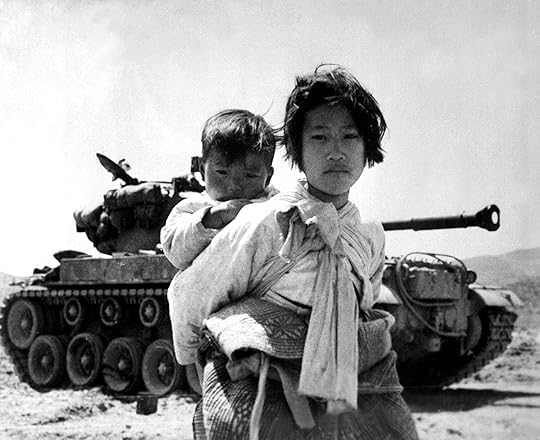
Korean War refugees, June 9, 1951
But war is a stern teacher; in depriving them of the power of easily satisfying their daily wants, it brings most people's minds down to the level of their actual circumstances.
So revolutions broke out in city after city, and in places where the revolutions occurred late the knowledge of what had happened previously in other places caused still new extravagances of revolutionary zeal, expressed by an elaboration in the methods of seizing power and by unheard-of atrocities in revenge. To fit in with the change of events, words, too, had to change their usual meanings. What used to be described as a thoughtless act of aggression was now regarded as the courage one would expect to find in a party membership; to think of the future and wait was merely another way of saying one was a coward; any idea of moderation was just an attempt to disguise one's unmanly character; ability to understand a question from all sides meant that one was totally unfitted for action. Fanatical enthusiasm was the mark of a real man, and to plot against an enemy behind his back was perfectly legitimate self-defence. Anyone who held violent opinions could always be trusted, and anyone who objected to them became a suspect.
- Thucydides
Warning: Some of what is to come below is not for those with weak stomachs.
At a time when "Rocketman" and "the dotard" are exchanging insults and placing their miniscule members on the table for comparison by those whose eyesight is necessarily more acute than my own, I have turned to the history of the Korean conflict for some perspective. And immediately, on the first page of Bruce Cuming's The Korean War: A History (2010) I find without surprise the following:
Forgotten, never known, abandoned: Americans sought to grab hold of this war and win it, only to see victory slip from their hands and the war sink into oblivion. A primary reason is that they never knew their enemy - and they still don't.
The Heavens wept!
As emphasized by both Cumings and Allan R. Millett in his yet unfinished massive trilogy on the Korean War - The War for Korea, 1945-1950: A House Burning (2005) and The War for Korea, 1950-1951: They Came from the North (2010) have appeared so far - the Korean conflict was primarily a civil war, and, as is unmercifully normal in civil wars, the Koreans were particularly murderous with each other. After decades of either denying or suppressing the truth, the South Koreans followed the example of the South Africans and set up a nonpunitive commission to investigate the crimes committed during the war. Nearly a decade later, it estimated that between 100,000 and 200,000 civilians, children included, were massacred - without trial - on the suspicion of Communist sympathies by South Korean police and military. The North Koreans and their sympathizers in the South were apparently slightly less profligate in their random murders of the populace, but not much less.(*) Needless to say, North Korea has had no Truth Commission to date.
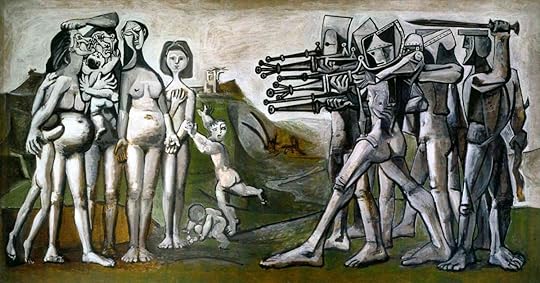
Pablo Picasso - Massacre in Korea (1951)
This was no artistic fantasy any more than the Guernica was, or, for that matter, Goya's The Third of May, 1808.
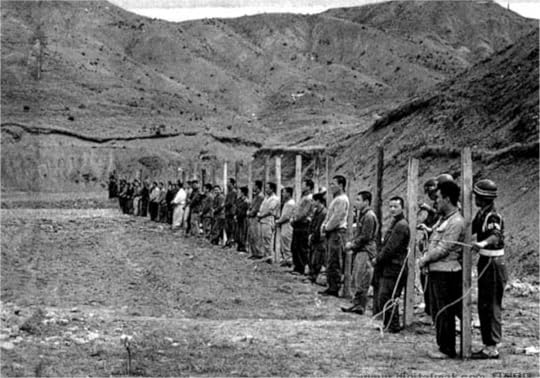
Some of the 3,400 civilians suspected of Communist sympathies executed without trial by the Republic of Korea in Pusan alone.
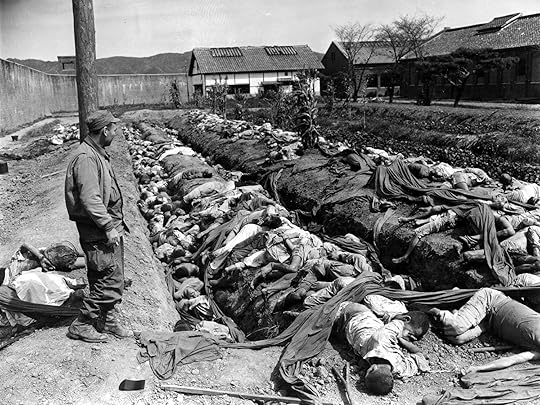
More Korean civilians bound and slain for political reasons, Taejeon, 1950 (**)
The roots of the Korean War go far deeper than the window-dressing ideological trimmings of Communism and anti-Communism. The aristocratic class in Korea had held the people in a stranglehold for centuries; at certain points in history over half of the Korean populace were, literally, slaves and the rest weren't much better off. Then the Japanese arrived and soon made Korea into a colony (from 1910 till 1945), ruthlessly capitalizing upon Korean resources and labor to set up and maintain their Asian empire. Their suppression of Korean resistance and later the very culture and language of the Korean people was equally ruthless. The Koreans came to loathe the Japanese with a passion. As usual there was a certain number of Koreans who collaborated; these people also came to be despised by their countrymen.
What I didn't know before is that most of the North Korean leadership came from the anti-Japanese armed resistance forces who fought the Japanese in China and Manchuria and much of the South Korean leadership (with the exception of Syngman Rhee himself - his name was actually Yi Sung-man) were notorious collaborators. Small wonder then that when the collaborators had themselves voted into power in the South in an election that many Koreans boycotted, a Korean had no need to caress Communist sympathies in order to find the government of the new Republic of Korea to be objectionable. But, of course, when the murdering commenced, all were painted with the same brush.
There was no simple story in Korea after its liberation from the Japanese in 1945; released from the Japanese death grip, many ideas for a new Korea were rampant in the populace. Unfortunately, those willing to commit violence for their ideas rose to power both in the northern portion, occupied by the Soviet Union, and in the southern, occupied by the USA, with the more or less active collaboration of the occupying powers. Both Cumings and Millett provide insight into the many political forces at play in Korea in the mid 1940's; really, anything I write here is necessarily an oversimplification.
Cumings takes a long view, from the late 19th century to the late 20th, and he does so with a deliberate polemical intent that is stirring but which left me with questions since some of his more important assertions were not backed up by Millett's more narrowly focused but much more intensely detailed tomes. Though not averse to directing criticism at all the parties in this conflict, Millett's yet incomplete work(***) provides a detailed look at the political and military aspects of the war without polemics.
Both the South and North Korean leadership were raring to go at each other's throats but were held back by their Russian and American masters through various kinds of threats. But then serious misapprehensions came into play. The North Korean leadership thought they didn't need the Russians (except for arms, munitions and training) - their longtime comrades-at-arms, the Chinese, would have their backs - and that the Americans wouldn't risk a nuclear war to prop up the South. The South Korean leadership thought that the Russians and Chinese wouldn't risk nuclear war and that it could handle the North Koreans easily with American help. The Americans thought the North Koreans and Chinese couldn't fight their way out of a paper bag (and that the Russians wouldn't risk nuclear war). The Chinese thought that the Americans would not be willing to sacrifice much of anything for this obscure Asian appendage. All were wrong, and millions and millions had to pay for their mistakes.
Shall we guess the misapprehensions now current among the Korean, American and Chinese leadership?
The mindset during the Peloponnesian War described so well by Thucydides in the epigraph has manifested itself repeatedly throughout Humankind's lamentable history, including in the Koreas during the late '40s. Its humors rose again in my homeland in 2001 and need but one overt act to overflow once more. The approval ratings of the glowing orange toad croaking in the White House actually edged up when he began his bluster about Korea. Nothing assures re-election like a war against a mannequin tarred and feathered by propaganda, particularly when that mannequin's own bluster has overreached into the absurd. And in Asia, face is everything. It's difficult to be sanguine about this...
(*) A particularly poignant story told by Millett: When a Communist-infiltrated regiment of the South Korean Constabulary (precursor to its army) revolted and massacred hundreds of police, officials, rightists and ordinary citizens in Yosu and Sunchon in 1948, they also killed two sons of a Korean pastor for being Christians. When the governmental troops regained control of the area, the pastor pleaded for the life of the young man who had betrayed his sons to their death, promising to raise him as his son and a Christian. In 1950 when the North Korean army came through the area, the pastor and his newly adopted son were executed by the Communists for being a propaganda embarrassment to them.
(**) This massacre was initially attributed by the South Korean government to the North (and is still so attributed on some internet sites), but, no, see here:
http://www.nbcnews.com/id/24695113/ns...
(Nonetheless, there were many such massacres by the North Koreans.) The corrupt and brutal South Korean police and their helpers generated such blazing resentment in the general populace that when a mob rioted in Taegu in late 1946 dozens of policemen were massacred with boundless brutality (but not before they killed hundreds of rioters); I quote from The War For Korea: "Policemen, youth auxiliaries and officials were found impaled through the rectum, mutilated, burned, castrated, disemboweled and buried alive."
(***) Volume two of Millett's history ends with the preparations for the Kaesong "Peace Talks"; two more years of shooting war remained at this point before it was ended temporarily with an armistice, not a peace treaty.

August 9, 2026
When North Korea invaded South Korea on June 25, 1950, it marked not the start of the Korean War but the inauguration of a new phase of it. As Millett detailed in the first volume of his trilogy about the conflict, the two countries had been engaged in a low-level “Parallel War” for two years already while also fighting local insurgencies supported by the other side. In this respect, a full-scale escalation was a natural evolution, and one that South Korea’s leader Syngman Rhee himself likely would have pursued had his patron, the United States, given him the resources necessary to do so.
Instead, it was Rhee’s counterpart, Kim Il-sung, who had been provided with the weapons and training needed to wage a campaign to unify the peninsula by conquest. By contrast, the Americans’ desire to constrain Rhee from engaging in such militarized adventurism left the forces of the Republic of Korea (ROK) poorly equipped to meet it. Lacking tanks and attack aircraft, and with anti-tank weapons incapable of penetrating the tough T-34/85 tanks the Soviet Union had supplied to the Korean People’s Army (KPA), the South Korean forces reeled before the onslaught. While Millett gives the ROK units greater credit for their resistance than was appreciated at the time, the superior firepower of the KVA proved more than they could withstand, and within hours their troops were in retreat.
News of the invasion quickly presented the United States with a challenge. As in his previous volume, Millett devotes considerable space in his book to describing the formulation of American policy towards the continent. Though President Harry Truman and his national security advisers debated how to respond, intervention was a foregone conclusion. What was at question was the extent of that intervention in light of America’s commitments in Europe and the possibility that the invasion was an elaborate effort orchestrated by Joseph Stalin to distract the United States from its commitments in Europe. As Millett observes, it was those very commitments which contributed to the decision to intervene in force, as any failure to respond adequately to aggression by a Communist nation might dissuade European countries from trusting American security guarantees.
While the Truman administration turned to the United Nations to formulate a global response, American air and naval units were the first international forces to intervene. These were soon followed by American soldiers from the occupation force in Japan, which was under the command of Douglas MacArthur. The author does not bother to hide his disdain for the pompous general, who had largely neglected his responsibilities as the head of the U.S. Far East Command in favor of his role as the military governor of Japan. Because of this, the Eighth Army under his command was poorly prepared for the fighting into which its units were now thrust. During this period, it was the ROK army which shouldered the burden of stemming the KPA’s advance, and Millett gives them considerable credit for their underappreciated efforts under such adverse conditions.
Equally underappreciated at the time were the strains experienced by the KPA forces. One of the features of Millett’s account that sets it apart from its predecessors is his efforts to recount the North Koreans’ perspective. Among the points that emerge from this effort is the degree to which their campaign was premised on a quick victory, ideally completed by the seizure of Seoul. While the South Korean capital was captured just three days into the invasion, this did not result in the collapse of the government as the North Koreans hoped. Instead, the KPA found itself in an extended pursuit of ROK forces, one made all the more debilitating by the growing presence of U.S. and British commonwealth air and naval forces in the campaign. As a result, by September the KPA found themselves at the limits of their endurance, unable to complete the conquest of the peninsula before the U.S.-led UN intervention could turn the tide.
With the KPA’s advance halted, the question became one of how to affect the reversal. Though the Eight Army’s commander, Walton Walker, wanted the reinforcements being dispatched to Korea to supplement his forces, MacArthur pursued instead the riskier strategy of a seaborne landing at Inchon. Millett demonstrates that this was no real surprise to the North Koreans, yet they simply did not have the forces available to redeploy to meet it. The invasion on September 15, coupled with the breakout of the Eighth Army and the ROK forces from the Pusan Perimeter a day later, sent the KPA in full retreat across the 38th parallel within a matter of days, with both ROK and UN forces in close pursuit.
As the combined ROK-UN forces rolled up the remaining KPA units, MacArthur predicted confidently that the U.S. troops would be home for Christmas. Millett makes it clear that such forecasts were made in spite of the mounting evidence of a Chinese intervention rather than the absence of it. Despite the evidence of troop concentrations by the Chinese People’s Volunteer Force (CPVF) in Manchuria, MacArthur’s intelligence chief, Charles Willoughby, exploited uncertainty over Chinese intentions to dismiss the possibility that they might join the war. Yet not only did Mao Zedong regard the prospect of a Korea reunified under American auspices intolerable, he saw Stalin’s desire to reverse North Korea’s failure as a useful way of leveraging from him the aid the Chinese needed to modernize their military. Overriding the reluctance of many in his military leadership, he ordered his forces to prepare for war.
While Millett does not make this point explicit, China’s intervention in November 1950 represented another dramatic evolution of the conflict. What had begun in 1948 before as a border war between the two Koreas now became a struggle mainly between China and the United States, as the two sides assumed the bulk of the fighting. Unprepared for the sudden influx of thousands of infantry, the ROK and UN forces waged a fighting withdraw back across the 38th parallel. Yet this success came at huge cost to the CPVF, who for all their numbers were unequipped to counter the U.S.’s advantages in airpower and artillery. As a result, the Americans were able to spearhead a series of offensives that by April 1951 had pushed the front lines back north across the prewar border.
Millett ends the volume in June 1951, with the start of the peace talks in Kaesong. It would be another two years before these would produce an uneasy peace, thanks in no small measure to the conflicting interests of the diverse range of actors involved. One of the great merits of Millett’s book is his success in conveying the complexities that both shaped its course and made its resolution so difficult. This he does in a well-written narrative that supports his sharp judgments with quality analysis grounded firmly in his archival research. Unlike the somewhat rote description of events in his first volume, A House Burning, the author’s emotional investment in the events he describes is obvious. Whether he sustains it in a volume focused on smaller-scale actions in a war stalemated both on the battlefield and at the negotiating table remains to be seen, but that Millett has produced the best English-language account of the most dramatic period of the Korean War is undeniable.
Instead, it was Rhee’s counterpart, Kim Il-sung, who had been provided with the weapons and training needed to wage a campaign to unify the peninsula by conquest. By contrast, the Americans’ desire to constrain Rhee from engaging in such militarized adventurism left the forces of the Republic of Korea (ROK) poorly equipped to meet it. Lacking tanks and attack aircraft, and with anti-tank weapons incapable of penetrating the tough T-34/85 tanks the Soviet Union had supplied to the Korean People’s Army (KPA), the South Korean forces reeled before the onslaught. While Millett gives the ROK units greater credit for their resistance than was appreciated at the time, the superior firepower of the KVA proved more than they could withstand, and within hours their troops were in retreat.
News of the invasion quickly presented the United States with a challenge. As in his previous volume, Millett devotes considerable space in his book to describing the formulation of American policy towards the continent. Though President Harry Truman and his national security advisers debated how to respond, intervention was a foregone conclusion. What was at question was the extent of that intervention in light of America’s commitments in Europe and the possibility that the invasion was an elaborate effort orchestrated by Joseph Stalin to distract the United States from its commitments in Europe. As Millett observes, it was those very commitments which contributed to the decision to intervene in force, as any failure to respond adequately to aggression by a Communist nation might dissuade European countries from trusting American security guarantees.
While the Truman administration turned to the United Nations to formulate a global response, American air and naval units were the first international forces to intervene. These were soon followed by American soldiers from the occupation force in Japan, which was under the command of Douglas MacArthur. The author does not bother to hide his disdain for the pompous general, who had largely neglected his responsibilities as the head of the U.S. Far East Command in favor of his role as the military governor of Japan. Because of this, the Eighth Army under his command was poorly prepared for the fighting into which its units were now thrust. During this period, it was the ROK army which shouldered the burden of stemming the KPA’s advance, and Millett gives them considerable credit for their underappreciated efforts under such adverse conditions.
Equally underappreciated at the time were the strains experienced by the KPA forces. One of the features of Millett’s account that sets it apart from its predecessors is his efforts to recount the North Koreans’ perspective. Among the points that emerge from this effort is the degree to which their campaign was premised on a quick victory, ideally completed by the seizure of Seoul. While the South Korean capital was captured just three days into the invasion, this did not result in the collapse of the government as the North Koreans hoped. Instead, the KPA found itself in an extended pursuit of ROK forces, one made all the more debilitating by the growing presence of U.S. and British commonwealth air and naval forces in the campaign. As a result, by September the KPA found themselves at the limits of their endurance, unable to complete the conquest of the peninsula before the U.S.-led UN intervention could turn the tide.
With the KPA’s advance halted, the question became one of how to affect the reversal. Though the Eight Army’s commander, Walton Walker, wanted the reinforcements being dispatched to Korea to supplement his forces, MacArthur pursued instead the riskier strategy of a seaborne landing at Inchon. Millett demonstrates that this was no real surprise to the North Koreans, yet they simply did not have the forces available to redeploy to meet it. The invasion on September 15, coupled with the breakout of the Eighth Army and the ROK forces from the Pusan Perimeter a day later, sent the KPA in full retreat across the 38th parallel within a matter of days, with both ROK and UN forces in close pursuit.
As the combined ROK-UN forces rolled up the remaining KPA units, MacArthur predicted confidently that the U.S. troops would be home for Christmas. Millett makes it clear that such forecasts were made in spite of the mounting evidence of a Chinese intervention rather than the absence of it. Despite the evidence of troop concentrations by the Chinese People’s Volunteer Force (CPVF) in Manchuria, MacArthur’s intelligence chief, Charles Willoughby, exploited uncertainty over Chinese intentions to dismiss the possibility that they might join the war. Yet not only did Mao Zedong regard the prospect of a Korea reunified under American auspices intolerable, he saw Stalin’s desire to reverse North Korea’s failure as a useful way of leveraging from him the aid the Chinese needed to modernize their military. Overriding the reluctance of many in his military leadership, he ordered his forces to prepare for war.
While Millett does not make this point explicit, China’s intervention in November 1950 represented another dramatic evolution of the conflict. What had begun in 1948 before as a border war between the two Koreas now became a struggle mainly between China and the United States, as the two sides assumed the bulk of the fighting. Unprepared for the sudden influx of thousands of infantry, the ROK and UN forces waged a fighting withdraw back across the 38th parallel. Yet this success came at huge cost to the CPVF, who for all their numbers were unequipped to counter the U.S.’s advantages in airpower and artillery. As a result, the Americans were able to spearhead a series of offensives that by April 1951 had pushed the front lines back north across the prewar border.
Millett ends the volume in June 1951, with the start of the peace talks in Kaesong. It would be another two years before these would produce an uneasy peace, thanks in no small measure to the conflicting interests of the diverse range of actors involved. One of the great merits of Millett’s book is his success in conveying the complexities that both shaped its course and made its resolution so difficult. This he does in a well-written narrative that supports his sharp judgments with quality analysis grounded firmly in his archival research. Unlike the somewhat rote description of events in his first volume, A House Burning, the author’s emotional investment in the events he describes is obvious. Whether he sustains it in a volume focused on smaller-scale actions in a war stalemated both on the battlefield and at the negotiating table remains to be seen, but that Millett has produced the best English-language account of the most dramatic period of the Korean War is undeniable.

May 27, 2012
A great, well-researched history of the first year of the war. Millett begins with the military preparations of the North Koreans and their invasion south. Millett contends that the performance of the North and South Korean armies was spotty at best, and that the brunt of the fighting was borne by the US and the Chinese as a result (hence the title) He also shows how both Mao and MacArthur tended to micromanage the war from their respective headquarters, and how the Chinese were handicapped by logistics and by the North Koreans’ refusal to form any kind of joint headquarters.
Stalin, who had backed Kim Il Sung’s invasion and provided Russian generals to revise his amateurish plans, expected a North Korean victory within weeks with no US response. Along with Stalin, Millett covers the roles of Rhee, Truman, Attlee, and Mao, as well as MacArthur, Walker, Ridgway, Almond and China’s Peng Dehuai. Interestingly, Millett contends that the quality of the North Korean forces was not always as high as previous accounts have suggested, and that the South Koreans were more competent than some allege.
Millett does a fine job covering both political and military aspects, although the former is allotted more space overall. His transition between all of these topics is smooth and deft. His style is engaging, crisp, and sometimes witty, and the quality of the analysis and attention to detail is always sharp.
A clear, sweeping history.
Stalin, who had backed Kim Il Sung’s invasion and provided Russian generals to revise his amateurish plans, expected a North Korean victory within weeks with no US response. Along with Stalin, Millett covers the roles of Rhee, Truman, Attlee, and Mao, as well as MacArthur, Walker, Ridgway, Almond and China’s Peng Dehuai. Interestingly, Millett contends that the quality of the North Korean forces was not always as high as previous accounts have suggested, and that the South Koreans were more competent than some allege.
Millett does a fine job covering both political and military aspects, although the former is allotted more space overall. His transition between all of these topics is smooth and deft. His style is engaging, crisp, and sometimes witty, and the quality of the analysis and attention to detail is always sharp.
A clear, sweeping history.

June 24, 2012
Finally, a book in English that takes all of the different sides into account, including the Koreans themselves. Millet is a wonderful writer as well. This work covers the mobile phase of the war and it is by far the best book on the Korean War that I've read. Having also read the first volume in the trilogy (A House Burning), I eagerly await the third.
September 26, 2026
The more I read about the Korean War, the less patience I have for descriptions of it as a simple morality play. Millett is useful precisely because he understands that several different wars were happening at once: a Korean struggle over the future of the peninsula, a conventional invasion, a Cold War confrontation, and eventually an international war involving powers with very different objectives.
He is particularly good on the military side. Decisions that can look obvious in hindsight become much less obvious once you see what commanders actually knew, what they misunderstood, and how quickly success could turn into catastrophic overconfidence. The North Korean invasion was real aggression, but acknowledging that does not require turning every decision made by its opponents into wisdom or virtue. Millett is generally too serious a historian for that.
I also appreciated reading this after Monica Kim. Millett gives you the armies, governments, alliances, and strategy. Kim made me think about the human beings being classified and politicized underneath those structures. The two perspectives don't always sit comfortably together, which is probably a good thing.
My reservation is that Millett is more convincing when explaining armies and states than when dealing with some of the messier civilian and political dimensions of the war. There were places where I wanted him to linger longer on South Korean agency and violence rather than moving back toward the battlefield.
Still, this is formidable history. Detailed without being mindless military chronology, skeptical without becoming cynical.
Four stars. It clarified a great deal while making the war considerably harder to fit into any tidy ideological box.
He is particularly good on the military side. Decisions that can look obvious in hindsight become much less obvious once you see what commanders actually knew, what they misunderstood, and how quickly success could turn into catastrophic overconfidence. The North Korean invasion was real aggression, but acknowledging that does not require turning every decision made by its opponents into wisdom or virtue. Millett is generally too serious a historian for that.
I also appreciated reading this after Monica Kim. Millett gives you the armies, governments, alliances, and strategy. Kim made me think about the human beings being classified and politicized underneath those structures. The two perspectives don't always sit comfortably together, which is probably a good thing.
My reservation is that Millett is more convincing when explaining armies and states than when dealing with some of the messier civilian and political dimensions of the war. There were places where I wanted him to linger longer on South Korean agency and violence rather than moving back toward the battlefield.
Still, this is formidable history. Detailed without being mindless military chronology, skeptical without becoming cynical.
Four stars. It clarified a great deal while making the war considerably harder to fit into any tidy ideological box.
March 25, 2021
Incredibly detailed to its own detriment. Almost read like the first draft of a compilation of dissertations. Would not recommend. “Longest Winter” and “This Kind of War” rule the Korean War books as they are informative while also engaging.

May 17, 2015
excellent book! A fine blend of military and political events from both sides of the conflict.
Displaying 1 - 7 of 7 reviews