

What do you think?
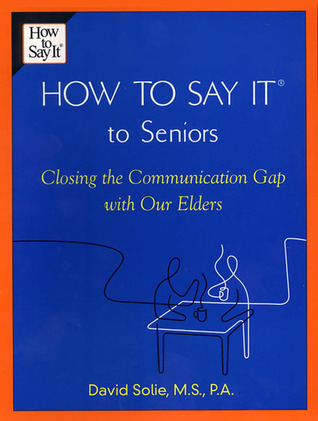
How to Say It to Seniors: Closing the Communication Gap with Our Elders
A practical guide to bridging the generation gap.
In How to Say It to Seniors , geriatric psychology expert David Solie offers help in removing the typical communication blocks many experience with the elderly. By sharing his insights into the later stages of life, Solie helps in understanding the unique perspective of seniors, and provides the tools to relate to them.
In How to Say It to Seniors , geriatric psychology expert David Solie offers help in removing the typical communication blocks many experience with the elderly. By sharing his insights into the later stages of life, Solie helps in understanding the unique perspective of seniors, and provides the tools to relate to them.
202 pages, Paperback
First published September 7, 2004
Ratings & Reviews
Friends & Following
Create a free account to discover what your friends think of this book!
Community Reviews
Displaying 1 - 30 of 32 reviews

February 17, 2020
This book taught me that young and middle-aged adults are different from older adults in terms of what drives them. Younger people are developmentally focused. We want to accomplish things. We value productivity and decisiveness.
Older adults, however, have generally entered a different phase. They are more focused on life review. They are looking back and determining what the events of their life have meant.
Another key driver for older adults is control. They want to be able to continue controlling their own life and managing their own affairs. After all, they've been doing it their whole life, so why should they feel unfit now? Other factors affecting seniors are that their bodies are beginning to fail them. They're cohorts are beginning to pass away. So just as they're experiencing grief and physical setbacks, they are also faced with making tough decisions in their life about what to do with their assets, where to live, etc.
These differences affect how younger adults can and should communicate with older adults. Getting angry at seniors because they can't make a quick decision isn't helpful. Seniors need time to process their options. They also need the space to feel they are making their own decisions and controlling their own fate. Presenting them with ultimatums or trying to browbeat them with logic is not effective. "The doctors says take the pills so you have to take the pills!" is not usually going to work.
One technique the author puts forward is basically giving seniors time to make decisions. They may not like the prospect of not driving their car any more, but given enough time to think it through for themselves, they may come to that same conclusion on their own without pressuring them.
Another communication technique is to help encourage life review, since that's the phase they're already in. It's a chance for the younger person to learn what the older person values. We may have heard the same story a dozen times, but we have to listen to what values the senior is conveying through the story. Hard work. Love of family. You have to listen to what the story is really about. Let the older person repeat the story without cutting them off or getting frustrated. Maybe ask them some open-ended questions to learn even more.
When seniors feel the younger people are open to hearing this information, they are better able conduct life review. They are more open to making decisions once they've voiced this history.
I found this to be an informative book. It's not the most cleanly written book and would have benefitted from better organization. Also, the last tenth of the book is targeted toward professionals (wealth managers, estate planners, et al) who work with older clients, so this wasn't all for a general audience.
Older adults, however, have generally entered a different phase. They are more focused on life review. They are looking back and determining what the events of their life have meant.
Another key driver for older adults is control. They want to be able to continue controlling their own life and managing their own affairs. After all, they've been doing it their whole life, so why should they feel unfit now? Other factors affecting seniors are that their bodies are beginning to fail them. They're cohorts are beginning to pass away. So just as they're experiencing grief and physical setbacks, they are also faced with making tough decisions in their life about what to do with their assets, where to live, etc.
These differences affect how younger adults can and should communicate with older adults. Getting angry at seniors because they can't make a quick decision isn't helpful. Seniors need time to process their options. They also need the space to feel they are making their own decisions and controlling their own fate. Presenting them with ultimatums or trying to browbeat them with logic is not effective. "The doctors says take the pills so you have to take the pills!" is not usually going to work.
One technique the author puts forward is basically giving seniors time to make decisions. They may not like the prospect of not driving their car any more, but given enough time to think it through for themselves, they may come to that same conclusion on their own without pressuring them.
Another communication technique is to help encourage life review, since that's the phase they're already in. It's a chance for the younger person to learn what the older person values. We may have heard the same story a dozen times, but we have to listen to what values the senior is conveying through the story. Hard work. Love of family. You have to listen to what the story is really about. Let the older person repeat the story without cutting them off or getting frustrated. Maybe ask them some open-ended questions to learn even more.
When seniors feel the younger people are open to hearing this information, they are better able conduct life review. They are more open to making decisions once they've voiced this history.
I found this to be an informative book. It's not the most cleanly written book and would have benefitted from better organization. Also, the last tenth of the book is targeted toward professionals (wealth managers, estate planners, et al) who work with older clients, so this wasn't all for a general audience.

Read
August 17, 2013I bought this book for many reasons: 1) I have octogenarian parents with whom I often need to close a communication gap. 2) I am a professional financial planner and am looking for better ways to connect with our senior clients. 3) I am interested in mitigating / eliminating my own "predictable dilemmas" that Solie describes so well. It helped on all three fronts. It drew me back into my study of Erikson, Piaget, Kohlberg, and James Fowler's work on Faith Development as well as The Fourth Turning. We are all on a journey; to think it ends at retirement is a serious mistake.

May 4, 2022
Review originally published February 2005
When I was growing up, it was still common for children to have nearby grandparents and other close relatives, sometimes living in the same household. We were taught to be respectful of our elders and to be extra patient with grandma and grandpa even if they told the same stories over and over.
But even with a strong foundation of empathy and compassion, communication with the elderly can be extremely frustrating. Ask any loving but busy middle age son or daughter who wants grandma to move into assisted living “for her own good.” Grandmas may agree to it one day and the next day insist that she’s doing just fine where she is. Adult children then complain that, “Mom just doesn’t get it. She gets hung up on details or changes the subject.”
It is critical to understand that repetition, not sticking to the subject, seeming inability to make a decision, and fretting out what younger people may consider unimportant stuff are not necessarily signs of dementia. How to Say it to Seniors: Closing the Communication Gap with Our Elders by David Solie discusses these issues in a way that will help younger people understand the predictable dilemmas of aging: Where will I live? How can I manage my health? How will I cope all by myself? What should I do about money?
These concerns affect how seniors communicate. How to Say it to Seniors presents communication strategies for well-intentioned and often well-educated adults who may answer a question before it's been asked or solve a problem before the older person even mentions it. The person we’re talking with isn’t halfway through their explanation and we’re already cross-examining or firing off solutions.
We have nearly infinite patience for a two-year-old's communication challenges–sometimes in the form of a tantrum–and almost no patience with a seventy-nine year old widow when she quietly changes her mind about a well-conceived plan to revise her financial statements.
After all, we need to load up the fax machine, whip out that Palm Pilot, make endless lists, and cross off as many items as possible every single day. That makes us feel powerful and in control. When we encounter older adults, who move at a snail’s pace, we get frustrated and blame them for their supposed infirmities.
Other books on aging may focus on how to stay perky despite aging, the grim life of loneliness and boredom that awaits the aged, or on how to manage the unmanageable older adult. This wonderful book offers concrete strategies for relating to the elderly and making conversations with them more meaningful. You may find new ways to think about the elderly and what may drive their difficult behavior, fussiness, attention to detail, or the repetitive nature of conversations.
There is much useful information in this book, but my personal favorite bit of wisdom comes from the author’s discussion of seniors "settling rituals." These rituals often involve getting physically comfortable in their chairs (a longer process for them than for us), and engaging in casual discussions before revealing what’s really on their minds or before they’re comfortable enough to hear what we have to say.
All of us are either old, going to be old, or know someone old. So, I make an unqualified recommendation of this book to everyone. George Santayana’s quote in this book is a gem:
Find this book and other titles within our catalog.
When I was growing up, it was still common for children to have nearby grandparents and other close relatives, sometimes living in the same household. We were taught to be respectful of our elders and to be extra patient with grandma and grandpa even if they told the same stories over and over.
But even with a strong foundation of empathy and compassion, communication with the elderly can be extremely frustrating. Ask any loving but busy middle age son or daughter who wants grandma to move into assisted living “for her own good.” Grandmas may agree to it one day and the next day insist that she’s doing just fine where she is. Adult children then complain that, “Mom just doesn’t get it. She gets hung up on details or changes the subject.”
It is critical to understand that repetition, not sticking to the subject, seeming inability to make a decision, and fretting out what younger people may consider unimportant stuff are not necessarily signs of dementia. How to Say it to Seniors: Closing the Communication Gap with Our Elders by David Solie discusses these issues in a way that will help younger people understand the predictable dilemmas of aging: Where will I live? How can I manage my health? How will I cope all by myself? What should I do about money?
These concerns affect how seniors communicate. How to Say it to Seniors presents communication strategies for well-intentioned and often well-educated adults who may answer a question before it's been asked or solve a problem before the older person even mentions it. The person we’re talking with isn’t halfway through their explanation and we’re already cross-examining or firing off solutions.
We have nearly infinite patience for a two-year-old's communication challenges–sometimes in the form of a tantrum–and almost no patience with a seventy-nine year old widow when she quietly changes her mind about a well-conceived plan to revise her financial statements.
After all, we need to load up the fax machine, whip out that Palm Pilot, make endless lists, and cross off as many items as possible every single day. That makes us feel powerful and in control. When we encounter older adults, who move at a snail’s pace, we get frustrated and blame them for their supposed infirmities.
Other books on aging may focus on how to stay perky despite aging, the grim life of loneliness and boredom that awaits the aged, or on how to manage the unmanageable older adult. This wonderful book offers concrete strategies for relating to the elderly and making conversations with them more meaningful. You may find new ways to think about the elderly and what may drive their difficult behavior, fussiness, attention to detail, or the repetitive nature of conversations.
There is much useful information in this book, but my personal favorite bit of wisdom comes from the author’s discussion of seniors "settling rituals." These rituals often involve getting physically comfortable in their chairs (a longer process for them than for us), and engaging in casual discussions before revealing what’s really on their minds or before they’re comfortable enough to hear what we have to say.
All of us are either old, going to be old, or know someone old. So, I make an unqualified recommendation of this book to everyone. George Santayana’s quote in this book is a gem:
“Before you contradict an old man, my fair friend, you should endeavor to understand him.”
Find this book and other titles within our catalog.

November 29, 2018
so far, not liking this book much. How can someone with such poor relationships with his grandparents and parents write a book about how to communicate with seniors. Very shallow. No sources or references mentioned - I'm sure these are not all his original ideas.
I completed reading this in the hope that I would learn something new. That did not happen. Basically, this book is about therapeutic communication renamed and marketed as legacy planning written by a physician assistant with no knowledge of what is taught as basic therapeutic communication in any nursing program.
I completed reading this in the hope that I would learn something new. That did not happen. Basically, this book is about therapeutic communication renamed and marketed as legacy planning written by a physician assistant with no knowledge of what is taught as basic therapeutic communication in any nursing program.

May 28, 2015
I think this book offers something really valuable: a way to have greater compassion and understanding of people in the latter stage of life. He talks about the developmental agenda of performing a life review and creating a legacy and how we in middle age can act as legacy coaches to facilitate this process. He urges the reader over and over to have patience with the elder's time and communication needs and explains why it's worth doing.

July 26, 2024
Solie’s advice is predicated on psychological theories which he presents as fact and discusses at length. Still, the practical advice offered in the second half of the book is quite helpful — both for readers who want better conflict resolution tools, and those who simply wish to foster more meaningful conversation. I came away with a deeper appreciation for the many small ways people feel a loss of control as they age (and techniques to avoid unintentionally triggering this feeling) as well as some new ideas for open-ended questions during visits.

April 15, 2014
4/23/14
Excellent book for working with elderly clients. Loved the discussion of major themes: give seniors control and look for legacy defining opportunities. I started reading this text last week and am already incorporating the ideas. Good stuff! I will be recommending it to my colleagues in home health care.
Excellent book for working with elderly clients. Loved the discussion of major themes: give seniors control and look for legacy defining opportunities. I started reading this text last week and am already incorporating the ideas. Good stuff! I will be recommending it to my colleagues in home health care.

December 23, 2025
This book is aimed at the person I was twenty years ago, when it came out: a mature adult, in the productivity-oriented part of my life, with parents in their 70's.
It also has valuable lessons for the person I am now, in my late 60's, both parents gone, thinking about the next chapter of my life (which means looking back at the story of my life so far).
Plus, it also addresses a third audience: professionals--mostly medical or financial--working with seniors. This multiple focus makes the book rich with insights but also a bit scattered.
Top-level summary:
Just like childhood and adolescence, old age is a developmental stage with its own challenges. Some of those challenges are conflicting.
• The need to assert and maintain control when our own capacities are diminishing and younger people are trying to step in and make decisions for us.
• The desire to do a life review and make meaning out of our whole life story.
If we can be sure the first need is being met, we are freed up to take on the second challenge.
The main implication:
When older people resist being directed, when we repeat stories that are meaningful to us and seem to more productivity-oriented people to wander off the topic, it’s not senility—or not necessarily! 😊 What we're doing is working on the primary challenge of old age, which is to make meaning of our whole lives (and not just this moment or the next).
As the author says, "When we start to realize that we're not going to be here forever, we become aware that it's not clear what it meant to be here at all." So, if we can get enough sense of control over our own circumstances, physical and financial, then we are liberated to do the real task of old age, looking back to pass on a legacy.
Contents
The early chapters lay out the framework, drawing on Erik Erikson but using non-technical language and a lot of stories. The later chapters go into details about some of the communications barriers that arise between adults and their elders.
(Some of those barriers are due to a luck of understanding about why the elders talk the way they do--less hurried, more nonlinear, with repetition--and why that IS "getting to the point" when the point is to define a life's legacy. Some of them are due to a lack of awareness that the stage we are in when we are in midlife is not the norm, but just that, a stage, like childhood or our senior years.)
The last section of the book give practical advice on how to initiate conversations, or listen for clues (or watch for nonverbal signals) as to what the elder person might want to talk about. The questions on pp.165-166 are key. I may even start using them for writing my own personal reflections!
-----------------------------
A fellow nonprofit fundraiser is the one who recommended this book to me, and here are some lessons I draw from it about asking seniors for legacy gifts.
It also has valuable lessons for the person I am now, in my late 60's, both parents gone, thinking about the next chapter of my life (which means looking back at the story of my life so far).
Plus, it also addresses a third audience: professionals--mostly medical or financial--working with seniors. This multiple focus makes the book rich with insights but also a bit scattered.
Top-level summary:
Just like childhood and adolescence, old age is a developmental stage with its own challenges. Some of those challenges are conflicting.
• The need to assert and maintain control when our own capacities are diminishing and younger people are trying to step in and make decisions for us.
• The desire to do a life review and make meaning out of our whole life story.
If we can be sure the first need is being met, we are freed up to take on the second challenge.
The main implication:
When older people resist being directed, when we repeat stories that are meaningful to us and seem to more productivity-oriented people to wander off the topic, it’s not senility—or not necessarily! 😊 What we're doing is working on the primary challenge of old age, which is to make meaning of our whole lives (and not just this moment or the next).
As the author says, "When we start to realize that we're not going to be here forever, we become aware that it's not clear what it meant to be here at all." So, if we can get enough sense of control over our own circumstances, physical and financial, then we are liberated to do the real task of old age, looking back to pass on a legacy.
Contents
The early chapters lay out the framework, drawing on Erik Erikson but using non-technical language and a lot of stories. The later chapters go into details about some of the communications barriers that arise between adults and their elders.
(Some of those barriers are due to a luck of understanding about why the elders talk the way they do--less hurried, more nonlinear, with repetition--and why that IS "getting to the point" when the point is to define a life's legacy. Some of them are due to a lack of awareness that the stage we are in when we are in midlife is not the norm, but just that, a stage, like childhood or our senior years.)
The last section of the book give practical advice on how to initiate conversations, or listen for clues (or watch for nonverbal signals) as to what the elder person might want to talk about. The questions on pp.165-166 are key. I may even start using them for writing my own personal reflections!
-----------------------------
A fellow nonprofit fundraiser is the one who recommended this book to me, and here are some lessons I draw from it about asking seniors for legacy gifts.
1. We may have to do a lot of listening before we get to the ask. Sample questions (if we haven’t had these conversations with the prospect earlier): “How did you come to this organization? What are some of your most vivid memories of being here? How would you say it’s been important in your life?”
2. We need to put the prospective donor’s desires ahead of our own. (We may want to reach a certain number of legacy donors by a certain date, but that is not important to the donors! They want to take time and make decisions that reflect who they are.)
[Note: Both of these first two points are less likely if we’ve already have extensive conversations and/or if the prospect is not interested in getting personal with us, but we may not know what they want ahead of time.]
3. We will probably do better if we take the emphasis away from “the organization needs the money” and put it on “This is a great chance for people like you and me to keep on making a difference at this organization/ for the people this organization serves for many years to come.”

September 27, 2019
How to Say it to Seniors: Closing the Communication Gap with Our Elders by David Solie is one of the required reading books on the Institute for Challenging Disorganization's list for its Level II Aging Specialist Certificate.
Mr. Solie teaches us how to finetune our conversational style to match the unique, long-term perspective of Seniors. People approaching the ends of their lives are not usually concerned with the day-to-day: they are reviewing their accomplishments, their relationships and their place in the world to summarize those fundamental aspects of their humanity. A successful interaction with an older person often hinges on a younger person's ability to slow down in the dialogue. Be curious about an older person's experiences, and carefully open to the idea that there is deep meaning in a story or an off-hand remark.
In addition, Mr. Solie emphasizes the critical emotional perspective of an Elder. They are experiencing increasing indignities - poorer vision, hearing, balance, strength. They are entitled to respectful accommodations. A slower, quieter discussion serves that purpose.
But after reading this book, I found myself determined to use its techniques with anyone - the reminder that we each have an irreplaceable point of view to share was valuable.
Lauren Williams, Certified Professional Organizer(R), Owner, Casual Uncluttering LLC, Woodinville, WA USA
Mr. Solie teaches us how to finetune our conversational style to match the unique, long-term perspective of Seniors. People approaching the ends of their lives are not usually concerned with the day-to-day: they are reviewing their accomplishments, their relationships and their place in the world to summarize those fundamental aspects of their humanity. A successful interaction with an older person often hinges on a younger person's ability to slow down in the dialogue. Be curious about an older person's experiences, and carefully open to the idea that there is deep meaning in a story or an off-hand remark.
In addition, Mr. Solie emphasizes the critical emotional perspective of an Elder. They are experiencing increasing indignities - poorer vision, hearing, balance, strength. They are entitled to respectful accommodations. A slower, quieter discussion serves that purpose.
But after reading this book, I found myself determined to use its techniques with anyone - the reminder that we each have an irreplaceable point of view to share was valuable.
Lauren Williams, Certified Professional Organizer(R), Owner, Casual Uncluttering LLC, Woodinville, WA USA

June 5, 2024
A mentor suggested this book, and I'm so glad I picked it up. Honestly, the premise is simple - but not easy - to be sure: treat people with respect, empathy and strive for connection.
The author spends significant time talking about the need for a legacy coach as our elders move toward a new phase of life where they are mining their memories, synthesizing the lessons, and calculating their legacy. This requires time, a slower pace (and patience) and attention. The themes are all things I've been convicted of in my regular life: seeing and being present for neighbors, kids, friends and strangers. I truly believe that we must choose slower than our world demands of us in order to see people and love them well. This is no different for the seniors in our life.
I found many parallels with the author's message to parenting preteens and teens. My daughter (13) asked me if she could read the book and I think it's a fabulous idea - learning how to connect and communicate with others well is an important skill and I think the messages in the book can be broadly applied.
The sample convos, and practical examples (what to do when a senior adult won't comply with the treatment plan of their doctor, etc) were really helpful.
I made notes and will keep it handy as I prepare for a new stage of aging parents. A quick and worthwhile read.
The author spends significant time talking about the need for a legacy coach as our elders move toward a new phase of life where they are mining their memories, synthesizing the lessons, and calculating their legacy. This requires time, a slower pace (and patience) and attention. The themes are all things I've been convicted of in my regular life: seeing and being present for neighbors, kids, friends and strangers. I truly believe that we must choose slower than our world demands of us in order to see people and love them well. This is no different for the seniors in our life.
I found many parallels with the author's message to parenting preteens and teens. My daughter (13) asked me if she could read the book and I think it's a fabulous idea - learning how to connect and communicate with others well is an important skill and I think the messages in the book can be broadly applied.
The sample convos, and practical examples (what to do when a senior adult won't comply with the treatment plan of their doctor, etc) were really helpful.
I made notes and will keep it handy as I prepare for a new stage of aging parents. A quick and worthwhile read.

November 8, 2017
Geriatric psychologist Solie does an excellent job of debunking the myth that our elders are merely older versions of ourselves. Seniors are undergoing a developmental transition akin to adolescence; practical, effective communication methods are presented to help minimize generational conflict. This, in turn, paves the way for the important work of advocating for (instead of marginalizing) elders, who face a daily struggle for control. Though an age group isn’t numerically defined (it’s more a life stage), this makes an important contribution to our cultural understanding of “seniors” and is highly recommended lay and professional readers.
Find reviews of books for men at Books for Dudes, Books for Dudes, the online reader's advisory column for men from Library Journal. Copyright Library Journal.
Find reviews of books for men at Books for Dudes, Books for Dudes, the online reader's advisory column for men from Library Journal. Copyright Library Journal.
February 19, 2020
A really eye-opening look at the developmental needs that drive the behavior of elder generations. Although much is broadly applicable, the focus is really on communicating with the Greatest and Silent Generations, so hopefully there is an update planned for Boomers. Only complaint is that it’s frequently redundant (resulting in the book probably being 20-30% longer than necessary).

December 22, 2021
As a former PA (Physican Assistant) who now works as a professional organizer and has parents in their 80’s, I found this book helpful on so many levels. I feel so much more equipped to help both family members and clients navigate the challenges of maintaining control and creating a legacy. What a tremendous resource!
July 23, 2025
focused on communication of hidden feelings, rather than communicating about day to day issues, seemed to be mostly geared for professionals and caregivers, maybe a little for kids who can’t get their parents to share anything meaningful such as family history. “How to get seniors to open up” would be a good alternate title — not what I’m looking for alas…
October 5, 2025
I would have given this book 5 stars if the editor had helped the author prune out the many repetitions.
If you need advice on how to communicate respectfully and proactively with your elders, you should read this book.
However you may find you skip over some sections that repeat what you've already read/heard.
If you need advice on how to communicate respectfully and proactively with your elders, you should read this book.
However you may find you skip over some sections that repeat what you've already read/heard.
June 1, 2019
Important! Need to value what our seniors have to tell us!!
June 23, 2019
Helpful insights for starting a conversation with those in our lives who might be reviewing their lives but I didn’t understand the organization at times.
November 15, 2024
Part of a family reading project. I only read half of it as I found it repetitive. So did my brother.
June 8, 2023
An interesting title concerning communication tools for improving understanding between generations, Solie presents some useful tidbits. However, some pieces of information are outdated as they reference generations that have now progressed to their own 'senior' realm as the younger generation. In addition, I found some of the advice somewhat condescending and ingratiating. There is still plenty to learn here with a discerning eye and empathy firmly in place.
February 18, 2017
If you work with seniors or have older family members, this book will put some remarkable tools in your hands. Here are my top 5 insights that I came away with: 1) the developmental tasks for seniors are to maintain CONTROL and discover their LEGACY; 2) listening to the repeated stories can allow them to discover the underlying meaning and value and discover the legacy; 3) allowing time for settling routines and warm-up answers facilitates discussions; 4) a list of action verbs that places control in the hands of my clients (and family); and 5) “unique but not new” allows me to acknowledge the individual situation and offer assurance that it’s normal.
September 6, 2016
I read a book called "How to Say it to Seniors, Closing the Communication Gap with Our Elders," by David Solie. That book gave me a lot of insights about how to listen and ask questions. It also helped me understand a lot of things I might otherwise have dismissed. I recommend it.
In the last year or two before she died, I started asking my mom about her life. She told me about her dad stealing a chicken and then inviting the farmer over for dinner. She told me about how somebody let them live in an old house, but there was no heat and the winter wind blowing through the walls and making the linoleum wave. She told me about her mother being sick when she was a very little girl and she was sent to a neighboring farm because they had a phone where she could ask them to call a doctor. She had to cross a field where there was a bull and she was scared to death of the bull but had to go anyway. These aren't necessarily the kinds of stories people just tell out of the blue, but if you ask some specific questions and don't shy away from the hard issues, and say things like "what was that like?" you can hear some remarkable things.
In the last year or two before she died, I started asking my mom about her life. She told me about her dad stealing a chicken and then inviting the farmer over for dinner. She told me about how somebody let them live in an old house, but there was no heat and the winter wind blowing through the walls and making the linoleum wave. She told me about her mother being sick when she was a very little girl and she was sent to a neighboring farm because they had a phone where she could ask them to call a doctor. She had to cross a field where there was a bull and she was scared to death of the bull but had to go anyway. These aren't necessarily the kinds of stories people just tell out of the blue, but if you ask some specific questions and don't shy away from the hard issues, and say things like "what was that like?" you can hear some remarkable things.
March 8, 2008
I got this so I could try to be less Senior to my own children. I don't want to be a Problem as I age, and would like to know how not to be.
If you are dealing with ageing parents who haven't made the leap to the modern world then this book along with Another Country by Mary Pipher will help you understand where they are coming from and perhaps help you deal with them without getting your buttons pushed.
Mr. Solie does refer to Mary Pipher in his book,which was a pleasant surprise!
If you are dealing with ageing parents who haven't made the leap to the modern world then this book along with Another Country by Mary Pipher will help you understand where they are coming from and perhaps help you deal with them without getting your buttons pushed.
Mr. Solie does refer to Mary Pipher in his book,which was a pleasant surprise!
October 6, 2011
Learn how to listen for openings and ask the right questions. The developmental stage at 70 is to define one's legacy and retain some sense of control while losing control in many areas of their lives. We should help them process their effort to make sense of the events in t heir lives and what has meaning, defines them and helps them shape how they want to be remembered. Decisions can be made if they are not rushed and have some choices in those decisions.
April 27, 2013
Anyone who is close to a senior citizen whether it be a parent, grandparent, or friend should read this book. It has many eye opening observations that will improve anyone's relationship with a senior. If you are someone struggling to communicate with a senior than this is a must read.
February 4, 2016
Hugely practical and important reading for anyone finding themselves frustrated by communications with the elders in their lives. I will definitely try the "legacy coach" techniques with my mother and see how it goes!
Read
May 7, 2009good points but very repetitive

September 1, 2010
Very helpful book on how to talk to my elderly, declining father-in-law.
September 21, 2013
This had a lot of good ideas but was repetitive. I'm glad I read it though.

Want to Read
March 29, 2015Recommended by Pat Pier

May 27, 2015
Interesting approach to dismiss actual memory loss diagnoses. Regardless, some helpful re-framing to address stubborn refusal.
Displaying 1 - 30 of 32 reviews