

What do you think?

The Essential René Guénon: Metaphysical Principles, Traditional Doctrines, and the Crisis of Modernity
A prolific writer and author of over 24 books, Rene Guenon was the founder of the Perennialist/Traditionalist school of comparative religious thought. Known for his discourses on the intellectual and spiritual bankruptcy of the modern world, symbolism, tradition, and the inner or spiritual dimension of religion, this book is a compilation of his most important writings. A key component of his thought was the assertion that universal truths manifest themselves in various forms in the world's religions and his writings on Hinduism, Taoism, and Sufism are particularly illuminating in this regard.
328 pages, Paperback
First published January 1, 2009
About the author
René Guénon
361 books839 followersRené Guénon (1886-1951) was a French author and intellectual who remains an influential figure in the domain of sacred science,traditional studies, symbolism and initiation.
French biography : http://arlesquint.free.fr/rene%20guen...
http://www.index-rene-guenon.org/
French biography : http://arlesquint.free.fr/rene%20guen...
http://www.index-rene-guenon.org/
Ratings & Reviews
Friends & Following
Create a free account to discover what your friends think of this book!
Community Reviews
Displaying 1 - 10 of 10 reviews

April 6, 2012
This book is a compilation of Guenon’s outlook on life and a fine introduction to the “traditionalist” school of religions. (It is probably best to speak of “metaphysics” instead of “religions,” since on Guenon’s gloss religion functions differently in the East than in the West.) Guenon begins with a searing critique of modernity. While not always explicitly stated, he attacks the modern world for embracing nominalism and reducing all reality to simple cause-and-effect. While such critiques are now quite common, one can only imagine the shock waves they caused in the 1920s. Unfortunately, this is probably the weakest section of the book because the chapters are simply snippets of individual chapters found elsewhere in Guenon’s corpus. As a result the reader often feels that the “force” of the argument is missing.
The next section explicates the Hindu worldview as a case-study and alternative to Western rationalism. Upon Guenon’s reading of Hinduism, the reader gets the impression that Hinduism is not simply the worship of 700 various deities, but rather a complicated system of Being, unity, and a poetic expression of various philosophical forces. Much of this section will be lost on the average reader—and it was certainly was lost on me—but there is still much that is valuable and fruitful for the reader. Guenon suggests that metaphysics is the foundation of traditional civilizations (77-78), metaphysics being defined as “beyond nature,” or the “supernatural” (80).
Guenon ends his book with an extended discussion on tradition. What is interesting is that Guenon was largely unfamiliar with Eastern Orthodox Christianity, yet he explicates a traditional outlook that seems largely drawn from Orthodox textbooks. About the structure of tradition in a community he notes, “a unity of a traditional order purely and exclusively and has no need to depend upon any more or less exterior forms of organization or upon the support of any authority other than that of the doctrine itself (136). Guenon is not advocating anarchy, as will be seen below, but pointing out that tradition’s essence does not depend upon the regulating function of an outside authority figure, such as a Pope.i (One could respond that the Holy Spirit is the principle of unity for Orthodox Christians and that would be true, but God’s actions in history are never un-interpreted and to leave it at that would beg the question. However, we may say that we identify the Holy Spirit’s actions by the transmission of that tradition in the community.)
While tradition does not need an external and legalistic authority figure to give it life, it must be noted that traditional societies are often hierarchical societies (Guenon, 151). Thus, we have priests and bishops. To note: these do not function in the role of top-down, external authorities, but as organic expressions of the traditional community (bearing in mind that tradition, on both Guenon’s gloss and the Orthodox Church’s gloss, is divinely inspired). This line of thought becomes particularly interesting when applied to the political order. Guenon, referencing his book Spiritual Authority and Temporal Power (2001), notes that kings were best seen as guardians and regulators of the tradition as it manifested itself in the social order (153). The parallels to Orthodox kings and emperors should not be overlooked: while charges of Caesaropapism abound (and have been ably rebutted by Fr John Meyendorffii), the king was not primarily responsible for the internal life of the church, though abuses did happen. Rather, he was to protect the tradition from outside invaders and threats. Guenon even suggests a connection between the “regulation” of tradition and the Latin word “rex.” (Perhaps this is why it is so difficult for democratic societies to maintain a coherent tradition, particularly in modern America. Each new democratically-elected administration is often a negation of the previous administration. This cannot be healthy for society.)
“But,” someone may object, “can you show me the divinely-inspired tradition at is point of inception?” The common-sense answer to the question, Guenon avers, is “no.” Authentic traditions are very old and usually predate writing, or at least writing on a level where the material would survive the ravages of time.iii This does not mean that intelligent questions can never be asked of the tradition. One can legitimately, and reverently, ask the tradition, “Are later manifestations of the tradition deviations or do they faithfully embody the character of the tradition?” Or, “Do we see clear negations of earlier expressions, or do we see a general continuity throughout the ages, allowing only for linguistic, cultural, and regional differences” (unity-in-diversity)?
The book ends with a section on initiation, or “entering into the tradition.” One enters the tradition by rituals seen as symbolic actions. The tradition’s rites are efficacious because the “symbol-rite” produces in the initiate the power of the reality which it symbolizes” (Guenon, 226ff.). One should note, however, that this should not be seen as “magic” or “fetishism.” Magic, as Guenon suggests, is the manipulation of dead matter, whereas the “rite” conveys spiritual realities through (very) material means.
Such begins the initiation into tradition, and Guenon approaches something very close to apostolic succession. He writes about an initiatic “chain” involved that transmits the spiritual realities in the physical community (255). Further, while books and texts are important, they can never substitute for this “initiatic chain.” This protects the adept from occultic visions and private interpretations.iv Further, the intiatic chain can never be reduced to mere writing, for writing is always subjected to various interpretations. It is true, one may object, that tradition can be misinterpreted. Perhaps, but it is not misinterpreted in the same way. Traditions, particularly those of an initiatic nature, are embodied in communities which are often spread out over a geographical area, allowing the practitioners of the tradition to note what may be legitimate or illegitimate differences and practices in the locations. Further, the rites of tradition are not subject to “deconstructionism” the way a text in the tradition might be. Finally, since traditions are communal in nature, it is never a matter of “one’s private interpretation.” One may certainly have private interpretations of a various text, but that means nothing vis-à-vis the everyday practices of the tradition.
The next section explicates the Hindu worldview as a case-study and alternative to Western rationalism. Upon Guenon’s reading of Hinduism, the reader gets the impression that Hinduism is not simply the worship of 700 various deities, but rather a complicated system of Being, unity, and a poetic expression of various philosophical forces. Much of this section will be lost on the average reader—and it was certainly was lost on me—but there is still much that is valuable and fruitful for the reader. Guenon suggests that metaphysics is the foundation of traditional civilizations (77-78), metaphysics being defined as “beyond nature,” or the “supernatural” (80).
Guenon ends his book with an extended discussion on tradition. What is interesting is that Guenon was largely unfamiliar with Eastern Orthodox Christianity, yet he explicates a traditional outlook that seems largely drawn from Orthodox textbooks. About the structure of tradition in a community he notes, “a unity of a traditional order purely and exclusively and has no need to depend upon any more or less exterior forms of organization or upon the support of any authority other than that of the doctrine itself (136). Guenon is not advocating anarchy, as will be seen below, but pointing out that tradition’s essence does not depend upon the regulating function of an outside authority figure, such as a Pope.i (One could respond that the Holy Spirit is the principle of unity for Orthodox Christians and that would be true, but God’s actions in history are never un-interpreted and to leave it at that would beg the question. However, we may say that we identify the Holy Spirit’s actions by the transmission of that tradition in the community.)
While tradition does not need an external and legalistic authority figure to give it life, it must be noted that traditional societies are often hierarchical societies (Guenon, 151). Thus, we have priests and bishops. To note: these do not function in the role of top-down, external authorities, but as organic expressions of the traditional community (bearing in mind that tradition, on both Guenon’s gloss and the Orthodox Church’s gloss, is divinely inspired). This line of thought becomes particularly interesting when applied to the political order. Guenon, referencing his book Spiritual Authority and Temporal Power (2001), notes that kings were best seen as guardians and regulators of the tradition as it manifested itself in the social order (153). The parallels to Orthodox kings and emperors should not be overlooked: while charges of Caesaropapism abound (and have been ably rebutted by Fr John Meyendorffii), the king was not primarily responsible for the internal life of the church, though abuses did happen. Rather, he was to protect the tradition from outside invaders and threats. Guenon even suggests a connection between the “regulation” of tradition and the Latin word “rex.” (Perhaps this is why it is so difficult for democratic societies to maintain a coherent tradition, particularly in modern America. Each new democratically-elected administration is often a negation of the previous administration. This cannot be healthy for society.)
“But,” someone may object, “can you show me the divinely-inspired tradition at is point of inception?” The common-sense answer to the question, Guenon avers, is “no.” Authentic traditions are very old and usually predate writing, or at least writing on a level where the material would survive the ravages of time.iii This does not mean that intelligent questions can never be asked of the tradition. One can legitimately, and reverently, ask the tradition, “Are later manifestations of the tradition deviations or do they faithfully embody the character of the tradition?” Or, “Do we see clear negations of earlier expressions, or do we see a general continuity throughout the ages, allowing only for linguistic, cultural, and regional differences” (unity-in-diversity)?
The book ends with a section on initiation, or “entering into the tradition.” One enters the tradition by rituals seen as symbolic actions. The tradition’s rites are efficacious because the “symbol-rite” produces in the initiate the power of the reality which it symbolizes” (Guenon, 226ff.). One should note, however, that this should not be seen as “magic” or “fetishism.” Magic, as Guenon suggests, is the manipulation of dead matter, whereas the “rite” conveys spiritual realities through (very) material means.
Such begins the initiation into tradition, and Guenon approaches something very close to apostolic succession. He writes about an initiatic “chain” involved that transmits the spiritual realities in the physical community (255). Further, while books and texts are important, they can never substitute for this “initiatic chain.” This protects the adept from occultic visions and private interpretations.iv Further, the intiatic chain can never be reduced to mere writing, for writing is always subjected to various interpretations. It is true, one may object, that tradition can be misinterpreted. Perhaps, but it is not misinterpreted in the same way. Traditions, particularly those of an initiatic nature, are embodied in communities which are often spread out over a geographical area, allowing the practitioners of the tradition to note what may be legitimate or illegitimate differences and practices in the locations. Further, the rites of tradition are not subject to “deconstructionism” the way a text in the tradition might be. Finally, since traditions are communal in nature, it is never a matter of “one’s private interpretation.” One may certainly have private interpretations of a various text, but that means nothing vis-à-vis the everyday practices of the tradition.

November 23, 2011
This is a remarkable compilation of selections from probably the greatest traditionalist/perennialist. Anyone seriously interested in spirituality and the decline of European societies must read this.
May 19, 2022
What makes a good society and where does modernity fit in? According to Rene Guenon, a good society is "traditional", in that it proceeds directly from a doctrinal, metaphysical truth. All its institutions are oriented around this truth and help its citizens to realize it. Modernity, on the other hand, is not the height of progress, it is the apotheosis of decadence, where materialism has taken precedence over metaphysics, rationality over intuition and the secular over the spirit. Unlike the proponents of progress, the Modern world is anything but...it is the end of a long cycle of degeneration that the Hindus referred to as the Kali Yuga. The further the foundational truths of metaphysics gets obscured, the more a society slides into decay. And that is exactly what we are left with here. An anomaly in history that is developed along *purely* material lines.
Yes, we have progressed in terms of material welfare, increasing the wealth and material wellbeing of most around the world. But at what cost? The consequences have been devastating: highest depression rates in history, destruction of the family, ubiquitous nihilism and ennui. According to Guenon, we are "spiritual beings living in an anti spiritual world of our own making". We have the greatest material wealth in history but also the deepest, demoralizing spiritual poverty.
Why?
The Hindu spirituality is clearly evident in Guenon: matter, according to the Hindus, is just the magical illusion of maya. There's no "there there". There's nothing possible to grasp and no way it could fulfill the deepest longing of our heart. Thus, "the more we seek to exploit matter the more they have become its salves, dooming themselves to ever increasing agitation without rule or objective". Instead, all we're doing is mechanizing our lives and our own humanity, sinking more and more until we aim at little more than satisfying the needs inherent in the material side of his nature". To seek is to suffer, as Bodhidharma said. Well, the West is entirely oriented around this seeking as its highest good.
The only thing that seems to count in this civilization is economics. Looking at the institutions we've built and where the emphasis lies, this is transparent: schools turning children into mass produced economic machines, colleges training in "marketable skills", healthcare industry focused on profits and allopathic medicine instead of quality of life, news focused on viewers over truth. All has been subsumed to quantity and profits because a material world has nothing else to strive for. Quality cannot be measured, and thus it cannot be sold. Along these lines, "The modern west cannot tolerate that men would prefer to work less and be content to live on little...as it is only quantity that counts and everything that escapes the senses is held to be nonexsistent".
What might that something else we could strive for be? According to Guenon it is metaphysical truth & deliverance. Modern society places zero value on anything beyond the physical senses and world, but it's only those things that can provide true meaning and fulfillment. Metaphysics is knowledge par excellence of reality directly as it is. Religion as we know it today is a bastardization of this metaphysics, focusing exclusively on the exoteric, material world, not on these esoteric truths. Whereas physics describes how nature behaves, metaphysics is beyond nature and describes what it is. Metaphysics is the truth at the center of all religious traditions, which is Yoga. The "self" is nonexistent and the true Self is one with all that is -- "Thou art That". Seated within the "cave of our hearts" is a supra individual intellect which can grasp this reality because it is one with it. The corporeal, material world that the modern man is solely fixated on is but a mere means to an end of this union. And this union, according to the Hindu tradition, is moksha or complete liberation from suffering and the cramped confines of the ego.
Modern world manufactures this suffering, whereas the traditional world "saves" from it.
This is where the differences between East and West become even more transparent. For the West, the material world is all there is, and is to be exalted in and of itself. Our heroes are those who have accomplished the most materially -- the Elon Musks -- and our lives are geared entirely towards material gain. Whereas the East instead views the material plane as something at best to use as support and at worst to completely turn away from as a fictitious dream. In modernity there can be nothing higher than the material world. Whereas in "tradition", the material world is the lowest of the low. The modern world has forgot this principal metaphysical knowledge. And it has forgotten that it's forgotten it. This is what's responsible for the dull ache everyone feels deep in their own being that something is off.
"For us, the great difference between the East and West (meaning here exclusively the modern West), the only difference that is truly essential, since all the other differences are derivative, is this: on the one hand, preservation of tradition and all that it implies, and on the other hand the neglect and loss of that same tradition; on the one side, the safeguarding of metaphysical knowledge, on the other, utter ignorance rance of all that relates to that realm."
For Guenon, like Shankara, the path to deliverance is one of knowledge. Action cannot liberate an individual for it always presupposes the individual to act. Whereas knowledge, like a sun lighting up a dark room, completely obliterates all ignorance. This is what a good life and a good society should be geared entirely towards. A society that breeds suffering and offers no solution to it cannot survive long.
Yes, we have progressed in terms of material welfare, increasing the wealth and material wellbeing of most around the world. But at what cost? The consequences have been devastating: highest depression rates in history, destruction of the family, ubiquitous nihilism and ennui. According to Guenon, we are "spiritual beings living in an anti spiritual world of our own making". We have the greatest material wealth in history but also the deepest, demoralizing spiritual poverty.
Why?
The Hindu spirituality is clearly evident in Guenon: matter, according to the Hindus, is just the magical illusion of maya. There's no "there there". There's nothing possible to grasp and no way it could fulfill the deepest longing of our heart. Thus, "the more we seek to exploit matter the more they have become its salves, dooming themselves to ever increasing agitation without rule or objective". Instead, all we're doing is mechanizing our lives and our own humanity, sinking more and more until we aim at little more than satisfying the needs inherent in the material side of his nature". To seek is to suffer, as Bodhidharma said. Well, the West is entirely oriented around this seeking as its highest good.
The only thing that seems to count in this civilization is economics. Looking at the institutions we've built and where the emphasis lies, this is transparent: schools turning children into mass produced economic machines, colleges training in "marketable skills", healthcare industry focused on profits and allopathic medicine instead of quality of life, news focused on viewers over truth. All has been subsumed to quantity and profits because a material world has nothing else to strive for. Quality cannot be measured, and thus it cannot be sold. Along these lines, "The modern west cannot tolerate that men would prefer to work less and be content to live on little...as it is only quantity that counts and everything that escapes the senses is held to be nonexsistent".
What might that something else we could strive for be? According to Guenon it is metaphysical truth & deliverance. Modern society places zero value on anything beyond the physical senses and world, but it's only those things that can provide true meaning and fulfillment. Metaphysics is knowledge par excellence of reality directly as it is. Religion as we know it today is a bastardization of this metaphysics, focusing exclusively on the exoteric, material world, not on these esoteric truths. Whereas physics describes how nature behaves, metaphysics is beyond nature and describes what it is. Metaphysics is the truth at the center of all religious traditions, which is Yoga. The "self" is nonexistent and the true Self is one with all that is -- "Thou art That". Seated within the "cave of our hearts" is a supra individual intellect which can grasp this reality because it is one with it. The corporeal, material world that the modern man is solely fixated on is but a mere means to an end of this union. And this union, according to the Hindu tradition, is moksha or complete liberation from suffering and the cramped confines of the ego.
Modern world manufactures this suffering, whereas the traditional world "saves" from it.
This is where the differences between East and West become even more transparent. For the West, the material world is all there is, and is to be exalted in and of itself. Our heroes are those who have accomplished the most materially -- the Elon Musks -- and our lives are geared entirely towards material gain. Whereas the East instead views the material plane as something at best to use as support and at worst to completely turn away from as a fictitious dream. In modernity there can be nothing higher than the material world. Whereas in "tradition", the material world is the lowest of the low. The modern world has forgot this principal metaphysical knowledge. And it has forgotten that it's forgotten it. This is what's responsible for the dull ache everyone feels deep in their own being that something is off.
"For us, the great difference between the East and West (meaning here exclusively the modern West), the only difference that is truly essential, since all the other differences are derivative, is this: on the one hand, preservation of tradition and all that it implies, and on the other hand the neglect and loss of that same tradition; on the one side, the safeguarding of metaphysical knowledge, on the other, utter ignorance rance of all that relates to that realm."
For Guenon, like Shankara, the path to deliverance is one of knowledge. Action cannot liberate an individual for it always presupposes the individual to act. Whereas knowledge, like a sun lighting up a dark room, completely obliterates all ignorance. This is what a good life and a good society should be geared entirely towards. A society that breeds suffering and offers no solution to it cannot survive long.

March 16, 2014
Rene Guenon was in many ways a modern revivalist, with a call that was near prophetic in nature, inviting humanity to return to foundational truth that is timeless and beyond particularity. Martin Lings, in his excellent introduction states the current conditions of modernity as follows: "Unity has become a multiplicity without center or purpose, while the sublimity of a wondrous spirituality has become a pedantic display of materialism dressed in the pretensions of rationality." (16) This says a lot about the perspective from which Guenon writes, and about the mindset which is necessary to understand him.
To Guenon, who was the "founder" of what many have termed the Perennialist or Traditionalist school of thought, this multiplicity without purpose has resulted from a gradual descent in spiritual consciousness. In the "profane" or non-spiritual realm, this descent is seen in the way that spirituality itself is veiled by innumerous distractions inherent to the very structures of modernity. In the religious traditions, these veils have caused a disproportionate focus on exoteric or external religiosity at the expense of underlying meaning, which at the higher transcendent levels of all religions is recognized as beyond form, beyond symbols, beyond comprehension, but unequivocally unified.
This is not to say that Guenon and the other Perennialists disavow traditional religious orthodoxy or adherence. The very message to return to the primordial path is itself a call to realize that all true religion is of the Divine Essence, and that the different paths have been revealed to a diverse world that varies in its circumstances, contexts and environmental conditions. For this reason, the transcendent Real has chosen certain paths up the summit of the mountain, yet has made it a natural law that one must remain vertically adherent to a particular path in order to reach the vertical goal. Crossing horizontally onto another path does nothing to increase progression towards ultimate union, and in fact results in disorientation and wasted efforts.
The ability to realize that the path is different than the goal is the same ability to hold in tension the idea of the importance of orthodoxy in religious practice while being able to learn from and recognize universal meaning behind all revealed religions, rites and traditional practices. Guenon sees - per Hinduism - humanity as being in the closing phase of a particular spiritual cycle, and within this cycle Hinduism is the oldest most primordial expression, while Islam is the latest and perhaps most universal. Yet with Guenon universality as a term transcends religious notions, and the very nature of a divine religious form means that it is a part of universality and therefore has an equal share in the truth.
Guenon spends a great deal of time discussing symbols as well as the esoteric/exoteric dichotomy. He argues that Hinduism as the oldest current spiritual form is also the one that most perfectly transcends that particular duality in one unified spiritual expression. For this reason, he utilizes Hindu symbolism to illustrate universal truths and often compares them with symbols from other traditions that express the same underlying concepts.
Guenon had a varied spiritual background. He was raised Roman Catholic, initiated into Hinduism, and ultimately converted to Islam as a Sufi initiate, moving to Egypt where he was known as Shaykh 'Abd al-Wahid Yahya. His call is to eliminate multiplicity on all levels, from the formal world which distracts from the true essence, to religious reactivity in failing to transcend the apparent duality in both the way we view others and the way we fail to delve below the surface in our religious traditions.
To Guenon, who was the "founder" of what many have termed the Perennialist or Traditionalist school of thought, this multiplicity without purpose has resulted from a gradual descent in spiritual consciousness. In the "profane" or non-spiritual realm, this descent is seen in the way that spirituality itself is veiled by innumerous distractions inherent to the very structures of modernity. In the religious traditions, these veils have caused a disproportionate focus on exoteric or external religiosity at the expense of underlying meaning, which at the higher transcendent levels of all religions is recognized as beyond form, beyond symbols, beyond comprehension, but unequivocally unified.
This is not to say that Guenon and the other Perennialists disavow traditional religious orthodoxy or adherence. The very message to return to the primordial path is itself a call to realize that all true religion is of the Divine Essence, and that the different paths have been revealed to a diverse world that varies in its circumstances, contexts and environmental conditions. For this reason, the transcendent Real has chosen certain paths up the summit of the mountain, yet has made it a natural law that one must remain vertically adherent to a particular path in order to reach the vertical goal. Crossing horizontally onto another path does nothing to increase progression towards ultimate union, and in fact results in disorientation and wasted efforts.
The ability to realize that the path is different than the goal is the same ability to hold in tension the idea of the importance of orthodoxy in religious practice while being able to learn from and recognize universal meaning behind all revealed religions, rites and traditional practices. Guenon sees - per Hinduism - humanity as being in the closing phase of a particular spiritual cycle, and within this cycle Hinduism is the oldest most primordial expression, while Islam is the latest and perhaps most universal. Yet with Guenon universality as a term transcends religious notions, and the very nature of a divine religious form means that it is a part of universality and therefore has an equal share in the truth.
Guenon spends a great deal of time discussing symbols as well as the esoteric/exoteric dichotomy. He argues that Hinduism as the oldest current spiritual form is also the one that most perfectly transcends that particular duality in one unified spiritual expression. For this reason, he utilizes Hindu symbolism to illustrate universal truths and often compares them with symbols from other traditions that express the same underlying concepts.
Guenon had a varied spiritual background. He was raised Roman Catholic, initiated into Hinduism, and ultimately converted to Islam as a Sufi initiate, moving to Egypt where he was known as Shaykh 'Abd al-Wahid Yahya. His call is to eliminate multiplicity on all levels, from the formal world which distracts from the true essence, to religious reactivity in failing to transcend the apparent duality in both the way we view others and the way we fail to delve below the surface in our religious traditions.

August 21, 2023
Martin Lings: “His (Guénon's) motto was vincit omnia veritas, “Truth conquers all”, but implicitly his motto was “Seek and ye shall find, knock and it shall be opened unto you”. Implicit in his writings is the certainty that they will come providentially to those who are qualified to receive his message and they will impel them to seek and therefore to find a way.”
The Symbolism of the Grail
“In connection with the Knights of the Round Table it is not irrelevant to show the meaning of the “Grail quest”, which, in legends of Celtic origin, is represented as their principal function. Every tradition contains such allusions to something which, at a certain time, became lost or hidden. There is, for example, the Hindu Soma—the Persian Haoma—the “draught of immortality” which has a most direct relationship with the Grail, for the latter is said to be the sacred vessel that contained the blood of Christ, which is also the “draught of immortality”. In other cases the symbolism is different: thus according to the Jews it is the pronunciation of the great divine Name which is lost; but the fundamental idea always remains the same, and it will shortly appear to what, exactly, it corresponds.
The Holy Grail is said to be the cup used at the Last Supper, wherein Joseph of Arimathea received the blood and water from the wound opened in Christ’s side by the lance of Longinus the Centurion. According to legend, this cup was carried to Britain by Joseph of Arimathea himself along with Nicodemus; and in this can be seen the indication of a link established between the Celtic tradition and Christianity. In fact, the cup plays a most important part in the majority of ancient traditions, and this, no doubt, applied particularly in the case of the Celts. The cup is also to be observed in frequent association with the lance, the two symbols then becoming in a certain way complementary; but it would take us far from our subject to enter into this.
Perhaps the clearest expression of the Grail’s essential significance is found in the account of its origin: it tells that this cup had been carved by the angels from an emerald which fell from Lucifer’s forehead at his downfall. That emerald strikingly recalls the urnā, the frontal pearl which, in Hindu (and hence in Buddhist) symbolism, frequently replaced the third eye of Shiva, representing what might be called the “sense of eternity”. It is then said that the Grail was given into Adam’s keeping in the Earthly Paradise, but that Adam, in his turn, lost it when he fell, for he could not bear it with him when he was driven out of Eden. Clearly, man being separated from his original center, thereafter found himself enclosed in the temporal sphere; he could no longer rejoin the unique point whence all things are contemplated under the aspect of eternity. In other words the possession of the “sense of eternity” is linked to what every tradition calls the “primordial state”, the restoring of which constitutes the first stage of true initiation, since it is the necessary preliminary to conquest of “supra-human” states. . . .
What follows might appear more enigmatic: Seth obtained reentry into the Earthly Paradise and was thus able to recover the precious vessel; now the name Seth expresses the ideas of foundation and stability and, consequently, indicates, in a certain manner, the restoration of the primordial order destroyed by the fall of man. It can therefore be understood that Seth and those who possessed the Grail after him were by this very fact, able to establish a spiritual center destined to replace the lost Paradise, and to serve as an image of it; thus possession of the Grail represents integral preservation of the primordial tradition in a particular spiritual center. The legend tells neither where nor by whom the Grail was preserved until the time of Christ; but its recognizably Celtic origin leaves it to be understood that the Druids had a part therein and must be counted among the regular custodians of the primordial tradition.
The loss of the Grail, or of one of its symbolic equivalents, is, in brief, the loss of tradition with all that the latter includes; nevertheless, the tradition is, in truth, hidden rather than lost; or at least it can only be lost as regards certain secondary centers, when they cease to be in direct relation with the supreme center. So far as the latter is concerned, it always preserves the deposit of tradition intact, and is not affected by the changes which occur in the outer world; thus, according to various Fathers of the Church and in particular Saint Augustine, the flood could not touch the Earthly Paradise which is “the dwelling of Enoch and the Land of the Saints” and whose summit “touches the lunar sphere”, that is to say finds itself beyond the domain of change (which is identified with the “sublunary world”), at the point of communication between the Earth and the Heavens. . . .
The Grail, accordingly, represents two strictly interdependent things at the same time: one who integrally possesses the “primordial tradition”, who has attained the degree of effective knowledge which this possession essentially implies, is thereby reintegrated into the fullness of the “primordial state”. The double meaning inherent in the very word Grail relates to these two things, “the primordial state” and “the primordial tradition”, for, through one of those verbal assimilations which frequently play a far from negligible role in symbolism, and which further have much more profound reasons than one would imagine at first glance, the Grail is at once a vessel (Old French grasale) and a book (gradale or graduale); this latter aspect plainly designates the tradition while the other more directly concerns the state itself.
We do not intend to enter here upon the secondary details of the legend of the Holy Grail, though each has its symbolic value, nor to pursue the history of the “Knights of the Round Table” and their exploits; we merely recall that the “Round Table”, constructed by King Arthur from the plans of Merlin, was designed to receive the Grail when one of the Knights had succeeded in overcoming it and had brought it from Great Britain to Brittany. This table is also a symbol, probably of great antiquity, one of those always associated with the idea of spiritual centers that preserved tradition; the presence of twelve principal personages around the circular shape of the table is, moreover, a formal link with the cycle of the zodiac. . . .
One other symbol relating to a different aspect of the Grail legend, merits special attention: it is that of Montsalvat (literally “Mountain of Salvation”), the peak standing “on distant shores that no mortal approaches”, which is represented as situated, in an inaccessible region, in the midst of sea, and behind which the sun rises. It is at once the “sacred isle” and the “polar mountain”, two equivalent symbols; it is the “Land of Immortality” which is naturally to be identified with the Earthly Paradise.
Returning to the Grail itself, it is easy to realize that its primary significance is fundamentally the same as that of the sacred vessel wherever it is encountered, and notably in the East that of the sacrificial cup which originally contained, as pointed out above, the Vedic Soma or the Mazdean Haoma, that is, “the draught of immortality” which confers or restores, for those who receive it with the requisite disposition, the “sense of eternity”. . . .”
― René Guénon, The Essential René Guénon: Metaphysical Principles, Traditional Doctrines, and the Crisis of Modernity
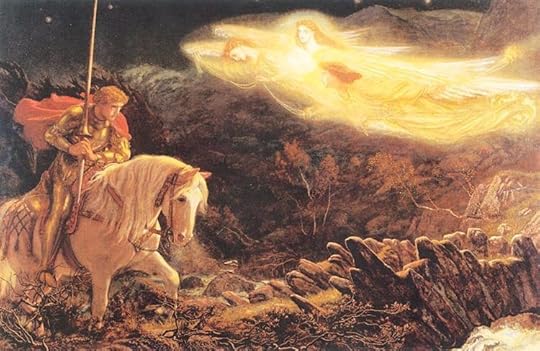
Sir Galahad - the Quest of the Holy Grail by Arthur Hughes
The Symbolism of the Grail
“In connection with the Knights of the Round Table it is not irrelevant to show the meaning of the “Grail quest”, which, in legends of Celtic origin, is represented as their principal function. Every tradition contains such allusions to something which, at a certain time, became lost or hidden. There is, for example, the Hindu Soma—the Persian Haoma—the “draught of immortality” which has a most direct relationship with the Grail, for the latter is said to be the sacred vessel that contained the blood of Christ, which is also the “draught of immortality”. In other cases the symbolism is different: thus according to the Jews it is the pronunciation of the great divine Name which is lost; but the fundamental idea always remains the same, and it will shortly appear to what, exactly, it corresponds.
The Holy Grail is said to be the cup used at the Last Supper, wherein Joseph of Arimathea received the blood and water from the wound opened in Christ’s side by the lance of Longinus the Centurion. According to legend, this cup was carried to Britain by Joseph of Arimathea himself along with Nicodemus; and in this can be seen the indication of a link established between the Celtic tradition and Christianity. In fact, the cup plays a most important part in the majority of ancient traditions, and this, no doubt, applied particularly in the case of the Celts. The cup is also to be observed in frequent association with the lance, the two symbols then becoming in a certain way complementary; but it would take us far from our subject to enter into this.
Perhaps the clearest expression of the Grail’s essential significance is found in the account of its origin: it tells that this cup had been carved by the angels from an emerald which fell from Lucifer’s forehead at his downfall. That emerald strikingly recalls the urnā, the frontal pearl which, in Hindu (and hence in Buddhist) symbolism, frequently replaced the third eye of Shiva, representing what might be called the “sense of eternity”. It is then said that the Grail was given into Adam’s keeping in the Earthly Paradise, but that Adam, in his turn, lost it when he fell, for he could not bear it with him when he was driven out of Eden. Clearly, man being separated from his original center, thereafter found himself enclosed in the temporal sphere; he could no longer rejoin the unique point whence all things are contemplated under the aspect of eternity. In other words the possession of the “sense of eternity” is linked to what every tradition calls the “primordial state”, the restoring of which constitutes the first stage of true initiation, since it is the necessary preliminary to conquest of “supra-human” states. . . .
What follows might appear more enigmatic: Seth obtained reentry into the Earthly Paradise and was thus able to recover the precious vessel; now the name Seth expresses the ideas of foundation and stability and, consequently, indicates, in a certain manner, the restoration of the primordial order destroyed by the fall of man. It can therefore be understood that Seth and those who possessed the Grail after him were by this very fact, able to establish a spiritual center destined to replace the lost Paradise, and to serve as an image of it; thus possession of the Grail represents integral preservation of the primordial tradition in a particular spiritual center. The legend tells neither where nor by whom the Grail was preserved until the time of Christ; but its recognizably Celtic origin leaves it to be understood that the Druids had a part therein and must be counted among the regular custodians of the primordial tradition.
The loss of the Grail, or of one of its symbolic equivalents, is, in brief, the loss of tradition with all that the latter includes; nevertheless, the tradition is, in truth, hidden rather than lost; or at least it can only be lost as regards certain secondary centers, when they cease to be in direct relation with the supreme center. So far as the latter is concerned, it always preserves the deposit of tradition intact, and is not affected by the changes which occur in the outer world; thus, according to various Fathers of the Church and in particular Saint Augustine, the flood could not touch the Earthly Paradise which is “the dwelling of Enoch and the Land of the Saints” and whose summit “touches the lunar sphere”, that is to say finds itself beyond the domain of change (which is identified with the “sublunary world”), at the point of communication between the Earth and the Heavens. . . .
The Grail, accordingly, represents two strictly interdependent things at the same time: one who integrally possesses the “primordial tradition”, who has attained the degree of effective knowledge which this possession essentially implies, is thereby reintegrated into the fullness of the “primordial state”. The double meaning inherent in the very word Grail relates to these two things, “the primordial state” and “the primordial tradition”, for, through one of those verbal assimilations which frequently play a far from negligible role in symbolism, and which further have much more profound reasons than one would imagine at first glance, the Grail is at once a vessel (Old French grasale) and a book (gradale or graduale); this latter aspect plainly designates the tradition while the other more directly concerns the state itself.
We do not intend to enter here upon the secondary details of the legend of the Holy Grail, though each has its symbolic value, nor to pursue the history of the “Knights of the Round Table” and their exploits; we merely recall that the “Round Table”, constructed by King Arthur from the plans of Merlin, was designed to receive the Grail when one of the Knights had succeeded in overcoming it and had brought it from Great Britain to Brittany. This table is also a symbol, probably of great antiquity, one of those always associated with the idea of spiritual centers that preserved tradition; the presence of twelve principal personages around the circular shape of the table is, moreover, a formal link with the cycle of the zodiac. . . .
One other symbol relating to a different aspect of the Grail legend, merits special attention: it is that of Montsalvat (literally “Mountain of Salvation”), the peak standing “on distant shores that no mortal approaches”, which is represented as situated, in an inaccessible region, in the midst of sea, and behind which the sun rises. It is at once the “sacred isle” and the “polar mountain”, two equivalent symbols; it is the “Land of Immortality” which is naturally to be identified with the Earthly Paradise.
Returning to the Grail itself, it is easy to realize that its primary significance is fundamentally the same as that of the sacred vessel wherever it is encountered, and notably in the East that of the sacrificial cup which originally contained, as pointed out above, the Vedic Soma or the Mazdean Haoma, that is, “the draught of immortality” which confers or restores, for those who receive it with the requisite disposition, the “sense of eternity”. . . .”
― René Guénon, The Essential René Guénon: Metaphysical Principles, Traditional Doctrines, and the Crisis of Modernity
Sir Galahad - the Quest of the Holy Grail by Arthur Hughes

February 18, 2013
Whether one agrees with his often times far out theories and speculations, one cannot doubt this man is a genius that has not received enough attention.

April 17, 2025
I should first get out of the way that, depsite the low rating, I don't necessarily disagree with Guénon's ideas or the traditional wisdom he presents. His knowledge of tradition and metaphysics are impressively deep and his insights are razor-sharp, especially in his analysis of the West (what Guénon referred to as the West, which could at this point be seen as postmodern society as a whole). He justly critiques how the West lacks true focus, how material excess will ultimately lead to its decline, and how it has become disconnected from the source. While I can't fully speak to his critique of Theosophy, it does resonate with my own views on the New Age spiritual movement and its often superficial nature.
That aside, I found reading this collection to be a pretty suffocating experience. After every two sentences, Guénon pauses to dissect a word’s meaning, its etymology, or the fact that there's no true translation for it in the West. A little more trust in the audience's intuition would go a long way—fewer of these elaborate detours would allow the writing to flow. Furthermore, there’s a constant undertone of East versus West, past versus present, with a clear negative bias toward the latter. I'd hoped that beyond the first article, Guenon's basic views on modernity were clear enough to leave it and continue, yet the comparisons continue and become redundant. And then, when we finally get to metaphysics- it reads dry due to more lengthy sentences and more meticulous elaboration on language. To get an idea: The following is a single sentence from the book: A state of being is then the development of a particular possibility contained in such a degree, that degree being defined by the conditions to which the possibility is subject insofar as it is envisaged as realizing itself in the domain of manifestation.
Given how incredibly loved Guenon's writing is, all this must be a question largely of personal taste and false expectations.
That aside, I found reading this collection to be a pretty suffocating experience. After every two sentences, Guénon pauses to dissect a word’s meaning, its etymology, or the fact that there's no true translation for it in the West. A little more trust in the audience's intuition would go a long way—fewer of these elaborate detours would allow the writing to flow. Furthermore, there’s a constant undertone of East versus West, past versus present, with a clear negative bias toward the latter. I'd hoped that beyond the first article, Guenon's basic views on modernity were clear enough to leave it and continue, yet the comparisons continue and become redundant. And then, when we finally get to metaphysics- it reads dry due to more lengthy sentences and more meticulous elaboration on language. To get an idea: The following is a single sentence from the book: A state of being is then the development of a particular possibility contained in such a degree, that degree being defined by the conditions to which the possibility is subject insofar as it is envisaged as realizing itself in the domain of manifestation.
Given how incredibly loved Guenon's writing is, all this must be a question largely of personal taste and false expectations.

June 10, 2020
An adequate introduction to a wide range of Guenon's writing.
Read
August 18, 2024Version catalana, la crisis del mon modern.

October 14, 2024
I won't write a review in the classical sense, as my knowledge about the spiritual is too small, but the book hits where it hurts the western soul the most. We know how to splice DNA, create nuclear reactors, and conjure AIs more intelligent than the average person from the global south, but we don't have the answer on why to live.
Displaying 1 - 10 of 10 reviews