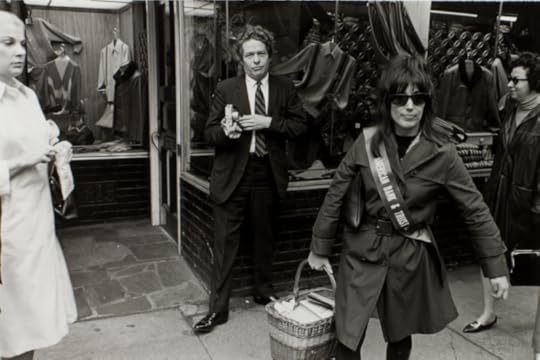
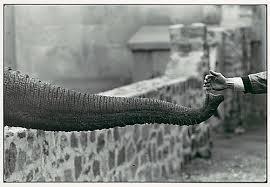
Back in Print! The first comprehensive overview of the work of Garry Winogrand, long out of print and difficult to come by, contains an eloquent and important essay on the life and work of the photographer by John Szarkowski and a lavish plate section presenting the photographs thematically. Grouped under the following titles-- Eisenhower Years, The Street, Women, The Zoo, On the Road, The Sixties, Etc, The Fort Worth Fat Stock Show and Rodeo, Airport and Unfinished Work-- many of the 179 plates are works that had never before been published. The last section includes 25 pictures chosen from the enormous body of work that Winogrand left unedited at the time of his death in 1984. In his essay, Szarkowski, who knew the photographer well during most of his career, describes the development of Winogrand's pictorial strategies during his years as a photojournalist, the increasing complexity of his motifs as he pursued more personal goals, and the challenge posed for other photographers by the powerful and distinctive authority of Winogrand's best work, "with its manic sense of a life balanced somewhere between animal high spirits and an apprehension of moral disaster."
Garry Winogrand (1928-1984) was a street photographer known for his portrayal of America in the mid-20th century. John Szarkowski called him "the central photographer of his generation".
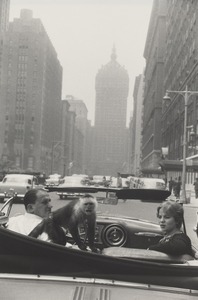
Winogrand was influenced by Walker Evans and Robert Frank and their respective publications American Photographs and The Americans. Henri Cartier-Bresson was another influence although stylistically different. Winogrand was known for his portrayal of American life in the early 1960s. Many of his photographs depict the social issues of his time and in the role of media in shaping attitudes. He roamed the streets of New York with his 35mm Leica camera rapidly taking photographs using a prefocused wide angle lens. His pictures frequently appeared as if they were driven by the energy of the events he was witnessing.
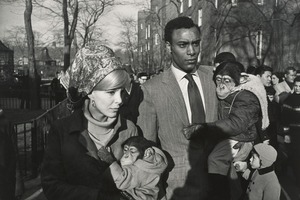
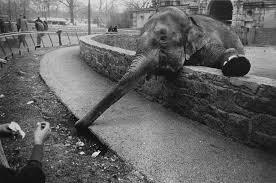
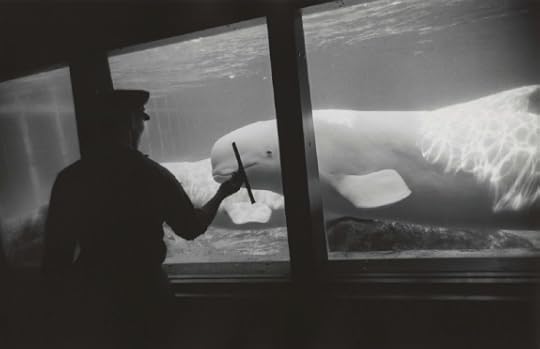
Winogrand's photographs of the Bronx Zoo and the Coney Island Aquarium made up his first book The Animals (1969), a collection of pictures that observes the connections between humans and animals. His book Public Relations (1977) shows press conferences with deer-in-the-headlight writers and politicians, protesters beaten by cops, and museum parties frequented by the self-satisfied cultural glitterati. These photographs capture the evolution of a uniquely 20th and 21st century phenomenon, the event created to be documented. In Stock Photographs (1980), Winogrand published his views of the Fort Worth Fat Stock Show and Rodeo.
At the time of his death there was discovered about 2,500 rolls of undeveloped film, 6,500 rolls of developed but not proofed exposures, and contact sheets made from about 3,000 rolls. The Garry Winogrand Archive at the Center for Creative Photography (CCP) comprises over 20,000 fine and work prints, 20,000 contact sheets, 100,000 negatives and 30,500 35mm colour slides as well as a small group of Polaroid prints and several amateur motion picture films.
As the title suggests the book is deep dive into the life and works of Gary Winogrand. The book also delves into development of Photojournalism and Photo stories which made photography central to journalism- magazines as well as newspapers and its eventual demise with the coming of Television. So in many ways the book is also a study of development of communication medium and interplay of various mediums.
Sometimes super funny, capturing well the flirt between a man and woman, a fast insight on the 40 to 60s of USA. And that Finn work on the Kennedy airport in New York, I wonder how many photographers have imortalize it...anyway it is as he said, a photographer captures the moment automatically not in a setup mode but as it is in real time.
Oddities. Street photography, not posed. People do peculiar things, wear peculiar clothes. Includes zoo photos. There's a very memorable photo of a couple holding chimpanzees dressed in human clothing as if they were the couple's children - and they're visiting the zoo with their chimpanzee child-substitutes.
Al morir Winogrand en 1984, John Szarkowski, como director de la sección de fotografía del MOMA, decide realizar una exposición monográfica póstuma para lo cual visita a la viuda del artista con idea de recopilar todo el trabajo de Winogrand. Con gran sorpresa se encuentra con la siguiente situación: "more than 2500 rolls of exposed film remained undeveloped, which seemed appalling, but the real situation was much worse. An additional 6500 rolls had been developed but not proofed. Contact sheets (first proofs) had been made from some 3000 additional rolls, but only a few of these bear the marks of even desultory editing ... he made more than a third of a million exposures that he never looked at." Esto plantea muchas cuestiones relacionadas con el arte, el artista y su propio trabajo y fue posteriormente llamado el caso Winogrand. Aunque después el trabajo de Winogrand ha sido ampliamente analizado, el artículo de Szarkowski escrito en este magnifico catálogo es uno de los primeros análisis de este artista y no tiene desperdicio.
Panoramica sulla sterminata produzione di un fotografo compulsivo, che ha lasciato una mole di foto grondanti vita e disordine. Diviso in temi che ricalcano alcune sue pubblicazioni: i primi reportage, le donne, la strada, la società degli anni 60, lo zoo, l'opera inedita. Quest'ultima consiste in decine di migliaia di scatti mai provinati o mai sviluppati, che alcuni intrepidi hanno visionato per realizzare una selezione.
Il saggio introduttivo di Szarkowski è come sempre un'ottima lettura, animata dalla biografia piuttosto sorprendente di un autore che ha lasciato il segno.
Da una mostra al MOMA di NY del 1988, replicata alla Mole Antonelliana di Torino nel 1990: l'edizione che ho preso in prestito dalla biblioteca ha un supplemento realizzato benissimo con la traduzione italiana. Bei tempi... e viva la biblioteca.
Garry Winogrand takes great candid people shots... most from the hip it seems, while walking through NYC. He has an interesting eye for composition, and always seems to get people's faces at just the right moment. He also has a dry photographic sense of humor that I enjoy.
This is a big heavy book and the photographs are printed very well.
Peace Demonstration in Central Park, 1968 is one of the most beautiful photographs I've ever seen. The essay at the front wasn't anything to take your breath away, some of the photos didn't kill me, but when he gets it right, he REALLY gets it right.
A grand read so far. I'll take my time with this one, as I have it checked out over the summer from the College for Creative Studies. It seems like a fine estimation of the enormous body of work from an underrated and little-known street photographer (outside the photography world, anyway).
Great overview of Gary Winogrand's work. I read it because I wanted to see the results of his use of the 28mm focal length, wider than most street/documentary photographers use. It was enlightening.