I want you to go with me, tonight, to a certain house in London; to tell me whether you see or hear; and, if you do, whether you can explain it on natural grounds.”
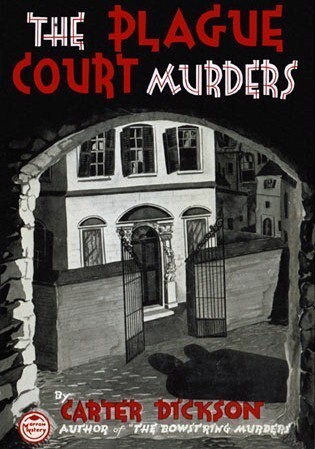
And when Ken Blake is approached by Dean Halliday with that request he jumps at the chance. Plague Court, is a derelict London property held by the Halliday’s, has a dark history of death. When they arrive, accompanied by Detective-Inspector Masters, they are startled to find the house already occupied. Halliday’s aunt, Lady Benning, his fiancée Marion Latimer, her brother Ted, and family friend Major Featherton have come to hold a vigil. Devotees of psychic Roger Darworth, they have brought him to Plague Court to exorcist the house of its ghosts. Before the night is over there is bloody murder as Darworth is brutally killed, alone in a small house on the grounds. Its walls are made of solid stone, the window unreachable from the ground, fitted with iron gratings, the door padlocked on the outside and bolted on the inside. Knowing that this was not the work of ghosts, but unable to explain how the murder could have been committed, they apply to Sir Henry Merrivale or help.
Am I the only person in the world who was underwhelmed by Plague Court? Okay, maybe underwhelmed is too strong of a word, because it is really a great book. But, it felt like a book of two halves. The first half felt uneven and erratic…the cadence just felt off. There were too many moving parts, and the narrative had a disjointed feeling that was distracting. It read like any other mystery, by any other good writer, and it wasn’t until Merrivale steps onto the stage that I found myself really pulled in.
But there are great things to be found in that first half. The ghost story quality that Dickson generates is remarkable. With imaginative passages, he is able to construct an intense atmosphere which is full of darkness and decay. Like the damp and fog, it bleeds into everything, and is unescapable.
…there seemed such an absolute hush in the desolation of the house before us. Something seemed to be impelling us to move faster; to get inside those high brick walls; something drawing us on and playing with us. The house—or what I could see of it—was made of heavy, whitish stones, now blackened with weather. It had almost a senile appearance, as of a brain gone, but its heavy cornices were carven with horrible gayety in Cupids and roses and grapes: a wreath on the head of an idiot.”
And while Dickson can never be accused of remarkable work regarding his characterizations, his caricatures are fabulous. Most notably here in the forms of the reptilian Lady Benning, with her cold malevolence—
…the small face, which suggested wax flowers, was unwrinkled except around the eyes, and it was highly painted. The eyes were gentle—and hard…her jeweled hands, lying limply along the arms of the chair, were twisting and upturning as though to begin a gesture.”
And the bumptious Major Featherton, the very image of a Regency fop gone to seed—
The paunchy figure tilted slightly backwards. From the brief glimpse I had had of him, of the map-veined cheeks and cadaverous eyes, I could fill out the bigness of an outworn buck and gallant of the eighties, tightened into his evening clothes like a corset.”
So once H.M. picks up the baton, he just runs away with it. All the little hints that Dickson dropped in at the time of the murder are slowly teased out by Merrivale as he goes over the evidence, prodding Masters (and the reader) to think harder about the facts. Oh, and the solution to the locked room murder itself, is so fabulous and imaginative, never even entered my mind. My solution originated in a mechanism that was found at the scene, putting me in mind of a certain honkaku work which I read earlier this year, but I was way off base. And I thought I had the murderer tagged too. But while I was close…I was of course wrong. This will be a hard one, even for the most avid of readers to figure before the reveal.
OK, so looks like I enjoyed this more than I thought. I think the quibble I really have is with Masters whose character just didn’t tweak my interest in the slightest. So, I’m just glad that Carr went with H.M. as his detective and not Masters. A great impenetrable locked room murder nestled very neatly inside a first-rate ghost story.