Revealing the horror and heroism the creator of Middle-earth experienced as a young man, Tolkien and the Great War also introduces the close friends who spurred the modern world's greatest mythology into life. It shows how the deaths of two comrades compelled Tolkien to pursue the dream they had shared, and argues that Tolkien transformed the cataclysm of his generation while many of his contemporaries surrendered to disillusionment. The fruit of five years of meticulous research, this is the first substantially new biography of Tolkien since 1977, distilled from his personal wartime papers and a multitude of other sources.
DOES ANYONE REALIZE HOW CLOSE WE WERE TO LOSING TOLKIEN?!?!?? Can you imagine a world without his Hobbits, his elves, his orcs? The man is a genius, not just a literary genius, but an absolute linguistic pedant. I finished this book simply fascinated and now I want to learn Norse, Welsh, Latin, and Greek. Not only have I gained a better understanding of the warfront during WWI, but I also appreciate the gifts Tolkien gave to us more than ever. I will cherish this book. A perfect audio read because all of the foreign and Tolkien vocabulary is pronounced correctly.
This is, for me, not just as my favourite history of WWI, and not simply one of the strongest Tolkien studies books I know, but a model for me as a writer. The audiobook is also quite excellently done, autumnal in quality giving the material a heartful melancholic atmosphere.
_Tolkien and the Great War_ is an obviously well-researched book that goes into explicit (at times I must admit tedious) detail on J. R. R. Tolkien’s involvement in World War I and its possible impact on his then-current and later writings. We begin by observing Tolkien’s earliest close friendships formed at St.King Edward’s Grammar School under the auspices of the “TCBS” (an acronym for Tea Club, Barrovian Society) where the core group of Tolkien, Christopher Wiseman, Robert Gilson, and G. B. Smith became close artistic confidantes, encouragers and critics of each other’s work. Convinced that they were a group that would change the world with their work, their dreams were turned to harsh reality with the advent of “the war to end all wars”.
We spend the majority of the remainder of the book following Garth as he traces the movements and vicissitudes of the various platoons to which each member of the TCBS was assigned, with a special concentration on Tolkien himself. It’s common knowledge that the Great War winnowed a generation, destroying the optimism of the Edwardian era and putting paid to facile romantic notions of the heroism of war. The ‘innovations’ of technology that made killing men easier than it ever had been before, along with the harrowing conditions of trench life and seemingly incompetent leadership, made this conflict a wake-up call for the world that shattered many illusions. As Tolkien himself noted: “By 1918, all but one of my close friends were dead.” In the midst of this carnage and despair Tolkien managed to begin work on the poems and stories that would become the germ for his masterpieces The Hobbit and The Lord of the Rings as well as the accompanying material that would evolve into the posthumously published The Silmarillion.
Garth does a fine job giving us details of the World War I experience, but I have to admit that in general I was a bit underwhelmed by this book. I found the prose to be a bit workmanlike, and this wasn’t helped by the sheer amount of detail. I appreciate the thoroughness of Garth’s research, but I did find my eyes glazing over a bit from time to time as troop movements, platoon names, and other details were gone into. Some of the extra biographical detail given on Tolkien was interesting, but I must admit that most of it I already knew, at least in broad strokes, from other sources so I didn’t come away feeling that I had learned anything heretofore unknown to me about the man himself. The main gist of Garth’s critical argument, namely that Tolkien, far from being an anachronistic throwback despite his literary tastes, was actually truly a man of his era who was responding uniquely to the horrors present at the birth of the twentieth century has also been covered by others, especially Tom Shippey in several of his works.
I did find the last section of the book the most interesting. In it Garth concentrates almost exclusively on the early writings Tolkien did in what would ultimately become his legendarium of Middle Earth and examines how his experiences in the war may have coloured the world he created, or even been lifted from direct experiences in his life. It is a kind of ‘biographical criticism’ for which Tolkien himself had great distaste and whose value he felt was dubious at best, but I must admit that much of what Garth posits makes sense to me, and I imagine that Tolkien’s youth, coupled with the monumental nature of the events through which he was living, could not help but leave their mark on what he wrote in ways perhaps more apparent than exists in his later, more mature writings.
In retrospect my review is probably unduly harsh. This was a fine work of biographical criticism giving great detail about a formative period of a great writer’s life. I think it was simply the fact that I wasn’t utterly wowed by the book, and found some moments slow going, that made it an interesting, though not inspiring, experience for me.
This is a necessary book - worth reading not just for the inside dope on Tolkien's mythology (which frankly I'm not that interested in, but the book was compelling anyway). This book is also a thoughtful, sensitive, well-written consideration of the WWI generation, and how the pre-War world and the War itself formed Tolkien and his fellowship of four friends. It is the best kind of cultural-literary criticism, especially when Garth talks about how the accepted narrative of WWI became the pessimistic Graves/Sassoon/Owen poetry. (Fussell does this a bit, but, as Garth correctly points out, he is clearly on the side of the pessimists.) This book also explains Tolkien's personal literary theory more clearly than any book I've read so far, including Carpenter's biography. It was easier for me to understand why Tolkien insisted LOTR was not allegory, i.e. Sauron was not Hitler/Stalin dressed up in a funny medieval hat. Also, clearly one reason Tolkien had such a problem with Lewis's Narnia series wasn't just the mixing together of Christian myths and Santa Claus, but the straight-up allegory of Aslan = Christ. Tolkien wasn't that happy about the modern literary critical technique of mapping personal experience to artwork, either, but I like to think he would have liked this dignified and respectful approach to how his own searing personal battles influenced the mythic ones he wrote out.
‘As under a green sea’: visions of war in the Dead Marshes, in The Ring Goes Ever On: Proceedings of the 2005 Tolkien Conference, ed. Sarah Wells (Tolkien Society, 2008), and (in slightly expanded form) in Myth and Magic: Art according to the Inklings, ed. Eduardo Segura and Thomas Honegger (Zürich: Walking Tree, 2007).
Frodo and the Great War, in The Lord of the Rings, 1954–2004: Scholarship in Honor of Richard E. Blackwelder, ed. Wayne G. Hammond and Christina Scull (Milwaukee: Marquette University Press, 2006). Presented at Marquette University, 2004. Revised version forthcoming in the proceedings of the Hungarian Tolkien Society’s Budapest 2012 conference.
I can't speak highly enough of this book. The amount of detailed biographical research alone would make it invaluable to anyone interested in Tolkien (or, for that matter, in the experience of the generation of university students who fought in World War I). I only wish we had two or three more volumes coming from him, to cover the rest of Tolkien's life, a deep-dive utilizing the research tools and resources of the twenty-first-century, ala what Mark Lewisohn is doing for the Beatles (ETA: YE GODS, HE *HAS* WRITTEN ANOTHER ONE! I'll get on that forthwith!). But I'm incredibly grateful that we have this work, which I feel has enriched my understanding of Tolkien far beyond even what I hoped to learn from it.
But beyond biographical detail, Garth also engages in extremely compelling analysis of the impact of the war on not only Tolkien's writing, but his worldview, his academic interests, and so forth (all of which are, of course, intertwined). Even more valuably, he does so while acknowledging Tolkien's own reluctance to admit much inspiration (though of course, an author is singularly unsuited to make those kinds of assessments!) as well as engaging with the many other excellent (and less excellent!) critical pieces to have tackled these questions over the years. There is a real sense of expertise throughout the work, which manifests not as a tone of "know-it-all-ism," but rather in his willingness to acknowledge what we can't know or understand about Tolkien and the people around him, or can only guess at. The mark of a real expert, in my opinion!
Stylistically, I was delighted by the tone: readable without being pandering or cheap, academic and knowledgable without being dense, full of love for Tolkien's work but never devolving into fannishness.
My only complaint is that I occasionally had difficulty reading scenes because I was tearing up. (Actually, my first emotional meltdown occurred on the dedication page, and my final one on the last page of the main text, when Tolkien signs his last letter to Wiseman "TCBS." So, it was a systemic problem, I guess! Hazards of dealing with stuff that touches on questions so deeply rooted in what it means to be a human, a writer, a person in the modern age, a lover of fantasy, and so forth.)
I read Tolkien and the Great War as part of a group read with the Tolkien group on Goodreads, and I'm so glad I did. I've read a lot of books about Tolkien, and this is one of the very best. Garth delves into the biographical details of Tolkien's youth and young adulthood, looking especially at Tolkien's friendship with three other schoolmates: G. B. Smith, Rob Gilson, and Christopher Wiseman. Together, these four formed the Tea Club and Barrovian Society (TCBS), a brotherhood dedicated to rekindling the enchantment of the world through their creative output (especially prose and poetry). The TCBS began as a group for conversation and clever pranks, but as these four men grew up together the TCBS became a refuge, a place of hope in the midst of a world at war. All four members eventually enlisted and served in the Great War, and as the grueling tedium and horror of trench warfare (and naval warfare, in Wiseman's case) took their toll, the men's letters to one another display a poignant yearning for even a brief time togehter, that the hope of the TCBS might enable them to endure through the war and dream of a better world after.
Gilson and Smith died in the war, which effectively ended the TCBS. Wiseman became a school headmaster, and Tolkien . . . well, of course we know what he did after the war. This story is significant because it was during these years that Tolkien began creating the Elvish languages and the history that goes with them. The encouragement of the other TCBS members helped give Tolkien the motivation to pursue his poetry and prose, and the dreams he shared with the TCBS--that beauty in writing might re-enchant the world, opening people's eyes to the "faerie" all around us--obviously resonated within him for the rest of his life.
John Garth's telling of this story is even and well reasoned. He presents the details as he has put them together, drawing from letters, wartime documents, other literature of the time, and other scholarship on Tolkien. There is surely a temptation for the biographer to make many presumptions, drawing connections between Tolkien's life experiences and his writings, and much of this would seem reasonable. However, Garth generally restricts himself to simply presenting the facts, and the book is stronger because of this. Throughout the book, he suggests that Tolkien's experiences may possibly be visible here and there in his fiction, only rarely in an obvious or direct way, but he respects Tolkien's own disdain for bringing the author's biography into his works.
For me the most fascinating parts of Tolkien and the Great War are Garth's Epilogue and Postscript, which are really distinct essays considering Tolkien's work as a whole, from a critical standpoint. Garth shares some wonderful insights into Middle-Earth: for example, the interesting parallel between Melkor's destruction of the Two Trees, using the shadowy cover of Ungoliant, and Beren's theft of the Silmaril, using the shadowy cover of Luthien's enchantment. How many times have I read The Silmarillion and yet not made that connection! Probably the greatest part of Garth's book is the Postscript, in which he defends Tolkien's writing against the attacks of critics, showing how Tolkien's archaic, seemingly backward-looking epic-creating is every bit as valid and appropriate a response to World War I as the trench memoir and poetry of disillusionment and disenchantment. Garth proposes that the literature of disillusionment in the decade following the war in many ways hijacked the actual feelings of the returning soldiers, giving the war in hindsight an emotional color that might not be entirely accurate. Tolkien, in contrast, created a literature that acknowledges the horrors and confusion, while still affirming that every act of heroism and bravery is valuable in itself, regardless whether the ultimate outcome seems to make any sense. The Beren/Luthien and Turin stories act as pictures of two ends of a spectrum of understanding war. In the story of Beren and Luthien, heroism and bravery result in victory, as well as the maturity of the heroic characters (though even in that story, the ending is tainted by the evils of war, greed, and selfishness). In Turin's story, the hero is ennobled through his dogged pursuit of justice and righteousness, even though he is also often rash and his decisions are fated to go awry to the very end; but the confusion and darkness that results from the hero's actions don't make his actions the less noble.
Garth's Postscript ought to be required reading for any Tolkien fan, and I highly recommend the whole book especially for readers who have spent some time with The Book of Lost Tales, the History of Middle-Earth series, or even just The Silmarillion. Tolkien and the Great War is simply a fantastic Tolkien book.
Why it took me so long to read this I cannot say. It had been on the back burner for me, and only really pushed to the forefront as I am seeing the author at a conference in a few weeks. To say that this book spoke to me in a way that only a small handful of books have done would be an understatement. I have long been fascinated both by Tolkien and military history, so it was a natural pairing. But beyond that, you cannot read this book without feeling a sense of the utter tragedy of youth and promise swallowed up in the trenches, and how no one from that generation, least of all the veterans who survived, escaped unscathed. Tolkien himself disliked literary criticism based on biographical exploration of the author, but we are all products of our environment and experiences. WWI changed Tolkien, and as Garth speculates, likely changed the trajectory of his writing. Consider this book part biography, part literary analysis. I think it is worth a read alone for the postscript: an examination of the prevailing narrative of Great War writers (disenchantment and disillusionment), and where Tolkien fits in that narrative. It also presents a strong argument against fantasy as "escapism", of which Tolkien has long been accused. I promise you will see Tolkien's work, especially what he produced in these war years, in a totally new light.
When Tolkien's The Lord of the Rings came at the top of a string of "best/favourite books of the twentieth century" lists in the late 90s and early 2000s, there was predictable harrumphing from some guardians of literary taste. People like Germaine Greer sneered loudly that the hoi polloi simply couldn't be trusted with this sort of thing, though her comments made it clear she had only a vague idea why she was so certain Tolkien's stuff was "tosh". She seemed to think he was a Nazi sympathiser (he hated the Nazis), thought his fans carried around teddy bears (that would be Waugh fans, if any at all) and later admitted she hadn't actually read The Lord of the Rings anyway. When pressed, she and other critics were usually very light on specifics, but generally characterised Tolkien as a whimsical escapist whose wispy fantasies were the antithesis of "proper" literature, which was to be heavily character-driven, light on plot, modernist (or post-modernist), gritty, prosaic and tending toward cynicism or at least moral ambiguity.
Much of this conception of how modern literature "should" be was born in the the First World War, which was thought to have swept away the kind of romantic, if not openly imperialistic literature of the Victorian Era. The literature that came out of the Great War was primarily in the new mode of the new century, as seen in the writing of Wilfred Owen, Siegfried Sassoon, Robert Graves, Edward Thomas or David Jones. It tended to subert or invert romantic and patriotic tropes and rejected any form of idealism.
Most people would be unaware that Tolkien fought in the First World War, saw action in the Battle of the Somme and was later to observe that "by 1918, all but one of my close friends were dead." Garth's book traces the importance and fierce intensity of those close friendships Tolkien referred to - especially his idealistic schoolboy fraternity dubbed the "T.C.B.S." which he formed with several like-minded literary friends at the King Edward's School in Birmingham. The closest of these were Christopher Wiseman, who served in the Royal Navy and survived the War, Rob Gilson, killed on the first day of the Somme in July 1916 and G.B. Smith, who died of shrapnel wounds in December 1916. Tolkien himself was stricken with trench fever and eventually evacuated from the front lines to convalesce in England.
Garth details how the experience of these deaths and the horrors of the Western Front changed the course of Tolkien's writings, moving it from the truly whimsical (and pretty awful) fairy Victoriana of his first published poem "Goblin Feet" (1915) to the far darker stories he began to write for his invented languages while recovering in a field hospital. These were to become the tales of The Silmarillion, which in turn formed the back-mythology for The Lord of the Rings. And once their origins in the mud of the Somme is understood, the dismissal of his work as mere wispy escapism can be recognised as utterly facile.
As Garth notes, all of Tolkien's work is set in a war, against the backdrop of a war, in the shadow of impending war or in the bitter wake of a terrible conflict. Victories are often fleeting, always hard-won and never won without terrible tragedy and loss. Bravery is often futile. Sacrifice is regularly in vain. Odds are almost always overwhelming. The most admired virtues are bravery in the face of almost certain defeat, fortitude against all odds, loyalty based on friendship rather than obligation and hope in the face of cynicism and despair. These elements are derived from the experience of a veteran of the Great War, not some armchair romantic.
For all his works' many aristocratic lords and mighty warriors, there are two characters for whom Tolkien had special affection. One was The Lord of the Rings's Faramir: a captain who took on impossible missions given by a deluded and out-of-touch superior, who worried for his men while admiring their courage, all while doubting his own bravery and strength of character. Tolkien later wrote that of all his characters, Faramir was most like himself as a young man. The other was Samwise Gamgee, who was famously based on the batmen who attended British officers and who Tolkien admired for their loyalty, steadfastness and courage. Both characters clearly derive from Tolkien's own experience of war.
Anyone who has read Tolkien's descriptions of the mounds of the slain heaping the field of the Nirnaeth Arnoediad - the "Battle of Unnumbered Tears" - or the rotting corpses in the pools of the Dead Marshes, or the Pelennor Fields where armoured behemoths lumber across the battlefield while winged terrors wheel and scream overhead knows that this is not escapist fantasy - it's modern war literature. Even his happiest endings have a heavy tinge of sadness and loss and the overwhelming feeling of his work is one of elegy, not whimsy. Garth shows that Tolkien was as much a war poet as any of the other writers who survived the Great War. And, as Tom Shippey argues in his J. R. R. Tolkien: Author of the Century (2000), the reason Tolkien has been embraced by millions in the century since the Great War is that he was very much a man of the world that war shaped, however much this confuses and annoys people like Germaine Greer.
Not a bad read, composition was quite good. Character development was meh. Very tenuous connection however between WW1 and Tolkien’s writing. In fact Tolkien had formed most of his ‘Silmarillion’ background by the time he left university and stated he did no writing during WW1 as it was a hard thing to do as an officer in the trenches. There is no doubt that war has an impact on anyone’s world view but I don’t think this book shed much light in that regard.
I did appreciate the background on Tolkien’s prep and university days, which is most of the book, and his time with his circle of friends.
My wife tells me that they recently made a movie based on the book. I might check it out as I tend to like period pieces and am a Tolkien fan.
One of the most important and thoroughly researched works on the early Tolkien. I highly recommend this and especially hearing John Garth read it. A must for any lover of Tolkien.
This book was something quite different from what I expected. Going in I expected a book focused on J.R.R. Tolkien almost exclusively, with discussions of the hells of the Western Front in WWI and then a deeper discussion of the themes of loss or nature and industrialization play out in The Lord of the Rings. I was looking forward to that analysis of the 'coming of the machine age' that Peter Jackson had played up so beautifully in the movie version of The Two Towers.
Instead, Garth treats us to a view into a group of Victorian friends with discursions on the philological and poetic world/myth building that Tolkien was working on at the time. The group of friends are the four self-appointed members of the 'Tea Club and Barrovian Society" (shortened to TCBS for most purposes). The grand name concealed what was no more than a high-school clique. I'm reminded of my own high-school poseur-gang dubbed "the D-Men" although in practice, the TCBS was closer to Tufts University's Film Series club.
Each of the four members of the TCBS saw themselves and the group as having the potential to change the world and bring forth works of immortal quality. Garth asserts that the TCBS was purely middle-class, but there is a strong strain of upper-class Victorian exceptionalism in Tolkien's peers views of their world. After being split apart to attend Cambridge and Oxford, the four friends still exchanged letters, poems, writings, and music and periodically met in what were referred to as ‘Councils.’
It’s all very idyllic and the reader can’t quite say whether these young men were destined to be the next Algonquin Round Table or just a group of high-school alumni pen-pals. And then Tolkien’s generation of young academics was swept-up in the Great War. Three of the four TCBS members were young officers leading patrols and assaults in the Battle of the Somme, the fourth was on a battlecruiser in the Battle of Jutland. Only one of the three sent to France came back. Tolkien was infected with lice-borne “trench-fever” and spent second half of the war on home guard duty and medical convalescence.
Garth makes a good argument for the power of Tolkien’s experience in the Somme for shaping much of his mythic background for Middle-Earth, particularly the stories that went into his Book of Lost Tales and The Silmarillion. I was pleasantly surprised to learn of the conceptual links between Tolkien’s mythology and books of H. Rider Haggard.
In the long Postscript, Garth makes an effort to place the writings of Tolkien in a literary universe defined by post-Great War writing. He makes a case that Tolkien was writing about his wartime experience without falling into the two major camps of war-writing of the period. Tales of Middle-Earth are neither the ‘high diction’ propaganda created by imperial powers in the image of Haggard and [William Morris} to impress their people and drive in recruits nor the studied, modernist, or gritty writings of [author: Robert Graves] or Sigfried Sassoon. Instead, Tolkien sought to create a new style. In the process, he created a whole new genre of popular literature.
This book is amidst the uttermost challenging that I've read hitherto. Bursting with stark, high diction and sheer, austere workmanlike style, which required the highest engagement of my attention. The book is, evidently, an outcome of Garth's apparent immense research that completely vindicates facts' overwhelming, and I do delighted its lack of gaudy, luscious periphrases that made me quite zestful as the pages were lessening. I may declare that this book is keen legitimate sequel of Carpenter's J.R.R. Tolkien: A Biography, that was highly and quite often cited by Garth. Withal author's elaborated depicting of the TCBS' origin, and then following the weird of each of its member during the war, the hallmark of the book is Tolkien's involvement and engagement in the Great War, where Garth gave quite unbiased rave of Tolkien's both psychological and physical conditions out of trenches. Another marvellous matter is detailed and listed review of the Tolkien's mythology emerging that much elucidated some of my doubts I had on that account. And as a pinnacle - the last two chapters i.e. Epilogue and Postscript are, in fact, assays where Garth explains shifting and phases of the mythology and the matter that once would originate The Silmarillion.
2021 review:
I couldn't agree more. "Tolkien and the Great War" is a serious study and not quite suitable to those who expect such book to burst out of humorous anecdotes, apt to be read at the seaside or so.
There are three essential works for anyone interested in going deeper into Tolkien’s writing and thought: Humphrey Carpenter’s biography, Tom Shippey’s philological appreciation, JRR Tolkien: Author of the Century, and John Garth’s Tolkien and the Great War. While Tolkien, famously and justly, abhorred the mining of an author’s life for the coal seam of his literary material, Garth’s study of Tolkien’s war, and that of the other three members of the youthful coterie that had gathered around him, the TCBS, is both an appreciation of the subtle weaving of thought, experience and action, and an examination of that generation, raised at the height of Empire, who bled out in the holocaust of the First World War. If anything, the two members of the TCBS who died in France, GB Smith and Robert Gilson, are portrayed even more vividly than Tolkien himself. It is clear that Tolkien was a writer who particularly required the frank and unvarnished feedback of men whom he admired and who resonated with him: most famously CS Lewis, who cajoled and encouraged the writing of The Lord of the Rings but, Garth’s book shows, Smith, Gilson and Wiseman similarly played midwife to the birthing of Middle-earth through their talks, discussions and shared ideals. For someone who has always been solitary in his creative endeavours, I find this aspect of Tolkien’s work fascinating and inscrutable. I’m also, I think, rather jealous. Would that I might say, “What! You too? I thought that no one but myself…”
John Garth has given us a work of the greatest value on several levels. Fans and scholars of Tolkien, students and scholars of the First World War, and literary critics in general will all find much of interest and many a lesson here.
Tolkien and the Great War: The Threshold of Middle-earth is among the foremost scholarly works on the intersection of any author's life and his work. All too often writers investigating such a connection go overboard, finding the details of an author's life encoded in every character and every event in a novel. Not so John Garth. With a studious eye for detail and the wit to sift what is relevant from what is not, Garth is as sensible in his claims as he is persuasive. His passion for his subject is clear, but it enlightens his judgement rather than clouding it.
The result is an outstanding, fascinating, and useful study of all the elements his title so succinctly conveys.
I actually really enjoyed this book. Other books about Tolkien seem to skip over the time he spent in WWI. They talk briefly about it and then move on. This book was based all around the time he spent in the army and it's effect on his writing. It seemed very logical for his war experiences to be portrayed in his writing some way, so I agree with the author. Also I was happy that they went not only into detail about Tolkien's war experience, but also Rob Gilson's, G.B. Smith's and Christopher Wiseman. They did talk about JRR grief at the death of Rob Gilson. But I was disappointed that they didn't go into his grief over G.B. Smith's death, since I know he had a closer relationship with GBS then he did RG. It was really cool, to see the timeline of what he wrote, during what. And how he revised it. It was an enjoyable read, I recommend it.
Besides showing how Tolkien’s war experiences and the fellowship of young scholars of whom Tolkien was a part helped shape The Lord of the Rings, John Garth gives a superb analysis of Tolkien's place in literature. The best part is the Epilogue.
“Just when the old ways of telling were being misused by the military propagandists and rejected by the trench writers, Tolkien envisioned ‘The Book of Lost Tales’, a sequence of stories salvaged from the wreck of history. That he saw the value in traditions that most others rejected is one of his gifts to posterity: truth should never be the property of one literary mode, any more than it should be the monopoly of one authoritarian voice. Tolkien was not immune to epochal change, however. He did not simply preserve the traditions the war threatened, but reinvigorated them for his own era.”
“The distillation of experience into myth could reveal the prevailing elements in a moral morass such as the Great War, show the big picture where trench writers like Robert Graves tended to home in on the detail. Tolkien is not the first mythographer to produce a grave and pertinent epic in time of war and revolution. However else they differ from him, in this John Milton and William Blake are his forebears. When the world changes, and reality assumes an unfamiliar face, the epic and fantastic imagination may thrive.”
This book was even better the second time through. It’s absolutely full of information and thoughtful dot-connecting. When I first read it three years ago, I’m sure I didn’t even absorb half of all the excellent content. In the ensuing years I’ve accrued a lot more knowledge about Tolkien’s life and works from other sources, enabling the content of Garth’s book to shine out even more clearly. Garth’s description of the TCBS members, their ideas, and their experiences in the Great War is moving as well as enlightening, and provides a crucial context for Tolkien and his work. I’m sure I’ll read it again in a few years when it will seem even more significant!
A bit dry in spots, and where it took its time early on, things felt rushed by the end. The postscript is sheer brilliance, however, to the point that it gained a fourth star all on its own. Read very well by the author.
One has indeed personally to come under the shadow of war to feel fully its oppression; but as the years go by it seems now often forgotten that to be caught in youth by 1914 was no less hideous an experience than to be involved in 1939 and the following years. By 1918, all but one of my close friends were dead. — J.R.R. Tolkien, forward to The Lord of the Rings
World War I represented everything Tolkien hated: the destruction of nature, the deadly application of technology, the abuse and corruption of authority, and the triumph of industrialization. It interrupted his career, separated him from his wife, and damaged his health. Yet at the same time it gave him an appreciation for the virtues of ordinary people, for friendships, and for what beauty he could find amidst ugliness. "They lie in all the pools, pale faces, deep deep under the dark water. I saw them: grim faces and evil, noble faces and sad. Many faces proud and fair, with weeds in their silver hair. But all foul, all rotting, all dead." - "The Passage of the Marshes", The Two Towers The dead lying in pools of mud is a powerful image of trench warfare on the Western Front, and is something that Tolkien would have undoubtedly seen during his wartime service. As the autumn rains fell, the battlefield of the Somme turned into a stinking mire seeded with the rotting corpses of men and animals. The dead men that Frodo and Sam see are not physically present – only their ghostly shapes have been preserved –but their forms inspire horror and pity.
We are all shaped by the world in which we live.
(I used this volume for a presentation on Tolkien and The Great War. I found it very useful and insightful into Tolkien the man and the "Lost Generation")
Una lectura complicada pero con un montón enorme de información interesante que vale la pena para todos los que disfrutamos la obra de El Profesor Tolkien.
One key to understand The Lord of the Rings and all the other great works by Tolkien is his involvement in the First World War. Elements like a last minute rescue of the Rohirrim, or the role of Samwise Gamgee, or the mechanical beasts entering the battle of Gondolin clearly refer to his experience in the Battle of the Somme.
Tolkien was there in the horrors of the trenches, as a Second Lieutenant of the 11th Lancashire Fusiliers, from June to October 1916. He survived because he caught trench fever, returned to England reporting sick and never returned to action.
Why doesn't the cover illustrate those trenches, then, why isn't there a tank, or soldiers in battle gear running through trenches? The photo is well-chosen, because it shows Tolkien as part of his beloved community at Exeter College. Consider, that Tolkien wasn't one of the first to be deployed as soldier, but decided to finish his degree in university first.
The core of this biography focuses on Tolkien's ways through the war. John Garth gives a fascinating portray, disentangles the complicated movements of WWI campaigns, and fleshes out how his schoolfriends of the T.C.B.S. club fared during the war. It is a highly involved and intense research into not easily accessible sources, and the author mastered them in a way which is accessible to a broader public.
One can literally watch the ideas leading to the Silmarillion coming to life. The author embeds and explains several poems from Tolkien and his friends through these early years. Tolkien started his mythology reluctantly before the Battle of the Somme. But only after he returned home, his ideas came to fruition in a kind of narrative explosion. His prose work started during his rehabilitation from trench fever back home in England, beginning with The Fall of Gondolin, continued with Beren and Luthien, and finished his Great Tales with The Children of Hurin. There was no idea of the Hobbit or the Lord of the Rings, and there was no Second or Third Age.
John Garth brings all this to life in a thorough amount of details. He contextualizes Tolkien as a war author. Where other authors of his generation like Graves, Sassoon, or Owen created a far more pessimistic, modern poetry, Tolkien reflected the fighting differently, staying with the naturalistic romances, taking a stance against the disenchantment of his time.
The last part of the book concentrates on the effects on Tolkien's later Middle Earth writings, how formative they were, and how his experiences influenced the world he created. Although Tolkien himself hated such interpretation, Garth's analysis makes sense to me.
A huge mass of literary references and notes are given at the end of the book. Garth's choice to not add footnote numbers in the text was a good one. The book finishes with twelve pages of bibliography and a handy index. More interesting to the casual reader will be the middle part with several photos of Tolkien, and his Exeter friends of the T.C.B.S, and the maps illustrating the movements of the Battle of the Somme.
You can see that this is not "yet another" Tolkien biography. It is a necessary one, adding much to the essential biography from Carpenter. The Mythopoeic Society honored the work with an Award for Inklings Study.
For further reading of the author, consider his Tolkien at Exeter Colleg, and his newer Worlds of J.R.R. Tolkien: The Places that Inspired Middle-Earth (which I haven't read, yet).
Tolkien and the Great War reads unevenly. Large sections are almost unbearably plodding, while others are vibrant, providing flashes of insight into the genesis of Tolkien's genius. In the balance, the insight gained is worth the plodding endured.
For me, the best of this book is saved for last. In the author's postscript he argues that, far from being mere escapism, Tolkien's writings were a valid counterpoint to the modernism that emerged from the Great War. Rather than discarding the romantic forms that Paul Fussell labelled as; "tutors in high diction to the war propagandists," Tolkien salvaged them and re-interpreted them through his own war-time experience. In doing so, he swam against the tide of academic chic, and rescued all of us from an unbearable future of endless and unabated T.S. Eliot and James Joyce.
This is simply the best biographical work on Tolkien I've read yet. It sheds more light on his relationships with the members of the 'TCBS', details what he would have seen during his Great War service, and effectively puts all of his early writings into a evocative chronological context. John Garth makes convincing arguments for how Tolkien's Great War experiences and friendships shaped his writing, and for how his writing should be understood relative to his contemporaries. This book illuminates the development of Tolkien's writing as a whole, and really should be required reading before anyone begins the Book of Lost Tales material.
Note: I decided to pair the physical copy of this book with the audio version and found reading and listening at the same time was very helpful in keeping my focus and helping me progress through this book without getting slowed down or distracted. The author of the book actually narrates the audiobook, which is something I always really enjoy.
An excellent read for this Tolkien fan! Thanks again for recommending and gifting it to me, Mary! :) <3
This being non-fiction, and me not reading non-fiction nearly as much as fiction, I’m always a little unsure how to write my review. I guess I’ll start by saying that I thought it was very well-written, well-researched, well-paced, and interesting enough that I never once got bored or wanted to skip ahead even though I already knew some of the things being conveyed. There were some new things too, though, such as more details about the TCBS (a close-knit group of friends and writing critique partners Tolkien was a part of in his college days) than I ever knew before and enjoyed learning. I also loved that the author included excerpts of Tolkien’s poetry where appropriate to make points and show how Tolkien’s writings developed over time, and I very much enjoyed reading them and discovering his inspiration for them.
Overall, this was a highly enjoyable non-fiction read for me and I happily give it 5 stars.
I would recommend this book both to long time Tolkien fans who are curious about his life, especially his experiences in WWI and their influence on his writings, and to people who are new fans, or maybe not even fans at all, but are still curious about this well-known person and his life. You don’t necessarily have to have read any, much less all of Tolkien’s works in order to get something from this book (though knowing at least some of his works will certainly add depth to what you learn here) as the author tells the audience just as much as is needed in order to show what he’s wanting to show.
Content advisory: I personally would recommend this book for ages 12+ simply because of how intellectual it is and the fact that, unless they were very curious and at an advanced reading level, children younger than that simply probably wouldn’t be interested in a book like this or be able to fully comprehend it to appreciate it. Otherwise, there is very little content of concern for younger readers.
Language: One instance of the word d****d in a brief quote from Tolkien. I don’t recall any other swear words.
Violence: There is talk of war and combat throughout, but the author keeps it very matter-of-fact, never going into icky detail, while still communicating what happened in various battles and such.
Worldviews: Again, the author simply reports the facts and doesn’t give his own opinion on things.
Tolkien and the Great War by John Garth is a broad-ranging biography of the creator of Middle-earth. Despite its title, the book covers J. R. R. Tolkien’s entire life. It starts with his time at King Edward’s School in Birmingham, where he became steeped in languages and met the three friends with whom he formed the Tea Club and Barrovian Society (or TCBS), a tight-knit club with world-changing literary ambitions. The four members of the TCBS are the focus throughout the account of the First World War. After the war, the book summarizes Tolkien’s life up until his death in 1973. It ends with an essay which argues that Tolkien’s work was influenced by the Great War. Prior to reading Tolkien and the Great War, I had dismissed this (as I thought) outlandish claim portrayed in, for example, the 2019 film Tolkien. Now, however, I am utterly convinced.
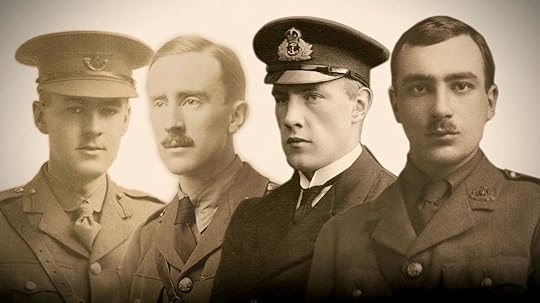
‘The Immortal Four’ members of the TCBS: G. B. Smith, J. R. R. Tolkien, Christopher Wiseman and Rob Gilson
In addition to these biographical details, the book charts Tolkien’s literary output up to around 1919 and the development of his mythology. The book also contains fascinating analyses of early Quenya and Sindarin (or Qenya and Goldogrin as Tolkien called them at the time). These examinations provide just enough detail to satisfy someone with an interest in languages but remain general enough not to put off a non-specialist.
Tolkien and the Great War is an excellent and very informative book about the life and influences of J. R. R. Tolkien. It is essential reading for any Tolkien fan, although it is perhaps not the best starting point for someone unfamiliar with the general details of Tolkien’s life (I would recommend Humphrey Carpenter’s book J. R. R. Tolkien: a biography as a good introduction to Tolkien’s life).
John Garth’s Tolkien and the Great War: The Threshold of Middle-earth Previously Published in Issue 10, Spring 2004, Journal of the Northeast Tolkien Society
Seeing John Garth’s new biography of J. R. R. Tolkien shelved next to many great books on the subject, a prospective reader wonders what Garth could add to the wealth of information. The question evaporates rapidly; reading Tolkien and the Great War is like slipping over a precipice of the Emyn Muil and free-falling into muddy march next to Battalion Signal Officer Tolkien with his closest friends, and then watching as their idealistic dreams and young lives vaporize, disappearing into the shadowy no-man’s land called the Battle of the Somme. J. R. R. Tolkien and his friends, Christopher Wiseman, Rob Gilson, and G. B. Smith, speak often and eloquently in poetry and letters throughout the narration which track their days as intellectual lights at King Edward’s School, and then details their plunge into the World War I abyss. First hand stories from other soldiers and a universe of facts large and small bring Tolkien, his friends, and the surrounding world at war vividly to life. Garth weaves into the account of inspirational fellowship, hope and loss, an absorbing study of J. R. R. Tolkien’s early work and creative development. Art and life fuse as Tolkien’s emerging vision of Middle-earth absorbs the nightmare landscape of the Battle of the Somme.
The interlacing biography of J. R. R. Tolkien and his three greatest young friends begins at King Edward’s School where they formed the Tea Club and Barrovian Society (TCBS): a fellowship based on passionate idealism, creativity and youthful high-jinks. Through mutual inspiration, the society imagined they would reach their fullest artistic potential. They hoped to “kindle a new light” (Garth, 180) in the world, and “re-establish…the love of real and true beauty in everyone’s breast” (Garth, 105) through the influence of their creations. Meanwhile, at King Edward’s they led their classmates and triumphed over their enemies--cynicism, sarcastic irony and decadence. Typically, they indulged in sophisticated word-play, staged debates in Latin and performed Aristophanes in classical Greek.
Garth’s narrative never hurries through the awkward and searching passage of youth. He uses Tolkien’s 1911 poem, “The Battle of the Eastern Field” (a parody of heroic epic style in the form of a glorified soccer match), to illustrate the Edwardians’ impression that sports were a showcase for imaginary combat and war was a sport that could be civil. War, as Rob Gilson proposed, “was not…of the first importance, and…was a scientific contest of calculation rather than of personal prowess” (Garth, 146). From an accumulation of detail it is possible to recognize the enthusiasm and idealistic naïveté of youth and take these young men to heart, investing in their futures. The portrait of their innocence greatly magnifies one’s perception of the tragedy that follows their brief studies at Oxford and Cambridge colleges.
While World War I lurks in the shadowy future, Garth spins the memoir of four intersecting lives together with a highly focused account of J. R. R. Tolkien’s education and creative development. Tolkien’s enviable linguistic education (beginning with standard translation of Latin and Greek poetry into English, extending to include Welsh, Old English, Gothic, Old Norse and Finnish and ending with a profound grasp of comparative linguistic history or philology) explains in part why his work remains unique. Tolkien remarked, “If the main mass of education takes linguistic form, creation will take linguistic form” (Garth, 17). Unfortunately, a later-day writer lacking such a linguistic education may never match Tolkien’s virtuosity in using the English language. Furthermore, one can hardly doubt Tolkien’s claim that he wrote his legends to support his invented languages after reading this biography. Garth cites repeated examples illustrating Tolkien’s philological method which involved working back from mysterious ancient words to infer meanings and then grounding them on reasonably imagined legends. He worked, for instance, from the name Eärendel, to “The Voyage of Eärendel the Evening Star”, to the legendary character in his mythology. On the other hand, Garth looks back frequently to Tolkien’s Quenya lexicon for clues to understanding his mythology. Looking for the meaning of Illùvatar’s “Secret Fire” that animates creation in “The Music of the Ainur”, for example, he finds that the Quenya word “Sā” means fire but is also the mystic name of the Holy Ghost. Finally, a sound shift Tolkien manufactured between Quenya and his later invented Goldogrin demanded an explanation, so he built philologically reasonable legends to support the language. In the end though, all of the legends lead back to war and “unnumbered tears” (Garth, 241).
Returning to John Garth’s interlacing chronicle of J. R. R. Tolkien and his three friends who were braving the ordeals of world war, one often finds echoes of The Lord of the Rings. As Tolkien did in his epic, Garth takes pains to indicate the relative positions of the TCBS and the time (sometimes down to the minute) of their struggles in the Battle of the Somme. He describes the approach to enemy strongholds and the landscape surrounding scenes of action as if he had been there. In addition, people who have poured intermittently over maps of Middle-earth while reading The Lord of the Rings may experience déjà vu studying Garth’s maps of the Battle of the Somme. They show the contours of the Western Front on the Somme along with the location of trenches and German strongholds, paths of marches, and important dates with the locations of the TCBS.
Adding first hand accounts from other soldiers, Garth puts a reader directly into the surreal landscape of battle. He quotes Edmund Blunden who describes the “ghastly gallows-trees” (Garth, 186) of Thiepval Wood where J. R. R. Tolkien spent time in a dugout between August 24 and August 26, 1916. Another soldier, Charles Douie adds, “The wood was never silent, for shell and rifle fire echoed endlessly through the trees…At night the flares, as they rose and fell, threw the wood into deeper shadow and made it yet more dark and menacing.” Such traumatized impressions of dark and light could certainly have fed Tolkien’s fascination with shadow and various manifestations of light in his mythology. The image of blinding light shining through a mesh of gallows-trees would not be alien to Middle-earth.
Moreover, Tolkien’s memory of “endless marching, always on foot” and the fact that he had gathered his belongings to move forty-five times between June 27 and October 24, 1916 reminds one of the heroes’ journey in The Lord of the Rings. Like Tolkien’s literary heroes, the marching TCBS were always mindful of mortality and their still unfulfilled mission to bring a new light into the world. In a passage reminiscent of Frodo handing the Red Book of Westmarch over to Sam, the aspiring poet G. B. Smith wrote to Tolkien: “may you say the things I have tried to say long after I am not there to say them, if such be my lot.” As Garth’s biography reveals, J. R. R. Tolkien took to heart the mission his friends assigned him by building his visionary poetry into a mythology of light and then weaving the mythology into his heroic epic of good and evil.
Garth dares to give each of J. R. R. Tolkien’s early poems careful consideration and room to breathe as they emerge from the timeline of the biographical narrative. This gift of time and space allows one the rare pleasure of contemplating Tolkien’s nascent luminous mystic landscape in microcosmic form. Slipping across the border from the darker wartime narrative, a reader may stand momentarily transfixed in the transcendent setting of Kôr with its “sable hill, gigantic…gazing out across an azure sea / Under an azure sky…marble temples white…dazzling halls…tawny shadows [and] massy trees rock-rooted in the shade”. This sublime world in miniature would evolve into “white shores and…a far green country under a swift sunrise”: Frodo’s first perception of the Undying Lands at the conclusion of The Lord of the Rings. Tolkien’s visionary poetic landscape keeps reappearing suspended in Garth’s narrative at mantra-like intervals. These distillations of color and light remind the reader repeatedly of what is sacred and eternal in humanity, thereby illuminating the surrounding mournful account of crushed dreams and muddy dismembered bodies with unbearable poignancy. Vistas symbolic of a soul’s longing for eternal beauty, they hover distressingly near to scenes of “the lost of the Somme”: the remains of 20,000 British victims of machine gun and shell fire felled on July 1, 1916 and still “lying around” after three weeks in a “forest of barbed wire…thick with bodies, their faces purple-black.” The tension between these two landscapes of war and transcendence intensifies the impact of both on the reader.
As war approaches and for the duration of Tolkien’s active service on the murderous Somme, Garth portrays him as dwelling on the intersecting borders of these two landscapes. Tolkien’s poetic landscape seems to shimmer and tremble like a perfect tear on the verge while the distorted Somme landscape and a disillusioned world appear to press in on all sides. However, an entire legendarium lay encoded at the still center of Tolkien’s mystical landscape. With the ending of his active duty on the Somme, Tolkien wrote the pivotal prose narration of “The Fall of Gondolin.” Garth’s analysis of this work creates a powerful image of Tolkien’s poetically encoded seed “quickening” to send radiating green roots and shoots snaking through the colorless, chaotic landscape of the Somme and bringing a timeless perspective to the universal experience of conflict and suffering.
To annihilate Gondolin, the Elvish haven and monument to the memory of unstained paradise, Tolkien’s most powerful fallen angel, Melko, manufactures iron dragons. According to Garth, these creatures “violate the boundary between mythical monster and machine, between magic and technology.” Tolkien describes them as moving on “iron so cunningly linked that they might flow…around and above all obstacles before them”. Garth quotes a German account of a British tank on the Somme that likens it to a “monster,” an “iron caterpillar” driven by a “supernatural force,” and the “devil’s chariot.” The devastating battle in Gondolin between the Elves and Melko’s iron dragons certainly evokes some aspects of World War I: a lethal war of men against machines. Garth’s study of “The Fall of Gondolin” also includes a striking insight into the use of fantasy as it exaggerates the state of humanity and therefore may warn about radical forms of human behavior such as totalitarianism. This is just one of many interesting observations Garth makes about J. R. R. Tolkien’s work.
As with the poetry, the focus of this biography on a short span of years allows John Garth the luxury of reflecting at length on Tolkien’s prose inventions individually as they arrive in the narrative of time. Tolkien’s creation myth, “The Music of the Ainur” is, according to Garth, an effort to find an unexpected blessing attached to the fact that God’s creation is tragically flawed. Garth introduces the Valar (Tolkien’s unfallen angels), explains their mission as guardians of the created world, and notes that Melko arrives in that world before them. Continuing, Garth makes the incandescent statement that Melko’s “ensuing conflict with the Valar makes a whole history out of the biblical declaration, ‘Let there be light’.” He goes on to illustrate the point. There are also comparisons to Milton and The Bible in Garth’s discussion of the “fall” as it occurs in Tolkien’s The Book of Lost Tales, and the reader will find many other thought provoking ideas in Garth’s analysis of Tolkien’s cosmic myth.
Turning to Tolkien’s romantic fairy-stories, Garth gives his full and appreciative attention to “The Tale of Tinúviel” and “Turambar and the Foalókë” (treasure-hoarding serpent). There are many interesting facets to Garth’s analysis of these two tales, but his focus on Tolkien’s attitude toward prejudice, mockery and the destructive use of irony is most compelling. Beginning with Tinwelint’s mockery of Beren and Beren’s ultimate answering jest in “The Tale of Tinúviel” and then continuing with the dragon Glorund’s sadistic enjoyment of irony in “Turambar and the Foalókë”, Garth’s discussion pulls the reader into the stories and highlights one of the evils J. R. R. Tolkien wanted to undo in this world.
On a more general level, Garth’s compression of The Book of Lost Tales illuminates shifts in Tolkien’s mythology and the reasoning behind those shifts that may stretch out over two volumes of The History of Middle-earth. His clarifications would be helpful to readers of The Book of Lost Tales who become confused when Eriol living in the Dark Ages becomes Ælfwine possibly living in the eleventh century, and when Tol Eressëa shifts from symbolizing Britain to representing a separate island far west of the British Isles. Garth also makes it easy to follow the devolution of Tolkien’s legendarium from myth, to romantic fairy-stories, to their intersection with Germanic sea-legends at the outer limit of recorded history.
In his postscript, John Garth sets out to demonstrate a connection between Tolkien’s World War I experience and his art--an argument that seems like a forgone conclusion after reading the biographical narrative. What Garth really forges in the postscript is a layered, instructive and convincing case for J. R. R. Tolkien’s legitimate place beside other authors from the history of great literature. He names the writers and describes the two literary styles (modernism, and classic World War I literature of protest and dark unflinchingly focused realism) that dominated post World War I literature. Then he explains the reasons why those authors rejected heroic epic and high diction, and the reasons why Tolkien defied this trend.
Tolkien, like his wizard Gandalf, always had good reason for his choices. Frodo and Sam, on their sacrificial quest in The Lord of the Rings, found a “desolation that lay before Mordor” “more loathsome” than the Dead Marches with their “Many faces proud and fair…all foul, all rotting, all dead.” Called “Noman-lands,” this new hell was a “land defiled, diseased beyond all healing” where the heroes saw themselves as helpless “little squeaking ghosts”. Here Tolkien bears witness to the horrors and the heroic acts of ordinary soldiers he saw in “No Man’s Land,” the desolate expanse of mud where two of his dear friends died tragically with so many others during the Battle of the Somme. Garth points to John Milton and William Blake as Tolkien’s predecessors who, like him, sought to refine the chaotic and tormenting details of their existence into the long perspective of an organizing myth.
In Garth’s biography, Tolkien states that human misunderstanding arises from a “clash of backgrounds” and “It is the tragedy of modern life that no one knows upon what the universe is built to the mind of the man next to him”. Tolkien may have offered a type of bridge between backgrounds with his legendarium. As Joseph Campbell (a master of comparative mythology) explains in his book The Inner reaches of Outer Space, mythological communication conveys “through all its metaphorical imagery…a sense of identity…which unites behind the scenes the opposed actors on the world stage.” This observation points to the relevance of Tolkien’s search for an organizing myth as activities in the theater of twenty-first century living take on global dimensions.
Tolkien’s use of high diction in the context of myth and legend was another choice made with good reason. As Garth’s biography reveals, Tolkien had a deep appreciation for the migration of meaning in language and he understood that language collects attributes such as ‘the memory of good and evil” that are irreplaceable and merit preservation. This was especially true for him in a time when many people denied the existence of absolute evil, seeing it only as a variable symptom of inadequate socialization. According to John Garth, the authors George Orwell, Kurt Vonnegut, William Golding, and Tolkien all turned to fantasy as a means of redefining evil. Tolkien’s evils and Garth’s discussion of them are thought provoking. Those evils include: disenchantment, materialism, the dominance of machines over nature, tyranny and orthodoxy, passive acceptance of defeat, and nihilistic application of the ironic viewpoint to art and life.
In addition, according to Garth’s book, J. R. R. Tolkien perceived that World War I was just a symptom of the great evil, materialism. Joseph Campbell was another thinker who pinpointed “radical materialism [as the force in the nineteenth century that caused] anything like the functional grounding of a social order in a mythology [to disappear] into irrelevance.” In other words, materialism removed the possibility of “opposed actors on the world stage” finding anything in common through the unifying potential of myth. These insights regarding the destructive potential of materialism are important to consider now as the world searches for an antidote to terrorism and the Middle-Eastern War.
Looking back at Tolkien’s catalogue of scourges, one might venture to say that J. R. R. Tolkien and orthodoxy could stand as opposites, and it is interesting to think of a universally accepted ironic viewpoint and modernism as forms of orthodoxy. Tolkien’s statement in Garth’s biography regarding his “instinct…to cloak such self-knowledge as he has, and such criticisms of life as he knows it, under mythical and legendary dress” brings to mind authors such as Gabriel García Márquez who express their opinions of oppressive political regimes by cloaking their meanings in magical-realism. Tolkien’s cloak woven of heroic myth and fairy-story serves well his mission to re-spiritualize creation; it sneaks his message under the radar of almost universal modern-day skepticism. Probably, this is why readers still love his books without fully understanding their reasons and why they might find themselves searching through Beowulf, Elvish lexicons, and all of the literature about Tolkien to understand their fascination and to keep the spell intact.
Now those readers can add John Garth’s biography to the collection of great books about J. R. R. Tolkien and about the Great War. Anyone who has not yet read first hand accounts of the Battle of the Somme will have a poignant revelation reading this book. Readers interested in J. R. R. Tolkien’s work and the forces that influenced his artistic development will have a mind-expanding journey. Those who value J. R. R. Tolkien’s voice and spirit will get much closer to a beloved companion. Multiple readings of Tolkien and the Great War do not diminish its power to move the reader emotionally, intellectually and spiritually. After reading Garth’s book once, or many times, all will find the world taking on elegiac colors that linger and inform stories and news of the world for a long time. The universe of readers owes a debt of gratitude to J. R. R. Tolkien’s family and all the individuals who shared the letters, poems and first hand accounts that animate this story of war, friendship, and the evolution of a singular artistic vision. Along with the tales from J. R. R. Tolkien’s own incomparable pen, this book is a gift to treasure always.