The Swiss writer Friedrich Dürrenmatt (1921–90) was one of the most important literary figures of the second half of the twentieth century. During the years of the cold war, arguably only Beckett, Camus, Sartre, and Brecht rivaled him as a presence in European letters. Yet outside Europe, this prolific author is primarily known for only one work, The Visit. With these long-awaited translations of his plays, fictions, and essays, Dürrenmatt becomes available again in all his brilliance to the English-speaking world.
This second volume of Selected Writings reveals a writer who may stand as Kafka’s greatest heir. Dürrenmatt’s novellas and short stories are searing, tragicomic explorations of the ironies of justice and the corruptibility of institutions. Apart from The Pledge, a requiem to the detective story that was made into a film starring Jack Nicholson, none of the works in this volume are available elsewhere in English. Among the most evocative fictions included here are two novellas: The Assignment and Traps. The Assignment tells the story of a woman filmmaker investigating a mysterious murder in an unnamed Arab country and has been hailed by Sven Birkerts as “a parable of hell for an age consumed by images.” Traps, meanwhile, is a chilling comic novella about a traveling salesman who agrees to play the role of the defendant in a mock trial among dinner companions—and then pays the ultimate penalty.
Dürrenmatt has long been considered a great writer—but one unfairly neglected in the modern world of letters. With these elegantly conceived and expertly translated volumes, a new generation of readers will rediscover his greatest works.
Friedrich Dürrenmatt (1921 – 1990) was a Swiss author and dramatist.
Dürrenmatt was born in the Emmental (canton of Bern), the son of a Protestant pastor. His grandfather Ulrich Dürrenmatt was a conservative politician. The family moved to Bern in 1935. Dürrenmatt began to study philosophy and German language and literature at the University of Zurich in 1941, but moved to the University of Bern after one semester. In 1943 he decided to become an author and dramatist and dropped his academic career. In 1945-46, he wrote his first play, "It is written". On October 11 1946 he married actress Lotti Geissler. She died in 1983 and Dürrenmatt was married again to another actress, Charlotte Kerr, the following year.
He was a proponent of epic theater whose plays reflected the recent experiences of World War II. The politically active author gained fame largely due to his avant-garde dramas, philosophically deep crime novels, and often macabre satire. One of his leading sentences was: "A story is not finished, until it has taken the worst turn". Dürrenmatt was a member of the Gruppe Olten.
Review of The Sausage ("Die Wurst") from this collection.
A short story, told in very short sentences. It opens: “A man murdered his wife and made her into a sausage. Gossip denounced him. The man was arrested. ”
A courtroom drama follows. The sexual symbolism of a soft, steaming sausage becoming firm and squirting is comically absurd. It’s also unsubtle and puerile.
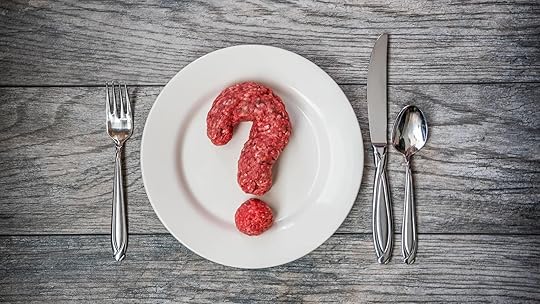
The story ends: “The world becomes a monstrous question mark.” That reflects debate in the group about what actually happened to said sausage.
Image: Ground meat, rolled into a sausage and twisted into a question mark, on a plate, with a knife and fork beside (Source)
See also
This reminded me of Nikolai Gogol’s The Nose, which I reviewed HERE.
As part of the Short Story club here on Goodreads, I read one story from this author: "The Sausage."
Thanks to the organizer, Cecily, two translations were provided, side by side. One from Alberto Manguel, and the other from google. Generally, I preferred Manguel's phrasings; however, since I am unable to read the original German I have no idea what the author intended. These two translations did offer a glimpse into the difficulties, and nuances, of translating works of literature.
The story itself is surreal, and evocative. What does it evoke? Confusion, the arbitrary exercise of power, and an overwrought imagination.
Only read "The Sausage" for GR short story group +++++++++++++++++++++
It may not be the wurst thing I've ever read, but this strange bit of absurdity about a wife-killing cannibal and his tasty sausage at their day in court did very little for me. Oh well...