Jump to ratings and reviews
Rate this book

Amours nomades

Rate this book
Écrites au début du XXᵉ siècle au coeur du Maghreb et nourries de l'intimité qu'Isabelle Eberhardt partage avec les gens du désert, ces vingt nouvelles décrivent le désespoir de la passion amoureuse devant les interdits du clan et la fragilité humaine.À travers ces amours mixtes "Orient-Occident" réprouvées par les deux cultures, précurseurs, fragiles et vouées au drame, quand elles ne sont pas transcendées par la foi, l'auteur, comme dans un miroir, est au plus près de lui-même.Ce récit est le fruit de sept années d'errance dans le désert, d'une jeune femme qui usa d'une double identité. Ainsi, quand elle meurt en 1904, à l'âge de vingt-sept ans, noyée dans la crue d'un oued, est inscrit sur sa tombe : Isabelle Eberhardt, écrivain, Mahmoud Saadi, baroudeur mystique du Sahara.En proposant une nouvelle lecture de son oeuvre, les "Éditions du Centenaire" veulent perpétuer son souvenir...

192 pages, Paperback

Published March 20, 2003

3 people are currently reading
72 people want to read

About the author

Isabelle Eberhardt

59 books160 followers
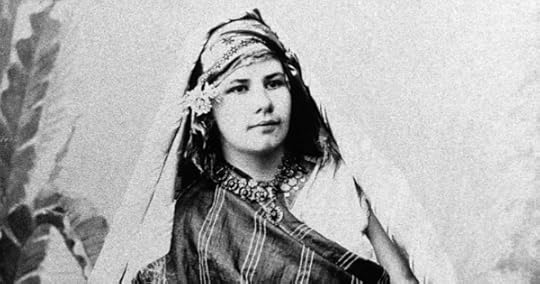
Isabelle Eberhardt was a Swiss-Algerian explorer and writer who lived and travelled extensively in North Africa. For the time she was an extremely liberated individual who rejected conventional European morality in favour of her own path and that of Islam. Dressed as a man, calling herself Si Mahmoud Essadi, Eberhardt travelled in Arab society, with a freedom she could not otherwise have experienced. She died in a flash flood in the desert at the age of 27.

Ratings & Reviews

What do you think?
Rate this book

Friends & Following

Create a free account to discover what your friends think of this book!

Community Reviews

5 stars
5 (10%)
4 stars
16 (34%)
3 stars
15 (31%)
2 stars
8 (17%)
1 star
3 (6%)
Displaying 1 - 9 of 9 reviews
Profile Image for Warwick.
Author 1 book15.4k followers
April 18, 2016

Je dépensais follement ma jeunesse et ma force vitale, sans le moindre regret.
(I spent my youth and my vital force in a frenzy, without the least regret.)


Isabelle Eberhardt's life was a biographer's dream: wild, unconventional, romantic – and short. Born to a Russian family in Geneva in 1877, she seemed from the very beginning to be unsatisfied with almost every aspect of her person: nationality, name, religion and gender, all would be reinvented. Early stories and letters were signed ‘Nicolas Podolinsky’, ‘Mahmoud Saadi’, or a variety of other pseudonyms, most of them male.

North Africa was her obsession from a young age. She first moved there when she was twenty, quickly picking up the local Arabic and converting to Islam; dressed as a man, she would spend nights exploring the docks, the brothels, the less salubrious parts of the medina. As she says in one of these semi-autobiographical sketches:

Je connaissais un nombre infini d'individus tarés et louches, de filles et de repris de justice qui étaient pour moi autant de sujets d'observation et d'analyse psychologique. J'avais aussi plusieurs amis sûrs qui m'avaient initiée aux mystères de l'Alger voluptueuse et criminelle.

I knew an infinite number of girls, ex-cons and cracked, dubious characters who for me were so many subjects of observation and psychological analysis. I also had many trusted friends who had initiated me into the mysteries of Algiers's voluptuous and criminal side.


She uses grammatically feminine forms to refer to herself there (qui m'avaient initiée), although in her own diaries she usually writes in the masculine, French being a language unlike English where one's gender has always to be reflected in everything one says. Most of the stories in this collection have a male protagonist, and it's clear that these restless, doomed alter-egos are Eberhardt's most faithful projections of herself: lonely but wise.

La tête appuyée sur son bras replié, les membres las, il s'abandonnait à la douceur infinie de s'endormir seul, inconnu parmi les hommes simples et rudes, à même la terre, la bonne terre berceuse, en un coin de désert qui n'avait pas de nom et où il ne reviendrait jamais.

Head pressed against his folded arm, limbs heavy, he gave himself up to the infinite sweetness of sleeping alone, unknown among simple, rustic men, against the ground – the good, soothing ground – in a corner of the desert which had no name and which he would never see again.


If I had read these stories when I was eighteen or nineteen, when I was living in Morocco and in the throes of my own melancholy North African ecstasy, then I think this could easily have become one of my bibles; even now, a lot of the passages here give me this great heaving of nostalgia and love. Her affinity with ‘le dédale silencieux des rues arabes’, her visceral reaction to the Arabic of the call to prayer heard at dusk, her attempt to reconcile the sadness and the beauty, the tristesse and the douceur, of Algeria – all these things are captured with a frenzied clarity. Her descriptions of the Maghreb shift between reportage and proto-Orientalist awe, everything intensely felt.

La vie musulmane est ainsi faite, toute de discrétion, de mystère, de respect des vielles coutumes, et surtout de soumission patriarcale.

That's what Muslim life is composed of – all discretion, mystery, respect for old customs, and, above all, patriarchal submission.


Interestingly, when Eberhardt herself fell in love – with a poor Algerian soldier – she was perfectly happy to drop the male disguise for good and live in a more or less conventional couple (as often as she and her partner were able to). Somehow, in those days before identity politics, though it was a rarer thing to dress as the opposite sex, in some ways it was also less of a big deal: she could drop it at a moment's notice without feeling any conflict or any need to explain herself. It didn't ‘mean’ something in the same way that it does now (you can see why Eberhardt has been rediscovered by modern scholars).

They married in Marseille when she was twenty-four. Just three years later an overnight flash-flood knocked through the building they were staying in; he survived, but Isabelle was killed. Very few of her writings had yet been published. Fortunately, her editor at one of the newspapers, Victor Barrucand, took it upon himself to gather up and organise her papers, leading to several posthumous editions of poems, stories and journals.

What would have become of this talent if it had been allowed to mature is difficult to imagine; as it is, her writing blows through you like a sirocco of youthful wonder and wanderlust from someone who, to the extent that she had yet understood any of the world's conventions, had no intention of following a single one of them.
Profile Image for Daniel Mercier.
45 reviews1 follower
February 1, 2025
dnf

J’aime beaucoup beaucoup mais j’arrive pas à m’accrocher quand l’histoire est pas continue à travers les chapitres. Chaque histoire est douce et jolie mais aussi sombre et déprimante.
Profile Image for Clara.
52 reviews
July 19, 2024
« Le Vagabond ne regrettait plus rien. Il ne désirait que l’infinie durée de ce qui était. » (116)
Profile Image for Carlos Eliseo Ortiz.
60 reviews
December 16, 2017
This book presents a selection from the fascinating journal of adventurer and writer Isabelle Eberhardt (1877–1904), stories of her life in Algeria as a man. (Her story reminds me of Catalina de Erauso.) The quote below captures the essence of the story. (Translation via Google follows.)
"Les nomades étaient partis, sans un regard de regret pour ce coin de pays où ils avaient vécu quelques semaines.
Sur l’emplacement désert des campements, des tas de cendre grise et des monceaux d’ordure attestaient seuls le séjour de tous ces hommes qui, après avoir dormi, mangé, aimé, ri et tué ensemble, s’étaient séparés, le cœur léger, peut-être pour toujours.” (105)
"The nomads were gone, without a look of regret for this corner of the country where they had lived a few weeks.
On the deserted camp site, heaps of gray ash and heaps of garbage bore witness to the stay of all those men who, having slept, eaten, loved, laughed and killed together, had separated, with a light heart, maybe forever.”
1,207 reviews5 followers
May 18, 2021
Isabelle Eberhardt est une femme exceptionnelle. Je l'ai découverte il y a peu à travers ses Notes de route:Maroc-Algérie-Tunisie rééditées aux éditions Aquilon cela a été une révélation. Amours nomades m'a été suggéré par la critique d'Isanne je suis ravie.
12 nouvelles parues entre 1900 et 19O4, 12 textes pleins d'amour, de joie et de drame, 12 textes pleins de la beauté de ces terres ensoleillées, 12 textes qui nous parlent de ces hommes et de ces femmes qu'isabelle Eberhardt a pris le temps de découvrir, de connaitre et d'apprécier.
Profile Image for Boukhalfa Inal Ahmed.
483 reviews17 followers
Read
October 14, 2020
L'écriture est belle et limpide. Les nouvelles sont belles par leur contenu, par les couleurs et leur mélancolie sous jacente.
A lire pour s'évader, pour rencontrer un pays par les yeux d'une femme déguisée en homme
Profile Image for Paul B.
177 reviews11 followers
June 25, 2020
Drames amoureux, d’exile et de voyages, lecture facile qui transporte le temps de quelques pages dans une Afrique du Nord entre deux époques, entre Berbères, Kabyles, Maures et colons.
80 reviews2 followers
May 22, 2020
I liked it OK but nothing to ride home about. I found too much resemblance in the short stories.
Displaying 1 - 9 of 9 reviews

Can't find what you're looking for?

Get help and learn more about the design.