Written in 1928, The Set-Up is a long narrative poem about the boxing underworld - a hard-boiled tragedy told in syncopated rhyming couplets. When the work was first published it made the bestseller list, and in 1949 it was turned into an award-winning film featuring Robert Ryan and Audrey Totter.
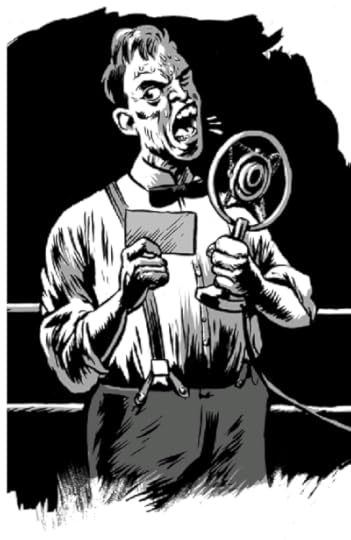
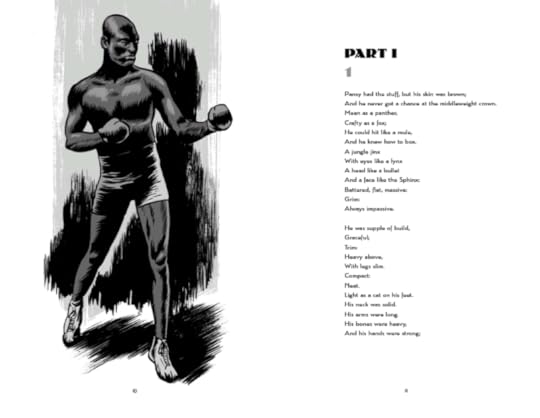
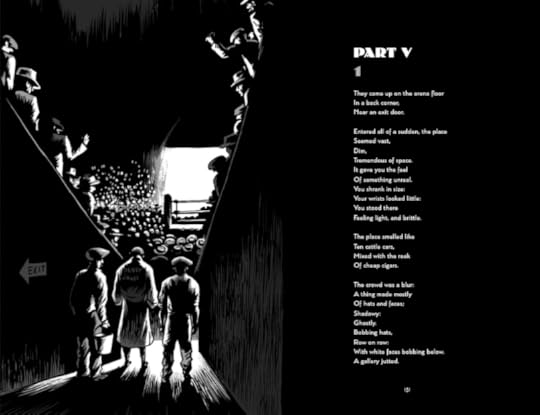
This reprinting of the original, unchanged 1928 poem features dynamic, specially commissioned artwork by Erik Kriek that vividly conveys the story of Pansy, an up-and-coming black prizefighter who takes on all comers. When he was in the ring, "It was over before you knew it. He'd carve you up like a leg of mutton. And drop you flat with a sock on the button."
Pansy's complicated love life leads to a spell in prison and his career subsequently takes a nosedive, but he continues to box until the fateful night his fight managers and opponent triple-cross him and he meets a grisly end at the hands of a vengeful gang.
After serving in World War I and graduating from Amherst College (where he was a protégé of Robert Frost), March worked as managing editor for The New Yorker in 1925, and helped create the magazine's "Talk of the Town" front section. After leaving the magazine, March wrote the first of his two important long Jazz Age narrative poems, The Wild Party. Due to its risqué content, this violent story of a vaudeville dancer who throws a booze and sex-filled party could not find a publisher until 1928. Once published, however, the poem was a great success despite being banned in Boston. Later in 1928, March followed up The Wild Party's success with The Set-Up, a poem of a skilled black boxer who had just been released from prison.
In 1929, March moved to Hollywood to provide additional dialogue for the film Journey's End and, more famously, to turn the silent version of Howard Hughes' classic Hell's Angels into a talkie — a rewrite that brought the phrase "Excuse me while I put on something more comfortable" into the American lexicon. March stayed with Hughes' Caddo Pictures studio for several years, temporarily running the office, overseeing the release of Hell's Angels, and getting into legal trouble after an attempt to steal the script for rival Warner Bros.' own flying picture Dawn Patrol.
March worked as a screenwriter in Hollywood until 1940, under contract to MGM and Paramount and later as a freelancer for Republic Pictures and other studios; he wrote at least 19 produced scripts in his Hollywood career. His most prominent late script is probably the left-leaning John Wayne curio Three Faces West, a knockoff of The Grapes of Wrath that ends with a faceoff between Okies and Nazis.
With his third wife, Peggy Prior (a Pathé screenwriter) and her two children, March returned to the East Coast in 1940. During World War II, he worked at a shipbuilding plant in Groton, Connecticut, and wrote features (mostly acid assessments of the movie business) for the New York Times Magazine. In later years, he wrote documentaries for the State Department and industrial films for Ford Motor Company, General Motors, Monsanto Company, American Airlines, and others. Several films starring industrial films icon Thelma "Tad" Tadlock, including Design for Dreaming (1956) and A Touch of Magic (1961) were made from March's rhyming scripts. March died in 1977.
March revised both The Set-Up and The Wild Party in 1968, removing some anti-Semitic caricatures from both works. Most critics deplored these changes, and Art Spiegelman returned to the original text when he published his illustrated version of The Wild Party in 1994. (The Set-Up has not been reprinted since 1968.)
Works and legacy: Both of March's long poems were made into films. Robert Wise's 1949 film version of The Set-Up loses the poem's racial dimension by casting the white actor Robert Ryan in the lead, while the Merchant Ivory Productions 1975 version of The Wild Party changes March's plot to conflate the poem with the Fatty Arbuckle scandal.
The Wild Party continues to attract new readers and adaptations. In 2000, two separate musical versions played in New York, one on Broadway, composed by Michael John LaChiusa, and the other off-Broadway, composed by Andrew Lippa, with mixed critical and popular success. The Amherst College library's large collection of March's papers includes unpublished poems, scripts, and a memoir entitled Hollywood Idyll.
A new reprint of a 'lost classic' from the 1920s, The Set-Up is a long narrative poem by Joseph Moncure March (known from cult classic The Wild Party, which I haven't read), beautifully illustrated in this edition by Dutch artist Erik Kriek.
I come from a theatre background, and I have a strong affinity with poetry, but I found this hard to get into. It feels overly long, and while the '20s dialogue is interesting, it can't carry what feels like a piece missing tension.
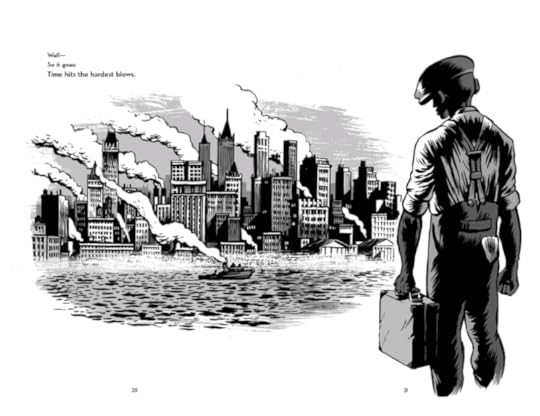
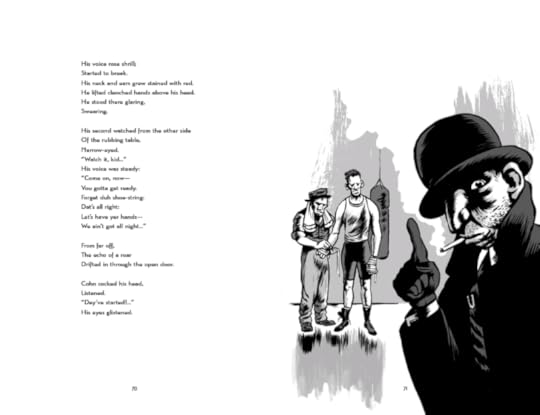
That said, Erik Kriek's illustrations are top notch, and should be reason enough to want to read this.
(Thanks to Korero Press for providing me with an ARC through Edelweiss)
Bij toeval gevonden, maar wat een lucky find. De cover omschrijft het als een ‘lost classic’ en dat klopt ook.
The Set-Up, geschreven in de jaren ‘20 door Joseph Moncure March en in deze recente uitgave geïllustreerd door Erik Kriek, is een bijzonder sfeervol boksepos bestaande uit korte, ritmische en rijmende verzen. De gritty atmosfeer druipt echt van elke pagina.
Ons leeshart maakte een vreugdesprongetje toen we ontdekten dat er een door Erik Kriek geïllustreerde uitgave van werk van Joseph Moncure March aankwam. We lazen eerder zijn wervelend prozagedicht 'The Wild Party', in een door Art Spiegelman geïllustreerde versie, en zijn daar nog steeds razend enthousiast over. Beat poet & cultheld William S. Burroughs zei trouwens dat The Wild Party hem inspireerde om schrijver te worden.
The Set-Up is een lang verhalend gedicht over het wedervaren van bokser Pancy Jones die na een tijd in de gevangenis weer de ring intrekt. De titel laat al vermoeden dat het niet om een glorieuze wedstrijd om het wereldkampioenschap gaat, maar een rauw gevecht wordt in een groezelige, verweerde bokszaal vol schimmige figuren, zweterige lijven en heimelijke afspraken.
Joseph Moncure March slaagt er in de rauwe bokserswereld in ritmische, snedige taal tot leven te wekken. De korte, wat ruwe maar smakelijke zinnen lijken zo uit de Bronx te komen en schetsen duidelijk de rand van de samenleving waaruit ze vandaan komen. De rake en spitse tekst sleurt je helemaal mee naar de versleten kleedkamers en wankele tribunes, de verschaalde geur van spuwbakjes zweemt tussen de witregels en bokserszweet lijkt zo van de bladzijden te spatten. Wanneer Pansy de ring induikt, kan je al lezer de mokerslagen voelen landen. Zo wordt je pijlsnel en genadeloos mee naar een strakke, confronterende plot gesleurd. Straf.
Ook als confronterend tijdsdocument kan The Set-Up gelden. Pansy is een zwarte bokser en het boek dateert van 1928. Meer hoeven we daarover niet te zeggen, me dunkt.
I really wanted to give this a five star rating due to it's well crafted narrative which is completely fleshed out in poem for of rhyming couplets. It's style is excellent as is the descriptions and characterisations that appear throughout. Another positive is the shiny new artwork which accompanies, and complements the poetry well. It has been added in recent years with barely a few pages being left as purely text and weaves more life to it's already engaging, yet gritty, atmosphere. The scene changes are portrayed well to suit the noir style and the fight scenes are particularly well detailed with the odd bit of boxing terminology mixed in.
Given it's original time of writing, I had to dismiss the racial slurs and colloquialisms of the era, but the story makes you root for our unwitting hero who is literally being 'Set up' as the title suggests. Having the classic noir style ending where nobody wins was particularly bleak in this case and I hope it serves purely to highlight the lack of respect via racial inequality of years long gone. With near zero character progression with very little options to divert for our hero MC, I can't quite give it full marks.
That said, this is certainly a piece of history that should be noted as it encapsulates important moments of social (dis)grace of the time. A lengthy, clever narrative poem that certainly doesn't pull its punches in the display of old school crime.
I enjoyed this more than expected, admittedly I only bought this because I loved the cover and thought the illustrations inside were beautiful, but the poetry is absolutely fantastic the whole way through. I've been quite skeptical about long-form narrative poetry before because I just didn't get how that would work, but this has definitely shown me how it can be just as good as any other storytelling format. I'd be willing to wager that there's more emotion, more depth of plot and character in this than a lot of books out there, all while fitting into the snappy rhythmic structure of poetry. Written in 1928 yet loses none of its punch today, the language and atmosphere fits the grimy, seedy world it portrays with such veracity, it's easy to get enraptured by it within the first few verses. It takes you on a personal and emotional journey, really took me by surprise and certainly will be something I'll happily return to for future re-reads.
The artwork is insanely cool. Amazing piece of art, the whole thing. Written in long form rhyming poetry/prose, it’s a quick yet punchy read. Got through it in an hour. Gritty, action packed story. Again, the artwork is awesome.
While the poetry is a little forced in places, it's a good enough long-form poem describing boxing in New York in the 1920s and is atmospherically illustrated by Erik Kriek. I read it in a single sitting, which is probably the only way to go to keep the momentum of the poem and storyline intact.
Very interesting piece of Americana. I love formatting the long-form narrative poem with illustrations to supplement the text, that was very well done. Not quite sure what to make of the story, but the rhythm of the poetry was good, and the dialogue/idiolect was very evocative of its time and place. I've been reading a lot of epic poetry over the past few years, and this is a fascinating play on some of those narrative/formal conventions.