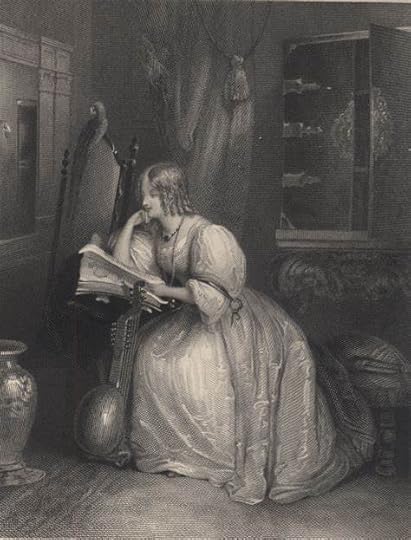
This illustrated version of Mary Shelley's classic short story, The Invisible Girl, is perfect for the fall season. Including gorgeous line and block prints from the period to illuminate the tale, Henry and Rosina's Gothic love story is a classic.
Mary Shelley (née Mary Wollstonecraft Godwin, often known as Mary Wollstonecraft Shelley) was an English novelist, short story writer, dramatist, essayist, biographer, travel writer, and editor of the works of her husband, Romantic poet and philosopher Percy Bysshe Shelley. She was the daughter of the political philosopher William Godwin and the writer, philosopher, and feminist Mary Wollstonecraft.
Mary Shelley was taken seriously as a writer in her own lifetime, though reviewers often missed the political edge to her novels. After her death, however, she was chiefly remembered only as the wife of Percy Bysshe Shelley and as the author of Frankenstein. It was not until 1989, when Emily Sunstein published her prizewinning biography Mary Shelley: Romance and Reality, that a full-length scholarly biography analyzing all of Shelley's letters, journals, and works within their historical context was published.
The well-meaning attempts of Mary Shelley's son and daughter-in-law to "Victorianise" her memory through the censoring of letters and biographical material contributed to a perception of Mary Shelley as a more conventional, less reformist figure than her works suggest. Her own timid omissions from Percy Shelley's works and her quiet avoidance of public controversy in the later years of her life added to this impression.
The eclipse of Mary Shelley's reputation as a novelist and biographer meant that, until the last thirty years, most of her works remained out of print, obstructing a larger view of her achievement. She was seen as a one-novel author, if that. In recent decades, however, the republication of almost all her writings has stimulated a new recognition of its value. Her voracious reading habits and intensive study, revealed in her journals and letters and reflected in her works, is now better appreciated. Shelley's recognition of herself as an author has also been recognized; after Percy's death, she wrote about her authorial ambitions: "I think that I can maintain myself, and there is something inspiriting in the idea". Scholars now consider Mary Shelley to be a major Romantic figure, significant for her literary achievement and her political voice as a woman and a liberal.
I was glad to find a few short stories by Mary Shelley on my book app and started with this one. It was good, but not great. Felt like something I've read many times before
I enjoyed this sort of gothic fairy tale. The narrator comes upon a watercolor painting in “what seemed a ruined tower, crowning a bleak promontory overhanging the sea, that flows between Wales and Ireland.”
The painting is of a lovely and innocent young girl, and we learn the story behind the picture, involving desperate sailors, a blind (literally and figuratively) guardian, an evil aunt, and two young lovers kept tragically apart.
But there is hope. “ … if we can make yonder light, we are saved!”
When faced with thwarted love, misery, longing, and threatening storms, belief in true love, belief in the existence of a guiding light might see us through the darkness.
I was in the mood for a short gothic romance. I also wanted to experience more of Mary Wollstonecraft Shelley's writing after being very impressed with "Frankenstein." This tale had lots of the usual gothic elements--a poor orphaned heroine, a stubborn guardian, a loving hero, a dark tower, a raging storm, a wave-swept boat, and a possible ghost. The frame made "The Invisible Girl" seem more credible. Gothic tales are a bit over the top, but fun to read! 3.5 stars.
I think there is an understated quality to this short work from Mary Shelley that I really loved. I hadn’t heard of this title but became familiar with it during a recent group read. What I really like about Mary Shelley is her writing style, and there are definitive similarities to Frankenstein in some aspects of how she presents the tale here.
In the story, there is a ghostly figure who resides and apparently haunts a tower, and she is dubbed “the invisible girl” and rumors of apparitions concerning her have become a legend of sorts throughout the community. When an outsider arrives to the tower and sees a portrait of a painting “The Invisible Girl” , he becomes intrigued by this, and the housekeeper relates the story to him.
I really liked how the tale is framed within the “story within a story.” It reminded me a little of how Frankenstein begins in the early chapters.
The story’s central focus is the forbidden love between Rosina , an orphan, and Henry. Henry’s father gets wind of their relationship and engagement , and casts Rosina out, banning her and leaving her to her fate in the outside world to fend for herself. Will the two lovers be reunited?
This is a quick, easy read, and while a simple little tale, I love how Shelley is able to successfully incorporate elements of Gothic romance, adventure, and intrigue and blend it so well and harmoniously. The only problem I had with the story is that it could have been more flushed out, and gone into greater detail and depth concerning the “hows” and the “whys” at various points, and going into Henry and Rosina’s relationship in greater detail.
Still, overall, a pleasantly underrated story, and one to check out. I’m glad this story came to my attention.
First review: 3.5 - Fuck the patriarchy man! I really enjoyed this one in the context of the time it was written in. Women had nothing, and really nobody. This story follows an orphan girl who leaves her house after her "protector" tells her to leave in a fit of rage, and he didn't actually mean to see her leave. She then is left alone and is found by one of the only people she had in her life. It's a story that showcases the control and imprisonment women went through during this time. It's also a very atmospheric tale that I enjoyed.
Second review: 3.5 - A very atmospheric and gothicly tragic love story. I still love how this represents the times so well because women really had nothing and if you didn't have family you were alone with nothing and nobody. I'm glad this story has a happy ending for our characters
Shelley being brilliant in a short Gothic tale which shockingly (spoiler) has a happy ending. Beautifully penned in her rich style. Thought provoking and charming.
A gothic short story about a girl, whose portrait was found in an old, ruined tower. An old lady narrates then the story of Rosina, an orphan, who was thrown out of the house when her guardian, Sir Peter Vernon, discovered that she was in love with his son, Henry, who is away from home when Rosina left. When she cannot be found the following day, son Henry sets out on a search and soon learns from fishermen about an invisible girl who guides their boats with a beacon from a deserted tower. A picture simply painted in watercolors where beneath was inscribed in golden letters, “The Invisible Girl.”
Lovely Romantic story that keeps all the elements of a gothic-romantic story that reminds me of some of the stories told in The Decameron by Giovanni Boccaccio. This book sparks a desire to read more shorter works of Mary Wollstonecraft Shelley. My classic reading friends let me know if you are interested too.
Not sure what I really expected from this book. It is formula love story, boy meets girl, they fall for each other, get separated, etc. It was a nice setting and a quick read.
Publicada en la revista The keepsake, La joven invisible (1833) es un relato fantástico muy en la línea de su autora, con paisajes del romanticismo más oscuro y agitado.
En una torre en ruinas hay un cuadro titulado La joven invisible, marinos supersticiosos, y una historia macabra, espectral, triste y sombría rodeada de un halo mistíco.
Personal Response: The Invisible Girl is a nice short story, because it demonstrates how someone can go from sad to happy with the help of one person. I like how someone can make a decision so clearly, but still can change it to another.
Plot Summary: A very wealthy, widowed man adopts a sad girl who is seen invisible to other adopters. The man does have a son of his own, and the girl would meet her new brother. The boy and the girl over the years find themselves talking and exchanging stories. They begin to fall in love, but they have to keep it secret from their father, but he finds out. The father strongly disapproves of this. Fights begin to happen, but the girl and the boy convince their father they were meant to be. They get married and live in their father's mansion.
Characterization: The girl- In the beginning the girl has no one, but at the end she is married to the person of her dreams and lives in a mansion.
The boy- In the beginning the boy is grieving the loss of his mother with his father, but at the end he is married to someone who shares his pain.
The father- In the beginning the man is very lonely. In the middle of the book the man is very angry. Lastly, at the end of the book the man was proud of his new family.
Setting: The book takes place in the mid to late 1800’s. The internet has not been invented at this time. Cars are also not yet invented. This is relevant to the story also because people could not travel from place to place or communicate their judgements on a situation. The book also takes place in Wales where the characters live.
Recommendations: I will recommend The Invisible Girl to people who are a fan of dramas. I would recommend this short story to high schoolers, because the type of reading has big words and may become confusing to the reader. The book also is a good read for any gender due to the different gender roles in the book.
The Invisible Girl is a classic romance story. A sad girl is adopted by a wealthy man, who brings her to his home and raises her alongside his biological son. As the years pass they become friends and the begin to fall in love. When the widower/father finds out he expresses his disapproval. But, eventually they convince him that they are meant to be together and they marry in his mansion.
We watch as these characters go from lonely, isolated, and swamped by grief people to happy and content ones. It is a quiet, comforting story that allows the reader to see that people can dig themselves out of their painful place in life and find happiness.
Letto nell'edizione italiana Marotta&Cafiero Il mio voto è 3,5 stelline solo ed esclusivamente perché in alcuni punti è un po' confusionario, ma in generale l'edizione italiana è molto curata, nonostante sia un racconto di sole 50 pagine (il libro è piccino piccino quindi in un formato "full size" conterebbe un numero minore di fogli) l'editore ha posto una nota critica al termine del libro - ovvero una nota del traduttore, che ho trovato puntualissima ed esplicativa! L'edizione in sé promossa a pieni voti!
Oggi vi presento un piccolo tesoro della letteratura inglese riedito e appena pubblicato da @marottaecafiero editore, “La ragazza invisibile” di Mary Shelley. Spesso gli autori divenuti famosi per un’opera specifica - nella fattispecie mi riferisco al “Frankenstein” della medesima autrice - finiscono per essere ricordati solo per quella, a mio parere ingiustamente, sebbene Frankenstein sia uno dei miei romanzi preferiti nonché il capolavoro della Shelley.
Ebbene “La ragazza invisibile”, pur contando solo 50 pagine, è un intenso racconto-matrioska che si stratifica su superfici differenti: diversi punti di vista che si intersecano l’uno con l’altro facendoci addentrare all’interno di una fiaba (con tanto di castello e giovane scomparsa) ma assolutamente oscura ed empia, colma di misfatti, crimini efferati e senso di colpa.
La narrazione fiabesca finisce col nascondere peró esperienze cupe e, checché sia un racconto del 1832, ci rivela abitudini attualissime quali abusi domestici, vendette e gelosie, ingiustizie immeritate. La ragazza invisibile rappresenta un narrato archetipico dell’amore turbolento e negato che pur di tornare all’unione sovrasta le correnti del mare e ogni ordine sociale. Un amore che ci regala peró, a dispetto di tutta la narrazione, un finale dolce e da fiaba.
Inoltre è vividissimo e tanto palpabile lo stile della Shelley, così riconoscibile e raffinato tanto da lasciarci condurre in questo viaggio assolutamente tortuoso con grande maestria.
Il mio consiglio spassionato è quello di leggere il testo con attenzione, senza fretta. Poichè pur essendo tanto breve è comunque ricco di sottotrame, per tale ragione è facile perdersi tra le sue pagine. Molto utile è stata in tal senso la nota alla traduzione posta alla fine del piccolo volume (ed è davvero mignon) che ci regala una chiosa eccellente. Ho apprezzato tantissimo la volontà dell’editore di inserire questo apparato critico in un piccolo testo del genere poiché utili alla sua contestualizzazione!
Un racconto breve meravigliosamente tradotto, la scelta di parole minuziose e cariche di significato che colpiscono diritto nel segno! Un piccolo romanzo gotico, romantico e velato di magia, drammatico per certi versi, ma che ci regala un sorprendente sorriso nel salutare la sua ultima piccola pagina! Grazie a Mary Shilley gli amori osteggiati come quello di Romeo e Giulietta hanno finalmente una possibilità, Rosina e Henry lasceranno cadere il velo dell’invisibilità!
I thought I'd try something different by Mary Shelley, out of curiosity. This was an odd little story - romantic, gothic, melodrama type thing. It kept my attention, but I wasn't particularly impressed by it. I'm curious how young she was when she wrote it - seems like something that could have been written by a teenager.
3 ⭐️ In The Invisible Girl, Mary Shelley crafts a dark, intriguing atmosphere with her elegant writing, setting a mysterious tone throughout. However, the resolution feels rushed and predictable, lacking in depth and impact. The story starts with great potential but loses momentum with an overly obvious conclusion.
🇧🇷 Em A Garota Invisível, Mary Shelley constrói uma atmosfera sombria e intrigante, usando sua escrita elegante para criar cenários carregados de mistério. No entanto, a resolução é apressada e previsível, deixando a desejar em profundidade e impacto. Ainda que seja um conto, a história começa com grande potencial, mas perde força ao concluir de forma óbvia.
After reading Morrison, I needed something to lighten my mood. Luckily, I found it right away, and it wasn't bad at all, just the right amount of gothic.
Dopo aver letto la Morrison, avevo bisogno di qualcosa che mi alleggerisse l'animo. Per fortuna l'ho trovato subito e non era niente male, gotico quanto basta.
The twisty, almost Proustian (before-time) sentences may be a barrier to comprehension for the modern reader, but this brief satisfying tale is worth the effort.
There are brilliancies in this tale, as is to be expected from Mary Shelley. The eeriness, the description of the sea and the tower and the uncompromising character of Rosine make this read wholly worthwhile.
The Invisible Girl is a tragic love story where an orphaned girl is raised by a family but falls in love with the son. To complicate things further, the aunt plots against the girl to get her thrown out of the house and the boy is sent away. After being sent away, the girl hides away in an abandoned light house and starts to run the lights for the sailors while she's there. Since the girl is always hidden away, she is perceived as the invisible girl (which was an interesting take from what I was expecting). One day when the boy is sailing home, his boat becomes shipwrecked at the lighthouse and the girl and boy are reunited for a happy ending. I quite liked this one and was very happy with ending considering how awful the aunt was and all that the girl had to go through.
Mary Shelley’s short story is an intriguing mix of romance and gothic melodrama. It’s a quick, pleasant read with a decent amount of plot but isn’t particularly memorable.
Ok, maybe it's personal bias with the high ranking, but i personally loved the story! I love the atmosphere of a lighthouse tower on sea and the creepy vibes of a ghostlike figure! And the writing was artistic but still to the point, and sections flowed effortlessly between description and dialogue and back, reminiscent of what i liked in To the Lighthouse*
*Wolfe! Virginia Wolfe. I literally remembered as i pressed the post button. 😅🤷♀️ *Woolf! (Would be nice if i remembered the spelling, eh? 🤷♀️)