Jump to ratings and reviews
Rate this book

The Mythology of Kingship in Neo-Assyrian Art

Rate this book

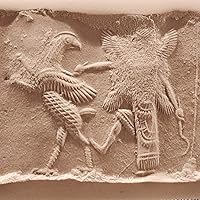
The relief slabs that decorated the palaces of the Neo-Assyrian Empire, which emphasized military conquest and royal prowess, have traditionally been understood as statements of imperial propaganda that glorified the Assyrian king. In this book, Mehmet-Ali Ataç argues that the reliefs hold a deeper meaning that was addressed primarily to an internal audience composed of court scholars and master craftsmen. Ataç focuses on representations of animals, depictions of the king as priest and warrior, and figures of mythological beings that evoke an archaic cosmos. He demonstrates that these images mask a complex philosophical rhetoric developed by court scholars in collaboration with master craftsmen who were responsible for their design and execution. Ataç argues that the layers of meaning embedded in the Neo-Assyrian palace reliefs go deeper than politics, imperial propaganda, and straightforward historical record.

300 pages, Hardcover

First published February 8, 2010

3 people are currently reading
22 people want to read

About the author

Mehmet-Ali Ataç

3 books1 follower

Ratings & Reviews

What do you think?
Rate this book

Friends & Following

Create a free account to discover what your friends think of this book!

Community Reviews

5 stars
2 (33%)
4 stars
2 (33%)
3 stars
1 (16%)
2 stars
1 (16%)
1 star
0 (0%)
Displaying 1 - 2 of 2 reviews
Profile Image for Jack Naylor.
41 reviews2 followers
July 3, 2024
Another reviewer rightly noted that this is a very heady book and quite tedious (especially in Part II); however, it is equally rewarding for the insight it brings to the longstanding conversation on Assyrian reliefs. Having read a great deal on this subject, it is easy to feel every interpretation only considers the propagandistic dimensions of the palace, with the emblematic/hieratic sprinkled in. Ataç does an excellent job of remedying this omission, and though some of his analysis may be "too clever," it moves the discussion forward. Part III, which focuses on the role of the Apkallu and Mischwesen in the artistic programs of the kings, is particularly wonderful with its incisive reading of Hesiod, the Epic of Gilgamesh, and the Underworld Vision of an Assyrian Prince. Ataç makes a very convincing argument for seeing the Netherworld as the locus of Mesopotamian scholarly heritage and successfully marries this textual vision with the iconographic record.

Admittedly, the beginning of the book often trails off and struggles to be relevant to the whole, but there are enough praiseworthy analyses afterward to make up for this weakness.
Profile Image for Gavin White.
Author 4 books27 followers
January 16, 2014
A very heavy going book on royal ideology and its manifestation in the artwork of various Neo-Assyrian palaces. I found this book a struggle but I did finish it.
The basic thesis of the author is that behind the stereotypical images of the king that promote him as warrior and priest, there are further layers of meaning that harken back to the archaic cosmos - the cosmos that existed before Tiamat was slain by Marduk who (re)created the world from her dismembered body.
The figures of the seven sages and the various animalian beings that are commonly found in palacial artwork are apparently the link between this world and the pre-flood state of the world.
Unfortunately an exploration of this archaic world is not on the agenda here. That's a pity as it could have made this book something special. All in all, I think this is far too heavy for the average reader and unless you are very interested in royal ideology there won't be that much of value to be gained here.
Displaying 1 - 2 of 2 reviews

Can't find what you're looking for?

Get help and learn more about the design.