I was one of those kids who talked all the time in class. I loved telling stories. One day in the 4th Grade, my teacher said, “You tell such good stories, maybe you should try writing some of them down.” “Wow,” I thought. “She thinks my stories are good.” That’s when I started to really enjoy writing.
I was also the class artist. When I wasn’t talking,I was drawing. When I was older, I studied art at the Rhode Island School of Design. That’s where I became interested in visual learning—how we decode and acquire information from graphs, charts, diagrams, models, illustrations and other images.
I became especially interested in educational publishing and have worked on the development of over a dozen major textbook programs, championing visual learning strategies from Pre-K through high school in every major curriculum area.
MATHSTART
The inspiration to write math stories for children was sparked by my work on a high school mathematics program. Visual learning strategies helped teens—who had been characterized as “reluctant learners’—understand difficult math concepts. Putting math in the context of stories based on their experiences made them feel more comfortable with abstract concepts. They actually became eager to apply math to real-life problems. If this approach worked for older students, I began to wonder what might happen if younger children were introduced to math this way!  Even before children can read—or speak many words—they can interpret visual information with ease. The MathStart books use simple stories coupled with diagrams, graphs and other visual models to teach everything from probability and pattern recognition to area, capacity and negative numbers.
The Best Bug Parade, (comparing sizes) was my very first published book. It was absolutely thrilling to see my name in print! I never expected that one day there would 63 MathStart books, split over three levels for ages Pre-K to Grade 4.
Each book includes two pages of review and activities designed to help teachers and parents extend learning beyond the story, along with suggestions of related books by other authors. After all, if a child enjoys learning math through stories, then let’s have more stories! (Pictures, Words & Math: An interview with Stuart J. Murphy )
THE MAIN STREET KIDS' CLUB: A MATHSTART MUSICAL
Now get out your dancing shoes—there is a musical based on six of the MathStart books! The Main Street Kids’ Club was workshopped at Northwestern University and adapted by Scott Ferguson, who also created the perennially popular production of Schoolhouse Rock Live! The songs are terrific. The math is spot on. And the club motto makes my heart sing: “Math Skills are Life Skills!”
STUART J. MURPHY'S I SEE I LEARN
My latest series of books is focused on young children—Preschool and Kindergarten age. I See I Learn books teach social, emotional, health and safety, and cognitive skills, such as how to make friends, build confidence, play safely, work together, manage emotions, and make plans. These skills are important for school readiness and for living happy, healthy, productive lives.  The stories “star” a wonderful bunch of friends who live in See-and-Learn City and attend Ready Set Pre-K. The cast includes Freda, Percy, Emma, Ajay, Camille, and Carlos. And, of course, Pickle, the green bull dog—who happens to have a soft-spot for butterflies—and Miss Cathy, their teacher.
I See I Learn stories are modeled on real-life situations and, just as in real-life, often involve more than one skill. For example, Freda Plans a Picnic is about sequencing, a cognitive skill, but the picnic itself is a social event. Percy Plays It Safe focuses on playground safety skills, but playing successfully in a group also requires self-regulation, an emotional skill.
This was a fun book about a boy having a bad day. Each time something is coming up he thinks about the likelihood of it occurring. This introduces the concept and vocabulary of probability: likely, certain, not likely, impossible. I enjoyed reading it and seeing the well done illustrations.
Book does a fair job of introducing the concept of probability given real world scenarios that are generally relatable for kids. This one is mainly rooted in theoretical concepts of likelihood, without the number s, which may be very effective for some kids in learning the core principle without getting bogged down by numbers yet.
This is another fun story in the MathStart series by Stuart J. Murphy. We like these books; they incorporate math principles into the story and show how math is fun and necessary for everyday life.
This is a great book, teaching math concepts without being overly obvious about it. This book is about probability and the narrative is reminiscent of "Alexander And The Terrible, Horrible, No Good, Very Bad Day." It's a fun book to read aloud.
After reading the book I will do a mini lesson on probability. I will model how probability works with a die. Then I will pair up my students and have them work together to --Determine where Jack could have placed himself in line for when the coach counted the students off my 3. --What could have Jack done to increase his odds of getting popcorn for a snack --Have students predict the lunch for the following day, week, and month I will provide the students with colored unifix cubes as assistance and have them write down on a paper the probability of each problem
A fun, interactive book that discusses the confusing topic of probability. The main character talks about the probability of things that would happen to him during his school day (like, what is the probability that his mom packed him a good lunch?). It is a fun, real life situation book that can get students engaged quickly an having them take guesses as I read. This book would definitely start a class discussion about probability.
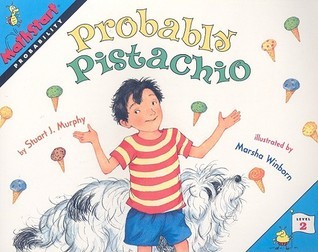
Honestly I really wish i had this book when i was teaching my fourth graders about probability. Some of them had a hard time with probability and all it takes is to take it back to the basics. Based on the certain events that happened in Pistachio's day. I also like how the illustrator made the pictures look real I also like how the front cover has ice cream falling from the sky. That is a good noticing queestion you can ask students when you read it for a read aloud.
A fun, interactive book that discusses the confusing topic of probability. The main character talks about the probability of things that would happen to him during his school day (like, what is the probability that his mom packed him a good lunch?). It is a fun, real life situation book that can get students engaged quickly an having them take guesses as I read. This book is great for grades 3 and up.
What a fun read aloud to introduce or review probability! The main character is not having a very good day and everything that could possibly go wrong has. The book talks about the probability of certainty, most likely, less likely, and impossible. I think that probability can be a math topic confusing to students so by applying the concept to this fun story the students have something to connect it to and make sense of. This book could be used during math in all elementary grades.
This book would be great to use when teaching probability to your students varying in age 6 and up to 5th grade. You can also incorporate teaching about patterns and counting when reading this book. You could also graph the things that may have gone wrong for the character up until he got his pistachio ice cream at the end of the day! This seems like a fun book that kids could relate to and really enjoy!!!
Jack is not having a good day. If something can go wrong, it's probably going to for him. Through the unfortunate events of Jack's day kids can practice probability. Not only can teachers and students discuss how likely an event is to happen to Jack (more likely, less likely, certain, etc.), they can also use the pictures and descriptions in the story to do mathematical equations. A fun story used to practice math!
Discuss probability with students. Then use a coin and estimate the probability of heads and tails individually. Then go do the experiment and see how close we were to our estimation. Then use last month's cafeteria menu and estimate the probability of having pizza (and other foods) for lunch this month.
Probably Pistachio is a fun way to introduce and discuss probability with students. The examples in the book are great because they are not only real world examples, but also things that kids like. You could definitely expand this to a probability project in the classroom using the students favorite foods and sports like in the book.
I would use this book for upper grade level students to teach probability. This book will build a great connection between probability and real world. I would have discussion with students about the story and have students to think about their own 'probably' moments.
This is an great book for probability. The book talks about the main character and how everything is going wrong that day. The book discuss the probability of it being certain, unlikely, and likely something will happen.
This book is perfect for a lesson about probability. I would use this book to introduce probability to my students. I would have them do the probabilities that arise in the book and have them discuss their findings.
Probability / Predictions: Illustrations show thought bubbles where the child is calculating the likelihood of an event before it happens. Remains at the level of picking one thing from a group and checking to see whether the child is right or wrong.
This entire review has been hidden because of spoilers.