Urasawa Naoki (浦沢直樹) is a Japanese mangaka. He is perhaps best known for Monster (which drew praise from Junot Díaz, the 2008 Pulitzer Prize winner) and 20th Century Boys.
Urasawa's work often concentrates on intricate plotting, interweaving narratives, a deep focus on character development and psychological complexity. Urasawa has won the Shogakukan Manga Award, the Japan Media Arts Festival excellence award, the Kodansha Manga Award and the Tezuka Osamu Cultural Prize. In 2008 Urasawa accepted a guest teaching post at Nagoya Zokei University.
Series list (not including short stories collections): - Pineapple ARMY (パイナップルARMY) 1985-1988, written by Kazuya Kudo; - YAWARA! 1986-1993; - Master Keaton (MASTERキートン) 1988-1994, written by Hokusei Katsushika; - Happy! 1993-1999 - MONSTER 1994-2001 - 20th Century Boys (20世紀少年) 1999-2006 - 21st Century Boys (21世紀少年) 2007 - PLUTO 2003-2009, based on Tezuka Osamu's Tetsuwan Atom - BILLY BAT 2008-2016 - Master Keaton Remaster (MASTERキートン Reマスター) 2012-2014 - Mujirushi (夢印-MUJIRUSHI-) 2017-2018, collaboration with Musée du Louvre - Asadora! (連続漫画小説 あさドラ!) 2018-ongoing
Más personajes unidos a salto en el tiempo implica tomo completo de transición. Inevitable y con la solvencia habitual de la casa, aunque el tema de la chica que se mete a Marisol japonesa de finales de los 60 como que me interesa menos que las historias de Asa, Haruo o Shota.
Note: There will be SPOILERS for earlier volumes of this series. If you don’t want to be spoiled, read those earlier volumes before reading this review.
Quick recap: Asa Asada was kidnapped as a child, but a typhoon and a mysterious monster forced her and her kidnapper, World War Two veteran Haruo Kasugo to work together to survive. They became friends and now run a small aviation company together, even though Asa is still in high school. The creature, usually referred to as “that thing”, resurfaced in 1968, just in time for the Tokyo Olympics. Asa and her faithful Piper Cub were able to drive it off with the help of college student Keiichi Nakaido, who inherited the research of the deceased Professor Yodogawa. Things are quiet for now, but that just means everyone’s got to get on with their ordinary lives.
Asa’s classmate Yone is working on having her professional debut as a singer, so she’s going to be singing in front of some recording agency scouts. She’s nervous, so asks Asa and their other friend Miyako (who’s in training to become a wrestler) to come to the audition for moral support.
Over at the tabloid paper Daily Every Sports, reporter Kamakura stands by his article on an alleged kaiju sighting. Sure, the witness recanted, but there’s enough wiggle room to justify printing the story. And Kamakura isn’t sure if there’s a real monster, but people are seeing something, and his instincts tell him this is worth investigating.
Asa’s childhood friend, Sho, a marathon runner who didn’t quite make the Olympics, has been given a stash of drugs by a shady acquaintance. They made him hallucinate that he became a giant that fought a monster…or was it a hallucination at all?
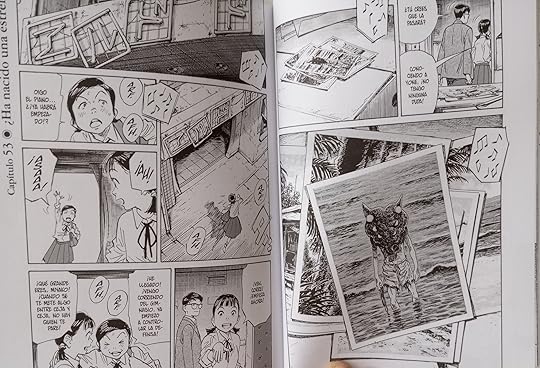
As it happens, Yone’s manager, Noro, is a relative of Nakaido, so the audition is happening at the same building Nakaido is doing his research in. Asa and Keiichi get in some discussion of the documents and photos, including one of a tribesman in East Timor wearing a mask that resembles “that thing.”
And all through this, Asa has to keep checking her radio from time to time just in case “that thing” shows up again and she has to deal with it.
Yone’s audition has a bit of a hiccup, but her professional singing career has begun!
Skip ahead a few months. Keiichi has gone to East Timor to do further research on “that thing.” Asa is now the face of her aviation company, using professional clothing and makeup to look a bit more grownup so that customers will trust her. Mr. Kasugo has hired a mechanic who’s also a veteran to help refurbish the Piper Cub for battle.
In the news, the anti-Vietnam War protests are heating up, and it mentions that the student activist groups are doing things like sheltering American deserters. Less importantly but more relevant to our protagonists, a former pop star and an assistant movie director have run off together. They’re currently holed up above Kinuyo’s restaurant, where Asa and her younger siblings live.
Turns out Yone was a one-hit wonder, though assistant director Terao collected all her records. Since her career had hit the skids, Noro found her a part in a movie. The crux of the problem is that no one had told Yone there’d be nudity, and the scene was written ambiguously enough that she thought she could shield herself. The skilled but dirty director insisted that she needed not to do that, and had the cameras running while they did the scene his way.
She felt defiled at the thought of all Japan seeing her lady bits, and Terao was so moved by her distraughtness that he filched the reel with the day’s rushes on it. That film is now in his apartment, and needs to be extracted before the director or his henchman break in and reclaim it.
Naturally, Asa is the only one who can be trusted with this mission. Except the other people who have injuries or otherwise are unavailable. So yes, Asa. (Amusingly, the cloth she brings to carry the reel in is the pattern used in Japanese pop culture for a thief’s bag.)
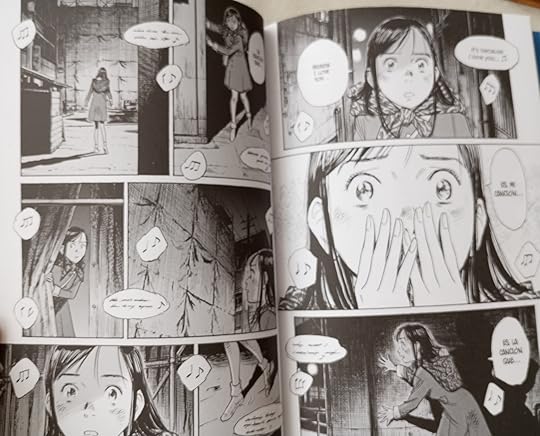
After a suspenseful infiltration and scary chase, Asa is thoroughly lost and shoeless. She’s distracted by someone singing her favorite American song from the radio. It turns out to be the writer/performer of that song, River Etheridge. Good thing Asa’s been keeping up with her English lessons! However, this doesn’t mean she’s out of the woods dark alley just yet. You see, he got drafted and is now a deserter from the American army.
This series continues to be the “human plotlines” from a kaiju movie extended out to novel length. Fortunately Mr. Urasawa is a very good writer, so makes the long periods when “that thing” is off camera interesting. (Good because it’s not even clear whether some turbulence offshore is “that thing” or not, and that’s the closest we get to an appearance this volume.)
And it’s fun seeing all the little bits of 1960s Japanese culture mixed in, like a mention of Chiemi Eri’s cover of “The Tennessee Waltz” (I’ve heard it, it’s very good, but a little too close to the Patti Page version to be an independent hit in America.)
The art is also excellent.
Content note: Yone is subjected to the expectations of “sex appeal” demanded of female entertainers, having her skirt blown upwards and later filmed partially nude (we don’t see any naughty bits.) Illegal drug use.
This continues to be an interesting series, but if you’re the sort of person who only cares about the giant monster action, you’ll probably lose patience.
Due to some of the "extras" in the story itself, things are a little slower than I would have liked, making this a 3.5 or 3.75 and not a "pure four." However, this edition shows more of the history of Japan in the 23 years after the war and what the later 1960s looked like. The ending was a bit of a surprise, allowing me to really need more. There are a few story arcs that were predictable and a couple things are not fully fleshed out, but overall enjoyable. We do not see our monster this time around, but it is never far from the plot. A bridge to the next book is its main point. Several endnotes, pieces of information help give more background that might not be obvious within the story itself.
Si on ne sait toujours pas bien où se dire l’auteur dans cette série, il nous offre néanmoins un très beau témoin de ces années-là où le Japon, toujours traumatisé par la guerre, se reconstruit peu à peu ayant cet occident en ligne de mire.
C’est donc un manga témoin que nous avons au fil des chapitres qu’un manga action. On peut le regretter après avoir été alléché par les promesses des kaijus des débuts mais Urasawa sait se montrer particulièrement efficace pour dépeindre avec force et parcimonie un passé oublié et souvent regretté, comme il l’avait fait avec la jeunesse des enfants de 20th Century Boys.
Il récidive donc ici avec Asa et ses copines que nous avons appris à connaître et que nous voyons grandir au fur et à mesure des métamorphose du Japon. Il y a la pilote d’avion avec Asa, la championne de catch avec Miyako et puis la chanteuse voulant être une starlette avec Yone, celle qu’on voit le plus ici. Chacune nous montre un petit pan de cette époque-là avec ses rêves et aspirations. C’est mignon tout plein mais en même temps on ne peut s’empêcher de retrouver le ton grinçant de l’auteur, notamment chez Yone ici, une jeune fille que des hommes vont chercher à exploiter en jouant sur son image. La critique de l’industrie des starlettes est piquante mais jamais l’auteur ne s’attaque à celle voulant vivre son rêve, c’est tout à son honneur.
Et les monstres alors ? Le temps passe et on n’en revoit pas. Ils sont toujours présents en filigrane à travers les petites scènes éparses où Asa surveille sa radio, ou bien quand un journaliste continue de mener l’enquête, sans oublier quand le professeur repart sur leur trace dans de lointaines contrées, mais aucun n’est en vue. Est-ce qu’ils manquent ? Un peu, quand même, je ne vais pas mentir. Est-ce que l’histoire est inintéressante pour autant ? Loin de là, l’auteur en profite pour faire vivre, grandir et évoluer ses héroïnes, mais aussi le cadre de son histoire, et on passe ainsi de la reconstruction à la question brûlante de la Guerre du Vietnam. J’ai aimé cette surprise inattendue, surtout incarnée dans la figure que nous allons découvrir dans les ultimes pages, le mangaka ayant toujours l’art et la manière d’amener des choses inattendues venant percuter ses héros et nous aussi. Qui aurait cru qu’une chanson avait ce pouvoir ?
Oeuvre de nostalgie, oeuvre de mémoire, Asadora est le témoin d’une époque passée que l’auteur fait revivre à travers ses rêves, ses passions, ses marqueurs comme la musique, mais aussi ses inquiétudes. Alors oui, ça manque un peu de monstres en dépit de ses promesses, mais que c’est bon aussi les histoires simples du Japon d’autrefois comme il sait le raconter avec familiarité et facilité comme si on y était. J’aime assez cet Urasawa conteur d’un passé révolu.
»»» A compra: Mal podia esperar por comprar o novo volume desta série. Mais uma vez compra pela Bertrand online.
»»» A aventura: Este volume acompanha Asa e as suas amigas de escola agora já mais crescidas, já com os seus empregos. Asa está lá para as apoiar. Yone, que seguiu de uma carreira de sucesso como cantora para o cinema, procura agora a ajuda de Asa na obtenção de um filme que está a ser usado para a chantagear.
»»» Sentimento final: Bom, mas esperava mais. Eu devo andar em sintonia contrária ao do pessoal que acompanha esta série. Adorei todos os livros anteriores, alguns com críticas medianas, e este volume achei que foi bom, mas nada de especial comparado com os outros e vejo as criticas e todos adoram este último volume. Eu não desgosto de histórias do dia-a-dia, mas não são o meu tipo de leitura, e este volume perdeu todo o mistério e ação, para nos dar um “slice of life”, um pedaço da vida, de Asa e das amigas, especialmente da Yone, sem praticamente vir à baila o monstro misterioso que ameaçou Tóquio ou ter qualquer avanço da trama neste aspeto da história. Também não vemos a nossa Asa como aviadora aqui. Para mim ficou aquém das minhas expetativas.
»»» Notas finais: --- [Capa] – Capa linda. --- [Ilustrações] – As ilustrações, como sempre, não desapontam, mantendo a sua elegância e pormenor fenomenal.
This is such an interesting manga. It's kind of all over the place, but in a good way. In many ways, it's a coming of age, slice of life type of story. Asa's family is visited by tragedy when a typhoon hits. Then she is the one left caring for her three younger siblings. She and her two best friends are doing their best to find their place in a world that's ever evolving, and though they go in vastly different directions, they still love each other and are there for each other. Asa is a pilot, which is rare even now, and is near unimaginable to the people of the 60's. And then there's a Kaiju in the background.
In this volume, the Kaiju is barely mentioned. The problems in this volume are purely human made, the monster is a cruel director, and our Asa is still the brave heroine that will face off against a monster to protect what she holds dear. The next volume comes out in December 2025 and I'm bummed I have to wait so long for it, but wait for it I will.
The Asadora! series starts with Asa Asada at age twelve; later we get seventeen-year-old Asa and friends; and midway through Vol. 8 we have twenty-one-year-old Asa when the setting jumps from 1964 to 1968, from Asa as schoolgirl to Asa as young professional. Asa, of course, retains her love of flying. She is a professional pilot who runs her own small company. She remains close to her family and friends. Loyalty to those she loves can be a good thing, usually. Here Asa steps in, somewhat reluctantly, to "rescue" Yone who has managed to get herself into something she deeply regrets. The "rescue" does not go smoothly and Asa finds herself on the run from paparazzi (or the Japanese equivalent). Needless to say, once Asa commits to doing something, she doesn't quit.
The 1968 setting touches on Japanese anti-Vietnam War protests; deserters from the U.S. army could seek shelter.
Recommend: the illustrations alone deserve more than 5 stars, as does Asa herself. Highly recommend but ... manga.
*Note that the kaiju remains in the background in this volume.
After the last few volumes were starting to feel a tad repetitive, this volume's 4-year time jump is exactly the reset we needed. The main plot takes a backseat while we reorient ourselves in 1968. We see where our characters have landed (see what I did there?), meet some new ones, and even get a few fun surprises. I really enjoyed this break from flying and battling kaiju. However, there's a Shota-sized hole so far in 1968 and I’m absolutely dreading his roided out return. While I’m bummed to now be caught up, Volume 9 comes out next month, so I thankfully won't have to wait too long (and there are plenty of other Urasawa series to tide me over after that).
You know ever since I started this series, yeah it's been cliffhanger after cliffhanger and of course- because of the fact that its ongoing, its been a right PAIN. But anyways, it feels nice to be along for Asa's story, like when she meets the guy who she finds out is a deserter, and she tells him that she found his song & it got her through hard times, at 12- and like as readers, we've been through it all- with her, since then. Since she found the song, since she lost her family in the typhoon and who knows where we'll continue to go with her?
This entire review has been hidden because of spoilers.
Not too much happening in this volume action-wise, but we did get a time jump and see how the 3 main girls are doing. I'm glad they're still friends after school! I'm hoping we get some more action in the next volume. Knowing Naoki Urasawa, he'll end up building us up to a big reveal in the next volume.
perhaps the end of the asadora universe? not sure yet if another one will be published… we shall see.
overall, i still really liked this volume even though it was quite disjointed & MAJORLY off plot. like why the hell are we in japan playing country music with some random guy from tennessee when there’s a giant monster in the ocean?? oh well. we’ll see what happens next time.
Love everything Urasawa does. Slower pace in this volume but cool to see these young ladies grow up and choose their own paths. Only volume that came out this year but I’m okay with it to keep Urasawa with us as long as possible. He’s the greatest Mangaka of all time.
Two and a Half Stars. A bit more character development for one of the secondary characters by way of her misadventures in seeking fame but what little happens with our titular protagonist is hard to parse without the context of future volumes which will presumably round out her current escapade.
I’m being optimistic, hoping that this will finally be their point where the series gets good. So far I’ve sort of found this series very middling with way too much downtime and distraction. Hopefully this is where everything comes together…. Hopefully….
This was an excellent installment! So much is happening here, Asa is getting older, and there's a big twist towards the end of the volume. I can't wait to see what happens in v.9!
Un nouveau tome qui prend des allures de défense féministe encore plus prononcées ! Une nouvelle rencontre incroyable vient ajouter une cerise sur le gâteau...