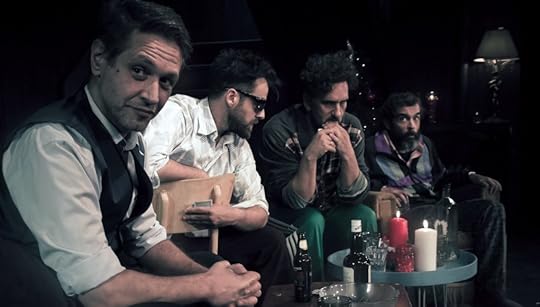
“Conor McPherson, who [turned] 35 in August, is one of the genuine treasures of the English-language theatre. It is absolutely intoxicating to ponder what he will give us in the future.”— Irish Echo “The unique and extraordinary aspect of McPherson’s writing is the way in which his characters reveal themselves in tiny details which almost imperceptibly build up an extensive picture of the past, present and future, not just of themselves but of Ireland.”— The Sunday Mail (London) Conor McPherson returns to his native Dublin for the setting of his new play, which he will direct in a much-anticipated production at London’s National Theatre in fall 2006. It is Christmas Eve, and James “Sharky” Harkin, erstwhile fisherman/van driver/chauffeur, gathers with friends at the dingy flat he shares with his blind brother to drink booze and play cards. As Christmas Eve becomes Christmas Day, the familiar-looking stranger Mr. Lockhart reminds Sharky of the bargain he made when they last met in prison—and Sharky suddenly finds himself playing a game with the stakes set at his soul. With this magnificently atmospheric new play, McPherson is once again set to entrance his audience, this time with a new take on the Faustian theme. Conor McPherson was born in Dublin, where he still lives. His plays include This Lime Tree Bower, St. Nicholas, The Weir, Port Authority, Dublin Carol, and Shining City, which premiered on Broadway in spring 2006. One of Ireland’s leading playwrights, his work has been produced throughout the United Kingdom and the United States.
Στην Ιρλανδία πέντε μεσόκοποι άντρες συγκεντρώνονται σε ένα σπίτι την παραμονή των Χριστουγέννων για να γιορτάσουν παίζοντας χαρτιά. Όλοι τους πίνουν μέχρι πρωίας. Ο ένας από αυτούς όμως είναι ξεχωριστός γιατί είναι ο διάβολος που ήρθε να πάρει ψυχές. Ατελείωτο μεθύσι, ατελείωτες βρισιές, κανένα ιδιαίτερο νόημα και η ιδέα του διαβόλου έχει ξαναειπωθεί.
I saw this play performed last night (December 26th, 2007) at the Booth Theatre in New York. So, if listening to an audio-book doesn't count as reading, then, having seen the play without actually reading the book of the script, I haven't read this book. But does reading a play count as experiencing what the playwright intended? I think seeing a play is, indeed, a legitimate way of absorbing it. I imbibed this play! It's two parts O'Neill, one part Joyce and as marvelous a touch of the poet as has been put on Broadway in years. A group of male Dubliners get together on Christmas Eve. There is drinking, there is trying-not-to-be-drinking. There is poker, involving winning and losing. There is a serious, serious card-sharp, who is and is not what he seems. Conor McPherson, the playwright, directed the version I saw. They say he's thirty-five. Or is he? He is of an ancient tradition and a modern one. I read stories from Joyce's DUBLINERS on the way in and on the way out. (I was on the Long Island Railroad.) Paddy reads on the railroad!, as the song goes...
The devil went down to Dublin, he was looking for a soul to gamble...
I really liked this play. I'd love to see it! I read this quickly, and could really watch it play out in my mind. It had just enough subtle fear to be eerie, while also being realistic. I enjoyed the relationship between the two brothers-- I hope they both find sight and peace. I'm curious about who was watching over Sharky. Dare we say God?
Christmas Eve in Baldoyle, five men play cards. Person histories are touched on, the disappointments of lives are mourned, poteen is drank, and shite is yacked. Oh, and one of these men is the devil who has come to collect a soul.
In case I haven't said it yet: my goodness I love McPherson! He is a master of speech and storytelling. In all his plays he touches upon the realities of life and how it compares to what we hoped it to be, and a good deal of his work utilizes folklore and superstitions as a means to bring this out. What is most remarkable is how he manages to do this and make vampires, ghosts, and the devil seem like perfectly natural parts of our world. He is not a flashy writer, and he follows in a great tradition, and even though he is Irish and his plays all take place in Ireland, they never feel as though he is trying to bank off this fact. He uses some Gaelic and Irish tradition to tell his stories, and they certainly exist in Ireland, but they are extremely universal.
Okay, so I've talked rather generally about him, and most say that not all his plays are perfect by far. But I must say that The Seafarer might now be my favorite McPherson play. It is touching and funny, and it haunts you for a while afterwards.
The Seafarer, by Conor McPherson, 2007. I’d like to see The Seafarer performed sometime, if anyone does a remake. It has been produced worldwide, including London, Dublin, New York, and Chicago and won several awards. Jeannette and I saw another McPherson play, Shining City, in Chicago at the Goodman Theater. We very much enjoyed it, got a lot out of it. I later read the play as well.
It’s hard to get the most out of a play just reading the written word. So much is communicated by the actors through their inflection, gestures and actions while speaking, and behaviors while not speaking. The play takes place in a grimy setting north of Dublin, between middle-aged men engaged in bouts of drinking and talk. There is much opportunity for humor in the back-and-forth. Somehow, through it all, the life of one of them is saved – by luck, by relationship, by chance, who can say? But any time the Devil is turned away, I’m in.
The Irish are known for spinning tales which may be why I consistently enjoy McPherson's plays, having seen quite a few: "The Weir," "Port Authority," "Shining City" and this one (by far the best of the lot). Funny in a harsh way, mean in a loving way, "The Seafarer" is also a downright scary, jaw-dropping story with a description of Hell, told by one of the devil's minion who, even to an atheist, seems totally, believably real. Terrifying!
McPherson writes cracklingly great dialogue, but that’s not enough to lift The Seafarer too far past its familiar Faustian tale of a man trying to get out of a bad bargain with the Devil. Aside from one stunning monologue about Hell—as a place not of fire but of brutal cold and unbearable isolation—it’s not particularly memorable.
I am currently directing this show, and I find it absolutely fascinating. The writing is profound in several spots, and one monologue in particular I find incredibly well written and thought provoking. This play is about redemption, forgiveness, and second chances, and explores the frailty of humanity. It is a wonderful character study, an if you can get by the language (it’s an Irish play!) then you will have a wonderful time reading it.
A very interesting story. Insight to male communication dynamics. A hard read, and I found it difficult to get the deeper meaning of this story and connect all the dots. I did initially read an eBook version of this which I think affected my comprehension. The root conflict, I think, everyone can relate to on some level: struggling with the devil/evil power/inner demons.
This entire review has been hidden because of spoilers.
The premise is compelling. I like pretty slow moving dialogue for plays, in general, and this delivers in that regard. I had a discussion with my professor about the ending of it, and I think for the most part I'm against the 180 reversal in any plot. It's to the same effect as the 'it was all a dream' trope. This is a far more in depth plot element, but I can't shake that feeling. Decent read
Really really wanted to like this one. I do think that with the right actors it is probably great onstage, but it just didn’t fully work for me on the page. So many conflicts were introduced that went nowhere, and the climax felt very contrived. I just think I wasn’t in the right headspace for this one.
The classic 'Devil wants your soul' bit surrounded by a merry group of Irish wankers. There's a whole lot of dialogue that's not interesting. Only when the Devil announces his devilish ways and the game itself, is this play actually engaging.
3.5 it’s one of those plays that has to be seen rather than read as the writing style isn’t very visual. I loved the concept, it’s a mix of Meet Joe Black & Murakami, but for theatre and with very human & relatable characters. Was Nicky just Nicky, or was he God?
the first act was interesting, i could see why my teacher picked it but the most significant part was like 10 pages and the rest was stupid and annoying jsp. now i have to write an essay on this wish me luck gonna kms
χωρίς να γνωρίζω το έργο, στην αρχή δεν καταλάβαινα το νόημα των luben περιθωριακών χαρακτήρων, στο δεύτερο κομμάτι όλα έδεσαν. Άνετα θα το έβλεπα και στο θέατρο.
A play set in Ireland around the end of the Celtic tiger. Sharkey has come home for Christmas which coincides with the fact he had to leave his job. A little far fetched near the end, which threw me a little but worth giving it a read. I don't think I would have chosen to read it if I didn't have to.
A bunch of Irish guys get drunk in a play that's not The Iceman Cometh. This is a lazy literary trope, not a way to write realistic characters. If you're a British playwright, you aren't working class, no matter how many times your characters say "shite." Just once, I'd like to read a play about Irish scientists. Although I recognize that Irish scientists playing cards with the Devil for their souls has a more limited appeal than the devil vs. incomprehensible drunks.
Anyway, I honestly cannot believe that this thing had a happy ending. It was twice as happy because I didn't expect it. In retrospect, it makes sense: incredible shit storm of sadness in act one was necessary to lay the groundwork for the ending. Without the first act, the play would be sanguine.
Final thoughts: I loved the devil's description of Hell. It was very spooky. And if the Devil ever wants my soul I would choose a card game and leave the fiddle contest to Charlie Daniels.
This entire review has been hidden because of spoilers.
The play is a beautiful interpretation of a theme that runs deeply through European story telling. The set is perfectly constructed to demonstrate the subtle and overt connotations of the play. The dialogue begins with very choppy language typical of the vernacular, but as the play progresses, and the characters become more intoxicated, their statements begin to gain confidence. One of my observations was the deep connection to Irish mythology in the play; it related to one play in particular. Sharky can be compared to the Irish god Lugh who went to the Tuatha De Danan to become a member of the parthenon of Irish Gods. In order to become part of the group, he had to prove himself in a chess match against the greatest players in the land. A knowledge of the legend makes for an interesting reading of the play.
Few playwrights can so convincingly create unique, compelling characters. Though the point of a play is performance, McPherson's works actually read quite well. He's a master at creating mood, at melding supernatural elements into the quotidian in a completely convincing way. I've seen The Birds (yes, it's based on the same Daphne du Maurier story that the Hitchcock movie is based on) and Shining City and am looking forward to seeing The Veil, which will be performed in DC in the spring.
On second reading nearly ten years later. In the interim, I've seen performances of The Night Alive (twice), St. Nicholas, Port Authority, and The Weir (twice), and am looking forward to seeing The Seafarer in a few days. A most engaging playwright whether you read him or see his work performed.
Of course it's not the same to read a play as to see it staged; plays come to life as they are acted and interpreted. But you can get a pretty good idea of what McPherson is up to by reading The Seafarer. It's an old-fashioned folk tale of the Devil coming to visit on Christmas Eve, disguised as an Irish kitchen-sink drama, or black comedy (which means it's not really funny at all).
These are dysfunctional people down on their luck and ready to drink what's left away. Even the teetotaler gets in on the act eventually, so powerful is the pull of drink for these Irish losers. The whole thing is a bit depressing, and yet it is a comedy in the classic sense of the term. But I can say no more, or I'll give the ending away.
Irish playwright McPherson crafts a unique tale involving a crew of down-and-out Dubliners who gather together one Christmas Eve for a boozy, bleary eyed evening of cards and blarney. The evening takes an unexpected and surreal twist when "Sharky" Harkin, a rough ex-fisherman, is unexpectedly confronted by the oddly familiar stranger Mr. Lockhart, who reminds him of a previous bet they made in jail. Suddenly, Sharky finds himself playing a game of cards where the stake is his soul. Wonderfully atmospheric with superbly crafted characters, this play is flat out terrific.
Another in the current wave of Irish plays so popular in America. McPherson, author of "The Weir," creates another well-written, realistic series of conversations amongst working-class Irish people. Though the conversations here are absorbing, and there is one terrific surprise, the play ultimately adds up to little that the reader or audience member will remember the next day. The theme seems to be, "There's a lot of living to do, so best get to it." "Bye, Bye Birdie" said the same thing, only with Ann-Margaret. An extra star for the surprise and the well-written dialogue.
The first play I've read in a long time didn't disappoint.
Set in Dublin, The Seafarer is a ruggedly charming mx of the mundane and the magical. The engaging plot becomes increasingly exciting and ties together a bunch of lively, robust characters. The play has a strong sense of identity but flexible enough to excite a creative director, whilst the lyrical dialogue blends base colloquialisms with the subtlety profound.
Dangerous, hilarious and,above all, thoroughly memorable.
Think O'Casey mixed with Pinter with a dollop of an old, dark fairytale tale thrown into the mix.
Wow, this certainly is Irish. Dialogue straight outta North Side Dublin. They're drinking the whole play. But there are some surprising twists in it, in a philosophical sense.
Spoiler alert! I wonder about the end, though, I guess it's hopeful, but did Sharky really win, or is he still in hell? Hmmm. Lockhart wants "peace of mind." Is that what they really end up with? I hope! At least it ends with sunshine!
This entire review has been hidden because of spoilers.