Jump to ratings and reviews
Rate this book

The Year of the Ladybird

Rate this book
A ghost story with a difference from the WORLD FANTASY and multiple BRITISH FANTASY AWARD-winning author of SOME KIND OF FAIRY TALE

It is the summer of 1976, the hottest since records began and a young man leaves behind his student days and learns how to grow up. A first job in a holiday camp beckons. But with political and racial tensions simmering under the cloudless summer skies there is not much fun to be had.

And soon there is a terrible price to be paid for his new found freedom and independence. A price that will come back to haunt him, even in the bright sunlight of summer.

As with SOME KIND OF FAIRY TALE, Graham Joyce has crafted a deceptively simple tale of great power. With beautiful prose, wonderful characters and a perfect evocation of time and place this is a novel that transcends the boundaries between the everyday and the supernatural while celebrating the power of both.

273 pages, Kindle Edition

First published June 20, 2013

72 people are currently reading
1988 people want to read

About the author

Graham Joyce

73 books569 followers
Graham Joyce (22 October 1954 – 9 September 2014) was an English writer of speculative fiction and the recipient of numerous awards for both his novels and short stories.

After receiving a B.Ed. from Bishop Lonsdale College in 1977 and a M.A. from the University of Leicester in 1980. Joyce worked as a youth officer for the National Association of Youth Clubs until 1988. He subsequently quit his position and moved to the Greek islands of Lesbos and Crete to write his first novel, Dreamside. After selling Dreamside to Pan Books in 1991, Joyce moved back to England to pursue a career as a full-time writer.

Graham Joyce resided in Leicester with his wife, Suzanne Johnsen, and their two children, Joseph and Ella. He taught Creative Writing to graduate students at Nottingham Trent University from 1996 until his death, and was made a Reader in Creative Writing.

Joyce died on 9 September 2014. He had been diagnosed with lymphoma in 2013.

Ratings & Reviews

What do you think?
Rate this book

Friends & Following

Create a free account to discover what your friends think of this book!

Community Reviews

5 stars
209 (14%)
4 stars
524 (36%)
3 stars
519 (35%)
2 stars
163 (11%)
1 star
39 (2%)
Displaying 1 - 30 of 260 reviews
Profile Image for karen.
4,012 reviews172k followers
March 25, 2020
3.5 stars

this is the 8th graham joyce novel i have read, and it's in the dead center of my "enjoyment of graham joyce" spectrum. it's not nearly as good as The Silent Land or Some Kind Of Fairy Tale, but it is much better than The Tooth Fairy. it's a historical coming-of-age novel that's not taking any big ambitious chances, the way my favorite of his books do, but it's quietly haunting with a perfect descriptive atmosphere that managed to make me nostalgic for a time and place i never personally experienced.

this book is pretty much as straightforward as graham joyce gets. yes, there are supernatural elements, but they are mild, and can be written off with non-magical explanations, and they contribute to the tone without transforming the narrative into a full-on ghost story.

this takes place in a coastal resort town during england's historic heat wave of 1976 which also saw a huge infestation of ladybugs. which is what i am going to call them, since "ladybird" doesn't feel right in my american head. in england, a heat wave means the temperature was in the 80's (F), with a record high of 96F.


and ladybug infestations look like this:


david is using his summer away from university to work as a greencoat, helping to entertain the vacationers at one of the holiday resorts in skegness, the same village where his biological father died when david was three years old. during this summer, he will experience great highs and lows, loves and lusts, disillusionment, obsession, fear, ghosts, drugs, companionship, family secrets, and the national front, as he tries to find his place in the world and figure out what role he has in the lives of others.

It was one of the features of being a Greencoat. The holidaymakers always wanted you to be photographed with them. I might as well have been dressed up in a cuddly bear suit for all they knew of me. Would my smiling face define the holiday for them? Would I help to fill in a hole in their memories? Even people whom I'd never spoken with pulled me into their snapshots. I often wondered what they would think when they reviewed these photographs, maybe years later. Would they only see the bright smile? Or would they recognize a troubled young man behind it all. But the photograph was a detail in a holiday story, where I was a theater prop, a bit of scaffolding on the stage. I crossed from my story briefly into theirs and back again.


it's a subtle story, without fireworks or jaw-dropping twists, but it's lulling, well-written, and recognizable - a bit of the human experience in a slim summer tale. it's worth a read, stretched out with a glass of something full of clinking ice cubes, with frequent glances up between chapters to stare off into the past.

come to my blog!
Profile Image for Connie  G.
2,143 reviews709 followers
March 13, 2018
University student David Barwise takes a summer job at an aging seaside resort in Lincolnshire. He works as an assistant to the professional entertainers, and runs activities for the families on vacation. He was drawn to the resort town of Skegness because his natural father had spent his last days there.

The summer of 1976 in England was known for its infestation of ladybugs. It's also remembered for its political turmoil with the activities of the fascist National Front which tries to recruit the resort workers. David makes friends easily with the old time performers and a certain young dancer. He gets into a scary situation with a violent man and his seductive wife. The most unusual thing about that summer is the supernatural appearances of a ghost in an electric blue suit.

The author had worked at several holiday resorts in his youth, and transports the reader back to the 1970s. The interesting characters and absorbing plot made the book an entertaining coming-of-age story. 3.5 stars.
Profile Image for Algernon.
1,839 reviews1,163 followers
October 1, 2013

It was 1976 and the hottest summer in living memory. The reservoirs were cracked and dry; some of the towns were restricted to water from standpipes; crops were falling in the fields. England was a country innocent of all such extremity. I was nineteen and I'd just finished my first year at college.

The storyteller is David Barwise, and the time and place are relevant to the way his summertime adventures will unfold. In need of pocket money, as every student ever known, he applies for a job at a seaside holiday camp:

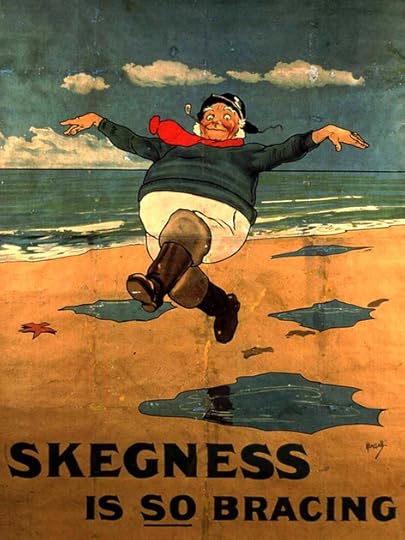
skegness

The year is important because it is a watershed moment, a turning point in the vacationing preferences. Cheap airplane tickets and non-stop sunshine in the Mediterranean and the Carribean resorts are putting the 'bracing' (translate windy and cold and often rainy) British camps out of business:

- It's just had it's day. The holiday camp is living on borrowed time, too. People don't want this anymore.
[...] She meant the holidaying habits of the industrialized working classes. She meant a way of life that had reached the end of its commercial utility. These were the last days of working culture, ended not through earthquake or tidal wave or volcanic eruption, but through the obstinate ticking of the cash register.


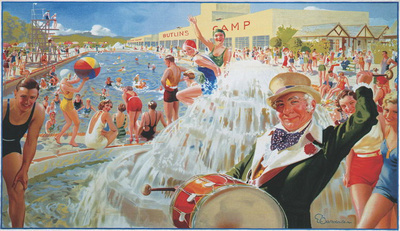
David catches the tail end of this era. The closest analogy for the holiday camp style of family entertainment that I can come up with is the movie Dirty Dancing . The setting shares the carefully orchestrated daily programmes, with activities involving everybody from small kids who compete in sandcastle construction or soccer to beauty and dance contest for the youngsters and evenings of cabaret dancing, magician acts, comedy skits, bingo and heavy drinking for the older family members.

holiday camp

There is romance in the air, but I found the plot comes closer to Water for Elephants than to Dirty Dancing, in which a greenhorn (Greencoat in this particular instance) is initiated into the closed culture of a fringe artistic community and learns along the way some valuable life lessons ( Perhaps I'd made the basic error of thinking that emotional intimacy automatically follows sexual intimacy.). David even falls for a femme fatale that is mistreated by her brutal husband, but the analogy stops here.

The novel is not derivative, and from the basic premises I've sketched here it develops into a ghost story, very well done in its turn, although I often felt the supernatural stuff takes second place in the writer's priorities to capturing the setting and the mentality of the people at this particular moment in time. While England struggles with unseasonal heat and political right wing upheaval, David is trying to unravel two mysteries that may or may not be related : the disappearance of his natural father in Skegness when he was three years old, and the visitations by two see-through figures with glass eyes that apparently are only visible to him.

Graham Joyce proves once again he is not only a talented storyteller, but also a stylist - elegant and subtle in the apparent simplicity of the text. He can build intensely emotional scenes without excesses of violence or language, preferring instead to rely on rhythm, on silences and body language, on attention to detail and strong characterization. David tells his story in the first person, and part of the charm of the novel is identifying with his problems. Some readers may ask themselves why should I read yet another coming of age story - they've been done to death - but there is something special about the moment when you leave the family nest, when you start to stand on your own two feet, when you get knocked about by life and you know you can't run to mommy or daddy to fix it, when you get your heart for the first time thoroughly broken in pieces and when you learn to accept it and to eventually try again. I liked in particular David's level headedness and sociable nature. He is sometimes too passive for a main character, and slightly too succesful with the ladies (do all writers fulfill some of their youthfull sexual fantasies through their characters?) , but he has a lot of common sense and basic decency going for him.

I would have given the novel five stars, but I did have some slight issues with pacing and with loose ends left untied at the end. But sometimes it is better to leave things unexplained and ambiguous than to try to fit everything nicely in its proper place. It leaves the door open for speculation and challenges the reader to come up with his own solutions, especially when the supernatural is involved. All in all it was a bittersweet journey down memory lane, beautifully summarized in the novel's closing lines:

The future will be what we choose it to be, just so long as we carefully engineer the present. As for the past, it moves like sand under your feet. These things happened a long time ago, yet remain luminous in my mind. As I write this I have resting on a pile of papers on my desk a glass paperweight. Scarlet with black spots, it is designed to look like a beautiful ladybird.

ladybird

P. S. I've read today an article about how Skegness and other British resorts are struggling to survive in the third millenium tourist industry. I hope this book will help a little with revealing the real charm and the history of the location.
Profile Image for Bradley.
Author 9 books4,865 followers
May 5, 2020
Weird stuff out of the way... I just took note that this came out within fifteen days of Stephen King's Joyland. And like Joyland, they both take place as a coming of age tale with a young man joining the seasonal help at an amusement park decades before today, with romance, somewhat dismissable supernatural elements, and very period political concerns.

Odd, right?

That being said, the quality of this particular novel was quite lulling and it evoked the whole sensation of this English bygone time that simmered with racial tensions and peculiar changing mores. Sex, scams, generally having a good time before college is the name of the game.

Hooking up with a woman with a domineering (rather abusive) boyfriend and running around without getting caught takes up most of the tale, and I have to admit... it's okay. It's gentle, amusing, and it takes no real chances. The skinhead convention definitely gave it good conflict fuel, but other than that... I've read much better, similar, tales... such as the one I mentioned in the first paragraph.

Still, it certainly wasn't bad and it might appeal very well for certain types of readers who prefer the comfort food of youthful nostalgia.
Profile Image for Jolene.
129 reviews35 followers
January 3, 2015
**Thank you Doubleday and Netgalley for providing this in exchange for an honest review**

David is a college student who decides to take a summer job at a holiday center, Skegness. His mother and stepfather are both against this. When David was three, his biological father died of a heart attack at this same holiday center. David tries to assure them he really is just going there because the job is available, not because of the ties to his past. The staff and the guest at Skegness take to David right away. Everything seems normal at first, but then Davis starts seeing a guy in a blue suite and a little boy. At first he thinks nothing of it. Working at a vacation spot for families you're likely to see certain people repeatedly. One day David happens to come face to face with the little boy. Right away he notices something isn't right. Normal little boys don't have eyes of clear glass...

I really liked the setting. While I'm sure there are (or were) vacation centers here in the US, I've never heard of them before. Its not very often that I'm introduced to an entirely new to me environment in realistic fiction. I also really liked a few of the secondary customers. I didn't really care much for David. I honestly found him kind of dull, and with him being the main character, that made it pretty difficult to like this title.

The title suggest the Ghost will be a major player in this story, but he isn't. This didn't even really feel like a coming of age story. Honestly, I'm not sure what exactly the author was going for. There were a few different romanceish story lines going, a sorta missing persons mystery, some Nazi politics, and the mystery of the ghost. I don't feel all these worked well together. There was too much going on. There just wasn't enough space in a 300 page book for each story to be fully fleshed out. Had a few of these been dropped and others developed further, this could have been a great book. As it is, everything feels underdeveloped. Very dissappointing
Profile Image for Gregor Xane.
Author 19 books341 followers
Read
December 7, 2014
A beautiful washer woman with a voice like an angel whose abusive husband won't let her take her rightful place on the stage?

No. I can't read on with such a clichéd character/situation.

Graham Joyce is one of my all-time favorite authors and I'm sad that he's no longer with us. But with this I cannot continue.

Thankfully, there are a bunch of earlier works by him that I have yet to read.

Profile Image for Mark.
Author 67 books173 followers
September 6, 2021
David Barwise is a 19 year old student who, against the better wishes of his Mum and step-dad, gets a summer job as a greencoat on a holiday camp in Skegness. Set against the scorching summer of 1976 - and the subsequent ladybird invasion - David is led into two love affairs, one with the wife of an apparent monster, one with a lovely Yorkshire lass, as he tries to find his feet amongst the staff of the camp - some theatrical, some racist, some thuggish and some genuinely nice - and the ever present punters, adults and child alike. He is not only there to escape from home, he’s also trying to find details about his long-since-dead father, the only photograph of whom shows him on a Skegness beach. And then, in between getting caught up in the rise of the National Front, he begins to see ghosts on the beach and on the camp, of a suited man and his young charge.

This is a glorious novel, full of wit and invention (and a nice line in dry humour) that is told is a deceptively simple style. Perfectly capturing both the 1976 summer and the start of the slow decline of the east coast seaside resort, this crackles with energy and pathos.

The characterisation - David narrates the story - is pitch perfect, often delivered with the lightest of touches - Pinky and the way he dresses, Tony and his exuberance, Colin and his chilling demeanour - but always spot on and always human, with none of the characters ever behaving in a way that seems out of place. David is first drawn into the web of Colin, a thuggish and boorish man, and his wife Terri, who sings like an angel but is apparently abused into submission at home. Attracted to her, the relationship between him and his older, secret lover, is fantastically played with neither David or the reader quite sure of what’s going on. A surer, safer bet is Nikki, a beautiful half-caste dancer, painfully aware of her own shortcomings (which aren’t really, to David or the reader) and it’s this relationship that we want to see work, the coupling that makes this the perfect coming-of-age novel. Because that’s what this is, at the end of the day. It’s a social and political observation - the holiday camp, the members of the National Front and what it’ll mean to people like Nikki (and how she reacts, when she realises David has been duped into attending a meeting, a stigma that remains with him for the bulk of the novel) - but it’s also about spreading your wings, finding love (the first erotic interlude, with David and Nikki, is wonderfully erotic whilst being almost mundane) and loss and setting out onto the path of adulthood.

There are supernatural elements - and the denouement of that particular plot strand is obvious but also heartbreakingly beautiful - but this isn’t a supernatural novel, it’s not a horror novel, it is instead a perfect drama about a young man, finding his way in 1970s Britain.

It speaks to me on a couple of levels, in that I love coming-of-age stories and the east coast seaside (and follows my reading of the similarly themed (in terms of nostalgia and love) “Joyland”), but also because I was seven in 1976 and my family holidayed in Ingoldmells, a few miles north of Skegness and it’s a town that I still visit on occasion today. A truly beautiful work of art (that had me in tears towards the end), populated with characters that I grew to love (and I so desperately want to know that the central love story carried on beyond the seventies), this is an incredible read and I cannot recommend it highly enough.
Profile Image for Althea Ann.
2,255 reviews1,209 followers
August 9, 2014
This book is like the British version of Stephen King's 'Joyland.'
Joyce's writing is more elegant, spare and lyrical than King's, and he doesn't succumb to King's urge to add in a grand finale - which makes me personally, judge that this is a slightly better-crafted book - but the two are very, very similar. If you liked one, you will love the other.

A young man, a college student in the 1970's, takes a job at a past-its-prime summer resort, and discovers that he's great with kids. He learns the ropes, negotiates relationships with some sketchy co-workers, develops an attraction for an older woman, but through it all, is haunted by the ghosts of the past.

(All of the above applies to both books.)

Here, though, the 'ghost' is personal. The narrator, David, knows that his biological dad died in this resort town when he was three. His mom and stepdad refuse to talk about the circumstances, and he has a sort of vague hope of coming to some kind of closure by taking this job, even against his family's wishes.

In addition to his own issues, this summer David must figure out who he is and where his place is in life. A love triangle develops: he develops a thing for the married Terri, whom he suspects is abused. Simultaneously, the young and lovely Nikki sets her sights on him. Meanwhile, Terri's husband persistently tries to recruit him to the National Front. Not getting his ass kicked by Nazi skinheads is also a goal. The innocent holiday fun has a dark current - and some of these people may not draw the line at murder. As this is a certain type of resort, there's also a fortune-teller, a stage magician, an Italian Tenor, and any number of colorful but believable characters. Through it all, the feel of the book is nostalgic without being sentimental; the message one about the complexities of negotiating life's pitfalls.

Copy of this book provided by NetGalley. Much appreciation for the opportunity to be an early reader - as always, my opinion is my own.
Profile Image for Frank Errington.
737 reviews62 followers
July 30, 2014
Review copy

I just read a truly mesmerizing book. The Ghost In the Electric Blue Suit by Graham Joyce is a book that takes you there. "There" is the eastern shore of Britain. It's the hottest summer in living memory. It's the summer of 1976.

Much to the disappointment of his mum and step-dad, David Barwise, takes a summer job at a resort in Skegness. David is drawn to the locale by a photo of his birth father, taken in Skegness when David was a small child.

In many ways The Ghost In the Electric Blue Suit reminded me of Dirty Dancing" (without the dancing). Similar drama, summer romance, at a place families would go for their week long vacation.

Graham Joyce's writing style is comfortable, relaxing, lyrical at times. As a reader I became immersed in the words to the point that it felt as if David's experiences where my own.

Throughout the story, David sees a man and a little boy, they are there one moment and gone the next. The man is always in a blue suit that takes on the same phosphorescence as the sea. Who is the man? Who is the little boy? What does it all mean?

The Ghost In the Electric Blue Suit is the kind of story I may read again some day. The characters are rich with personality and mostly a pleasure to be around and I wouldn't mind visiting with them from time to time.

The Ghost In the Electric Blue Suit will be available as an ebook, hardcover and Audio CD on August 5th, 2014 from Random House LLC.

Strongly recommended.
Profile Image for Vivienne.
Author 2 books112 followers
March 25, 2014
This was another beautifully written coming-of-age tale from Graham Joyce. He has a tremendous skill in writing supernatural elements that integrate seamlessly with everyday life.

The ghost story here is a subtle one and it is as much about the loss of innocence and a young man's coming of age as being haunted by the past. Joyce captures the atmosphere of the period with aspects such as the rise of the National Front, racial tensions and other social changes along with how the British coped with the record-breaking heatwave of 1976. His portrayal of the seaside family holiday camp was brilliant evoking a nostalgic look at this very British phenomena.

There are some coincidental similarities with Stephen King's 'Joyland' as both share a 1970s setting, a coming-of-age tale and certain themes though they have very different ghosts. Interesting that both novels were published in June 2013.

1976 was the year that I moved to England from Florida and I recall that it was a memorable summer for the heat even though I was used to even higher summer temperatures. There were no swarms of ladybirds in the part of London that I was living and it is something that I would have remembered. In his acknowledgements Graham Joyce advises that he drew on his own memories of working during those years at various holiday camps and this accounts for the vividness of his observations of David's experiences as a 'Greencoat' as well as the other aspects of that ladybird summer.

In the USA this novel will be published in August 2014 under the title The Ghost in the Electric Blue Suit.
Profile Image for Evan.
538 reviews56 followers
July 23, 2013
Totally confused Goodreads readers. This was the HIGHEST rated book in my to-read list. And I'm more than a little flabbergasted; did we read the same thing? This book was just totally dull. It lacked sparkle and charm. The characters were under developed. The story dragged on, the writing one-dimensional, and the ending was the dumbest, most pointless thing ever. Also, this the least interesting, least scary ghost story I have ever read.
Profile Image for Jessica.
Author 26 books5,911 followers
August 20, 2015
Another of the late, amazing Graham Joyce's gemlike novels. As usual, it has a strange blend of gentle nostalgia, harsh reality, and magic, along with a cast of memorable characters, and little details that are drawn from Joyce's own life. I would try to tell you ABOUT the book, but that's useless for several reasons: It would spoil things, there's too much going on to accurately describe, and it's Graham Joyce, just read the damn book.
Profile Image for Jack Haringa.
260 reviews48 followers
January 5, 2014
Graham Joyce continues his run of beautifully crafted, deeply thoughtful, and immensely affecting novels with 2013's The Year of the Ladybird. While the story is lightly tinged with the supernatural, it is in the main an affecting character study and coming of age tale set in the early '70s in Skegness, a British seaside resort. In some ways, Joyce is offering an English reflection of this year's Joyland by Stephen King, and it's interesting to consider how the two books were written and released so close together as there is something in the auctorial zeitgeist that both writers tapped into.

More and more, Joyce is revealing himself to be one of the chief descendents of Bradbury. There's less nostalgia to his work, but a similar power in the evocation of place and time. His insights into heart of emotional turmoil and the quiet revelation of memory are also reminiscent of Bradbury's best work. But Joyce's voice is entirely his own, and his characters are breathing a different, but similarly rarefied, literary air. Highly recommended.
Profile Image for Jo.
Author 5 books20 followers
January 12, 2018
Brilliant! Just brilliant! This novel is so quintessentially English: Set on a holiday camp in Skegness; a plague of ladybirds, the hot summer of 1976 and the emergence of The National Front. This is a coming-of-age story with a difference. David is a student, drawn to Skegness for a holiday job, as this was where, at three-years-old, he spent his last holiday with his late father. Who is the man in the blue suit holding a small boy's hand? He sees them on the beach on several occasions. Joyce flags up early on that the mysteries of David's past are about to be revealed. In the meantime, he has a fling with one of the cleaners, whose husband is likely to kill him, if he finds out, then David falls in love with fellow Greencoat, Nikki. There is even a suggestion that a crime has been committed and David has unwittingly had a hand in it. I love the way Graham Joyce weaves mundane every day life with the supernatural. Those things that are just at the edge of our consciousness that he is able to tap into and reveal another world. I honestly couldn't put this book down.
Profile Image for Jayaprakash Satyamurthy.
Author 43 books517 followers
March 15, 2017
It takes a lot to write a coming of age novel that feels fresh and vital, and Joyce has done it at least twice in his career that I know of. A wonderful novel by a writer we lost too soon.
Profile Image for Nancy Oakes.
2,019 reviews918 followers
Read
October 13, 2013
Tough book to rate, but only because I was expecting a "ghost story" as promised by the subtitle of the novel and instead got a coming-of-age story with a couple of ghosts and a psychic laundress thrown in. I'll call it a 7 out of 10, which isn't measurable on a 5-star rating scale. You can read this short version OR you can click here to get to the longer discussion at my online reading journal.

The Year of the Ladybird surprisingly has much the same feel as Stephen King's recent Joyland, in terms of setting and the fact that they're both coming-of-age-stories with a slight infusion of the supernatural. King's excursion into the ethereal has much more to do with the plot of the story, while Joyce's foray into the phantasmal is much more limited to the psyche of the main character. To be really honest, while I enjoyed Mr. Joyce's writing here, the ghost story neither grabbed nor thrilled me; nor did it give me even the slightest outbreak of goosebumps. What is really well done here is the time-capsule element. He describes this small piece of yesteryear so nicely that it's almost like being there, and the wide variety of people around the main character really enliven what could have otherwise been a been there, read-that-dozens-of-times kind of book.

It's 1976. England is sweltering, the political right is in turmoil as fears of immigrant job takeovers loom large and people are starting to not only notice but to get angry. A heat wave has enveloped large parts of the country, water usage has been restricted, and and large clouds of lady bugs (ladybirds) are everywhere. In that milieu, David, a young college student begins working at a holiday camp in the seaside town of Skegness. The story is told from his own first-person perspective, and as he notes, in 1976, the "heyday of the British holiday camps had slipped," because cheaper flights were allowing more people to take their vacations in exotic locations. David had gone there largely out of curiosity: earlier in his childhood, he'd found a photo showing his real father and himself at age three with the word "Skegness" written on the back. He works as a "Greencoat," someone who does pretty much anything, helping with the entertainments for all ages -- calling bingo, supervising sand-castle building among the younger kids, doing show lighting etc., etc. While he's there, he meets all manner of people who also work in the holiday camp, falls for the wrong woman before finding the right one, is introduced to an ultra right-wing group called "The Way Forward," and learns how things really work in the world. David is bothered throughout the story with a sense of dread as if something terrible's about to happen, and he also encounters two strange figures along the seaside whom no one else but he can see.

As I noted, the ghost story isn't frightening, and I think it's just here to illustrate a point and aid in David's arrival at self awareness. Considering that I read this book hoping for even a mild frisson of fright, I was a bit disappointed; considering the entire book is about the progression of the main character as he comes into his own awareness of the world around him, the ghost story definitely plays second fiddle here. What kept me reading were the holiday camp scenes, the descriptions of growing political unrest and turmoil of the time, and the people in this book. The ending may seem a little ambiguous, but as I always say, if authors always wrap things up nice and tidy without leaving any questions behind, what's to think about?

If you're looking for an eerie, unearthly sort of read, this isn't the one. If you're into the bildungsroman genre, then this one may interest you as well. Even better, if the appeal lies in picking up a book with a wide range of characters, or getting sucked into novel where the author paints a portrait of a particular place at a particular time, then definitely add this one to your tbr pile.
Profile Image for April Wood.
Author 4 books64 followers
September 19, 2014
Please check out my full review @ http://aprillwood.wordpress.com/2014/...

The Ghost in The Electric Blue Suit is going to stick with me for a very long time. It is hauntingly beautiful, sometimes poetic, and anything but predictable. The characters are a hoot, each of them contributing equally to the story. In the end, there were absolutely no loose plot strings… everything was tied together nicely, and I got the answers I wanted.

Graham Joyce will keep you guessing. The suspense mounts, with each page that is turned! Nearly impossibly to put down, Joyce has a masterful way of weaving together fantasy with the paranormal!

College student David has no desire to work with his step-father this summer during break, so instead he seeks a job at a holiday resort in the town of Skegness.
Skegness has a way of pulling him in, much like the tides of the beach. An old photo of his biological father he keeps near and dear to his heart, and on the back it reads “Skegness”. Wanting to learn more about this place, he happily accepts a job as a greencoat.

While he is being shown the ropes, he notices a strange man on the beach wearing a suit that appears to glow electric. This man has a little boy with him, but something is off about them… very off.
Now David is seeing them often, and before his mind can register who or WHAT they are, they vanish. He begins to have nightmares, suffers from insomnia, and there is a ghastly plague of ladybugs making everything all the weirder!

“I could still taste the saltwater from her lips. And the honey. And the fire.”
As if he didn’t have enough on his plate, he begins an affair with a married woman who has an abusive husband… and they all work together! Foolishly seeing himself as her rescuer, his world begins to spin out of control…

“I was moving in a world where I didn’t know what people were capable of.”
Isolated, in a fragile condition and further falling apart, David visits a psychic, Madame Rosa, in hopes of getting answers. However, the answers are already inside of him, so dark he hides them even from himself…

I would like to thank DoubleDay Books for providing me with The Ghost in the Electric Blue Suit, in exchange for a thoughtful, fair, and honest review.

Profile Image for David Harris.
1,024 reviews36 followers
June 24, 2013
1976 - the long hot summer, cloudless skies and drought, and a plague of ladybirds, swarming over everything. I was nine that year, and I remember the kids stamping on them in the playground (why?)

In Graham Joyce's new book, 1976 is the year that student David turns up in Skegness, looking for work on at a run down holiday camp. Although David remembers nothing about it, Skegness was where his father died when he was three, and that event haunts the book as he settles down to a summer organising sandcastle-building contests, Glamourous Grannies and bingo. Also working at the camp are dangerous Colin and his bewitching wife Terri...

The book is like a broken chunk of seaside rock, tasting of sugar and sand and salt from the dunes. Joyce captures David's growing up that summer, as well as being drawn back into his past, and wobbling on the edge of some real bits of nastiness. 70s nostalgia is quite popular just, but this isn't a nostalgic book - there's a steak of bitter right wing politics running through that rock as well.

Just as in his last book, Some Kind of Fairy Tale, Joyce captures the essence of a part of England and adds his own spooky otherness to it. Like in that book, he looks at growing up and the hold of the past on us. It's a delicious read, all the better because not everything is ever clear: I wasn't sure, in the end what Colin was really up to the whole time, or the truth of him and Nikki.

Well worth reading.

(In passing - you wait ages for a mystery-supernatural-coming-of-age story set in a rundown seaside amusement park in the 1970s featuring a young man on a summer job who's lost a parent, and then two come along at once - this, and Stephen King's Joyland. And both are excellent. Weird, or what?)
Profile Image for Suzanne.
94 reviews50 followers
October 26, 2015
I've had the pleasure of reading several Graham Joyce books, and this one is by far my favorite. It reminded me somehow of Stephen King's Joyland, although they're very different stories. "Haunted" male protagonists working in carnival-like settings, nostalgia, spooky events that may or may not be real, maybe that's it. And it's difficult for me to say as a longtime King fan, but Joyce does it better, if I have to choose between the two.

I love the writer Joyce is evolving into. He weaves such atmospheric yarns, and his storytelling gets better and better. He's predictable sometimes, but still manages to keep you on the edge of your seat and sometimes even gives you goosebumps, and this one is no exception. 5/5 stars, I can't say enough good about this book.

RIP, Graham Joyce. One of the most talented (and sadly underrated) writers of our generation, you'll be missed.
Profile Image for Tudor Ciocarlie.
457 reviews225 followers
August 20, 2013
Another very good novel by Graham Joyce, The Year of the Ladybird is a ghost story, but like all great ghosts stories, this book is not about dead people, but about the minds of the living ones.
Profile Image for The Strange and The Curious.
4 reviews9 followers
May 19, 2014
Graham Joyce has completely captured the era and culture in which this book is set in, with the troubled and confusing turmoil of racial / political agendas mixed in alongside the somewhat oxymoron element of a fun and friendly holiday camp. Of course, behind the scenes of the happy façade, our protagonist David soon meets an array of memorable characters. His youthful naivety sees him accidentally attend a National Front meeting and his teenage libido catapults him into trouble quickly.

The cover of the book promises a ghost story, and it delivers. Unlike some stories that rely mainly on the supernatural element, this book relies on the subtle undertones that play throughout the novel, which keeps you guessing all the way until the end.

Overall:

This is how a book should be written. It has clearly been well thought out and flows perfectly through the chapters. David is a likeable character even though he may not makes the right decisions all the time, reflecting a very realistic teenager. Readers who are expecting a ghost story with plenty of scares may feel slightly misled, but will no doubt be left satisfied that they have read such a masterpiece.
Profile Image for Melinda.
1,020 reviews
December 2, 2015
I enjoyed the period depicted. I was also fond of David, he's nondescript yet fascinating. He's invisible but visible. His plainness is what I find appealing, apparently others in the narrative as well. His vulnerability and innocence endearing. Other characters were memorable in their motley way.

The narrative skims the 1970's, Britain's dying seaside resort business, the recession, the hottest summer, and the National Front which is grand, however, the minimal length prevents from delving into further, as is you are merely given a gloss over, nothing to dig your teeth into or make a substantial impression in the plot.

The paranormal aspects, the imaginative along with nightmares were well done, perfect amount without becoming a distraction or commanding. Loose ends coming together in the end.

The length is the handicap, more elaboration would have been welcomed in order to explain the neglected areas in a better fashion as it stands it feels rushed and untidy.

Offbeat coming of age story running the gamete of love, high and lows, fear, family secrets.
Profile Image for Davy.
369 reviews25 followers
November 11, 2015
I couldn't help being a little disappointed with this one. The story is a great one, but the writing -- and I feel guilty even thinking this, knowing what Mr. Joyce himself must have feared: that this will be the last Graham Joyce novel -- is a little scattered. It's almost as if you can read in the prose how the author was feeling that day. There will occasionally be a 20-page stretch that just burns everything down, totally brilliant, and then there will be a chapter that stumbles a bit, and repeats sentences two or three times, and basically just treads water. Maybe I'm reading too much into it, but at times I wondered why he wasn't getting more help from his editor on this one. But again: the story is wonderful, and there are plenty of moments in here where Joyce's brilliance shines through. Recommended, but maybe not as a starting point.
Profile Image for Miamona.
75 reviews17 followers
June 3, 2015
Amikor A Katicák évét a kezembe vettem, nem vágytam semmi flinc-flancra. Valami kis lassú víz, partot mos érzésre vágytam, és mindezt hangulatban, tempóban is megkaptam.
Vannak könyvek, amelyeket felesleges boncolgatni. Erősségük az egyszerűségükben rejlik. Olvasni kell, és kész. A katicák éve is ilyen. Bevallom időnként olyan volt, mint egy kánikulai álmos délután. Élveztem, de a szemem nem bírtam nyitva tartani, vagy elkalandoztam, saját, süppedő, vizes homokban hagyott lábnyomaimban gyönyörködve. Azt hiszem épp itt a szezonja ennek a könyvnek, ha valaki szeretne egy kis borsot is a limonádéjába.

Katicával lepett zakónyit bővebben: http://miamonakonyveldeje.blogspot.hu...
Profile Image for Karl.
3,258 reviews372 followers
July 14, 2014
This is the American Edition of "Year Of The Lady Bird" which I read about a year ago. I hate when publishers re-package and re-title a book with out letting you know of it's previous incantation.

That said. I hate the publisher for doing this evil deed, but I quite liked the book. I understand that Mr. Joyce may be quite unwell (Health wise) so I hope that the sale of this book will help pay medical expenses.
Profile Image for Cat.
Author 56 books98 followers
August 3, 2013
Thoroughly engaging. I consumed it in a single sitting.
20 reviews1 follower
October 26, 2013
This is the U.S. version of THE YEAR OF THE LADYBIRD. I couldn't wait for it, so I ordered it from Amazon UK. It is terrific, like all of Graham's novels.
Profile Image for Sean.
90 reviews4 followers
June 26, 2015
I miss Graham Joyce. End of story.
Profile Image for Alan.
1,268 reviews158 followers
March 4, 2018
Trudging slowly over wet sand
Back to the bench where your clothes were stolen
This is the coastal town
That they forgot to close down...

—The Smiths, "Everyday Is Like Sunday"
Morrissey wasn't singing about Skegness on England's eastern shore, the setting of Graham Joyce's The Ghost in the Electric Blue Suit—but he could have been. David Barwise arrives in that fast-fading coastal town in June 1976, at the start of high tourist season, during one of the hottest summers the country had ever undergone—but despite those differences, I still couldn't keep from flashing back to Morrissey's evocative lines.
"How I Dearly Wish I Was Not Here"
—ibid.
David comes to Skegness hoping for a job—any job, just about, as long as it's not working for his stepdad's construction firm. Places like Skegness are always looking for workers who don't know the value of their own labor, after all, and college-boy David, with his long hair, T-shirt and faded bell-bottoms, is certainly that. He fits in well with his coworkers, charming the holidaygoers and their children, and even seeming to get along with the aloof and thuggish Colin, whose cryptic advice to David ("Lend them no money, buy them no beer") comprises the title of Chapter 1.
Come, Armageddon! Come!
—ibid.
Besides, David has his own reasons for wanting to come to this particular seaside town, the one where his father died when he was only three years old...

The Ghost in the Electric Blue Suit (published in the U.K. as The Year Of The Ladybird, but I like the U.S. title and cover better) is, perhaps, a little less supernaturally-oriented than most of his previous work—more autobiographical, in fact, as Graham Joyce mentions in his Acknowledgements—but it has the same sort of magic that captivated me in his earlier work.

Some of that magic is contained in Joyce's chapter titles, each of which could be a poem of its own. A sampling, selected mostly at random:
The aforementioned Chapter 1—LEND THEM NO MONEY, BUY THEM NO BEER
Chapter 7—WHEREUPON THEY GATHER TO DRINK BITTER TEARS
Chapter 20—YET THERE IS ONE WHO SEEMS TO HAVE PRIOR KNOWLEDGE

The edition of The Ghost in the Electric Blue Suit that I picked up (at Powell's on Hawthorne—an unsolicited plug) is an uncorrected advance readers' copy, so I won't be engaging in my usual nitpickery about proofreading errors. I am also glad to see that the clever lettering on this edition's cover—the letters in pink, spelling out L-O-S-T—did make it to the published version.

This was Graham Joyce's final novel, and I believe it was a fitting note upon which to end, if end one must. I haven't touched on everything I liked about The Ghost in the Electric Blue Suit in this rather scattered review, but then I'm sure Joyce did not get to finish all that he had intended to write either. He will be missed, not least because he always wrote with such beauty and grace, both in his published fiction and on his own website, where he was posting until just a month before he died.

I will close by commending to your attention that final entry, from August 2014, entitled "A Perfect Day And The Shocking Clarity Of Cancer"—perhaps you can read it without tearing up, but—as is the case with so much of Joyce's work—I could not.
Profile Image for Vilis.
705 reviews131 followers
August 15, 2017
Lielākoties patīkami atmosfērisks pieaugšanas stāsts ar vieglu fonā briestošu šausmu piesitienu, taču pēdējās 50 lappusēs viss nokārtojas gludāk kā romantiskajās grāmatās, turklāt žanrs "pavisam jaunā rakstniekā samīlas tik smukas meitenes, ka viņš nezina, ko iesākt" man šķiet drusku smieklīgs.
Displaying 1 - 30 of 260 reviews

Can't find what you're looking for?

Get help and learn more about the design.