

What do you think?

Children of the Fox
Three novellas depict the courageous actions of children dedicated to the cause of the Greek General Themistokles during the Persian Wars.
115 pages, Hardcover
First published July 1, 1978
About the author
Jill Paton Walsh
78 books228 followersJill Paton Walsh was born Gillian Bliss in London on April 29th, 1937. She was educated at St. Michael's Convent, North Finchley, and at St. Anne's College, Oxford. From 1959 to 1962 she taught English at Enfield Girls' Grammar School.
Jill Paton Walsh has won the Book World Festival Award, 1970, for Fireweed; the Whitbread Prize, 1974 (for a Children's novel) for The Emperor's Winding Sheet; The Boston Globe-Horn Book Award 1976 for Unleaving; The Universe Prize, 1984 for A Parcel of Patterns; and the Smarties Grand Prix, 1984, for Gaffer Samson's Luck.
Series:
* Imogen Quy
* Lord Peter Wimsey and Harriet Vane
Jill Paton Walsh has won the Book World Festival Award, 1970, for Fireweed; the Whitbread Prize, 1974 (for a Children's novel) for The Emperor's Winding Sheet; The Boston Globe-Horn Book Award 1976 for Unleaving; The Universe Prize, 1984 for A Parcel of Patterns; and the Smarties Grand Prix, 1984, for Gaffer Samson's Luck.
Series:
* Imogen Quy
* Lord Peter Wimsey and Harriet Vane
Ratings & Reviews
Friends & Following
Create a free account to discover what your friends think of this book!
Community Reviews
Displaying 1 - 3 of 3 reviews

June 17, 2023
This omnibus book collects three related stories (told in chronological sequence) with different child protagonists but all involving the Greek military hero Themistocles - the titular Fox. The first story takes place in the time after the Battle of Marathon (490 B.C.) and over the course of the book, we more or less get a summary account of what happened to Themistocles for the rest of his days. It includes the Battle of Salamis in the first story, the refortification of Athens in the second, and the ostracization and pursuit of Themistocles in the last, including his escape and eventual residence in Asia Minor.
It's quite remarkable how Paton Walsh gets so much history into these brief books, especially since there is no sense of being drowned with facts. Some specific names are mentioned, such as the Spartan general Pausanias, but the story is effectively told without them. When using this book as part of a study of the period, it might be best to introduce things with a map and an overview so that the names and events mentioned so casually in the stories have some context.
There are not many historical fiction books about this time for readers of this level, but there are a couple that should be read before this one. The story of Marathon is important, and there are references to the Battle of Thermopylae. The First Marathon: The Legend of Pheidippides and At the Hot Gates: An Account of the Batle of Thermopylae are two that could be used.
These three stories, for me, are highlights of the publisher series in which they originally appeared (Long-Ago Children) in the 1970s. I am eager to read more as I can.
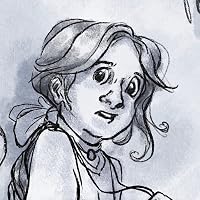
The pictures by Robin Eaton are OK, but not superb - a bit too modern-looking for my taste. The UK originals had illustrations by David Smee, and I'd be interested to see how they compare.
It's quite remarkable how Paton Walsh gets so much history into these brief books, especially since there is no sense of being drowned with facts. Some specific names are mentioned, such as the Spartan general Pausanias, but the story is effectively told without them. When using this book as part of a study of the period, it might be best to introduce things with a map and an overview so that the names and events mentioned so casually in the stories have some context.
There are not many historical fiction books about this time for readers of this level, but there are a couple that should be read before this one. The story of Marathon is important, and there are references to the Battle of Thermopylae. The First Marathon: The Legend of Pheidippides and At the Hot Gates: An Account of the Batle of Thermopylae are two that could be used.
These three stories, for me, are highlights of the publisher series in which they originally appeared (Long-Ago Children) in the 1970s. I am eager to read more as I can.
The pictures by Robin Eaton are OK, but not superb - a bit too modern-looking for my taste. The UK originals had illustrations by David Smee, and I'd be interested to see how they compare.
June 24, 2016
Three short stories based on Greek history, written in Walsh's engaging style. The voice is exquisite and the four young protagonists have interesting adventures which change the course of history. Challenging vocabulary, but beautifully written.

July 12, 2016
Excellent addition to a study of Ancient Greece.
Displaying 1 - 3 of 3 reviews