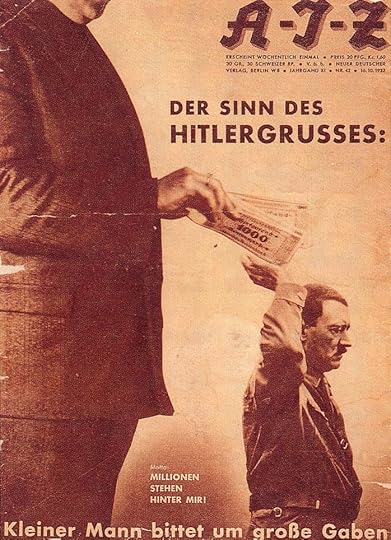
John Heartfield (1891, Berlin – 1968) is the anglicized name of the German photomontage artist Helmut Herzfeld. He chose to call himself Heartfield in 1916, to criticize the rabid nationalism and anti-British sentiment prevalent in Germany during World War I.His photomontages satirising Adolf Hitler and the Nazis often subverted Nazi symbols such as the swastika in order to undermine their propaganda message. One of his more famous pieces, made in 1935 entitled Hurrah, die Butter ist Alle! ( Hurray, the butter is gone!) was published on the frontpage of the AIZ in 1935. A parody of the aesthetics of propaganda, the photomontage shows a family at a kitchen table, where a nearby portrait of Hitler hangs and the wallpaper is emblazoned with swastikas. The family — mother, father, old woman, young man, baby, and dog — are attempting to eat pieces of metal, such as chains, bicycle handlebars, and rifles. Below, the title is written in large letters, in addition to a quote by Hermann Göring during food shortage. Translated, the quote "Iron has always made a nation strong, butter and lard have only made the people fat".In 1918 Heartfield joined the Berlin Dada club and the Communist Party of Germany.He would turn out to be highly active in the Dada movement, organizing the First International Dada Fair in Berlin in 1920. In 1919, he was dismissed from the Reichswehr film service on account of his support for the strike that followed the assassination of Karl Liebknecht and Rosa Luxemburg. With George Grosz, he founded Die Pleite, a satirical magazine. After meeting Bertolt Brecht in 1924, who was to have an influence on his art, Heartfield developed photomontage into a form of political and artistic expression. He worked for two communist the daily Die Rote Fahne and the weekly Arbeiter-Illustrierte-Zeitung (AIZ), the latter of which published the works for which Heartfield is best remembered.
I have made my way through Jonathan Littell’s nearly thousand-page novel, The Kindly Ones, a fictional autobiography of a former Nazi SS officer who served on the Eastern front. This was not an easy book to read and listen to (I listened to the audio book); matter of fact, it is a tough book to stomach – at no point are we given the slightest break from the details of the first-person narrator's sordid, complex life. I have also recently listened to a series of illuminating podcasts about 20th century art, including the painting and sculpture and films made for the Nazi propaganda machine. Most insightful.
Littell’s novel and these podcasts prompted me to take another hard look at one of my favorite art books: Heartfield Versus Hitler by John Willett. Due to the strong anti-British mindset of Germans during World War 1, German photomontage artist Helmut Herzfeld changed his name to John Heartfield and during the 1930s created innovative, penetrating art portraying Adolf Hitler and the Nazis. There is something gripping about these photomontages and Willett’s book contains many excellent reproductions. Here are my comments on four of Heartfield’s works:
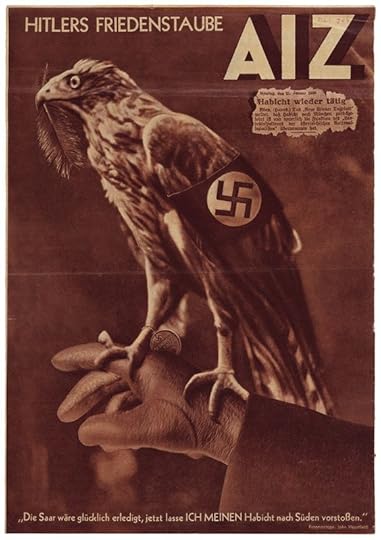
With Hitler’s Dove of Peace on the cover of one of the AIZ (Worker’s Illustrated Magazine), we see an ominous big-eyed hawk with a swastika armband on its wing, holding not an olive branch but a feather in its beak, as if perhaps fresh from devouring a prey. A coin bearing the stamp of a swastika is fastened to its leg. The hawk can’t be controlled, even by the handler, as evidenced by the long nasty gash at the base of the handler’s thumb. John Heartfield captures the spirit of Hitler’s peace, which, in fact, is the exact opposite of peace, as the hawk is the opposite of the dove.
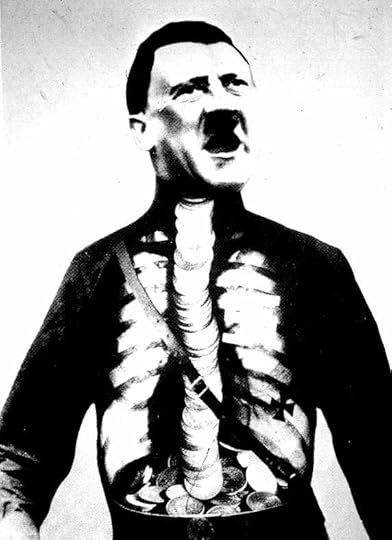
Adolf, the Superman, Swallows Gold and Spouts Tin features Hitler doing what he does best – mouth wide open, barking his speech to the German people. We are given an x-ray of what Hitler is on the inside: a Nazi swastika in place of an organic human heart and not an organic, human respiratory system but a tall stack of gold coins running from Hitler’s diaphragm right up to the top of his throat. Also, gold coins are scattered in place of a flexible, human diaphragm. With keen artistic vision, John Heartfield in 1932, when this photomontage was created, could peer at the inner man Hitler and see a diabolical egotist who would strip the world of its wealth and, in return, give the world false coins of lies, illusion and destruction. Unfortunately for the world, Heartfield’s vision hit the bull’s-eye.
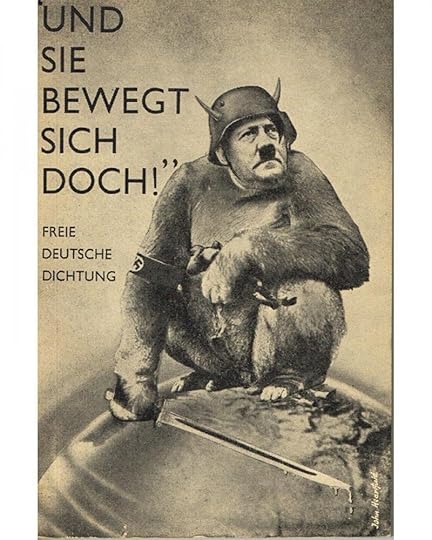
With the photomontage for a brochure cover, 1943, we have Adolf Hitler inhabiting the body of a gorilla, crouching atop a globe. The Hitler-Ape wears the Nazi swastika on its right upper arm as well as a Nazi helmet with devil horns and holds a sword in its right hand, a sword dripping with white liquid, not exactly blood but something that, no doubt, having satisfied its revolting desire to slice and stab. Heartfield portrays Hitler as the bestial, twisted, evil thug that he was. The Hitler-Ape looks up as if ready to grunt and wave its sword at victims in other worlds. We can almost smell the reeking, putrid stench of this most foul and deformed of creatures.
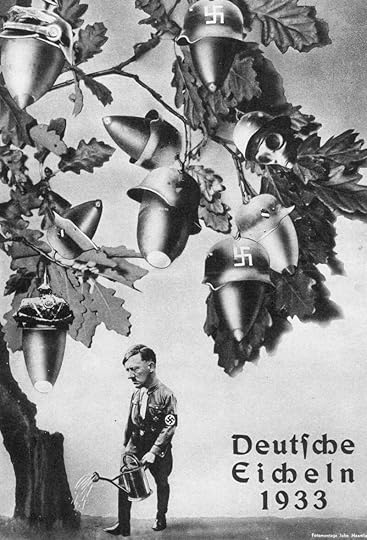
The German Oak Tree has a placid Hitler holding a watering can to dutifully water an oak tree with huge acorns, each acorn wearing a German Nazi helmet, an old Prussian-style helmet or a gas mask. John Heartfield understood clearly anything this wicked toad-scum by the name of Hitler touched, even something as innocent and life-giving as a tree, turns to militarism, violence, death and ruin.
John Heartfield had a vision ahead of his time: Hitler and the Nazis seen for exactly what they were: a force of diabolical evil and mass-destruction. Has there ever been a clearer instance of evil in the modern world? Has there ever been an artist who created art displaying to the world in more striking images exactly how evil and destructive this force? My dad landed on the first day of D-Day and fought against the Nazis as a sergeant of a tank in the US army. Ordinarily I take a pacifist stand but, in this case, I think my dad did the right thing.
This was an incredible book the offers an artistic take on how people have fought fascism and the nazis. Heartfield was a genius that few know, but all should. Sadly, I'm pulling this book out again because it might be useful to take another look.