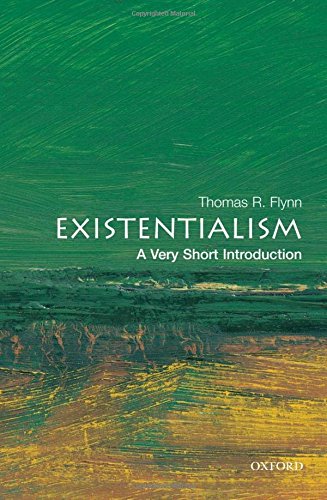
A Study in Existential Thought:
For a VSI, this is surprisingly comprehensive and provides an extensive discussion on numerous issues that form the subjects of many existential thinkers from Kierkegaard to Sartre. The latter, though, and his philosophical system is scrutinized in detail especially, but Flynn does a great job in always comparing and contrasting Sartrean atheistic existentialism to its theistic counterparts as we find it in Kierkegaard and Jaspers, to give a kaleidoscopic effect to the reader who experiences a whirlwind of thoughts and emotions as he or she wades through this text. It has been a tremendously informative and educational experience for me, though existentialism, both the philosophical theory and the ethic, mutually inclusive as they might be, is something that might take me several more books to understand completely in all its variations and ramifications.
Coming to the specifics of this book, Flynn mentions in the preface that his aim with the VSI is to clear up the charges that uninformed minds have placed against existentialism, pretty much what Sartre set out to do in Existentialism is a Humanism. Existentialism has popularly been misconstrued as a) a contemplative, bourgeois philosophy and b) a product of the upheavals of its time and thus, having no relevancy for the individual today. Whether we historically marginalize it or make the claim that it has little worth for the dynamic individual, Flynn states, in both cases we’re way off. The question of being and meaning, Flynn explains, has been a subject of philosophers since the ancient Greeks and continues to hold currency even for the individual today as it talks of things most personal to the individual; a philosophy where he is the subject and not some impersonal realm of knowledge irrelevant to the condition of man. Also, existential thought, irrespective of its atheistic or theistic underpinnings, is action-oriented and not simply thought-oriented. It is not philosophizing for the sake of philosophizing but has tremendous practical possibilities.
The Problem of Meaning:
"I have never seen anyone die for the ontological argument… Whether the earth or the sun revolves around the other is a matter of profound indifference. To tell the truth, it is a futile question. On the other hand, I see many people die because they judge that life is not worth living. I see others paradoxically getting killed for the ideas or illusions that give them a reason for living (what is called a reason for living is also an excellent reason for dying). I therefore conclude that the meaning of life is the most urgent of questions."
– Albert Camus, The Myth of Sisyphus
The problems of the “first philosophy”—the nature of knowledge, its limitations, its possibilities—have troubled the philosopher’s mind since ages and much of philosophical thought has been concerned with questions that, though were and are important in their own right, do not answer the “human” question, the human predicament directly. In the face of a world divested of meaning, where no religious anchorage can provide relief, where the yawning abyss of nihilism always grows deeper and bigger in front of us, how exactly can we lead our lives without succumbing to either suicide or pessimism? For Sartre, even though life and existence is intrinsically superfluous, man still has the power and capability to endow it with his own meaning, his own direction and his own purpose. When he says "existence precedes essence", it covers both situations: that of human existence and of existence generally. There is no specified, predetermined essence to the human individual and thus, he is free to make whatever he wants out of himself. Similarly, existence or life having no essence entails that it, too, could be steered in any direction as the existent desires. This is the dynamism of existential thought that it focuses upon “constructing” and “building” meaning rather than simply accepting the lack of it and slipping into nihilistic withdrawal. As Camus says, the acceptance of the “Absurd” or the meaninglessness of life must be taken as a premise and not as a conclusion. I am here, an insignificant existence in a world that could have done very well without me, with no intrinsic purpose and direction, I am a creature of chance and accident, but I am free. I am free and I am alive and I exist. This freedom over myself and my life gives me the power of constructing an Übermensch out of myself or a Machiavelli. I am free to choose. I am free to act. I am utterly and completely free.
Existence precedes Essence: Facticity and Transcendence
"Atheistic existentialism, which I represent, is more consistent. It states that if God does not exist, there is at least one being in whom existence precedes essence—a being whose existence comes before its essence, a being who exists before he can be defined by any concept of it. That being is man, or as Heidegger put it, the human reality. What do we mean here by "existence precedes essence"? We mean that man first exists: he materializes in the world, encounters himself, and only afterward defines himself. If man as existentialists conceive of him cannot be defined, it is because to begin with he is nothing. He will not be anything until later, and then he will be what he makes of himself. Thus, there is no human nature since there is no God to conceive of it. Man is not only that which he conceives himself to be, but that which he wills himself to be, and since he conceives of himself only after he exists, just as he wills himself to be after being thrown into existence, man is nothing other than what he makes of himself. This is the first principle of existentialism."
-- Jean-Paul Sartre, Existentialism is a Humanism
Naturalists in literature proclaimed that there are certain things that we cannot help--the socio-economic conditions in which we were born, our genetic makeup or whether it cripples us in some way or makes us stronger, the kind of environment we’re raised in—and these things play a vital role in shaping our character. We are, thus, products, conditioned and made by certain unavoidable circumstances and forces and thus, this determinism, be it biological or otherwise, does not make us wholly responsible for our selves, our beings, our characters.
Sartre calls these aspects as Facticity: the things we’re born with, the things we cannot change about ourselves.
But he goes further. Flynn writes:
"Facticity denotes the givens of our situation such as our race and nationality, our talents and limitations, the others with whom we deal as well as our previous choices. Transcendence or the reach that our consciousness extends beyond these givens, denotes the takens of our situation, namely how we face up to this facticity."
Let’s say two kids growing up suffer from sexual or physical abuse. One grows up vulnerable, depressed, with low self-esteem while the other grows up to be strong, determined, learning from his scars and making trophies out of them. This is their respective Transcendence. For Sartre, we are all free to transcend over our facticity and so even if predetermined in some way, we are still free to define ourselves by acting and doing. We are the products of our actions which are the results of our transcendence, and are not simply the products of our facticity. How we respond to the givens of life is up to us; they do not shape us, we can shape them.
Here lies the humanism of existentialism, the glorification of the freedom individuals have over themselves. When most people misread existentialism as a pessimistic philosophy, it might majorly be due to its emphasis on the meaninglessness of life and its rejection of any transcendental purpose that life or man might have. But, if one thinks like Sartre, this is exactly what sets the existential man free.
Existential Authenticity and ‘Bad Faith’:
Those who “blame” their facticity for the choices they make in life and their consequences and fail to own up to the responsibility, for Sartre, they act in bad faith. When we can always transcend and be “more” than what we’ve been given then it is “we” who make decisions and it is “we” who must follow through. As we are free, we are free to choose and those who fail to choose at all or fail to own up to its responsibility are those who act in bad faith and are those who are “existentially inauthentic”. Flynn writes:
"This teaches the existentialist lesson that our entire life is an ongoing choice and that the failure to choose is itself a choice for which we are equally responsible. Sartre formulates this bluntly when he asserts that for human reality [the human being], to exist is to choose and to cease to choose is to cease to be. Sartre also echoes Kierkegaard’s relation of choice to self-constitution when he adds that, for human reality, to be is to choose oneself."
Authenticity in existentialism is of prime importance. This entails being completely aware of oneself and of one’s freedom, and making choices, willingly and consciously, and accepting responsibility for the results. To be authentic is to be an individual and not part of the herd or like the “others” just to be accepted, but to make your own choices even if it risks isolation and ostracism. Thus, Kierkegaard and Nietzsche see in the person of Socrates an existentially authentic individual who chose a path willingly that he could live for and die for. Meursault, Camus’ Stranger is a stranger for similar reasons—he will not and cannot conform even knowing that it is this nonconformity and “strangeness” that might end his life.
The existentialist accepts the absurdity of his life, recognizes his freedom thereof, knows that his essence is up to him to define, makes the necessary choices, and accepts responsibility. He will not and cannot role-play throughout his existence: wearing convenient masks as those around him demand.
Those who do not do any one of these things have agreed to a life of self-deception, a life of bad faith, according to Sartre.
Existentialism and its Social Conscience:
“In choosing, I choose for all people”, he insisted. And in words that carry a distinctively Kantian ring, Sartre challenges that each agent ought to say to himself: “Am I he who has the right to act such that humanity regulates itself by my acts?” This seemed to convey a sense of responsibility for the other person and even for society as a whole that was different from his previous contentions. Sartre introduced yet another ethical principle when he asserted that in every moral choice we form an image of the kind of person we want to be and, indeed, of what any moral person should be: “For in effect, there is not one of our acts that, in creating the man we wish to be, does not at the same time create an image of man such as we judge he ought to be.”"
-- Jean-Paul Sartre, Existentialism is a Humanism
“In choosing myself, I choose man” says Sartre in Existentialism is a Humanism, thus endowing the philosophy its moral and social conscience. If I prefer being free to being a slave and choose freedom then it could not simply be a choice that I make for myself but for all humanity. Thus those who, being privileged themselves, deny the same privileges to others are not existentially authentic and are steeped in contradiction. Flynn refers to Simone de Beauvoir in this respect of existential ethics and a detailed reading of her might be of help to the student.
Existential ethics basically rest upon keeping the entire human picture in mind while committing certain acts that on a personal moral plane might shame the individual. What if everyone started doing what I am doing? What if someone did this to me, would I be okay with that? Those acting in bad faith might say to themselves: but everyone isn’t like me! Everyone doesn’t do this! In Existentialism in Humanism, Sartre writes:
"Certainly, many believe that their actions involve no one but themselves, and were we to ask them, "But what if everyone acted that way" They would shrug their shoulders and reply, “But everyone does not act that way." In truth, however, one should always ask oneself, "What would happen if everyone did what I am doing?" The only way to evade that disturbing thought is through some kind of bad faith. Someone who lies to himself and excuses himself by saying "Everyone does not act that way" is struggling with a bad conscience, for the act of lying implies attributing a universal value to lies."
Isn’t it obvious how this kind of ethic can be beneficial to the entire human community? The claims of existentialism being too individualistic and relativistic seem to me specious and shallow, in the light of Sartre’s arguments, but even so there is much more to be learnt and discovered. To cut it short, existential ethics give social magnitude to individual moral actions which, I personally think, is pretty good. Anyway…
Conclusion:
This VSI covers a lot of ground and talks of plenty other things that I haven’t spoken of here. There is a very interesting discussion on Husserlian phenomenology and its impacts on existential thinking; Kierkegaard has been given his due and his three important stages of the development of man are discussed separately; and the reasons why Sartre was slightly wary of Freud and his theories are also discussed, something I didn’t know of before and found quite fascinating. I would still recommend Existentialism is a Humanism to the uninitiated as that is more accessible and concise than this VSI but for those who feel themselves prepared for the next rung in the ladder, then I’m sure Flynn will not disappoint.
Important note to the students of literary criticism: this book does not touch upon existential literature per se and is an exclusive study of simply the philosophy. For those who look for a study of existential literature specifically, then this is not your book, though it will definitely help explaining the literature in its own way.