Jump to ratings and reviews
Rate this book

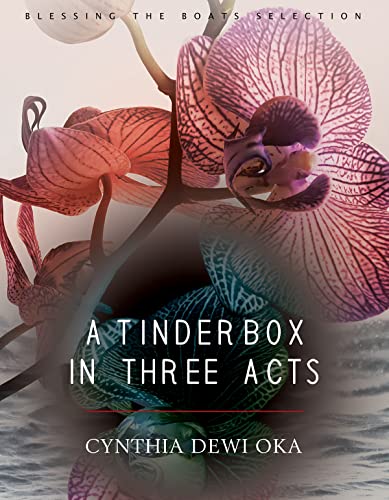
A Tinderbox in Three Acts

Rate this book
Selected by Aracelis Girmay, A Tinderbox in Three Acts is at once elegy and exegesis, fact and invention. 

In her fourth poetry collection, Cynthia Dewi Oka performs a lyric accounting of the anti-Communist genocide of 1965, which, led by the Indonesian military and with American assistance, erased and devastated millions of lives in Indonesia. Under the New Order dictatorship that ruled by terror for over three decades in the aftermath, perpetrators of the killings were celebrated as national heroes while survivors were systemically silenced. Drawing on US state documents that were only declassified in recent years, Oka gives form and voice to the ghosts that continue to haunt subsequent generations despite decades of state-produced amnesia and disinformation.

In service of recovering what must not be remembered, A Tinderbox in Three Acts repurposes the sanitized lexicon of official discourse, imagines an emotional syntax for the unthinkable, and employs synesthetic modes of perception to convey that which exceeds language. Here, the boundary between singular and collective consciousness is blurred. Here, history as an artifact of the powerful is trumped by the halting memory of the people whom power sought to destroy. Where memory fails, here is poetry to honor the dishonored, the betrayed, the lost and still-awaited.

112 pages, Kindle Edition

First published October 11, 2022

3 people are currently reading
98 people want to read

About the author

Cynthia Dewi Oka

10 books33 followers
Cynthia Dewi Oka is a poet and author of "nomad of salt and hard water" (Dinah Press, 2012) and the chapbook "poems from the cracks" (2010). Born and raised in Bali, Indonesia, Cynthia migrated to Turtle Island at the age of 10 and was a visitor for many years in Vancouver, unceded Coast Salish Territories prior to residing in New Jersey. An alumnus of the Voices of Our Nations (VONA) Workshops, her poems have or will soon appear in Boxcar Poetry Review, Generations Literary Journal, Zocalo Poets, Borderline Poetry, 580 Split, SCHOOL Magazine, Briarpatch Magazine and Kweli Journal, among other publications. As a scholar and activist, her essays have been published in Studies in Political Economy, CitizenShift and Leftturn: the Global Intifada. She is a member of the Press Release and Cinderblock Poets collectives. She is also a proud young mama. Visit cynthiadewioka.wordpress.com and www.dinahpress.com for more information.

Ratings & Reviews

What do you think?
Rate this book

Friends & Following

Create a free account to discover what your friends think of this book!

Community Reviews

5 stars
24 (50%)
4 stars
17 (35%)
3 stars
5 (10%)
2 stars
1 (2%)
1 star
1 (2%)
Displaying 1 - 12 of 12 reviews
Profile Image for Katie Bennett.
44 reviews8 followers
November 10, 2022
“A Tinderbox in Three Acts” is a bold docupoetic collection that joins M. NourbeSe Philip’s “Zong!” and Bhanu Kapil’s “Humanimal” in re-imagining history & its fictions. Writing in the wake of the National Security Archive’s declassification of reports which prove the US government supported the Indonesian military and paramilitary’s killing of its people in the name of anti-communism, Oka refuses to be complicit in the slaughter of her people and the Indonesian government’s subsequent denial of these acts. She bores into holes as a means of excavating buried ancestral voices, in turn asserting her own worth. She writes against archive, where gardens “exceed,” and “hanging vines”—sparks of suppressed lives—thrive.

I’ve sat with this text a long time. Sometimes feeling out of my depth and questioning my ability to “understand,” especially as a non-poet. While it’s true that the quality of a poem’s shine depends on who’s pointing the spotlight on it, Oka’s poems especially invite spaciousness in their interpretation. Oka addresses this directly: “My resistance to narrative clarity has to do with the failure to accept coherence as the best thing we have to offer each other.” She understands that “coherence” and Western literature’s worship of linearity (and the ways this linear thinking has enacted social hierarchies and the subsequent oppression of ideas and people), have been used against her, her family, and her culture. So she invents new forms of writing. She gives ghosts voices. She disassembles documents and rearranges their letters to create new meaning. She uses research as a launch pad for personal narrative, and she melds research and poetry without disrupting the text to cite her sources. Reading Oka, I think of Glissant’s essay “For Opacity,” in which he argues that opacity leaves space for disparate ideas (and peoples) to be held in equal regard. Opacity, and Oka’s poems, are invitations to freedom.

As much as I’ve stretched myself reading “Tinderbox,” as much as I’ve deepened my thinking and challenged my capacity to understand, there are certain lines I feel intuitively, such as, “I look and listen only to whom/ I belong,” and “Build any world/ you can love.” These are reminders of our personal power and agency. And ultimately, through writing, Oka does build a world she can love: “Perhaps return is possible across generations, if not always geographies. This imagining is my offering to the holes in my ancestry, and in myself.”
Profile Image for Emily Neuharth.
4 reviews
June 5, 2023
Oka chose to write about this injustice by refusing to give us a cohesive story which communicates the most important part— invoking in readers the reality that the consequences of this loss are still actively present. Such a brilliant, creative, heavy, important book.
Profile Image for Crystal.
594 reviews186 followers
July 1, 2023
Excerpts:

On earth, I have mistaken a rock

for a voice. A voice for a listening.

(from "Apologia")

I am

dust or nothing.

(from "Diplomacy")

I am a girl not a razor blade please let me hold more than onions and windows with no one I can see behind them

(from "Window #033)
Profile Image for rosie (donna tartt’s version).
157 reviews
October 9, 2022
i'm grateful to Cynthia for letting me in to her work, including being sent her newest book before its pub date, and for having been able to be in community with her in the Summer 2022 Docupoetics class. i was able to hear (and see) just how much blood, sweat, and tears went into this new collection, between all of the research of the archive to the why's, how's and even the unanswerable questions.

i am both a poet and an aspiring archivist. i believe that the preservation of our histories is a right, yet when a specific history is systematically destroyed and erased from public memory, there are so many blank spaces and silent rooms that we must fill in with what we know to be true now. Cynthia wrote that A Tinderbox in Three Acts was a work of fiction "because it must be." in this work we learn of the ghosts that live in those empty spaces where the unspeakable is purposefully destroyed, who these ghosts possess, and the entire weight that comes with a generation of descendants that remain haunted. Cynthia uncovers the empty spaces and breathes life into these ghosts, giving them voice and reason and memory. so often i thought while reading, what does it mean to learn of your history through an colonized lexicon? these are questions that i find difficult to answer as an archivist, but as a poet, it goes back to what the poet does always: pushing in, listening, unveiling.

Cynthia's work feels so special. We are being let in to such a intimate and new encounter, born of something purposefully camouflaged and thus, when found again, made to be heard and listened to.
Profile Image for Garden Oluwakemi.
2 reviews
Read
September 30, 2022
[I received a free copy of the book in exchange for an honest review.]

“The circle is a cruel shape…Crueler when it fails to / close, when the hand journeying // back toward the point // of its beginning falters, is / deleted. Our minds crescent, while // grief spirals // down, down, a generational design.”

Whew. Cynthia Dewi Oka’s A Tinderbox in Three Acts weaves fragmented lyric, conversations, and visual mappings to explore the 1965 Indonesian genocide, which was led by the Indonesian military and assisted by the United States. In response to governmental denial of the genocide, Tinderbox both resists and reimagines against the cruelty of circles, of narrative clarity, of “coherence.” Through fragmentation and ambiguity, Oka refuses to “accept coherence as the best that we have to offer each other.” When preoccupied with tidiness and rationality, coherence can turn suppressive. After all, it was in the name of “coherence” that the genocide reimagined murdered Indonesians as “‘chickens’ so that slaughter would seem their logical, even inevitable fate.”

Tinderbox resists the “cruel shape” of the circle through the anti-historical character Nonik, who interrogates memory and the six other characters across the three acts. In “Rules of the Interrogation,” the book declares, “There is no direct correlation between what you reveal and what is recorded... between what you speak and what you reveal.” True to this, the characters’ dialogue circumvent each other, inadvertently revealing the wounded wariness of an archive which can be easily distorted.

Furthermore, the book presses against archive through the ironic and painful repurposing of official U.S. records of the Indonesian genocide—by looking into the complicit mouth of empire. Oka also presses against poetic form through the character profiles: each character (except Nonik) is introduced with a synesthetic visualization—marks drawn to music in a manner that, to me, reimagines and questions how to embody/archive a single person, not to talk about a country.

As a reader and writer, I feel invited by Oka’s assertion about coherence to reflect on clarity, universality, and the meaning-making work that poetry is ostensibly “supposed” to do. If coherence isn’t all that we have to offer each other—if efforts at clarity can paradoxically lead to obscuring and/or suppression—what about resonance? How do we invite resonance and pulse into our reading and writing? As someone who often gets intimidated by poetry, and as a Black person who recognizes my positionality when reading about Indonesian experience, I shifted my reading of Tinderbox into that of the prelingual: seeking the intergenerational pulses of this work as it emotionally and imaginatively reckons with a suppressed past. Overall, A Tinderbox in Three Acts challenges me with fraught diasporic yearning and memory, as well as the boundaries and boundlessness of imagination:

“As an artist, I too, traffic in imagination,” Oka writes in her dedication. “What I do not have is the power to enforce my imagining as policy. Nor would I wish to.…Perhaps return is possible across generations, if not always geographies. This imagining is my offering to the holes in my ancestry, and in myself. This imagining is a memorial for those who were systemically denied the right to be mourned.”
Profile Image for J.
631 reviews10 followers
July 18, 2023
This poetry collection focuses on the 1965 genocide in Indonesia, which was led by the Indonesian military and backed by the United States. It's a dense collection that asks the reader to realize the damning position that US empire has had globally, but especially in Asia. Oka approaches her poems from different angles, ranging from character interviews, illustrations drawn to music, fictional telegrams, to a disassembling of declassified documents. She invites the reader to sit with grief of this genocide, but also grief of buried voices and histories due to oppression.

I continue to think about what Oka wrote in Act I, which I think captures her call to the reader to take time to reflect while making sense of this collection:

My resistance to narrative clarity has to do with failure to accept coherence as the best thing we have to offer each other. Coherence is linear or circular. It mitigates risk. In the progression of a march, or the loop of a hook, I am safe from the feeling that possesses no trajectory or destination. In this sense, the melody that neither extends nor offers return to a specific point is the enemy and identity of the displaced.


A powerful collection, but definitely a dense one that will take time to mull over.
Profile Image for Oliver.
229 reviews3 followers
February 19, 2024
From what I hear, Camille Paglia says that poetry doesn't need theory because it IS theory, or something along those lines at least. That sentiment certainly rings true here as Oka forges a body of work worthy of the label of theory in dizzying new ways. Oka resists "narrative clarity" or any sort of "coherence [that] mitigates risk" through the slippery medium of poetry (and abstract art!) to probe lost and obscured histories of harm. This book does interesting, new things with form (in ways that I wonder if it overtakes the content...). I am reminded of Annie Finch's Among the Goddesses—using almost-allegory fictions to supplement history, sampling forms like dialogues and interviews amidst free verse to gesture towards larger, unspeakable things that can't be contained within a single traditional genre... I won't lie, it's hard to grapple with, and I think it's meant to be that way, but this goes on my list of poetry books I wouldn't immediately recommend for non-poetry-readers, although it fills a conspicuous silence in beautifully loud ways.
1 review
September 20, 2022
A Tinderbox in Three Acts centers on the 1965 Genocide in Indonesia. This book feels like a culmination of several things: a reckoning, an act of love, a stage for those murdered to be seen and felt, how personhood is tangled with the where, and how deadly nationalism can be/is.

One of the things I value the most when I read is the awareness I gain. Something that I can also take away to improve my writing practice. I appreciate A Tinderbox in Three Acts for doing just that. When I started reading the book, it was close to Mexican Independence Day. The Southwest Side of Chicago was full of cars cruising with Mexican flags hanging out their windows. As I read, I had to stop and journal what the flag/nationalism means. Even though it's a privilege to be born in the U.S., I've always felt displaced. The Mexican flag feels like a connection to the land of my ancestors. But I also realize it's also a symbol of oppression in Mexico. I'm still working through the nuances of these realities.

The form this book of poetry takes through visual art, telegrams, script, and generous context through annotation is a work of courage and brilliance.
Profile Image for imeda.
258 reviews
October 6, 2024
honestly this book is incomprehensible but in the best way possible.

the narrative is very hard to follow. i don’t think i really got it until i read it a second time, but gosh, the poetry is so beautiful. each line is so well-constructed and it was honestly just so fun to read.

the mix of media is also really cool. it’s part poetry, part play, part fiction, part historical, part whatever the fuck. it all weaves together really nicely and i really enjoyed it. there’s a section where it discusses coherence and incoherence and it really struck a cord with me bc i believe incoherence is part of human nature. people will never truly understand one another, but god, we try so hard to. each person’s experience is unique and and every person can have a different view on a situation. that’s why this book isn’t coherent. people aren’t either. we just have to figure it out anyway.

it’s a really beautiful poetry collection. i really enjoyed reading it and will probably read again in the future which i don’t usually do for readings i get assigned in school.
Profile Image for Caitlin Cacciatore.
7 reviews2 followers
November 30, 2022
A Tinderbox in Three Acts is a tender, moving, timely work. Some gems: “The warehouses are ashes. While my bothers / are out patrolling, bats peel themselves from the insides of the earth.” (p 71) and “I saw a pit I did not mean / to enter language for a country / that wasn’t even there” (p. 47)

The poetic imagery is sublime throughout, and this ‘tinderbox in three acts’ tells the often-neglected story of the 1965 genocide in Indonesia. It highlights the human cost without being overtly graphic, and the subject matter is handled expertly.

This poetry collection is defiant and proud – spoken from a place of great grief and sorrow, about a decades-deep national trauma. This book is unafraid to speak about the damages of imperialism and the atrocities humankind can be capable of, but the language itself maintains a poetic, dark, and lovely mystique throughout. 5 stars out of 5.

Please note: I received a complimentary copy of this book from LibraryThing.
Profile Image for Abigail.
173 reviews3 followers
August 25, 2024
Beautifully written but I felt like I was just reading it to completely solely for the purpose of finishing another book and not to enjoy the poetry to its fullest
23 reviews
August 31, 2025
it’s a bit too abstract than my usual reads but i enjoyed the reimagining of Indonesian history that would otherwise be completely unexplored
Displaying 1 - 12 of 12 reviews

Can't find what you're looking for?

Get help and learn more about the design.