Nicholas Mosley was educated at Eton and Oxford. He served in Italy during World War II, and published his first novel, Spaces of the Dark, in 1951. His book Hopeful Monsters won the 1990 Whitbread Award.
Mosley was the author of several works of nonfiction, most notably the autobiography Efforts at Truth and a biography of his father, Sir Oswald Mosley, entitled Rules of the Game/Beyond the Pale.
This book was written by the English novelist, Nicholas Mosley.
Despite its non-fiction title, I think I bought it in the expectation that it would be a novelisation of the events around the assassination of Trotsky in Mexico in August, 1940.
As it turns out, it’s a fairly straightforward biographical account, even if the chronology is a bit muddled. It jumps backwards and forwards from May, 1940 (the time of an earlier assassination attempt), to the revolution in October, 1917, to the time of Lenin’s illness and death in 1922 - 1924, to Trotsky’s initial exile from the Soviet Union in 1928 - 1929, to Stalin’s show trials in 1936 - 1939, to Trotsky’s expulsion from Norway to Mexico in 1939, to the trial of Ramon Mercader (the assassin) in 1942.
I haven’t been able to find any suggestion that Mosley was a Communist, let alone a Trotskyist (or a Trotskyite). It’s possible that the author was just interested in the dramatic appeal of the events in their own right.
Efforts at Truth
This is where the story gets a bit strange. In 1959, an American Trotskyist named Bernard Wolfe published a novel called “The Great Prince Died” (later republished as “Trotsky Dead”). This novel was optioned in 1965 by the film producer, Josef Shaftel, who made a film directed by Joseph Losey called “The Assassination of Trotsky” (released in 1972). The screenplay for the film was written by Nicholas Mosley. There’s some suggestion that Mosley was thrown off the production (“Mosley was often at odds with his collaborators—he was thrown off the latter projects, and essentially novelized Trotsky in retaliation.”), although he didn’t lose his credit (which suggests that his script or some of it was actually used). On the other hand, Mosley says in his autobiography that he complained to Josef Schaftel about script changes that Losey was making, to which Schaftel responded, “If you’re so anxious to put over your ideas, why don’t you write a book of the film.” As it turned out, Schaftel had already reached a very lucrative agreement with the publisher, but the book had to be ready in eight to ten weeks. Mosley was reluctant to accept the commission until he learned the size of the advance on offer. Mosley had carte blanche as to the form the book took.
The copyright notice for this book indicates that the copyright belongs not to Mosley personally, but to Josef Shaftel Productions (presumably the production company with respect to the film). The book doesn’t purport to be a screenplay, nor does it refer to Wolfe’s novel in the Note on Sources. It is however possible that it was based on some kind of treatment that Mosley had used to pitch his services and ideas for the film project. At any rate, the production company obviously believed that it held the legal rights to the book. For some reason, whether for copyright or quality reasons or otherwise, the book was excluded from the package of Mosley works that Dalkey Archive Press re-published in 1985 and afterwards. Thus, the book is now both out of print and in some kind of legal limbo that might effectively bury it, if you are hoping to purchase a new copy. I found my copy several years ago in a box of second-hand left-wing literature in Grub Street Bookshop in Brunswick Street, Fitzroy.
Four Things I Learned by Reading This Book
1. Trotsky cared for chickens, rabbits and cacti at his villa in Coyoacan, Mexico (where he was assassinated).
2. His autopsy revealed that both his brain and his heart were much larger than normal.
3. Vladimir Petrov, the Third Secretary of the Soviet embassy in Canberra, Australia defected in April, 1954 (13 months after Stalin’s death in 1953). He inspected the official files on Trotsky in Moscow in 1948 and claimed that there was no trace of any of the letters from Trotsky to Zinoviev and Kamenev that justified the allegations of conspiracy that were the subject of the show trials which resulted in their execution. He also viewed detailed photos of Trotsky’s home and garden, of Trotsky having coffee with his guards, of his wife and son, and his dog, all of which must have been taken by a guest of Trotsky who was also a G. P. U. agent.
4. Sylvia Agelof, one of Trotsky’s secretaries and the wife of his eventual assassin, Ramon Mercader (known to her as Jacques Mornard or Frank Jacson), is described as “quiet and not very attractive”, while Jacques is described as a “dashing and debonair” Don Juan figure (played by Alain Delon). Yet, in the film, Sylvia (under the name Gita Samuels) is played by the beautiful actress, Romy Schneider.
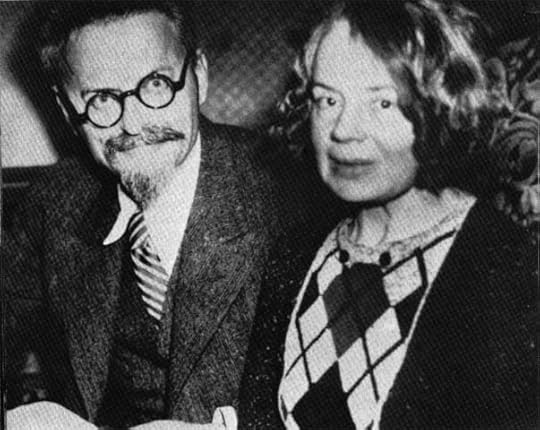
Leon Trotsky and his wife, Natalia Sedova (1932)
Stalinists versus Trotskyites
Mosley reveals in his autobiography that, while writing the screenplay for the film, he said to Losey, “A Stalinist is a Communist in power; a Trotskyite is a Communist out of power.”
This is slightly at odds with the tone of his character analysis of Trotsky in the book.
The political analysis is quite perfunctory. It’s especially lacking whenever Mosley uses the words “dialectic” or “dialectical”, which he interprets solely in terms of disagreement or antagonism. However, he is most insightful when he writes about Trotsky’s artistic temperament.
The Artist and the Revolutionary
Mosley quotes Trotsky:
“...there is always implied, conscious or unconscious, active or passive, optimistic or pessimistic, a protest against reality in any (genuine) artistic creation...Truly intellectual creation is incompatible with lies, hypocrisy, and the spirit of conformity...Artistic creation has its laws...Art can be the revolution’s great ally only in so far as it remains true to itself.” (59)
“...Permit me, nevertheless, to cast a glance at the historic mission of the Fourth International not only with the eyes of a proletarian revolutionist but with the eyes of the artist which I am by profession. I have never separated these two spheres of my activity. My pen has never served me as a toy for my personal diversion or for that of the ruling classes. I have always forced myself to depict the sufferings, the hope and the struggles of the working classes because that is how I approach life, and therefore art, which is an inseparable part of it.” (179)
Trotsky said of Stalin:
“He is neither a thinker, a writer nor an orator...Stalin took possession of power not with the aid of personal qualities but with the aid of an impersonal machine. And it was not him who created the machine, but the machine that created him.” (141)
Mosley adds, in contrast, “Trotsky was a great writer and a great orator; in these senses he was an artist but it did not seem to be just of this that he was speaking...If the contradictions deep within history could not be reconciled within the structures of society they could still perhaps be reconciled in the activity of a person or persons who were the expressions of history. This was leadership. It was also a process usually thought to be aesthetic...The role of a leader was to have the right vision.” (179)
Similarly, Trotsky had said of Lenin:
“Besides other qualities, a great creative imagination was necessary to guide [the work of the 1917 Revolution]. One of the most valuable powers of imagination is the ability to visualise people, objects and events as they really are, even if one has never seen them...to recreate a certain sphere of human life in all its concrete reality, basing everything on experience in life and upon theory - that is the imagination that a legislator, an administrator, a leader must have, especially in a period of revolution. Lenin’s strength was chiefly this power of realistic imagination.” (179 - 180)
Mosley concludes, “[Trotsky] never in any way...advocated the renunciation of politics for art - this would have been anathema to him. But he did seem to say that in the years when the blank-faced bureaucrats would be running the earth then the life of the true politician should have something of the solitariness and austerity and discipline of mind of the true artist - as well as the commitment. Without this, a politician would not be effective in history because he would not be true.” (180)
In a more artistic context, Trotsky wrote to Andre Breton:
“The struggle for revolutionary ideas in art must begin once again with the struggle for artistic truth, not in terms of any single school, but in terms of the immutable faith of the artist in his own inner self. Without this there is no art. ‘You shall not lie!’ - that is the formula of salvation.” (181)
What If Trotsky Had Succeeded Lenin?
This issue is relevant to another concern of Mosley’s, which he expressed in a review of a subsequent biography of Trotsky by Ronald Segal:
“Why did he not come to power, instead of Stalin, after Lenin’s death in 1924; and if he had, how different would the history of Russia, and of the world, have been? Was there something in his nature, or is there something in the nature of power, that makes it impossible to imagine seriously that he could have assumed this kind of power?”
Mosley didn’t directly answer his own questions in this book. He concluded, “Trotsky himself had turned his back on power almost somnambulistically in 1925. The question is sometimes asked - If Trotsky instead of Stalin had taken over power then in Russia would he have been forced to be as ruthless as Stalin was? But the question is no real question; Trotsky was not a man who in 1925 would have got power; he was too mercurial, too talented; he could not have settled to the rythms of everyday politics that history seems to require - in terms of either cocktail parties or gratuitous killings. He had been a leader of exploits like Achilles: he retired to his tent. The man who took over, Stalin, was successful and rude on committees...Stalin did his job - according to the particular rhythm of history. The workers' state was saved: the war was won. The cost was millions of men dying like mayflies.” (182)
However, Mosley continually refers to the killing of sailors in the Kronstadt rebellion. Trotsky argued that he took no direct part in the suppression of the rebellion, but held Zinoviev and Dzerzhinsky responsible. Mosley, on the other hand, infers that, if Trotsky was capable of such violent suppression, he would have reacted in a similar way to Stalin when confronted by a counter-revolution.
Passionate Affirmations
Mosley adds:
“Trotsky became the person with whose name for years people could magically conjure. By chipping away at the world he, like they, created an effect which was the living expression of his belief in permanent revolution. If the revolution did not occur as was required in the world it could exist in the pattern he made for himself and which others would follow. Trotsky knew about power: he knew also about the impossibility except at moments of combining power with dignity and freedom. Everything of importance had to grow; dialectics was a process both of man’s evolution and that of history. The roots of dialectics were in nature; man was what they flowered into...A man worked hard according to the best scientific methods but in the end life had its own inner workings. A man’s faith should be that there was some relation between his efforts and the outside world; but this was also his experience...By this he could make, as Trotsky did, his passionate affirmations.” (183)
It’s not clear exactly what Mosley meant. It’s possible that he was saying that the artist in Trotsky identified with the historical project of the revolution and the attainment of Communism. Therefore, he might have approached his revolutionary goals with the same determination that he approached his artistic ambitions. In otger words, there is in the revolutionary some of the egotism of the artist, especially when they believe that they are guided by History. Hence, nothing would be allowed to stand in the way of Trotsky's/the artist's personal expression.
As Trotsky did to his assassin, he would bite his finger and say, “I prevented him!”
This is a simplistic analysis, but it’s possible that the same conclusion might be arrived at by a different method.
An Excess of History
Once having successfully achieved a revolution, focus justifiably turns not just to transforming society, but to suppressing counter-revolutionary forces who wish to over-turn the revolution and revert to the pre-revolutionary social and economic relations. I have argued in response to William T. Vollmann’s moral calculus that this is a justifiable use of force or violence. This argument would have applied equally to the aftermath of both the American Revolution and the Russian Revolution.
Stalin used the show trials to rid the Soviet Union of Trotsky’s supporters and Stalin’s rivals. It’s arguable that Trotsky would have had to rid society of Stalin and at least some of his followers, although there mightn’t have been as many of them.
Trotsky might have anticipated this when he argued that excess was a by-product of revolution:
"Idealists and pacifists have always blamed revolution for 'excesses'. The crux of the matter is that the 'excesses' spring from the very nature of revolution, which is itself an 'excess' of history." (77)
Nicholas Mosley's The Assassination of Trotsky started as a screenplay for Joseph Losey's 1972 film of the same name (starring a stentorian Richard Burton and inexpressive Alain Delon); Mosley quit the project over disagreements with Losey and turned his research into this nonfiction volume. No masterwork of literature or biography, the book's at least more entertaining and lucid than Losey's embarrassingly bad film, which treats graphic scenes of a bull vomiting blood as an insightful metaphor for...something. Mosley provides the briefest of sketches of Trotsky's life, career and mercurial personality; he largely adheres to the standard portrait of Trotsky as the True Bolshevik who might have led the Soviet Union to Socialist Utopia, a view as trite as his assertion elsewhere that communism and fascism were two sides of the same coin. Mosley also probes the fallout of Trotsky's epic feud with Stalin, the fractious state of Mexican politics of the time, along with sketches of Trotsky's wife, followers and inner circle. Mosley doesn't provide a great deal of insight either into Trotsky or his executioner, Ramon Mercader, a Spanish communist who insinuated himself into the "Old Man's "inner circle, in order to bury an axe in his brain. Mosley's book is oddly structured; bookended by the failed assassination carried out by muralist Daniel Siqueiros and Mercader's more successful plot three months later, it leaps across many subjects and times in the pages between. By its nature, the story generates suspense and intrigue as the noose tightens around Trotsky, forcing him to rely on questionable followers, surly bodyguards and an ever-smaller circle of intimates to broadcast his plans for the Fourth International to the outside world; if not always a penetrating analyst, Mosley is a lucid writer who expertly recreates his grisly climax. Still, readers aren't exactly spoiled for choice on this topic, from Bernard Wolfe's novel The Great Prince Died to Bertrand Patenaude's nonfiction Downfall of a Revolutionary; the only reason to read Mosley's book is if you can't find the others at your local library.
October revolution was a surprise to everyone, especially to Lenin and his bolsheviks. They were surprised that they ended up in power and they got surprised by the fact they met no serious opposition.
Comprised of what might be called theoretical politicians (who prided in scientific approach - sounds familiar right?) that were fighting for a common man but lived much better than common man (they all lived in London, Switzerland, Germany and all other exotic locations in Europe not by a lone coin but by pretty good money - again, sounds very similar to modern day politicians) this intellectual force came back to Russia where they managed to win (to their own bewilderment) and managed to stay in power (by defeating some even truly progressive movements).
As time went on Lenin soon started to become an obstacle for rising bureaucracy. Same happened to all and every old guard politician. Reason? Simple - being theoretical in nature they established all of the mechanisms of iron rule (machine is always right!) but when they started seeing that they might have been wrong and changes need to be done - oh, man, didn't you read the latest political manifesto, there is absolutely no way we can come back or change anything. Because we cannot be wrong (you said it day ago and said it is ultimate truth) then you are wrong! Machine cannot be wrong! So you are wrong and we cannot tolerate it (activism eh - again maybe too close to heart today)! And so they had to go out into exile or end up dead.
So we follow our humble Trotsky in this book as he goes from Siberia to living in the Europe and finally settling in the Mexico. During his exile Trotsky was fighting against the Stalin .... to a degree. You see, only problem Trotsky had with Stalin is that Trotsky is not ruling instead of Stalin. All the explanations Stalin gave, Trotsky seemed to confirm and accept - there must be no doubt, state machine is always right! He did not like the fact he was now targeted but he understood it because this is how things should be. Proletariat cannot take the responsibility, it needs the iron hand to rule it. And this is my problem with Trotsky - he is not that different from Stalin. It is just that he was put on high ground because he was the only one openly critiquing Stalin in these turbulent years. For everything else it was like Behemoth saying to Kraken how monstrous he is!
Author obviously supports Trotsky and has great sympathy for him. Unfortunately I dont share this sympathy because I had opportunity to see this kind of sleazy "scientific" politician practically doing nothing but always be ready for exercises in futility through long quasi philosophical discourse - for a single goal, to prove how smart he is! But this does not take away anything from the book itself. Author manages to interweave turbulent years of Revolution with Trotsky's years in Mexico and portray people he lived with and finally how GPU organized several attempts on his life. In the end sad story - because man was murdered - but also something of a let down because Trotsky was glorified for causes that are actually far away from his core politics - his goal is eternal revolution, eternal angst and eternal strife (where his [Trotsky's] machine is always right!).
For those interested in final years of Trotsky this book will be interesting. For any more details on his person there are much better and more detailed books.
The book could not decide what it wanted to be. From the beginning, it says that it will not cover the life of Trotsky. It proceeds to do a very confusing surface level stitching together of different moments of Trotsky’s life. The assassination aspect was well told but besides that it was far too scrambled.