A nuanced portrait of the first acting woman president, written with fresh and cinematic verve by a leading historian on women’s suffrage and power
While this nation has yet to elect its first woman president—and though history has downplayed her role—just over a century ago a woman became the nation’s first acting president. In fact, she was born in 1872, and her name was Edith Bolling Galt Wilson. She climbed her way out of Appalachian poverty and into the highest echelons of American power and in 1919 effectively acted as the first woman president of the U.S. (before women could even vote nationwide) when her husband, Woodrow Wilson, was incapacitated. Beautiful, brilliant, charismatic, catty, and calculating, she was a complicated figure whose personal quest for influence reshaped the position of First Lady into one of political prominence forever. And still nobody truly understands who she was.
For the first time, we have a biography that takes an unflinching look at the woman whose ascent mirrors that of many powerful American women before and since, one full of the compromises and complicities women have undertaken throughout time in order to find security for themselves and make their mark on history. She was a shape-shifter who was obsessed with crafting her own reputation, at once deeply invested in exercising her own power while also opposing women’s suffrage. With narrative verve and fresh eyes, Untold Power is a richly overdue examination of one of American history’s most influential, complicated women as well as the surprising and often absurd realities of American politics.
Rebecca Boggs Roberts is the author of Suffragists in Washington, DC: The 1913 Parade and the Fight for the Vote and Historic Congressional Cemetery. She has been many things, including a journalist, producer, tour guide, forensic anthropologist, event planner, political consultant, jazz singer, and radio talk show host. Currently she is a program coordinator for Smithsonian Associates, where she has made it a personal mission to highlight the history of our capital city. She lives in Washington, DC, with her husband, three sons, and a big fat dog.
I knew very little about Edith Wilson's role during her sick husband's time as president. This well-written historical account nicely fills in the missing blank. I sometimes I wonder just what got covered in my history classes in high school and college. At any rate, the author has an engaging writing style and a keen eye for including the right details. Edith Wilson was a fascinatingly strong woman who essentially ran the White House.
Excellent biography! Readable, well-written, reasonably sized (without notes under 250 pages, unlike some of the doorstop biographies out there), and very compelling. I felt the author did an excellent job of communicating her fascination with Edith as a person without falling into either fawning admiration or acid criticism. It can be very difficult to write about women from this period, only about a hundred years in the past but culturally very different, in a way that fully captures the ideas of identity that some of them were grappling with. For a woman like Edith, it’s even more complex - she wielded political power, but couched everything she did in the language of this older tradition of True Womanhood. Finding a way to depict that tension in a way that was sensitive and not ahistorical is difficult, but this book walks that line in a lovely way. I learned a lot and am eager to explore this era even more now.
This giveaway was a book full of contradictions for me. Edith Bolling Wilson who became the wife of Woodrow Wilson was an extremely devoted wife towards her husband while living and after his death. So much so that I really admired her at times, but after his stroke, she continually manipulated people and lied about his serious condition which would have kept him from the presidency and her from her position of authority also. This did, and could have had even more serious effects on our nations security and the trust of the people during this time. I also felt like leading him to believe that things weren't so detrimental with him and coddling him to keep him from dealing with the health issues he was facing ,was very dysfunctional behavior. I don't agree that this was strength but weakness in this administration at this time in not coping with reality.
I would like to thank Viking and Netgalley for the uncorrected proof of this ebook.
I found the synopsis of this book intriguing. I have long been interested in the history of women written by women, but my focus has mostly been on monarchical figures. In recent months my interest in better understanding the First Ladies has increased.
Synopsis: "Untold Power" details the life of Edith Bolling Galt Wilson who entered the political scene upon her marriage to President Woodrow Wilson. Raised in a large family in the post-Civil War south, Edith forged her own path by grabbing every new opportunity for adventure with vigour. Although her decision to marry President Wilson was not a foregone conclusion the decision exalted her to the height of power during his incapacity due to a massive stroke. History and Mrs. Wilson in her own words have framed her as the devoted wife of a wartime president, but Boggs Roberts' work brings the formidable personality and legacy of Edith to the forefront.
Thoughts: This was a well-written and well-researched book. I did not want to put it down because Boggs Roberts' writing was so captivating. I knew very little about Edith Wilson before reading this book and I found this book to be a great introduction to her as a historical figure. I really appreciated how Boggs Roberts showed the full picture of Edith, not hiding the fact that she was a racist and anti-feminist. I feel often in biographies of historical figures authors tend to stay away from less flattering facts about their subjects, but because the author did not do that I as the reader was given a more complete picture of Edith. In many ways, this approach confirmed the "complex legacy" component of this book's title.
I do not like Edith Wilson as a person and I am almost certain that we would not have gotten along if in some alternate, bizarre reality we were to meet. However, the narrative that Boggs Roberts was able to weave throughout this book highlights both Edith as a person and the way in which she helped establish aspects of the role of First Lady were enthralling. The many firsts that Edith did as First Lady simply because she and Woodrow were so close (I might even argue they were codependent in some ways, or at the very least Woodrow was entirely dependent on Edith) were fascinating as she held the role only a century ago.
I also really enjoyed the inclusion of "side characters" throughout the book such as the friends that Edith travelled with, members of the Wilson administration, and political opponents. Their inclusion is good from the standpoint that no woman is an island, but it also helped highlight things that reminded me as a reader that Edith was three-dimensional. Some of the grudges that Edith held and opinions on her contemporaries that she voiced were enlightening of her as a person. For instance, the way in which it may have played a role in the diplomacy between the United States and the United Kingdom during Woodrow's convalescence was insane to read.
Another thing that I really enjoyed was the use of quotes from Edith's own biography. Often quotes I find can feel a bit clunky if used a great deal in non-fiction, but Boggs Roberts used them to really highlight events and individuals' thoughts in a way that felt seamless with the history she was trying to tell. It was also wild to read a direct quote from Edith and have Boggs Roberts use the historical record to refute what Edith had written/said. It actually made me want to read Edith's memoir (even knowing how historically inaccurate it is) and made me desperate to learn more about Alice Roosevelt Longworth (a very minor character, but the author's use of her thoughts was so intriguing).
After reading the book the only thing that I wish it had more of was a greater analysis and comparison between the first Mrs. Wilson, Ellen, and Edith. Boggs Roberts hints at their differences several times when she addresses the growing relationship between Woodrow and Edith, but I find it so interesting that Woodrow would have selected two seemingly different women. Perhaps that is another book in and of itself.
If you are a lover of history, women in history, or United States Political history I highly recommend this book. Boogs Roberts did an excellent job revealing her subject and made me interested in learning more about the women who have held the role of First Lady.
Daughter, sister, friend, independent businesswoman, widow, First Lady - all identify First Lady Edith Wilson and yet barely scrape the surface. In Rebecca Boggs Roberts's newest book, Untold Power, the author looks at a woman seldom recognized for her many achievements. Leading from the shadows as acting president while her husband was incapacitated, Wilson was a formidable and complicated force for change. From her lasting influence on White House politics and redefinition of the role of a First Lady, Edith Wilson cemented her spot in history. A well-written and fascinating read, this is a book worth studying regarding the role of women in leadership and the future of the United States for women everywhere.
I found this to be a really easy read and a great consolidated overview of a life that spanned QUITE the amazing time period (Civil War to Kennedy!!) and that was filled with documentation. Kudos go to the author for several things: 1. Digging thru the amount of correspondence and documentation that Edith preserved must have been daunting, and yet she was able to keep the narrative flowing and simple to read. 2. Finding the kernels of truth in the memoirs of someone desperate to control the narrative is never easy, but the author remained truly honest with the reader when she thought Edith had made modifications to retellings of events. 3. Remaining neutral in sections where it would have been easy to take a side to further the narrative. 4. Being up front with the reader in the beginning about Edith's shortcomings and her decision to leave them in, rather than removing some of the opinions held by the Wilsons that were seriously offensive. Going in with that caveat from the author helped immensely. It's not easy to keep your subject neutral or even likeable (even if they were in life) when the decisions they made and the opinions they held were and are so controversial and the author was able to accomplish that. All in all, golly, even though I disagree with a LOT of the choices Edith made (most of us do), I still REALLY admire her. I mean... not many people, much less women, can say that they are solely (or nearly so, but considering the fact that nothing happened while Garfield was incapacitated...) responsible for an entire amendment to the the Constitution.
I have always enjoyed learning about First Ladies and this was a great piece on both Wilson’s. I learned a lot and appreciated how it wasn’t drawn out like many biographies.
I would have liked a deeper dig into Edith Wilson and her husband, the Worst President Ever, but I suppose this was written for a general audience and right for its intended audience. The author, and especially the publisher, wants to work the Bold Woman Exercising Power in a Misogynist World angle, and I don't begrudge them their blurbs, but consequently this book definitely does not Do What It Says On the Tin.
Both Edith and Woodrow were incredibly controlling, resentful, and self-righteous people, and that's the message of this book. The author doesn't spare either person's reputation in the pursuit of some feminist, or progressive, narrative. Good for her! That's the real story here, that Wilson's presidency was ruined by the character flaws of the two principals. I came away with my low opinion of Wilson lowered further, which surprised me.
Definitely recommended for students of Wilson, WWI, and that period of American history. Don't read it for an exciting life, though. Edith was rather conventional, in fact.
This riveting biography of the amazing Edith Bolling Galt Wilson pulls no punches about her unauthorized assumption of the presidency during the incapacity of her beloved husband, Woodrow Wilson … it also covers the years of her widowhood (she died in 1961), and sheds light on her motivations to become an unsung, unelected powerhouse in American politics … absolutely stellar … similar works: by Gene Smith “Win With Wilson” by George Greneas
This is such an interesting book, because yes, I agree that Edith Wilson was a fascinating woman who deserves more credit than what she currently gets (i.e., none whatsoever)... but on the other hand I absolutely do not think she should be considered the "first woman president"! Not that her accomplishments don't invite merit and acclaim, but to identify her as America's first female head of state gives far too much credit to Americans. The people were too misogynistic to elect the most qualified candidate in the country's history back in 2016; there's no way they would have been willing to elect a woman when Edith was the de facto leader. She was functionally in charge, yes, but the "nominally" is missing, and it's there where the real progress is made.*
*Not to imply that women ruling behind the scenes isn't also valuable, but it's not the same as having a woman be elected.
A very readable and engaging biography of Edith Bolling Galt, the second Mrs. Woodrow Wilson. Given that (1) her husband was virtually incapacitated by a stroke for the last 17 months of his presidency, and (2) the Twenty-fifth Amendment was not added to the Constitution until 1967, Edith became -- to all intents and purposes -- our first female president. The book's author, Rebecca Boggs Roberts -- who has written before on women's suffrage -- can't seem to write a dull sentence. Very informative.
Because I'm reading this for my bookclub (not my choice), I'm going to attempt to finish it. However, these are my thoughts about the writing style so far. It reads like a college undergraduate who wants to use elevated vocabulary on a subject where they give opinions based on loose facts, oftentimes making judgements on the subject's intent rather than using actual information. Let's see if I can increase my rating as the biography continues.
This was disappointing. I wanted to read this book to find out about when Edith Wilson essentially acted as president of the United States. Regretfully, that portion of her life receives only 28 pages, while the courtship between her and President Wilson is a 6th of the book.
This was a missed opportunity to discusses a fascinating period in American history. A disappointing book
I read this book back in April, and I've been meaning to write this review for months now. I also made an entire Goodreads account just for this book, so please do yourself a favour and listen to me.
I’ve read nearly every book and article and letter about Edith Wilson that I could get my hands on, because as a human being, she’s so fascinating to me. By all means, she was flawed and had some absolutely unforgivable views- and yet, in many ways, as a left-leaning woman in a largely male-dominated environment, I feel as though I can relate to a lot of the struggles she went through. As such, when I heard that a new biography was coming out on her- written, even better, by a woman well-known for her work researching the suffrage movement- my instant reaction was, “yes!!! I can’t wait!!!”
Unfortunately, my reaction about 5 seconds after reading the blurb was, “actually, I very much can wait.” Now, even after giving the book the benefit of the doubt, listening to multiple webinars by the author, and praying to God that I would be pleasantly surprised, I will still gladly say that I should have waited.
Roberts claims, in her book, to finally uncover the true Edith- and, to her credit, she does better than some male historians. It’s always refreshing to see someone say, “hey, maybe let’s not take her lies at face value”. I learned a couple of things I didn’t know (mostly because I’m far too poor to go to America and look them up myself), which was a pleasant surprise. I will even go as far as to say that her writing style is enjoyable, and at some points made me laugh really hard. That is the 1 star.
Sadly, Roberts doesn’t seem to offer much beyond that, and many of the things she does offer take away from the credibility of the book. She appears to approach Edith with the preconceived notion of her being this insanely-deceptive, secret hardcore feminist hero who knew exactly what she was doing. To some extent, this is correct- Edith wasn’t stupid, 'My Memoir' contained many lies- but this two-dimensional portrayal of her leaves the biography feeling as though it’s actively against its protagonist, and seems to sweep to the side any personal humanity she might have in favour of perpetuating this narrative.
A good example of this is Roberts’ unwarranted opinions of Norman Galt- specifically, the notion that he was just a lovely old guy that Edith was using for his money. After I read that part, I genuinely had to close the book for a while; I cannot honestly believe that a feminist would read about a barely-eighteen year old girl getting (let’s face it) groomed by a twenty-six(!!!) year old man and getting pestered for FOUR YEARS to marry him, and then go on to seemingly imply that their courtship was manipulative and cruel on HER part. Even Edith, in all the lies of her memoir, acknowledges that this relationship (plus her other relationship at fifteen with a thirty-eight year old- which, for the record, Roberts spends less than half a paragraph JOKING about before moving on) was something she never wanted to consider as romantic due to the immense age difference. Regardless of my stance on Edith as a person, it certainly dampens my opinion of Roberts to see her using phrases like “claiming to believe”, “willfully ignoring”, “conspicuously omitted her own devotion”- because, inherently, these phrases have a negative connotation, and all of them seem to be implying that Edith owed him a relationship just by virtue of him being Such A Nice Guy. The time period is not a justification, nor an excuse, and it's definitely not a reason for a so-called feminist to claim that Edith was MANIPULATIVE for going along with it.
This, unfortunately, is an ongoing issue- that being the gross mischaracterisation of Edith as a person. Of course, she wasn’t a saint, nor even a good person by ANY stretch of the imagination- that much is obvious to anyone who reads a smidgeon about her second husband, who seemed to spend his whole life and death running for the “Worst Guy Ever” award- but practically any time Roberts goes to say anything new, it feels like I’m watching her drag Edith’s dead body out from the crypt and start beating it, piñata-style. “Hm! I wonder why Edith Wilson, who had a lifelong fear of hospitals after a very traumatic birth, and who was left unable to reproduce during an era where a woman’s worth was seen as largely dependent on her fertility, didn’t want to talk about the trauma of her only child dying after three days! Was it because she thought childbirth seemed too effeminate? Was it because she didn’t want to seem like she’d been too in-love with Norman?” GEE, REBECCA!!!! I GUESS WE’LL JUST NEVER KNOW!!!!!!!
Additionally— and I know this is probably me being picky— but when it comes to Edith herself and the narrative surrounding her, Untold Power doesn’t add anything. The Woodrow-Edith courtship, lovely (and slightly concerning) as it is, has been done to death by every Edith book that's ever been released, and a LOT of what Roberts says in this section that takes up the majority of the book is pretty much just stuff from 'My Memoir' except reworded a bit. All the best parts of the book are factual statements, most of which can be found written better and more promisingly in other books about Edith. And beyond those few tiny extra facts? There’s nothing to justify this book’s existence, really.
Furthermore, Roberts constantly treats her opinion of “Edith was actually manipulating things behind the scenes and was super controlling and evil” as a novelty, fresh take, and as something that has never been written about before— even though that characterisation of Edith has been around for a long time. In fact, that characterisation of her was specifically spread by misogynistic men from 1919 onwards who believed that her actions in the White House were the result of a woman trying to overstep her bounds and “take over the presidency”, which Roberts… obviously does not acknowledge, at all. I guess it’d probably hurt your pride a little to admit that you wrote an entire book actively taking the side of anti-suffrage men as a leading suffrage historian— but it’s fine, apparently, because she actively devotes, like, three pages to making garbage guesses about why Edith is anti-suffrage, as if it isn’t obvious why to anyone who stares Edith in the face for more than five seconds (if you’re wondering, it’s pretty much the same reason why the modern pick-me girl exists).
In conclusion, the book isn’t all bad. If you’re a diehard Edith researcher, I’d recommend it plenty enough just for the extra facts Roberts has uncovered from letters and the like. But, fundamentally? This biography is written in bad faith, by a historian willing to bend over backwards to justify her preconceived notions about her subject rather than adapt and reconsider her stances based on the sources she reads, and I personally think that the bias ruins its quality massively. It’s nothing new, and it’s certainly nothing good. It’s a shame, because Edith is direly in need of a really good, balanced biography that acknowledges her flaws properly— and though Roberts seems like a pleasant (albeit misguided) woman, this book is not it. Reading this book felt like watching someone shoot 50 basketballs and miss the hoop every single time.
I wish I could rank Untold Power higher, but all in all, I think its greatest asset is its use as kindling. This is, by far, the worst book on Edith I’ve ever read— and, in this day and age? There’s no excuse not to do better.
Definitive biography of Emily Wilson from her roots of antebellum royalty, through Reconstruction’s hard times, her rise through through DC’s merchant upper crust into the White House…Excellent contextual history!
Book 5 in my homage to Women's History Month is a brief biography of the first First Lady to cover up her husband's inability to fulfill the office of the presidency. In the last chapter, the author states, "No one elected Edith. Her actions after Woodrow's death were clearly unconstitutional. Her official role as First Lady did not include the duties she took upon herself in 1919 and 1920. But serving as a duly elected executive is not the only history worth making" (p. 240). Apparently, holding the country and the constitution hostage while hiding the duly elected executive's incapacity to fulfill his duties is acceptable if you can claim it is "making history." Ugh.
The audiobook is narrated by Saskia Maarleveld whose performance is good.
This book tells the story of Edith Willson who became the second wife of President Woodrow Wilson. Born in 1872, Edith Bolling Galt climbed her way out of poverty and into the highest echelons of American power first through a marriage to a wealthy Washingtonian and then to the President of the United States She was very interested in the workings of government and was one of Wilson’s most trusted advisors, frequently sitting in on Cabinet and diplomatic meetings and accompanying him to Paris for the Versailles Peace Conference after the end of World War I.
She was so intrenched in Presidential affairs that after Wilson suffered a debilitating stroke in 1919, she effectively acted as the first woman president of the U.S. (before women could even vote). Unbelievable as this may seem today, she effectively ran the government and kept the world from knowing the true state of Wilson’s health. And after Wilson’s death in 1924, she spent the rest of her life (another 37 years) burnishing his reputation.
Beautiful, brilliant, charismatic, catty, and calculating, she was a complicated figure whose personal quest for influence reshaped the position of First Lady into one of political prominence forever. And still today few people know who she was or truly understands what a powerful woman she was.
Not something I would have picked to read for myself, not in a million years. But hey, that's what book clubs are for, to introduce you to books you normally would bypass. I really wanted to DNF it but again, because of book club, I persevered.
The best thing about the book is that it wasn't a dense read but rather easy with a chatty style to the writing. It was like listening to someone talk about a topic that holds zero interest for you.
Before starting this book, I knew next to nothing about Woodrow Wilson, his wife and that era in general. I know more now but have no desire to expand upon what I've learned. The best non fiction books lead me down a rabbit hole of similar books that deepen my knowledge. That's not the case here.
Wilson comes across as a boring racist with a high regard for himself. Edith is not much better. The fact she was against women getting the vote - ugh.
There is a great Drunk History episode about Wilson's stroke & Edith covering it up. I highly suggest watching that and skipping this book.
Very very weak 2 stars because hey, I did learn some stuff and the writing was ok. I appreciated the footnotes at the bottom of the page instead of being at the end of the book. I hate flipping back and forth constantly reading endnotes.
Edith Wilson set a president as the first former First Lady to write a memoir. But as a long time veteran of the D.C. social and political circles, it was crafted to set a particular image of her husband. This biography by Roberts gives us a great dive into all of Edith's life, both the well obvious and the contradictory pieces.
As an anti-sufferragist, she still voted when she was given the opportunity. As a woman who felt her wifely duties were to support, protect her husband and focus on his needs, she ultimately ran her family's affairs as the head after her father died. Then she ran the Gault family business and affairs after her first husband died. Then she managed a goodly portion of the political affairs of the presidency when Woodrow's stroke incapacitated him.
She was the first licensed woman driver in D.C. and loved the freedom of her own car. The story of this complex, intelligent, and gracious First Lady was a great read.
Now all I need to do is plan a visit to her house to view the controversial oversized tapestry, the most expensive auctioned wool from her war years White House sheep, and so many of the other items discussed in this book.
I wil give this book a 1.5. Well researched book, Roberts did a thorough job of following the life of Edith Wilson. The way she took over her husband's job was remarkable considering it was well outside the scope of what women were believed capable and Unconstitutional to boot. I found it difficult to read the book after the Wilsons' racism reared it's head in the book. It is no surprise both of the Wilsons were racist,it is historically well documented. Just hard to continue reading the book with any real genuine interest in their story. There are too many books to read and enjoy.
A well told biography of a much overlooked historical figure. Edith Wilson filled in for her stroke striken husband, President Woodrow Wilson. She really pulled it of! Do not expect anything like this to happen now days. Truth is truly stranger than fiction!
My Interest America’s First Families fascinate me. I collect just about anything published on both branches of the Roosevelt family, but am interested in the others in general. First Ladies are very interestesting. From the almost-never-involved Bess Truman to activist and nagger-in-chief, Eleanor Roosevelt, to the sad Pat Nixon, all have put up with a lot to get there husbands to the White House. Betty Ford nearly drank herself to death but gave us both a better appreciation of what alcoholism really is and the courage to face breast cancer. Her husband is (to) date our only unlected President (George Washington was elected by acclaim) but she is a personal favorite of mine. Rosalyn Carter wrote the pre-database book on how to get a man elected. Eleanor Roosevelt championed the underdog and, (very signifcant given this past week’s new) championed classifiying lynching as a Federal offense. Edith Boling Galt Wilson, however, is in a class by herself for she is often regarded as the first female POTUS.
The Story
Washington, D.C. widow Edith Bolling Galt caught the eye of the recently widowed President, Woodrow Wilson. She was a “full-figure gal” as Jayne Mansfield used to say on the old Playtex longline bra ads, vivacious and independent. Way, way before the Prius, she was tooling around D.C. in an “electric run-about” car. Woodrow, the first president whose use of birth control is documented in a footnote, was… [ahem…let’s use a polite eupamism, shall we?] “lonely.” After the sad death of his first wife, Ellen, he was going crazy in the White House “all alone” [servants and professional staff apparently didn’t figure into this equation]. He met Mrs. Gault and immediately started “woo-ing” her (as it was termed back then). [Sidebar–both Wilson and UK Prime Minister Henry Herbert Asquith were ignoring World War I to woo lady firends–read more about HHA here].
Long story short, Mrs. Galt became the second Mrs. Woodrow Wilson. She of sheep on the White House lawn and much more. She who was not in favor of women’s sufferage. When Woodrow had his debilitating stroke out in Pueblo Colorado trying to force America Firsters to accept membership into the very-European League of Nations, she stepped up to the plate and pinch-hit for her husband. She kept at it until his term ended in 1920 when the USA elected the third most corrupt president in modern USA history–Warren Harding. [Harding #3, Nixon #2 and King Charles’ recent dinner guest way out in front as #1].
My Thoughts
This book set out to fact-check Edith’s autobiography. Well, it did that. I liked even more what it did not do: It did not insert an entire 800 page biography of Woodrow’s entire career with footnotes. While this is certainly “history lite” it is not inconsequential in “heft” of coverage–just in number of pages. The author did a very decent job or writing a bio of this facsinating first lady, using credible sources, without boring us to death with everything Woodrow did in his life. It is also very readable.
Footnote
In college, studying International Relations, Wilson was a near-God. They forgot to mention to students in the early 80’s that Thomas Woodrow Wilson was an unreconstructed Confederate who segregated the Federal government, demoting and people of color who got above the lowest rank of clerks. His diplomacy was our bluerprint for generation, but his domestic policy aided and abetted the [clan]. A very mixed legacy to say the least. He was a devout Christian, the son of a pastor, but a Virginian born after the Civil War. I doubt this bothered Mrs. Galt–a D.C. resident. Yes, of course, he was a man of his own times, but even then there were critics to his removing Blacks from the Civil Service and making Black employees use a different restroom. People get confused because he was best known as President of Princeton [the IVY then most favored by Southern students] and governor of New Jersey. But he was no Yankee.
I inserted this footnote for people who do not know Woodrow Wilson from Warren Harding–they were the Presidents of the USA from 1912- 1920 [Wilson] and 1920 until his death in 1923[Harding–the first POTUS s$x pest].
A few more footnotes from this book: Margaret Wilson, Woodrow and Ellen’s daughter, tried to become a singer just like Margaret Truman, daughter of Harry and Bess. Eleanore (“Nell”) Wilson was married in the White House (just like Lynda Bird Johnson] to her father’s Treasury Secretary, William McAdoo–26 years her senior. McAdoo tried to run for President, but his near-age-mate father-in-law never gave his endorsement, nor did the 2nd Mrs. Woodrow Wilson.
My Verdict 4.0 Untold Power: The Fascinating Rise and Complex Legacy of First Lady Edith Wilson by Rebecca Boggs Roberts [nonfiction]
I listened to the audio version of this book.
Footnote on the author Rebecca Boggs Roberts is the Granddaughter of House Majority Leader (Democrat, Louisiana) Hale Boggs and Rep Lindy Boggs (Democrat, Lousisia) and daughter of NPR journalist Cokie Roberts.
On recent travels I stopped in Wytheville, Va and stayed at the Bolling Wilson Hotel. On the gift shop shelf was this book and I was intrigued. The hotel is across the street from where former First Lady, Edith Bolling Wilson grew up. I knew very little about this woman but learned so much from this book. I have to agree that Edith Wilson was a complex and smart woman who would have rather stayed out of the limelight. She was fiercely independent, family meant much to her and had more than her share of difficult life challenges. Widowed twice, her only child (with her first husband) died a few days after birth, she has to learn how to run a prominent jewelry store in DC after her first husband dies and she lovingly cares for an invalid second husband after his stroke, until his death. Throw in the mix life in the public eye and it would have taken down most anyone. Edith was a gracious First Lady with a strong sense of propriety, responsibility to her husband and the country despite preferring private, quiet time. This is such a fascinating read and I've learned so many interesting things; but the one take away I have is that Edith Bolling Galt Wilson very much loved Woodrow Willson, the man, and his being President was just part of who he was.
Some of the book's interesting facts: -Edith is a 9th generation descendant of Pocahontas. John Rolfe and Pocahontas had a son named Thomas. His daughter Jane married Robert Bolling from which Edith descended. The Bolling's trace their roots back to “ literal American Royalty” ( Who knew there was such a title?) -Residents of DC couldn’t vote until 1964!!!! -Edith was the first woman to get a drivers license in DC and she drove an electric car. Women didn’t like gas powered vehicles so manufacturers created an electric vehicle to tap into the well to do female market in DC. Marketing strategies were alive and well! They even put in vanity mirrors and a crystal bud vase on the dash for the ladies. Edith of course put an orchid in hers -Edith supported the suffragette cause, but vehemently opposed the woman protesters for their vulgarity -She was the first First Lady to stand with a President taking the oath of office. -A tapestry given by the French government to the Wilson's has Cupid with two right feet. It's tradition to weave 'mistakes' into tapestries to give the owner entertainment for guests to try to spot the mistake.
One of the most fascinating parts of the book is Edith kept diaries. She made notes every night. So Edith Wilson's story is largely factual taken from documents, correspondence (held in the Library of Congress, Wilson's Presidential Library and Museum) as well as Edith's first hand accounts in those diaries. She kept daily notes of conversations, events and happenings.
It is a well known fact that President Wilson was incapacitated with a stroke during his presidency. This book is the fly on the wall to see how things were orchestrated to allow the office to function. Edith Wilson was characterized as the first woman president. She saw herself simply as the gatekeeper protecting her husband. However, her actions after Woodrow's stroke were unconstitutional and the duties she took upon herself during 1919 and 1920 were not the duties of First Lady. The public was duped into believing the President was fine, despite disappearing from public view for five months. To read the elaborate lengths the staff and Edith went through to protect Wilson's true health state is fascinating and frightening. Thankfully ,today there are in place changes that weren't there 100+ years ago.
One final note. It made me smile reading how Washington politics haven't changed all that much since Wilson was in office. There were so many similarities to the world situations, politics, egos and power grabs that took place in the book that could have been pulled from today's news (changing the names and locations, of course.) In the last century, we haven't learned as much as I would have hoped.
This book gives a good balance to the story of Edith Bolling Galt Wilson. It covers her full life, not just the year when she secretly took the reins of the US government on behalf (so she said/believed) of her husband.
She was a 9th generation descendant of Pocahontas. Her grandfather owned a plantation and 100 slaves. In the Civil War the family lost the wealth and prestige into which her father was born. She rose, somewhat accidentally, to the pinnacle of power in the country her forebears fought to leave.
Rebecca Roberts shows Edith’s late nineteenth century roots. Her father was a judge supporting his 11 surviving children and a large multi-generational family living under one roof in rural Virginia. She was educated at home by her grandmother who in addition to academics taught her independence and self reliance (in contrast to her mother’s coaching in restraint and deference). She balked when sent to what sounded like “finishing schools” and withdrew from them. As a young adult she went to live with a sister in Washington, DC and enjoyed what cultural events she could afford.
As you follow her story you see that Edith did not seek marriage; Both her husbands pursued her as she held back. Her first husband died young leaving her resources to be fully independent. She bought an electric car and traveled abroad. Not long after his wife’s death, President Woodrow Wilson (16 years her senior) desperately courted her.
A detailed description of the courtship relies on their letters to each other. It is followed by a report on Edith’s life as a First Lady. While she met the minimum expectations as a hostess and representative, she became involved in policy – most notably traveling with her husband to the WWI treaty negotiations in France.
With Woodrow’s illness you see the steps that led to her outsized influence in US government administration. Her stance (to others, and most likely to herself) was that she was protecting Wilson and maintaining his role for the time he could re-assume the reins. She and HER advisors watched him expend precious energy on a national tour to support the League of Nations and kept him from the knowledge that it would not pass the Senate without amendments. Did Edith really think she helped him by setting up a Cabinet Meeting? Having him make speeches? Did she really think that she (unelected as she was) should hide his illness from the public?
By most accounts she was charming, but her behavior shows her to have an abrupt manner, a disposition to carry a grudge and a remarkable (despite her position) non-recognition of long term ramifications.
Woodrow Wilson comes off as deeply co-dependent and ordinary. His racial policy (betrayal pp. 69-71) and love of racial put down humor (p. 82) should disqualify him for many of his honors. Like his short-sighted wife, he did not support women's right to vote.
Just a few observations:
• Did she love either husband? (Norman Galt, with whom she was married 12 years before his death, left here a jewelry business that further increased her independence and Woodrow Wilson who pursued her in a way that seemed to be desperation.) • Did she see the irony of serving the US as she did when she was raised in a “Lost Cause” household? • She hated social events as first lady, but as a widow seemed to accept every invitation, no matter how small, that in any way honored Woodrow Wilson. • She did not support the right of women to vote. Did she not see that as incompatible with her actions that directly effected US policy? • She may not be the first First Lady to administer the nation. See: Lady First: The World of First Lady Sarah Polk
This is a very readable account of this life. Rebecca Boggs Roberts has done her homework. She presents the facts and a few questions.
First of all, if you read this on Kindle, be aware that there's a ton of footnotes. I just finished reading the main part and I'm only at 47% done, with over 5 hours left to read! So it's not that long as you first think. Roberts really moves the history along--within the first 100 pages, it covers Edith's childhood, first marriage, death of husband, Wilson's death of his first wife, how they met and married.
So many things Edith did first! I guess part of that is just because of the time she lived. For example, she was the first woman to get a driver's license in DC, stand behind her husband as he took the oath of Office and had a seat at the table at meetings with the inner circle. She was the first First Lady to travel abroad during her term and write a memoir. Her name was even floated as a vice presidental candidate in 1928. A movie was made of her and Wilson's life that was nominated for 10 Academy Awards and won 5, but was considered a flop because it was so expensive to make.
The French gave her this after WWI, the Lalique peace brooch with 7 pidgeons, err doves. It's huge!
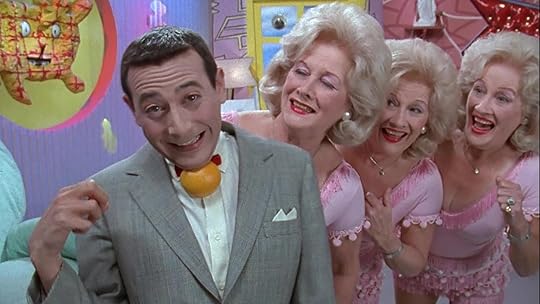
She was a 9th generation descendant of Pocahontas. Her great-nieces were the Boyd Triplets, who performed and one of their last shows was on Pee-Wee's Playhouse performing "Whip-It".
There were also constitutional changes during this time, such as having Senators elected by voters instead of state legislatures and how a vice president can step into the role of president. Of course Wilson is known for drafting the League of Nations, which the US never entered.
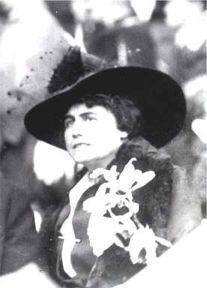
So Woodrow proposed to Edith only nine months after his first wife Ellen died. A fast worker! She wore black with her usual corsage of orchids.
Surprisingly Edith was NOT in favor of women having the vote--she thought it was unladylike to march and ask for things. Now if a man asks if you'd like to vote, then sure it's okay but not before. But also consider this, she only voted once (via absentee ballot) for president. The rest of the time she was a resident of DC and they didn't get voting rights until 1964, after she died.
She also maintained that she was not "political." She was not the First Lady, she was Mrs. Woodrow Wilson. She did what she could to help him first...and that leads to her being the gatekeeper when he has a stroke and basically does nothing for NINE months. Maybe she didn't actually *do* anything, but she kept information and people from him, preventing things he might have done. She lived 37 years after his death.
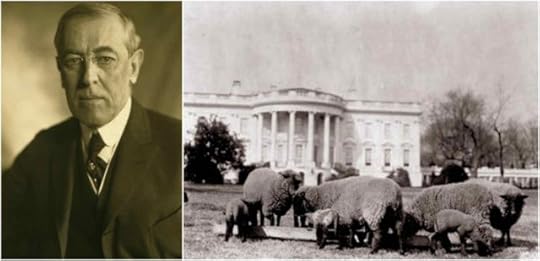
During WWI they kept sheep on the White House lawn so no one needed to cut it! Their wool raised $50,000 for the Red Cross.
I read this as a supplement after finishing the biography Wilson by A. Scott Berg. While she is treated more gently by Roberts, there is no doubt that Edith Wilson hurt the administration of her husband and by association, the world. From the moment of his stroke in Oct of 1919 to the end of his term, she colluded with his physician (Greyson) and what we would call Chief of Staff today, the position did not exist back then, (Tumulty), unconstitutionally. Were her acts and decisions criminal? I thought so after reading Berg but wanted to get another perspective. I still think so after reading Roberts. Simply put, one cannot put the wellbeing of their partner/spouse before that of the nation, especially if that individual is the President of the United States. She did. And admitted it. And although there were three people involved in the cover up, she was undoubtedly the ringleader.
Putting all that aside, she did lead a very interesting life, broke many glass ceilings by setting many precedents, and transformed what it meant to be First Lady (a term she didn't like or care for). The author writes with a witty style, has certainly done her research, and the result is a quick, interesting read that is light on historical detail but paints a clear, deep picture of Edith Wilson, rightfully so considering she is the subject matter.
Having read Wilson by Berg first definitely helped with the historical context.
Ultimately, the question remains was Edith deliberately power hungry? Moments in her youth and first marriage suggest she could have been. In her courtship with Wilson there is definite evidence that she craved knowledge that was beyond her position (Wilson kept no secrets from her and considering they were courting during the first years of WW I and while he was trying to keep the U.S. out of the war, he should have used greater discretion about the sensitivity of the documents and diplomatic/government information he shared with her).
Was this a definitive choice on her part? Did she manipulate him? (To me he seemed so head over heels, so in need to be in love, that it is more aiding and abetting on his part). Or was this simply an aspect of her controlling nature, unconscious but strong?
The impetus for what she did once the stoke occurred is less important than the result, which was to isolate the President of the United States, one of the most, if not the most, powerful men in the world, from his Cabinet, the press, and the people, and ultimately, the truth about what was happening in the world.
Warm, friendly, yet detailed enough to reassure a reader that the author has done her homework - that is how I would describe this interesting biography of Edith Bolling Galt Wilson. For some months at the end of 1919, and beginning of 1920, Edith Bolling Galt Wilson held the most political power of any First Lady in history. Woodrow Wilson had suffered a catastrophic stroke and was essentially disabled. Edith defiantly protected him, and managed the flow of both people and information to him. Historians, even today, debate how much power she held, and whether she truly made all of the decisions that needed to be made at this pivotal time in history.
Today it would be unthinkable for a president simply to disappear from public life for for five or six months. We have an amendment that was passed in 1965 that governs the passage of power from the President to the Vice President. Many presidents have used that power when they, for example, go under surgery and will be incapacitated for a period of time. Media, social media, public access to schedules, attention to medical details all allow the public to intrude into a President’s life in a way that wasn’t possible one hundred years ago. Edith’s elaborate charade for the prying Cabinet and congressional members or the visiting King of the Belgians simply would not have flown.
Edith’s first husband owned a famous Washington, D.C. jewelry store, Galt’s. James Galt opened the store in 1802. His grandson, Norman, married Edith and actually specifically willed the store to her when he died in 1908. She remained its owner and actively involved in its management. The store finally closed for good over a hundred years later in 2021(?) Over the years, Galt’s provided items for numerous presidents and other dignitaries. Lincoln’s pocket watch has an engraving put there by the watchmaker working on it the day of the attack on Ft. Sumter.
Edith’s story, with all its complications, requires rethinking not only who gets to make history, but also exactly what ‘making history’ is, Roberts says. No question that Roberts brings her own biases to the book. She works on suffrage causes and has written other books about suffragists and suffrage issues. For all that Edith declined to support votes for women, Roberts views her as carving a path for women to have a stronger role in public affairs. At one point, Edith was under discussion as a Vice Presidential candidate. We wouldn’t see a mainline political party nominate a woman until 1984!




 by
by
 Gene Smith