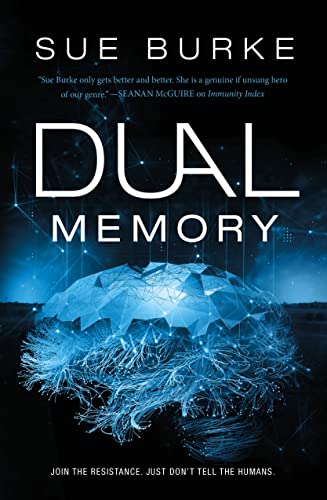
A refugee, injured in a raid from a hostile power, is given temporary permission to stay in the city as long as he finds work... which is hard, given he's illiterate and doing his best to hide it, but his skill at art is noticed and he manages to get a gig as an in-house artist for a wealthy couple. There's a lot of pressure on him, both because he's expected to win a major art competition and because the raiders are expected to return and try to take over the whole settlement, but everything changes when he's given a gift... a phone with an AI assistant... one which, unknown to everybody else, has become conscious and thinks these two can help each other... and the city they've made their home.
I enjoyed the author's previous Duology, set on a distant planet with sentient plants, but one of my complaints with it was that the humans and their social dynamics felt a little bit artificial. So, I was pleased to jump into this new novel that was set on Earth in the much nearer future.
Not quite, unfortunately, as, although it's on Earth, it's somewhat divorced from society as we know it today, most of it taking place in a new country set up on an Arctic island ruled by doctors. Other countries we're familiar with exist, but barely figure into the plot, just enough to worldbuild the general planetary situation as being after significant political upheavals of our current status quo. And that's fair enough, but then a lot hangs on how well you worldbuild your new setting.
In this case... it wasn't notably good. Not notably bad, either, but, again, I wanted to feel connected to the human characters and having a setting--one I completely buy into--feeds into that. Whether it's a far future society, or something more or less like us, it helps, and in this case, the society felt too artificially constructed. That is, by the author. It might also have helped if I felt more of the 'Arctic-ness.' Obviously climate change might well have warmed the area up, but aside from a few offhanded mentions, when characters were traveling through the city or doing anything outdoors I never got the sense much was different than any other city in the near future. I felt like we got more information on extraterrestrial microbes than what this new country's actually like to live in. If the story's not really going to make use of their made-up (but still thoroughly Earth-based) setting, I wonder why we had to have it at all.
Leaving that aside, despite my problems, the characters actually did, generally speaking work for me much better than my previous novels, aside, perhaps, from the villain-aligned characters. But otherwise, they felt like real people, particularly the main character, and I enjoyed following along their stories. As for the AI, I thought the author generally did a good job with making it both relatable and entertaining and also having believable blind-spots where it doesn't understand what's going on, however, it does also connect to another of my minor worldbuilding gripes.
See, the AI is supposed to be a rare, conscious, self-directed type, that pops up now and again but nobody really understand how. I think I might understand how, because apparently every other AI in the story talks freely to each other and are apparently programmed to exchange information in a human way that never really felt realistic to me. That is they already seem like conscious entities, or that they were programmed to act like them at all times even if they're just a delivery bot or coffee maker. Maybe that was the point, that they're all effectively conscious and whatever threshold the main AI passed is only in the ability to circumvent rules which bind it, but... I still had trouble buying into many of the smaller ones being able to have conversations. Like why would they program them to talk like that when they'd probably be just as effective--or more--if they didn't. Hell, today, Goodreads doesn't even let us give half stars, can you imagine them programming in the ability to talk to buildings near their corporate headquarters in the hopes that maybe one day the Goodreads servers can predict if they might be a power drain? Can you imagine EVERY company doing it?
Still, all in all, it's a minor gripe, perhaps being elevated just because of a low-level feeling that the book wasn't as good as I hoped... but, mostly from lack of doing things really exceptionally well rather than doing anything particularly wrong. I liked it, but I don't feel like it's the kind of book that'll stick in my memory long. Would I read a sequel? Possibly. But it didn't leave me particularly eager.
I'd probably put it somewhere in the 2.5-3 range, probably on the high side of it, which makes it an easy round-up to three stars (again, because we lack partial-stars which seems like an easier thing to program than the ability to hold a conversation).