Jump to ratings and reviews
Rate this book

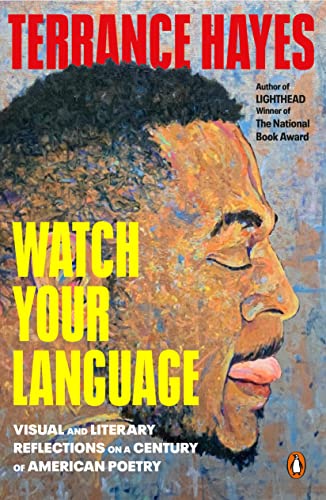
Watch Your Language: Visual and Literary Reflections on a Century of American Poetry

Rate this book
“Dazzling . . . a verbal and visual feast that defies genres.” —The Washington Post

“Hayes [is] one of the best and most important poets now writing.” —Craig Morgan Teicher, Poetry

From the National Book Award–winning author of Lighthead, Terrance Hayes, a fascinating collection of graphic reviews and illustrated prose addressing the last century of American poetry—to be published simultaneously with his latest poetry collection, So to Speak


Canonized, overlooked, and forgotten African American poets star in Terrance Hayes's brilliant contemplations of personal, canonical, and allegorical literary development. Proceeding from Toni Morrison's aim to expand the landscape of literary imagination in Playing in the Dark ("I want to draw a map, so to speak, of a critical geography"), Watch Your Language charts a lyrical geography of reading and influence in poetry. Illustrated micro-essays, graphic book reviews, biographical prose poems, and nonfiction sketches make reading an imaginative and critical act of watching your language. Hayes has made a kind of poetic guidebook with more questions than answers. "If you don't see suffering's potential as art, will it remain suffering?" he asks in one of the lively mock poetry exam questions of this musing, mercurial collection. Hayes's astonishing drawings and essays literally and figuratively map the acclaimed poet's routes, roots, and wanderings through the landscape of contemporary poetry.

230 pages, Kindle Edition

Published July 18, 2023

25 people are currently reading
267 people want to read

About the author

Terrance Hayes

59 books340 followers
Terrance Hayes is the author of six poetry collections, including American Sonnets for My Past and Future Assassin, How to Be Drawn, and Lighthead, which won the National Book Award. He is a MacArthur Fellow and teaches at the University of Pittsburgh.

Ratings & Reviews

What do you think?
Rate this book

Friends & Following

Create a free account to discover what your friends think of this book!

Community Reviews

5 stars
47 (44%)
4 stars
41 (39%)
3 stars
13 (12%)
2 stars
1 (<1%)
1 star
3 (2%)
Displaying 1 - 25 of 25 reviews
Profile Image for Ken.
Author 3 books1,238 followers
Read
March 23, 2024
Good, but not as good as To Float in the Space Between: A Life and Work in Conversation with the Life and Work of Etheridge Knight, which was a sustained contemplation of the work and influence of Etheridge Knight.

In this case, the focus is diffused and divided as Hayes offers short pieces on influential poets -- mostly Black and overlooked -- of the 20th and 21st century. My favorite was the tribute to Yusef Komunyakaa because it was starting to build like all the fine Knight stuff from the last book.

These are a collection of essays previously published in other journals. Reading it makes me wish I could take a course taught by Hayes. Unfortunately he doesn't seem to visit (much less teach in) Maine very often. He's not alone.
Profile Image for emily.
629 reviews542 followers
October 23, 2023
‘Have you ever seen someone with a “Because I could not stop for Death” tattoo?’

Mostly ‘listened’ to the audiobook; but in any case, it’s the kind of book that is too brilliant to talk about properly. It’s an experience better ‘experienced’ directly. The audiobook is really fantastic; narrated by the author, Terrance Hayes, no less.

A few chunky chunks that I like below :

‘Does reading require talent? No, reading requires stamina and time—two things that may yield the same fruit as talent. Reading poetry is an especially refined kind of telepathy, says a poetry enthusiast—Every reader is a potential writer. I don’t say every good or bad reader is a good or bad writer. Such judgments don’t matter when the act of reading is, like the act of writing, mostly a matter of keeping an eye on your thinking, of bearing witness, of keeping record. Drawing, which, for me, is close to the act of writing, is also a way to watch your language.’

‘Any book that matters to a reader is literature. Any book that matters to a reader is permanently housed in their mental, emotional, psychic library. It is the sort of library Italo Calvino describes in The Uses of Literature. He imagines a culture’s most significant books at the centre of an ever-expanding, borderless library: “Literature is a search for the book hidden in the distance that alters the value and meaning of the known books; it is the pull toward the new apocryphal text still to be rediscovered or invented.” I hope any reader convinced of this constructs the appropriate fluid, personal genealogy of reading; a creative shelter, a psychic data bank, a resource for living.’

‘I reflected very specifically on a century of American poetry. I said American poetry was born essentially of two streams: Emily Dickinson, the shy, private weirdo, and Walt Whitman, the public, social weirdo.’

‘—Guan Guan buy peaches from a street vendor before we entered the Hot Pot to dine after the event. In the Hot Pot pots of boiling water sat on a hot plate at the center of the table, full of strips of beef. The poet translator translated the multi-language but mostly Mandarin conversation—I fell in love once or twice along each of the dozen or so blocks I walked from Shanghai Times Square to Xintiandi, to the Huaihai Middle Road residential district, to the crowded labyrinths and enclaves of Tianzifang. It was my last day in Shanghai. I did not have my camera—Guan Guan told us that after the man who invented language gained God’s favour, ghosts began to appear. I won’t be sure of anything, even if I live to be eighty-eight. Four in five poets believe ghosts communicate telepathically. Therefore you may never prove their existence—“Man, you too old to be so joyful,” I said to Guan Guan when I realised he understood me. The poet need not write poems if the poet becomes a poem—’

‘Susan Sontag waving her ass in Brooks’s face during a writer’s panel in Russia. “Ass-stounding,” says Ms. Brooks, according to her second autobiography. Do you know this story? She’s in Russia with Robert Bly, Susan Sontag, and some other important American writers when a Russian journalist asks her what it’s like to be Black in America. Sontag proceeds to answer. Brooks interrupts for obvious reasons, and then an angered Sontag stands up and shakes her big white ass in the face of the calmly seated Gwendolyn Brooks(!). Gwendolyn Brooks, the neighbourly, Pulitzer Prize–winning Black lady from the South Side of Chicago. Brooks doesn’t reveal her answer to the question, only the audacity of Sontag. I can’t tell whether Brooks is enraged, embarrassed, or flattered by Sontag’s antics.’

‘Were my poems poetic because I’d played basketball? She moved her arms back and forth in a running motion as she asked it. She was trying to be kind; she was trying to draw connections. The smell of cliché almost overpowered the smell of racism beneath it. Racists, when they are passive, don’t bother me too much. Ignorant racists (not the same as passive racists) concern me only when they are in power. The poems I’d read that evening were maybe, if it can be reduced, exploring a poetics (a practice) of kinds and kindness: kinds of sonnets, kinds of Americans, kinds of time, kinds of assassins; the power of love versus the power of unkindness. Unkindness is a bit more nuanced than hate. Unkindness suggests the opposite of generosity, which is a bit sadder than mere hate. Unkindness suggests the opposite of consideration, which is a poverty of thoughtfulness. One who does not “consider before acting” is inconsiderate. One who does not treat others as he would like to be treated is inconsiderate. At the root of selfish, the noun self suggests a consideration for little more than the self. At the root of kindness, the noun kind self suggests a consideration for little more than the self. At the root of kindness, the noun kind suggests groups, types, character. The nice white woman’s stupid, racist, cliché question essentially suggested I was a certain kind of poet because I appeared to be a certain kind of Black man. Obviously, she was wrong.’

‘I take Gwendolyn Brooks as a model in this approach to writing and living—We are still listening. To the notion of inherent poetic Blackness, she adds a notion of kindness. It is not niceness. Niceness is superficial, civil, cosmetic. Kindness is closer to the bone; truth is in the marrow of kindness. Even a vulgar kindness, a selfish kindness; one can offer a cruel kindness—truth can be a kind of cruel kindness. I didn’t embarrass the woman. I gave a slanted nod and asked what she meant.’

‘Who, if not Emily Dickinson, is mother of the modern and contemporary American lyric poem, a poem that can sound like a letter from and to the self, a measure of consciousness?—She’s not mentioned in the letters or poems of Gertrude Stein or Edna St. Vincent Millay or Marianne Moore, is she?—Is there no real sense of Dickinson’s influence until after the poems her editor, Thomas Wentworth Higginson, manhandled and published after her death were replaced with a complete and reportedly less manhandled version sixty-five years later, in 1955?’


Besides Gwendolyn Brooks, Hayes also writes/raves about Emily Dickinson a lot, so if you don’t like her, bear that in mind? I was ‘neutral’ about her ‘pre-reading’, but now I think I might like her ‘post-reading’. But I also want a copy of everything written by Hayes.
Profile Image for emma charlton.
281 reviews410 followers
February 13, 2024
This is one of the most creative books I've ever read. Terrance Hayes wrote Watch Your Language as a response to prompt about reflecting on the last 100 years of poetry (1917-2017). He approaches this in sections which include one-of-a-kind book reviews, essays, letters to impactful poets (dead and alive), and short tributes to dozens of poets, often with drawings alongside. I do feel that he gave a little too much trust to the reader. There were many references that I recognized but couldn't quite place, and some places where I felt lost. Also, as is the nature of truly creative, experimental work, some stuff just didn't work for me. That said, what a triumph!

I would recommend this both to anyone who feels they have strong understand of modern poetry (Hayes will challenge your assumptions and force you to look at the last century of poetry in a new way) AND to those who are not really sure how to approach poetry (though NOT as a front to back read.) I myself am going to use this as a resource going forward when looking for new poetry collections, because the recommendations are endless!
Profile Image for Taylor Franson-Thiel.
Author 1 book25 followers
August 2, 2024
What an honor to learn from Hayes. My poetry TBR def grew thanks to this book.
Profile Image for Kaila  Minei.
50 reviews1 follower
November 20, 2024
Hayes is a genius. An excellent introduction to the study of creative criticism. Only gave it four stars because I am reading another work of his (To Float in the Space Between), and enjoy it even more.
Profile Image for Kelly.
1,333 reviews1 follower
August 9, 2023
We are so lucky to have Terrance Hayes. I needed this book. To pull from the synopsis, this is a "lyrical geography of reading and influence in poetry," "a poetic guidebook with more questions than answers."

There are essays, yes, also lists of open-ended exam questions, timelines, graphics, poetic biographies, and one of a kind creative pieces, like the explanation of a Tim Siebels board game, that avoid being gimmicky even while being a gimmick.

Hayes always makes me laugh and he always makes me think, and this book is no exception. The unique shape of the thinking in this book blows my mind; it's weird and wonderful, and I chose the word weird bc it feels kind of supernaturally charged, perhaps in part by how the book seems to call upon the poets it discusses, bringing them into the room with us.

I absolutely loved this, yet I don't think it's for everyone. You need to love poetry, I think, to love this book. It's no earnest call to the masses; it's an esoteric endeavor for people who love poetry enough to question it. Not in technical critiques, but in foundational ways.

Anyway, this book is so dang good and was so much fun to read. It's sharp and critical, tender and kind.
Profile Image for Eric.
186 reviews3 followers
March 15, 2024
At first, I thought this might be a three star book, as at times Mr. Hayes style is so complicated and so full of references from a very specific circle of understanding that the reading became almost incomprehensible. Yet, the depth of resource contained in this book, the passion, and the poetic heft wins out. I know I will be referring back to this book repeatedly, and that I should also take another pass at the more complicated passages, to more fully understand.
Profile Image for amf.
131 reviews3 followers
August 29, 2023
Hayes is a poet & thinker that makes every thought he writes about thought provoking. This small volume is full of amusing, serious, and thought provoking posts on poets he'd place in the American Poetry cannon. He starts with Whitman as a pushing off point (but not necessarily advocating for his place in the cannon) and meanders from there, though, this meandering is sectioned with a creative timeline that introduces poets and movements...complete with a list of what-if and did-you-know that I flunked quite well as a lurker who has been lazy with my poetry self-education. Wanda Coleman is a fine example of the poet who is motivated because the words refused to not rise from her even when traditional education was not her vibe.

There is joy in this book and quick wit that is wrapped around the very real truth that many poets Hayes presents are not in the cannon because Black poets were|are rarely given their time to shine. Even if they were it was often undercut by white ego in the academy (thinking Sontag's disrespectful conduct to Miss Brooks). Hayes does not preach, he sings of these losses and we readers become even more curious of their words and where we can find them today.

If you want a quirky immersion to learn about voices/spirits that often didn't reach mainstream academia (or the local bookstore) this one is a keeper.
Profile Image for CW Billings.
18 reviews
January 16, 2024
“Watch Your Language” is unlike anything I have read before. I read this book in a single day! It was captivating.

I loved it from the first page but the deeper I dug the more insightful it became. This book taught me a lot about my own blindspots when it comes to literature, art, and it revealed pieces of my ignorance I am grateful to have brought to the light!

I had never heard of the majority of artists and poets mentioned in this book! I’ve now taken notes on who and what I should be reading to broaden my understanding of differing perspectives, opinions, and worldviews. He forced me to face my own whiteness/complicity in remaining unknowledgeable. This book left me with a million questions that I am invigorated to research and answer. Beyond that, this work is deeply inspiring for a budding poet such as myself. He includes wonderful writing exercises and thoughtful questions meant to spark a writer’s critical thinking.

My favorite parts were the segments on Gwendolyn Brooks and Yusef Komunyakaa. But also the hundreds of questions that divided the book. Hayes constantly made me pause and consider.

The one critique I have for this work concerns the pieces at the end. The bit about the board game, the Fortune Telling Machine and the tarot cards was just a bit too disjointed and experimental for my taste. It seemed he got away from himself with those.

Overall, I would highly recommend this book to any lover of poetry, American art, and aspiring writers across the board.
Profile Image for Jacob.
165 reviews
May 29, 2025
I struggled with finding meaning or purpose in this book. The author meanders through topics without connection or inherent meaning; comes off as arbitrary commentary. The author narrates and I would’ve liked more tonality and inflection to breathe life into the various works and topics presented: very monotonous. Many thought provoking concepts and pieces, but what poetry isn’t? I’ve sat through a few MFA level courses in poetry and was expecting more and was going to leave it at two, but there are some aspects that contradict themselves; a shared suffering is mentioned but then another section advocates having your own experiences. Plus a referenced Wikipedia page in the last four minutes was not on my bingo card for this journey. I felt like it’s one of those projects where you’re proud of what you accomplished but it doesn’t resonate with the audience.
Profile Image for jude lee.
80 reviews
September 23, 2025
so uniquely creative. from the diary entries to the drawings to the biography poems this book expands on poetry at an elevated level. this isn’t just a “reflection” on american poetry from Hayes but it also reflects onto the reader forcing questions of how we interact with the timeline of heard and unheard, seen and unseen poetics and how those notions shape the literary world as it is currently viewed and taught. i think you can read this many times and get more out of it each time. especially the questions for each chapter. they beg you to think about how american history and historical events cannot be taken out of the writing published at the same time. such a treasure to walk through the landscape Hayes provides through both reading and writing poetry.
Profile Image for Anatoly Molotkov.
Author 5 books54 followers
Read
August 2, 2024
"Kindness takes practice." So does writing thoughtful, insightful sentences. Since Terrance Hayes is among the best poets today, I am not at all surprised to find his thoughts on poetic choices and history illuminating. He can even make Robert Frost sound interesting. Still, his coverage of this country's Black poets does essential work toward dismantling the myth of white American literature in favor of the more interesting and nuanced picture. I appreciated the rhetorical questions throughout and may need time to answer some of them.
Profile Image for Miriam Hall.
315 reviews22 followers
September 7, 2023
I picked up this book on a whim, which is something I don’t often do anymore. I was delighted by the illustrations and playing with forms. The history lessons refuse to be linear, and the inter-relational quality of all the poets (with or not with Hayes) is whimsical and deep.

I learned a lot, and reflected a lot.

A few things towards the end got too far out for me somehow - the games and machines. But the final piece about basketball and poetics and Gwendolyn Brooks? Perfect.
Profile Image for Carolyn.
2,007 reviews86 followers
July 12, 2025
Oh, wow. Terrance Hates is just wicked smart and charmingly inventive. Don’t read this book unless you want to add approximately 97.2 billion poetry books to your TBR. Don’t read this book unless you want to mope about the deficient levels of your own imagination that could never pull this off.
.
Tour de force. Highly recommend.
.
Gotta go read some Toi Derricotte, Yusuf Komunyakaa, Afaa M. Weaver, Wanda Coleman, Tim Seibles, Nin Andrews… to start.
1,328 reviews15 followers
May 13, 2024
I really liked this book. It is made up of little pieces (like tesserae?) that form a beautiful mosaic. This book tells about poets, poets the author loves, poets who shaped the culture of this country, poets who gave sight to the blind, that causes deaf ears to hear. What an interesting book both in form and content.
Profile Image for Elsie Coen.
130 reviews2 followers
November 1, 2023
this is the kind of book/collection/gathering of works that makes me want to teach a class on it. terrance hayes is one of my favorite voices, writing the imagination in congruence and dissonance with history, loyalty, and honesty. cant wait to reread and leaf through this for years to come.
159 reviews6 followers
October 12, 2023
Passionately creative survey of poets essential to Hayes' own work and life. Fully illustrated and totally addicting, its a true gift of a book from one of this country's great poets.
Profile Image for Jim.
227 reviews1 follower
February 1, 2024
An astonishing work of memoir, literary criticism, cultural and American history, pedagogy, and poetry. Like touching a downed powerline.
Profile Image for Samantha M..
108 reviews
February 29, 2024
Because Terrance Hayes is @#%!ing brilliant is why. He gives literary theory a necessary update. Inspired, witty, and not stuffy.
293 reviews
May 3, 2024
Enlightening, inspiring--so many poets now to read. 4.5
5 reviews
May 15, 2024
The work this book does is important and experimental. In many places, the experimental worked well -- others, it didn't. It introduced me to many poets that are now on my list of being read.
Profile Image for Marek Hnatiak.
198 reviews11 followers
Read
August 17, 2024
Dobrý výběr v hravém formátu. Autor pokládá zajímavé otázky, ilustrace jsou skvělé, ale některé biografie a závěrečné části (společenská hra, detektivní vložka) byly vyloženě zbytečné.
Displaying 1 - 25 of 25 reviews

Can't find what you're looking for?

Get help and learn more about the design.