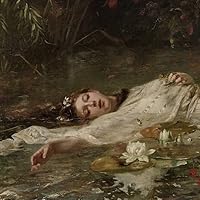
the new grrly, grotesque, burlesque poetics brings together eighteen poets of wide-ranging backgrounds, united in their ability to push the aesthetic envelope through radical, femme, Third Wave strategies, and pairs them with visual artists who do the same. At the turn of the millennium, we are witnessing the emergence of a vital—perhaps viral—new strain of female the “Gurlesque,” a term that describes writers who perform femininity in their poems in a campy or overtly mocking manner, risking the grotesque to shake the foundations of acceptable female behavior and language. Built from the bric-a-brac of girl culture, these works charm and this work is fun, subversive, and important. Poets include Brenda Coultas, Brenda Shaghnessy, Cathy Park Hong, Matthea Harvey, and Sarah Vap.
My favorite part of this book were the two awesome introductory essays. These essays describe/embody the "gurlesque" aesthetic--a manner of riot grrl poetry for the 21st century. Think unicorns, kink, glitter, casual references to theory, lots of female body parts, witches, snark...the introductions entertainingly and insightfully describe this phenomenon.
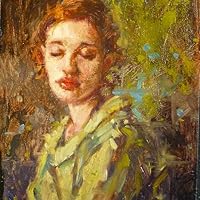
I also really liked the middle section of visual art--some crazy subversive vivid stuff.
Two of my favorite favorite poets are in here, with their usual mixes of wicked precision, humor, and melancholy (Brenda Shaugnessy and Matthea Harvey). I got a kick out of a few poets I hadn't read before: Brenda Coultas, Catherine Wagner, Cathy Park Hong, Chelsey Minnis...
There was some writing that was a bit too political for my taste, stuff that, to me, came off as stale or silly or too much positing woman as victim.
Gurlesque is an anthology of poetry edited by Lara Glenum and Arielle Greenberg. While the Gurlesque aesthetic is loosely defined, all of the poems (and the selections of visual art) fall somewhat into the term, coined by Greenberg in 2001. In her introduction she charts how she was reading a lot of poetry by women as a graduate student and began to notice trends, or “ghosts.” The Gurlesque can deal with, and often does, young women’s experiences, the female body, and “America as a rape culture.” But, Greenberg notes, “there appeared almost no trace of the earnestness, sensitivity or self-seriousness that marked many such poems stemming from Second Wave feminism. She charts the movement emerging as a response to phallocentric countercultures, paying special attention to the Riot Grrl, fed up with the overload of testosterone that permeated “punk.” The Riot Grrl, “wanted to take back language, take back girlhood, take back their lives.” She ends her introduction by questioning the very word “girly,” emphasizing how it can be empowering and problematic by listing all the things it can be, then telling us, “Take the girly. Shake it up. Make a milkshake. Make it throw up.” The Gurlesque embraces stigmas and the feminine, but does so while violently attacking it and questioning all that has created it.
Glenum brings a more theoretical approach to her examination, calling upon the likes of Baudrillard, Butler, and Foucault to form a critical analysis of how the Gurlesque functions. For her the power of the Gurlesque lies in its ability to harness negative or reductive imagery to a point of parody, thus harnessing them to attack themselves. Burlesque shows, before their Vaudville incarnation in the 1930s were a forum for women to perform their femininity to an extreme degree, using it to create a world entirely their own, a bizarre fantasy world where anything could happen. Through self parody the Gurlesque poet refuses to acknowledge an “I” or a true self at the center of their performance. The Gurlesque poet, for Glenum, luxuriates in the conflicting desires and influences that come together to form an image of identity. Rather than trying to get to the center of this jumble of influences, the Gurlesque poet harnesses them, “they are to be savored and tapped for their cultural power” Glenum notes.
She also examines how Gurlesque poetry harnesses power of the cute and the Grotesque. By appearing vulnerable the cute brings out the sadistic drives of anyone who engages with it. For Glenum and obsession with cuteness can be caused by people seeing their own vulnerability in the cute rather than their own innocence. Use of the grotesque in Gurlesque is intended to defy masculine aesthetics and normative ways of thinking of the body. It parodies the ways in which the body has been written on, as with burlesque, to the end of denying an idea of a pure or true body.
The poems in the anthology generally work within this framework, but each poet attacks the issues in unique ways. There is a brief interlude in the middle of visual art which expresses the text as images nicely.
Citing a poetic tendency that cropped up through publications such as Fence, Chain, and Tinfish, the editors, Arielle Greenberg (who coined the term in 2001) and Lara Glenum, says the Gurlesque anti-movement inspires radical change by "incorporating the grotesque and cruel with the spangled and dreamy." If there were a mission to the Gurlesque anthology, it would be to begin a conversation that uses the "collision or collusion of fantasy and ethics" to ultimately expose America as a "rape culture," and by doing so, to take back language, girlhood, and women's lives. But a mission would suggest a camp, clique or club, and the editors insist that this tendency has not become that.
So far I've read some critique, debate and discussion, but women, who seem to think that the book's biggest flaw is that it doesn't include more lesbian poetry, have so far been the dominant voices on the matter. My notion is that the book's intention is to challenge the stereotypes created by men, so the book is intended to be read and talked about by men.
This is a review for men, written by a man. Since I plan to cite many quotes here, naming every poet and poem referenced would be quite tedious; so in most cases I will merely include the number of the page that the quote is found on.
This collection of 18 "third wave feminist" poets is a spin-off of the hardcore poetry and performances of the late 80s, when Karen Finley invoked the wrath of Jesse Helms by smearing chocolate syrup all over her breasts, and Wendy O. Williams sang about getting "butt fucked" while chopping her guitar in half with a chainsaw, and Chicago poet Lorri Jackson wrote lines like "she did what her boyfriend wanted / and he finally left her for good / she cried rape for a few days / after giggling the knife up where it hurts"—and with those lines she opened for bands like Ministry and the Revolting Cocks. The militant Sister Serpents of the early nineties eventually found more power in sarcasm than in seriousness, and the next generation was transformed into Riot Grrls. It is from that platform this anthology admits it was launched.
I thought I would hate this. I loved it. If you pick it up, do yourself the initial favor of reading BOTH introductions. Context means a lot in this anthology!
I’ve had this book on my TBR since 2011 when a professor said I should read it because my poems reminded him of some of the things here. I was really interested in flarf at the time, so I can see the comparison. While I hope I’ve retained the feminism in my poems, I’m not sure I’m this over the top nowadays.
I fucking loved this book. It is feminist, fucked up, raw, gross, cheeky, sexy, and so incredibly smart. I don't want to read any other poems again. I want all my poems to get to this depth with their blend of darkness and whimsy.
The essays about the concept of Gurlesque are on point and genius. The fact that its something that had emerged rather than a style formed by a group makes it inclusive and open, and let's people who "don't want labels" in to an awesome new tradition of feminist creations.
It's is a specific niche, certainly, but I recommend this to anyone who loves art or poetry, hates sexism, and doesn't mind raunchy, heady talk.
Loved the two introductions, also loved several of the poets but really didn't connect with many of other ones -- still (somewhat) skeptical about this movement that is eschewing the label "movement" (but I'll call it that anyway for the sake of clarity/simplicity,) but less than before, and now I know what this all is -- what exactly I'm buying into, if/when/how I choose to buy into it, which I think I might!
Gurlesque poetry fills a need I didn't really know I had. Or maybe the need was there, I just wasn't aware of it as a categorized thing. Anyway. As others have said, the introductions alone are fantastic and a great addition in their own right to the anthology. The work of the poets featured is more of a mixed bag, but this anthology is well worth having, for those interested in the topic. There's also some great art featured, a visual part of the book that really enhances the poetry.
I am glad this book exists, and I like what it's doing in terms of merging performance and gender and poetry. That being said, I didn't feel at all times like I "got it," and sometimes the experimentation made it impossible for me to get in and swim around in the poems; rather, I had to take them as the experiment they were and move on. Maybe that's the point.
Glenum and Greenberg are obviously as hard working as they are talented. this book will shove a foot of knowledge up your ass and retrograde what the patriarchy wants you to think you know. beeyotch.