

What do you think?
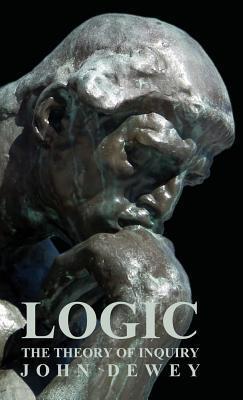
Logic - The Theory of Inquiry
This antiquarian volume contains a detailed treatise on logic and the theory of 'Inquiry', as a development of ideas regarding the nature of logical theory that were first presented in Studies in Logical Theory . The present work is marked in particular by application of the earlier ideas to interpretation of the forms and formal relations that constitute the standard material of the logical tradition. Inquiry is one of the most essential skills in the world of business and management; as well as being of great utility to the student of philosophy, this book can help clarify the process of inquiry and develop skills for inquiry in the context of decision making, and may therefore be of considerable service to a range of different readers. The chapters of this volume - The Matrix of Inquiry - The Problem of Logical Subject-Matter - Common Sense and Scientific Inquiry - The Needed Reform of Logic - Immediate Understanding and Inference
This vintage book is being republished now in an affordable, modern edition complete with a new prefatory biography of the author.
This vintage book is being republished now in an affordable, modern edition complete with a new prefatory biography of the author.
844 pages, Hardcover
First published January 1, 1938
About the author
John Dewey
1,060 books745 followersJohn Dewey was an American philosopher, psychologist and educational reformer whose ideas have been influential in education and social reform. Dewey, along with Charles Sanders Peirce and William James, is recognized as one of the founders of the philosophy of pragmatism and of functional psychology. He was a major representative of the progressive and progressive populist philosophies of schooling during the first half of the 20th century in the USA.
In 1859, educator and philosopher John Dewey was born in Burlington, Vermont. He earned his doctorate at Johns Hopkins University in 1884. After teaching philosophy at the University of Michigan, he joined the University of Chicago as head of a department in philosophy, psychology and education, influenced by Darwin, Freud and a scientific outlook. He joined the faculty of Columbia University in 1904. Dewey's special concern was reform of education. He promoted learning by doing rather than learning by rote. Dewey conducted international research on education, winning many academic honors worldwide. Of more than 40 books, many of his most influential concerned education, including My Pedagogic Creed (1897), Democracy and Education (1902) and Experience and Education (1938). He was one of the founders of the philosophy of pragmatism. A humanitarian, he was a trustee of Jane Addams' Hull House, supported labor and racial equality, and was at one time active in campaigning for a third political party. He chaired a commission convened in Mexico City in 1937 inquiring into charges made against Leon Trotsky during the Moscow trials. Raised by an evangelical mother, Dewey had rejected faith by his 30s. Although he disavowed being a "militant" atheist, when his mother complained that he should be sending his children to Sunday school, he replied that he had gone to Sunday School enough to make up for any truancy by his children. As a pragmatist, he judged ideas by the results they produced. As a philosopher, he eschewed an allegiance to fixed and changeless dogma and superstition. He belonged to humanist societies, including the American Humanist Association. D. 1952.
In 1859, educator and philosopher John Dewey was born in Burlington, Vermont. He earned his doctorate at Johns Hopkins University in 1884. After teaching philosophy at the University of Michigan, he joined the University of Chicago as head of a department in philosophy, psychology and education, influenced by Darwin, Freud and a scientific outlook. He joined the faculty of Columbia University in 1904. Dewey's special concern was reform of education. He promoted learning by doing rather than learning by rote. Dewey conducted international research on education, winning many academic honors worldwide. Of more than 40 books, many of his most influential concerned education, including My Pedagogic Creed (1897), Democracy and Education (1902) and Experience and Education (1938). He was one of the founders of the philosophy of pragmatism. A humanitarian, he was a trustee of Jane Addams' Hull House, supported labor and racial equality, and was at one time active in campaigning for a third political party. He chaired a commission convened in Mexico City in 1937 inquiring into charges made against Leon Trotsky during the Moscow trials. Raised by an evangelical mother, Dewey had rejected faith by his 30s. Although he disavowed being a "militant" atheist, when his mother complained that he should be sending his children to Sunday school, he replied that he had gone to Sunday School enough to make up for any truancy by his children. As a pragmatist, he judged ideas by the results they produced. As a philosopher, he eschewed an allegiance to fixed and changeless dogma and superstition. He belonged to humanist societies, including the American Humanist Association. D. 1952.
Ratings & Reviews
Friends & Following
Create a free account to discover what your friends think of this book!
Community Reviews
Displaying 1 - 6 of 6 reviews

January 2, 2022
The radical argument of this book is undermined by how incredibly tedious and repetitive it is. Dewey thought it was a scandal that we've made so little progress in solving societal problems when compared to the progress we've made in fields like physics or chemistry. How can we learn from the scientific method and apply it to ethics and politics? Dewey thinks that a realist picture of the world has held us back. We've abandoned the idea that science brings us closer to God's mind, but we still think physics and math tell us something about 'how the world really is'. This is opposed to those 'soft' sciences which can't ever really aspire to truth.
But Dewey says that if we look at the practice of science (apart from what scientists actually say), we find that all theories are just tools that help us solve problems. Math, physics, and even logic are just useful tools. Most of this book is an attempt to show that all of the things we learn in Intro to Logic are just different steps in the process of inquiry. Disjunctive propositions help us figure out what situation we're in, not eternal truths. Dewey's really arguing against Russell and the Vienna Circle here. He says they're confusing a tool with reality. Logic needs to change as we learn to solve new problems. We'll find better tools (such as Pearl's model of causality) as we learn to solve new problems (class inequality, for example).
It's surely the case that we haven't gotten much better at solving social problems since Dewey's time, due to many of the factors he mentions: people have a pet solution they try to apply to every problem, we don't have useful ways of clarifying the facts of the matter (this would probably involve deliberation, which we're terrible at), and we don't treat the political process as experimental. But is a rethinking of logic what's required? I'm not sure. Dewey's reuse of the term doesn't seem very helpful. I personally found Experience and Nature more useful. It seems odd that at 80 years old, this is what he'd choose as his final major work.
But Dewey says that if we look at the practice of science (apart from what scientists actually say), we find that all theories are just tools that help us solve problems. Math, physics, and even logic are just useful tools. Most of this book is an attempt to show that all of the things we learn in Intro to Logic are just different steps in the process of inquiry. Disjunctive propositions help us figure out what situation we're in, not eternal truths. Dewey's really arguing against Russell and the Vienna Circle here. He says they're confusing a tool with reality. Logic needs to change as we learn to solve new problems. We'll find better tools (such as Pearl's model of causality) as we learn to solve new problems (class inequality, for example).
It's surely the case that we haven't gotten much better at solving social problems since Dewey's time, due to many of the factors he mentions: people have a pet solution they try to apply to every problem, we don't have useful ways of clarifying the facts of the matter (this would probably involve deliberation, which we're terrible at), and we don't treat the political process as experimental. But is a rethinking of logic what's required? I'm not sure. Dewey's reuse of the term doesn't seem very helpful. I personally found Experience and Nature more useful. It seems odd that at 80 years old, this is what he'd choose as his final major work.

May 8, 2025
A frustrating, challenging, and deeply insightful book. In every chapter, Dewey is at pains to demonstrate insights about the nature of many philosophical topics by drawing on his instrumentalist, operationalist, functional theory of inquiry. Because of this, there is a lot of repetition and reformulation of the same ideas. It could probably have been a much shorter book, but then the points that Dewey wants to demonstrate would have been more easily overlooked.
On my reading of the book, I take away three absolutely essential points:
(1) The general structure of inquiry, from a problematic -- indeterminate, unclear, unintelligible, incoherent -- situation, to a resolution of the problem by instituting a determinate -- unified, clear, intelligible, coherent -- situation. All inquiries move from felt indeterminacies in a situation, to a determinate situation.
(2) The function of both selected existential materials (or facts of the situation) and conceptual materials (or procedural means) in overcoming a problematic situation. Bringing these two functionally distinguished elements together, by using conceptual materials to direct operations for experimenting on existential materials, into a coherent whole is what provides a solution to a problem, instituting a determinate situation.
(3) The role of *intelligence* as specified by the means-consequence relation. The means-consequence relation specifies the instrumental meaning of things, through their figuring as means to bringing about specific consequences or as consequences of operating on specific means. This is especially interesting in relation to Dewey's claim that actions and operations are "universal", providing a kind of master argument for pragmatism, since kinds are not identifiable independently of their role in activities. Dewey thus provides a theory of the pragmatic or operational a priori through this relation.
On this last point, there is some uncertainty about whether the means-consequence relation overlaps with the so-called "conceptual materials/procedural means", or is supposed to be broader than this.
Inquiry is, at heart, both practical and conceptual. Conceptual materials are directive of operations to be performed on existential materials, to perform experiments guided by procedures and ideas that have proven themselves in past inquiries. In the end, inquiry is a matter of doing things intelligently: science too develops by articulating and testing practical inferences at a general level, which bottoms out in operations on stuff in the world.
We learn not only facts, but about how to conduct inquiry better. Methods emerge organically from past successful inquiries, providing both the means to guide future inquiries and normative standard of success. There is thus an iterative process of method-learning, which also is the basis for the selection of relevant existential materials.
Dewey also expresses interesting pluralist ideas at various points in the book, which have become independently popular and important in contemporary philosophy of science. Well worth reading for contemporary philosophers concerned with the nature of inquiry, both in philosophy of science and in "zetetic" epistemology.
On my reading of the book, I take away three absolutely essential points:
(1) The general structure of inquiry, from a problematic -- indeterminate, unclear, unintelligible, incoherent -- situation, to a resolution of the problem by instituting a determinate -- unified, clear, intelligible, coherent -- situation. All inquiries move from felt indeterminacies in a situation, to a determinate situation.
(2) The function of both selected existential materials (or facts of the situation) and conceptual materials (or procedural means) in overcoming a problematic situation. Bringing these two functionally distinguished elements together, by using conceptual materials to direct operations for experimenting on existential materials, into a coherent whole is what provides a solution to a problem, instituting a determinate situation.
(3) The role of *intelligence* as specified by the means-consequence relation. The means-consequence relation specifies the instrumental meaning of things, through their figuring as means to bringing about specific consequences or as consequences of operating on specific means. This is especially interesting in relation to Dewey's claim that actions and operations are "universal", providing a kind of master argument for pragmatism, since kinds are not identifiable independently of their role in activities. Dewey thus provides a theory of the pragmatic or operational a priori through this relation.
On this last point, there is some uncertainty about whether the means-consequence relation overlaps with the so-called "conceptual materials/procedural means", or is supposed to be broader than this.
Inquiry is, at heart, both practical and conceptual. Conceptual materials are directive of operations to be performed on existential materials, to perform experiments guided by procedures and ideas that have proven themselves in past inquiries. In the end, inquiry is a matter of doing things intelligently: science too develops by articulating and testing practical inferences at a general level, which bottoms out in operations on stuff in the world.
We learn not only facts, but about how to conduct inquiry better. Methods emerge organically from past successful inquiries, providing both the means to guide future inquiries and normative standard of success. There is thus an iterative process of method-learning, which also is the basis for the selection of relevant existential materials.
Dewey also expresses interesting pluralist ideas at various points in the book, which have become independently popular and important in contemporary philosophy of science. Well worth reading for contemporary philosophers concerned with the nature of inquiry, both in philosophy of science and in "zetetic" epistemology.

April 10, 2007
This book is a crucial resource for my dissertation. Not the first place to start for Dewey's views on Logic and Inquiry, perhaps.
December 8, 2008
Dewey presents a fully-developed Pragmatist theory of Logic.

June 14, 2014
Not an easy book. Still the chapters on the biological and the cultural matrix of inquiry are very insightful, and provide a good theoretical framework for a naturalistic epistemology that is humanistic, scientific and NON-REDUCTIVE.
July 28, 2012
Dewey's most challenging book on his critique of Realism and Certainty in an arena for which he is not well known.
Displaying 1 - 6 of 6 reviews