Jump to ratings and reviews
Rate this book

The Legend of Rah and the Muggles

Rate this book
In another land far from the shoreline of Aura, war was raging, and Lady Catherine launched a raft with precious cargo aboard, her two infant sons. She wrapped the boys in royal blankets and quilts, and packed a jewel box filled with bright rubies and other gemstones between them. The raft drifted away with no charted destination but the babies' survival.

288 pages, Hardcover

First published January 1, 1984

3 people are currently reading
73 people want to read

About the author

N.K. Stouffer

5 books2 followers
Nancy Stouffer is an American author of children's books and coloring books.

She unsuccessfully tried to sue Harry Potter creator J.K Rowling over alleged plagiarism of her "Larry Potter" character, and started to market her material under the name N.K. Stouffer. A judge eventually fined Stouffer $50,000 for lying to the court and doctored evidence.

Ratings & Reviews

What do you think?
Rate this book

Friends & Following

Create a free account to discover what your friends think of this book!

Community Reviews

5 stars
4 (4%)
4 stars
3 (3%)
3 stars
6 (6%)
2 stars
25 (25%)
1 star
61 (61%)
Displaying 1 - 27 of 27 reviews
Profile Image for Marc *Dark Reader with a Thousand Young! Iä!*.
1,509 reviews312 followers
February 11, 2025
How to Lose $50,000 in Two Easy Steps

There's the story, and there's the story behind the story. Both are hilariously awful. The stupid, it burns.

Maybe you've heard of this book, first self-published in some form in 1984, or its author who in 1999 tried to sue J.K. Rowling for copyright and trademark infringement over use of the word "Muggles" and other matters. This was in between Harry Potter and the Goblet of Fire and Harry Potter and the Order of the Phoenix, and who wouldn't have wanted a slice of that sweet Potter pie? Unfortunately for Nancy Stouffer—I'm sorry, that's "N.K." Stouffer on her republished books by sheer coincidence, I'm sure—her claims were prima facie absurd. But for a time, the lore tells us that Rowling was "fretting so much over this one stupid case that it’s kept her from finishing her latest book," making Stouffer probably the most hated woman in publishing for a time. My, how the tables have turned.

Anyway, Stouffer was found to have falsified promotional materials for her prior self-published material, in an attempt to bolster her claim that Rowling must have seen her work and stolen her ideas, and was sanctioned $50,000 in a summary judgment by the court, so that was the end of that. There's a nice one-page summary of the affair here: http://nielsenhayden.com/makinglight/...

I particularly enjoyed this detail from the legal judgment (https://www.eyrie.org/~robotech/stouf...), because I was already ready to say that if Stouffer had ever sold even three copies of The Legend of RahTM prior to her claims of infringement, I would eat a Real MuggleTM :
It is undisputed that Ande [the publishing company Stouffer created for her own work] never sold any of its booklets in the United States or elsewhere.
Sounds about right!

Another hilarious fact: Ottenheimer Publishers of Maryland was in business for 111 years before they republished Stouffer's The Legend of RahTM and the MugglesTM and other books of hers (under the created-just-for-this Thurman House imprint), capitalizing on the publicity surrounding the legal claims. Within the following year they went bankrupt and closed forever, by sheer coincidence I'm sure.

So, about the book: it's stupid. So, so stupid. If I may paraphrase Fran Lebowitz, you have not read any book as stupid as The Legend of RahTM and the MugglesTM. You just haven't.

It's for children. Do you hate children? Do you want children to grow up stupid? Then by all means, read them this book. Hey, do you know what makes a great foundation for a children's story? Nuclear fucking war, that's what.

From the very first page, the first paragraph, the first sentence, this book has you asking, "What the fuck are you talking about?" Try it for yourself:
On the far side of the earth, Aura citizens fought great wars with other nations. They had lived a relatively peaceful coexistence until government representatives became restless and greedy. The need for power and control seemed to spread throughout the Congress of United People, C.O.U.P., like a disease out of control. The discord caused great unrest within the colonies. Absent any real or decisive leadership, citizens gathered arms and formed militia groups.

These splinter revolutionaries were determined to reclaim democracy, . . .
"Please, sir, I want some more" said no child ever. The commentary writes itself. On the far side of the earth from where? What government representatives? Colonies from where? What the fuck are you talking about? I particularly enjoy the presumably unironic United Nations stand-in abbreviated "coup".

You don't even have to read the first page time to appreciate this book's insane stupidity. The copyright page alone does that. Stouffer, in her ill-guided, extremely expensive attempt at legal maneuvering, tries to trademark everything under the sun (I regret that I can't make superscript work here for all the "TM" markings, but you'll get the idea):
MUGGLEtm, MUGGLEStm, MUGGLES-BYEtm, and The Legend of RAH and the MUGGLEStm, MUGGLEDOMEtm [NB: term not in book], MUGGLEPLICATIONtm [NB: term not in book], SHADOW MONSTERStm, NEVILtm, NEVILStm, NARDLEStm, GREEBLIEStm, NADIE [sic, different spelling from in book] & NEDDIE SPOONERS OF THE DEEPtm, WINKLEtm, ELDERStm, RAHtm, ZYNtm
Y'all better not ever use the words "elders" or "shadow monsters" in y'all's books, or Nancy Stouffer's gonna git ya!

But if for some reason you continue reading, it gets even worse. Chapter One (the previous example is from the introduction which is actually a prologue) is a run-on, bloated, terrible regency romance between Lady Catherine and her butler, Walter, after her husband dies while she's pregant with twins, with a confusing timeline that begins and ends with unspeficied enemy soldiers breaking down the palace doors, in a conflict that Lady Catherine is sure will end with nuclear weapons. Note: this is a completely different use of nuclear weapons from the introduction, which happened several hundred years prior and let to the creation of MugglesTM. You know, for kids.

Chapter Two is way stupider, and Chapter Three is even stupider than that, and oh by the way after that first 45-page long first chapter, do we ever hear about Lady Catherine and Walter and will these crazy kids be able to make it after all? We do not. We do not, in fact, ever hear again about any crucial story element once introduced.

Chapter Four is, once again, the stupidest yet to come, and so forth and so forth. I could provide countless examples, but I would hate to spoil it and encourage you to read it for yourself if you're at all inclined to read the worst thing you've ever read. I happen to find joy in such things. Yay, me. But really, it's all so, so dumb. Like, this land (country? continent? archipelago?) of Aura, devastated by nuclear weapons whose radiation transformed humans into MugglesTM over centuries, has
never experienced the warmth of sunlight, nor the beauty of an evening sky filled with glittering stars. Their world is lit only by moonlight shining through a purple haze left behind by nuclear warfare.
So the planet became tidal-locked because of nuclear war? What? But a box of jewels comes to them on a raft, carried between two babies floating on the ocean for over a week without sustenance (and if I know anything about babies, it's that they survive perfectly well without food or water for days on end), and somehow these jewels absorbed the power of the sun and as they approach the MugglesTM's land it gives off heat sufficient to instantly warm the air and light to instantly cause trees and shrubs that survived and grew without sunlight for centuries in a nuclear wasteland (where squirrels and rabbits and lion-sized dogs and birds managed to survive just fine along with the MugglesTM) to burst into leaves but somehow doesn't fry these babies to a crisp or permanently blind them. The MugglesTMplace the sunlight-giving jewel box on top of the Tower of Time which by the way is shaped like a pyramid, as towers tend to be, but now the story talks all the time about sunrises and sunsets and the MugglesTM have always had songs and poems and stories that specifically reference day/night cycles and how the fuck is any of this supposed to make any sense. And this is just the start of it! So many more stupid things follow! Like the sheet music at the back of the book for the MugglesTM traditional bedtime song that indicates 4/4 time but has measures that are 10/4 or 1/4 and is just an awful song with terrible lyrics and you bet your ass I'm going to play it.

I know you've been wondering all this time, what is a MuggleTM, if not a non-magical person? I'll let the completely necessary character glossary from the back matter answer that:
MUGGLES, Humans left behind on Aura, the Forgotten People, conscientious objectors, sick and diseased, physically challenged, elderly, blind, deaf, savants, dwarfs, earning disabled [sic], the Have Not's [sic]. They became genetically mutated humans, hybrid humans, resemble children when fully grown, large hairless hears [sic], tiny ears, large oval eyes, eyelids with no eyelashes, blue, violet, brown and gree [sic], lump cheeks [sic?], narrow shoulders, thin arms chubby hands [sic], three fingers and one thumb, no fingernails, thin legs, chubby feet, four toes, no toenails, round plump bellies, half-moon shaped belly button, height: 3'-4', weight: 45-90 lbs., skin color: white, brown, beige or olive, vegetarians.
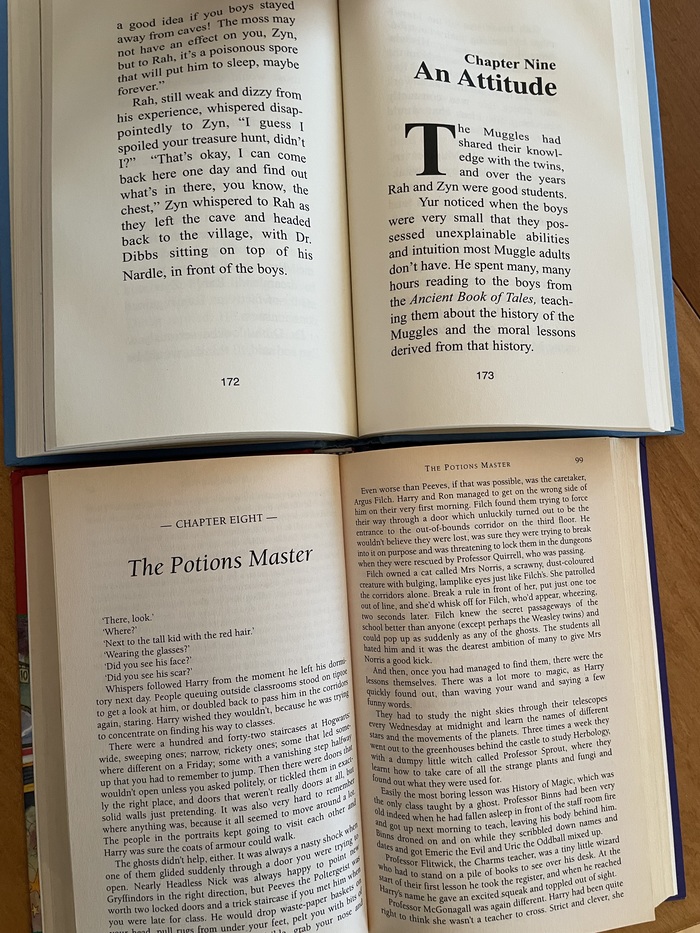
Got that? What, you need a picture? Fine, but first I want to show a picture of the print layout next to a copy of Harry Potter and the Philosopher’s Stone so you'll understand how padded the page count is:


And now, please enjoy a sample of the artwork included in every copy of The Legend of RahTM and the MugglesTM:


Are they . . . polishing a mushroom? Anyway, my copy of the book, purchased second-hand from Thriftbooks, came with a photocopy of a 2001 news article ("Harry, meet Larry Potter in a battle of the muggles"), reporting the claims of similarities but obviously published before Stouffer was laughed out of court to the tune of $50,000. I entertain the thought that Stouffer herself inserted one of these articles into every copy that went out into the world. Teach the controversy, that'll do it!

In conclusion, I love everything about this book. Just like Antigua: The Land of Fairies, Wizards and Heroes, it's a thoroughly, undeniably stupid book, written for children by an idiot who thinks children are morons, and the result is pure comedy gold.
Profile Image for Alex.
808 reviews19 followers
February 7, 2017
I read this book when I was ten, and it was one of the worst things I've ever held in my hands. The plot was nonsensical, the characters cardboard, the good-vs-evil too clearly drawn, and I was so bored. Do not ever read this book.
Profile Image for Beth.
1,434 reviews199 followers
February 19, 2025
(Note to those reading this review: while I put this on a "children" shelf, that does not mean that I in any way believe actual children should be exposed to this book.)

In a world post-nuclear apocalypse, a young mother sends her twin infant sons down a river on a raft made of lily pads. (Where have I seen a story like this before?) They're discovered by muggles, weird-looking little people who are the 500-years-later mutated version of humans, I think. Light is returned to the previously dark land? island? of Aura, courtesy of an artifact that was on the raft with the babies, and plants come back to burgeoning life.

The muggles live a nature-loving, peaceful existence, with each other and with various wild and tame creatures, some who can talk. That is, until Zyn--one of the twins--goes rogue and takes a few outsider muggles to a new colony on a dark island with very little food. The muggles on Dezra become products of their environment, getting very hairy (their counterparts on Aura are hairless) and growing claw-like fingernails and developing webbed feet.

As with a lot of the "372 Pages" selections, I can kind of see the vision here. The writing has its moments. The author seems to have a love of the outdoors, and frequently describes plant life on the island of Aura, and the crops the muggles grow and gather. The illustrations are... decent... though the character design of the muggles is rather off-putting. (Their cheeks really do look like .) There's even a cute song that the author herself composed, and put the melody and chords for in the back of the book.

But the flow is kind of wonky, going from prologue to "comedic" episodes, and then changing to something that kind of resembles a story in the last third of the book. The humor isn't funny--unless you think pages and pages of a deaf old man misunderstanding a sentence is funny--and the lore and fables from the "Book of Tales" either make no sense, or are conveniently dragged out to move the plot forward. A lengthy, forgettable poem, and a pointless glossary, add a few pages to a book that was not terribly long to begin with, and had extraordinarily large print on top of that.

Muggles don't invent things on their own--Rah, the "child of light" twin, is the one who does that. The ugly muggles, and "child of darkness" twin Zyn, are irredeemably evil, and once they've left Aura, they cannot return. Maybe there's a reason for that, but it isn't explained. At least they won't starve to death, as the muggles on Aura airlift food to them with the help of friendly, talking birds.
Profile Image for John.
Author 537 books183 followers
September 18, 2011


The Legend of Rah and the Muggles

by N.K. Stouffer

Thurman House, 267 pages plus 12 pages colour illustrations,
hardback, 2001; reissue of a book originally published in 1984


By all rights, this review should be littered with instances
of the letters "TM" in superscript, just as is the front cover of
The Legend of Rah and the Muggles, for Nancy Stouffer is
the author who has created minor shockwaves in the book trade by
pointing out that the name "Muggles", used by J.K. Rowling in her
Harry Potter series, was previously used by Stouffer, who
is also the author of a pre-existing series of books for the very
young based on the character Larry Potter. Moreover, Stouffer's
illustrations of Larry Potter bear a very considerable
resemblance to the depictions of Harry Potter on the covers of
the Rowling books. The response of the book trade to Stouffer's
objections, in the USA at least, has been a courageous unofficial
boycott of Stouffer's books and a stolid silence on the whole
matter: nothing must threaten the Harry Potter cash-cow.

Leaving the Larry/Harry Potter dispute aside, the Muggles of
this book bear no resemblance beyond the name to Rowling's.
Instead, they are the mutant descendants — bald, huge-
headed, small, childish — of the people left behind in the
island nation of Aura, many generations ago, when the wealthy
deserted it and them in the wake of a nuclear war. Since that
time Aura has been covered with a purple haze through which
sunlight can barely trickle but moonlight, paradoxically, can
pass undimmed.

All this changes with the arrival on the shore of Aura of two
baby twin brothers aboard a makeshift raft; they were cast adrift
by their mother, as per Superman by his parents during the
destruction of the planet Krypton, when she saw that her own
country was plunging into an all-destroying war. Aboard the raft
along with the twins is a magical illuminating stone, which
brings sunlight back to Aura.

The two brothers, Rah and Zyn, are nurtured by the Muggles.
Although identical in every respect to begin with, their
personalities come to differ radically: Rah grows up good and
wise while Zyn grows up nasty and spiteful. The dispute between
them is chronicled in the Muggles' ongoing Ancient Book of
Tales
, upon whose account the current volume is purportedly
based.

Illustrated with a central clutch of Stouffer's own rather
jolly colour illustrations, The Legend of Rah and the
Muggles
is a much shorter book than the page-count above
might suggest: the type is extremely large and the page margins
likewise. It is also a very badly published book; clearly
Thurman House does not believe in quaint customs like editing,
copy-editing and proofreading (I liked the idea of a bright star
"shinning" in the sky, and especially approved of the term
"dinning room"). The text reads as if it's a somewhat inaccurate
transcript of an oral presentation, complete with shifts of tense
(between past and present) and countless typographical and
grammatical errors — a few spelling errors, too.
Furthermore, this being a fantasy for young children, someone
should have pointed out to Stouffer the meaning of the word
"bugger", which she uses frequently and clearly regards as
innocuous.

Delivered as an oral presentation for children, this tale,
which comes complete with songs (the music for one of which is
supplied at the back), would one imagines be tremendous fun; it
is easy to envisage a youthful audience falling around with
laughter at some of the jokes, for example, while the ramshackle
nature of the plot wouldn't be evident — or, at least, it
wouldn't be important — in a spoken, necessarily episodic
telling. As a printed novel the text doesn't work nearly so well;
most of the jokes just referred to fall flat when rendered in
type. In their place are moments of humour that are certainly not
deliberate, such as the Monty Pythonesque legend drawn from
The Ancient Book of Tales about The Year of the Rabbits:


And so it was that the rabbits with protruding teeth lost
their gentleness and ravaged the continent. . . .


Likewise, some of the early scenes, set in the castle where
the noble Lady Catherine decides the only hope for her twin
babies is to consign them to the mercy of the seas aboard a raft,
smack considerably of Daisy Ashford's The Young Visitors
(1919). Lady Catherine, although heartbroken over the death of
her beloved husband Sir Geophrey (sic), nevertheless
immediately starts flirting audaciously with her butler, with a
strong suggestion that onstage flirting is likely to be matched
by offstage naughtiness Real Soon Now, if it hasn't started
already:


"Sir, there is no woman in this room that wouldn't trade
dance partners with me right now; I'm not about to give them the
chance. If that makes me wicked — so be it!" she said with a
poor attempt at a Shakespearean delivery, and they both laughed.


Stouffer has not fully realized her fantasy world. Aside from
the curiosity, already mentioned, of moonlight being able to
penetrate where sunlight cannot, there are items such as the
Muggles managing to grow fruit and vegetables in a sunless land.
In the same context, the traditional Muggle songs make reference
to such events as dawn, which the Muggles could not have
experienced before the arrival of the twins; also mentioned in a
song is the "star that's shinning bright", even though the very
existence of stars, brightly shinning or otherwise, must be
unknown to the Muggles. There are countless other such lapses.

Nevertheless, Stouffer's achievement in conceiving the
fantasy shouldn't be underestimated. Although The Legend of
Rah and the Muggles
doesn't bear up well in any comparison
with Tove Jansson's Moomins series, of which it is in some
ways reminiscent, it has its excellent moments. I was much taken,
for example, with the Greeblies, creatures amply worthy of
inclusion — and this is high praise indeed! — in the
ecology of Rene Laloux's animated movie Fantastic Planet
(La planŠte sauvage, 1973):


Greeblies are fat ratlike rodents that live in Sticky Icky
Swamp and often hide beneath boulders. They are nocturnal little
pests with faces that resemble rabbits', and their large round
ears curl slightly forward at the top. Their bodies are covered
with gray coarse hair with black tips that look like they were
dipped in ink.


Greeblies have short legs, but they can jump five feet in the
air from a sitting position. Their long, coiled tails are used to
quickly grab and snatch anything of interest to them, before
being seen.


They have been known to grab hold of Muggle legs from behind
and drag them frantically for yards and yards, before letting
them go. Most often their goal is to steal food or raid the
garbage.


Only two things frighten Greeblies: sand dogs called Nardles,
and getting caught in a trap set by the Muggles — who would
more than likely use them as dinner for their pet Nardles.


Nardles live in burrows along the shoreline, and Greeblies
won't go near them. Even though the Greeblies are difficult to
see, the Nardles can smell them a mile away.


It is at times like this, when Stouffer's imagination just
suddenly lifts off the ground and carries her to who knows where,
that The Legend of Rah and the Muggles is at its best.
Given a thorough edit, this book could be much recommended; as it
stands, however, the best that can be said is that The Legend
of Rah and the Muggles
is worth picking up primarily for its
curiosity value and, of course, for its occasional delicious
flights of fancy.


This review, first published by Infinity Plus, is
excerpted from my ebook Warm Words and Otherwise: A Blizzard
of Book Reviews
, to be published on September 19 by Infinity
Plus Ebooks.


6 reviews6 followers
August 31, 2016
When I say that this book was a terrible mess, I know I'm not adding anything new here. By this point, I think everyone who has heard of "The Legend of Rah and the Muggles" knows how awful it is. What gets me, though, is how completely jumbled it is.

(Remember, folks, nothing described in this review is made up. Chew on that as you read.)

The story's natural progression is thus: Description of nuclear war/ranting about politics and the UN/very awkward social commentary/learning how the titular Muggles were created from radiation in the prologue --> nuclear war in entirely different country and awkward fairy tale backstory as a widowed noblewoman gives birth to twins, immediately starts flirting madly with the butler, then sends the babies to sea to give them a better shot at life --> saccharine nonsensical one-shot anecdotes about the babies being adopted by the muggles and being raised by them --> a Cain and Abel story as one of the brothers turns evil for no reason, tries to kidnap/kill the other, and ends up banished to an island.

If that makes no sense to you, that's about how logical it is in the book. Stouffer just has things happen and doesn't think of what kind of story she wants to tell. A post-apocalyptic story with modern-day (or "modern"-day, seeing as it's stuck in the 80s or so) commentary? A Regency-esque romance? A changeling fantasy tale? A story of good and evil between two brothers? She can't decide and she doesn't layer what she has in any way that makes sense. She just jumps from one to the other as she pleases.

Characterwise, everyone was bland as toast. Names were thrown around in an attempt to pretend there was a wide, developed cast (and there's a glossary in the back of the book with them all, because apparently Stouffer thinks much is lost by forgetting the names of muggles or servants who only show up one time). Everyone who shows up before the muggles, with the exception of the brothers, is completely irrelevant. As for the muggles themselves, they're badly-handled cartoonish characters who have one quirk apiece (one's amusingly hard of hearing! One's the kindly grandmother! Two are children who always hold hands! Etc. and so forth!)

And then, there are the brothers themselves. Rah and Zyn are their names (which are, apparently, the muggle words for "sun" and "flower" respectively). They're also the protagonists of the story (so to speak) and get something close to character development. Unfortunately, neither are particularly enjoyable as characters.

Rah is supposed to be the "good" brother, shiny, clean, rule-abiding, humble, helpful, well-loved, industrious, well-groomed, someone please stop me I'm going to gag. It's INCREDIBLY obvious that Stouffer is trying to use him as a moral template for children to learn off of, but the book's so incredibly preachy about it that I just found myself disliking him. He isn't witty, he isn't charming, he isn't funny, and he really doesn't have any traits beyond being the dull Good Kid. I couldn't stand him because he read more like a PSA example than an actual person who's fun to hang around with. Stouffer tried to add some emotional complexity when he becomes overwhelmed by alleged feelings of sorrow over his brother turning evil (more on that in a minute) and sobs while wishing his mother was there, but considering how out of left field it is (and how his mom hadn't been around since about two chapters in), it doesn't do anything besides make him look rather wimpy.

Then, there's Zyn. Oh god, Zyn. Of all the characters, he's the only one I felt any pity for. And that's because despite (or because of) Stouffer doing her damndest to make him the Bad Kid, I just saw no one giving him a break and him being dumped on by his author. We see him start to get jealous of Rah's favoritism when they're kids and we do get a couple of halfway emotional scenes (him being genuinely afraid when Rah has an allergic reaction and his adopted grandmother giving him a worry stone to assure him he's loved). Unfortunately the whole Cain and Abel story kicks off and any complexity his character may have had goes out the window. All we're told is how Zyn is ugly and rude and nasty and mean and don't we all just HATE him? He and his followers are horribly poisoned by a radioactive tree they live in (yes, really) and end up stranded on an island. It's incredibly easy to read his more extreme actions later as him being incredibly sick and unstable from those things happening to him, but the idea of circumstances leaving him at all deserving of sympathy is completely ignored. Even his supposedly compassionate brother does nothing but wring his hands and cry when Zyn tries to leave, not actually trying to talk things over with him or anything.

And that leads to the main issue of the characters (and the book in general, really). What little we get is generally very, very unpleasant. The muggles are unhelpful and useless. While Zyn is having an emotional breakdown and suffers an inferiority complex towards Rah, only one of them actually does ANYTHING to try to reassure him. All the other muggles do nothing but gather around Rah and say how great he is and basically feed Zyn's belief that yes, Rah is the favorite of the two. Zyn bullies and abuses a group of muggle children into working for him and despite the text clearly stating that they were forced into it and abused until they snapped, none of the other muggles seem to care. They whine about the trouble being caused, but they don't try to reach out and get their family back.

And the unpleasantness isn't limited to the Cain and Abel story at the end. The book begins with horrible descriptions of two nuclear wars, but they're just forgotten about. Muggles, the "cute" little things they are, were created when the "have-nots" of society (Stouffers words, not mine) were mutated by generations of exposure to radiation. The twins' mother is sobbing over news of her husband's death one minute and then practically jumping the butler the next. Nobody is particularly likeable or sympathetic. Reading some parts actually made me feel very uncomfortable.

And I think this all goes back to Nancy Stouffer and how she went about writing this. It is my belief that Stouffer is one of those folks who believes that anyone can cobble together a children's book. Certainly the quality of hers is slapdash, a hardly-edited jumbled mess. It feels like she threw a bunch of things together thinking that children will accept anything if it's shiny enough. I guess it's possible she felt she put her heart and soul into this and that her work really is that special, but that doesn't change the fact that she didn't plan this out at all. She didn't figure out what kind of story she wanted, and that's why there are countless reviews pointing out how rushed and nonsensical this book is (to say nothing of fairy tale tropes like the talking animals or magic sun, which COULD have been handwaved with better writing ).

Finally, I should bring up the plagiarism controversy. Everyone and their mother has pointed out how baseless it is, and that's true. Not only do Stouffer's points of similarity focus only on superficial details (one thing she argues is that both books have a castle with a Great Hall/receiving area. Because that's daming), but some of her points don't even come up in The Legend of Rah. Larry Potter and Lilly, for example, are from an entirely different line of children's books she's written, and have nothing at all to do with magic or England or Harry Potter. I also suspect that she's arguing plagiarism based on books she hasn't written/published/did publish but got a very limited release, but I'm not sure on that.

Regardless, the Legend of Rah and the Muggles is a Thing and a very bad one. If you're very interested in it and want to see for yourself, give it a look if you have the chance. But don't go out of your way to find it. This book has taken up too much of our time as it is.
6 reviews
February 17, 2025
Some fun and funny stuff but not much happens. Not a “fun” bad book after the 2nd half. Although starting with a nuclear holocaust will always be the boldest move for a kids book
This entire review has been hidden because of spoilers.
Profile Image for Niko.
177 reviews23 followers
February 11, 2025
Read-along with the 372 Pages We'll Never Get Back podcast.

I can't decide what the most bizarre part of this children's book is: The nuclear holocaust that happens on page 2? The part where the author refers to a bunch of teenage bullies as "terrorists"? The fact that the character whose name is in the title barely does anything in the story? So many choices!
Profile Image for Jon Huff.
Author 16 books33 followers
March 17, 2025
Truly dreadful, but it was fun reading along with 372 Pages We'll Never Get Back.
18 reviews1 follower
June 13, 2025
This book should not be called “The Legend of Rah and the Muggles,” it should be called “The Misadventures of Zyn and the Nevils.” Clearly the author really liked Rah given that, in the character glossary, she spends three sentences giving us details about Rah all the way down to his heigh and weight. Whereas Zyn only has one sentence. That said, Rah does next to nothing in this book. You’ll see what I mean as I spoil everything below.

Before going any further, it needs to be said that this is a book meant for children. Which is precisely why it starts off with a global civil conflict, ethnic genocide, and nuclear war. Imagine explaining all of that to a child before going to bed. But don’t worry, the book has enough details to help:

‘The Great Thirty-Year War would be recorded as the most vicious and evil in the history of mankind… The nuclear holocaust had blanketed the sky with dark poisonous clouds of radiation.’

Oh my God!

‘Beaten, tired, and nearly starving, they deserted the ruins, leaving behind the imprisoned have-nots: the injured, the disabled, the ethnically impure, the elderly, and other less fortunate human beings. No mercy was shown to even the children of the abandoned citizens. Their cries for help went unrecognized as they rang out with piercing resound.’

And then little Susie asked, “Mommy, what are the ethnically impure?” To which Mommy replied, “Just wait sweety, we’ll get there. We’re about to get to the effects of mustard gas.” Little Susie clapped and cried, “Yea.”

The point of that very familiar criteria for genocide is that all the “have-nots” bred with each other and evolved into an abomination called, Muggles:

‘Muggles look much like human babies, but none of them have hair. Their shoulders are narrow and delicate. They have round, plump bellies, which make their legs and arms look very thin.’

Upon hearing this little Susie yelled, “Purge the mutants! The impure and unclean!”

And all of this is the introduction before the first chapter. The book technically starts with a post-apocalyptic Victorian erotica between Lady Catherine of the House of Sheridan and her palace butler Walter Randolph Winfred Cherrington. It starts with a little curiosity:

‘Walter was a man with great pride and cherished his position. Cat had always wondered why a lady had never captured this gentle man’s heart.’

Alas, Lady “Cat” belongs to the Sir Geophrey Luttrell. But don’t worry, Geophrey dies fighting… someone. War breaks out and Cat receives a letter of his demise. In her grief, Walter comforts her:

‘“Please, please tell me how I can help you, Madame,” he compassionately demanded. Cat looked into those magical eyes of Walter’s and said nothing—'

So, Walter makes a move on a grieving widow who’s pregnant with twins. Not long after giving birth, the two find some place alone and get frisky:

‘“Join me in the Great Room,” she said as she slipped her arm beneath his. “Most certainly, Madame” he said playfully, and winked at her. Still holding his arm, Lady Catherine leaned back ever so slightly, looking into his gorgeous face with a humorous grin. “Why, you handsome diplomat! I didn’t know you could be so wicked,” she said. Walter just couldn’t help himself. He responded, “I’m flattered that you noticed.” “Noticed what, Sir, that you are handsome, or wicked?” she chided back.’

And little Susie asked, “Mommy, what is Walter doing with his hands?”

On a side note, all those grammar issues are in the book.

Moving beyond the author’s erotica, the book moves on to Cat putting her children in a boat to avoid getting killed as a war is nearing the House of Sheridan. Obviously, the babies must be pushed out to a nearby landmass:

‘The boys spent many days on the water. They slept through the first eight days.’

Or maybe their mother just wanted them dead. I can only assume humans have less need to drink water in this post-apocalyptic world.

This is where the book takes a sharp turn in tone. After the apocalyptic war and erotica, we get babies being saved by fish, one of which has a speech impediment. Is this speech impediment written down? Absolutely.

Eventually, the babies make it to the land of Aura, home of the Muggles. When their boat arrives, they bring light that pierces the purple haze and burns the abominations in holy fire. No, that’s not what happens. But they’re excited, take the babies in as their own, and name them Rah and Zyn.

This is where things go from shockingly stupid to just stupid. I get this is meant to be a kid’s book, but when it starts off with nuclear war and “slam-bam-thank-you-ma’am,” I’m going to be in a dickish mood when we are introduced to characters like Pitter and Patter:

‘Pitter to Patter, a twelve-year-old little girl and boy who loved each other so very much they never stop holding hands.’

If you think that’s weird, get a load of this:

‘They loved each other so much that you could hear their hearts beating during silent moments, and see them thump, thump, thumping through their clothing.’

The Muggles call it love, but I think they are both going into cardiac arrest. Perhaps this is another mutation of these abominations. Their bodies are far too frail to withstand their own heartbeats.

However, not all is fun and games in Aura. There are also dangerous creatures called Greeblies; fat rodents of unusual size from the “Sticky Icky Swamp.” They do horrible things to Muggles:

‘They have been known to grab hold of Muggle legs from behind and drag them frantically for yards and yards, before letting them go.’

Is it possible they are just playing? The Muggles don’t seem to think so because once they catch them, they feed them to their pet “Nardles.”

In this bizarre world, Rah and Zyn grow up learning the ways of the Muggles from the “Ancient Book of Tales.” This book is full of a collection of madness with all the lessons of history, including the most evil war in the history of mankind.

In fact, we read a lot of books within this book. Which is a perplexing decision. It’s like the author had other children’s books ideas that she wanted to include in one book. To give you an idea what this is like, there is a scene where the muggle Golda is reading a story called, “The Fishing Hole,” and it goes on for six pages.

Now despite being in an impressively naïve and childish community, Zyn isn’t good:

‘Zyn seems to be a bit insecure in the presence of his brother.’

Unfortunately, Zyn realized his name wasn’t in the title of the book and knew his destiny was to be an asshole. Instead of resisting the will of the author, he embraced his role as the villain and made the book more ridiculous to read. He did this knowing he would be hated and live a life of agony, but it was a noble sacrifice:

‘Zyn lost confidence in himself, and lost his self-esteem. His every thought and action became resentful and nasty… Zyn’s wit was replaced by constant sarcasm.’

Rah, naïve of the books title, doesn’t understand how his brother is changing:

‘Rah was very frustrated with his brother’s behavior. Of the many challenges Rah had faced over the years, his inability to help his brother was disappointing.’

The Muggles try to support Zyn, but he knows in order to be a villain, he can’t just be nasty but have his own crew. Eventually, he forms a gang called the Nevils. His gang is comprised of Teeter, his second in command, Jitters, a muggle constantly shaking, Chops, the gum chewer, Fraidy, the nail bitter, Stubby, the short fat ball that asks questions, Boggs, dirty and reeks of swamp ass, and Patch, a carefree bastard.

Now all that sounds bad but remember, this is a children’s book. How bad could it be:

‘The Nevils are terrorists, and very threatening to the Muggles; even the Greeblies are a bit uneasy around this group.’

You know, when Mr. Rogers brought up heavy subjects like assassination, he did so in a mature way that kids could understand. This is just weird and hilarious.

After assembling his army of minions, Zyn forces them to make a boat, and they sail off to form their own country on the island of Dezra. There they encounter “Shadow Monsters.” They are terrified of these Shadow Monster but adapt to their pattern of only going out at night. After establishing their colony, the Nevils change into furries:

‘Teeter’s eyes were glossy and catlike, making it easier for him to see in the dark. Wild hair covered his arms and legs. His fingernails were long, resembling tiger claws protruding from the tips of his tiny hands and webbed feet.’

With their power-up complete, they return to Aura. In the middle of the night, they ransack the Muggle village, kidnap Rah, and return to Dezra like Vikings.

The Muggles are traumatized by the damage but find the resolve to launch their own raiding party to save Rah. They plan to do it with the help of the Shadow Monsters:

‘“… We can make these monsters appear or disappear, which will keep them there on Dezra forever,”—“These pods filled with fireflies will create light against the darkness—hence, the Nevils’ most feared enemy, Shadow Monsters…”’

Yeah, okay, okay.

I don’t know what the author was thinking when writing this book. This is one of the most whiplashing books I’ve ever read in terms of its tone shifting constantly. This is a children’s story, made up of multiple children’s stories that don’t have anything to do with each other. That’s without bringing up the Armageddon introduction and poorly disguised fetish at the beginning. When only looking at the things directly related to the Muggle storyline, I can see what the author was going for, but even then, it’s loaded with details that are ridiculous. I’m giving this two stars only because of the leniency you’d give a children’s book and because it fails so spectacularly I can’t help but be entertained by it.
151 reviews1 follower
June 26, 2025
This is a very, very stupid book. But then, I read it for a bad book podcast, so I really have no one but myself to blame.

372 Pages We’ll Never Get Back covered this book largely, I think, because it was the topic of a lawsuit in which Stouffer sued JK Rowling over her use of the term Muggle. (It’s more complex than that—Stouffer also had a character named “Larry Potter” from another series, this book features “Nevils” which Stouffer claimed Rowling was ripping off by having a character named “Neville,” etc., but, though I am no fan of Rowling, all the claims were ridiculous and in some cases fraudulent.) The book has more than a lawsuit going for it for those with “so bad it’s good” tastes, however. I recently read an article making the case that, because of technological advancements, the classic age of the “bad movie” is over. Perhaps AI will change this, but I think we’re still in a golden age for bad books: it has never been easier to publish an utterly incompetent novel, and this 1984 novel makes it clear that this was the case in the late twentieth century pre-Amazon self-publishing as well.

The book is an inelegant mix of post-apocalyptic fiction and fantasy, clearly aimed at a younger audience but perhaps no particular age group: the postapocalyptic beginning, in which a widowed noble lady of some unspecified nationality falls in love with her butler, seems like it might be aimed at teens or at least preteens, but, in trying to remember myself as a twelve-year-old, I simply cannot imagine that I would have put up with the awful nursery rhyme-esque poetry. Its premise:


I genuinely don’t believe that a child of any age would find this to be a good book. It strained my patience at points, as someone who actually has a taste for “so bad it’s good.” But it does have some goofy delights to offer the connoisseur of badness. (You thought I was complaining about the croquet match? No no no, my friends, that might actually have been my favorite part.) I don’t know if it would be as fun to read outside the context of following along with a bad book podcast, but arguably it’s an object of historical interest due to the lawsuit, so if any part of this sounds like something you’d like, perhaps it's worth checking out.
Profile Image for Scott.
463 reviews11 followers
January 17, 2025
I don't know what I expected, but it wasn't this....

PAGE TWO: "The nuclear holocaust...." JESUS CHRIST! WHY!

I'm not really sure what the point of this was? We start off with, apparently, humans in wartime. Given the title and no other context given, I didn't realize until the babies got the Moses treatment that they were human.

This seems to take place on our own planet for some reason, with explicit mentions of "Persian rugs" and even "Pachelbel, Canon D [sic]". The first night reading this I came to the conclusion that it feels like the Muppet Babies spinoff to Antigua: The Land of Fairies, Wizards and Heroes.

Similar to Antigua, there's no real plot to speak of, it's mostly just random vignettes and characters talking to one another. In the last two chapters suddenly conflict is introduced when one of the twins starts a gang and turns evil? Then they're...imprisoned on an island by jars of fireflies?

It's bizarre, it's incompetent, it's incomprehensible...but it's not as funny-bad as I would have liked. As they say all the time on Best of the Worst, "The worst thing you can be is boring." This unfortunately committed that cardinal sin throughout. At least in Antigua we got nonsense like wizard contests where they ride their tiny wands like broomsticks somehow, or a talking cat fighting a mouse with human intelligence and sarcastically arguing with its owner.

None of that here, just dry, boring passages of things like a nearly deaf character "comically" misunderstanding simple statements.

I know this is aimed at children, but that doesn't mean it shouldn't make some sense and have a story. I think that's an excuse that is used a lot with books for kids, and I think we need to hold children's authors to a higher standard; kids deserve quality stories as well.
44 reviews
February 24, 2025
While there is some imagination here, the book feels rushed and unpolished, as though it were made quickly to be put on the market as soon as possible. There are numerous proofreading errors and several continuity errors throughout the story and the included appendices, resulting in a published book that feels like a first draft. This is a second printing, so it’s even less excusable (though even this edition was rushed out to capitalize on the author’s then ongoing plagiarism lawsuit against JK Rowling).

Rah and the Muggles is an amateurishly told story with a purely commercial feel.
Profile Image for Jeffrey Greek.
391 reviews4 followers
February 19, 2025
The suspense in this "book" makes a Hallmark movie look like Das Boot.
Profile Image for Jeffrey Gao.
141 reviews29 followers
October 23, 2020
This was bad but at least interesting. This has some good ideas but it isn't by any means Harry Potter(yeah good going there Stouffer. You made yourself into a laughingstock.)
Also, man! This would be so much better if the Spooners were beaked whales!
Profile Image for Paige.
77 reviews7 followers
January 31, 2025
The body horror in this is so gross.
Profile Image for Michael.
335 reviews
March 17, 2025
Yet another 372-Pages read, shared with Donald, as usual.

I'm updating my reading blog after four months or so, and I had almost forgotten this one. How is that even possible?

Top three things I remember about this book:

1. You'll get whiplash from the stylistic changes in the beginning of the book. It starts by recounting a nuclear war that causes (part of) the human race to mutate into a new species, then it turns into a wanna-be Harlequin romance, and then it morphs into a children's fairy-tale fantasy. All within the first few chapters, if I recall correctly. (It wanders off into something else later on, but I'll leave that for others to describe...)

2. So many elements of the story are left hanging. Zero payoff. Highly annoying!

3. Do you vaguely remember that someone accused J.K. Rowling of plagiarizing her work with the Harry Potter series? This is that book/author. It's all absolute nonsense.

Bonus thing I remember about this book: There's a song, complete with lyrics and sheet music (though apparently it's as poorly composed as the rest of the book). Some listeners recorded themselves playing or singing this song, and it still pops into my head from time to time, several weeks later. Send help.
Profile Image for Shaun Michael.
10 reviews
March 17, 2022
I gave up.

I read the prologue and the first 20 pages (which would be 5 pages, if a normal font size was used). The writing is bad and the characters are completely uninteresting. The tone is strange. I just don't think it is a good use of my time to keep reading this.

Also, the reason people even know this book exists:
In September 2002 the U.S. District Court for southern New York found not only that Rowling did not pilfer the Muggles, but also that Stouffer had lied to the court and doctored evidence to support her claims. The court fined Stouffer $50,000 for this "pattern of intentional bad faith conduct"
1 review
Read
January 1, 2023
Got this for my kids, and the first one stabbed his older brother with a McDonalds straw in the eye.
Thought nothing of it, but decided to read this on the pot and when I found out that I was out of toilet paper, respectfully, it was the much deserved pages of this book, or the butcher knife that was laying on the ground. Let's just say, after reading this nightmare, I didn't wipe with the book.
Profile Image for Jacob.
61 reviews
March 17, 2025
Yet another book I read for the 372 Pages podcast. I don't know why I torture myself like this. Capsized cruise ships, poisonous clouds, a nuclear holocaust: these are just a few of the ingredients of this so-called children's novel.

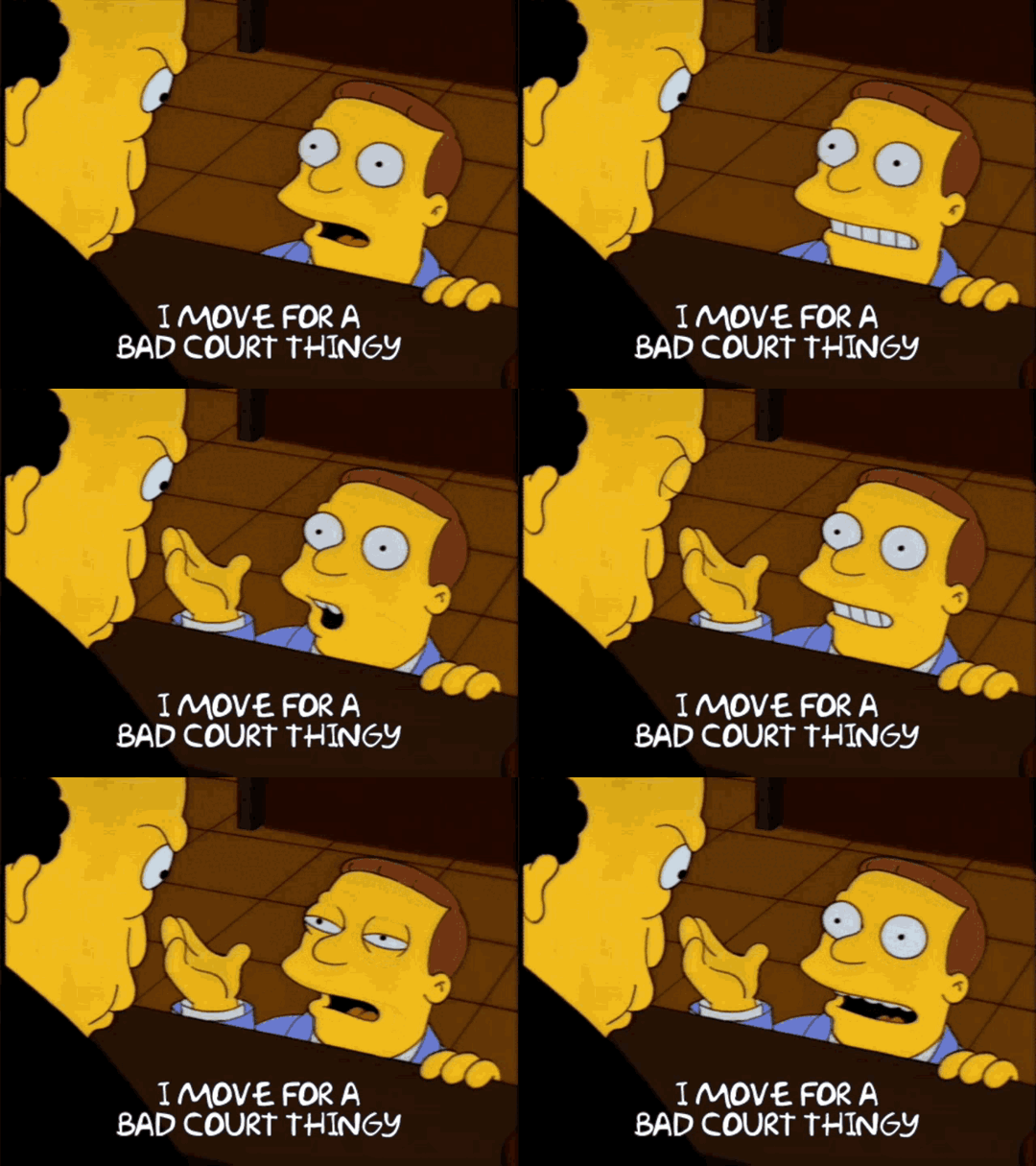
Much more interesting than the book itself is the author's lawsuit against J.K. Rowling. You might think Stouffer hired Lionel Hutz as her attorney.
159 reviews6 followers
December 12, 2025
A farce of a book. The first time I tried reading it, I couldn't make sense of its content. The plot was mediocre, the prose was pathetic, and the universe presented was absurd. A waste of time and a waste of literature. The libraries who purchased copies for it really wasted their budget on that sludge.
It is no Harry Potter, and its author is no JK Rowling, who is a so much better writer.
Profile Image for Summer.
709 reviews26 followers
August 9, 2016
This book is so badly-written. I would only recommend it as an example of how NOT to write. It is good for a few laughs though, and both boosts your confidence in your own writing skills and makes you want to curl up and cry over the fact that shit like this actual gets published.
Profile Image for Valerie.
20 reviews3 followers
July 24, 2022
Really poorly written nonsense story.
74 reviews
May 22, 2021
This is. A very funny book that got. Stolen by J (erk) k ( (rap) rolling for his book, hairy pothead and stoned sorcerer
Displaying 1 - 27 of 27 reviews

Can't find what you're looking for?

Get help and learn more about the design.