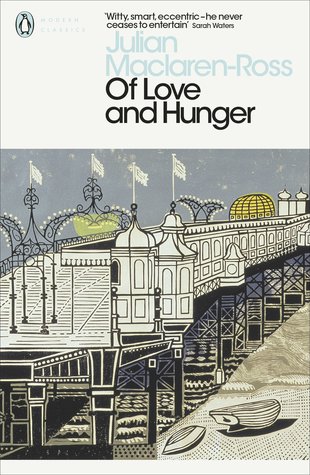
The key literary figure in the pubs of post-war Fitzrovia, Maclaren-Ross pulled together his dispersed energies to write two great books: the posthumously published Memoirs of the Forties and this spectacular novel of the Depression, Of Love and Hunger - harsh, vivid, louche, and slangy, it deserves a permanent place alongside 'Coming Up for Air' and 'Hangover Square'.
The English writer and dandy, Julian Maclaren-Ross (1912-64), is synonymous with the bohemian world of mid-twentieth-century Soho. There he rubbed shoulders with the likes of Dylan Thomas, Quentin Crisp, John Minton, Nina Hamnett, Joan Wyndham, Aleister Crowley, John Deakin, Augustus John, Robert Colquhoun and Robert MacBryde. His theatrical dress sense — a sharp suit combined with his famous teddy-bear coat, aviator-style dark glasses and cigarette-holder — ensured that he stood out even in such flamboyant company. Intrigued by his stylish get-up and dissolute way of life, numerous writers, most notably Anthony Powell and Olivia Manning, used him as a model for characters in their fiction.
During the 1940s Maclaren-Ross was usually to be found in the Saloon Bar of the Wheatsheaf Pub on Rathbone Place, From the late 1930s until the late 1950s, this took over from the nearby Fitzroy Tavern as the most fashionable of the many watering-holes in North Soho, an area that has since become known as ‘Fitzrovia’.
Besides being one of Soho’s most famous denizens, Maclaren-Ross was the writer most responsible for defining its sleazy allure. He did so through a string of witty and influential short stories as well as his classic Memoirs of the Forties which also features memorable portraits of Graham Greene and Dylan Thomas.
But Maclaren-Ross is far more than just another sharp-eyed, literary bar-fly. During his lifetime he produced a substantial, astonishingly diverse body of writing which broke new ground in many genres. As an occasional film essayist, his writing about Alfred Hitchcock and film noir was well ahead of its time. As a short story writer and novelist, he introduced a new, vernacular, Americanised style to English fiction. As a writer of reportage, he anticipated Hunter S. Thomspon, Tom Wolfe and the other American ‘New Journalists’ of the 1960s. As a literary critic, he wrote with rare acuity about the writers as varied as Georges Simenon, Raymond Chandler, John Buchan, Frank Harris, Jean Cocteau, M.P. Sheil, Dashiell Hammett and Henry Green. As a memoirist, he was a forerunner of so many current writers who work in a similarly delicate, novelistic vein. As a literary parodist, he was praised by William Faulkner and P.G. Wodehouse. As a translator, he was very sensitive to stylistic nuances. And as a dramatist, he was hailed as ‘radio’s Alfred Hitchcock.’
His work was admired by writers Evelyn Waugh, John Betjeman, Elizabeth Bowen, Graham Greene, Cyril Connolly, Anthony Powell, Olivia Manning, John Lehmann, Lucian Freud and others. Since his premature death at the age of only fifty-two, he has become a cult favourite among fellow writers such as Harold Pinter, Michael Holroyd, John King, Iain Sinclair, Jonathan Meades, Chris Petit, D.J. Taylor and Virginia Ironside. His reputation has also been kept alive through the campaigning of groups such as the Lost Club and the Sohemian Society.
In the wake of the publication in 2003 of Paul Willetts’s Fear and Loathing in Fitzrovia, the first biography of Maclaren-Ross, there has been an enormous resurgence of interest in both his life and work. The critical and commercial success of the biography triggered a major republication programme which has brought his touching, influential and often witty work to the attention of a wider public. Critics have been unanimous in their praise, hailing him as a major twentieth-century writer.
Probably the second best British novel I've read from the 1940s, after Patrick Hamilton's 'Slaves of Solitude'. If you're a fan of the period, or of Hamilton's fantastic writing, then grab this little gem on Kindle Unlimited; it a wonderful and almost entirely forgotten classic.
The lives and loves of a vacuum cleaner salesman and his married paramour, Suki, in a depressed pre-war Britain. Naturally the love affair isn't all plain sailing, but it is as much a novel about the people and the times as it is about the affair.
It isn't a hopeful novel. It is life lived at the very edge of poverty where love isn't so much a grand illumination as light relief from the grinding greyness of a day where the future is always uncertain. Will there be enough money to pay the landlady, to eat, to buy cigarettes and maybe for a cheap date at the movies or the zoo? War looms, but again, it is the future, and today is another day to be got through.
Julian Maclaren-Ross has written a good contribution to the very British genre of boarding house literature, along with John Braine's Room At The Top, Lynne Reid Bank's The L-Shaped Room, Muriel Spark's wonderfully low-key A Far Cry from Kensington and George Orwell's rather disappointing Keep the Aspidistra Flying among many other books, all of them a bit depressing.
The book is a solid four-star read. Very enjoyable but a bit downbeat, a reflective read rather than a jolly beach book.
An interesting novel set in 1939 in the months before the start of war. It opens a window of an England now mostly disappeared; landladies, jobs easy to get and lots of smoking!!. However the themes of love and loss are eternal. The shadow of war is ever present. The main character isn't likeable but the descriptions of daily life are fascinating. The wiki entry is a one-liner and absolutley hilarious; "Richard Fanshawe sells vacuum cleaners for a living and has an unhappy love affair with Sukie, the wife of his friend." How to really sell a novel! The descriptions of the selling tecniques and the fake camaraderie, the hollowness at its centre reminded me of the more organised telephone selling we have today. Bitingly satirical and bitter Maclaren-Ross dissects the whole set up.
I picked this up again last night and found it worth a re-read. Maclaren-Ross was a fascinating character, a real bohemian and denizen of Soho and Fitzrovia in the mid century. Constantly in debt and avoiding landlords, turning out reviews and short stories to keep the wolf from the door. He was dead at 52 and mostly forgotten.He was perhaps an English, slightly earlier version of Bukowski; but it's difficult to have the same feel if you're setting your novel in Bognor Regis! Maclaren-Ross was the model for X. Trapnel, the alcoholic novelist in Powell's Dance to the Music of Time series. A good period novel in the tradition of Orwell and Patrick Hamilton; just what slow Saturdays are for
Desde el comienzo, la novela aparece narrada con la convicción de una obra maestra. La voz nos va llevando y no lo podemos dejar. Extraordinario desarrollo de los personajes con breves pinceladas descriptivas, pero sobre todo a través de las escenas. Maravilloso.
I first came across the name of Julian Maclaren-Ross in 2019 when I read The Book of Forgotten Authors by Christopher Fowler, who produced a memorable character sketch of Maclaren-Ross, describing him as: "skiving and diving from one set of debts to the next, robbing Peter to pay Paul (sometimes literally), forever in need of a few bob, hastily following his suitcase out of windows and generally behaving like an utter cad."
So I doubt I would have wanted to make the acquaintance of Maclaren-Ross in real life, but I’m glad to have made his acquaintance in literature, as it turns out he was an excellent writer. This novel was published just after WW2, but is set in 1939. The lead character, Fanshawe, is a posh bloke who is down on his luck and trying to scrape a living by being a door to door salesman of vacuum cleaners in an English seaside town. We aren’t told the name of the town, but we can safely assume it is Bognor Regis, as the author himself made a sort of living selling vacuum cleaners in that very town in 1938. Fanshawe also spends his time scrounging off friends and relatives and borrowing money to pay off other debts, much as the author did in real life. The novel also features a tempestuous romantic relationship.
This isn’t really a plot-driven novel, more one that relates Fanshawe’s daily struggle to get through life. He takes more than a few knocks as things move along, and I couldn’t help feeling some sympathy for him even though he’s far from an attractive character. There’s a lot of dialogue, which is really well done, but with quite a bit of slang, so it might not be the easiest book for anyone who has English as a second language. Some of the slang is dated as well. I understood most of it, but there was one term I had to look up. It must have fallen out of use before even my time.
Normally I would say it’s fogeyish to go on about the price of things decades ago, but I confess I couldn’t help a snort of laughter at the following extract: “Smiler and I were thinking of going halves in a car. There was one going for eight quid that chap Monkhouse took us to see.”
The author’s style is for short, punchy sentences, but which still contain plenty of descriptive power – we really get a sense of 1930s England. Maclaren-Ross also mentions other novels and authors, with particular homage to The Postman Always Rings Twice. There’s a little bit of political stuff in the novel, but it doesn’t overwhelm it.
Set in pre-war South England, a door-to-door vacuum cleaner salesman called Fanshawe is asked by his mate to look after his wife Sukie while he’s away at sea. The naiveté of some folk, eh? Fanshawe and Sukie end up having an affair, but, with the ever-encroaching spectre of war and the uptight morals of 1930s British society, what will become of their love?
On paper, Of Love and Hunger sounds like a mundane romance novel but Julian Maclaren-Ross’s witty and unique storytelling, crystal clear social realism, cracking dialogue and sharp characterisation turns it into something special.
Though it was published in 1947, it still reads very well today - the only problem I had was with the currency which was all bob this and guinea that; no clue how much we were talking about! The writing is very modern and quickly paced so I was always engaged, the focus on characters doing things with many pages given over purely to rapid-fire, interesting dialogue.
Maclaren-Ross writes a compelling and fascinating portrait of this era of British history, showing us what life was like for working-class people in places like London and Brighton - a hardscrabble, hand-to-mouth existence, living in grimy rented rooming houses, being chased by creditors left and right, something which was very reflective of the author’s own difficult life as well.
Despite that, the tone of the book is never maudlin or tries to make you feel sorry for the characters. Maclaren-Ross strikes a nice balance between the romance and the amusing vacuum cleaner demonstrations that go awry, and the bleak realism of living just above the poverty line with Hitler gearing up for war just across the Channel.
Fanshawe and Sukie are fully-realised, likeable characters who feel like real people and their up-and-down romance was convincing. Other characters also jumped off the page like Heliotrope, the larger-than-life con-artist, and Smiler, Fanshawe’s backstabbing crooked colleague.
I really liked Of Love and Hunger but I can also see why it’s more-or-less faded into obscurity today. The story isn’t that memorable and it’s not an Important Novel like the kind Maclaren-Ross’s more famous contemporary George Orwell produced in this era. But it’s very well-written and a great read - a hidden gem of 1940s British literature that’s worth checking out. Fans of Patrick Hamilton’s Hangover Square will definitely enjoy this one too.
Of Love and Hunger, Maclaren-Ross’s first full length novel, draws on his own experiences of living in Bognor Regis and working for Electrolux in Hove as a door to door vacuum salesman. In common with Patrick Hamilton, this is a world of casual work, drinkers, hardship and boarding-houses.
The story takes place during 1939. War looms and Maclaren-Ross evokes the sense of impending doom and transience. I really enjoyed it. Well observed characters populate the main story of a doomed love affair, that also features pettiness, snobbery, fascism, misanthropy, and humour. Whilst not quite up there with Patrick Hamilton's Hangover Square or The Slaves of Solitude (let's face it - what is?), it is nonetheless a compelling, enjoyable read filled with great period detail. The short epilogue, three years on from the main story, beautifully brings together the threads of the ensuing War and the personal lives of the main characters. A minor classic.
Of Love and Hunger by Julian MacLaren Ross is an absolute favorite of mine and one of the 1,000 Novels Everyone Must Read
10 out of 10
For me this novel was glorious, astounding, divine and we could continue up that path, it is the absolute joy that comes every few months – maybe it will happen more often, in between exciting, if not stupendous reads -and all the ingredients, and the ‘je ne sais quoi’ are mixed in to make this a book that I want to read again…
Soon, if possible, it is inspired by real life events, we understand that Julian MacLaren Ross has been a travelling salesman, and albeit we have artistic license, and maybe most of what we enjoy is juts made up, still, there is something from reality – in the introduction, the audience is told that the author discussed with his friend… Who will use this material, and it turns out that this phenomenal book is here to enchant forever – mind you, we have to be aware that this is a personal, biased, and what was exalting for me, could well be banal for others, indeed, I am flabbergasted to see the ‘page’ that this magnum opus has, or better said it lacks
Julian MacLaren Ross was the inspiration for Francis Xavier Trapnel in another fabulous favorite of mine, A Dance To The Music of Time https://realini.blogspot.com/2013/07/... by Anthony Powell, who said something like ‘I do not know about in vino veritas, but there is truth in writing’ He spoke about that to another liminary, Magister Ludi Kingsley Amis, who has included this in his Memoirs https://realini.blogspot.com/2022/12/... the idea being that maybe wine makes you genuine, but the writer has to use his own experiences, on every page there is something about him or her
Richard Francis Fanshawe is the hero of the novel, the one who experiences Love and Hunger, although we find his Christian name – the two actually – about half way into the story, or at least it felt that way, he is trying to sell vacuum cleaners, travelling around and showing how they work to housewives, soon before World War II starts The massive conflict will ignite, and we are updated on the news, Hitler, the rattle, the preparations, the predictions, and towards the end of the narrative we will have seen it blow out, with the invasion of Poland, mobilization and the dramatic change in the life of the protagonist and…the world, which will never be the same
This is a spectacular combination of humor, from the presentations, the arrival of the mean sister, who cancels the prospect of a sale, to the manner in which we are presented with the facts, the dialogue between Francis and the others, the personages, from Heliotrope, a ruffian, to the supervisor Smiler, a crook
Derek Roper is another salesman, and he works like Fanshawe trying to sell vacuum cleaners, without much success, and therefore, when he has no way to make money left, Derek would choose to embark on ship sailing to Australia, so that he will be able to send money to his wife, and return some time in summer… Before this dramatic departure, taking months, Francis is introduced to Derek’s wife, Sukie, and they go together for a while, to the point where the former would say one night ‘funny (I told you so, mn) they hadn’t asked me to come upstairs and go to bed with them’, however close this will come to a menage a trois…
For Derek asks Fenshawe to look after his spouse, while he is sailing to the end of the world, and the latter refuses, he says this is no good, he is not good company, being morose, but when the parting fellow explains how he will be so worried, leaving his wife all along on shore, and it would mean so much to him, a deal is reached Sukie will lend books to our hero, they meet a few times, exchange some jokes, Francis seems to be if not a misogyn, then afraid of women or something – that is due to some bad experiences, when he went to India, to work as a journalist, his lover would not wait, because Francis played the wrong cards, had the wrong attitude
The lonely wife encourages Francis to write, and indeed, he had intended to write about India, though he says ‘I knew I’d never write anything now…why, I hadn’t even the energy to read’, though he does n like The Postman Always Rings Twice, which Sukie was reading, and the intellectual interests seem to be shared To begin with, she appears to be more political, radical even, with not just a penchant for leftist, perhaps Marxist ideas, she insists that Francis, and her husband, when he was on shore, suffer from the lack of a safety net – she did not use that term, and it is just the gist of what I think I remember and then he was not so keen
They meet more often, and suddenly, he tells her he loves her, as readers we have had the benefit of knowing this feeling before, the narrator aka Fanshawe had shared it with us, they go to a picnic, when it looks like they will make love – anyway, they used ‘making love’ in a different sense then, it was not they had coitus It looks like a match made in heaven, she does not love Derek, Sukie says she loves Francis, so we (as in just me) expect them to find a way, soothe the poor departed cuckold, and then we get the joy of seeing our favorite couple continue, live happily forever after, only this does not look like a fairy tale, and it is not…it has reminded me of Glengarry Glen Ross https://realini.blogspot.com/2023/05/...
Now for my standard closing of the note with a question, and invitation – maybe you have a good idea on how we could make more than a million dollars with this http://realini.blogspot.com/2022/02/u... – as it is, this is a unique technique, which we could promote, sell, open the Oscars show with or something and then make lots of money together, if you have the how, I have the product, I just do not know how to get the befits from it, other than the exercise per se
There is also the small matter of working for AT&T – this huge company asked me to be its Representative for Romania and Bulgaria, on the Calling Card side, which meant sailing into the Black Sea wo meet the US Navy ships, travelling to Sofia, a lot of activity, using my mother’s two bedrooms flat as office and warehouse, all for the grand total of $250, raised after a lot of persuasion to the staggering $400…with retirement ahead, there are no benefits, nothing…it is a longer story, but if you can help get the mastodont to pay some dues, or have an idea how it can happen, let me know
Some favorite quotes from To The Hermitage and other works
‘Fiction is infinitely preferable to real life...As long as you avoid the books of Kafka or Beckett, the everlasting plot of fiction has fewer futile experiences than the careless plot of reality...Fiction's people are fuller, deeper, cleverer, more moving than those in real life…Its actions are more intricate, illuminating, noble, profound…There are many more dramas, climaxes, romantic fulfillment, twists, turns, gratified resolutions…Unlike reality, all of this you can experience without leaving the house or even getting out of bed…What's more, books are a form of intelligent human greatness, as stories are a higher order of sense…As random life is to destiny, so stories are to great authors, who provided us with some of the highest pleasures and the most wonderful mystifications we can find…Few stories are greater than Anna Karenina, that wise epic by an often foolish author…’
‚Parturiunt montes, nascetur ridiculus mus’
“From Monty Python - The Meaning of Life...Well, it's nothing very special...Try and be nice to people, avoid eating fat, read a good book every now and then, get some walking in, and try and live together in peace and harmony with people of all creeds and nations.”
The story in front about vacuum salesmen and failed love is a bit lean, but the larger background themes remain frighteningly fresh and relevant. Not exactly a compelling read, but I liked it overall. Label-resistant and genre-bending. Try to imagine Patrick Hamilton (between-the-wars English boardinghouse and pub settings; love-obsessed, socially marginalized narrator; political themes with a socialist-leaning viewpoint) mixed with James M. Cain (jaded tough-guy protagonist; clipped, vernacular-laden, hardboiled prose) and J. D. Salinger (lots of swearing; “lone wolf” narrator; direct confessional narration). Similar to all three of these authors in some aspects but, taken as a whole, not like any of them at all.
“The tea-room was full of women: sort that lived on big estates behind the town, in square white villas with long windows and hardwood floors and steel and glass furniture: you know the type. Belong to bridge clubs and country cubs and golf and tennis clubs, sit around talking scandal all day long…”
“Dour old boy. Rat-trap mouth, red bald head. Hard collar, blue suit, Sunday best. … Skinny wife well under control. ‘Looks a bastard,’ I said. ‘He is. He’s a fascist bastard. Why, he gave the salute to the Italian delegates when they were passing through. On the station. Everyone saw him. There was a picture in the paper.’”
“’D’you reckon there’ll be war?’ Roper asked me. ‘Certainly,’ I said. ‘Why not.’ ‘It doesn’t worry you?’ ‘Why should it. Things couldn’t very well be worse.’”
Una novela extraordinaria. Richard y Sukie componen una historia inolvidable. Tan actual lo que le ocurre a Richard con su "trabajo", hoy podría ser repartidor. Está narrada con una pasión que resulta todo verosímil, y no la podés dejar. Le creo todo a esa primera persona. Llegué a conmoverme en muchos pasajes
Well, to be completely honest with you, I had even forgotten I bought this one on a second hand books purchasing spree in Paris.
Then, as soon as I've seen the novel on my bookshelves stuck in between scores of moth-eaten Penguin titles by David Lodge and George Orwell, I remembered how excited I was when I found it back in France.
I will be partial in this review.
As a matter of fact, there's no other place and time in literature which I like more than England between the 1930s and 1940s. In a span of 15 years and a radius of 100 miles from London novelists such as the aforementioned Orwell, Graham Greene, Patrick Hamilton, Christopher Isherwood, Evelyn Waugh and P.G Wodehouse wrote some of the best stuff I've ever read.
From now onwards, I will make sure to include the name of Julian Maclaren-Ross in this pantheon of mine. Because 'Of Love and Hunger' is one of those novels which leave a mark. If I taught my own class of English literature of the 1930s and 1940s I would tell my students to read this book together with 'The Slaves of Solitude' by Hamilton, 'Coming Up For Air' by Orwell, 'Put Out More Flags' by Waugh and 'The Ministry of Fear' by Greene.
Julian Maclaren-Ross was an interesting chap - bit of a scoundrel if you ask me - with awful drinking habits, dandy clothes and sordid lodgings. He wore shades in all seasons, spent fortunes in the pubs and didn't manage to write as much and as good as he could have done in his debaucherous life.
However this 'Of Love and Hunger' is an achievement in itself. The style here is so terse and yet meaningful, the sentences so short and straight, the lines of dialogues delivered like bullets that one cannot get distracted. I could easily picture the author sitting at his desk pushing the keys of his typewriter in a bout of apparently furious but calculated inspiration with a bottle of whiskey on his left and a flask of gin on his right.
The greatest gift of this novel is its dark humour. I cannot recall such humour in, say, Patrick Hamilton another half-forgotten British author of the same period with whom Maclaren-Ross shared much in lifestyle and in prose. 'Of Love and Hunger' is certainly derivative in some of its parts paying a clear debt to 'Keep the Aspidistra Flying' and introducing a capricious female character, Sukie, who bears many a resemblance with the suburban femme fatales portrayed by Hamilton and Waugh.
Nevertheless, the ability of Maclaren-Ross shines when introducing the reader to the pedestrian world of vacuum-cleaner door to door sellers. These young and disillusioned chaps, who are unsure if considering themselves members of the working class, lead a depressing life made of 'rackets', 'dems' (demonstrations) pining for sales and commissions.
Julian Maclaren-Ross is masterful and pitiless in portraying the competition between the two rival vacuum-cleaner firms the protagonist here has to work for. A competition which looks so dramatically contemporary to me with all of its empty slogans, its fake team spirit, its 'best seller awards', its internal hyerarchies, its dodgy 'schools' where agents are told what to do and say. All of this reminded me of at least a couple of places where I worked and is surprisingly close to the whole customer service subculture now so ubiquitous in the UK (and elsewhere).
This is a novel written in 1947 and set around 1938 so I assume it was not regarded as 'ahead of its times' when it got published. But still, 'Of Love and Hunger' deserves to be read and enjoyed for plenty of bloody good reasons in AD 2013.
Julian MacLaren-Ross, one of the post-war crust taking it upon himself to live a bohemian lifestyle until he found himself on his uppers, much like Derek Raymond would do in the 1980s and how Of Love and Hunger's protagonist Frances Fanshawe chose to live. As a door to door vacuum cleaner salesman no less, flitting from job to job, dwelling to dwelling, debt to debt with a never to be forgotten past that haunts him but is ony hinted at. There's a lost love, a lost career, a lost father, a lost self-respect hidden in there somewhere, informing the actions of a wannabe writer who accidentally discovers the remarkable terse, lean prose of James M. Cain and you get the feeling that the boundaries between author and protagonist blur more than is usual in these novels about authors. I can't help but be reminded, as others have been before me, of Patrick Hamilton, of Evelyn Waugh, of the less religious work of Graham Greene, Maclaren-Ross feeling like a bridging novel between the English writers of the 1930s and the so called angry young men that would come to the fore of British letters in the following decade, Osborne, Sillitoe, Barstow et al. This is a contemporary literary work of the highest order that deserves to be rediscovered in addition to which it is a damned fine read that hooks you early and keeps you reading until the all too quickly reached end.
"She'd dropped an awful brick at the shop: somebody'd slammed the door behind her, and thinking it was Warren, she'd said: 'For Christ's sake make less din, you silly bitch.' Turned around and it was old Morecombe instead. Not so hot, he being a pious old bastard and a churchwarden to boot. Thought she'd get the sack at first, but all she got was a long lecture on ladies using bad language and the decadence of modern youth in general."
How smashing is that?! How about: "My heart sank when I first saw Miss Purves, the new interviewer. Sort of old girl you'd see at a charity bazaar. Straggly grey hair, face like the Wolf playing Grandma. Frock about 1880 and a Queen Mary toque. Grey woollen gloves and rubbery shoes."
There's another bit where he has a wank. Loved it.
This was quoted from Auden and MacNeice's Letters From Iceland: "Adventurers, though, must take things as they find them, And look for pickings where the pickings are.
The drives of love and hunger are behind them, They can't afford to be particular: And those who like good cooking and a car,
Another entry on the "great English boarding-house novels" shelf I referred to in connection with Patrick Hamilton. Maclaren-Ross is a legendary Bohemian of the sort who really lived it, didn't just mess around in his 20s, consequently dying, alcoholic and indebted, at 52.
The characters frequent pubs, get kicked out of their lodgings at boarding houses over tiny amounts of money and unsuccessfully sell vacuum-cleaners door to door (was this really the slacker job of choice in the 1940s?) - once in a while someone takes it into his head to scribble a bit of something for some literary magazine.
It might, despite the specificity of time and place, remind you of someone you know.
Taking its name from the poem by Auden, a kitchen sink novel many years before the genre existed. The language, sex, social injustice, Fanshawe is a guy you'd want on your side whose forthrightness mirrors the injustice he experiences, in the language of the everyman rather than uni speak, so many scenes here that would have no doubt shocked at the time. I'd give it a reread, it'll still transport and absorb.
Magistral. Pocas novelas resultan tan verosímiles. Será porque es algo autobiográfica? Gran traducción además. Me sentí muy emocionado al llegar al final.
I seem to have developed a bit of a thing for novels featuring life in the great British boarding houses of the 1930s and ‘40s. First came Patrick Hamilton’s brilliant Slaves of Solitude, one of my favourites from last year, and now the equally marvellous Of Love and Hunger from Hamilton’s contemporary, Julian Maclaren-Ross. It will make my 2015 highlights, for sure.
First published in 1947, Of Love and Hunger is narrated by Richard Fanshawe, a young man in his late twenties who finds himself in the unenviable position of trying to sell vacuum cleaners to sceptical housewives. Life as a door-to-door salesman is soemwhat miserable; the pay is lousy and with sales being so hard to come by, the prospects of commission are pretty poor. It’s all a desperate racket of course, and Fanshawe has enough nous to see through the flannel being peddled his employers. On a good day, canvassing door-to-door might yield four or five ‘dems’ (in-home demonstrations, carpets cleaned for free), and once you’re inside, there’s the question of convincing the customer to sign. Not as easy as it might appear. Here’s an excerpt from one of Fanshawe’s calls.
This one was called Miss Tuke. 49, The Crescent. Small house, two storeys, villa-type; small dark drawing-room full of knick-knacks, thick old-fashioned hangings full of dust. No maid, no cleaner, woman in once a week. A cert, if I played it right.
Miss Tuke didn’t seem a bad old girl either. Bit jumpy: kept looking up at the ceiling as if expecting it might fall on her at any moment. Couldn’t believe her eyes when she saw what I got out of her carpet.
‘But I don’t understand. I had the carpet cleaned. Two days ago. I had a woman in.’
‘This dirt didn’t accumulate in two days, Miss Tuke.’ I told her. ‘It’s been in your carpet for years. The ordinary methods of cleaning won’t remove it.’
‘Then what can I do?’
‘There’s only one thing,’ I said, pointing to the cleaner. Miss Tuke looked at it and swallowed. I waited to let the idea sink in. It was too soon to start on her yet, but I felt in my pocket to make sure I’d an order-form ready when the time came. It was there all right. (pgs. 6-7)
I won’t reveal how this one turned out, but let’s just say things don’t go quite to plan.
The novel is set in a colourless seaside town near Brighton in the late 1930s, and with the country on the brink of WWII, a sense of uncertainty is simmering away in the background. Fanshawe’s current abode is a tawdry boarding house, a place where he remains under the gaze of the ever-watchful landlady, Mrs Fellows. Constantly in arrears with the rent and heavily reliant on credit, Fanshawe never seems to have enough money in his pockets. He’s living from one day to the next, but there’s always the hope that wealthy Uncle George will come through with a cheque to tide him over for a while. Meanwhile, Fanshawe’s landlady is on the lookout for any signs of money.
Mrs Fellows popped out of her den next to the dining-room as I was reading the letter. All day long she sat in there by an electric fire, dressmaking. She made all her own dresses. But when I came in she always popped out, in case I got a cheque and hid it before she’d time to get her hooks in. I was six quid in arrears, and she watched my mail like a hawk.
‘Any luck, Mr Fanshawe?’ She asked, with one eye on the letters.
Maclaren-Ross is excellent at portraying the dismal and somewhat futile nature of life as a door-to-door salesman. Everyone is on the fiddle: some salesmen are pulling names and addresses from the telephone directory, noting them down as ‘dems’ to meet their targets; others are hiring out cleaners instead of selling them; sales managers are flogging second-hand models to make a bit of extra cash on the sly. You name it, they’re doing it. Every now and again a sales manager swoops in for a pep talk with the troops and then disappears as quickly as possible. It’s all a load of bluster, and Maclaren-Ross captures it perfectly.
This was pushing against an open door I feel. Over-educated, underskilled, poverty stricken wannabe writer trapped in a meaningless job, heartbroken at destroying his one chance at a decent relationship falling through unsuitable women in a grimy, depression ridden seaside town under the looming shadow of war. Yep. I’m there. JMR lived the life too, he wasn’t a tourist, he lived dodging landladies and creditors, spending his days drinking and cadging money and his nights bashing out the squalor into short stories. Unfairly neglected these days. His prose is a delight, not as visceral as Bukowski or poetic as Fante (his obvious American counterparts) but there’s a beauty in his telegram style.
I came to this after reading Patrick Hamilton's Hangover Square and it is a similar dive into the shaky existence of British alcoholic low life, with the ever present existential threat of the outbreak of WW2 lurking as a backdrop. While the main characters of the two books share certain behaviours, pub at 11 in the morning et al, there is a certain Lucky Jim esque quality to Fanshawe's life, a possibility that despite all the failure, something may turn up and sometimes it does. He does win big on the gambling machine once in his dreary boarding house, for periods he is a success as a vacuum cleaner salesman before bureaucratic manoeuvering by head office exiles him and his colleague Smiler from the more lucrative prospects in town and even his relationship with Sukie, the wife of his absent sea fairing friend Roper, shows moments of flourish and potential. This is unlike Hangover Square, in which everything continually goes wrong for George Bone. He is perpetually tormented by his longing for the solipsistic Netta Longdon. He is weak, drunk and no one shows him any respect. Reading that book is like being punched in the face by a metronomic boxing glove of futility. In Of Love and Hunger the tragedy is less certain, although apparent, making the book more conducive to humour. Things are always hanging in the balance. Fanshawe can be lucky, but it is a fading form of luck, a luck that was always going to run out. Debt collectors and over bearing land ladies always win in the end, but Fanshawe puts up a noble fight.
The many hours spent in Soho bars granted Maclaren- Ross with a sharp ear for dialogue. Hitler's invasion of Poland is revealed through casual conversations between characters, showing how the war was not considered through some grand narrative, but through everyday banalities like the rise in the price of scotch.
There is a slight political feel to the book, although I am not sure this was Maclaren- Ross's intention. Anyone who has worked in a large corporation will be fed up of the jargon filled instructions which really aim to passify and cudgel employees into doing exactly as they are told. Consider Mr Playfair's marshal instructions to the salesmen:
"Boys, its up to you. Don’t tell me it depends on the prospect. It doesn’t. It all depends on you. On your initiative, your persuasiveness, your ability to give a rousing good dem. Learn to make decision moulding statements. Expose yourselves."
One can imagine Maclaren- Ross , who actually worked as a vacuum cleaner salesman, sitting through all this bilge, plotting how to get his own back one day through this extremely funny novel. It deserves to be more widely read and considered among the tradition of great English comic novels.
A semi-autobiographical novel set amongst door-to-door vacuum-cleaner salesmen in Bognor Regis, 1939. Who could resist such a treat?
I bought and shelved Of Love and Hunger after reading Patrick Hamilton and picked it off the shelf after reading Anthony Powell. It doesn’t disappoint. Maclaren-Ross, when he’s on form, has a terse style that deftly captures contemporary scenes, like waiting on a deserted station:
“The platform was empty. Smith’s Bookstall, Nestlés Chocolate, Churchman’s Cigarettes, Stephens Ink, a porter asleep on his trolley, one taxi on the rank in the road. No sign of Barnes.”
As well as contemporary characters, such as a fellow vacuum-cleaner salesman:
“This chap Matey was a grim-looking piece. Tow hair. Furrowed face. No eyebrows. Cycling clips and a bright brown suit. Came from up north, didn’t talk. Could say ‘Ah,’ though.”
Together, they combine to paint an all-too-real portrait of the last days of the Depression when people were desperate to find any job that would pay for digs, food, and fags and when borrowing a couple of half-crowns could temporarily stave off your landlady’s plans to kick you out or keep your creditors at bay. It was a life with which Maclaren-Ross was unhappily familiar.
Strong on atmosphere, therefore, but also quite funny – as one might hope from the world of Sucko vacuum cleaners. The louche narrator’s rather forlorn affair with another salesman’s wife is by comparison less compelling, as is an unconvincing (but possibly tongue-in-cheek) wartime epilogue. Still good though...and I have a particular fondness for the unsavoury if improbable wide boy, Larry Heliotrope - a man partial to onions:
“Heliotrope was eating an onion...’Have a sandwich,’ I said to him. There was a packet I’d brought with me and hadn’t eaten. But Heliotrope wasn’t having any. ‘No sandwiches for me,’ he said. ‘I’m on a diet, see? Vegetarian, same’s Bernard Shaw. Read about him the other day. He don’t wash, neither.’”
Engaging/evocative albeit slight tale of vacuum-cleaner salesman(!) in south of England just before outbreak of WW2. Wonderful rolling/laconic style actually makes you interested in Fanshawe's mundane love-life or whether he wins a few bob on a fruit-machine or can successfully dodge his landlady, or... actually sells a cleaner, or... you get the idea!
Richard, a vacuum cleaner salesman in pre-war Britain, lives on the edge of poverty, hopping from cheap dig to cheaper dig in Brighton. He tries to escape this daily darkness by embarking on an affair with Sukie, his best friend's wife. The love story (and its final resolvement) isn't that compelling to read, but Maclaren-Ross manages to capture the atmosphere of Britain in its pre-war days. Literary style is crystal clear and surprisingly contemporary.
Short, clipped, sentences, the slang of the Depression era, bars, clubs, and the struggle to earn a very few bob and maintain some sort of outward respectability - Julian MacLaren-Ross, in an economically-concise novel, evokes it perfectly.
Shades of Keep The Aspidistra Flying - with even a Mrs Comstock making a cameo - and The Slaves Of Solitude are ever-present, and it’s almost perverse, but true, to have the Second World War creep up to offer some sort of personal salvation to the protagonist. I’m firmly of the belief that Roger Waters summed this era up in his succint “Hanging on in quiet desperation is the English way.”
In one respect my initial encounter with this book was a solid blow that sent me down to earth with a resounding crash. Here I was, happily secure in the smug certainty that my knowledge of British fiction and authors of the thirties and forties was an unalterable fact, inviolably cast in stone. And then I stumbled across this novel and its (to me) unknown creator. Talk about stubbing a vulnerable toe on a particularly heavy piece of furniture in a very dark room ...
After buying it I rushed off to consult one of my trusted companions on the complexities of 20th century fiction, i.e. "Guide to Modern World Literature" under the capable editorship of Martin Seymour-Smith. Not even the slightest hint of a mention of either the novel or its author could I find. Feeling that I had been redeemed in an obscure sort of way, I swallowed my hurt pride and promised myself a close encounter of the critical kind with this novel as soon as possible.
And what a formidable read this has turned out to be. Addressing social issues and themes that would come into its own a decade or so later in the brutally honest and dissecting novels and plays of the likes of John Osborne, Alan Sillitoe, Shelagh Delaney, Stan Barstow, Keith Waterhouse and David Storey, Julian Maclaren-Ross' novel is a precursor of the best of what would come to be recognized as a distinct sub-genre of its own -- the so-called kitchen-sink dramas of the late fifties and early sixties.
Maclaren-Ross drew me into a world of shabby boarding houses and the never-ending grind of trying to make ends meet with jobs that carry no prospects and are likely to end in dismissal and the humiliation of dealing with supercilious clerks at the local Labour Exchange; of trying to stay one step ahead of creditors seeking payment for providing board and cigarettes; of rain-washed piers and arcades offering tawdry entertainments; of ill-advised but consuming love affairs that are ultimately revealed to be meaningless and unsustainable entanglements. And looming large over all of this is the inevitability of war, but also the faint intimation of a better world to come in its aftermath.
British sink literature by one of late 40's early 50's great London Soho Dandy figures Julian Maclaren-Ross. A traveling salesman that sells cleaners to housewifes that turns into a romance - it is almost a Morrissey type of romance. Remarkable talent that needs to be read.
An interesting insight into Britain on the cusp of war. With hindsight, the inevitability of the war happening builds a tension throughout the novel, making it a hard-to-put down book! Julian Maclaren-Ross is not an author I’ve come across before but I will be definitely investigating his other works, and other authors alike!
Really captures the despondency of 1940s boarding house London life, in a similar vein to Patrick Hamilton (Slaves of Solitude) without the humour. Very enjoyable though with interesting characters, worth a read.
Great at evoking the atmosphere of late-1930s Britain, well written and some great description. But, too short for there to be sufficient character development (and there were many characters who could have been developed). Ultimately a frustrating read as feel he wasted his raw material.