Jump to ratings and reviews
Rate this book

Sterling Karat Gold: A Novel

Rate this book
Like Franz Kafka’s The Trial for the post-truth era, at once “surreal, polemical, and fun” (The Telegraph).

Sterling Beckenbauer is plunged into a terrifying and nonsensical world one morning when they are attacked, then unfairly arrested, in their neighborhood in London. With the help of their friends, Sterling hosts a trial of their own in order to exonerate themselves and to hold the powers that be to account.

Sterling Karat Gold, in the words of Kamila Shamsie, is “a madly brilliant and deeply sane novel that reveals surrealism as possibly the most effective way of talking about the political moment we find ourselves in.” In it, Isabel Waidner concocts a world replete with bullfighters, high fashion, DIY theater, the Beach Boys, and time-traveling spaceships. The acclaimed winner of the 2021 Goldsmiths Prize for fiction that breaks the mold and extends the possibilities of the form, this novel explores the phantasmagoric nature of contemporary life, especially for nonbinary migrants, and daringly revises how solidarity and justice might be sought and won. Sterling Karat Gold couldn’t be a better North American introduction to a writer with an irresistible style and unforgettable vision.

193 pages, Kindle Edition

First published June 24, 2021

57 people are currently reading
3391 people want to read

About the author

Isabel Waidner

13 books130 followers
Isabel Waidner is a writer and critical theorist.

Their books include We Are Made Of Diamond Stuff (2019), Gaudy Bauble (2017) and Liberating the Canon: An Anthology of Innovative Literature (ed., 2018), published by Dostoyevsky Wannabe.

Waidner's critical and creative texts have appeared in journals including AQNB, Cambridge Literary Review, The Happy Hypocrite, Tank Magazine and Tripwire.

They are the co-founder of the event series Queers Read This at the Institute of Contemporary Art (with Richard Porter), and an academic at University of Roehampton, London.

Ratings & Reviews

What do you think?
Rate this book

Friends & Following

Create a free account to discover what your friends think of this book!

Community Reviews

5 stars
251 (24%)
4 stars
352 (34%)
3 stars
266 (26%)
2 stars
112 (10%)
1 star
42 (4%)
Displaying 1 - 30 of 198 reviews
Profile Image for David.
301 reviews1,436 followers
November 11, 2021
Be gay, do crimes. This is an exceptional novel from Isabel Waidner about state-sanctioned violence, particularly violence against people who are queer or non-conforming. Waidner uses surrealism to explode myths about violence and the state’s role in perpetuating it. Bullfighters, time travel, and space ships are layered with meaning. This is easily the best novel I’ve read this year and one of the most extraordinary works of fiction I’ve seen in some time.
Profile Image for Paul Fulcher.
Author 2 books1,953 followers
March 6, 2024
WINNER OF THE 2021 GOLDSMITHS PRIZE!!!!!!!!!!!!

Shortlisted for the 2022 Republic of Consciousness Prize - the third time the author has been shortlisted in the 6th year of the prize

Finalist for the 2022 Orwell Prize for Political Fiction


Their third novel, Sterling Karat Gold confirms what was already apparent from Gaudy Bauble and We are Made of Diamond Stuff: Isabel Waidner, three times Republic of Consciousness Prize shortlisted and twice Goldsmiths prize shortlisted winning once, is contemporary literary fiction’s most exciting and vital author.

Sterling Karat Gold is narrated by Sterling Beckenbauer, aged 37, their father Franz Beckenbauer a world-famous footballer, who played for Birth-Town FC, and later a World cup winning manager. Sterling has lived in London since 2001, and their story begins:

I'm Sterling. Lost my father to AIDS, my mother to alcoholism. Lost my country to conservativism, my language to PTSD. Got this England, though. Got this body, this Sterling heart.

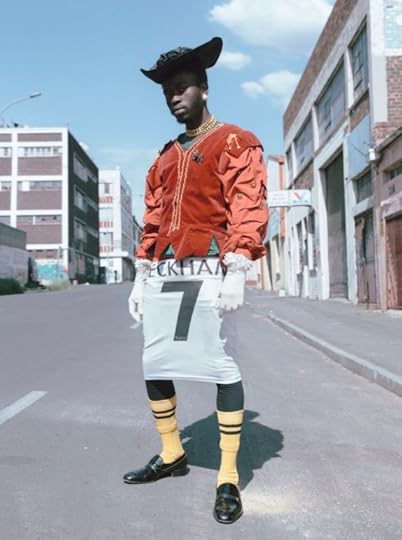
Today, I'm in a white football shirt wrapped round my waist like a skirt. Red velvet bullfighter jacket on, and black montera, traditional bullfighter hat. Yellow football socks, black leather loafers. Outside my flat on Delancey Street, Camden Town, six, seven actual bullfighters walk up, hustling me. 'Huh,' they say. I keep my head down. Focus on loafers, familiar tar-mac. Again, 'Huh!' Guttural call bullfighters use to get the fighting bull's attention. Still, head down, I keep walking. They follow.


Fashion is one key signature of Waidner’s novels, and Sterling’s outfit here is inspired by one designed by Ibrahim Kamara:

description

The matadors, a metaphor for “the logical extension of class war, anti-immigration policies, transphobic media and state-sanctioned racism,” attack Sterling who defends themself but is ultimately rescued by a footballer who literally, sends them off to their escape, showing a red card after awarding a penalty to the matadors.

Sterling then heads to the flat of their bestie and artistic collaborator Chachki Smok, a “brown-brick, low-rise estate, L-shaped at the corner [of Delancey Street] with Arlington [Road], typical with external walkways along the facade.” (the building and route taken by Sterling can be followed appropriately (see later) on Google maps):

description

Chachki’s mother came to the UK from Poland in 1983 while pregnant and now, also aged 37, Chachki is a first-year student in fashion at Central Saint Martins. Their signature clothes line of ‘Pastel Dragons’ inspired, as the author acknowledges by the designs of Nasir Mazhar.

Together Sterling and Chachki are the creators of Cataclysmic Foibles, a Patreon-funded performance art project held in their flats, following in the footsteps of Mojisola Abebayo’s Afriquia Theatre and The Farmyard is not a Violent Place and I Look Exactly like Judy Garland by Alex Margo Arden & Caspar Heinemann.

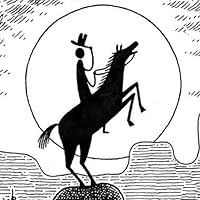
Chacki identifies the footballer/referee as Rodney-something, originally from Iraq and an occasional attendee to Cataclysmic Foibles performances. Meanwhile out of the window a horseman confronts the matadors, one that looks remarkably like the subject of Robert H. Colescott’s painting The End of the Trail, and indeed Chachki names them as Elesin Colescott, a sex-worker and Robert’s (fictitious) child, a Mehmet Scholl and hence Karlsruher FC (a losing institution from a city they’d never visited) fan.

Another signature Waidner theme is inanimate objects coming to life, for example from t-shirts. Here Beach Boy album covers play a key role. Colescott’s painting is a modern, subversive reworking of James Earl Fraser’s sculpture End of the Trail, and an image of the original sculpture graces the cover of the Beach Boy’s album Surf’s Up (1971).

Sterling decides to go in search of Rodney, although not before an encounter with someone claiming to be Chacki time-travelling from the near future, at various local non-league football teams. They start with watching Hendon FC reserves at Silver Jubilee Park on Townsend Lane. Rather brilliantly, Waidner adapts the descriptions of the game from extracts from the Guardian minute-by-minute of the May 16th Bundesliga fixture between Borussia Dortmund and Schalke, a clash known as the Revierderby. This contains an implicit nod to the Covid-19 epidemic as the game was the first in major European football after sports were halted for the crisis.

GOAL! Borussia Dortmund 4-0 Schalke (Guerreiro 63)
This is a delicious goal. Guerreiro powers in diagonally from the left. He slips a pass inside for Haaland, just to the right of the D. Haaland returns it down the channel, Guerreiro having continued his diagonal run. Guerreiro then flicks home sensationally, flicking it with the outside of his boot into the right-hand side of the net.
C.f Hendon Reserves 1 Away Team 0 from the novel:

Hendon No 8 powers in diagonally from the right. Slips a pass inside for No. 10, who returns it down the channel, No. 8 having continued his diagonal run. No. 8 then takes the ball, flicking it with the outside of his boot into the right-hand side of the net. GOAL!! GOOAAL!!!!!!

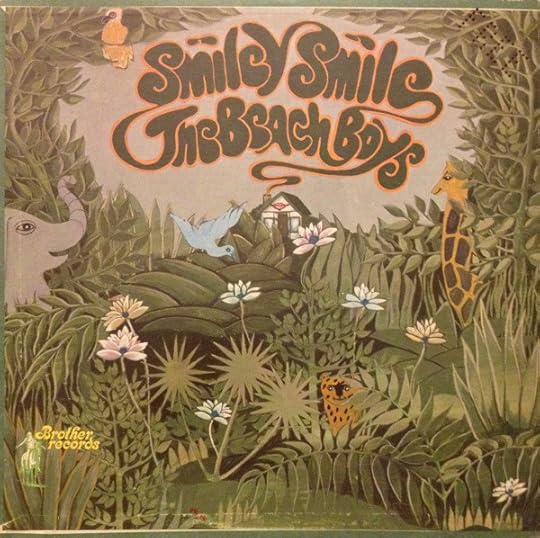
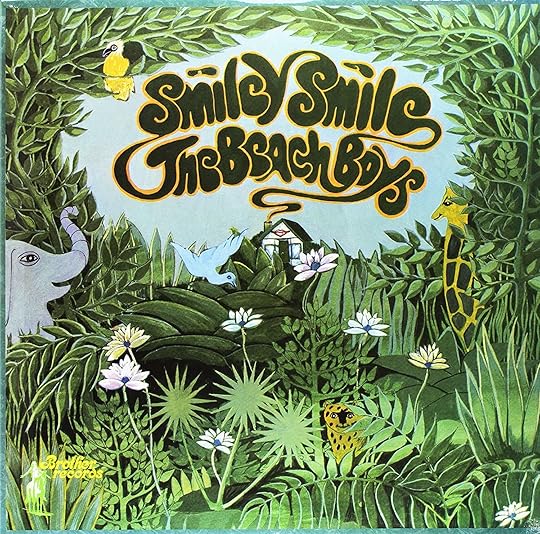
But, while watching, Sterling is arrested by two representatives of the authorities, Pinky Authority and Soft-O Authorito, for assaulting one of the matadors, Nimo Bosch (a descendant of Hieronymus?) and made to practice football dribbles in a lush field behind the football ground that bears a striking resemblance to the cover of the Beach Boys’ Smiley Smile (1967), including live giraffe, elephant and wildcat cuties.

description

And they are later rearrested, and placed in a detention camp in Margate (set in a garden filled with creatures, I think, from Hieronymus Bosch's The Garden of Earthly Delights) for accidentally killing the cuties while hacking through the high grass.

The next chapter begins:

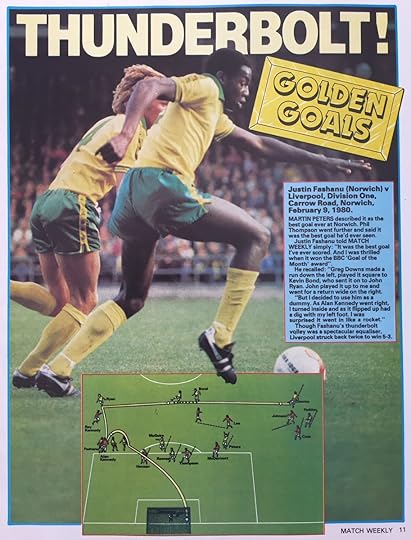
WHAT A GOAL! goal of the season, Justin Fashanu we want you we love you, the way you volleyed it in with your left foot from well outside the box, the way you Spun round and slipped it between the goalkeeper's hand and the right post, the fans wanted you, Norwich City FC did, your teammates jumped you like only footballers playing on the exact same team jump each other when one of them scores. Justin Fashanu, we wanted you when you became the first black British player to sign for £1 million to Nottingham Forest in 1980, we wanted you then but we didn't want you in the late 1990s when you hanged yourself in a garage in Shoreditch, Fairchild Place, after what would have been your final visit to Chariots Roman Spa, the local gay sauna across the road, which personally I never attended and it's not like I didn't try or didn't collect Chachki from Chariots on many occasions.

Justin Fashanu’s wondergoal in February 1980 was to grace the backpages:

description

But, and the real reason for the extensive football links in the novel, Justin Fashanu was soon to feature on the tabloid frontpages, when he became the first (and so far last) top-flight footballer to come out, and Sterling, for whom in the novel Fashanu was a step-dad, explores the tragedies and contradictions of his life, and death, drawing on the Justin Campaign.

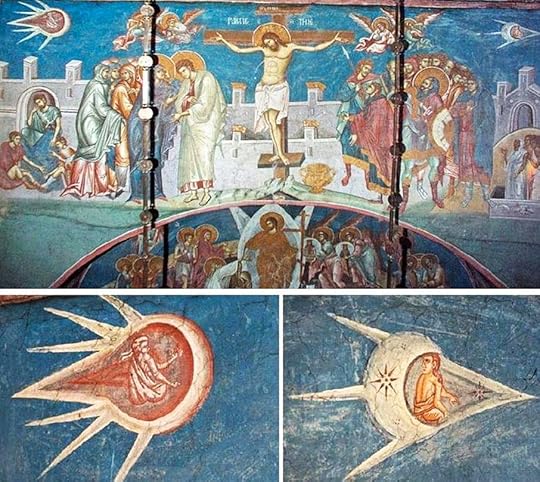
The above, and more, all takes place in the first third of a wonderfully rich novel, one which gets increasingly Kafkesque (literally) and surreal and as it progresses, such as when Rodney picks up Sterling in his spaceship, which navigates in space and time via Google Earth and Street View. A spaceship that itself was first seen in a 14th century fresco from Visoki Dečani Monastery in Serbia (bottom right pane):

description

But along with the brilliantly-imagined, and moving, story, Waidner’s novel has some important things to say about identity, belonging and state-sanctioned intolerance of those deemed to be ‘others’ (black, foreign, gay, trans or working-class female.)

Highly recommended - Waidner's best novel yet, and that is high praise indeed.
Profile Image for Henk.
1,196 reviews304 followers
January 14, 2023
Fascinating trip through time, space and existence as a prosecuted minority. Fragments of Kafka, Hieronymus Bosch, Marina Abramovich to the max and bullfighting populate the world Waidner transports the reader to
Is this the moment he realises what he has let himself in for? What it means to give up control, even if temporarily and in the context of an artistic performance? What it’s like to exist on someone else’s terms? In someone else’s violent fiction?

A book that feels like an acid trip, reminding me maybe most of Slaughterhouse-Five in how Isabel Waidner lets the main character travel throughout the world in a space/timeship. Sterling Karat Gold is exuberant and wild, unpredictable, and features bullfighting, Franz Kafka like legal proceedings, American football players and much more. The richness of the allusions in the book is large, but this doesn't impede immersion in the book nor enjoyment. A wildly ambitious, but above all quite fun book; I plan to discover more of the writing of Waidner!
Profile Image for Meike.
Author 1 book4,946 followers
June 19, 2024
Winner of the Goldsmiths Prize 2021
Waidner pays homage (kind of) to the two great German-speaking Franz (Franzen? Franze?): Franz Kafka und soccer legend Franz Beckenbauer. They both feature in this hilarious novel about state violence against queer people and othering due to gender, race, class, sexuality. Our protagonist is 37-year-old Sterling Beckenbauer who is not only a nonbinary immigrant, but also, of course, the kid of Franz Beckenbauer who, as we all know, was a famous gay soccer player who died from AIDS. Sterling and their friend Chachki Smok run a Patreon-funded anti-theater program, and performance art plays an important role throughout the text, starting with the cataclysmic event that sets the plot in motion:

Sterling gets attacked in public, the whole scuffle is described like a bullfight and is only broken up when an Iraqi-born referee named Rodney shows up. Later a man on a horse confronts the attackers: he looks like the subject of Robert H. Colescott’s painting "The End of the Trail" and is named Elesin Colescott (the painting is a remix of James Earl Fraser’s sculpture "End of the Trail", which is depicted on the Beach Boys' cover art for "Surf's Up" - the Beach Boys re-appear again and again in the novel). Later, Sterling is approached by officials during a soccer match and told she has to go on trial for the attack (hello, The Trial, where an innocent man is randomly accused of an unspecified crime). Now, naturally, Sterling, Chachki and Elesin take an UFO to search for sex-worker Elesin...

Yes, this is surreal and innovative, and it employs methods that de-familiarize and thus de-automatize our everyday use of language in order to ponder violence against gender non-conforming people. The strong, clear political message is issued in a boundary-pushing, creative way, and the outrageous fictional turns are intertwined with a montage of real issues and people, e.g. the story of Justin Fashanu, the first openly gay soccer play who killed himself, or the story of sex worker and activist Thierry Schaffhauser. There are references to Hieronymus Bosch and other paintings, the performances by Sterling and Chachki are inspired by real performance art troupes, their outfits by real designers, real soccer teams and games are remixed, etc.

This novel is A LOT, but I admire its inventiveness and daring approach to political writing.

Also, shout-out to Ann Cotton, the German translator who works with so-called Polish gendering in her translation Vielleicht ging es immer darum, dass wir Feuer spucken, meaning that the letters needed to represent all genders are added to the word ending in random order (German grammar does not allow to literally translate "they", because the pronoun is identical with "she", thus failing to represent the gender-neutral meaning of the singular "they"). Her innovative approach to gender-sensitive language earned Cotton the Internationaler Literaturpreis for this translation.

You can learn more about the novel in our latest podcast episode (in German): https://papierstaupodcast.de/podcast/...
Profile Image for Emmanuel Kostakis.
106 reviews199 followers
February 16, 2025
“It’s not just us on trial, it’s the system. Every time they put one of us in the dock, they put themselves there too, only they don’t see it yet.”.

Isabel Waidner’s Sterling Karat Gold is a raucous, genre-smashing blitz of queer defiance and working-class rebellion, blending the surreal with the suffocating grind of reality. A fever dream set in a Britain warped beyond recognition yet unsettlingly ordinary, it follows Sterling (they/them), a nonbinary migrant, through a labyrinth of absurdist trials (including a Kafkaesque courtroom where time collapses and reality rewrites itself mid-sentence) while they grapple with systemic oppression. Waidner’s prose unapologetically chaotic interrogates what it means to survive under a systemic reality while carving out space for joy, love, and community - all wrapped in glitter and rage.
It’s as if Franz Kafka got drunk with Derek Jarman and decided to torch the establishment! So here it is…Enjoy!


“We’re the glitch in their programming, the error in their architecture. We’ll rewrite the code, one flamboyant, impossible act at a time.”


4.5/5
Profile Image for Neil.
1,007 reviews757 followers
October 9, 2021
”The way the campaign combined queer culture, art activism and football spoke to me…”

I mean this in a positive way: only Isabel Waidner could have written “Sterling Karat Gold”. This is their third novel and I have read them all. I was fortunate to be part of the judging set up for the 2018 Republic of Consciousness Prize where we shortlisted Waidner’s “Gaudy Bauble” which almost literally blew my mind (I had to read it twice to get to grips with it at all and then again to appreciate it). Then “We Are Made Of Diamond Stuff” was also shortlisted for the 2020 version of that prize as well as being shortlisted for the 2019 Goldsmiths Prize. And now there’s “Sterling Karat Gold”.

This book is a heady mixture of Kafka’s “The Trial”, time travel (but only to the past for reasons that will become apparent), The Beach Boys, football, fashion, art, and several other things. As the book blurb says, it’s a ”surreal inquiry into the real effects of state violence on gender-nonconforming, working-class and black bodies”.

The time travel parts are genius!

I have to admit that I needed this book to come along at the time it did. Nearly all the books I have read over the last 4-5 weeks have been full of desperately sad people in desperately sad situations and it was all getting a bit much for me. This, however, is completely bonkers: the perfect antidote. I always look forward to reading Waidner's books: they (the books) come at the world from a very different direction to me and I find that refreshing and helpful.

My Goodreads friend Paul has written a detailed review of this book, so if you want details about what happens, go there because I’m not going to talk about that. At times it is confusing. Always it is completely zany. Mixed in with it all, there’s a serious message.
Profile Image for Hugh.
1,293 reviews49 followers
March 26, 2022
Winner of the Goldsmiths Prize 2021
Shortlisted for the Republic of Consciousness Prize 2022

My fifth book from the Goldsmiths list is another very strong one, and once again Waidner is entertaining and a little surreal - the anarchic plot brings together the Beach Boys, Franz Beckenbauer, Justin Fashanu, Google maps, time travel, the Nation of Islam, bullfighting and the state's attitude to various minority groups while remaining just about coherent enough to follow, and full of interesting asides.

I could say much more, but I would rather encourage anyone who has not tried Waidner to read it!
Profile Image for Eric Anderson.
716 reviews3,920 followers
October 27, 2021
Isabel Waidner has invented such a unique style of writing that's a mixture of social commentary, wildly creative imagery and buddy humour. I feel like Waidner is a modern-day Joe Orton. “Sterling Karat Gold” is a play on Kafka's “The Trial” in which an innocent character named Sterling is arrested after unwittingly being drawn into a bull fight in London's Camden Town. Sterling faces prosecution by a corrupt judge, enlists the help of friends, grapples with their lost father, stages a radical theatre production and uses space ships to cross time barriers. If this sounds too fanciful let me assure you that these stretches of the imagination always feel rooted in real-world issues and reflect the feeling of being marginalized within oppressive systems. As a character named Chachki states at one point: “correcting falsified narratives is important; but conjuring counter-realities even more so.” The bizarre quest which Sterling embarks on has the effect of liberating these characters and the reader from the restrictions and limitations we are forced to live under by plotting out new possibilities. It's also fantastic fun to read and gives a warm sense of camaraderie.

Read my full review of Sterling Karat Gold by Isabel Waidner on LonesomeReader
Profile Image for Vartika.
523 reviews772 followers
May 11, 2024
Some of the most exciting writing I have come across in recent years rests between the covers of this novel, and I am in absolute awe of how accomplished a stylist and storyteller Isabel Waidner is; the economy, humour, and bite with they demonstrate the malleability of language, logic, narrative, and our conceptions of reality.

Sterling Karat Gold is a play on Kafka’s The Trial, wherein an innocent person is arrested for a crime they didn’t commit – it all starts when our narrator Sterling Beckenbauer is assaulted by bullfighters in broad Inner London daycloudlight. But whereas Kafka’s characters are usually well-to-do and caught off-guard by the bureaucracy that takes them under, Waidner’s have led their entire lives enmeshed in it, in the endless rotation of documents, interviews, interrogations, and alien identities that are always being contested:
“I’m Sterling. Lost my father to AIDS, my mother to alcoholism. Lost my country to conservatism, my language to PTSD. Got this England, though. Got this body, this Sterling heart.”
It is 2001, and bullfights, as Sterling shows us, abound in Camden Town – as in the staged, ritualised slaughter of an animal undangerous until driven by provocation; as in the ceremonial harassment done against lone members of minority communities; AS IN the state violence committed against queer, immigrant, BIPOC, non-conforming people. In 2001 in Camden Town, Waidner deploys surrealism (spaceships, football, fashion, Google Earth-powered time travel, Patreon-funded sketch theatres, shapeshifting bestiaries, the 1967 Beach Boys album Smiley Smile and so on) to dive deeper into all that is otherwise triggering and harrowing about their subject matter, and have their characters and their friends hold the powers that be to account.
Waidner frames the dreamlike logic of this novel through Hieronymus Bosch’s fifteenth-century triptych The Garden of Earthly Delights (the plaintiffs in the absurd trial against Sterling are named Hiero Moussi and Nimo Bosch respectively) and is as ripe with symbolism as the painting. Bringing together settings, characters, and incidents from observable history (notably the suicide of the black gay footballer Justin Fashanu) with exquisite, associative wordplay (“Picador is one of a pair of horsemen in a traditional bullfight who jabs the bull with a lance, and also a British publishing house”), it seeks to create narrative moments that reveal “incongruities and irregularities in the official narrative, so-called 'spaceship moments', to confirm what we already know, namely that we're alive in a sub-standard fiction that doesn't add up…that we [are] non-consensual participants in a reality put together by politicians, despots, more or less openly authoritarian leaders."
A thirteenth century fresco from the Visoki Decani monastery in Kosovo (referenced in the book) depicts sun and moon figures that look vaguely like spaceships, leading many to believe that our ancestors made contact with aliens. Waidner, despite the spaceships in their novel, seems to imply that such assumptions downplay the richness of human creativity and imaginativeness that predates modernity and is likely to outlive it.

All in all, Sterling Karat Gold is Waidner’s exercise in imagining otherwise: in the words of Sterling’s ‘bestie’ and creative collaborator Chachki Smok, "Correcting falsified narratives is important, but conjuring counter-realities even more so." There are two moments, at nearly two opposite ends of the book, that when juxtaposed bring this idea to the forefront: during Sterling’s absurd trial, Chachki is called to testify and ask if their friend ‘at least partly exists in a dreamland of their own making.’ As the novel reaches full circle with its echoing of the opening scene of bullfighting as ritual violence, Sterling – no longer the victim – dares to ask: “What’s it like to exist on someone else’s terms? In someone else’s violent fiction?”

A breathtakingly subversive and satisfying adventure that reframes the novel form and reality as we know it.
Profile Image for Robert.
2,308 reviews258 followers
December 28, 2021
When I reviewed Isabel Waidner’s previous book We are made of Diamond Stuff , I said that the book satirized the current state of British politics , focused on gender and was a reading experience.

I’m glad to say that Sterling Karat Gold is the amplified version of Diamond stuff. It’s wackier, more playful, still has complex metaphors, more bizarre situations and, without any doubt, a fun book . Yes and reading it was an experience. Think of a rollercoaster ride: tons of loops, brain warping situations. Thematically there are a lot of similarities with Diamond Stuff… but it’s done via a Kafka tribute.

With Isabel Waidner’s books, I feel that plots are a bit superfluous as they are springboards to the myriad of ideas that leap out at you. Simply the book is about Sterling Beckenbaur, a non binary immigrant. As the book opens they are in some sort of bullfight, which I assume represents everything that is politically wrong with Britain: racism, transphobia, classism and insecurity. Later on Sterling is falsely arrested for various misdemeanours which they did not commit, is sent to a detention centre and is to attend a trial as part of an experimental play that their fellow immigrant friend Chachki is holding.

Sterling Karat Gold also contains sections about Beach Boys cover art, miniature animals (if I understood correctly), features a time travelling spaceship and a homage to Kafka’s trial. Like Kafka’s novel the situation Sterling finds themselves in is one that is equally absurd and yet has serious undertones. I understood the book to be a snapshot of the fascist like state Britain has turned into for people who form part of the trans community. Sterling does find a way out in the end but does it signify that in order to make a voice heard one has to resort to more forceful tactics?

Sterling Karat Gold is a busy book. Each line is filled with symbolism and they all fly by at rapid pace, stylistically, the prose is distinctive and, and this is something I admired, the book is funny. Sterling’s worldview and observations of this crazy world are humorous. Going back to Kafka, Sterling is in a situation which finds them trapped for most of the novel and this humor provides a temporary escape from the madness or is it a result of the madness?

Sterling Karat Gold is not a book to read once. I am sure that upon a second reading my interpretation will be incorrect spurred by a little detail. However I think it’s an important book. Is there anyone who can create such a cerebral, complex and distinctive novel? This is a landmark in experimental fiction and an essential document of our mixed up planet. To use an abused term, this is a work of genius.
Profile Image for Alan (on December semi-hiatus) Teder.
2,705 reviews250 followers
February 16, 2022
February 15, 2022 Update Now longlisted for the 2022 Republic of Consciousness Prize. Shortlist to be announced March 26, 2022. Winner April/May 2022?

November 10, 2021 Update Now the winner of the 2021 Goldsmiths Prize!

Solid Gold Fun
Review of the Peninsula Press paperback (June 2021)

A definite 5 stars for this latest from Isabel Waidner which is possibly even more fantastical and surrealist than the previous outings Gaudy Bauble (2017) and We Are Made Of Diamond Stuff (2019). With imagery drawn from Hemingway's Death in the Afternoon (1932) through to The Beach Boys Smiley Smile (1967) and a courtroom presided over a judge looking like something out of Hieronymus Bosch's Hell panel from The Garden of Earthly Delights (1490-1510) and a set of injustice enforcers dressed as matadors (which is the Spanish word for "killers") you know that you are in for a wild ride. Oh yes, and there are time machines which set their coordinates by referencing the street views of Google Maps if you needed any further encouragement.

Recommended for fans of surrealist science and fantasy fiction, or just anyone looking for what fun can be had with a wide ranging imagination.


A photograph of a matador (circa 1935). Image sourced from Wikipedia.


Album cover for The Beach Boys album "Smiley Smile" (1967) which includes the small animals referenced in Sterling Karat Gold. Image sourced from Discogs.

I read Sterling Karat Gold as the June 2021 selection from the Republic of Consciousness Book of the Month (BotM) club. Subscriptions to the BotM support the annual Republic of Consciousness Prize for small independent publishers.
Profile Image for Ruth.
104 reviews46 followers
September 26, 2022
What a wonderful surprise this book was for me.
I started reading it after finishing a fascinating economics book in which I particularly enjoyed clarity of ideas, logic of conclusions and the infinitely interesting historical facts. After all of the above a fiction book where surrealism is weaved with facts (I live a walking distance from Camden the neighbourhood where this novel is placed) initially didn’t go down smoothly at all.

I had to power through the first few chapters ignoring the demands of my brain to go back into the safe lands of clear logic. Because this novel doesn’t reads like a straight forward fiction either. I must say that I am very happy I didn’t listen to my brain but trusted the Mooks (GR group) and kept reading. Because this book is the highlight of my reading this year.

There is a lot being said about the social critique of modern Britain in this book so I wont repeat that.The parts that particularly touched me were more about the emotional insight.

One example is the narrative in which the protagonist re-tells his family history to himself, with slight variations, again and again throughout the book. Almost to validate himself through it.
This behaviour is so familiar, we all do it.
Validate ourselves through past experiences and traumas just to make sure we are still alive and that there is a justification to why we are the way we are (or why we are not the way we think we should be). The protagonist does that until he finally drops it during a re-living of a situation (which he travelled back in time for) and this allows him to break free and start living a new reality. That moment of breaking free is so powerful that I could feel it physically in my body.

Another example would be how the author writes about friendship - what it means and how true friendship is expressed - in the small things not just the big gestures. After a long period of COVID and the consiquent disruption of our social lives I was reading these parts feeling like a thirsty man finding a spring in the heart of a desert.

This book came alive for me. After I finished it I took a long (and a bit sad) walk around the streets described in the book parting with it’s characters. What an experience this little book is!
Profile Image for Lee.
381 reviews7 followers
November 24, 2021
The front cover to the Peninsula Press paperback features a surly-looking set of Droogish police officers stood right behind (bit like that JCB following David Bowie in the Ashes to Ashes video?) a nice-looking giraffe, just minding its business, looking past us and the fluorescent green wash that fills most of the rest of the cover. If a giraffe suddenly turned up on the streets of London, what would happen to it? It'd be moved on. It would be a bit of an anomaly, might stop traffic. Best taken back to the zoo, or quietly put down.

The cover is a small hint as to what to expect in Sterling Karat Gold, as much an environment (or haven) as a novel, half surrealist-absurdist willed-through-anger-and-helplessness ruptured reality, rejection of dismally dangerous authoritarian states, half joyous celebration of difference, of whatever autonomy you can claim, while the authorities aren't looking. It features Justin Fashanu (long dead (by suicide) gay black footballer), spaceships, pastel dragons, menacing pink fountains, weird penalty shoot-outs (and almost entirely convincing match scenes), Saddam Hussein novels and bullfighting. Read it for those reasons alone, or for chapter 4, My Father*'s Lover Was Never The Stepdad I Wanted Him To Be, which is, though I could never explain why, perfect. (Long live Cataclysmic Foibles.)

*Franz Beckenbauer, German football legend.

'It was never actually about your clothes but always about you, and if you hadn't worn this or that skirt, or those socks, you would've had the exact same thing coming, the kind of thing, Justin Fashanu, that doesn't happen to everybody, but that happened to us, Justin, and to you, a lot, that's why we developed a language around it, we were kids, didn't care for the precise or even correct use of words, we still don't, we care for their capacity to give life, and to take it away.'
Profile Image for WndyJW.
680 reviews153 followers
July 21, 2021
I’m at a loss to explain the book so I’ll try to convey the experience of reading Isabel Waidner. It’s a trippy, disorienting, vivid dream-like evening trying to keep up with the images, action sequences, and characters in a Waidner book.

I urge everyone to read Paul Fulcher’s review if you feel you’ve lost you way in this fantastic book, or at least keep your tablet, laptop, or phone handy to look up the real artwork, artists, fashion designers and fashion, and sports figures that make up the north London of Waidner’s creation.

Waidner’s message about the treatment of gay, queer, black and immigrant bodies by authorities is clear and the effort by Sterling and his friend Chachki to process the abuse they experience through performance art is endearing.

My experience of this surreal, avant-garde, work of genius is that it is not easy to keep up with, but it’s great fun trying and worth the effort and after a few readings it falls into place.

I heartily recommend it.
Profile Image for Amy Biggart.
683 reviews842 followers
Read
April 1, 2024
if I’d understood that, I would rate it

What a slippery book
Profile Image for Peter.
644 reviews68 followers
July 11, 2021
Isabel Waidner's latest book, Sterling Karat Gold, breaks open the possibilities of what writing can offer. Their world is one that follows its own unusual logic and never deviates away for the sake of the reader, a logic that reminds me of queer films like "I Be Area" "Pink Flamingos" or "Liquid Sky". Matadors roam the streets imposing violence onto queer bodies, and the central characters resist the violence imposed on them by the world through projects such as the anti-theater troupe "Cataclysmic Foibles" or the fashion project "Pastel Dragons". History is explored through a time machine operating off of the Google Earth service, as well as a queer history of football player Justin Fashnau. Between this, a Kafkaesque bureaucracy mediates the future of this group through strange laws and unusual punishments.

Isabel Waidner's greatest strength is understanding the core tenets of camp aesthetics. Plot is secondary to the voice that the story takes and the unusual antics that lie therein. In the place of a cohesive narrative, you get a hopscotch of global politics and how art resists it. It may not always make sense to the reader - I suspect most of the negative criticism will center around the seemingly nonsensical arc the story takes.

But why do you need something conventional? Underneath the outrageously colorful language of this book, Waidner is a careful and intelligent writer who is extremely intentional about the history they are invoking. The unusual perspective of Sterling Karat Gold offers a different lens by which to see not only contemporary events, but the function of art. In a recent interview with the Guardian, Waidner states:

"Many people who come to London as migrants, especially queer and trans migrants, work these jobs while trying to do something more ambitious and at the same time juggling the oppressive structures impacting on our lives... I’m staging a complexity we don’t always see in novels: working-class characters often do one thing – work – and then maybe they’re a little bit criminal, and that’s it."

One of the things this book seems to suggest, in my opinion, is the idea that even minority groups are capable of self-determination. For the central characters of this book, they accomplish this through the means of artistic endeavors, giving them a power over bureaucratic figures who might otherwise impose their will upon them. Art, the very thing that working class people are deprived the time of doing, becomes the weapon they wield against a society that seeks to take away their personhood and reduce them to machines. Sure, it sounds a little cheesy, but that's part of what makes it fun!

Waidner is, to me, doing one of the most important things a queer artist can do: create new colors, sounds, worlds in which to inhabit. My favorite parts of this book are when strange action is couched in real history - the examination of Robert H. Colescott's, Justin Fashnau's career, and UFO sightings in renaissance paintings were my favorite parts of the book. It struck me as a death knell to boring autofiction, which this book decidedly is not.

While this is only being published in the UK currently, it will be published soon state-side by Graywolf Press, who have pushed some of my other favorite queer authors, notably Natalie Diaz and Maggie Nelson. I sincerely hope Waidner gets the attention that they have, and look forward to future work!
Profile Image for Lee.
548 reviews64 followers
July 24, 2021
“Different doesn’t need to be scary. It can be fun,” says Isabel Waidner in a Guardian interview on the occasion of the release of their new novel, Sterling Karat Gold. The book takes a zany, surrealist route in exploring issues of racial, sexual, and class oppression in modern day Britain. For every brutalist migrant detention center, there’s a micro-dragon and a living pink fountain with a black hole in its center. For every murder of a racial/sexual minority, there’s a bullfight that goes to penalty kicks. In its best bit, there’s a time-traveling spaceship that operates through the channels and limitations of Google Street View.

The characters here live on the edge in more ways than one. Their vulnerability is expressed brilliantly in the naming of their two-man amateur drama series staged periodically in a cheap flat: Cataclysmic Foibles, which has a central role in the novel (Justin Fashanu, mentioned below, was a black and gay professional footballer for those like me who didn’t know already):
Take Cataclysmic Foibles, the name, which referred to a state of precarity in which any foible, character flaw, or momentary slip up can and will have cataclysmic personal consequences, imagine, e.g., that all you did was walk down Delancey Street, white football shirt wrapped round your waist like a skirt… That’s what years ago we somewhat childishly, imprecisely - liberally, even - called a cataclysmic foible, the fact that you wore that stuff, the skirt in particular, the fact that it was never actually about your clothes but always about you, and that if you hadn’t worn this or that skirt, or those socks, you would’ve had the exact same thing coming, the kind of thing, Justin Fashanu, that doesn’t happen to everybody, but that happened to us, Justin, and to you, a lot, that’s why we developed a language around it, we were kids, didn’t care for the precise or even correct use of words, we still don’t, we care for their capacity to give life, and to take it away.


The plot has Sterling, our central character, on trial for something or other, basically for being himself, whatever the official reason, as suggested in the above passage. But this is surrealism, so the judge has the body of a crustacean and reigns above a hole in the floor in their flat, with the assistance of an AI-run drone armed with knives.

Does it all make for fun? Surrealism is not really my favorite so ymmv on that, depending, but be aware that there is a twist at the end, twice; in that Guardian interview, Waidner puts us all on note: “don’t think we’re so harmless”.
Profile Image for Christina Dongowski.
254 reviews71 followers
November 14, 2021
Experimental of avantgardist writing has a reputation for making great claims about its revolutionary or at least critical potential but really failing on delivering even on criticality, because most of it is deemed unreadable or hermetic academeese (which is true, in a lot of cases). Isabel Waldner proves, again, that experimental writing really has the capacity for being hugely entertaining, funny, moving, and by transforming the realities especially marginalised people have to live, into a surrealist time travel bull fighter court room drama - Kafkas Der Prozess meets LGBTQIA TikTok and Instagram (& real life Brexit UK). This is a really great read & the Goldsmith Prize for it is really well deserved.
Profile Image for asmalldyke.
128 reviews15 followers
February 25, 2023
That was the weirdest Beach Boys reference I ever did see, without a doubt.

But it's actually not that complicated or weird, once you get over being blasted in the face with its odd prose and, *colourful* pool of allusions and references. It was an adjustment period, even as someone who makes a habit of reading these blunt, overtly polemical queer novels. The thing about Sterling is that the book has no brakes, at all; you crack the spine, and first page BAM a bullfight-cum-execution in the streets of Camden, which that early on may be metaphorical, without any lead-up or establishment it's hard to tell.

But get past the bullfighting and football stuff, and the zany moon logic through the book's middle third, and also the time traveling Google streetview stuff... you should get used to taking things mechanically at face value. Past all of that, it is just a tidy little story about violent(yet outwardly polite!) oppression in the modern day, against qtpoc. A tidy little story which uses "lol" and "fr" in narration.

Surprisingly, given that I am at least adjacent to the target audience, I didn't find Sterling to be that affecting. Perhaps I am just weird, but I felt waaay too outside the story with all of its whacky insanity to really get invested. I like Sterling themself, but generally it'd be like if you picked up Tell Me I'm Worthless at page 200 or something, it's that loud and unsubtle at points.

I did end up reading a lot about the Beach Boys' 1966-71 career thanks to this book, so there is that.
Profile Image for Chris.
612 reviews183 followers
July 4, 2021
This was a wild ride!
Profile Image for Paul Dembina.
694 reviews163 followers
February 8, 2022
Such quirky writing is right up my street. A mixture of science fiction and social commentary
Profile Image for Harrison.
217 reviews63 followers
February 5, 2025
2⭐
Um, sure, I guess...

Points for this book being short and not dragging too badly. However, I still felt this could have been way shorter, or the "plot" condensed down.

I don't vibe with this book at all. I see little pearls of stuff that make or are worthwhile, but the overall thing is just a chop, in my opinion.
Profile Image for Arno Vlierberghe.
Author 10 books137 followers
February 1, 2022
Wat een fucking trip. Een ware spoeling van de darmen. (En hoe arm is onze Letterkunde dat we geen eigen Isabel Waidner hebben. Hopelijk is die nog op komst.)
Profile Image for Stuart.
72 reviews
May 28, 2022
Fine literary fiction. I am baffled by the plot but so enjoyed the characters, the language used, the imagination and metaphorical play on racial, gender and economic differences in society.
Profile Image for Areeb Ahmad (Bankrupt_Bookworm).
753 reviews262 followers
January 26, 2022
"Instead, he strains his neck. Is this the moment he realises what he has let himself in for? What it means for him to give up control, even if temporarily and in the context of an artistic performance? What it's like to exist on someone else's terms? In someone else's vio lent fiction?"


I won't be surprised if Isabel Waidner wrote this novel on a trip after dropping multiple tabs of acid. In fact, I refuse to believe anything to the contrary. I admit I say "I haven't read anything at all like this before" a little too often but I mean it every time and I mean it most right now. The book begins conventionally enough, with our main character walking down Delancey Street in Camden Town before they are very violently accosted by a bunch of bullfighters and manage to escape them. They recuperate at a friend's with whom they curate an avant-garde drama series. So far so good? It does not take long for murderous matadors, sinister authority figures, time travel, spaceships, kangaroo courts, and amphibian judges to make their appearance.

Sterling Karat Gold explores, through clear-cut allegory and surreal metaphor, the subordinate classes and how they are blatantly dominated in a modern surveillance nation state, through ideological state apparatuses, and if that fails, the repressive state apparatuses. Waidner here highlights how hegemony is maintained in our societies, how people who don't conform to norms are met with violence—effaced, erased, eliminated. Its a masterful attempt to articulate the tumultuous daily existence of queer people, migrants, the working classes—anyone who is by default disadvantaged in a world divided into binaries of centre and periphery.
Profile Image for Cody.
988 reviews300 followers
April 22, 2025
Reader's Digest Version OR, 'Those "Down In The Well" (Bevis Frond) of Book Reviews and Need to Catch the Fuck Up' Review:

Yet all that glitters is...Led Zeppelin lyric.

Despite the same manic energy in Corey Fah being rampant here, I gotta be honest: nine days later: I don't remember a fucking thing. Zippo y zilch. Mucho crash-bang, yes; prodiguous in the BIFF BANG POW!, but too little storyline to have ever even tickled my brain organ enough to remember a single fucking thing. No shit. Huh. It's weird. Maybe I was abducted and this was that 'lost time' you read so much about on the TeeVee.

I have a recollection of finding it good but far from great. Luckily, the previous novel by Waidner would reify my suspicion of an incredible talent that just went too wild somewhere in Sterling Karat. But that earlier novel happened later, in the future, as it were; I can't just sit here and speculate what some future me (who's already read the book, yes) will have to say. That's just sacrilege, or wormhole territory shit. Creeps me shivery just thinking on it.

Who knows, the next time I read this short-short (I do dare), I may come away with my foot placed firmly in mouth. Nothing would please more, actually. Waidner sure as shit deserves a better reader than my (apparently) Alien-abducted, onset dementia, time traveling ass of outlaw justice.
Profile Image for MJ Nicholls.
2,274 reviews4,845 followers
June 8, 2022
Primed to like the face off this novel, scoring a merry frolic with We are Made of Diamond Stuff, my thrill muscles were simply not twitching as I skipped through the surreal, satirical antics in this one. Casmilus wrote a far more appreciative review for the Exacting Clam, which I suggest you read until your eyeballs ache.
Profile Image for nethescurial.
228 reviews76 followers
October 31, 2025
"I can put up with a little discomfort, for art's sake."

Just completely besotted with how balming this felt to read above everything, and really, to even know something like it exists. Hard to believe a serious and avant-garde social novel with such an ostensibly bleak premise - and by all means, featuring some incredibly harrowing events - could also naturally feel this joyous, this warmhearted, this expansive and loving and sweet and life-affirming without ever once sacrificing its underlying effect... a story by and for queer people, never once feeling like it has to kowtow to incredulous outsiders even if I'm sure its "wacky" aesthetics and centering of plainly neurodivergent and "socially unacceptable" voices are sure to draw in some people who would gawk at it. You're telling me I finally found a novel (after five fucking years of reading regularly in my adult life) almost completely populated by out non-binary characters who are taken seriously and empathetically AND allowed to be flawed, goofy, morally and intellectually complicated as any cis person?? Where lived queer experiences aren't taken for granted or objectified from an outside-looking-in perspective but centered instead as universal reality, while still appropriately acknowledging how difficult it is for us to be understood on the terms we need from the surrounding universe?? Sterling is easily among the most valuable first person narrative voices I've read, a beautifully endearing and adorable mess of a person whose screwed up lovableness is communicated just as much in what they don't say as what they do, and whose inflection and circumstances perfectly communicates how a non-binary person specifically experiences the world and our alienation from it while also being a pinpoint with whose voice explores the emotional alienation inherent in the greater human condition. And it's a book that's got razor sharp musical prose that feels as twee as it is vicious, with influences ranging everywhere from the Beach Boys to Bosch to Kafka and performance art, and combines offbeat realism with sci-fi time travel and courtroom drama inside an endearing yet dark buddy adventure framework and somehow all feels perfectly cohesive to establishing the weird, specific thing it is... oh how happy I am to live in a world where this exists, no matter how difficult the depicted (present)future will be and is for queer folk. If there's any criticism I have of it, it's that I was about to dock a point for maybe just being a bit too ephemeral as it almost feels like a missed opportunity not to inhabit this world for three times its length, but since the book is deliberately released as novella-length as is, complaining about too little of an amazing thing is probably moot, and the more I think about it the more it rises in my esteem, as I expect it will continue to as I familiarize myself with it and the rest of Waidner's work, who has strong potential to be my next Me-core obsession as far as authors go. Cataclysmic Foibles forever.
Displaying 1 - 30 of 198 reviews

Can't find what you're looking for?

Get help and learn more about the design.