Die-hard Avengers fans know that over the years, there have been many changes in this roster of "earth's mightiest super heroes". What remains the same are the best in thrills, fun and fantasy provided by our superheroes and supervillians engaged in the classic good vs. evil struggle.
Stan Lee (born Stanley Martin Lieber) was an American writer, editor, creator of comic book superheroes, and the former president and chairman of Marvel Comics.
With several artist co-creators, most notably Jack Kirby and Steve Ditko, he co-created Spider-Man, the Fantastic Four, Thor as a superhero, the X-Men, Iron Man, the Hulk, Daredevil, the Silver Surfer, Dr. Strange, Ant-Man and the Wasp, Scarlet Witch, The Inhumans, and many other characters, introducing complex, naturalistic characters and a thoroughly shared universe into superhero comic books. He subsequently led the expansion of Marvel Comics from a small division of a publishing house to a large multimedia corporation.
Actually I'm a bit ticked off. Not at the book, but at the reviewers who think the 1960s are to be sneered at because they were the 1960s. I was a kid (and young adult) in the 60s. When grown I raised my own kids and in the 80s I would never have let them wander in alone and select from the comic books of that era without supervision. Yes comics of the '60s were different. You don't like it...don't read it. If however you think you might enjoy the art and stories of a time when comics were a different thing then give it a try. Sure the dialog is a bit more corny, the characters don't disembowel each other, any love stories are implied more than graphically drawn... how terrible.
The nostalgia here is (for me) so thick you can cut it with a knife. I was 11 years old in 1963 and just becoming a Marvel fan. Over the years that followed Captain America became my favorite comic book hero. Yes, that Captain America, the one who made speeches about free people standing and fighting for their freedom against despots and dictators. (Many villains were surviving Nazis [Nazi super villains]or invaders from space or the future or an alternate dimension or whatever). As soon as I opened this up I was there again and I enjoyed the book immensely. (I have ordered the next 2. LOL)
These are comics from what is called the Silver Age of comics. No they're not the gritty 1980s and 1990s gore fests. No they're not the angst ridden "who are we really" 2000s. They tell direct stories where there is usually a clear right and wrong. The heroes often fall for obvious ploys by the "bad guys". Plot exposition takes place often in word balloons over the character's head as their in the midst of a fight. BUT, you also get the patented wise guy comments that Marvel pioneered. In their day these were actually on the cutting edge. Jack Kirby is still remembered as THE comic artist. He originated Cap back in WWII and was the artist that brought him back here.
So, this is comic history and it's worth holding on to and remembering, even if all don't really appreciate it. If it's what you're looking for enjoy.
Title: Marvel Masterworks #4: The Avengers, Vol. 1 Author: Stan Lee Genre: Superheroes Publication Date: 1990 (reprinting material from 1963)
As a non-white, Puerto Rican man, I have to be honest about noticing the fact that there were very few superheroes that spoke to me as a boy. I love the Avengers, but in the beginning, these first ten issues have an overt problem of all the characters being one-note, macho, nimrods. It's possible that Stan Lee may have been a little burnt out at the time.
I hate that all of these alphas want to fight each other at the slightest provocation, almost to the point of ignoring the villains to settle a long-standing beef with a fellow Avenger. Captain America is brought in on the fourth issue. He added stability and actual leadership to the team. An even bigger problem to my mind is the Wasp. She is an absolute ditz with only one thing on her mind. The only reason, I rate this so high is deference to these as classic.
Books have significance for me that go far beyond the actual pages. In 2018, I resolved to go through a lot of the graphic novel, trade paperbacks curated in my father's home. Among the most prominent were the Marvel Masterworks series of TPBs. The fourth of the series was Marvel Masterworks: The Avengers, Vol. 1 written by Stan Lee, penciled by Jack Kirby and Don Heck, with Dick Ayers, Paul Reinman, George Roussos, and Chic Stone on Inks, and Sam Rosen and Artie Simek on Lettering. Of the earliest Stan Lee characters, these are the most lacking in characterization. The heroes are Hulk, Thor, Iron Man, Antman and Wasp. I know, no Captain America in the first 3 issues, but you got to give them time to figure it out. However, my first major problem is that all the males are constantly measuring their phalluses. "Do you know who you're talking, too? Let's fight!" Huh! A team of alphas that just want to fight each other at the drop of a hat. What sort of a dysfunctional mess am I reading? And for all the jerks the men are, Wasp is worse? Stan Lee doesn't know how to have a woman interact with men other than to think that they are all "cute," "handsome," "hunks." It's vapid, and hugely disrespectful to women. So, I understand that this is a compilation of Avengers #1-10, originally published in 1963, there is surprisingly very little diversity in this team. (Hulk is green; the only person of color.) Well, to be frank, in all of them, but I really felt the overt white, maleness of this book, because the characters all are so oppressively onenote and cardboard. If I wasn't such a damn fanboy, I should really rate this lower, but I won't because Captain America was back in issue #4 with Sub-Mariner, the Lava-Men and the Masters of Evil that kept changing their membership. By the later issues, you could tell that Stan Lee was getting a little burnt out because issues 6 through 10 are all one-shot stories with the Mighty Avengers versus the Masters of Evil. I would still audaciously recommend this because it is the beginning of the classic / iconic team.
It has the lighthearted, warm, team feel that I've missed since Avengers Disassembled but older comics have a lot of things I'm less jazzed about. Too much exposition when you could show rather than tell, little use of female characters (and when they are there, it's simply to assist), it's all very, very white.
That being said, this is one of Marvel's better older series. Sometimes I struggle to get through their old catalogue but I have no problem reading older DC comics. This one was fairly easy. I skimmed through some of Ant-Man's scenes because he's a complete asshole to Jan for no reason whatsoever. Speaking of, I don't have a problem with Jan being boycrazy but (and this is my complaint with several characters written this way) they don't let her do anything else outside of that. She's an Avengers, a founding Avenger and they just use her to create distractions so Hank can get out of jams. She doesn't get a huge slot on in panels because he's Giant Man and she's usually in Wasp mode so you can literally skip right over her. It's a bummer because, from the newer comics I've read, Janet van Dyne is a treasure and she deserves so much better.
The stuff with Cap, Iron Man and Thor is really great. The stuff with Cap and Rick was a little odd.
The art is pretty great.
So, it's a recommend because it's fairly easy to get into but don't waste time getting bogged down by the exposition heavy panels.
Earth's mightiest heroes join forces as... The Mighty Avengers!
The Avengers have never been my favorite team but I have a soft spot for Avengers #4 since it's part of one of my treasured possessions, the Pocket Books Captain America from the 1970s. Anyway, I saw this on sale for fairly cheap and picked it up.
Marvel Masterworks: The Avengers volume 1 contains Avengers 1-10. Highlights include formation of the team, The Hulk leaving the team to battle them with Namor, and Captain America's revival. The writing is pure Silver Age Stan Lee, for good and for bad. Issues 9 and 10 are drawn by Don Heck and Dick Ayers but 1-8 are drawn by Jack Kirby.
The Avengers were a little overpowered at the start with Hulk and Thor on the team. Namor on a rampage is my favorite era of Namor so I was all over this. Of course, my favorite issue by far was Cap joining the team.
Even though Stan Lee's dialog is as ham fisted as ever, there's a certain charm to these stories. You can tell Stan and Jack were still having a good time working together at this point. It's astonishing how many characters Kirby created at Marvel.
Marvel Masterworks: The Avengers is a fun look at Earth's Mightiest Heroes in their embryonic form. 3.5 out of 5 stars.
I've seen reviews on this volume that rate it low because of cheesy storylines and bad writing. Overall, the storyline IS cheesy and the writing is not the best, but these comics have to be taken in their intended context. These comics were written in the 1960s, an era where social issues were just coming to the fore and children were certainly not exposed to the violence we see today. Comics were a simple art and were supposed to be uncomplicated. As far as 60s comics go, The Avengers was golden.
Don't go into these with the idea that you will be reading something complex and daring. Take these comics as the light-hearted pasttime they were meant to be.
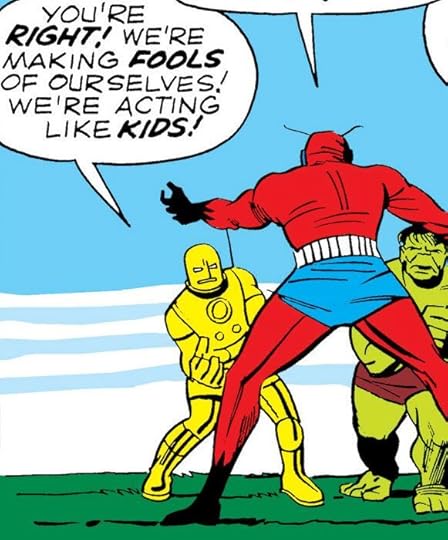
Thor's nemesis Loki is imprisoned, but Loki's magic is unbound and he uses his power of illusion to cause the Hulk to be hunted. Rick Jones, Hulk's teenage sidekick, tries to contact the Fantastic Four for help but instead reaches Thor, Iron Man, Ant-Man, and Wasp. They all converge and eventually the misunderstanding with the Hulk is cleared up; the five heroes agree to form a tentative team, named the Avengers by Wasp. Eventually the Hulk leaves the group and Captain America makes his first Silver Age appearance, becoming a core member. The Avengers go up against notable antagonists for the first time in nearly all of these first ten issues, such as the Sub-Mariner, Kang the Conqueror, Zemo and his Masters of Evil, Wonder Man, and Immortus.
Stan Lee and Jack Kirby finally begin nailing it as they bring all of their independent heroes together into one group to fight legitimate threats that are greater than any of the individuals could deal with. Though the action-filled panels can only briefly focus on one Avenger at a time, the switching off between the various Avengers and their occasional interactions produce issues that are greater than the sum of their parts. The continued inclusion of Rick Jones as Captain America's mostly useless sidekick and the gender stereotyping of Wasp are my only gripes, though these elements are typical for their time and easy to overlook. The best examples of Silver Age Marvel fun I've read so far.
Mighty Marvel Masterworks: The Avengers Vol. 1: The Coming of the Avengers collects issues #1-10 of The Mighty Avengers.
I last read this in 2020 but I traded in the hardcover for this more compact edition. I graded it a little harshly last time for some reason. I enjoyed it quite a bit more this time.
Stan Lee scripts these issues and it's vintage Stan Lee, for good and bad. Jack Kirby draws the first 8 issues and Dandy Don Heck draws 9 and 10. Highlights include the formation of the team due to Loki's interference, Hulk quitting the team, battles with Hulk, Namor, the Masters of Evil, Kang, and Immortus.
As with last time, I felt The Avengers were a little overpowered at the start with both Hulk and Thor on the team. Avengers #4 was still my favorite issue. Stan Lee's dialog didn't irk me as much as it did last time. Kirby is still The King. I enjoyed this way more than the Thor masterworks I just read. Four out of five Silver Age stars.
I love these Marvel Masterworks. The Avengers, Vol 1 contains the first 10 issues of the Avengers, From way back in 1963 I believe it was. I think as a young reader I did not actually start with #1, but probably around issue #18 or so. I am sure I have these tales before from somewhere, either an old Marvel Annual (for 25 cents) or such.
Classic stories with classic heroes and villains. Somewhat simple by today's standards, but these were the issues that started it all for the Avengers and for Captain America (into the 60's from the dark days of the 40's/50's).
Jack Kirby was everywhere for Marvel in those days, as was Stan Lee.
I read this via Comixology Unlimited and have already downloaded Vol 2 of the Avengers, with issues #11 thru #20. These stories bring back many memories of those early days at Marvel!
The beginning adventures of The Avengers! I really enjoyed reading how the heroes worked together as part of a team. Plus seeing how loyal and caring they were, sacrificing their own safety for their team members. Overall, definitely worth reading to witness the origins of one of the most famous teams ever!
This book is a book that really shows its age. And that's not to say that I didn't enjoy the book, because I did. I like the older drawing style and seeing how the team started and all of that.
However, for the first three books, Hulk was pretty much their enemy and the "bad" guy. And then he kind of disappeared from the books. It's also hard to follow sometimes, because an entire story line would happen in a different series (such as the Iron Man comics) and you wouldn't have any sort of frame of reference in this anthology. At the time, it was probably fine, because if you were buying one, you were buying them all and comics were cheaper. But, now, it's a style that doesn't work so well.
You also had the characters CONSTANTLY narrating their actions. "I'm the Mighty Thunder God, Thor and now I'm going to take my mighty hammer and twirl it so that a cyclone will engulf you and disable you." No, I'm not even making this up. It was pretty much an entire comic book full of that.
Also, I understand it was 1962, but good God. Couldn't the (only) woman in the group have SOME sort of important role? Wasp never did anything. She talked about how cute all her male counterparts were, she talked about make-up and she ran away a lot. I am so glad that female comic book characters aren't wilting flowers anymore (even if they are still incredibly over-sexualized.)
So did I like the comics? Well, yes, but I think I just have a hard time reading something that's so dated. I just don't think I have the ability to appreciate the comic like I should.
Ich habe die letzten Tage immer wieder ein paar der Geschichten gelesen. Es war sehr interessant, einen Einblick in die alten Avengers-Geschichten zu bekommen.
Mit den Zeichnungen habe ich mich ehrlich gesagt oft schwer getan. Ich hatte immer wieder Panels, bei denen ich nicht wusste, wer da jetzt zu sehen ist. Ich fand es auch schwierig, wenn sich von einer Geschichte zur nächsten ein Avenger eine neue Idendität zugelegt hatte. Die einseitige Vorworte konnten da aber viel helfen.
Es gibt eine Auswahl an Geschichten, wie die Avengers entstanden sind und welche Heldentaten sie erlebt haben. Oft geht es um die Geschichten hinter den Charakteren, wie sie zu den Avengers kamen und die wechselnden Besetzungen haben das Lesen vergnüglich gestaltet. Auch war in den Comics der typische Marvel Humor ausreichend vorhanden.
Ein Highlight war für mich die Geschichte um Ultron und Vision. Da ich den Film kannte, war es total interessant zu sehen, woher einige Inspirationen kamen. Und ebenso spannend war es, den Film Revue ziehen zu lassen und zu sehen, was alles geändert wurde um es in diesem riesigen Marvel Universum einzufügen.
Die letzte Geschichte war noch mal ein netter Zusatz, war es die 100. Nummer der Avenger Comics. Ich großen und ganzen gut, aber ich hätte sie nicht unbedingt lesen müssen.
Alles in allem ein interessanter Einblick in alte Comics und somit lesenswert!
This was my first real foray into the comic book world in text form. I was determined to read the original stories despite being urged to choose something more modern. I am so very pleased to have been able to find these books and look forward to continuing to read Marvel's Masterworks collection to the extent that I can. There was of course some dated language and context but the fact that the stories managed to keep me, a New Yorker engaged on my daily commute through the subway system while also eliciting some interesting glances from my fellow riders is a testament to the strength of the overall concept of heroes. We can all relate to the characters in some way as they are not perfect and we can all watch in awe as the team behind The Avengers develop their style and update costumes, hairstyles, colors, and as they feel their way through the tone and writing style in an effort to constantly engage their readers. This medium is always a work in progress and I appreciate that the Marvel team seemed to appreciate that even in the early days of their success.
After reading the first issues of Spider-Man, Fantastic Four & X-Men, The Avengers was my fourth journey with what can be called "The Dawn of Marvel". Yet it was a major step down from X-Men (published at the same time).
The writing is back again to the childness of the Fantastic Four.
Iron Man is almost never mentioned without inserting the word "transistor".
Wasp is basically a slut.
And Hulk is suddenly Don Blake (Thor).
And then he once again becomes "Bob" Banner.
My favorite bits here (both of them) featured Captain America. Interestingly, the first was published many years before "The Dark Knight Returns".
And the second was published many years before "A Death in the Family".
And now my phase one has ended, I'm on to phase two. Spider-Man, John Romita's run.
The Avengers is a pretty amazing look at the early Marvel universe. That's not just because it brings together five of their early heroes: Thor, Iron Man, the Hulk, Ant-Man, and the Wasp. It's also because it briefly touches upon others like the Fantastic Four, the X-Men, and Spider-Man, revealing most of the early Marvel universe in its glory. Meanwhile, the foes too are a who's who of the early House of Ideas.
It's rather surprising to see that the Hulk lasts a full three issues, two as a member and one more as a foe, then returns as an ally again in issue #5. It's a pretty dramatic difference from the common story that's told, that he left after the Avengers' first mission. But, that presence makes some sense, as these stories help to fill the gap between The Hulk's original short six-issue series (1962-1963) and his return in Tales to Astonish. The Hulk here is also surprisingly thoughtful, a real change from the mindless beast of later dates. Meanwhile, foes like Loki and the Sub-mariner make these early comics interesting (and the Lava Men less so). In fact, the introduction of Captain America (in #4) and the reuse of Sub-mariner both help to remind us of Marvel's Golden Age origins, which are all too often swept under the rug.
However, The Avengers really take off in issue #6 as Baron Zemo makes his debut. Though the Space Phantom (in #2) was a new character, it's Baron Zemo and his Masters of Evil that are truly the Avenger's first notable foes, and the first notable creation in the comic. It's fun that he has two different teams in two issues: Black Knight, Melter, and the Radioactive Man in #6 help to bring together the rogues' galleries of all the heroes (though the Wasp totally doesn't get a villain of her own), then they're traded out for the Executioner and the Enchantress in #7. Their return, with the new Wonder Man in #9 truly locks them in as the Avenger's great foe (and is a strong story for Simon's memorable sacrifice).
Meanwhile, the Avengers' two great time-traveling foes also appear. Kang, in #8, comes off better. He's just a crazy world conquerer, but his background as Rama-Tut is there from the start. Immortus, in #10, seems like much smaller potatoes. He actually appears asking for admission to the Masters of Evil, then runs around doing what they say, like he's a minion. Even his powers seem mostly like a Kid Eternity knockoff. Ah well! He'll do great things in the future.
A lot of these early comics have a certain childlike quality to them that's somewhat endearing. The Masters of Evil running around spreading Adhesive X in #6 is just so bizarre, as is the Space Phantom's strange quest to beat up the Avengers in #2. It's a reminder of how primitive these comics were in their early days.
One problem in these early issues: the treatment of women. They're written horribly by Stan the Man. The Wasp is constantly a'flutter at every man she sees, when she's not thinking about shopping. Jane Foster only has eyes for Don, while Enchantress goes gaga for Thor. Sue Storm is more interested in fashion shows than problems. Then there's cringeworthy lines like the one where Hank yells at Janet that she'll type his notes if she wants to go on a particular trips. Hank the future abusive husband is right there from Day One (but sadly on Day One it's just a reflection of '50s culture). Janet helping to save the day against Kang would have partly made up for this if not for Hank's doofish response: "Wasp! You did it! I'll take over now!"
Of course, they're not the only ones who are one-dimensional. Steve constantly obsesses over Bucky, while the motives of the villains rarely go beyond beating the Avengers or conquering the world. Though much has been said about how the Marvel Age introduced real characters with real problems, that depth really isn't on display here.
Nevertheless, this an intriguing comic both for the joy of its bringing together Marvel's heroes for the first time and for the inventiveness of new characters who would last for decades.
In an attempt to recreate the success that Fantastic Four had Marvel thought it wise to start another "team comic," this time consisting of the pre-established heroes Iron Man, Hulk, Thor, Ant/Giant-Man, Wasp, and, eventually, straight from the golden age, Captain America. Equally uninspired are the villains in these early issues. Most of the time the Avengers are just chasing around the Hulk, who is more a villain than an actual member. Plots play out similarly, with a Tolstoyan amount of writing despite the issues being 90% action.
The main problem with these crucial but lackluster formative issues is that unlike in the Fantastic Four comics or in the concurrent X-Men, the Avengers as a team lacked chemistry between its members and lacked an interesting dynamic that holds them together. FF was a family, with interesting family drama. The X-Men were young, outcast teenagers, with an interesting heroes-in-training element. Each team relied on each of its members abilities, individuals combining into a greater whole. The Avengers are a group of the strongest heroes there are, but they lack personality and none of these issues match the quality of each hero's respective solo adventures. The Avengers rarely use teamwork, instead preferring each member to work more or less alone. It seemed like there was interest in the idea that this could be a team that doesn't get along and are so strong individually that they fail to understand the concept of teamwork (evidenced mostly by the mistrust of the Hulk) but it never really explores that. There isn't enough time to spend with each individual character so it instead feels like you're not really seeing the potential of any character at all (the useless Wasp perhaps has the most personality but even then it's poor, amounting to little more than an obsession with Thor unmatched by even that little girl from Adventures in Babysitting). It's just a big blur of red, yellow, green, and blue figures attacking some equally colorful baddie with no interesting drama, characterization, or story in-between. If Fantastic Four's premise was "superhero family," and X-Men's "superhero teenagers," then Avengers's is "superhero superheroes."
The Avengers of course went on to get better (the Masters of Evil were perhaps the first sign of this), its roster constantly changing and proving to be one of the most significant teams in comics history. These early works are interesting to look back on, and Kirby's art here is solid as always, but nothing ever seems to quite come together, as is often the case with premieres that carry such a large and ever-growing legacy on their floppy, four-color processed shoulders.
Favorite issue(s): Captain America Joins... The Avengers! (#4) Best Cover Art: The Coming of the Avengers! (#1)
Introducing Zemo and his Master's of Evil was my favorite in the bunch, though the later stories with them got a bit old. Still fun though. The story with Kang was also devine.
The characters were all white, which I didn't care for. Also the women weren't all that well portrayed either. But it was the sixties and not everyone was that evolved back then. Though from my understanding - I'm new to the comic world - that this changes considerably year after year. The only female worth a damn was Enchantress, and even she had to have an element of romantic thoughts. But anyways. The stories were well-written for the time, in that they over explained (yes I know kids were the key audience but most kids can pick up on context in a story) and were dated. But despite their flaws and the clean endings I had a ton of fun.
A classic begins. Its very gung ho and action orientated. I love the way the women character spend half their time flirting or swooning at the men. It makes you wonder what the Wasp saw in Giantman in the first place. Not much detailed character stories, the Hulk joins and then becomes the bad guy. Nothing really indepth on the individual issues.
'Foundational' first ten issues. Lee/Kirby continue to consolidate plots and interactions: the team finds that they must work with each other to confront some of the deadliest super villain's in the Marvel Universe. Without an existing relationship before the founding of the team (contrast with the FF) the Avengers must put aside ideological disagreements and join forces to protect the world.
1. It's interesting that originally, Captain America had no superpowers, he was just a really good athlete. 2. The horniest woman in Marvel comics is not Sue Storm. It's Janet Van Dyne. 3. Baron Zemo being unable to remove his mask because it's literally glued to his face is funny as hell.
The early imagination and sheer ebullience of Lee and Kirby's most fertile period is definitely on display here. The ideas come fast and furious, although they are rarely explored in any detail. That must wait for some future date. Seeing the history of these characters was great, but my enjoyment in reading this was continually dampened by the absolutely outrageous sexism that pervades this book. I realize this work is a product of its time, but cheese and crackers, it's unbelievable! Literally every line out of the Wasp's mouth is some boy-crazy garbage or remarks about her makeup/clothes. The same ridiculousness infects Sue Storm and even the Enchantress when they make appearances. This book reads like the eager and fevered imagination of teenage boys, and I guess they brought their conceptions of women with them.
Crucial piece of Marvel history, with inconsistent story and art. Legend has it that the first issue was slapped together and rushed out because the Daredevil series was running late--and it shows. #1-3 are shaky, but things pick up once Cap is introduced in #4. Around that time, Kirby's art improves in leaps and bounds; Chic Stone and Dick Ayers take over inks and the results are gorgeous.
Once Kirby leaves, Don Heck takes over. Never a fan favourite, Heck's figures are clear, his storytelling flawless and each panel is a complete scene unto itself. Stan Lee's writing falters in the last few issues, but it still makes for a fun read.
Overall, a mixed bag, but Lee & Kirby were just churning this stuff out; I'm sure they had no inkling we'd be scrutinizing it 50 years later.
I online-borrowed from the library and didn't read all 10 issues through, but it was fun to skip through and see the origins of the phenomenally-produced Marvel films, in all their 60's-era-youthfully-idealistic fantasy. Many parallels to the films, including: Captain America's awakening from suspended animation (they used that term) in ice, his grief over his friend Bucky, and his joining of the Avengers. The waywardness of the Hulk. Iron Man's transistor-based tech! Battles with Loki, Zemo, and others. And occasional battles with each other.
Trivia: Which character (who is featured in the Marvel cinematic universe too) came up with the name Avengers? You'll never guess. :) (Scroll down for answer.)
I love the original Avengers line up! One of the greatest hero team line ups ever. Marvel tries to create it's own version of the Justice League and then realizing they have some powerhouses on the team, Stan and Jack then created menaces that could really make them break sweat. in one of the first bits of keeping track of continuity, they realized they couldn't keep the Hulk on the team so found a decent way to write him out, while leaving the door open for him to return and replaced him with Captain America.
Larger than life heroes and villains and great locations. Just pure big super heroic action.
Pretty decent read as far as it goes being from 1963, my only real problem would be the character of Wasp (aka Janet Van Dyne) who while being directly responsible for saving the day numerous times never is given the due as a strong female character. instead Stan Lee chooses on falling back on the damningly misogynistic tropes of "boys are cute" "I wish you'd notice how pretty I am" and "I just want to go shopping". As I said, it's not bad, and Wasp is really a bit player in the bigger story, it's just a shame this level of misogyny was so commonplace in the 60's while Marvel championed themselves as somewhat progressive thinkers for their time and place.
Disappointing. This is a collection of the first ten Avengers comic books printed between September 1963 and November 1964. Heroes featured include the Hulk, Thor, Iron Man, Ant-Man/Giant-Man, the Wasp, and Captain America. For all the plotting and characterization skills of Stan Lee, we don't see much beyond the formulaic in these early adventures. My sense is Lee was saving his best stuff for Spider-Man and The Fantastic Four. Still, some of the villains are fun. And I love it when Zemo says to the Executioner, "You dare threaten me??! When all of science is at my command!!"