A stunning debut novel from the Northern Irish poet Eoghan Walls, The Gospel of Orla is the coming-of-age story of a young girl, Orla, and the man she meets who has an astonishing and unique ability.
It is also a road novel that takes us across the north of England after the two flee Orla’s village together. Here the mysteries of faith charge full bore into the vagaries of contemporary mores. A humorous, wise, deeply human and sometimes breathtaking work of lyrical fiction.
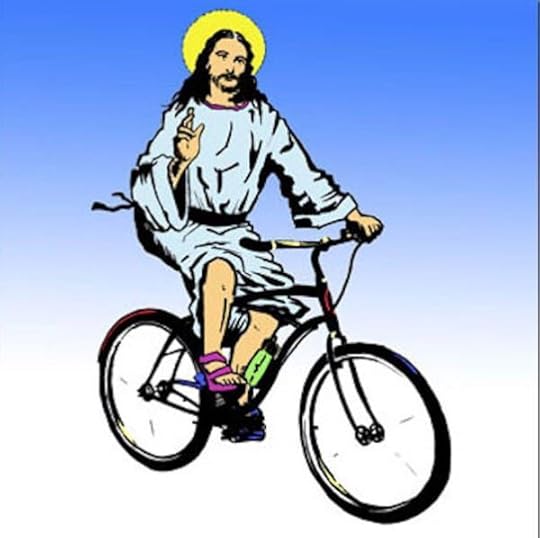
Jesus, take the wheel . . . or at least the handlebars.
Fourteen-year-old Orla has been unhappy at home ever since her mum died. Though she dotes on her baby sister, her dad's drinking is getting out of hand. She's in the midst of plotting her escape when she meets a homeless man who claims to be Jesus. Yes. The bloody Jesus Jesus. Her response? "Fuck off and leave me alone." But Orla discovers that the strange man has an unusual talent, and soon this girl, who's obviously never read Pet Sematary, and Jesus are on stolen bicycles headed for Liverpool where Orla plans for him to resurrect her mother, and Jesus hopes to be more popular than The Beatles.
I enjoyed this rather oddball read. Though it deals with some serious topics, there's a humorous, absurdist tone hovering in the background, and I hope it's not a spoiler to say that it ends on a melancholy but hopeful note. I'd recommend this to anyone looking for something unusual.
Thanks to NetGalley and Seven Stories Press for sharing.
Orla’s voice is wild, funny, and dark and her bike adventure keeps the reader transfixed until the magnificent ending. More than an engagement with complex theological arguments, this is a gritty but optimistic coming-of-age tale about the magical and mysterious in the wake of death. Eoghan Walls brings to life a heroine—covered in mud, enchanted by circus animals, emerging sputtering and running from the canal—with a poetic command of language that’s a testament to his north of Ireland origins. The Gospel of Orla is one of those rare debut novels you’ll want to tell all of your friends about.
I thought I would like this book more, but in the end, it was mostly ok with some parts that worked more than others. Thanks to Penguin Random House for a free advance print copy of this book.
Walls’s very peculiar novel begins with his 14-year-old protagonist, Orla McDevitt, attempting to make a nighttime escape from her troubled home. She wants to get to Liverpool and cross to Northern Ireland. Aunt Sinéad lives in Drumahoe and the girl’s mother was recently buried there. Orla’s mum died of esophageal cancer two months before, and the McDevitt house has been in chaos ever since. Mr. McDevitt drinks heavily, the house is squalid, and Orla is often left to care for her two-year-old sister. At school, she’s doing poorly. The teachers have cut her a fair bit of slack, but they know her home life is unstable. The family is on the radar of child welfare services, and the children may be taken into care. Fear, anger, and grief are fuelling Orla’s plan to run, but there may be other factors at play as well. Soon the girl’s hope for a miracle will become her main motivation for leaving home.
Orla is an unpleasant, even unsympathetic, protagonist: foul-mouthed, egocentric, and a shoplifter. Her best friend, Jamie, was recently suspended from school after a bag of stolen iPhones was discovered in his locker. Orla’s missing him now because the ferry trip to Belfast can only be funded by selling what she’s nicked and it’s hard to work as a solo shoplifter when you’re used to being part of a dynamic “mad-dog” duo. Food for her trip must also be stolen. That, too, is something of a challenge, but Orla meets it.
Based on the elements I’ve described, I thought I was in for a realistic, somewhat gritty tale about an angry, grieving adolescent girl. I was wrong. This is a surreal narrative I could make little sense of.
Walls introduces an unexpected character—Jesus. He appears as filthy, foul-smelling homeless man, entirely naked but for a blanket. He’s come back to guide humanity, he says, having emerged from a box at the bottom of the sea where many bodies of the dead lie. He is now living in a derelict barn preparing for his mission, trying to find the right location to start, the place most in need of his message. He intercepts Orla as she attempts to make a late-night escape by bike. Why he does so is not clear. After scrabbling out of the canal into which she and her bike have fallen, the frightened girl is forced to return home.
A few nights later, her attacker—this strange man, Jesus—returns the bike to her home. Angry but curious, Orla follows him. This is when she discovers where he lives, who he claims to be, and the supernatural powers he possesses. Having watched Jesus perform miracles, Orla decides that he needs to accompany her to Northern Ireland. A fair bit of the novel details the challenges of Orla and Jesus’s journey, which becomes nightmarishly strange.
I honestly cannot recall the last time I read such a weird book. When I began it, I wondered if I was getting a novelistic variation on the 1961 film Whistle Down the Wind in which three children discover a man in the family barn and believe him to be Jesus Christ. (He’s actually an escaped murderer.) Later, I wondered if the author was presenting a case of folie à deux, in which a grieving girl buys into the delusions of a schizophrenic man, possibly a refugee, claiming to be the Son of God. In the end, the only conclusion I could reach was that this was the story of a psychotic break.
The book ends very abruptly. I flipped ahead, thinking my digital advanced reading copy must be missing pages. Apparently not. I won’t lie: I was relieved. By that point, enough was enough.
I’m afraid I cannot recommend this novel. I’m surprised it was actually accepted for publication. Maybe I’m missing something. If someone figures out what that is, please let me know.
Thank you to Net Galley and the publisher for providing me with a free uncorrected proof for review.
From the first paragraph, this debut novel grabs the reader with its voice as well as its dramatic plot setup:
“I am sad to go but it is time now and there is no point in hanging around any longer. I leave my phone under the pillow. I don’t leave a note because that is just for suicides…Last time they got me at the station but at least I hadn’t bought a ticket so they don’t know where I was going so they won’t know where I am headed now.”
The narrator-runaway is 14-year-old Orla McDevitt, whose life in the north of England, never very stable to begin with, was upended when her mother died of cancer two months earlier. Living on welfare with her alcoholic father and two-year-old sister, Lily, Orla spends her days surfing her phone during classes, shoplifting, and avoiding nearly all offers of help or friendship.
Her escape plan is to bike southward along a route to Liverpool that she found in a tour book, then take the ferry to her aunt’s house in Ireland. On her next attempt to run away from home, Orla is accosted by a filthy, bearded man wrapped in a blanket who claims to be Jesus. When she tracks him down the following evening, she sees him pick up a dead duck, bite his own arm, put the duck’s beak into his mouth – and then, somehow, the once-dead creature is flapping its wings and honking.
And Orla wonders: If this tramp can bring a duck back to life – if he really is Jesus – can he also resurrect her mother?
Suddenly, this book has shifted from Trainspotting to One Hundred Years of Solitude.
What grounds The Gospel of Orla in the world of real-realism, not magical realism, is Orla’s wonderfully vivid voice. Author Eoghan Walls is an award-winning Irish poet, and Orla’s stream-of-consciousness sings with a carefully crafted combination of music and the genuine workings of a teenager’s mind:
“But they know me at Lancaster but they don’t know me in Morecambe and it is only what a ten-mile walk which I reckon I could do in one night all I would need is more cash but actually less provisions so it balances out.”
As well, Orla is fearlessly honest in describing what she encounters, calling on all five senses – sometimes, perhaps, beyond what a reader wants to stomach.
The book certainly has its flaws. You just have to accept that there’s no explanation for the Jesus character. The plot is mainly predictable, with some surprise turns – including some graphic ones. And Orla is equally predictable, as the standard alienated, working-class youth. But her wonderful voice and the mystery of her experience make this novel a compelling read. (Adapted from my review in the New York Journal of Books https://www.nyjournalofbooks.com/book... )
This was an interesting one. A teenage girl plans to run away after the death of her mother but the plan changes a bit when she runs into Jesus sleeping in a barn and asks him to tag along. A coming of age written in prose that felt a bit clunky, it was hard for me to find rhythm.
On the flip side, the unique writing gave our teenage protagonist a strong narrative voice. Her thoughts and feelings came through exactly as is, sentence structure be damned.
This is a coming of age story about 14 year old Orla and her grief when her mother dies. She plans to travel to Ireland where her mother is buried and ropes in a homeless man called Jesus, to assist her.
Walls uses magic realism to tell a compelling and at times weird story of a young girl's visceral grief. There are some beautiful scenes, humour and some just downright WTF is going on! Certainly not predictable and as the title suggests some biblical influences and spiritual questions. I enjoyed the writing and sought out Walls' poetry. Encourage all to do the same. He definitely has a way with words.
4.5⭐️
Thanks to #netgalley and @7storiespress for the ARC ebook in exchange for an honest review.
I gulped this book down. Orla's breathless adolescence kept pulling me to keep reading. To keep hoping that she would slow down enough to see the people around her who wanted to help. And to learn that you can't outrun (or out bike) grief. It's a beautiful, magical novel. I'm so glad I got to read it.
This debut novel has such an original, compelling voice in Orla, a grieving teen left behind with her alcoholic but kindly father and her little sister, Lily, after their mother dies of cancer. Orla doesn't have a sense of closure or the means to fully express and deal with her grief; she acts out at school and at home. An Irish citizen, she plots to escape her town by biking to the ferry that will take her from Liverpool to Ireland to live with her mother's sister, Sinead - until she crashes her bike into a tall, bearded man near the river. Her bike is ruined and, furious, she asks for his name. "Jesus," he replies. What follows is at times sad and at times hilarious: a coming-of-age tale that defies convention, with Orla and this Jesus - sometimes co-conspirator, sometimes nemesis - fleeing together. Is he mentally ill? Is he the resurrected Christ? Orla never really knows, and the reader doesn't, either. She only knows that his behavior - preaching to strangers, healing sick birds and animals with his blood, making grand pronouncements about heaven and eternal life - is completely foreign to her. She needs his help, though. If he can bring animals back to life, then what about her dead mother? There is a lot going on in this short novel, which is very visceral, letting us see and feel and smell all the experiences that Orla goes through in her quest. At times it's a seemingly misguided quest, but it's a magical, hopeful one as well. I was really impressed with the ability of the author, an Irish poet, to get under Orla's skin and share her unique personality with his readers. You won't forget her when you've finished reading.
*I was pleased to receive an advance review copy from Penguin Random House and Seven Stories Press in exchange for an honest review.
Christ on a bike! This is an original, engaging, and touching novel about a troubled 14 year-old girl missing her late mother and dealing with school, her father (who is drowning his sorrows regularly) and helping care for her baby sister. She is about to run away from home when she meets a man who calls himself Jesus. 4.5 stars rounded up.
The premise of the book was so creative, but its execution was an epic failure. I absolutely hated the writing—a gnarled mess of words with no punctuation, no meaning, and no beauty. The character development of the protagonist was decent, but everyone else felt one-dimensional, including Jesus. I can understand choosing to only develop one character, especially in such a short book. But it felt so odd to end Jesus’ story so abruptly given the personal conflict/turmoil he had been in just pages before. He just got dumped off the story—the end. It was ultimately a pretty frustrating read because it could have been so brilliant.
Wowie, where to start; I still don’t know what I read and I mean that as the highest compliment! The best way to describe this book is if pet semetary, bones and all, ladybird, let the right one in, and the little vampire all had a weird and demented baby. This book was a thoroughly entertaining and DEMENTED little read.
Macabrely funny. Twisted. Weirdly touching. Sentimental but not overly saccharine. Unpredictable. The story takes so many forms and in the end even though the ending is different than what it had been building up to it weirdly made sense. Because of how unpredictable it is there were moments I was questioning what would happen next and the story would just kept twisting and morphing into something else. Completely subverted every expectation I had for it. The segments felt just right and the key plot points felt like they lingered on for just the right amount of time.
I feel like it’s also important to talk about the main character for a second because she is the reason for the season. At first, I was really hesitant about her and about the book by extension. It had reminded me of some other popular YA novel characters and some of Ottessa Moshfegh’s characters for the wrong reasons. Quickly, however, I realized this wasn’t the case and was more complex than my first impression of her. She is someone you can’t help but root for and that’s often an issue I have with YA novels. To circle back to Moshfegh, this book feels like what Moshfegh thinks she’s writing but actually does it right! He actually writes a realistically “shitty” character but gives his character enough life, substance, wit, and writes her in an empathic light that it still actually lets me enjoy reading the book and not just feel shocked for the wrong reasons. The voice of the narrator the author got spot on and by the end it felt like the entries of a girl’s diary which felt very appropriate and I enjoyed that; the author knew his character very well and it translated in every page.
Also, it’s important to note that this book is a road story and a bildungsroman. I have a hard time getting into those kinds of stories in the past because they often dip into cheesy or overly saccharine territory but this book never comes close to doing that. It easily felt like the most fun road bildungsroman I’ve ever read and was why I devoured the book in a day and a half.
I have nothing but raving reviews for this book, the only reason I didn’t give it a perfect score was because it’s not the most revolutionary life changing perspective altering story I’ve read. However, not every book I read needs to be that and that’s okay! It was still so much fun and it ends up ranking as my second favorite book I’ve read this year <3
"You are the Son of God so get up and walk again. [...] All I have are memories. Good bits and bad bits. That's all I have. I don't want to give them up."
So you wanna meet God, kid? Because Orla didn't. Orla wants to runaway to Ireland, where her mother's family is, and she has the plan. She's prepared for the roads, and boats, and bad weather conditions, yet for what she is not prepared is peculiar meeting with strange men that tries to steal her bike. This one unusual guy will shatter all her preparings (with which she won't be happy), but that's not how her story will end.
The question mark for this book is accurate. What is this story? Starts blurry and finishes even less clearly. Orla's story was written by a poet, which is incredibly visible, but it's this kind of poetry that's weird and confusing, the one that's not very much liked by people. We don't like things hard to categorise, and Orla is everything but easy to categorise. Behind her runaway plan lies conflict with family, grief, loss, feeling of being los, alienation and questions. A lot of questions about the way life goes.
At first it's just a book, a strange one for sure. It doesn't show its true conflicts for a very long time. There is one peculiar girl that wouldn't fit with reader in real life and one depressed Jesus eating birds, but then there is family abuse. Religion trauma. Fear of world going to fast. The deal behind life and death. It's not perfect, but it sure is a try to get your mind wrapped around the idea what if religion was as literal as we always take it. Is the world ready for what it knew since the very beginning. How hard is to say goodbye, especially for people that felt like one wasn't needed.
I was thrown into the eye of a conflict and left with no answer. And so I'm not sure how to feel about it. But there is this interesting feeling inside me, like if Orla has stolen something from me like she steals some things through the whole book. And I think like I need to thank her for that.
A touching, jaunty coming of age story with dark and humorous overtones, The Gospel of Orla is right up my alley. I thought Walls' lyrical prose really worked in helping establish a voice and presence for her young nearly-adult main character.
If you're interested in authors who aren't afraid to take risks in the pursuit of creating something new and exciting, I'd recommend this read for sure.
Thanks to NetGalley, the author and the publisher for the digital advance copy in exchange for an honest review.
Picked this up on a whim from the library and really appreciated the book.
It’s written in very vernacular Irish prose but ultimately found the story to be a raw and gritty look at a girl coming of age in a hard life, encountering Jesus, and like many people at a crossroads of what she wants to use Jesus for vs who He actually is and then encountering a glimpse of that truth in a subtle yet profound way that has an impact though not all tied up neatly in a bow. In other words a religious encounter happening in the most non religious way possible.
I know that probably makes little sense when read, but I’m glad I picked this one up.
The Gospel of Orla focuses on Orla’s grief after her mother dies and her father struggles to put their family back together. With a decent amount of magical realism, Orla shares her dark thoughts, frustrations of being a teenager, and the conflict between being a caregiver and wanting to be cared for.
This book is called lyrical for a reason and should be emphasized because if you don’t like quasi-whimsical, prose-like language, this book is not for you.
The book is a really interesting take on what would you do to get your loved one back.
The premise of this books was intriguing and I thought I’d like it more than I did. I found it to be a wandering a storyline without the depth I was looking for. The characters were also a little one dimensional for me. I found myself trying to finish the book rather than wanting to finish it. Thanks to Seven Stories Press for the print ARC.
I have no idea what I just read, but something kept me reading. Maybe it was because the girl was running from her grief, maybe from everything going wrong with her life, just to discover that the further she ran, the worse off she was.
I was so excited to read this book and it unfortunately did not live up to any of the expectations. The blurb and beginning make promises that are never fulfilled and nothing is resolved in the end. With the promise of “magic and miracles” I expected so much more. I’m just going to list all of the issues:
- Certain characters are not fully fleshed out (Jamie, and Jesus most especially)
- Storylines begin in such interesting ways and then are completely destroyed in lazy mediocrity (Jesus return to the earth vs where Orla leaves him, Jesus’s magics skills and the possibility the Orla could have obtained these skills, Jesus’s singing that was only touched on once, the storyline of the elephant, Jamie’s storyline needing more)
- Jesus is such a limp dick of a character like damn he had nothing going for him
- The fact that the story was pretty much a very detailed account of bike routes in the UK
- The fact you never really know what the characters look like and then there is a slight description of them (Jamie being short) that does not match up with how you originally saw them and should have been addressed sooner
Just overall a failure to live up to expectations and I’m so sad about it. At least it was fast and easy to read
A troubled teen plans to escape her precarious home life by bike, but in mid-flight crashes into Jesus, who is having troubles of his own finding an audience for eternal salvation in a cynical, modern world.
Befitting this Northern Irish poet's roots, the language is jagged, the scenery flies, and I’ll tell you this: I doubt you’ve ever been here before. I was genuinely sad to have finished it, because I know this is the only place like it.
Thanks to Bex at @booksaremagicbk who wrote the "shelf-talker" (those little tabs that hang off the shelf where staff members can recommend personal favorites) -- it sold me on a day I SWORE I wasn't going to buy anything.
3.75*?????? full disclosure i picked this up because i saw the name orla on the cover and i really like that name so i decided to read it not particularly knowing what it was about and was very pleasantly surprised! the main character (a 14 year old girl from the u.k.) is written with such strong voice! story is an absolute whirlwind and very immersive. i feel like it cut off quite abruptly at the end, but other than that i really enjoyed it!
i definitely thought i would like this book more. the character arc just felt forced and rushed and also didn’t really happen and the ending was really bad no loose ends were tied up but that wasn’t done in a way that was beneficial to the story. this has left me very unsatisfied and i would have wished this had been done better because the concept itself is interesting.
This book is written as if by a 13-year-old, so rid yourself of the notion that this novel will have powerful, lyrical prose. It does not. It was still intriguing and at times incredibly weird. It's a short, fast read (unless you hate teen girl speak) that's at least worth picking up.