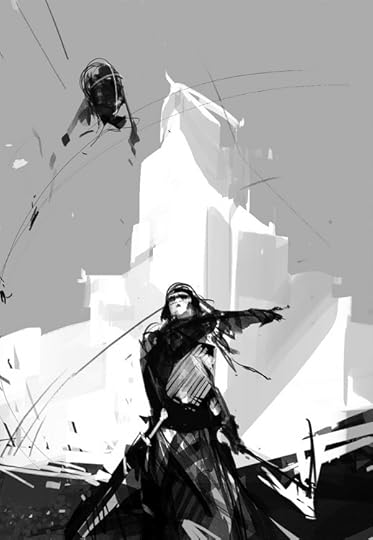
Le mani di Cete sono sporche del sangue dell'uomo sbagliato. Uccidendolo, ha salvato persone innocenti. Viene investito della massima onorificenza, ma nel contempo viene condannato all'esilio. Divenuto un mercenario, gira per terre devastate, in cerca di un luogo da chiamare casa. La Colonia degli Antach sembra un buon posto dove ricominciare, ma il fato ha altri piani. La Colonia di Antarch sta per essere distrutta. Barbari, traditori e usurai cospirano nell’ombra per ridurla in cenere. Se Cete fosse saggio se ne andrebbe. Ma ci sono forze che lo spingono a restare. Una ricamatrice cieca, un mantello dai colori del vespro. Elementi che compongono un arazzo che dev'essere preservato. La posta in gioco è più alta della sua vita. Saranno solo volontà, sangue e acciaio a frapporsi tra la colonia e l'abisso...
Sunset Mantle is my first venture into Tor.com’s impressive line-up of novellas from their brand spanking new publishing arm. It wasn’t originally on my to-read list, but after hearing it described as a pocket-sized epic fantasy, I decided I had to take a look after all. The idea of a story like that, packed into just over 190 print copy pages really intrigued me.
The book’s protagonist is Cete, a former hero now in exile. Dismissed from his command both in honor and disgrace, he wanders the Reaches in search for a new place to call home. His travels lead him to Reach Antach, a settlement doomed to fall in the coming storm of infighting among several factions. But before Cete can turn on his heels and leave, a chance meeting with a blind woman in her shop changes everything.
Hanging there on display is the sunset mantle, beauty and light embroidered in cloth. The fine craftsmanship touches Cete in a way he cannot understand; all he knows is that he must have it, and if he can’t, he would want to commission a garment for himself from the shopkeeper and weaver, Marelle. To afford the commission and to stay in Reach Antach, Cete would have to find employment, and to find employment, Cete was going to have to go back to doing what he knows best. Once a fighting man, always a fighting man. However, being in the army also means being embroiled in the politics and schemes of the various clans trying to destroy Reach Antach, and even as his relationship with Marelle deepens, Cete’s fight eventually becomes more than just the mantle and even more than love.
This story left with mixed feelings. On the one hand, I am beyond impressed with author Alter S. Reiss’s marvelous success at laying out Cete’s journey from outcast to legendary warrior, all within this very slim volume. Sunset Mantle is not a “true” epic fantasy per se, with no magical element, and nor does it span a gazillion kingdoms or have enough points-of-view to populate a small village. There is, however, enough political intrigue to fill two fantasy worlds. This degree of complexity is not something I would have expected from a novella, and it also makes the scope of the story feel much, much bigger than the thin slice of what we get to see. Reiss gets a lot more accomplished in under two hundred pages than it takes some other authors to do the same thing in novels three to four times as thick. It does have a way of making you stop and wonder just how much gratuitous or unnecessary flourish goes into some of these doorstoppers.
I also really liked Cete as a protagonist as well as the nature of his relationship with Marelle, which goes much deeper than a romantic union. The trust and honesty between them is a rare thing to find indeed, even between two lovers. Cete sees Marelle as his equal, taking her guidance and respecting her need to do what she believes is right, even if it means letting her put herself in harm’s way. Cete also treats his own soldiers with that same practical respect. He is a man of honor and duty, as evidenced by the loyalty he shows Reach Antach, even though he came to them as a stranger and outcast. Other highlights include the battle scenes, which are quick but powerful, making the most out of the restrictive page count.
That said, the book wastes no words in establishing the situation surrounding Reach Antach and the city clans. Blink, and you could potentially miss something important. Ironically, it made Sunset Mantle a slower read, and it doesn’t give you much time to chew on the plot or characters. In fact, most of my questions came later, after I had finished the book and had some time to mull over what I just read. It made me realize a lack of background information made the story a little harder to understand, and sometimes that uncertainty or need to re-read a passage or two distracted from my enjoyment and prevented me from being fully engaged. Simply put, the overall style of the narrative begs to be savored, but the format is not that well suited for it.
Still, there’s something to be said about something as special as Sunset Mantle. It’s true I would have preferred a bit more breathing room, but that is not an uncommon complaint from me when it comes to novellas and short fiction. I’m usually very picky about this format, which is probably why I don’t read as much of it as I should. All things considered, I was actually quite pleased with this novella, which for me is saying a lot.
Sunset Mantle is an epic fantasy novel written in novella form. Also, Sunset Mantle is a high-decibel reminder how, when it comes to epic fantasy, writer doesn’t need 800+ pages to tell a captivating story, build a magnificent world and develop a society eager to play politics, wars, intrigues and mysteries, while showing all advantages and flaws one can face in honoring his duty. All of which written with incredibly gifted prose in less than 200 pages long book.
We’re not introduced with character’s past more than it’s necessary for us to understand his current state, his position in the world that is crumbling, and the city that’s quietly and unknowingly awaiting its imminent peril. Little we get of our main protagonist’s longing, our wanderer exiled veteran warrior Cete, when we meet him in his search for a place to call home. And yet, with author’s carefully implemented formula “less is more” we are already emotionally invested in him.
Without burdening his readers with Cete’s morals and his apparent empathy for citizens of a settlement he’s passing by, in a very short chapters, narrative is carefully constructed so that we could subtly understand why he came from one decision to the next. Why he chose to stay and share this short-lived future with a town that is already doomed to perish.
“Because of an embroidered mantle, and a blind woman’s smile”
Which leads me to Marelle, our main female protagonist and probably best most believable female character written in epic fantasy. Fierce, smart, trustworthy, loyal and brave. Her presence is never overwhelming to contrast or challenge Cete’s, nor is she some kind of a half measure waiting to fill or be filled with someone else’s half.
“I suppose it is the role of a wife to urge caution, to try to convince you to give up fighting, to remain at home and to live to die in bed. Is that what you expect of me?” Cete was silent just as long. That was what was expected of the wife of a fighting man, just as Marelle had said. The men in the ranks were supposed to leave behind women who wept at them to stay, who needed lies and cajoling before letting their men march out to war, and who cared less for war and honor than for home and hearth. “Marelle,” he said, finally. “I do not wish you to be anything other than what you are.” “Good,” she replied. She let go of his hand, stroked his cheek. “I cannot be. And neither can you.”
Their relationship that goes beyond romance, beyond that of two lovers and spouses; it’s a relationship of mutual understanding, compromise and sacrifice. Sharing a life. It’s beautiful in its simplicity. When one fights like an animal to protect the other, to support each other, even when they disagree, willing to share consequences of other person’s actions.
And this is supposed to be militaristic novel. Believe me when I tell you, battle descriptions are vivid that any avid reader of military genre would very much enjoy this book. So much achieved in less than 200 pages.
“If you think that I have not faced the choice of an easy death or a difficult life,” said Marelle, “you are a great fool. I can no longer see the sun rise and set; I have never seen your face. But I am not a fighting man, and I am not so perfect in my obedience to the law. I will not hear Radan speak to me over your corpse, Cete. If you will not let me die upon the field, I will die in my house, amidst the flames.” “I would have you live.” said Cete.”
Esta es la primera novela que leo del autor. Me llamó la atención sobre todo por su extensión, pues cuenta con menos de doscientas páginas.
La he leído a un ritmo pausado y creo que ha sido lo mejor que he hecho, si llego a leerlo de una sola pasada, creo que me habría pasado factura y no habría sabido disfrutarla.
« And the clouds have not yet reached the horizon. And when they come, we will regret this ».
La novela está en inglés y no se encuentra traducida al español. En cuanto a su nivel de idioma, yo lo enmarcaría en un avanzado, B2-C1. Admito haber tenido algunos problemas de comprensión en algunas partes de la novela que he tenido que releerla hasta tres veces para entender el contexto. Además, cuenta con un vocabulario especifico. No la consideraría una novela para empezar a leer en inglés.
«It was glory like unmixed wine, like the sun when it touches the peaks of the mountain, like the first rains of Winter on a dry and hungry land»
Ahora en cuanto al argumento, debo admitir que me ha gustado y el hecho que la historia se fuese cociendo a fuego lento ha sido otro punto más. No me ha enganchado, pero sí que la he disfrutado.
«But while it was fare more likely to mean his deathm he could not leave Reacg Antach, could not walk away from the glory of that mantle of hope of having something that fine for himself. »
Los personajes, sobre todo el protagonista creo que está bastante bien creado, la única pega que tengo son los secundarios, los cuales a veces sentía que estaban de decoro para iluminar-oscurecer el camino del protagonista.
« But when the time came, a reckoning would be paid ».
Ahora, el problema que tuve, si se le puede llamar así ha sido el worlbuilding, el autor nos mete de lleno en un mundo de fantasía medieval. Me han faltado explicaciones sobre el funcionamiento-política de las aldeas-ciudades pues muchas veces no llegaba a entender del todo.
Pienso leer otras novelas de este señor, siento que tiene bastante potencial.
« Because of an embroidered mantle, and a blind womans smile ».
Esta es una de esas novelas que se deja leer bien, tiene un personaje protagonista interesante, el worldbuilding no está mal, pero que se ve penalizada por una trama con demasiado rollo conspiratorio y de leyes que al final se hace un poco pesado, ya que corta el ritmo de la historia. Otro problema, es que al ser un libro bastante corto, su autor no es capaz de ofrecernos una amplia visión de los personajes secundarios, ni mucho menos sacarle mucho jugo al mundo que ha creado.
Lectura interesante, pero que ni mucho menos va a pasar a mi lista de preferidos.
I’ve always enjoyed epic fantasy (as a genre, anyway; there are probably individual stories I’ve disliked), so I was excited to see Sunset Mantle in Tor.com’s novella lineup described as such — and doubly encouraged by Jo Walton’s endorsement on the cover. Epic fantasy has such a problem of scope sometimes: you need the world to feel huge, while also giving intimacy with a handful of characters, to make both the setting and the plot work together. Sometimes that makes a book balloon out into multi-volume epics like Steven Erikson’s Malazan books, or George R.R. Martin’s Westeros novels.
So I was very intrigued to see what someone would do without a pre-established world, within the slim confines of a novella. And I think Alter S. Reiss does a pretty good job of sketching in a wider society: tribes, clans, reaches, links both economic and feudal, with politics that dictate what happens in this story while also hinting at greater complexities. There’s the ‘madding’, too — some kind of battle rage, and a system of customs surrounding it which aren’t explained fully, but which shape the circumstances of the story. And Reiss does indeed keep it to a handful of characters: really just Cete, the first character we meet, and Marelle, the blind woman whose embroidery work enchants him, and with whom he falls in love.
If military fantasy is your thing, the battles and the training are here: Cete has to work to pound his unit into shape, to make them work together (of course), and there’s two major battle scenes. I think the only battle scenes I can think of that are evoked more clearly are some in Bernard Cornwell’s The Winter King; the clash of the enemy lines is present in both, and there’s a real idea of the sweat and muck and blood and terror.
I suppose the only unsatisfying note is that we don’t know how the politics continue to play out, how Cete and Marelle weather the changes, and whether Cete ever really receives the rewards he deserves. And really, I do want to know: having got this invested in Cete and Marelle, I want to know what happens, whether they have children, and whether those children come to inherit, and — and — and —
Very competently written book, done in a style that reminded me of Gemmell. However, it's just not the sort of book that grips me (too much focus on military manoeuvres) so despite several solid characters and interesting world-building I didn't truly enjoy this one. No fault of the book, there!
A wonderful little military fantasy story worthy of comparison to Gemmell.
Cete comes to the Reach Antach at a mercenary in perilous times. The Reach is going to be acted against because it's an upstart military power and it has made unwise allies. An early encounter with a blind seamstress sparks unexpected loyalty to the Reach though, and Cete performs a feat of honor that leaves him an outcast. That doesn't stop him fighting though, and with his blind love's support he can do the impossible.
A tale of honor, loyalty and heroism against overwhelming evil forces, this is a terrific story. The world is no-magic but filled with the sort of economics and politics that any student of medieval Europe would feel right at home with. Cete himself is a great character with a noble point of view. Marelle is the craftswoman responsible for the mantle with the sunset embroidery that first catches his eye, and she is equally noble especially considering her vulnerability.
Sunset Mantle is a solid work of high fantasy. What’s most fascinating about it is that for all it’s battles and political intrigue, it’s less than 200 pages long. That’s right ya’ll. This is a high fantasy novella.
Cete is a wandering solider for hire. He knows that Reach Antach is about to be on the losing side of a war and that the smart thing to do would be to move on… but somehow, he just can’t bring himself to do so. When he sees a beautifully embroidered mantle made by a blind craftswoman, he becomes inspired to stay and to risk everything for the town of Reach Antach.
The world of Sunset Mantle doesn’t have magic, but it does have a historical feel. I’ve seen other reviewers say it reminded them of the Old Testament, but I was personally thinking of the ancient Greek city states. A small number of cities loan out the supplies and money needed to found new cities, the Reaches, which are then in debt for hundreds of years, due in part to constant warring with local tribes. Reach Antach has found a faster way out of their debt by creating an alliance with the nearest tribe, giving them the peace and prosperity needed to raise the funds to pay off their settling debt. Of course, this threatens a situation that is immensely beneficial to the most powerful cities, hence war is soon arriving.
Unfortunately, I don’t think this story was my type of thing. While it was solidly executed, there’s nothing about it that would ever draw me to reread it or even to remember it. Sunset Mantle is missing that hard to define element that makes you connect to the characters and world and become emotionally invested in the plot. Basically, it ended up feeling paint by numbers. Of course, it could be due to my preferences as a reader. There’s certain things I really love in fantasy books (inventive world building, active female characters, queer characters, heist plots, ect.) and Sunset Mantle didn’t really fall into any of those categories. Maybe fans of military fantasy would enjoy it more.
My favorite thing about Sunset Mantle was Cete’s relationship with the blind weaver, Marelle. They do become romantically involved, but their relationship is based on mutual respect. Even though the world of Sunset Mantle appears to be a patriarchal society, Cete treats Marelle as an equal and listens to her advice on what decisions he should make.
Perhaps readers with different tastes will enjoy Sunset Mantle more, but it’s not a story I will ever return to.
Cete, professional soldier forced from his last position because he had to do the right thing, comes to Reach Antach (a recently-established settlement currently under obligation to the founding cities, and menaced by tribal nations) and, because he sees a particularly lovely cloak, joins the Reach's military (briefly) and has to try to defend the Reach (and his mantle) from enemies both external and internal, while navigating a very narrow and tricksy course between what is legally right, what is morally right, and what is possible.
An amazing amount of story packed into just under 200 pages.
Cete was general to a powerful clan until he killed a berserk lord, earning acclaim & exile at one stroke. Now he's drawn to a new settlement aspiring to independence, even though he's certain it's doomed to be destroyed by the cities who hold its debts. I still think a good cloak is a terrible reason to volunteer to die, but this is an impressively epic story packed into 200 pages as Cete proves over and again that he is an honourable badass.
Notable for unusual world-building & older protagonists.
TRAMA E SPOILER: il veterano Cete è stato esiliato e vaga ramingo fino a quando un mantello splendidamente ricamato gli mostra qual'è la sua casa. per quella casa, per quelle mani ricamatrici e per onore e giustizia combatterà battaglie impossibili
non male ma non vale i soldi spesi (e componente fantasy zero)
Non vedevo l’ora di parlarvi di Alter S. Reiss e del suo "Manto del Vespro", romanzo stand alone edito da Letterelettriche nella collana Badlands, dedicata a Grimdark, Dark Fantasy e Adult Fantasy. In questo caso si tratta di un Nobledark, sottogenere caratterizzato da mondi oscuri e decadenti dove i protagonisti incarnano ideali positivi capaci di portare luce e speranza.
Leggere questo libro è stato come tornare indietro nel tempo, Alter S. Reiss deve essere cresciuto a pane e Heoric Fantasy anni '90. Pur prendendovi spunto, l'autore crea una storia dai toni moderni e frizzanti, coinvolgente ed emozionante. Fulcro di tutto è Cete, veterano che porta sulle spalle il peso della guerra e la macchia di un esilio. Arrivato nella Colonia degli Antach decide di mettersi al servizio della città. Qui scoprirà una fitta rete di intrighi e complotti che lo condurranno a scelte difficili e dolorose.
Il protagonista viene tratteggiato in modo encomiabile, risultando così la vera forza del romanzo. Cete, nonostante sia conscio del mondo marcio in cui vive, persevera nel mantenere intatti il suo onore e il suo senso di giustizia. Alter S. Reiss dipinge un protagonista estremamente umano e profondo, dai solidi principi morali, determinato a difendere ciò che ama e gli ideali in cui crede. Questo lo porterà inevitabilmente a combattere e uccidere, a fare quello per cui è nato.
L'eroismo di Cete si delinea attorno ai campi di battaglia ed è qui che notiamo tutta l'abilità narrativa di Alter S. Reiss. Le scene di sangue e violenza, gli scontri e le mischie vengono descritti minuziosamente e senza eccessi, trasmettendo al lettore l’essenza dura e cruda della vita militare, la tragedia e l'epica della guerra.
Schieratevi lancia in resta al fianco di Cete, non rimarrete delusi!
Secondo libro della collana Badlands che qua ci propone un cosiddetto military fantasy, l'esordio di Reiss. Un libro che parla di onore, giustizia,e di cosa le persone sono disposte a sacrificare x fare la cosa giusta seguendo la "legge" sempre e comunque. Un libro che cattura fin da subito grazie ai personaggi ben caratterizzati, il mercenario Cete un uomo che sa bene il peso delle proprie azioni e delle proprie parole, e Marelle ,tollerata dalla comunità nonostante la cecità grazie all'abilità di ricamatrice.il loro incontro in qualche modo cambierà il corso degli eventi, che traditori, barbari e alleanze potenti, avevano deciso x la Colonia degli Antach,dove si svolgono i fatti. Eccellente anche la qualità della stampa. Con anche immagini al suo interno, oltre a un racconto dello stesso autore, e a una bella disamina sulla guerra nei fantasy, che di sicuro impreziosisce il tutto.
Very well done, a meaty sword story. no sorcery, none of the usual motivations of S&S outside a thirst for fighting, a love of war. this is a story with heft, with weight, with beauty. reminiscent of a Gemmell tale and character, well worth the two to three hours to read, filled with honor and nobleness and sacrifice and love and hope and blood. a long time ago in a galaxy far away, I almost published an Alter S. Reiss tale; I would have been thrilled to publish this one.
Trama: un guerriero prestante per colpa di un bel mantello (che non può permettersi) nella vetrina di un negozio, un bel giorno si ritrova invischiato in una sanguinosa faida di clan in cui tutti lo vogliono fare fuori.
*Disclaimer: I was provided with a review copy from the publisher in exchange for my honest opinion*
This story should have been called, "Sunset Mantle: The Legend of Cete", because that who this story is about, Cete, and that's what he is a legend; a warrior turned both hero and outcast, and this novella tells the tale of the days for which he will become known a legend.
Cete has come to the Reach Antach as a wandering outcast. He is not staying though; merely passing through. He has looked around and seen the signs that is not safe here. Wether it be in a day or a year, war and destruction will come, and with it, the lives of the people will be lost. Yet, when he passes the shop and sees the Sunset Mantle, that no longer matters. The mantle is the finest thing he has ever seen. He knows he must be going before the slaughtering arrives, but when the shopkeeper, Marelle, comes out, without realizing it, he offers to pay for a commission and pulls off his belt in exchange. When she refuses the belt - because it is a merit chain from the prince of the Hainst clan - she suggests putting it use again. Cete knows what joining an army entails, and what is coming to Reach Antach, but that Sunset Mantle (and the woman, Marelle, too) - he cannot resist, so goes in search of work.
Quickly Cete finds himself in the middle of those warning signs he had foreseen, and things are no longer about a his mantle. Cete must decide between protecting his own honor and protecting the lives of people of Reach Antach.
One of the first things that drew my to this story (aside from another amazing cover by Richard Anderson!) was the distinctive narrative voice. They way the story is told, Reiss made it feel like I was sitting around fire with my regimen, and I was hearing this story of Cete from some old, war-hardened veteran warrior. (If you've ever played the game Bastion, it the reminded me a lot that narrative style and type of voice). What the narrator chooses to point out and emit in the scenery, and what they decide to put an emphasis on, felt true to how a warrior would look at the world. That being said: while you can bet a warrior can tell a good battle scene (which I will get into later), they aren't going to care what color the shutters of the shop's windows are, how the merchants are lined up and selling what, or what way the wind in blowing. I love that kind of world-building - especially in fantasy - so I wish the story had been more description of the scenery to help me build a better picture.
Where the world-building is spot on though, is with the politics and culture. The way things work in this world is there are basically three, we'll call them, establishments: city clans, reach clans, and tribal clans. City clans from time to time will create a reach and protect it while it is being built, in exchange for a debt. These debts will generally take hundreds of years to pay off and is almost impossible for reaches get out of. Tribal clans are people who are neither part of a city nor reach. It's straight forward how that chain works, and Reiss does a good job at explaining it.
The culture of this world is unique. It's almost like religion and law are one in the same. They do believe in God, and have a set of laws, but the same person who preaches at church about God, will also at the same time preach of the laws and how the rules work in church too. They are called scholar-priests, and I thought of it as a lawyer and priest in one. The laws themselves are heavily based on honor - i.e. listing to your commander no matter what, having the right to murder an intruder on your property, and doing wrong will cause shame to you, your family, and potentially your clan. The world feels very "ancient" with that, but at the same time the way the these laws are written and how some people try to exploit the loop holes, things can get very complicated and these scholar-priest almost end up acting like a judge.
It is this mixture of a reach's debt and the manipulation of the laws in which Cete foresaw that danger and where he now finds himself.
Cete, obviously, is the star of the story. The first word that comes to mind when I think of him is "stoic". He is a mature, wise, veteran warrior, who knows how to handle an axe, and seems to live his life for honor. However, is not always for the "honor" that the law describes. Wether it be for his personal or for a clan's gain, he does what he believes is right - regardless of the law. Reminded me a lot of Ned Stark with how much he life is about that. The difference is that while Ned talked to Cersei, because it was the "right thing" to do, Cete would have stabbed a knife thew her throat, because even though the law said "no", he would have believed it was the right thing to do for the people. He knows he would have to be killed for it, but he also knows the people will thank him for it.
Speaking of killing, I loved all the battles scenes! The fighting is, by far, Reiss's greatest strength. They are fast, tense, brutal and gory! Once you see Cete fight for the first time (which reminds me, Cete has a little Bloodynine in him - if you know what I mean ;) ) you're going to be wishing for more! And the last part of the novella is essentially on giant battle :)
Sunset Mantle is an epic fantasy novel in novella form.And since I haven't actually mentioned it yet, Cete is a character who is going to tug on reader's emotions with the choices he make and what he has to endure and the situations he ends up in because of them. Although the law may not say so, I believe Cete is "honor", and he may not look like it on the outside, and he has his flaws, but he is what I would call a hero.
Engaging take on the exiled soldier taking on an impossible mission epic fantasy. Well-developed plot and engaging characters. What’s not to like? The storytelling. It reads almost as if English is not the author’s first language. Occasional awkward phrases. Amateurish grammar. Inconsistent punctuation. (Why is the placement of commas a big deal? It isn’t until it jerks you out of the flow of the story. As it often does here.) Needed one more proofreading by a real editor, because he’s got a great voice.
Sunset Mantle earns its fourth star, however, for something which rarely occurs in fantasy literature: a full-blown, integral-to-the-story religion. Not a copy--must less caricature--of one of our world religions, as is de rigueur for current fantasy and science fiction, but a fully developed system of beliefs and practices presented almost anthropologically as “that’s what these people believed.” Even the bad guys believe in God, though it doesn’t straighten their bent to evil. The presence of a supernatural belief system adds depth to the characters and story, even though there are no supernatural elements to the story.
Finally, though Reiss leaves himself plenty of hooks into a sequel, he weaves all the main threads into a satisfying tapestry to close this story.
Loved the cover art.
Looking for more and better from him.
Thanks to Tor Books for finding and publishing new authors.
In meno di 200 pagine l'autore riesce a creare un Worldbuilding profondo e sfaccettato, con una prosa ritmata e priva di fronzoli.. personaggi ben costruiti e scene d azione ben descritte.. per mio gusto manca l aspetto prettamente magico che mi sarei aspettato e che ci sarebbe stato benissimo.. ma l autore ha fatto davvero un ottimo lavoro.. Edizione italiana a cura di LettereElettriche meticolosa e davvero ben curata.. Contiene anche un racconto dello stesso autore di negromanti in chiave fantasy cyberpunk di cui avrei voluto leggere non poche pagine ma un romanzo intero
I'm going to call this a speculative historical military fiction. There are unrealistic scenes, but there's nothing fantastical, so I prefer not to call it fantasy. A secondary world that mimics the real world without any meaningful divergence isn't fantasy to me. Historical Fantasy is defined in far too vague terms for my preference. That's entirely a personal issue though.
The simplest way to describe this would be a Logen Ninefingers, from Joe Abercrombie's First Law World series, continuation story. The relatively aged protagonist is a wandering veteran who was a hero of a tribal people and has a tendency to go berserk. He finds himself in a a settlement that is obviously doomed and knows it's time to move on. However, he then sees the sunset mantle, and decides it's the greatest piece of fashion that he's ever seen and is smitten with it. Since he can't have it for himself he commissions the blind seamstress to make something for him and he instantly likes her as well. With no other option available he joins the town's military despite assuming it will be his death, because he needs the money for the commission. Problems ensue because insubordination because he knows best, but there's also loyalty.
Sunset Mantle is mostly about the military and large battles, though there's also romance, political maneuvering, and revenge. None of it is a strong point though. It's all rather standard stuff, which provides for a decent experience, but nothing more than that. The setting, writing, characters, plot, and everything else merely suffice. The setting is unclear. It could be anything from Ancient Greek colonization efforts to much later European tribal conflicts. Clans are very important. I saw some mentioning it had an Old Testament feel, but considering how religion is used in this I didn't see that.
Theoretically this is something I ought to like, but I found myself surprisingly indifferent to it. Mostly I couldn't get over what I wrote in my opening paragraph and how it didn't favorably compare to what it made me think of. It made for a strange experience of me being rather uncertain of whether I liked it or not. I thought about it for a while and I still don't know whether I'd want reading any more from this author despite it being fine. Ursula K. Le Guin's Planet of Exile is a mildly similar story that I enjoyed more.
Un po’ di tempo fa discutevo su WhatsApp con il mio amico Riccardo su cos’è fantasy, cosa non lo è, e quanto bisogna essere fantasy per essere considerati a tutti gli effetti “fantasy”. Insomma, una di quelle conversazioni che riuscirebbero a deviare la traiettoria di un gigantesco asteroide diretto verso la terra se solo a cavallo di esso si trovasse una bella pheega.
Ho sempre pensato che delle definizioni, così come delle etichette, non me ne frega un accidente e, da quando ho cominciato a cimentarmi nello scrivere, questa convinzione è diventata una fortezza inespugnabile; tuttavia, sarebbe da sprovveduti non ammettere l’importanza che ha per il pubblico la definizione di un genere o un sottogenere. E il pubblico, non dimentichiamolo, è quella cosa importante che legge i libri di noi stronzi che li scriviamo.
Intendiamoci, non ne faccio certo una questione commerciale, ma di mera riconoscibilità. E quindi ben vengano le definizioni, laddove aiutino il pubblico a orientarsi nel marasma letterario odierno. Vi faccio un esempio personale: non penso che i miei libri siano ascrivibili esclusivamente al genere grimdark, perché non scrivo pensando a un genere in particolare ma alla storia che voglio raccontare, eppure il grimdark è senz’altro un’etichetta che, con il senno di poi, a mio avviso calza, e questo non mi crea alcun problema, anzi.
Mi sentirei invece in grande malafede se scrivessi un libro e poi gli appioppassi del tutto arbitrariamente un’etichetta che non gli appartiene solo per lo scopo pretestuoso di accalappiare qualche gonzo, perché magari il giochetto può durare anche un po’, ma a una certa, quando, oltrepassata la cerchia dei lacchè, tu continui a belare in giro per anni che scrivi grimdark, be’ amico, la voce si sparge e arrivano quelli che il genere lo conoscono per davvero e, appurato che sei solo un miserabile poser, quelli si radunano e ti pisciano in testa, come è sacrosanto che sia. Fa ridere comunque notare come ultimamente qualche soggetto intellettualmente disonesto, resosi conto di averla fatta un metro fuori dal vaso, sia corso ai ripari nascondendo le vecchie etichette sotto il tappeto appiccicandoci una pezza con la saliva, con la vana speranza che internet si dimentichi di quando lui belava “grimdark” ai quattro venti come uno stambecco della riviera. Ma internet, miei cari, è come la mafia, non dimentica, bìcces 😉. Comunque un genere per voi ce l'ho io: il #fintasy. Vi cade proprio a pennello.
Definire un genere, dicevamo. Quando intendo parlare di qualcosa io voglio innanzitutto comprenderlo. E per capire un fenomeno, o un genere, che non conosco, parto dallo 0, così solitamente vado subito a cercare una definizione soddisfacente, per poi leggere articoli, libri, wiki sull’argomento. Documentazione di routine. In questo caso, con il fantasy è stato diverso: io bazzico il genere da quando ho imparato a leggere e per me è praticamente casa. Però, mentre discutevo con Riccardo ho scoperto che non avevo mai cercato una definizione “da manuale” del genere fantastico. E ho scoperto che la definizione di “fantasy” della Treccani, quindi tutto sommato una fonte autorevole, combacia con l’idea che ho io del genere. Non che fosse chissà quale sorpresa ovviamente, ma a mio avviso è un punto importante, quantomeno per partire con le idee chiare. Cos’è il fantastico per voi lettori? Cosa vi spinge a chiedere in libreria “scusi, dov’è la sezione fantasy”?
Senza andare a scomodare Tolkien, vocabolari ed enciclopedie: *per me* un libro fantasy è tale quando una sua componente *essenziale*, ripeto: *essenziale*, supera la realtà in modo inspiegabile. Mi spiego meglio: non basta, per me, che il mondo in questione sia semplicemente immaginario: per intenderci, se parlo di un'isola con una grande città tagliata in due da un fiume, qualche castello e la gente che tira con l'arco, e la battezzo "la non-gran bretagna del non-medioevo", quello non è sufficiente per arrivare alla definizione di fantasy che ho in mente io. È tutto qui. Perdonatemi se può sembrarvi una banalità, e forse un po’ lo è, ma non riesco a farmi venire in mente una definizione più efficace di questa. Siete i benvenuti nel farmi sapere la vostra.
Per questo motivo, quando ho letto questo Manto del Vespro, ho provato un certo disappunto. Perché, al di là del fatto che qualitativamente si tratta di un libro meno che mediocre, è importante mettere un punto e dichiarare che questa roba qui non è davvero fantasy. Non so voi, ma dopo decenni di ambientazioni medievali vanilla di appestati con le pezze al culo dove la cosa più fantasy, attenzione: fantasy secondo la definizione che ne dà la Treccani, la cosa più fantasy che possa capitare è rappresentata dall’osso del buco del culo di un drago ormai estinto da un milione di anni gelosamente custodito nelle profondità di un castello governato dal solito reuccio storpio dei miei coglioni… mi sento come se avessi appena mangiato un intero accappatoio di spugna senza bere nemmeno una goccia per mandarlo giù. Siamo nel 2023, gente. Nessuno di voi scrittorucoli di merda è mai vissuto nel medioevo, tantomeno avete mai trascorso anche solamente un quarto d’ora della vostra vita senza elettricità, acqua corrente, cibo in abbondanza e internet, quindi fateci la cortesia: dateci un taglio e piantatela di inseguire un “realismo” che esiste solo nel vostro ennesimo, patetico tentativo di riscrivere il povero Martin o chi per lui. Siete solo carta carbone sempre più sbiadita e, se non ve ne siete resi ancora conto, state *scomparendo* e nessuno si ricorderà di voi.
Non andrò a dissezionare trama, stile o altro di questo libro perché sinceramente non ne vale la pena: è un libro insulso da qualunque punto di vista lo si guardi. Ci sta sto guerriero che vince tutti i combattimenti, sposa una cieca, ammazza una sagoma di cartone con su scritto “il cattivo”, fine. Vi basti sapere che in tutto il libro non esiste nemmeno l’osso del buco del culo del drago. Zero elementi fantastici. Zero! L'autore nella prefazione dice di essere una specie di archeologo ma non c'è nemmeno l'ombra di una descrizione esotica o chissà quale fedeltà a un determinato costume dell'antichità... leggendo insomma non si capisce che l'ha scritto un archeologo.
In postfazione c’è una mini-discettazione in stile tesina liceale sul cosiddetto “military fantasy”, genere nel quale sembra rientri il libro. L'ambientazione è la solita pastina fredda e incollata di soldatini medievali malridotti, poveracci e zoppi, polvere e giusto qualche schizzetto di sangue. Non c’è traccia di un worldbuilding che valga la pena di essere definito tale (fun fact: se non ricordo male il protagonista ogni tanto va a messa), non c’è nemmeno una trama particolarmente coinvolgente che aiuti a dimenticare un simile piattume desolante. Tantomeno il personaggio principale è interessante: fa quello che fa perché vuole portarsi a letto la cieca ma tutto sommato viene da pensare che una volta impalmata la signora potevano anche raccogliere le loro cose e togliersi dai cabbasisi, e il libro sarebbe finito dopo 30 pagine.
Ho sentito paragoni con Gemmell ma non scherziamo raga, I Drenai si trovano su un altro pianeta, che dico: un altro sistema solare. A proposito di questo libro ho anche sentito parlare di grimdark, termine che ormai in italia è diventato il prezzemolo di quelli che hanno bisogno di un'etichetta da appioppare a un mondo mediamente medievale senza l'ombra di un elemento fantastico, e questo la dice lunga su come la natura del genere sia stata cinicamente distorta negli ultimi anni. Chissà di chi è la colpa?
No, cari pulcini, questo non è decisamente un libro grimdark, più di quanto non possa esserlo il libro dei 3 moschettieri che ho letto in quinta elementare. La violenza è presente ma non ricordo niente di eccessivo, anzi, data la componente "military" sinceramente mi sarei aspettato qualcosa di più truculento dalle "coreografie" di combattimento. A proposito delle scene di combattimento: spezziamo una lancia e registriamo con piacere che se non altro non sembra di assistere a una puntata di One Piece e si nota lo sforzo verso una relativa verosimiglianza che non fa storcere il naso.
Sssh, zitti, la sentite? L'eco della vocina nasale provenire dal loggione: “ma se non ti piace il genere perché l’hai comprato?”
A parte il fatto che non è certamente il genere che non mi piace, ma adesso ti spiego, sozzo infame di uno gnomo malefico. Acquistai i primi 5 libri della serie “badlands” di Letterelettriche *a scatola chiusa* ormai parecchio tempo fa, in assoluta buona fede (sono stato un ingenuo? Sì sono stato un ingenuo), pensando, sperando che avrebbe portato qualche interessante novità in lingua italiana, magari dando anche spazio a qualche esordiente nostrano, ma finora posso dire di aver toppato alla grande. Non richiederò certamente i soldi indietro perché non sono un micragnoso, ma è dura riuscire a trovare qualcosa di positivo da dire su questa collana, tra traduzioni maldestre (bisogna comunque dire che da questo punto di vista Manto del vespro è già uno scalino sopra Re dei bastardi, il primo volume della collana, tradotto in maniera oggettivamente imbarazzante, un pessimo biglietto da visita…), copertine e illustrazioni fatte con Midjourney (quando l’ho visto mi rifiutavo di crederci – cos’è, i soldi sono finiti tutti con Cardoselli?), revisione mediocre (i refusi sono parecchi) e una sostanziale assenza di filo conduttore che leghi i libri tra loro. Certo, sempre lo gnomo malefico asserirà che siamo solo al secondo volume ed è ancora poco per poter parlare. È un’obiezione assolutamente lecita, seppur proveniente da uno gnomo. In questi giorni è uscito il terzo volume della collana, Cuore di Ossidiana di Michael R. Fletcher, che dal punto di vista qualitativo è un nome un pelo sopra gli altri. Lo leggerò senza dubbio e spero quindi di cambiare presto opinione.
"Tu stai cercando di affossare una realtà che si pone come alternativa al mainstream!" Ma va a cagare. Il mio unico consiglio a Letterelettriche è: provare a pubblicare un esordiente, magari italiano, perché tanto, fare peggio di questo Reiss (che sembra lui stesso partorito da una IA, inquietante) è difficile.
Voto: 1.5/5, e ci sto andando largo. E adesso aridatece i draghi, cazzo.
ORIGINALLY PUBLISHED AT FANTASY LITERATURE One of the discoveries I made this year about my reading preferences was that I really enjoy shorter reads. It may have been because the behemoth volumes typical of fantasy series made me sceptical that you could, gasp, actually tell a good story that would leave me satisfied in fewer pages, but I am glad now that I am actively looking for stories that I would have otherwise neglected to take into consideration. Alter S. Reiss’ Sunset Mantle is one of those stories which I would have missed were I to only read doorstoppers, and it reinforces my love for shorter works because Sunset Mantle is a fantastic book.
Cete is a veteran with decades of experience in the art of warmaking. Pragmatic and honest to a fault, he was exiled from his home for having slain his leader after he was taken by the madding, a sort of war lust that clouds one’s judgment and turns people into blood-seeking berserkers. Cete holds no grudges against those who exiled him, for he is smart enough to know that it was what had to be done by those in charge, but he is left now with the charge of having to procure a contract into a fighting company without any of the safeguards of belonging to a clan. He is utterly alone when he arrives at Reach Antach, and he soon learns, after attending a religious service, that Reach Antach is doomed.
The Antach of the Antach, one of the leaders of Reach Antach and the head of the Antach clan, has a remarkable resemblance to the leader of the White Horn tribe, and when Cete realizes that this most likely means they are brothers, he knows the city clans will not abide having one of the Reaches forming an alliance with the tribes. Cete decides then to abandon Reach Antach, but when he discovers a gorgeous mantle of exquisite craftsmanship in the shop of a blind lady, he decides to stay so that the woman Marelle might finish his own commission for a new, beautiful mantle.
Cete is without a doubt one of the strongest things about Sunset Mantle. Very observant of his surroundings and fiercely intelligent, he is the type of character that would behave similarly were he dealing with a soldier or with the leader of a nation. He is loyal to those he commands and doesn’t believe that their lives are interchangeable and fit to be thrown into suicide missions for meagre gains, and his honour may sometimes cost him dearly; for Cete, such is the price of living a life truly worthwhile. He finds in Marelle a partner not unlike himself, and in their union will come to rest the very future of Reach Antach.
Much of the marketing buzz surrounding Sunset Mantle bills it as a mini-epic fantasy, an epic fantasy without the hundreds of pages of expository world-building and the usual trappings of the genre that makes it so propitious for a story to be told in multiple volumes, but for my money Sunset Mantle is more sword and sorcery than epic fantasy. An argument could be made successfully about the line between the two genres being sufficiently blurred for the distinction to be pedantic, but I do think that it reads more like a sword and sorcery story than an epic fantasy one. A more accurate way to describe it would be to call it a sword and sorcery story embedded in an epic fantasy tapestry. This is, of course, not a critique but an observation, for if you haven’t realized by now, I really enjoyed Sunset Mantle.
It was also refreshing to find that the romantic relationship between Cete and Marelle was a mature one, where each saw the other as a full person and knew themselves to be whole. They love each other, go to each other looking for guidance about what ails them, but if one contradicts the other about some issue the other doesn’t raise hell on earth about some perceived malfeasance against their “loved one”. In a way it’s a rational relationship, which isn’t a word usually associated with romantic love but which I find to be the best compliment I can give about the way Reiss handles their relationship.
Were there betting markets on which new authors will become big in the field, and were I a betting man, I would put my money on Alter S. Reiss. There’s something commendable about managing to tell so good and thoughtful a story in what amounts to a novella, and though at times I thought it was too easy for Cete to reach certain conclusions with so little information available to him, his grizzly, worn-down, but honourable and honest behaviour made him a character one could look up to and try to be like, in mind-set if not in action (unfortunately my sword technique is a little rusty and I never really did like blood). I wholeheartedly recommend you pick up Sunset Mantle, and I hope to read more in the future from Alter S. Reiss.