An heiress, an obligation and an unfortunate love for physics, fossils, dead fish and… ladies?
“At once the easiest truth to know, and the hardest to realise”
Thea Morell, Georgian heiress and eligible lady, is not normal. At least, that’s what she has come to believe. She loves nothing more than spending hours at the study of natural history, collecting fossils, insects, dead fish, bones and even the odd spider. Up to now, she has held off her mother’s entreaties to marry, but this year may be her last chance to make a good match and the pressure is mounting.
In her search for scientific truth, Thea also begins to acknowledge a truth about herself - a most inconvenient one which sparks at the lips of the ‘electrical venus’ and bursts into flame in the presence of the very proper Lady Eleanor Harrington. Despite her attempts to observe and understand, this particular truth defies all rationalisation. Has her obsession with the male-dominated world of natural history caused the unnatural tendencies she can’t seem to control? And more importantly, can she protect her family’s interests whilst reconciling the dual passions of her mind and her heart? A tale to shine a light on the overlooked female pioneers of eighteenth-century science. Penned by Dr Suzanne Moss – expert in historical collection, plants and gardens – this refreshing story is inspired by real events and formidable women who broke the mould. Chemistry, physics, botany, cabinets of curiosity and collections of natural philosophy become the theatre for intrigue and a romance nobody was expecting. Within a tender and unconventional love story, the passion and ambition of these perpetually curious women comes to life in an exploration of Enlightenment scholarship and sexuality. “A beautiful essay on the Love of Nature and the Nature of Love.”
“One of the most well written books of the year.”
“This book is a love letter to women and science. An absolute brilliant debut!”
“A ‘couldn’t stop reading but don’t want it to end’ type of book.”
“It is so well versed and researched on the scientific discoveries, curiosities, and exotic fauna and flora species of the day, it almost didn’t seem like I was reading fiction.”
“Reminiscent of Jane Austen’s novels, if they had a gay twist to them.”
“This is a book that will stay with me for quite a time. It made me feel, it made me think and it made put off other stuff so I could keep reading.”
“A romance for people that think.”
“The quality of the writing is second to none. You feel as if you are England during these times with the different architecture, smells, horse and carriages, and the gentry in their fine regalia.”
“This is not a book to inhale at speed, even though you'll probably want to. It is a book to sink into and savour, so you experience the world and the work that has gone into making it so seamless and real.”
“I think this is one of the best books I’ve read this year. I can’t even begin to say how much I loved it, and what an inspiration it is, and how much it makes me proud. Proud of how many women, non-binary, queer, sapphic, straight humans are out there fighting for new generations.”
I recently became acquainted with the phrase "competence porn" and that's exactly what this book is. Absolutely delicious. Brilliant women who dare to expand their minds and share their knowledge with the world well before the world was ready for them to do so. While it's frustrating that women were primarily encouraged to do little more than make a good match in the 1700s, some broke out of that mold and found ways to explore their passion for learning - and if they were lucky, found others of the same persuasion to share it with.
This historical Jane Austen-eque novel is also a gorgeous love story with unforgettable main and strong supporting characters. Detailed, surprising, thoughtful and intelligent, it's a long, glorious read and worth every moment. My understanding is that this is the first of a three part series and thank goodness because I'm nowhere near ready to let these characters go.
This is easily one of the best books of 2022. Incredible that it's a debut novel! Even if you think historical novels aren't for you, I strongly encourage you to pick this up. The writing is beautiful, the romance exquisite.
While I could go on and on about this book, I want to refer you instead to my friend Menestrella's perfect, eloquent review. https://www.goodreads.com/review/show...
An interesting and very well written story. This is laid out in such a way as it would make a perfect mini series. I would love to see this on TV.
I actually wrote a bunch more, but I deleted it all because part of what makes the story so enjoyable and incredible is not knowing what’s going to happen next so just trust me it’s worth your time if the premise sounds the least bit interesting to you you will not regret reading it.
If you have Kindle unlimited, this is a no-brainer read. If you like historical romance, do not hesitate to pick this one up.
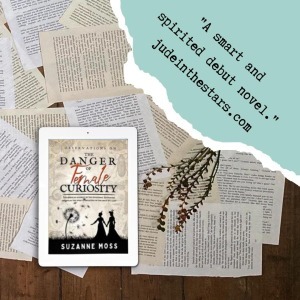
I have been looking forward to reading this book for a while, since I first saw the cover, I think. Yes, covers matter, they’re the first introduction readers get to the book, the first impression. And this one does a very good job, reflecting what the book will be about in a most accurate manner. It’s at once pretty, funny, and busy. The tongue-in-cheekiness of the title (the full title is Observations on the Danger of Female Curiosity: Including an account of the unnatural tendencies arising on the over-stimulation of the mind of a lady) allows the book to feel lighter than what the topics it tackles threaten.
Thea is the eldest daughter of the Morell family and, as such, is expected to marry so that her husband can inherit her father’s wealth and keep her mother and sisters safe. The trouble is, Thea would much rather learn about nature than about men. And most men don’t care for scholarly women, so even if she was inclined towards falling for one, he would have to be open-minded enough to let her pursue her collections of dead fish and insects. When Thea realizes her feelings for women go beyond accepted romantic friendships, she’s faced with momentous choices.
Set in the second half of the eighteenth century, both in London and in the countryside, Observations on The Danger of Female Curiosity is about changing minds, one bigot at a time.
I have my issues with the main romance arc but I can’t write about them without spoiling, since the author very cleverly sprinkled twists here and there. I’m also not entirely comfortable with the way handicap, colonialism, and slavery are referred to. I understand the need to balance the reality of the times the story is set in and the readability of the story itself but these topics felt mostly used as a way to establish Thea as progressive. The characters most affected, in particular Scip, exist in intention but only on the side.
That said, this is a debut and a very interesting one. It’s smart, the writing is spirited and there’s enough lightness, including really funny scenes, to offset all the drama. I look forward to seeing where (and when) Suzanne Moss will take her readers next.
As an aside, I’m pretty sure Thea would have enjoyed my pebble-of-the-day pictures on social media.
I received a copy from the author and I am voluntarily leaving a review.
Read all my reviews on my blog (and please buy from the affiliation links!): Jude in the Stars
i’m not very easily swept away (though rumor has it, im easy to please), i can confirm that the last time i felt such sorrow over finishing a book that was so delightfully captivating, was when i finished ‘the seven husbands of evelyn hugo.’ and that was nearly 2 years ago!
there is no review nor language that could ever encapsulate the masterpiece that is this book. to call it a ‘masterpiece’ alone feels like such a disservice to this story and it’s inexplicably dynamic characters. i thought blindly starting this review would magically bring me some sort of direction as to where i want to take it, but truly, words escape me. it was just that good.
to put it simply, this book is a love letter to the relentlessness and resilience of women in the pursuits of that which they love. it meets you at that complex intersection between love and womanhood. there is a generational quality to the trials and tribulations our protagonist, thea, faces. in that they aren’t entirely unfamiliar nor too far fetched despite the fact that this story unfolds quietly throughout the 1700s.
there are far too many good things to say about this book that if i were to begin here and now, you’d catch me singing it’s praises till next sunday. but a couple of details i find particularly important to mention that i think anyone should like to know is that, firstly, with regard to the romantic aspect of this book, you never know where it’s going and then, when it finally lands and you have that moment of realisation, you’ll find yourself so pleasantly surprised you wouldn’t be able to put the book down.
secondly, i think the author, suzanne moss, does the most wonderful job at balancing the themes of this book that at no point does it ever feel overbearing (the way historical fiction books can occasionally tend to be). talk of science and philosophy and their descriptions are so very fascinating, especially from the point of view of someone in the 21st century. the execution, the balance was truly stunning.
like i said, i may never be able to eloquently describe how beautiful this book really is (i literally have tears in my eyes just typing this review) so…for the sake of lengthy paragraphs that come with unexplainable feelings, i’m going to pen the rest of my thoughts in scattered and shameless bullet points in the hope that it would convince even one person to immerse themselves in this book.
1. i think the author makes a valiant effort to incorporate constraints of the time that are not restricted to whiteness and privilege through that lens. race is a topic that is frequently and meaningfully broached in this book and instead of merely acknowledging the issue vapidly, the conversations surrounding race, i found, were both - thoughtful and pertinent.
2. the forbidden love trope in historical romances is many things but it is most especially thrilling with a guarantee of the most passionate love story you’ll ever read
3. the proclamation of love scene in this book is so SO f*cking delicious, im almost certain i’ll be revisiting it nearly everyday for the foreseeable future. (seriously. think: passion, a little jealousy and the tension that comes with the longest overdue admission….)
4. speaking of revisiting scenes, the quintessential ‘first night together’ scene is sickeningly beautiful.
5. if you are into any of the following, drop what you’re doing and read. this. book. - (i) women in STEM (ii) women in STEM absolutely demolishing the patriarchy (iii) condescending, sexist, misogynistic men being absolutely owned by said women in STEM. oh and (iv) age gap romances, slowburns and women getting very real and very valid lady boners over the capacity and depth of the “female mind”
6. the most wonderfully complex side characters
7. the author promises that this book is the first of a series so we will know What Happens Next in no time (but clearly not soon enough, im literally bursting at the seams here unable to contain my impatience and excitement)
i could go on forever, but here is where i force myself to stop. if you’re debating picking up this book, know that you absolutely will not go wrong.
what a way to kick off 2023’s reading challenge my god, into the favourites this goes
This book!! Wowww this was excellent. My latest obsession is historical (especially pre-1800) sapphic fiction, and this book certainly scratched that itch. From the never-ending train of men with too many names (Earl Something, Lord Something, and George Somebody are the same person??) to the descriptions of resplendent gowns and powdered faces, Dr. Moss’s writing made me feel like I was truly in upper-class 1750’s England. And the fact that it starred nerdy, capable historical ladies of science was like catnip for me. While the science descriptions were hard to follow at times, I still found them fascinating. Dr. Moss is truly an expert in her field.
Thea Morell (23) is a captivating main character and I loved seeing the world from her perspective. She’s passionate and thoughtful and intelligent and imperfect and feels fully human. When she meets Eleanor “Ella” Harrington, Thea is faced with the exciting possibility of her feelings for women being reciprocated. Thea and Ella are very sweet together and I adored witnessing their individual self-discovery journeys as a result of their relationship. Also, the novel’s expansive cast of characters is great: some are incredibly lovable, others are hateful, and others are iffy. Some standout characters are Mrs. Phibbs, the Morell family’s housekeeper who wholeheartedly supports Thea; Ursula, Thea’s sister who is also a badass science lover; and Martha, a family friend who is a brilliant botanist and mentor to Thea.
As explained in the author’s note, Dr. Moss tackles the injustices of the time head-on. We become very familiar with the aching dread of being a woman and having to secure a marriage for the good of your family. Plus, there was the fact that only white men had any power and that there was a limit to what could be done about it. At times, even the characters we grow to care about show saddening displays of prejudice. While this made me uncomfortable at times, I think it was a necessary, humbling depiction of the time. Would any of us have been any better if we had grown up in that setting? It truly makes you think.
Spoilers ahead!! (More relating to who is involved rather than what exactly happens)
Knowledge is powerful. Once you acquire it, you can’t turn back. You need to know more. A breathtaking historical novel on the rights of women to fight for their recognition in society.
Observation on The Dangers of Female Curiosity brings us back to the second half of the XVIII century, in a world showing beginnings of turmoil with the slow change from the Enlightenment to the so-called Pre-Romanticism. It is set in the notoriously gloomy and rainy England, and it centers on the life and curiosity on natural science of the eldest daughter of the Morell’s family, Thea Morell.
The novel sheds some light on the role of women in the past, and the sad reality of it. Women had to be nothing more than “companion”, something for men to be showcased during society’s events. Women were believed to have a smaller brain than men, and therefore knowledge was not something they could attain. A woman was supposed to carry on the fortune or misfortune of the not so gentleman she was promised to by her own family to save their reputation. Secure a marriage of wealth, with a good name. How horribly restrictive and how horribly contemporary. Women have thought for their rights in many countries, but so many battles still need to be fought. So many women are still oppressed by men. So many women still leave in fear of showing the world what they are worth. So many women are still not free to love who they love. My heart goes to the pioneers, to those who had the courage to lead the path for future generations. To those who continue to fight for freedom and the choice of being able to learn. Through knowledge there is hope, and hope that things will be better in the end.
Observations on The Dangers of Female Curiosity is a beautiful essay on the Love of Nature and the Nature of Love.
By observing Nature, we can understand better the world, and thus ourselves. What is natural and what is unnatural. Why we are the way we are. Why can’t we be all natural and normal. But is Nature that normal?
Thea Morell has a fascination with some very peculiar objects, showing the interest of the century for the obscure, even the macabre, the unknown. Dead insects, fossils, exotic specimens from lands she can only fantasize about in her dreams. Her father supplied her and her sister Ursula with all the books and knowledge he could afford, conducting experiments and research with their help and that of trusted long time friends Edgar Pickles and Lady Foxmore. The latter, an immeasurable source of inspiration for Thea. Martha nurtured Thea’s thirst for knowledge since she was very young, and now she’s still at her side supporting her while she comes to terms with the continuous pressure of Mrs Morrel, who wants her speedily married to ensure the Morrel’s family will still be able to thrive in society. If only Thea was a bit more her other sister Tabitha, embroidery devoted and perfect daughter for a marriage match. If only things were so simple. With her need to explore the world, and the reasons why the world is as it is, another quest will rise in front of Thea: what is the nature of love and why we love who we love. Can knowledge be the reason of why she starting to have unnatural feelings towards the same sex? The loneliness of realizing you are different… The cruelty of feeling helpless and doomed to accept a future that is not the one you hoped for. The need to pursue not only what the mind wants, but what the heart feels. A fight between doing what is right for the others, sacrificing your own will, and freeing yourself from any responsibilities to embrace true love.
Drama. Romanticism at its best. Pure angst of a forbidden love. Fascinating scenery and breathtaking observations on humankind and the atrocities of history, and human trafficking. The need for change is alive in every and single one of the pages of this novel. The author makes a wonderful job in depicting both conservative and liberal parties. Some of the characters’ retelling will have you grimace and make your stomach churn. How could humans do this to other humans? How can humans still do this to other humans? Where is justice? How can you believe that since birth you are superior than others because of the circumstances they were born, the color of their skin, their sex, their wealth. How? How can you trade humans? How can you disregard their life? If you love natural science, biology, zoology, fossils, the history of science experiments, and most of all “electricity”, this is the book for you.
The electricity theme is depicted not only as the natural phenomenon, but also as the force that creates sparkles between two humans.
The force that pulls together Thea and Martha is so strong and electrifying, making their hearts beat faster at each of their encounters. It’s the beating of their own electrified heart that feels again alive and truly alive for the first time. It’s a can’t-stop-reading age-gap novel that will charm you from the beginning.
Observations on The Dangers of Female Curiosity has an exceptional array of secondary characters, which are wisely depicted at the beginning of the novel to ensure each of them will have a specific role to play later on. Some are truly hideous, and some will be redeemable, and some will make you cry and laugh.
I think this is one of the best books I’ve read this year. I can’t even begin to say how much I loved it, and what an inspiration it is, and how much it makes me proud. Proud of how many women, non-binary, queer, sapphic, straight humans are out there fighting for new generations. When I read it, my thoughts went to Vindication of the Rights of Woman: with Strictures on Political and Moral Subjects by Mary Wollstonecraft.
I can’t wait to learn more about Thea and Martha. Knowledge has never been to charming and intriguing. Respecting the one you love and their choices and their need to be fully happy has never been so heartwarming.
I can’t count all the times I highlighted a passage that pierced my heart with how heartfelt it was. Love is setting the other free, even if this causes you pain. Their happiness will be your happiness, and the hope for the future.
The partnership between Thea and Martha is not only based on love, it is more than lust, it goes much more deeper, into a deep admiration of each other. They challenge each other to be better. To become someone they can be proud of. It's a deep intellectual love and it's amazing.
Stunning novel. Absolutely stunning. One of my favorites this year for sure.
This is a very different book from the general romance offerings. Start with the authors note. I read it before and after reading the book. It gives background, sets the scene and gives a flavour of what is to come! The author knows the field of plants and collections as well as human nature. This comes over in detail in scenes and conversation. I will, confess a good bit of it went over my head, but that in no way impeded my enjoyment. We are subtly reminded of the different times this book is set in. The writer puts things baldly that we now find abhorrent, and that is a very effective tool, reminding us that these opinions and outlook have no place and should have no place in our society. As someone who mainly reads romances set in the present time, I found it very refreshing to be in a different world. Current novels obviously have and have to have a reason the mains can’t be together be it family approval, religion or other barriers. I found the coming to terms of the inner knowledge really well done, and the what on earth will happen next exciting and compulsive. Difficult ideas and historical realities are not shied away from. This feels like a romance for people that think. In a good romance novel you should feel it is impossible for the mains to be together - Not just for want of a conversation or understanding a misunderstanding or actually talking to each other rather than assuming. I honestly have no idea what the solution will be. I am gripped. However I am also incredibly moved by the humane depiction of the lives of the slaves. This book has made it real and horrible in a far more effective way than my sanitised school lessons did. (Knowing and feeling don’t always go together. I feel their pain in this book.) I also feel I need to know how this will end. I have been fortunate enough to be gripped by a number of books this year, and keen to find how it would work out in a number of others but I honestly don’t remember many times before not actually sure how even a happy enough ending is possible. Gripping! Well, the ending is as good as could be……. The author has done a great job of setting expectation. This is a book that will stay with me for quite a time. I look forward to the next in the series!
Life in the 18th century: women, sapphism and science This debut book (and indeed a series is on the horizon) is a detailed and finely executed fictional account of female (upperclass) lifes in the 18th century in England - about two generations before Jane Austen. We are thrown into the middle of the ‚age of enlightenment’ and the novel revolves aptly around the spreading interest in scientific exploration in certain parts of society. And science is as much part of this book as the characters and mores of the time. Of course there is a focus on women and there is an in-depth exploration of the pressures and confines of upperclass women - not only with regard to their engagement into the scientific developments of their times but also with regard to their place in society, their duties to marry suitably and how same-sex relationships might or might not fit into the mold ladies might have been pressed into. The German „Sittengemälde“ comes to mind when looking back at the book. The title is clever and well describes what will unfold.
The language and leisurely pacing of the book reflect the subject matter admirably. I esp. enjoyed the scientific passages and had fun with the characters populating and enriching the story. At the same time I was always wary - as the characters might have been - for the other shoe to drop. The inclusion of themes dear to our modern heart (e.g. slavery, inclusion of disabled people, diversity) was not overdone for the time depicted here.
This is not a quick read or an easy romance - it requires an open mind and time to explore a time at the threshold of what we now think of as modern times. And the author, a scholar and woman herself, probably satisfied her own curiosity and most certainly my curiosity about our past and the giants on whose shoulders we stand who endured and slowly, ever slowly opened so many doors for us.
I received an ARC. The review is left voluntarily.
Well, this book has truly destroyed me. It was so beautifully written, and I am absolutely in need of a sequel. 😢
The romance is exquisite, from beginning to end. The small touches and complete understanding in the beginning (so subtle but extremely noticeable due to the effect it has on them), the confession of love, everything about them really.
The side characters were also wonderfully written, some loveable and some horrible, but all perfectly served the story in their own way. For me, the romance was the absolute highlight, but the book does touch on a lot of great and important subjects, which did add to the story in a beautiful way.
This was a practically perfect read for me, and I already want to read it again. It's definitely a book I will cherish and re-visit frequently.
I’m a little lost for words, really, after finishing what could possibly be one of the most well written books of the year. With the greatest title. And the most beautiful artwork cover design.
Thea is heir to her family fortune, which unfortunately is looking rather unstable at the moment. Her marriage to a respectable and wealthy man is what will stabilise the future for her and those who depend on her.
Thea, however, has no interest in men or marriage and is happy to spend her days studying, learning, and collecting. Much to the dismay of her conservative mother and delight of her ever supportive father.
Thea, along with a fantastic group of eclectic side characters discovers that the life she yearns for can be possible with a few sacrifices and compromises.
I love a good book that has required a heap of research and flows seamlessly, showing the intelligence of the author. After reading her bio, it’s clear Suzanne Moss knows her stuff, but then to be able to create those characters and settings, using words to bring them to life in such a way that the reader is easily transported back to the eighteenth century shows how truly talented she is.
Don’t leave this one in your TBR for too long. It’s brilliant and deserves to be pushed right to that number one spot.
I received an ARC from the author in exchange for my honest review.
5 stars. I need book two because that ending! I knew it was coming but I still didn’t want it to happen so now I need to know what happens with Thea and Martha next. I was smitten with the romance between those two and it was the highlight of this book for me personally. I also loved that both women are such intelligent characters. The author is very clearly into science which was great because I will always love women in STEM and the way Moss wrote about it in this felt really passionate. I think my one and only gripe is that this was just a tad bit too long. It honestly didn’t need to be 500 pages as a lot of the middle section felt dragged out. Other than that this was wonderful. Beautifully written, intelligent and likable main characters with a swoon worthy romance. I cannot wait for book two.
Thea Morell lives and breathes natural history and science. Unfortunately, Thea was born into a time of gowns and petticoats, where the eldest daughter must maintain her social standing, marry well, and secure her family’s future. Maintaining her social standing does not include indulging her curious mind, or her unexpected passion for a lady friend.
Convinced that her eccentricities result from her over-stimulated mind, Thea must choose between love, passion, and duty in this delightfully informative, impeccably researched Sapphic historical fiction.
In this debut novel, Suzanne Moss has delivered everything I look for in sapphic historical fiction ... smart ladies who love ladies, a wee bit of mystery, and characters who fight for love against all odds.
I understand this is the first of three books, and I can’t wait to see what happens next! Highly recommend.
Well written story that keeps you wanting to turn the page
It's fairly rare to have a sapphic book set in the 1700's that isn't pirate related. Not that pirates are a bad thing, my philosophy is more pirates always, but I digress. Back to Curiosity, the book is well-written and intriguing. It had a lot of tidbits of information. Beware the book will make you reflect (and potentially rage) on all the trials women had to go through. There are some great characters that jump off the page. This story is not really an HEA but I'll definitely be looking for the next book in the series.
Many thanks to the author for an ARC copy. I'm voluntarily leaving an honest review.
The author highlights the tired battle of women fighting for a place in society from petticoats, the discovery of electricity and now TikTok. Still fighting and never giving up.
Nothing fires my ovaries more than a bullied female scholar being downtrodden by the patriarchy. The best part of this book is that the main character is so polarising in her personality of wanting to find herself yet serve her family. And that’s how it is being a woman, isn’t it? We’re everything, we can be a lover, a scholar and a family lifeline. We have to be. However, nothing comes for free. Sacrifices have to be made. The author navigated through the story so seamlessly and the excitement of an “illicit” love just seemed to fan the flames of anticipation!
Why the rating change? Three weeks after finishing this book, I'm still thinking about it! And I want the sequel NOW! But mostly it's because I've realized what a gift it is learning what women in the past had to do and issues they dealt with …
I liked this book and it definitely kept me reading. But set in the 18th century, it was bound not to end happily. Inclusion of women in science is actually still in its infancy today, so the main characters were bound to have insurmountable problems being heard and had virtually no expectation of being respected! Women were wholly dependent on men for their economic lives and so their really was no chance for two women to find a way to live as romantic partners (not to mention the societal and moral judgements). That the author manages to end on a hopeful note without delving into fantasy (and promising a sequel of further adventures) was plotting genius.
I did enjoy the portrayal of natural philosophy in the book. It gave depth to the historical portrayal and was just plain interesting and enlightening!
A quibble … while the age difference between the MCs didn't bother me, I found it unlikely that romantic feelings would develop for someone who was both a friend of parents and who had been a family fixture throughout the younger character's childhood. Really, this is just a quibble. I was rooting for the characters (in spite of everything stacked against them) the whole time!
The writing/setting/story was good, I didn’t enjoy the romance part of it. Commenting further on that would spoil the book for some so I’ll leave it at that. I would read from this author again.
Wow. This read is so much more than a romance. I know it’s an historical fiction but it really is the best mix of both history and fiction. The setting is so beautifully immersive littered with facts we as readers generally know and also get to learn for the first time (I now know more about plants than I ever thought I would). You can really tell the author has such an extensive research background. Mix in a little taboo romance and both my heart and head were thoroughly entertained.
I would say the overarching theme of this book is fulfilling familial/ societal expectations versus finding true happiness. Thea is such an eclectic main character. The oldest daughter expected to marry into wealth to secure her family’s position in the social hierarchy. However, Thea is much more interested in natural science. Thea also becomes very interested in other women. The lust, spice and love was handled with as much enthusiasm as the science. I don’t want to spoil any of the story as it’s a long book filled with revelations and some twists! I will say that I was enamoured by Thea trying to push through her anxiety to pursue her passions. As a young woman Thea feels so utterly confused, ostracised and just different. Like many people who don’t fit the mould, Thea thinks (and is told) there must be something wrong with her, some cause, some blame for why she is who she is. The character development throughout the book, encouraged by amazing supporting characters, gives the reader such a sense of hope.
You can’t really talk about this book without acknowledging the fearless trailblazers which it is inspired by. Suzanne Moss credits Margaret Cavendish Bentinck, Duchess of Portland in particular along with all women of science in the past. It made me think of every minority that stood up and decided to be among the first, against all odds. Anyone who was not an able-bodied, rich, white, straight, cis-male who continued to further push boundaries they had no hand or say in creating. Gramsci’s cultural hegemony outlines the ruling of the bourgeoisie through the creation (or illusion of) a shared worldview rather than by sheer force alone. In my opinion, you can see this so clearly in 18th century British society (and perhaps today’s society but that’s another story🤪). You can see how women were made to believe themselves so inferior. How the men who ruled used every tool at their disposal- education, laws and social practices to chiefly benefit themselves. They made all of this so common place that others had to accept it as the universal standard. Women were expected to marry well and not be too ‘learned’. Thea, Ursula and Martha went against the grain and not without personal sacrifice. I’m heartbroken that this is the first book of the curiosity series and that book 2 is not yet available for me to devour.
Something that really struck me whilst reading is the relentless pursuit of knowledge. The amount of ‘facts’ discovered that have since evolved or even been disproven. The possibility for growth and the unlocking of the secrets of our world. To think of even a general consensus shifting so completely with time- I’m both apprehensive and excited to see what is yet to come 🔬
I think it's best to go into this one expecting a historical fiction about women in science and completely ignore the romance because, despite a large part of this book being focused on the romance, it's not a very well-written or compelling romance.
The flip side of this is that the women being naturalists aspect of this book is informative and engaging. The sort of restrictions based on gender and men's gatekeeping of scientific forums is something that should be very familiar to readers who have already read The Lady's Guide to Celestial Mechanics (A book that tackles similar themes but has an engaging romantic element). It's enjoyable to read about competent women trying to work against the societal expectations for women, sexism, and the lack of funds needed to properly do scientific work. Unfortunately, I must confess that the aforementioned book does it better because it's shorter and more compelling emotionally in terms of stakes.
Thea Morell has always been different. She is not like other well-bred Georgian ladies who are mild mannered, dainty, and eager for marriage. Thea has never been interested in pursuing ladylike hobbies such as painting and needlepoint, instead she spends her time being curious —reading and learning all she can about natural history, and observing scientific experiments with her friends—much to the dismay of her mother. Thea shares her love of knowledge with father, younger sister Ursula, and a small circle of friends, while her mother and middle sister Tabitha are more interested in society, gossip, and eligible bachelors. As Thea’s mother stated, “Ladies should make a good wife and be able to run a household. Any education is a distraction and gives them unnecessary… ideas.”
Keeping herself engaged with collecting, classifying, and categorizing items for her collections, Thea does her best to thwart the advances of eligible suitors, but as she approaches the prime marrying age of 22 she can’t hide from her persistent mother any longer. When a wealthy, aristocratic family moves back into town, Thea is introduced to the rich, handsome, and eligible bachelor Samuel Harrington, Viscount Stockwood, but she finds his sister, Lady Eleanor (Ella) Harrington far more intriguing.
Observations on the Danger of Female Curiosity is an intelligently written historical novel featuring strong female characters, witty dialogue, and delightful descriptors of 18th century Georgian England reminiscent of Jane Austen’s novels, if they had a gay twist to them.
In the author’s note section, Suzanne Moss described the inspiration for her novel to be the “overlooked, awesome women of science.” The story begins in England in 1758. It doesn’t shy away from unpleasant topics from that time period such as colonialism, slavery, bigotry, sexism, classism, prejudice, and homophobia —instead they are discussed openly and woven into the story line. While topics such as these can be uncomfortable through our modern lenses, the author did her best to balance between the narrow minded and the enlightened.
In Georgian times women had no right to inheritance. At a cross roads between her duty and her passions, Thea doesn’t want to marry, she wants to pursue her study of natural history and grow her collection, but being the eldest daughter with no brothers to inherit the family estate, she feels the weight of responsibility to marry to secure her family’s future.
Thrust into the social scene by her mother in hopes of finding her a husband, Thea is uncomfortably out of her element at lavish balls and dinner gathering when she’d rather be home reading. Thankfully Lady Foxmore, Thea’s dear friend and mentor, is always around to both support and encourage her studies and calm her anxieties. Thea shares everything with Martha —everything but Thea’s uncontrollable feelings for Ella. Those are too risky to share.
Observations on the Danger of Female Curiosity features a diverse cast of colourful characters, intriguing plot twists, formidable allies vying against shady adversaries, and the perfect mix of action and conflict packaged together with a happy ending. Yes, this is a slow burn romance novel with its fill of heartache, angst, and heartwarming moments, but it is much more than that. It is so well versed and researched on the scientific discoveries, curiosities, and exotic fauna and flora species of the day, it almost didn’t seem like I was reading fiction.
I highly recommend this debut novel by Suzanne Moss. I was given an ARC for review, and it is so good I pre-ordered my own Kindle copy as well. It was a definite a page turner —a ‘couldn’t stop reading but don’t want it to end’ type of book—so I was quite happy to find out this is book one in the Curiosity series. I look forward to more adventures with Thea and her friends.
Rating: 5 out of 5 stars
Genre: fiction, romance, historical, historical romance Categories: lesfic, saphic, f/f, wlw, slow burn, age gap, friends to lovers, central character with a disability
Title: Observations on the Danger of Female Curiosity: Including an account of the unnatural tendencies arising on the over-stimulation of the mind of a lady Author: Suzanne Moss Publisher: Aesculus Books suzannemoss.co.uk
I stumbled across this book on twitter and am not sure I can express exactly how much this book touched my soul. It’s a wondrous journey into Georgian England, a story of defiance and curiosity, of strong minded and intelligent women set in a time where those traits were frowned upon to say the least.
Thea Morell is the eldest daughter of the Morell family. Her duty lies in securing the future of the family estate and her sisters. Thea has found a love for natural history and collecting pieces from around the globe in her quest to make sense of the world at large. This thirst of knowledge is a thorn in the eye of her mother as it is her wish for Thea to marry a man of fortune. All the while Thea is far more interested in learning all there is to know.
Thea always knew she was different. She isn’t interested in the activities society expects of a lady. She can’t paint to save her life and embroidery dulls her brain. She is expected to marry but her heart is drawn to women. Another inconvenient and highly despised trait.
From a young age Thea is tutored by her father and family friend Martha Smilgrove. Martha is a plantswoman and collects plant samples and conducts experiments with different plants. The two women form an unbreakable bond based on mutual respect and a shared interest in the sciences. While they navigate life within society and the demands society puts on Thea, they grow even closer.
Suzanne Moss takes you on a journey back in time to Georgian England. She paints a picture of grand estates, flowing dresses and a time when things we take for granted now, were still considered wonders of the world. You can smell the dusty library books, see the light reflect on jars and jars filled with natures precious offerings and feel the jostling of the wheels during a carriage ride between the estates. As you see the world through Thea’s eyes you feel the pressure of societal conformity on her shoulders, your heart will ache for her and you will cheer her on from behind the book as she grows into herself and fights for what her heart and mind really want and need.
The romantic tension between the characters is palpable. There is something about two women in period dresses sharing heated looks, stolen kisses and defying expectations together that will make your heart thunder in your chest! There are some spicier scenes throughout the book but never does it get extremely graphic. I might have liked a little more explicitly heated scenes, but the way this story is built, the radiating tension leaves enough for the active imagination!
Moss doesn’t shy away from the harsh realities of Georgian times and depicts the horrors of the slave trade as horrific as they were. As the story is told through the eyes of Thea, as a reader you feel her growth and understanding on the topic. The harsh reality is that the privileged life she leads is a direct result of the wealth made from slave trade and questionable business dealings in the colonies. Thea’s realization and the way she deals with that are to be admired, given the times.
The whole cast of characters surrounding Thea consists of well rounded people. Each and every one has a layered persona and acts exactly ‘in character’ throughout the book, even when eventually revelations are unveiled. I especially loved the feisty Ursula, Thea’s sister. She encourages Thea to be herself and to exercise her brain like it is intended too. The way Ursula tells off some of the men in the story is a hilarious delight and makes you want to stand up for yourself and other women too when dealing with ignorance in daily life!
This is part one in the Curiosity series, I can not wait to read on about the adventures of Georgian queer ladies of science!
I can keep writing about this wondrous, delightful and soulful book, but in the end…I can only tell you to go read and experience for yourself the power of female curiosity!
5 out of 5 stars: 'Observations on the Danger of Female Curiosity' by Dr. Suzanne Moss is the first DEBUT novel to sweep me off my feet in quite a while! I am yet to wrap my head around the fact that it is a debut novel, by the way; I am honest-to-god beyond impressed with everything about it!
Thank goodness that it is only the first book in the author's Curiosity Series—and that the author even provides her readers a multi-chapter Epilogue (An Account of A Voyage of Curiosity) and a short prequel (A Defence of Astronomical Curiosity For Ladies)—because after the novel's hopeful yet bittersweet, poignant ending, I am not yet ready to let go of many of the characters—not just of one certain Countess!
Anyway, my thoughts and feelings are all over the place at the moment, but one thing is clear: I NEED EVERYONE TO READ THIS BOOK. Whether they happen to be a Sapphic fiction reader or not, I urge them to give this book (series) a try.
This was a lovely book that deserves a place next to Sarah Waters and Mackenzi Lee's the Montague Siblings. The pacing was sedate, think: Affinity, The Paying Guests and The Tell Tale rather than: Fingersmith, Tipping the Velvet - but the drama was intense. The author's affection for science and history, and her commitment to try and get things right is admirable.
There are moments where the author's affection for science and minutia outpaced my own, and the book could probably have been ~70 pages shorter - but these are my only complaints.
The narrative follows three sisters (all of them fascinating) as they negotiate their entry into Edwardian society and attempt to preserve their family's fortune. The eldest (our protagonist) discovers to her horror that she is rather more interested in ladies & Linnaeus than the roguish Duke next door; the middle sister (oh, how I wish we'd see more of her) appears to have a predilection for cards and gambling; and the youngest is an intellectual powerhouse who has been written off by society because she is wheelchair bound.
All are trapped between duty, desire, and obligation.
Observations on the Danger of Female Curiosity: Including an account of the unnatural tendencies arising on the over-stimulation of the mind of a lady by Suzanne Moss and the first book in the Curiosity series.
The story is set around England in the Georgian period, 1800’s, with all its prejudice, class distinctions and country estates. The role of women during this time was for all intents and purposes to serve men, take tea, attend balls, and partake in womanly activities! Within this world you will find Thea, eldest daughter in the Morell family who is fascinated by knowledge including collections and curiosities. Thea’s dalliances are so heart-warming as she questions and looks for answers regarding her sexuality, however she is in a world where one must seek a husband of means.
The quality of the writing is second to none. You feel as if you are England during these times with the different architecture, smells, horse and carriages, and the gentry in their fine regalia. There are some awesome one liners and humour in places. This book was a compelling read that took me through a rollercoaster of emotions.
For those on a reading challenge this book covers a wide range of genres including – age gap, romance, character with disability, newbie author, historical/period, over 400 pages. I cannot recommend this book highly enough.
I received an ARC copy of this book from the author in exchange for my honest review.
This book is.. "everything". It's what would happen if Pride and Prejudice met Bridgerton. There's romance, friendship, plants, sexy botanists and sexy banter between women in the 1750's.
Thea Morell is curious about everything and it leads her down a path of learning and self discovery, and one of the things she discovers is that she likes women. What will come of that? Is curiosity good or would it lead to her future with suitors being jeopardized? Will she secure her family's future or go where her heart leads her.
I like all the characters depicted. Knowing that back in those days women still had support to pursue knowledge with people close to them warms my heart up. If you're a science nerd like me and have a green thumb, some parts of the book are going to jump out at you, if you're not, do not despair, they aren't boring.
There's drama, there's angst, there's biology, zoology and science experiments. At the end of the day this book makes me grateful that I can love women out in the open in this day and age, it's beautifully written.
This book will take you on a journey of discovery through Georgian Society at the shoulder of Thea Morell, who captured my heart in half a page and did not let go for the rest of the novel. Extremely well written you will find yourself absorbing botanical facts as well as enjoying utterly delicious sapphic interludes (if you do not like sex scenes in books then this may not be for you) and rooting for Thea to find a way to make it all work.
This is not a book to inhale at speed, even though you'll probably want to. It is a book to sink into and savour, so you experience the world and the work that has gone into making it so seamless and real. It covers a lot of ground, both real and metaphorical, but at no point does the text feel laboured or fraught. It felt, to me, like the best sort of mix between Jane Austen's observations of life and the breadth of topics in the Memoirs of Lady Trent series, although without the fantastical element.
It is a proper slice of Georgian romance, beautiful balanced between the main story and the sub plots, all of which shape the story arc perfectly. The characters are well written and whilst a few may appear at first to be caricatures you'll soon see them grow and round out as the story progresses. Yes, even the ones you'll love to hate.
The ending is bitter sweet but satisfying and there are some wonderful moments when, if you're anything like me, you'll want to punch the air in triumph. I cannot recommend it highly enough and I am extremely happy that Suzanne is already working on the second book in this series.
Considering it’s historical fiction there’s a lot of injustice which the characters struggle with adapting or conforming depending on their inner strengths and what they’re made of. I loved that the characters were naturalists, etc. I definitely would love to read further adventures.
This was a five-star read for me even though it was set in 18th century England, a time and place that interests me not at all. But it is such a wonderful lesbian love story! It really is. The characters are both likable and believable. Their struggles and choices are completely relatable. Many of my favorite books are either written or set many hundreds of years ago. The thing that elevates a book to five-star or favorite status is when it conveys something essential and timeless about human nature, and this one definitely did. A bit of a slow start but I couldn’t put it down once I got about 50% of the way in.
Read for a bookclub! A fun story with many sweet and heartfelt affirmations about the truth of love and life. A good read for anyone interested in strong independent women challenging societal norms in a historical context