

What do you think?

God's Pauper : A Novel(Paperback) - 2000 Edition
Fictional account of St Francis of Assisi's heroic single-mindedness in the face of extreme physical & spiritual suffering. He portrays the saint as a great lover & inspiring leader, who embraced radical poverty in the face of many obstacles & temptations.
Kazantzakis (2/18/1883–10/26/57) was born in & lived in Greece most of his life. His most famous novels include Zorba the Greek ('46, Βίος και Πολιτεία του Αλέξη Ζορμπά); The Greek Passion ('48, UK title Christ Recrucified, Ο Χριστός Ξανασταυρώνεται); Captain Michalis ('50, UK title Freedom & Death, in Greek Καπετάν Μιχάλης); The Last Temptation of Christ ('51, Ο Τελευταίος Πειρασμός) & St Francis ('56, UK title God's St Francis of Assisi, Ο Φτωχούλης του Θεού). Report to Greco ('61, Αναφορά στον Γκρέκο), containing autobiographical & fictional elements, summed up his philosophy as the "Cretan Glance."
Kazantzakis (2/18/1883–10/26/57) was born in & lived in Greece most of his life. His most famous novels include Zorba the Greek ('46, Βίος και Πολιτεία του Αλέξη Ζορμπά); The Greek Passion ('48, UK title Christ Recrucified, Ο Χριστός Ξανασταυρώνεται); Captain Michalis ('50, UK title Freedom & Death, in Greek Καπετάν Μιχάλης); The Last Temptation of Christ ('51, Ο Τελευταίος Πειρασμός) & St Francis ('56, UK title God's St Francis of Assisi, Ο Φτωχούλης του Θεού). Report to Greco ('61, Αναφορά στον Γκρέκο), containing autobiographical & fictional elements, summed up his philosophy as the "Cretan Glance."
390 pages, Paperback
First published January 1, 1955
About the author
Nikos Kazantzakis
67 books4,484 followersNikos Kazantzakis (Greek: Νίκος Καζαντζάκης) was a Greek writer, journalist, politician, poet and philosopher. Widely considered a giant of modern Greek literature, he was nominated for the Nobel Prize in Literature in nine different years, and remains the most translated Greek author worldwide.
Ratings & Reviews
Friends & Following
Create a free account to discover what your friends think of this book!
Community Reviews
Displaying 1 - 30 of 256 reviews

December 31, 2014

مقدمه
فرقه ی فرانسیسکن، یکی از فرقه های بزرگ مسیحیت قرون وسطا بوده و این داستان، شرح زندگی قدیس فرانسوا (فرانسیس) مؤسس این فرقه است.
این فرقه، شباهت زیادی به راهب ها داره، یعنی اعضای این فرقه، تارک همه ی مظاهر دنیا هستن. اما بر خلاف راهب ها که در صومعه ها معتکف میشدن و فعالیت نداشتن، اعضای این فرقه به اطراف و اکناف میرفتن و مسیحیت و اصول فرقه ی خودشون (عشق کامل، فقر کامل، سادگی کامل) رو تبلیغ میکردن.
اين كتاب
اول: ابتدای داستان عالی بود. هم مقدمه، و هم فصل های آغازین داستان. خیلی خیلی خوب بود. شرح یک انسان که همه چیز داره، اما آن چیز که باید داشته باشه رو نداره. و جوینده ی خدایی که به سمت یک انسان گناهکار فرستاده میشه، نه برای این که مرادش بشه، بلکه برای این که مریدش بشه. و بخشی که فرانسوا متحول شد و لباس هاش رو جلوی همه درآورد و... همه خیلی خیلی عالی بودن. گاهی منو به اشک هم مینداختن.
دوم: به خلاف شروع داستان، میانه ی داستان خوب نبود. البته، تکه تکه جاهای خوب و خیلی خوب داشت، اما روند کلی، خوب نبود. داستان به ورطه ی تکرار افتاد. شرح موعظه های تکراری و یکنواخت فرانسوا به لئون، شرح معجزه های تکراری فرانسوا، شرح وسوسه های تکراری لئون که تا پایان داستان، همچنان همون جاهل ابتدای داستان بود و سفرهایی که با فرانسوا کرد، کمترین تغییری درش ایجاد نکرده بود. و خلاصه یه مضمون واحد، به شکل های مختلف تکرار می شد، بدون این که آدم احساس کنه داستان داره رو به جلو حرکت میکنه.
سوم: اگه من بخوام داستان یه قدیس، یا یه پیشوای مذهبی رو بنویسم، سعی میکنم تا حد ممکن، عنصر معجزه و "ماوراء" رو از داستان حذف کنم یا کمرنگش کنم.
مثلاً. توی حکایت های مذهبی، معمولاً منوال این طوریه که یه آدم گناهکار تصویر میشه، بعد این آدم گناهکار به یه علت "ماورائی" متحول میشه (این علت میتونه یه خواب، دیدن یه معجزه، منقلب شدن حال در نتیجه ی یه امر تصادفی و... باشه) و بعد از اون، به راه خیر در میاد و تبدیل به قدیس میشه.
مشکل اینه که اولاً، به این ترتیب، قدیس شدن اون گناهکار هیچ امتیازی محسوب نمیشه. چون اگه اون امر "ماورائی" برای هر کس دیگه ای رخ داده بود، اون هم متحول میشد و قدیس میشد. قدیس، با اراده ی خودش قدیس نشده، با یه امر خارج از اراده ش قدیس شده.
و ثانیاً، این حکایت هیچ فایده ای برای منِ خواننده نداره. باعث نمیشه زندگیم رو عوض کنم، راهکار نشونم نمیده که چطور خودم رو اصلاح کنم و سالک این راه بشم. فقط و فقط بهم میگه "بشین و منتظر یه امر ماورائی باش که متحولت کنه." و بر فرض که این امر "ماورائی" برای من رخ نداد...؟
توی رمان "سرگشته ی راه حق"، عنصر معجزه نقش بیش از اندازه پر رنگی داشت. خیلی ها به خاطر معجزه اصلاح شدن، حتی خود قدیس فرانسوا. و این یعنی این رمان نمیتونه الگو سازی بکنه برای منِ خواننده.

November 19, 2017
3,5
Μια Καζαντζακια βιογραφία ενός καθολικού Αγίου . Η μεγάλη διαμάχη του καζαντζακη με την εκκλησία ξεκινούσε απο την πεποίθηση του οτι αυτη δεν εκπροσωπούσε ούτε το Θείο , ούτε το ανθρώπινο , αλλα τον εαυτο της και τους υπαλλήλους της. Και αυτο το βιβλιο έβαλε ακομα ενα λιθαράκι στο ηδη υψωμένο βουνό της πεποίθηση του .
Μια Καζαντζακια βιογραφία ενός καθολικού Αγίου . Η μεγάλη διαμάχη του καζαντζακη με την εκκλησία ξεκινούσε απο την πεποίθηση του οτι αυτη δεν εκπροσωπούσε ούτε το Θείο , ούτε το ανθρώπινο , αλλα τον εαυτο της και τους υπαλλήλους της. Και αυτο το βιβλιο έβαλε ακομα ενα λιθαράκι στο ηδη υψωμένο βουνό της πεποίθηση του .

October 30, 2020
Ο Καζαντζάκης έχει μια αρκετά συγκεκριμένη θεματολογία. Το έργο του μιλά για την ανθρώπινη φύση, αλλά για την ανθρώπινη φύση που μπορει και περιέχει μέσα της και τη θεϊκή. Όλο αυτό το κάνει πιο κατανοητό δίνοντας συνήθως ένα ζευγάρι πρωταγωνιστων όπου ο ένας είναι ο απλός, καθημερινός άνθρωπος που όμως μέσα του υπάρχει μια σπίθα πνευματικοτητας και πίστης και κάπου εκεί έρχεται να κάνει τη σπίθα αυτή, φωτιά, ο δεύτερος που είναι ένας επίγειος "θεός". Σε αυτή την περίπτωση έχουμε τον Άγιο Φραγκίσκο της Ασίζης, που λίγο πολύ όλοι γνωρίζουμε κάποια πράγματα γιαυτον, έστω και από το τραγούδι του Μαχαιριτσα (δεν άντεξα, συγγνώμη)και από την άλλη τον φρατε Λεόνε, τον πιστό ακόλουθο του . Το βιβλίο αυτό λοιπόν εξιστορεί τη διαδρομη των δύο αυτών(κυρίως όμως του Φραγκίσκου) ανθρώπων που αποφασισαν να γνωρίσουν το θεό, μέσα από ελλείψεις, κακουχίες, φτώχεια, χλευασμους, κοινώς όλα όσα εισπράττουν όσοι τολμούν να πιστέψουν με πάθος σε μια ιδέα.
Τα συναισθήματα που μου προκάλεσε όπως πάντα η ανάγνωση ενός βιβλίου του Καζαντζάκη, ήταν πολύ έντονα. Συγκίνηση, θαυμασμός, μια εσωτερική ισσοροπια και ένωση. Κάποια περιστατικά δε, με αποκορύφωμα το φινάλε, με το θάνατο του Φραγκίσκου, με συγκίνησαν σε σημείο δακρύων.. Δεν έχω να πω αλλα, μόνο ότι ο Καζαντζάκης είναι πραγματικά ένας πολύ σημαντικός συγγραφέας και χαίρομαι που το ανακαλύπτω, έστω και τώρα..
"αδέλφια ακούτε όλοι τι ο Θεός με προστάζει : ως τώρα έλεγα τον σιορ Πιέρο Μπερναντονε, πατέρα μου. Από τώρα και πέρα θα λέω : πάτερ ημών ο εν τοις ουρανοις. Σπαζω τις αλυσίδες που με εδεναν με τη γης. Παίρνω φόρα να γυρίσω πίσω σπίτι μου, στον ουρανό. Ετούτη είναι αδέρφια, ακούστε τη, η καινουρια τρέλα. "
" το μυαλό όλο μιλάει, ρωτάει, σκαλίζει. Η καρδιά δε μιλάει, δε ρωτάει, δε σκαλίζει. Αμίλητη κιναει και παραδίδεται στο Θεό. Το μυαλό είναι ο δικηγόρος του Σατανά, η καρδιά είναι η δούλα του Θεού. Σκύβει και λέει στον Κύριο, Γενηθητω το θέλημα σου. "
" Ετούτο θέλω να πω φρατε Λεόνε, τριών λογιών είναι η προσευκη :
Η πρώτη :θεέ μου, τεντωσε με, αλλιώς θα σαπισω.
Η δεύτερη : θεέ μου, μη με παρατεντωσεις, θα σπάσω.
Η τρίτη : παρατεντωσε με, κι ας σπάσω. "
Τα συναισθήματα που μου προκάλεσε όπως πάντα η ανάγνωση ενός βιβλίου του Καζαντζάκη, ήταν πολύ έντονα. Συγκίνηση, θαυμασμός, μια εσωτερική ισσοροπια και ένωση. Κάποια περιστατικά δε, με αποκορύφωμα το φινάλε, με το θάνατο του Φραγκίσκου, με συγκίνησαν σε σημείο δακρύων.. Δεν έχω να πω αλλα, μόνο ότι ο Καζαντζάκης είναι πραγματικά ένας πολύ σημαντικός συγγραφέας και χαίρομαι που το ανακαλύπτω, έστω και τώρα..
"αδέλφια ακούτε όλοι τι ο Θεός με προστάζει : ως τώρα έλεγα τον σιορ Πιέρο Μπερναντονε, πατέρα μου. Από τώρα και πέρα θα λέω : πάτερ ημών ο εν τοις ουρανοις. Σπαζω τις αλυσίδες που με εδεναν με τη γης. Παίρνω φόρα να γυρίσω πίσω σπίτι μου, στον ουρανό. Ετούτη είναι αδέρφια, ακούστε τη, η καινουρια τρέλα. "
" το μυαλό όλο μιλάει, ρωτάει, σκαλίζει. Η καρδιά δε μιλάει, δε ρωτάει, δε σκαλίζει. Αμίλητη κιναει και παραδίδεται στο Θεό. Το μυαλό είναι ο δικηγόρος του Σατανά, η καρδιά είναι η δούλα του Θεού. Σκύβει και λέει στον Κύριο, Γενηθητω το θέλημα σου. "
" Ετούτο θέλω να πω φρατε Λεόνε, τριών λογιών είναι η προσευκη :
Η πρώτη :θεέ μου, τεντωσε με, αλλιώς θα σαπισω.
Η δεύτερη : θεέ μου, μη με παρατεντωσεις, θα σπάσω.
Η τρίτη : παρατεντωσε με, κι ας σπάσω. "

April 27, 2016
”Ce este dragostea, frații mei? Nu este doar milă și nici doar bunătate. În milă sunt doi, cel care dă și cel care primește. Dar în dragoste este unul singur, cei doi se unesc și devin una, nu se deosebesc. Eu și tu dispar. Iubesc înseamnă: dispar eu.”
October 9, 2008
I learned from this book how the life of a genuine seeker of God is one of constant crucifixion. Of the total sacrifice of the ego at the altar of the Divine, so that we may partake of that divinity. And how intensely humanely superhuman that divinity is. The soul suffers with all of suffering humanity, rejoices with all of rejoicing humanity. Awesome. Tempting, fearful yet a journey to be yearned for. Even the yearning is much better than all possessions and attainments which we normally hold dear. My profound regards for the author. And for St. Francis, my reverence has increased a thousand-fold. Amen!

December 8, 2012
BOOK : God's Pauper
Author : Nikos Kazantzakis
A flawless masterpiece about the devotion of a true devotee.....that is the story of God's Pauper written by Nikos Kazantzakis. The epic story of the life of one of the greatest Saints in the world is narrated in a lucid & yet heart wrenching fashion that makes the reader one with the pain & passion of the man behind the Saint.
Being a passionate believer & student of the Franciscan way of life, I find this book quite in keeping with not only history but also with the current ideas religious personalities have about the pain behind the total annihilation of the ego (flesh in the case of Saint Francs of Assisi). Kazantzakis in a simple way reveals to the reader not only the life of Saint Francis. The writer does us a favour for which I shall be ever grateful to him as a reader.....he makes the life of this pauper very REAL ! We generally find the lives of most of the Christian saints highly above our normal dealings & therefore most of the time ignore their life histories as well as their writings which seem rather dogmatic....not in keeping with our practical mind-set. Kazantzakis is aware of this failing & therefore, brings out the true side of Saint Francis of Assisi.....the struggling man to become one with his creator. It is not the lofty saint that we encounter in this classic work but, the lowly man trapped by his love for God & the desires of his flesh which he wishes to overcome. The person that we witness in this narrative is the human being that signifies ALL of us with all our faults, yet wishing to love God in perfection sans faults & sinful ways.
This is not merely a religious document, but a mirror into the heart & mind of one of the greatest mystics of the Medieval Age in Europe. In fact, I would not be wrong if I stated that this novel is the life story of a revolutionary. Saint Francis of Assisi indeed was a revolutionary not only where his thinking was concerned but also his ideals on the way his society was progressing. Kazantzakis brings to us that revolutionary.
The story is narrated by St. Francis’ close comrade & fellow friar Brother Leo who although not all that divinely in tune with God (unlike his friend St. Francis) yet loves St. Francis to such an extent that he goes through the worst of situations to prove his loyalty & devotion. Brother Leo in this novel undergoes the hardships of whipping, self-torture, weather changes, sickness, hunger, thirst, mental turmoil etc., all because of his loyalty toward the person he considers to be quite sure about everything heavenly. More than just the narrator however, Brother Leo in this novel signifies…all our doubts…the scepticism that we are born with & in more than one way does he bring out his doubts. Through him, it is we who are questioning the authenticity of God & the divine call of St. Francis. Just like Brother Leo, we do not question because we think we are more than human….we question because WE ARE HUMAN & can a mere human become a saint? Can a human give up the longings of the flesh? Can a mere human overcome the impossible? These are questions posed to us & by us throughout the book.
The characters in this story may have been moulded in a different way by the author so as not to break the rhythm of the narrative….but they all did exist, this is history, and this is fact. Not only was there the ever loyal but doubtful Brother Leo but there was also the loving Saint Clara who followed in St. Francis’ footsteps ; not only was there a devoted Lady Pica the mother of St. Francis but also the crafty Brother Elias who twists the rule of St. Francis to his own liking & for his own self glory. These were REAL people like you & me who lived during troubled times & yet were asking the same questions about God & humanity that we are asking today.
The author himself has stated in the novel that he has added many stories from his own imagination at times so as to link together certain intricate parts of the legend of this peculiar medieval saint. He does so to merge the myth with the truth to bring out the essence of St. Francis’ teachings.
The extraordinary part of the book is that, the wild passion of the human soul is dramatised to perfection that even if an atheist were to read this book, he would be pulled in with this tide of emotional outbursts. The maniacal side of the Saint is seen by us & also accepted by us maybe because we realize that he is one of us. His passion was for God whereas currently our passion may be for many other concerns like Democracy, elimination of corruption, feminism, Global warming , communalism……it could be anything, but we all have our own goals & our own personal barometers to assess whether we have achieved our goal. The fanatic following of the revolutionary ideals of perfect poverty, perfect chastity & perfect obedience by St. Francis reminds us of our own fanaticism to our own ideals. His extraordinary way of living…..his stigmata….his fasts……..his bleeding body……..his hunger…..his yearning for Saint Clara…….his semi blindness all shows a level of extreme that was revolutionary for its time & age. It was not accepted readily of course & he resented it much, but did not complain. His job was to show the passion of his devotion to the world, which he did……which we daydream about too…….to show our ‘different’ ideas to the world which wants us to conform with its own set rules. St. Francis in the novel & in real life never followed the bandwagon but was always standing apart & therefore went the distance.
The novel finally is a revelation into our own hearts & minds……..what is our real mission in life? To conform to something that is not right or to change the rules….even if it takes us to the brink of insanity…..or sainthood!
Author : Nikos Kazantzakis
A flawless masterpiece about the devotion of a true devotee.....that is the story of God's Pauper written by Nikos Kazantzakis. The epic story of the life of one of the greatest Saints in the world is narrated in a lucid & yet heart wrenching fashion that makes the reader one with the pain & passion of the man behind the Saint.
Being a passionate believer & student of the Franciscan way of life, I find this book quite in keeping with not only history but also with the current ideas religious personalities have about the pain behind the total annihilation of the ego (flesh in the case of Saint Francs of Assisi). Kazantzakis in a simple way reveals to the reader not only the life of Saint Francis. The writer does us a favour for which I shall be ever grateful to him as a reader.....he makes the life of this pauper very REAL ! We generally find the lives of most of the Christian saints highly above our normal dealings & therefore most of the time ignore their life histories as well as their writings which seem rather dogmatic....not in keeping with our practical mind-set. Kazantzakis is aware of this failing & therefore, brings out the true side of Saint Francis of Assisi.....the struggling man to become one with his creator. It is not the lofty saint that we encounter in this classic work but, the lowly man trapped by his love for God & the desires of his flesh which he wishes to overcome. The person that we witness in this narrative is the human being that signifies ALL of us with all our faults, yet wishing to love God in perfection sans faults & sinful ways.
This is not merely a religious document, but a mirror into the heart & mind of one of the greatest mystics of the Medieval Age in Europe. In fact, I would not be wrong if I stated that this novel is the life story of a revolutionary. Saint Francis of Assisi indeed was a revolutionary not only where his thinking was concerned but also his ideals on the way his society was progressing. Kazantzakis brings to us that revolutionary.
The story is narrated by St. Francis’ close comrade & fellow friar Brother Leo who although not all that divinely in tune with God (unlike his friend St. Francis) yet loves St. Francis to such an extent that he goes through the worst of situations to prove his loyalty & devotion. Brother Leo in this novel undergoes the hardships of whipping, self-torture, weather changes, sickness, hunger, thirst, mental turmoil etc., all because of his loyalty toward the person he considers to be quite sure about everything heavenly. More than just the narrator however, Brother Leo in this novel signifies…all our doubts…the scepticism that we are born with & in more than one way does he bring out his doubts. Through him, it is we who are questioning the authenticity of God & the divine call of St. Francis. Just like Brother Leo, we do not question because we think we are more than human….we question because WE ARE HUMAN & can a mere human become a saint? Can a human give up the longings of the flesh? Can a mere human overcome the impossible? These are questions posed to us & by us throughout the book.
The characters in this story may have been moulded in a different way by the author so as not to break the rhythm of the narrative….but they all did exist, this is history, and this is fact. Not only was there the ever loyal but doubtful Brother Leo but there was also the loving Saint Clara who followed in St. Francis’ footsteps ; not only was there a devoted Lady Pica the mother of St. Francis but also the crafty Brother Elias who twists the rule of St. Francis to his own liking & for his own self glory. These were REAL people like you & me who lived during troubled times & yet were asking the same questions about God & humanity that we are asking today.
The author himself has stated in the novel that he has added many stories from his own imagination at times so as to link together certain intricate parts of the legend of this peculiar medieval saint. He does so to merge the myth with the truth to bring out the essence of St. Francis’ teachings.
The extraordinary part of the book is that, the wild passion of the human soul is dramatised to perfection that even if an atheist were to read this book, he would be pulled in with this tide of emotional outbursts. The maniacal side of the Saint is seen by us & also accepted by us maybe because we realize that he is one of us. His passion was for God whereas currently our passion may be for many other concerns like Democracy, elimination of corruption, feminism, Global warming , communalism……it could be anything, but we all have our own goals & our own personal barometers to assess whether we have achieved our goal. The fanatic following of the revolutionary ideals of perfect poverty, perfect chastity & perfect obedience by St. Francis reminds us of our own fanaticism to our own ideals. His extraordinary way of living…..his stigmata….his fasts……..his bleeding body……..his hunger…..his yearning for Saint Clara…….his semi blindness all shows a level of extreme that was revolutionary for its time & age. It was not accepted readily of course & he resented it much, but did not complain. His job was to show the passion of his devotion to the world, which he did……which we daydream about too…….to show our ‘different’ ideas to the world which wants us to conform with its own set rules. St. Francis in the novel & in real life never followed the bandwagon but was always standing apart & therefore went the distance.
The novel finally is a revelation into our own hearts & minds……..what is our real mission in life? To conform to something that is not right or to change the rules….even if it takes us to the brink of insanity…..or sainthood!

August 23, 2018
لطالما نظرت لكزنتزاكيس كمتصوف، ربما ليس كمذهب التصوف العام، و لكن كزنتزاكيس لطالما أحس بتوحده مع إلهه الخاص، و إن اختلف إلهه عن سائر المتصوفة.
القديس فرانسيس الأسيزي لربما كانت أجمل ما قرأت في التصوف، لكنك تخطيء إذا قرأت لكزنتزاكيس و اعتمدت على ما يكتب، و إنما عليك البحث عن ما لم يكتبه بين السطور لترى كلامه واضحا و جليا.
القديس فرانسيس رجل نذر نفسه لله، و اعتبر الفاقة هي الطريق الصحيح، و قدس الجهل، و استصغر العلم، على أن الله يعرف بالقلب لا بالعقل، و مضى ينشر مذهبه المسيحي، الذي لم يعتبره الطريق الوحيد، بل هو أحد الطرق المؤدية لله، ترك عائلته الثرية، و مضى راهبا يأكل ما يشحذه و يلبس ما يتصدق به الآخرون، و اعتبر ان القبر المقدس هو قلب الإنسان، و إنك إذا أردت الله فلن تجده إلا إذا بحثت داخلك، لأن داخل الإنسان، هو حيث يسكن الله.
بعض ما كنت أفكر فيه و أنا أقرأ الكتاب ( أفكاري الخاصة و ليست أفكار المؤلف).
* الإنسان مخلوق مختلط التكوين، فجسده الذي يشده للأرض، تقابله روحه التي تسعى للسماء. لكن الإنسان كذلك ذو فكر غريب، إذ أنه إما أن يبحث عن الخلاص بتمسكه المطلق بالسماء، او أنه يبحث عن الحياة بتمسكه المطلق بالأرض. و غالب الناس واقع بين الأمرين. لكن الحقيقة أن تركيبه المزدوج يحقق له السعادة بين الأمرين، فلا التمسك التام بالسماء و حمل كل الأفعال على إرادة السمو يحقق له السعادة ( و لا الحظوة الإلهية كذلك) و لا الركون إلى الأرض مطلقا و تجاهل نداء السماء من الممكن أن يحقق له ذلك. بل على كل جانب أن لا يتعدى على الجانب الاخر و ان يتعلم الإنسان علاقته بربه دون أن ينسى جسمه و حاجاته الدنيوية و متعها كذلك.
* كثيرا مانرى الكاتب يخلط بين الله و الشيطان، و هو طبيعي ففرانسيس اعتمد اعتمادا كليا على قلبه، و القلب مع كل أهميته لا يمكن أن يميز الحقيقة بدون العقل. و عليه اعتبار الجهل طريقا مقدسا إلى الله خيار أحمق بغض النظر عمن اتخذه.
* ان الاتصال بالله لا يمكن ان يكون عن طريق إيذاء الآخرين، خصوصا اذا كان الآخرين هؤلاء هم أمك و أباك. و فرانسيس الذي اتخذ طريق المحبة إلى الله، لا يمكن أن ينكر المحبة اذا جاءت من أمه و أبيه، و حتى من الفتاة التي أحبته.
* الله سبحانه و تعالى أعدل العادلين، فكيف يحمل إنسانا ما لا يطيقه و لا يتحمله، فمسألة أن يحاسبك الله على ضعف جسدك الذي هو أعطاك اياه مسألة حمقاء جدا.
* لا يمكن ان يحمل الله أحدا ذنب شخص آخر، فذلك خلاف العدل بل و خلاف العقل، و تفني فكرة الحساب من أصلها.
طبعا هذه آرائي ببعض الأفكار التي مرت، و لكن الكتاب ككل أكثر من رائع ككل كتب كزنتزاكيس التي قرأتها لحد الآن.
القديس فرانسيس الأسيزي لربما كانت أجمل ما قرأت في التصوف، لكنك تخطيء إذا قرأت لكزنتزاكيس و اعتمدت على ما يكتب، و إنما عليك البحث عن ما لم يكتبه بين السطور لترى كلامه واضحا و جليا.
القديس فرانسيس رجل نذر نفسه لله، و اعتبر الفاقة هي الطريق الصحيح، و قدس الجهل، و استصغر العلم، على أن الله يعرف بالقلب لا بالعقل، و مضى ينشر مذهبه المسيحي، الذي لم يعتبره الطريق الوحيد، بل هو أحد الطرق المؤدية لله، ترك عائلته الثرية، و مضى راهبا يأكل ما يشحذه و يلبس ما يتصدق به الآخرون، و اعتبر ان القبر المقدس هو قلب الإنسان، و إنك إذا أردت الله فلن تجده إلا إذا بحثت داخلك، لأن داخل الإنسان، هو حيث يسكن الله.
بعض ما كنت أفكر فيه و أنا أقرأ الكتاب ( أفكاري الخاصة و ليست أفكار المؤلف).
* الإنسان مخلوق مختلط التكوين، فجسده الذي يشده للأرض، تقابله روحه التي تسعى للسماء. لكن الإنسان كذلك ذو فكر غريب، إذ أنه إما أن يبحث عن الخلاص بتمسكه المطلق بالسماء، او أنه يبحث عن الحياة بتمسكه المطلق بالأرض. و غالب الناس واقع بين الأمرين. لكن الحقيقة أن تركيبه المزدوج يحقق له السعادة بين الأمرين، فلا التمسك التام بالسماء و حمل كل الأفعال على إرادة السمو يحقق له السعادة ( و لا الحظوة الإلهية كذلك) و لا الركون إلى الأرض مطلقا و تجاهل نداء السماء من الممكن أن يحقق له ذلك. بل على كل جانب أن لا يتعدى على الجانب الاخر و ان يتعلم الإنسان علاقته بربه دون أن ينسى جسمه و حاجاته الدنيوية و متعها كذلك.
* كثيرا مانرى الكاتب يخلط بين الله و الشيطان، و هو طبيعي ففرانسيس اعتمد اعتمادا كليا على قلبه، و القلب مع كل أهميته لا يمكن أن يميز الحقيقة بدون العقل. و عليه اعتبار الجهل طريقا مقدسا إلى الله خيار أحمق بغض النظر عمن اتخذه.
* ان الاتصال بالله لا يمكن ان يكون عن طريق إيذاء الآخرين، خصوصا اذا كان الآخرين هؤلاء هم أمك و أباك. و فرانسيس الذي اتخذ طريق المحبة إلى الله، لا يمكن أن ينكر المحبة اذا جاءت من أمه و أبيه، و حتى من الفتاة التي أحبته.
* الله سبحانه و تعالى أعدل العادلين، فكيف يحمل إنسانا ما لا يطيقه و لا يتحمله، فمسألة أن يحاسبك الله على ضعف جسدك الذي هو أعطاك اياه مسألة حمقاء جدا.
* لا يمكن ان يحمل الله أحدا ذنب شخص آخر، فذلك خلاف العدل بل و خلاف العقل، و تفني فكرة الحساب من أصلها.
طبعا هذه آرائي ببعض الأفكار التي مرت، و لكن الكتاب ككل أكثر من رائع ككل كتب كزنتزاكيس التي قرأتها لحد الآن.

December 9, 2020
كيف يمكن لكاتب أن يكون له هذا الأسلوب العذب الراقي عميق التأثير علي النفس
أشعر بجمال أسلوبه حتي والرواية أقرأها مترجمة فكيف سيكون أسلوبه باللغة الأصلية
إذا نيكوس كازانتزاكيس هو كاتب العام بالنسبة لي وبكل جدارة
في البداية لم أكن أعرف أن فرانسيس الآسيزي هو شخصية حقيقة بالفعل وإذا بهذا الكتاب عبارة عن سيرة ذاتية لشخصية شهيرة جدا .. رحلة حياة فرانسيس الفتي الذي ولد بملعقة فضة فهو ابن واحد من كبار تجار المنسوجات وثري جدا لذلك كان في شبابه الفتي الذي يقضي وقته في إنفاق المال ومنافسة أبناء النبلاء لأن لتنقلب حياته ويبدأ رحله البحث عن الذات ليتخلص عن كل هذا الثراء ويعيش حياة الراهب ويمارس النشاطات الدينية ويكسر حياته في مساعدة المساكين والبؤساء
سيرة تروي علي لسان الأخ ليو الذي رافق فرانسيس من البداية في رحلته
أشعر بجمال أسلوبه حتي والرواية أقرأها مترجمة فكيف سيكون أسلوبه باللغة الأصلية
إذا نيكوس كازانتزاكيس هو كاتب العام بالنسبة لي وبكل جدارة
في البداية لم أكن أعرف أن فرانسيس الآسيزي هو شخصية حقيقة بالفعل وإذا بهذا الكتاب عبارة عن سيرة ذاتية لشخصية شهيرة جدا .. رحلة حياة فرانسيس الفتي الذي ولد بملعقة فضة فهو ابن واحد من كبار تجار المنسوجات وثري جدا لذلك كان في شبابه الفتي الذي يقضي وقته في إنفاق المال ومنافسة أبناء النبلاء لأن لتنقلب حياته ويبدأ رحله البحث عن الذات ليتخلص عن كل هذا الثراء ويعيش حياة الراهب ويمارس النشاطات الدينية ويكسر حياته في مساعدة المساكين والبؤساء
سيرة تروي علي لسان الأخ ليو الذي رافق فرانسيس من البداية في رحلته

November 21, 2019
لا زال كازنتزاكيس الذي قرأته له قُرابة الأربعة أعمال يُدهش بقدر ما يندهش هو من الشخوص التي يتناولها، محور هذا التناول هو الصعود والارتقاء، أكان ارتقاءً روحياً أو عقلياً أو شخصيًّا.
عندما تقرأ سيرة القديس فرانسيس، الذي انطلق من زاوية "فقر المسيح" وأن المسيح لا يملك، بقلم كازانتزاكيس، تفهم سبب تعلقه الكبير به، هو الذي لا يتصيّد إلا الشخصيات التي تمثل إنموذجاً في ارتقاء الإنسان وصعوده وكفاحه.
لم تكن شخصية "فقير الله" شخصيةً عاديةً عابرة، التحول الذي جذبه مما هو أرضي لما هو لا أرضي، اكتفائه وانكفائه عن المرئي باللامرئي، السعي للسمو والعُلا بالفقر والفاقة، بالحب والسلام، يُدهشك كازنتزاكيس بما يثيره من زوايا في شخصية القديس، تجعلك تلتمس جانب الصعود والارتقاء من خلال الكفاح والجهاد الإنساني، تقف عند بعض الأفكار لتندهش من مقدار ما تحمله هذه الشخصية من ثقة في الخلاص للبشرية قاطبة، بل لكل مخلوقات الله، ليتسع هذا الخلاص ليشمل الشيطان نفسه، الذي سيدخل الفردوس مع البشر، كما يدخل الحمل والذئب الذي أكله الفردوس معاً.
رحلاته ويومياته وحكمه وأقواله، دوّنها كازنتزاكيس في قالبٍ بديع، لا يخلو من لمساته الفنية المبهرة، مما يجعلك شريكاً – كقارئ – في هذا الكفاح والجهاد المقدس نحو السمو والارتقاء الانساني.
عندما تقرأ سيرة القديس فرانسيس، الذي انطلق من زاوية "فقر المسيح" وأن المسيح لا يملك، بقلم كازانتزاكيس، تفهم سبب تعلقه الكبير به، هو الذي لا يتصيّد إلا الشخصيات التي تمثل إنموذجاً في ارتقاء الإنسان وصعوده وكفاحه.
لم تكن شخصية "فقير الله" شخصيةً عاديةً عابرة، التحول الذي جذبه مما هو أرضي لما هو لا أرضي، اكتفائه وانكفائه عن المرئي باللامرئي، السعي للسمو والعُلا بالفقر والفاقة، بالحب والسلام، يُدهشك كازنتزاكيس بما يثيره من زوايا في شخصية القديس، تجعلك تلتمس جانب الصعود والارتقاء من خلال الكفاح والجهاد الإنساني، تقف عند بعض الأفكار لتندهش من مقدار ما تحمله هذه الشخصية من ثقة في الخلاص للبشرية قاطبة، بل لكل مخلوقات الله، ليتسع هذا الخلاص ليشمل الشيطان نفسه، الذي سيدخل الفردوس مع البشر، كما يدخل الحمل والذئب الذي أكله الفردوس معاً.
رحلاته ويومياته وحكمه وأقواله، دوّنها كازنتزاكيس في قالبٍ بديع، لا يخلو من لمساته الفنية المبهرة، مما يجعلك شريكاً – كقارئ – في هذا الكفاح والجهاد المقدس نحو السمو والارتقاء الانساني.
January 1, 2023
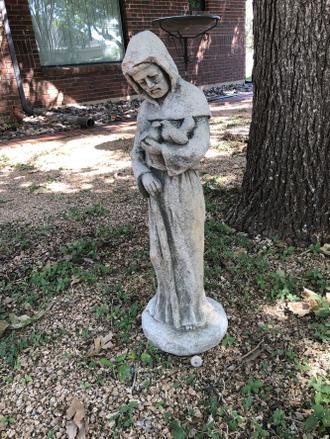
خیلی کتاب لذت بخشی بود برای من. در میانه خواندنش با تنها دوست آمریکایی م درباره ش حرف زدم و او با اینکه پروتستان است گفت فرانچسکو برایش مورد احترام است و عکس زیر را از حیاط خانه اش فرستاد که یک تمثال سنگی از فرانچسکو است و همانطور که میبینید اینجا هم پرنده در آغوش دارد
بهانه آشنا شدن با فرانچسکو آسیزی برای من موسیقی بی نظیر فیلم "فرانچسکو" بود که ونجلیس ساخته بود و ترغیبم کرد فیلم را پیدا کنم و ببینم. اثری درخشان به کارگردانی لیلیانا کاوانی که نگاهش علاوه بر مذهبی بودن کاملا هنری هم هست. فیلم دیگری درباره زندگی فرانچسکو آسیزی هم دیدم به نام "برادر خورشید، خواهر ماه" که یک ایتالیایی دیگر ساخته و این اصلا غنای هنری فیلم کاوانی را ندارد و بیشتر برای مخاطب معتقد مذهبی ساخته شده
بعد اتفاقی رسیدم به این کتاب. خواندنش واقعا مثل نوشیدن آب زلال و یخ از یک جوی کوچک در سبزه زار پای کوه است. همان یک ذره ساختار و طرح و توطئه که کازانتزاکیس در زوربا و مسیح بازمصلوب تعبیه کرده هم اینجا وجود ندارد و البته به نظرم این همان هماهنگی فرم و محتواست چون زندگی فرانچسکو آسیزی همین قدر مبتنی بر گریز از همه تعلقات و بندهای دنیایی است
صحنه های مهم زندگی فرانچسکو که در دو فیلم وجود دارد اینجا هم هستند: گفتگو و انس با پرندگان، برهنه شدن در منظر عموم، همراه شدن با جزامیان، رفتن به دیدار پاپ برای گرفتن تایید فرقه و ... البته در فیلم فرانچسکو صحنه زخم پذیری فرانچسکو هم وجود دارد که با موسیقی ونجلیس جزو تاثیرگذارترین بخشهای فیلم است. زخم پذیری یعنی فرد معتقد و مومن به حضرت مسیح با پدید آمدن همان پنج زخمی که مسیح بر صلیب داشت مورد تایید و تقدیس او قرار بگیرد که فرانسیسکن ها معتقدند فرانچسکو اولین زخم پذیر تاریخ بوده است. بعد از او هم افراد دیگری مدعی پدیدار شدن زخم در کف دستها و پاها شده اند.
در طول مطالعه بارها و بارها فکر کردم فاصله عرفان فرانچسکو با عرفان اسلامی به نازکی مو است. مهمترین آموزه های او "فقر کامل و عشق کامل" هستند. مدام لذت طلبی را نکوهش میکند و یارانش را به ترک دنیا و دوری از قدرت طلبی فرا میخواند. از مهم ترین فرازهای رمان (و هر دو فیلم) اواخر کار است که اقبال به فرانچسکو زیاد شده و جوانان از گوشه و کنار ایتالیا می آینده تا به فرقه او بپیوندند اما فرانچسکو نه بلد است و نه میخواهد که مرامنامه ای تدوین کند. گیج و گول و سرگشته خداست و این خودش باعث اعتراضاتی میشود.
اگر ریویو را در این صفحه بخوانید برخی از مواعظ عارفانه و دلنشین فرانچسکو را هم میتوانید ذیل متن ببینید و لذت ببرید
درباره این که کازانتزاکیس در این رمان چه کار کرده من هم مثل خیلی های دیگر نمیتوانم نظر بدهم چرا که او مهم ترین کار را کرده: خودش را کنار کشیده! از میان برخاسته تا حجابی بین مخاطب و فرانچسکو نشود. به نظرم خیلی با عشق و اعتقاد این رمان را نوشته و با توجه به دو رمان قبلی که اسم بردم باید هم این طور باشد. کازانتزاکیس منتقد سرسخت قدرت طلبی و دنیاپرستی کلیسای مسیحی است و اینجا با ارادت فراوان نسبت به فرانچسکو مینویسد که اشرافزاده ای فراری از لذتها بود
این را هم بنویسم و تمام: در نهج البلاغه امیرالمومنین وقتی از عیسی علیه السلام یاد میکند او را به همین صفت دنیاگریزی و گرایش به فقر میستاید با تعابیر تکان دهنده
اما فارغ از بحث دین به نظرم برای لذت بردن از این کتاب باید کمی احوالات درویشی و مردم گریزی داشته باشید. باید ذوق خاص عرفانی، دوری از لذت ها، تردید در توقعات بی پایان بشری و بیزاری از طمع سیری ناپذیر آدمها و خلاصه یک جور صوفی مسلکی داشته باشید. اگر این نمک در آب و گلتان نباشد همان اول کتاب را به کناری می اندازید.

December 31, 2012
In honor of the new Pope's election, my roommate named his T.V. Francis and I finally picked up Nikos Kazantzakis's novel Saint Francis, which has been on my shelf for two years.
This book is told in the first person by Brother Leo, the title character's companion. The narrator, many of the other characters, and many of the events are true to history. Unfortunately, while Francis of Assisi is a compelling figure from history, the character in this book didn't work for me. His transformation is too quick and inexplicable and he then spends the entire book torturing himself.
After having done nothing worse than eat good food, play music for the ladies, and desire military glory, Francis turns into a hard core ascetic and begins collecting a number of followers, whose undying loyalty to Francis seems under-motivated. At first he rebuilds a church and shows compassion to lepers, but thereafter he never does anything to help anyone. He just starves, freezes, exhausts, and flagellates himself, ultimately leading to his death, which I must rule a suicide.
Francis comes across as "so heavenly minded he's no earthly good." At one point he literally catches on fire and tells his companions not to put it out. Unfortunately, they do (leading to another 150 pages before he finally kills himself). After his inexplicable conversion, his character doesn't change. Brother Leo is also totally static, but at least comes across as a bit more human.
All of Francis's struggles are internal and seem manufactured. Though if you think God wants some people to torture themselves you may disagree. There was some tension with Brother Elias, but it never went anywhere. I got excited halfway through when the girl he was infatuated with, Clara, showed up again. But, after forcing him to look at her, she immediately joins his order and is shipped off to a convent where she can't possibly tempt him or provide any drama.
The book's message is a mess. He affirms the goodness of creation, but keeps it at arm's length. He puts handfuls of ashes in his food so he won't enjoy it too much. He praises God's goodness in giving us wine, but why? I'm sure he'd just pee in it so he wouldn't like it too much. Francis tells his friars to work for their living, but never works at all himself.
As a whole, this novel has a lot of issues. The pacing is off, the characters are all static, Francis is unrelatable and not very likeable, and the problem he wrestles with seems artificial, and the book's framework doesn't build to a natural conclusion. There are good episodes, anecdotes, parables, sayings, and such throughout. But they don't form a coherent whole.
If you're looking for a novel about the inner struggles of a well-known Christian figure, I'd suggest The Last Temptation of Christ by the same author. There is external opposition to the main character, who undergoes legitimate change, and has a strong conclusion that it builds to. None of that happens here. 2/5 and not recommended.
This book is told in the first person by Brother Leo, the title character's companion. The narrator, many of the other characters, and many of the events are true to history. Unfortunately, while Francis of Assisi is a compelling figure from history, the character in this book didn't work for me. His transformation is too quick and inexplicable and he then spends the entire book torturing himself.
After having done nothing worse than eat good food, play music for the ladies, and desire military glory, Francis turns into a hard core ascetic and begins collecting a number of followers, whose undying loyalty to Francis seems under-motivated. At first he rebuilds a church and shows compassion to lepers, but thereafter he never does anything to help anyone. He just starves, freezes, exhausts, and flagellates himself, ultimately leading to his death, which I must rule a suicide.
Francis comes across as "so heavenly minded he's no earthly good." At one point he literally catches on fire and tells his companions not to put it out. Unfortunately, they do (leading to another 150 pages before he finally kills himself). After his inexplicable conversion, his character doesn't change. Brother Leo is also totally static, but at least comes across as a bit more human.
All of Francis's struggles are internal and seem manufactured. Though if you think God wants some people to torture themselves you may disagree. There was some tension with Brother Elias, but it never went anywhere. I got excited halfway through when the girl he was infatuated with, Clara, showed up again. But, after forcing him to look at her, she immediately joins his order and is shipped off to a convent where she can't possibly tempt him or provide any drama.
The book's message is a mess. He affirms the goodness of creation, but keeps it at arm's length. He puts handfuls of ashes in his food so he won't enjoy it too much. He praises God's goodness in giving us wine, but why? I'm sure he'd just pee in it so he wouldn't like it too much. Francis tells his friars to work for their living, but never works at all himself.
As a whole, this novel has a lot of issues. The pacing is off, the characters are all static, Francis is unrelatable and not very likeable, and the problem he wrestles with seems artificial, and the book's framework doesn't build to a natural conclusion. There are good episodes, anecdotes, parables, sayings, and such throughout. But they don't form a coherent whole.
If you're looking for a novel about the inner struggles of a well-known Christian figure, I'd suggest The Last Temptation of Christ by the same author. There is external opposition to the main character, who undergoes legitimate change, and has a strong conclusion that it builds to. None of that happens here. 2/5 and not recommended.
June 2, 2024
După „Ultimpa ispită a lui Hristos” a urmat această mărturie romanțată în maniera lui Nikos Kazantzakis a vieții sfântului Francisc din Assisi care mi-a plăcut atât de mult încât pur și simplu am bifat pe Google Maps toate locurile în care Sf. Francisc și „leuțul său” au ajuns în această călătorie ghidată de Dumnezeu prin aparițiile din visele eroului.
„-Dumnezeu ține în mână un burete și șterge. Nu sabie, nu cântar; burete. Iar dac-ar fi să zugrăvesc Mila lui Dumnezeu, L-aș zugrăvi pe El ținând în mână un burete . Toate păcatele vor fi șterse, frate Leo, toți păcătoșii vor fi mântuiți, Satana însuși, frate Leo, va fi mântuit, iar iadul nu-i nimic altceva decât anticamera raiului.
-Dar atunci... am început eu.
-Taci, spuse, nu micșora măreția lui Dumnezeu.”
„-Ai grijă de Francisc, spuse părintele Silvestro plecând, îl sfâșie Dumnezeu și o să-l mănânce, nu vezi? Nu i-au rămas vii decât ochii răniți, dacă se sting și ei, frate Leo, se va stinge lumina din lume.”
„-Și sfânta Simplitate?
-S-a dus și ea, frate Francisc. Au deschis școli noi, aleargă unii la Bologna, alții la Paris, și studiază cum să potcovească puricele. Adună carți groase, urcă la amvon, țin cuvântări, asudă din greu ca să arate că Cristos este Dumnezeu, că s-a răstignit și că a treia zi a înviat. Și atât de mult le încurcă, încât mintea se zăpăcește și inima omului îngheață. Din ziua-n care au început învățații să vorbească, Cristos n-a mai înviat.”
„-Dumnezeu ține în mână un burete și șterge. Nu sabie, nu cântar; burete. Iar dac-ar fi să zugrăvesc Mila lui Dumnezeu, L-aș zugrăvi pe El ținând în mână un burete . Toate păcatele vor fi șterse, frate Leo, toți păcătoșii vor fi mântuiți, Satana însuși, frate Leo, va fi mântuit, iar iadul nu-i nimic altceva decât anticamera raiului.
-Dar atunci... am început eu.
-Taci, spuse, nu micșora măreția lui Dumnezeu.”
„-Ai grijă de Francisc, spuse părintele Silvestro plecând, îl sfâșie Dumnezeu și o să-l mănânce, nu vezi? Nu i-au rămas vii decât ochii răniți, dacă se sting și ei, frate Leo, se va stinge lumina din lume.”
„-Și sfânta Simplitate?
-S-a dus și ea, frate Francisc. Au deschis școli noi, aleargă unii la Bologna, alții la Paris, și studiază cum să potcovească puricele. Adună carți groase, urcă la amvon, țin cuvântări, asudă din greu ca să arate că Cristos este Dumnezeu, că s-a răstignit și că a treia zi a înviat. Și atât de mult le încurcă, încât mintea se zăpăcește și inima omului îngheață. Din ziua-n care au început învățații să vorbească, Cristos n-a mai înviat.”

February 21, 2023
მინდოდა ვრცელი რევიუ დამეწერა, მაგრამ საქმე საქმეზე რომ მიდგა, მივხვდი, რომ ვერ შევძლებდი. რა უნდა ვთქვა ადამიანზე, ვინც აბსოლუტურ სიყვარულს და მშვიდობას ქადაგებდა. ან კაზანძაკისის სამწერლო ოსტატობას რას შემატებს ჩემი ქება. ადრე შემთხვევით ინტერნეტში გადავაწყდი ფრანცისკე ასიზელის ლოცვას და იმდენად ჩამწვდა გულში, რომ მას მერე ჩემი მთავარი ლოცვა გახდა. ჰოდა ის ჩემზე კარგად იტყვის სათქმელს:
ღმერთო, მაქციე შენი სამყაროს ინსტრუმენტად.
და იქ, სადაც სიძულვილია, სიყვარული დამათესინე,
სადაც წყენაა - მიტევება,
სადაც უიმედობა - სიხარული,
სადაც ეჭვია - რწმენა,
სადაც სასოწარკვეთილება - იმედი,
და იქ, სადაც სიბნელეა, ღმერთო, მაქციე სინათლედ.
ო, ღვთაებრივო ოსტატო!
მომეცი ძალა იმისათვის, რომ გავუგო, იმის მაგიერ, რომ მსურდეს, რომ გამიგონ მე.
დავეხმარო, და არა ვისურვო, რომ დამეხმარონ მე.
მიყვარდეს, და არა ვისურვო, რომ მე ვუყვარდე.
რამეთუ, გაცემისას - ღებულობ,
მიტევებისას - შენც გეპატიება,
გარდაცვალებისას - ვიბადებით მარადიული ცხოვრებისათვის.
ო, ღვთაებრივო ოსტატო!
ღმერთო, მაქციე შენი სამყაროს ინსტრუმენტად!
და მაშინ სასწაულს მოყვება სასწაული.
და ის არასოდეს დასრულდება.
ღმერთო, მაქციე შენი სამყაროს ინსტრუმენტად.
და იქ, სადაც სიძულვილია, სიყვარული დამათესინე,
სადაც წყენაა - მიტევება,
სადაც უიმედობა - სიხარული,
სადაც ეჭვია - რწმენა,
სადაც სასოწარკვეთილება - იმედი,
და იქ, სადაც სიბნელეა, ღმერთო, მაქციე სინათლედ.
ო, ღვთაებრივო ოსტატო!
მომეცი ძალა იმისათვის, რომ გავუგო, იმის მაგიერ, რომ მსურდეს, რომ გამიგონ მე.
დავეხმარო, და არა ვისურვო, რომ დამეხმარონ მე.
მიყვარდეს, და არა ვისურვო, რომ მე ვუყვარდე.
რამეთუ, გაცემისას - ღებულობ,
მიტევებისას - შენც გეპატიება,
გარდაცვალებისას - ვიბადებით მარადიული ცხოვრებისათვის.
ო, ღვთაებრივო ოსტატო!
ღმერთო, მაქციე შენი სამყაროს ინსტრუმენტად!
და მაშინ სასწაულს მოყვება სასწაული.
და ის არასოდეს დასრულდება.

May 16, 2016
Scrierea tulburătoare a lui Kazantzakis face din Sfântul Francisc din Assisi nu numai un personaj istoric de însemnătate negrăită, ci și un personaj literar monumental. Iar cartea pare să răspândească la fiece pagină pilda neprihănită a iubirii, printr-un meșteșug rafinat al limbajului. O veritabilă plăcere estetică, un roman care se citește cu sentimentul acut al căinței și al fericirii de toate zilele. 4,5/5

December 25, 2014
I've read this book three times. There are many non-fiction books about Francis, as there should be. He is one of the most important saints in the Catholic world. But he is often misunderstood as a kind of love child/hippie dancing in ecstasy among the animals. Or someone who transcended the Roman Catholic Church. Not even close on all counts. Nikos Kazantzakis, who wrote "Zorba The Greek" and "The Last Temptation of Christ," among others, clearly loved Francis. This is a work of fiction, but also one of love and reverence. We actually know a lot about Francis, which is remarkable given he lived 900 years ago. Kazantzakis manages to delve into the heart of Francis while at the same time staying more or less true to what is historically true. Let me say this, because I"m having trouble expressing this: This book helped me more than any other to build a love for Francis that I would never have gotten in a non-fiction book. Francis is accessible to all but make no mistake that he was a devoted son of the Church.. He made sure that the pope approved his radical agenda.

May 22, 2012
When this 624 page book landed on my doorstep, I chuckled. I'll never find time to finish it, I thought. Then I started to read it. I couldn't put it down. Nikos Kazantzakis does such a great job of pulling in the reader. I was hooked. I finished it in two days.
Kazantzakis managed to capture the essence of St. Francis--a man who many of us can relate to. St. Francis is portrayed as a glory-seeking partier who turned from his ways and brought many to Christ.
As I read it, I felt like I was walking the journey with St. Francis. I could picture him wandering around San Damiano begging for stones to rebuild a church that had fallen into disrepair. I could see the countryside that he crossed, the people he encountered, and the very first nativity scene. It has drawn me closer to this lovable Saint, wanting to learn more about him, and emulate some of his wonderful, faithful qualities.
Kazantzakis managed to capture the essence of St. Francis--a man who many of us can relate to. St. Francis is portrayed as a glory-seeking partier who turned from his ways and brought many to Christ.
As I read it, I felt like I was walking the journey with St. Francis. I could picture him wandering around San Damiano begging for stones to rebuild a church that had fallen into disrepair. I could see the countryside that he crossed, the people he encountered, and the very first nativity scene. It has drawn me closer to this lovable Saint, wanting to learn more about him, and emulate some of his wonderful, faithful qualities.

April 29, 2021
After recently finishing Will Durant's The Age of Faith, I felt the resonance of this retelling of the life of Saint Francis. Though I am not particularly religious at this point in my life, I perceived some of the roots of the faith in which I was raised and the faith from which the non-violent protests driven by Martin Luther King in the 1960s derived. Kazantzakis always put his own interpretation on suffering, God, Christ and the saints. Somehow I can feel in sympathy with such views, even some relevance in my own life. The book is moving and makes one think about how to deal with adversity and oppression.
April 7, 2017
O carte scrisă într'o manieră emoționantă. O carte care te poartă prin zambete involuntare și cugetări nostalgice. O carte despre Dumnezeu și ispită, despre bine și rău. O întreagă luptă împotriva trupului. O flagelare voită și dorită de suflet pentru a învinge ispita care nu'ți dă niciodată pace: trupul.
"Eu și tu dispar. Iubesc înseamnă: dispar eu."
"Eu și tu dispar. Iubesc înseamnă: dispar eu."
October 17, 2007
سنت فرانسیس آسیزی
یا ترجمه ی ایرانی اش که شده
سرگشته ی راه حق
داستانی واقعی به قلم شیوای نیکوس .
قدیسی را به ما نشان میدهد که در همه ی مراحل
یک انسان است
یا ترجمه ی ایرانی اش که شده
سرگشته ی راه حق
داستانی واقعی به قلم شیوای نیکوس .
قدیسی را به ما نشان میدهد که در همه ی مراحل
یک انسان است

May 11, 2023
Ένας θρησκευτικός λαπας που δεν με συγκίνησε και δεν καταφερα να συντονιστω αλλά μάλλον με κούρασε , μια κατεύθυνση συγκατάβασης που δεν με αφορά και δεν καταφερα να την αντέξω ως το τέλος , ο Καζαντζακης εχει ενδιαφέροντα στοιχεία αν και τα αποδίδει καλύτερα σε αλλά έργα και η αλήθεια είναι ότι τα τελευταία αναγνώσματα μου της βιβλιογραφίας του με απογοητεύουν οικτρά, βεβαια ακόμα θυμαμαι σημεία της ασκητικής που με κέρδισαν και δεν έχω αναμετρηθεί με τα τρία σημαντικότερα του έργα πέρα της ασκητικής που θα γίνει και αυτο καθώς τα έχω αγοράσει

September 26, 2017
Περνάει πολύ σημαντικά μηνύματα.Μία διαφορετική ματιά πάνω στη πίστη και στην αλληλοϋποστήριξη,συγκινητικό αλλά τραβάει σε μάκρος και κουράζει,με επαναλαμβανόμενα μοτίβα και ίδιες πάντα δανεικές και αναμασημένες ιδέες.Μετά την ανάγνωση του βιβλίου απορώ πως γίνεται να έδιωξε η εκκλησία το μεγαλύτερο Έλληνα συγγραφέα.Όχι μόνο δεν είναι ιερόσυλος αλλά φαίνεται και πιο θρησκευόμενος από πάρα πολλούς ιερωμένους της εκκλησίας.
May 18, 2016
I read this book for the first time 30 years ago
This man - Nikos Kazantzakis - is still there, speaking loud and strong in many corners of my soul
A few month ago, I found an interview with him in youtube
Wow...
https://youtu.be/jRd2K22Mgqg
This man - Nikos Kazantzakis - is still there, speaking loud and strong in many corners of my soul
A few month ago, I found an interview with him in youtube
Wow...
https://youtu.be/jRd2K22Mgqg

October 23, 2014
Συναισθηματικά φορτωμένος ο συγγραφέας μας παρουσιάζει το υπόδειγμα ενός λειτουργού της θρησκείας.
July 17, 2025
Kazantzakis’s Saint Francis does not offer the domesticated Francis of postcards, bird sermons, brown robes, and gentle piety. It gives us a starving, bleeding, excessive, almost unbearable man who takes the Gospel so literally that ordinary life itself begins to look like apostasy.
If The Odyssey: A Modern Sequel explores the external limits of freedom, sending Odysseus outward through civilizations, religions, revolutions, and deserts until no harbor can hold him, and if The Last Temptation of Christ turns that same struggle inward, making the body and soul of Jesus the battlefield of salvation, then Saint Francis (published in Greek one year later) pushes Kazantzakis’s spiritual drama into its most ascetic and joyful form. It is the novel of holy poverty, but poverty understood as a metaphysical weapon. Francis does not merely give up possessions. He declares war on possession itself.
Kazantzakis does not write a Catholic hagiography in the conventional sense. He writes a myth of spiritual combustion. His Francis is not holy because he is meek but because he has accepted the terrible command that governs Kazantzakis’s entire universe: matter must be transubstantiated into spirit. Human beings are not placed on earth in order to be comfortable, moderate and respectable. They are entrusted with flesh, hunger, fear, shame, weakness, love, hope and death so that they may burn these things and send the smoke upward. The body is not simply rejected; it is also used as fuel.
Kazantzakis’s Odyssey says:
My life is a strong arrow, mounted toward the sky
but now the earth allures it to a sweet descent.
(Book III, 1172-1173)
And his autobiographical novel – Report to Greco starts with an epigraph:
Three kinds of souls, three prayers:
I am a bow in your hands, Lord. Draw me, lest I rot.
Do not overdraw me, Lord. I shall break.
Overdraw me, Lord. And who cares if I break.
Taken together, the lines from the Odyssey, the epigraph to Report to Greco, and Francis’s own language reveal one of Kazantzakis’s central images: the human being as a tension between the downward pull of earth and the upward propulsion of spirit. The body is not merely a prison, nor simply an enemy to be despised. It is the bow whose very strain makes the flight of the arrow possible. In this sense, Kazantzakis transforms Bergson’s élan vital into a dramatic image: life ascends only by resisting matter, yet it can ascend only through matter. The body must be overcome, but not bypassed; it must be bent, wounded, disciplined, and finally converted into spiritual force. This also helps explain Kazantzakis’s attraction to pre-Christian Greek vitality: he does not seek a purely disembodied (pre-axial) spirituality, but a tragic vision in which body, struggle, suffering, and sacred ascent still form one indivisible process.
This is why Francis cannot follow any middle road. Moderation belongs to those who want to remain intact. Francis wants to be consumed. When he says that man stands within the bounds of moderation but God stands outside them, he formulates the Kazantzakian view of sanctity. God is not found in balance, but in excess*; in the leap beyond security; not in the respectable compromise between earth and heaven, but in the impossible demand that earth itself become heaven through agony.**
*Much like ancient Greek heroes - often not pious and modest, but simply extreme in some way and that is why they often meet terrible ends.
**And even Satan might rise from the bowels of hell and be forgiven (Francis’s wish)
The God of this novel is not a comforting father watching from above. He is the imperiled, struggling God of Kazantzakis’s mature imagination: the divine force trapped in matter, crying out from within creation, demanding to be liberated through human courage. Francis hears this God not as consolation but as command. Again and again, after each victory, after every renunciation, after each step beyond ordinary human limitation, the inner cry returns: not enough! Rebuild San Damiano — not enough. Abandon wealth — not enough. Embrace poverty — not enough. Kiss the leper — not enough. Give up the world — not enough. Give up even the desire for heaven.
This is the source of the novel’s terrifying energy. Francis’s sanctity is an escalation. He must become what he is by being driven beyond what he can bear. Like Kazantzakis’s Christ, he does not begin in the narrative as a finished ideal. He is hammered into sanctity. The halo is not given; it is forged. The saint is the struggling man brought to incandescence.
Brother Leo is crucial because without him Francis might become too remote, too absolute, too inhuman. Leo is the frightened and faithful witness, the ordinary human soul dragged behind the impossible. He is hungry when Francis wants to fast, cold when Francis feels divine wings around him, terrified when Francis wants to leap. He understands the attraction of the warm fire, the full belly, the small shelter, the little mercy of satisfaction. This real historical figure becomes for Kazantzakis the human weight that makes Francis’s ascent visible.
Together, Francis and Leo form one divided being. Francis is the upward flame; Leo is the earth that resists being burned. Francis is the soul’s insane demand; Leo is the body asking why salvation must hurt so much. Their relationship prevents the novel from becoming abstract theology. It gives the struggle a body, a companion, a witness, and sometimes a protest in the voice of reason. Leo loves Francis, but he cannot fully follow him. Through Leo, the reader is allowed to admire Francis without pretending that such sanctity is easy, balanced, or even entirely sane and attainable for a normal human.
Francis is one of Kazantzakis’s purest images of freedom. But the freedom here is not Odyssean restlessness. Francis does not prove his freedom by abandoning every harbor. He proves it by emptying himself so completely that nothing can possess him. Odysseus is free because no value can finally hold him. Francis is free because one value — poverty — has consumed him so absolutely that all lesser values lose their power.
Francis’s kinship with birds, wolves, sun, moon, water, fire, and death is not the pleasant ecology of a gentle medieval soul. It is the result of dispossession. He can call the sun brother and the moon sister only because he no longer wants to own the world. Perhaps for him once creation is no longer useful, it becomes sacred. This is one of the novel’s deepest paradoxes. Francis renounces the earth and receives it back transfigured. He strips himself naked and becomes kin to everything.
The encounter with the leper is one of the novel’s great Kazantzakian moments because it reveals that transcendence does not mean bypassing horror. Francis does not reach God by avoiding the repulsive, diseased, wounded, and humiliating parts of existence. He reaches God by embracing precisely what his flesh fears most. The leper is not an obstacle to spirituality but its gate. Francis discovers Christ in the rotting body and sanctity begins where disgust is transfigured into love.
The opposition between flesh and spirit in Kazantzakis’s works should never be read too crudely. The flesh is dangerous because it seeks comfort, repetition, sleep, satisfaction. But it is also the necessary battlefield. Without the body, there is no ascent. Without hunger, there is no fasting. Without desire, there is no renunciation. The body is “Brother Donkey”: stubborn, ridiculous, burdensome, but also loyal, and necessary. Francis’s late tenderness toward his own body prevents the novel from collapsing into a simple dualism. The body is not evil. It is the poor animal that has carried the soul toward God. Francis even asks his own body for forgiveness.
Francis’s rejection of family, wealth, erotic fulfillment, and social respectability can be unsettling. The novel does not allow us to dismiss these things as false values. One of the possible roads to God is to marry, have children and start a family. These values are real, beautiful and human. But for Francis they are not final. His calling is so extreme that even legitimate happiness becomes temptation when it asks the soul to stop too soon. Francis wants the most difficult road.
Later in the novel the order Francis founds begins to harden into institution. Brother Elias introduces pragmatism, hierarchy, and organization. The Franciscan flame becomes administrable. This is not merely a historical disappointment; it is one of the central tragedies of religious life. Revelation erupts as fire, but institutions preserve fire by turning it into rule and structure. Here Saint Francis touches the same disturbing insight that appears in The Last Temptation: the living sacred event cannot enter history without being interpreted, organized, defended, and partially falsified. Francis’s poverty is too pure to survive unchanged in the world. The saint creates a flame; the institution builds a lantern around it. The lantern protects the flame, but it also limits its light.
The culmination on Mount Alvernia is the logical endpoint of Francis’s whole existence. He does not merely admire Christ. He wants to undergo Christ. The stigmata are the final transubstantiation of body into meaning / logos / spirit.
And then comes Kazantzakis’s most radical move: Crucifixion, Resurrection, and Paradise are revealed as one. This is wonderful Kazantzakian extremity rooted in dialectic and holism. Paradise is not a reward after agony. Resurrection is not a cancellation of the cross. The cross itself, fully accepted, already contains resurrection.*** The true saint must renounce not only earthly possessions but even heavenly reward.
***The narrative of The Last Temptation does not include a resurrection at all.
Saint Francis does not send the hero to the end of the earth, nor between humanity and divinity. The hero is important because he shows what the human soul might become when it refuses to remain safely enclosed in itself.
Francis does not remain a grub because the cocoon is warm. But neither does he become a butterfly by despising the cocoon. He tears through it, blesses it, and leaves it behind. Then, wounded and singing, he calls even death his sister.
If The Odyssey: A Modern Sequel explores the external limits of freedom, sending Odysseus outward through civilizations, religions, revolutions, and deserts until no harbor can hold him, and if The Last Temptation of Christ turns that same struggle inward, making the body and soul of Jesus the battlefield of salvation, then Saint Francis (published in Greek one year later) pushes Kazantzakis’s spiritual drama into its most ascetic and joyful form. It is the novel of holy poverty, but poverty understood as a metaphysical weapon. Francis does not merely give up possessions. He declares war on possession itself.
Kazantzakis does not write a Catholic hagiography in the conventional sense. He writes a myth of spiritual combustion. His Francis is not holy because he is meek but because he has accepted the terrible command that governs Kazantzakis’s entire universe: matter must be transubstantiated into spirit. Human beings are not placed on earth in order to be comfortable, moderate and respectable. They are entrusted with flesh, hunger, fear, shame, weakness, love, hope and death so that they may burn these things and send the smoke upward. The body is not simply rejected; it is also used as fuel.
Kazantzakis’s Odyssey says:
My life is a strong arrow, mounted toward the sky
but now the earth allures it to a sweet descent.
(Book III, 1172-1173)
And his autobiographical novel – Report to Greco starts with an epigraph:
Three kinds of souls, three prayers:
I am a bow in your hands, Lord. Draw me, lest I rot.
Do not overdraw me, Lord. I shall break.
Overdraw me, Lord. And who cares if I break.
Taken together, the lines from the Odyssey, the epigraph to Report to Greco, and Francis’s own language reveal one of Kazantzakis’s central images: the human being as a tension between the downward pull of earth and the upward propulsion of spirit. The body is not merely a prison, nor simply an enemy to be despised. It is the bow whose very strain makes the flight of the arrow possible. In this sense, Kazantzakis transforms Bergson’s élan vital into a dramatic image: life ascends only by resisting matter, yet it can ascend only through matter. The body must be overcome, but not bypassed; it must be bent, wounded, disciplined, and finally converted into spiritual force. This also helps explain Kazantzakis’s attraction to pre-Christian Greek vitality: he does not seek a purely disembodied (pre-axial) spirituality, but a tragic vision in which body, struggle, suffering, and sacred ascent still form one indivisible process.
This is why Francis cannot follow any middle road. Moderation belongs to those who want to remain intact. Francis wants to be consumed. When he says that man stands within the bounds of moderation but God stands outside them, he formulates the Kazantzakian view of sanctity. God is not found in balance, but in excess*; in the leap beyond security; not in the respectable compromise between earth and heaven, but in the impossible demand that earth itself become heaven through agony.**
*Much like ancient Greek heroes - often not pious and modest, but simply extreme in some way and that is why they often meet terrible ends.
**And even Satan might rise from the bowels of hell and be forgiven (Francis’s wish)
The God of this novel is not a comforting father watching from above. He is the imperiled, struggling God of Kazantzakis’s mature imagination: the divine force trapped in matter, crying out from within creation, demanding to be liberated through human courage. Francis hears this God not as consolation but as command. Again and again, after each victory, after every renunciation, after each step beyond ordinary human limitation, the inner cry returns: not enough! Rebuild San Damiano — not enough. Abandon wealth — not enough. Embrace poverty — not enough. Kiss the leper — not enough. Give up the world — not enough. Give up even the desire for heaven.
This is the source of the novel’s terrifying energy. Francis’s sanctity is an escalation. He must become what he is by being driven beyond what he can bear. Like Kazantzakis’s Christ, he does not begin in the narrative as a finished ideal. He is hammered into sanctity. The halo is not given; it is forged. The saint is the struggling man brought to incandescence.
Brother Leo is crucial because without him Francis might become too remote, too absolute, too inhuman. Leo is the frightened and faithful witness, the ordinary human soul dragged behind the impossible. He is hungry when Francis wants to fast, cold when Francis feels divine wings around him, terrified when Francis wants to leap. He understands the attraction of the warm fire, the full belly, the small shelter, the little mercy of satisfaction. This real historical figure becomes for Kazantzakis the human weight that makes Francis’s ascent visible.
Together, Francis and Leo form one divided being. Francis is the upward flame; Leo is the earth that resists being burned. Francis is the soul’s insane demand; Leo is the body asking why salvation must hurt so much. Their relationship prevents the novel from becoming abstract theology. It gives the struggle a body, a companion, a witness, and sometimes a protest in the voice of reason. Leo loves Francis, but he cannot fully follow him. Through Leo, the reader is allowed to admire Francis without pretending that such sanctity is easy, balanced, or even entirely sane and attainable for a normal human.
Francis is one of Kazantzakis’s purest images of freedom. But the freedom here is not Odyssean restlessness. Francis does not prove his freedom by abandoning every harbor. He proves it by emptying himself so completely that nothing can possess him. Odysseus is free because no value can finally hold him. Francis is free because one value — poverty — has consumed him so absolutely that all lesser values lose their power.
Francis’s kinship with birds, wolves, sun, moon, water, fire, and death is not the pleasant ecology of a gentle medieval soul. It is the result of dispossession. He can call the sun brother and the moon sister only because he no longer wants to own the world. Perhaps for him once creation is no longer useful, it becomes sacred. This is one of the novel’s deepest paradoxes. Francis renounces the earth and receives it back transfigured. He strips himself naked and becomes kin to everything.
The encounter with the leper is one of the novel’s great Kazantzakian moments because it reveals that transcendence does not mean bypassing horror. Francis does not reach God by avoiding the repulsive, diseased, wounded, and humiliating parts of existence. He reaches God by embracing precisely what his flesh fears most. The leper is not an obstacle to spirituality but its gate. Francis discovers Christ in the rotting body and sanctity begins where disgust is transfigured into love.
The opposition between flesh and spirit in Kazantzakis’s works should never be read too crudely. The flesh is dangerous because it seeks comfort, repetition, sleep, satisfaction. But it is also the necessary battlefield. Without the body, there is no ascent. Without hunger, there is no fasting. Without desire, there is no renunciation. The body is “Brother Donkey”: stubborn, ridiculous, burdensome, but also loyal, and necessary. Francis’s late tenderness toward his own body prevents the novel from collapsing into a simple dualism. The body is not evil. It is the poor animal that has carried the soul toward God. Francis even asks his own body for forgiveness.
Francis’s rejection of family, wealth, erotic fulfillment, and social respectability can be unsettling. The novel does not allow us to dismiss these things as false values. One of the possible roads to God is to marry, have children and start a family. These values are real, beautiful and human. But for Francis they are not final. His calling is so extreme that even legitimate happiness becomes temptation when it asks the soul to stop too soon. Francis wants the most difficult road.
Later in the novel the order Francis founds begins to harden into institution. Brother Elias introduces pragmatism, hierarchy, and organization. The Franciscan flame becomes administrable. This is not merely a historical disappointment; it is one of the central tragedies of religious life. Revelation erupts as fire, but institutions preserve fire by turning it into rule and structure. Here Saint Francis touches the same disturbing insight that appears in The Last Temptation: the living sacred event cannot enter history without being interpreted, organized, defended, and partially falsified. Francis’s poverty is too pure to survive unchanged in the world. The saint creates a flame; the institution builds a lantern around it. The lantern protects the flame, but it also limits its light.
The culmination on Mount Alvernia is the logical endpoint of Francis’s whole existence. He does not merely admire Christ. He wants to undergo Christ. The stigmata are the final transubstantiation of body into meaning / logos / spirit.
And then comes Kazantzakis’s most radical move: Crucifixion, Resurrection, and Paradise are revealed as one. This is wonderful Kazantzakian extremity rooted in dialectic and holism. Paradise is not a reward after agony. Resurrection is not a cancellation of the cross. The cross itself, fully accepted, already contains resurrection.*** The true saint must renounce not only earthly possessions but even heavenly reward.
***The narrative of The Last Temptation does not include a resurrection at all.
Saint Francis does not send the hero to the end of the earth, nor between humanity and divinity. The hero is important because he shows what the human soul might become when it refuses to remain safely enclosed in itself.
Francis does not remain a grub because the cocoon is warm. But neither does he become a butterfly by despising the cocoon. He tears through it, blesses it, and leaves it behind. Then, wounded and singing, he calls even death his sister.

June 22, 2013
Der Geruch des Heiligen
Bis heute ist der heilige Franz von Assisi einer der Heiligen, die auch in der modernen Gesellschaft geschätzt werden können - soweit, dass ein Papst heute seinen Namen annehmen kann und dafür gelobt wird. Doch das war nicht immer so, seine Lehre war immer kurz davor, als Häresie gebrandmarkt zu werden, und seine minoritischen Ordensbrüder mussten oft genug um ihr Leben fürchten, selbst, wenn sie wie Bruder Leo, der Erzähler dieser modernen Hagiografie des Franziskus, seine Lehre nicht aktiv missionierend verbreiteten.
Aus dem Lebemann Franziskus wird der Asket Franziskus - eine Wandlung, die seine Familie, Freunde und Umgebung bass erstaunt, und die viele erschreckt, denn nicht seine plötzliche Einkehr und Hinwendung zu Gott ist es, was ihn vor allen anderen religiösen Anführern, damals ausgesprochen häufig anzutreffen, auszeichnet: Es ist sein Totalitarismus, sein Extremismus. Wer ihm folgt, muss nicht nur sein altes Leben ablegen, sondern sogar sein Menschsein völlig aufgeben. Ein Stein ist ebenso Geschöpf Gottes wie ein Mensch.
Franziskus, der auch als Schutzpatron der Tiere gehandelt wird, erkennt in allem Materiellen Gott. Schwester Feuer, Bruder Wasser, Freund Vogel: Alles ist Gottes Schöpfung, alles ist inkarnierte Heiligkeit. Um so überraschender ist seine gleichzeitige völlige Ablehnung des menschlichen Körpers und seiner Bedürfnisse.
Der Idealismus als philosophische Strömung ist eigentlich eine moderne Idee, zumindest im Westen. Auch mir liegt der Substanzdualismus, also dass Geist/Seele und Körper verschiedene Substanzen sind, nicht - persönlich bin ich diesbezüglich allerdings nicht idealistisch, sondern eher materialistisch eingestellt und halte den menschlichen Geist für eine Funktion unseres Gehirns, und nicht umgekehrt, wie Franziskus dies andeutet. Wir sind materielle Wesen, und ohne unseren Körper nichts.
Das körperliche Leben ist für mich daher alles, was wir haben, und eine Lehre, die diese Körperlichkeit geringschätzt, kann ich nicht akzeptieren. Franziskus, wie er in diesem Buch vorgestellt wird, ist daher für mich kein Vorbild, sondern eher Abschreckung, wie weit religiöser Wahn führen kann - die imitatio christi in vollster Konsequenz bis zum Kreuzestod. Auch das Gottesbild des Franziskus als nie zufriedenzustellender Fordernder, der nur durch völlige Aufgabe sowohl des Körpers als auch des Geists befriedigt werden kann, der die absolute Askese und die Aufgabe aller Handlung und aller Gedanken verlangt, verneint das, was uns zu Menschen macht.
"Temi, Adso, i profeti", sagt Franziskanermönch William von Baskerville zu seinem Adlaten Adso in Der Name der Rose, denn Propheten schätzen das Leben an sich gering, ihr eigenes sowieso, aber auch das ihrer Begleiter. Bruder Leo verkörpert diesen Kampf des Anhängers, der sich so gerne genauso hingeben würde wie sein Vorbild, aber nicht die unendliche Kraft der Selbstverneinung besitzt wie ein Heiliger, und darin dem Leser ein ehrlicheres Menschenbild präsentiert als der völlig entrückte, von allem Menschlichen losgelöste Franziskus, der uns immer ein Fremder bleibt.
Letztlich rettet dieser Satz Franziskus für mich. Askese allein, das erkannte schon Buddha, führt nicht zur Erlösung. Nicht die Abwesenheit von etwas ist das Ziel, sondern die totale Anwesenheit.
Ich mag Kazantzakis' Bücher. Alexis Sorbas begeisterte mich durch Sprachgewalt und Subtilität; "Franziskus" ist sprachlich weit dahinter (vielleicht liegt es an der Übersetzung) und stellenweise etwas langatmig, und insgesamt vielleicht einen Tick zu lang, regt aber den Geist trotzdem ungemein an, führt dazu, dass man beim Lesen die Handlung vergisst und sich selbst Gedanken macht. Wer dafür offen ist, findet in diesem Buch viele Anknüpfungspunkte. Und schließlich ist es ein klarer Anwärter auf den Titel "bester Schlusssatz eines Buches".
Bis heute ist der heilige Franz von Assisi einer der Heiligen, die auch in der modernen Gesellschaft geschätzt werden können - soweit, dass ein Papst heute seinen Namen annehmen kann und dafür gelobt wird. Doch das war nicht immer so, seine Lehre war immer kurz davor, als Häresie gebrandmarkt zu werden, und seine minoritischen Ordensbrüder mussten oft genug um ihr Leben fürchten, selbst, wenn sie wie Bruder Leo, der Erzähler dieser modernen Hagiografie des Franziskus, seine Lehre nicht aktiv missionierend verbreiteten.
I had taken up my quill to begin writing many times before now, but I always abandoned it quickly: each time I was overcome with fear.
Aus dem Lebemann Franziskus wird der Asket Franziskus - eine Wandlung, die seine Familie, Freunde und Umgebung bass erstaunt, und die viele erschreckt, denn nicht seine plötzliche Einkehr und Hinwendung zu Gott ist es, was ihn vor allen anderen religiösen Anführern, damals ausgesprochen häufig anzutreffen, auszeichnet: Es ist sein Totalitarismus, sein Extremismus. Wer ihm folgt, muss nicht nur sein altes Leben ablegen, sondern sogar sein Menschsein völlig aufgeben. Ein Stein ist ebenso Geschöpf Gottes wie ein Mensch.
Thy face is behind water, behind bread, behind every kiss; it is behind thirst, hunger, chastity. O Lord, how can I escape Thee?
Franziskus, der auch als Schutzpatron der Tiere gehandelt wird, erkennt in allem Materiellen Gott. Schwester Feuer, Bruder Wasser, Freund Vogel: Alles ist Gottes Schöpfung, alles ist inkarnierte Heiligkeit. Um so überraschender ist seine gleichzeitige völlige Ablehnung des menschlichen Körpers und seiner Bedürfnisse.
In my dreams I kept asking myself if perhaps there is no such thing as the body, if perhaps only the soul exists and what we call body is simply that part of the soul which we are able to see and feel.
Der Idealismus als philosophische Strömung ist eigentlich eine moderne Idee, zumindest im Westen. Auch mir liegt der Substanzdualismus, also dass Geist/Seele und Körper verschiedene Substanzen sind, nicht - persönlich bin ich diesbezüglich allerdings nicht idealistisch, sondern eher materialistisch eingestellt und halte den menschlichen Geist für eine Funktion unseres Gehirns, und nicht umgekehrt, wie Franziskus dies andeutet. Wir sind materielle Wesen, und ohne unseren Körper nichts.
Oh, if I could only be a clod of soil and could dissolve into the celestial waters!
Das körperliche Leben ist für mich daher alles, was wir haben, und eine Lehre, die diese Körperlichkeit geringschätzt, kann ich nicht akzeptieren. Franziskus, wie er in diesem Buch vorgestellt wird, ist daher für mich kein Vorbild, sondern eher Abschreckung, wie weit religiöser Wahn führen kann - die imitatio christi in vollster Konsequenz bis zum Kreuzestod. Auch das Gottesbild des Franziskus als nie zufriedenzustellender Fordernder, der nur durch völlige Aufgabe sowohl des Körpers als auch des Geists befriedigt werden kann, der die absolute Askese und die Aufgabe aller Handlung und aller Gedanken verlangt, verneint das, was uns zu Menschen macht.
Does this mean there is no other road, no easier, more convenient road for poor, wretched man to take in order to come and find Thee?
"Temi, Adso, i profeti", sagt Franziskanermönch William von Baskerville zu seinem Adlaten Adso in Der Name der Rose, denn Propheten schätzen das Leben an sich gering, ihr eigenes sowieso, aber auch das ihrer Begleiter. Bruder Leo verkörpert diesen Kampf des Anhängers, der sich so gerne genauso hingeben würde wie sein Vorbild, aber nicht die unendliche Kraft der Selbstverneinung besitzt wie ein Heiliger, und darin dem Leser ein ehrlicheres Menschenbild präsentiert als der völlig entrückte, von allem Menschlichen losgelöste Franziskus, der uns immer ein Fremder bleibt.
To have no further use for the world is not enough, Mother. You must have a use for God.
Letztlich rettet dieser Satz Franziskus für mich. Askese allein, das erkannte schon Buddha, führt nicht zur Erlösung. Nicht die Abwesenheit von etwas ist das Ziel, sondern die totale Anwesenheit.
Ich mag Kazantzakis' Bücher. Alexis Sorbas begeisterte mich durch Sprachgewalt und Subtilität; "Franziskus" ist sprachlich weit dahinter (vielleicht liegt es an der Übersetzung) und stellenweise etwas langatmig, und insgesamt vielleicht einen Tick zu lang, regt aber den Geist trotzdem ungemein an, führt dazu, dass man beim Lesen die Handlung vergisst und sich selbst Gedanken macht. Wer dafür offen ist, findet in diesem Buch viele Anknüpfungspunkte. Und schließlich ist es ein klarer Anwärter auf den Titel "bester Schlusssatz eines Buches".
July 18, 2011
I think I would have appreciated the book more if I haven't read The Last Temptation of Christ before. I was searching for this book for a while and my joy knew no bounds when I found it in the dusty corner of the library.Yes, I very much wanted to fall in love with the Little Pauper. But I just have to admit that Saint Francis failed to move me like Last Temptation. I admit that my lack of knowledge about Christianity might be a factor. Still, that didn't prevent me from loving Last Temptation .
As expected the writing is delightful and captivating. I especially liked the last portion of the book where Lady Pica came to see her son in his deathbed.
It is not an easy read and took me more than one one month to finish.
PS:Kazantzakis is still my favorite author and I will read Zorba the Greek for sure.
As expected the writing is delightful and captivating. I especially liked the last portion of the book where Lady Pica came to see her son in his deathbed.
It is not an easy read and took me more than one one month to finish.
PS:Kazantzakis is still my favorite author and I will read Zorba the Greek for sure.
August 30, 2014
فرآنسوای اسیزی درست در نقطه مقابل زوربای یونانی قرار دارد هر چند که هر دو در جستجوی آرامشند. فرآنسوا زمین خاکی را برای روان خود آرامشبخش نمیبیند و آرامش روان خود را در دنیایی دیگر میجوید. اما این دنیا برای زوربا خود آرامش است چرا که در هر چیزی و هر کاری شادی را میبیند. دنیای زوربا با کامجویی از همه نعمات و لذایذ این جهان معنا میگیرد اما در دگر سو دنیای فرآنسو با پرهیز از همه چیز و همه کس شکل میگیرد. حقیقت هیچ یک مشخص نیست و نمیتوان قاطعانه یکی را قبول و دیگری را رد کرد. ولی قدر مسلم اینست که آدمی اگر به دنبال آرامش میباشد بایستی یکی از این دو راه را برگزیند البته راه میانهای هم وجود دارد که ملغمهای از هر دو است و حاصلی جز بلاتکلیفی ندارد.
برای خود من مسلم است که با زوربای یونانی همسفر خواهم شد و برای رهروان راه فرآنسوا نیز آرزوی آرامش ابدی میکنم.
برای خود من مسلم است که با زوربای یونانی همسفر خواهم شد و برای رهروان راه فرآنسوا نیز آرزوی آرامش ابدی میکنم.

March 30, 2016
انتشارات امیرکبیر - چاپ دوم 1363 شمسی - تیراژ 11000 نسخه - 351 صفحه
.
نگاهت را متوجه آن درخت بادامی کن که در درون خودت شکوفه می کند و این روان توست - ص 289
عشق چیست؟ عشق بالاتر از ترحم و مهربانی است. در ترحم دو عامل وجود دارد، یکی آنکه رنج می کشد و دیگری آنکه با او همدرد می شود. در نیکوکاری هم بدینگونه است. یکی آنکه می دهد و دیگری آنکه می گیرد. اما در عشق تنها یک عامل هست، زیرا دو طرف در هم حل شده اند و هرگز از هم جدا نمی شوند. من و تو از میان رفته است. - ص 346
.
نگاهت را متوجه آن درخت بادامی کن که در درون خودت شکوفه می کند و این روان توست - ص 289
عشق چیست؟ عشق بالاتر از ترحم و مهربانی است. در ترحم دو عامل وجود دارد، یکی آنکه رنج می کشد و دیگری آنکه با او همدرد می شود. در نیکوکاری هم بدینگونه است. یکی آنکه می دهد و دیگری آنکه می گیرد. اما در عشق تنها یک عامل هست، زیرا دو طرف در هم حل شده اند و هرگز از هم جدا نمی شوند. من و تو از میان رفته است. - ص 346

November 30, 2019
.
.
.
القديس فرانسيس: فرنسيس الأسيزي أو (فرانسيسكو دي أسيس - فرانسيسكو بيرناردوني) ينحدر من مدينة أسيزي 26 سبتمبر 1181 - 3 أكتوبر 1226 لقب كقديس في الكنيسة الكاثوليكية، جاء من عائلة تعمل في التجارة ويعتقد بأن أمـه فرنسية الأصل ووالده كان يسمى بيدرو بيرنادوني في اسيس عرف بفرانسيسكو (تصغير لكلمة فرنسي أو الفرنسي الصغير).
ترك عائلته وأصدقائه وبيته وبدأ بالدعوة إلى مساعدة الفقراء واستعمل لغة بسيطة ومؤثرة لمدة سنتين، وفي 1209 كوّن مجموعة تتألف من 12 شخصا، تابعين له وهبهم سكان مدينة أسيس قطعة أرض، قاموا ببناء مساكنهم عليها واتخذو لأنفسهم ملابس بسيطة. وكان يدعو فرانشيسكو إلى البساطة، حب الله والناس والمحبة الحقيقية في المسيحية. أعمال فرنسيس الأسيزي انتشرت في البداية بين الطبقات الفقيرة في المجتمع، وذلك بفضل استخدامه للغة العامية في وعظه، ومن ثم فإن هذه الأعمال انتشرت بسرعة فائقة بين جميع طبقات المجتمع.
.
.
عندما تقرأ للمبدع #نيكوس_كازانتزاكيس تحتاج إلى صبر وتأنِّي.. لا تضجر منذ البداية وتتقاعس بعدها عن إكتشاف قلمه المبدع.. ولابد أن تُحصن نفسك لِتبقى مستقيمة لا تتأثر بما يكتب.. هو متصوف ولكن من نوع متفرد.. اختار له زاوية معزولة ومختلفة يعيش من خلالها تصوفه ويبحر دائماً إلى العمق في كتاباته.. قرأت له أكثر من عمل ودائماً أنهي العمل بتعجب واستنكار كيف لهذا الرجل أن يُفاجئني في كل عمل أقوم بقراءته دوم مبالغة.
.
الإرتقاء بالروح الإنسانية والوصول إلى الله والسمو يحتاج منّا العمل الحثيث والتقصّي والعلم والإيمان والتنعم بِنْعم الله والغدق على الآخرين بما نملك أيَّاً كان.. ولكن كزانتزاكيس نظرته مختلفة في مسألة الإرتقاء والسمو للنفس الإنسانية والطريق إلى الله.. من خلال سيرة القديس فقير الله فرانسيس تتوضح لنا طريقة هذا السعي.
.
الفقر والإبتعاد عن ملذات الحياة وطرد كلَّ ما يطيب إلى النفس الإنسانية.. والابتعاد عن الفوضى والتمسك بالسلام والحب والفاقة هم أحد طرق فرانسيس للوصول الى الله والارتقاء النفس الانسانية، رغم الترف المالي الذي تملكه عائلته ويعيش بماله حياة الأمراء لكنه اختار أن يخلع هذا الثوب ويرتدي ثوب الفقر ويكون شحاذ، طعامه ما يتصدق عليه به الآخرين.. لا يعمل ولا يبحث عمّا يشغل به نفسه ويستغل طاقته الشبابية في عمل ما فهذا لا ينطبق مع شروط مسيرته. كذلك العلم لا يجب عليه أن يغرق في بحر العلم بل اختار الجهل طريقاً للوصول إلى الله.
.
الإله الذي يتحدث عنه كزانتزاكيس أو فرانسيس صفاته مختلفة عمّا نملك نحن لذلك سنجد تضارب بين ما تم ذكره في هذه السيرة وبين الله في واقعنا..
.
- من يملك العدل في هذه الحياة لا يقبل بالظلم وإن كان الظلم واقع على نفس الإنسان، حين يكون ظالم لِنفسه وجاحد بنعمة ربه بِحجة الارتقاء والسمو والوصول إلى الله فهذا لا يقبله عقل المؤمن.
.
الجهل ومعرفة الله يسيرون بِخط متوازي لا يلتقيان مهما فعلنا، معرفة الله حق معرفته والوصول إلى الراحة والأمان والثقة به تحتاج للعلم لا للجهل، كلما تعرّفنا على هذا الخالق العظيم، كلما زادت معرفتنا به واقتربنا من الوصول إليه بكل حواسنا وكياننا.. فكيف فرانسيس وصل إلى ما وصل اليه بالجهل!؟
.
لا أعلم ما معنى الحب المطلق لدى فرانسيس، ولكن محبته سواء للوالدين أو حتى ممن سكن هو ربوع ربوع قلبها كانت الموازين مختلّة لديه، فكيف يعتبر الحب من ضمن أساسيات الوصول إلى الله وهو يتعامل معه بطريقة لا أراها سديدة، كانت مجحفة ووقعها عليهم مؤلم وسبب لهم ضرر وهذا بِميزاننا وميزان الله حتى غير صحيح وتختل الكفة مع اختلال العلاقة، الله هو الحب والحب رحمة وأول من يجب علينا رحمتهم هم الوالدين.
.
هل ممكن أن يرضخ الشيطان لأي مخلوق! كيف استطاع فرانسيس أن يلعب مع الشيطان ليصبح هدف يفوز به هو، دون أن يكون فريسة لها.. ونحن نملك سلاح آخر نرجم في شيطاننا.. الكثير من الحكم والمشاهد والدروس موجودة بهده السيرة، والكثير من التساؤلات ربما تتركه بداخلنا هذه الرواية.
.
نشر المسيحية بطريقته الخاصة ووجد الإخوة التي وصلت أرواحهم للحد الذي يتكئ عليهم بمسيرته.. كانت حياة حافلة.. تترك داخلك شعور لذيذ بالنعمة التي أنت بها.. وهي نعمة الإسلام وطرق معرفة الله والوصول إليه.. وتضيف لك هذه الكتب والسيّر أفكار المختلفين عنك بالدين والعقيدة والإيمان والتفكير.. تحصل من خلالهم على زخم من المعلومات التي لم تكن تعرفها عن هؤلاء ولا عن الشخصيات التي كانت لها مسيرتها في أي عقيدة كانت.. أحب الغوص بهكذا كتب ومعرفة حيثياتها وكيفية التفكير المتعلق بالروح الانسانية وبالموت المطلق والحياة المطلقة وكيفية العيش بين الارض والسماء وكيف انوجدنا نحن و الحياة باعتقادهم وما يتعلق بالإله والشيطان وغيرهم من الأمور.
.
سيرة حقيقية للقديس فرانسيس ولكن لا تخلو من أفكار كزانتزاكس ونظرته للإله والروح البشرية والتصوف والسمو والإرتقاء وغيرها من الأفكار التي يبعثرها لنا في سطور أعماله ويترك بصمته بداخلنا ونبقى بُرهة من الزمن لا نستطيع الخروج من جو كزانتزاكس، بل تبقى الأحداث والأفكار والتفاصيل ساكنة بنّا لا نتجرد من قيدها بسرعة.. قلمه من الأقلام التي لها أثر على نفس القارئ.. هذا ما أجدني عليه بعد إنتهائي من قراءة أي عمل له.. ورأيت الشيء نفسه ببعض القرّاء.. هنا يكمن إبداع الكاتب.. يتملك كيان وحواس القارئ بشكل محكم منذ السطر الأول حتى اخر نقطة ولا ينفك قيده سريعاً بل ببطء شديد.. مبدع حقاً👏
.
الاقتباسات التي اقتبستها لا تُعد ولا تُحصى:
.
{حقاً إن الإنسان من تراب. ولهذا مثله- مثل التراب، يستمتع بمطر الربيع الناعم الهادئ أيما استمتاع.}
.
{ما هو الحب؟ إنه ليس عاطفة فقط، ولا حنين. في العاطفة ثمة إثنان: من يعاني ومن يشعر بالعاطفة. وفي الحنين ثمة إثنان أيضًا: من يعطي ومن يأخذ. أما في الحب فليس هناك غير واحد: يتحد الإثنان: يمتزجان، يغدوان غير منفصلين. الـ "أنا" والـ "أنت" يتلاشيان. فإن تحب معنى هذا أن يضيع العاشق في المعشوق.}
.
{أطرق رأسه وصمت. لكنه قال بعد لحظة: السماء عالية، بعيدة المنال. والأرض مناسبة، مناسبة بشكل ممتاز- وهي أقرب إليّ
ما من شيء أقرب إلينا من السماء، فالأرض تحت أقدامنا، وندوسها، أما السماء فهي في داخلنا}
.
{كلما تغورت عميقاً في كسب الزخم، كلما صرت قادراً على بلوغ الأسمى. فالقيمة الأعظم للمسيحي المجاهد لا تتأتى عن الفضيلة التي لديه، وإنما عن كفاحه المرير لتصيير ما في نفسه من صفاقة وخسة وغدر إلى فضيلة. فذات يوم سيكون إبليس، وليس ميكائيل أو جبرائيل أو رافائيل، هو كبير الملائكة الأكثر مجداً أو الأقرب إلى الله- لكن شريطة أن يكون في النهاية قد حوّل ظلمته الرهيبة إلى نور.}
.
{أن تكون قديساً يعني أن تتبرأ ليس فقط من كل ما هو أرضي "دنيوي"، بل ومن كل ما هو سماوي "ديني" أيضاً.}
.
{هل تصدقون حقًا أن هذه الحياة جميلة إلى هذه الدرجة؟ أين إيمانكم بالحياة الأبدية يا إخوتي؟ أهو هزيل إلى هذه الدرجة؟ أخي الموت، أنت يا من تنتظر خلف الباب: سامح البشر. إنهم لا يعلمون برسالتك النبيلة، ولهذا فهم يخشونك.}
.
{لا بد أن لكل امرئ طريقاً خاصاً به يقوده إلى الله. فأيُّ طريق سلكت؟}
.
{ليس ثمة شيء أبسط من الرب، ولا شيء أكثر انعاشاً، ولا أكثر حلاوة على شفاه الإنسان.}
.
{ألا تخجلي أن تهدري روحك في التعلق بالمخلوقات بدلاً من الخالق؟ كل الأشياء الجميلة على وجه الأرض تمنعنا من رؤية اللامرئي "الله"، ولذلك يجب أن تهلك.}
.
{إن البهجة الوحيدة في هذه الدنيا تتأتى من تلبية مشيئة الله.}
.
{ما يريده الله هو ما نريده نحن أيضاً، هو بالضبط- حتى لو كنا لا نعرف ذلك إذ أن الله يأتي وينبّه أرواحنا، مبيناً لها رغبتها الحقيقية، لكن غير المعرفة.}
.
{إن روح الإنسان البشرية لشريرة، ضعيفة، منحطة.. شريرة، ضعيفة، منحطة.. فمتى ترحمها يارب وتنقذها؟!}
.
{أما الرجال، أولئك العرب المسلمون، الخارجون عن القانون، فإنهم ما أن يمتطي أحدهم صهوة جواده حتى يصير معه جسداً واحداً، ويستحيل على المرء أن يميز عندئذ الخط الفاصل بين نهاية بدن الفرس وبداية جسد الفارس. رأسان، وست أرجل، بروح واحدة!}
.
{روح الإنسان كلِّية القدرة، وأن الله، بكل جلاله، يسكن داخل الإنسان، وبأنه لا حاجة بنا كي نركض إلى أطراف الدنيا بحثاً عنه. كل ما ينبغي علينا فعله هو أن نمعن النظر في قلوبنا.}
.
{ها أنت ترى الآن ما هي الروح على حقيقتها، ما هي حقيقة الله، وماذا يعني حقاً أن تكون إنساناً.}
.
• ملاحظة: كل قارئ ينتقد ما يقرأه بحسب وجهة نظره الخاصة دون التقليل من شأن الكاتب، فلا يحق لِـ أحد مصادرة حق القارئ في نقده سواء كان بالإيجاب أو بالسلب ولا الاستهزاء بخيارات أحد القرائية لكل قارئ ذائقته، ولا تعتمد في خياراتك على أراء الآخرين بل أعطي نفسك فرصة لتقرأ وتحكم بنفسك، فما يعجب غيرك ليس بالضرورة يعجبك والعكس صحيح. وأي تشابه بين مراجعاتنا كـ قرّاء فهو محض صدفة لا غير.
.
#البحرين_تقرأ #رباب_تقرأ #اخترت_متنفسي_بين_كتاب_وقلم #لكل_منا_عالمه_الخاص_وهنا_عالمي #ماذا_قدمت_لك_القراءة؟ #القراءة_نور #اتحدى_مصاعب_الحياة_وألمي_بالقراءة #لا_وحدة_مع_الكتاب #بادر_بالقراءة_واخلق_جيل_قارئ #أقرأ_لأن_حياة_واحدة_لا_تكفيني
.
.
القديس فرانسيس: فرنسيس الأسيزي أو (فرانسيسكو دي أسيس - فرانسيسكو بيرناردوني) ينحدر من مدينة أسيزي 26 سبتمبر 1181 - 3 أكتوبر 1226 لقب كقديس في الكنيسة الكاثوليكية، جاء من عائلة تعمل في التجارة ويعتقد بأن أمـه فرنسية الأصل ووالده كان يسمى بيدرو بيرنادوني في اسيس عرف بفرانسيسكو (تصغير لكلمة فرنسي أو الفرنسي الصغير).
ترك عائلته وأصدقائه وبيته وبدأ بالدعوة إلى مساعدة الفقراء واستعمل لغة بسيطة ومؤثرة لمدة سنتين، وفي 1209 كوّن مجموعة تتألف من 12 شخصا، تابعين له وهبهم سكان مدينة أسيس قطعة أرض، قاموا ببناء مساكنهم عليها واتخذو لأنفسهم ملابس بسيطة. وكان يدعو فرانشيسكو إلى البساطة، حب الله والناس والمحبة الحقيقية في المسيحية. أعمال فرنسيس الأسيزي انتشرت في البداية بين الطبقات الفقيرة في المجتمع، وذلك بفضل استخدامه للغة العامية في وعظه، ومن ثم فإن هذه الأعمال انتشرت بسرعة فائقة بين جميع طبقات المجتمع.
.
.
عندما تقرأ للمبدع #نيكوس_كازانتزاكيس تحتاج إلى صبر وتأنِّي.. لا تضجر منذ البداية وتتقاعس بعدها عن إكتشاف قلمه المبدع.. ولابد أن تُحصن نفسك لِتبقى مستقيمة لا تتأثر بما يكتب.. هو متصوف ولكن من نوع متفرد.. اختار له زاوية معزولة ومختلفة يعيش من خلالها تصوفه ويبحر دائماً إلى العمق في كتاباته.. قرأت له أكثر من عمل ودائماً أنهي العمل بتعجب واستنكار كيف لهذا الرجل أن يُفاجئني في كل عمل أقوم بقراءته دوم مبالغة.
.
الإرتقاء بالروح الإنسانية والوصول إلى الله والسمو يحتاج منّا العمل الحثيث والتقصّي والعلم والإيمان والتنعم بِنْعم الله والغدق على الآخرين بما نملك أيَّاً كان.. ولكن كزانتزاكيس نظرته مختلفة في مسألة الإرتقاء والسمو للنفس الإنسانية والطريق إلى الله.. من خلال سيرة القديس فقير الله فرانسيس تتوضح لنا طريقة هذا السعي.
.
الفقر والإبتعاد عن ملذات الحياة وطرد كلَّ ما يطيب إلى النفس الإنسانية.. والابتعاد عن الفوضى والتمسك بالسلام والحب والفاقة هم أحد طرق فرانسيس للوصول الى الله والارتقاء النفس الانسانية، رغم الترف المالي الذي تملكه عائلته ويعيش بماله حياة الأمراء لكنه اختار أن يخلع هذا الثوب ويرتدي ثوب الفقر ويكون شحاذ، طعامه ما يتصدق عليه به الآخرين.. لا يعمل ولا يبحث عمّا يشغل به نفسه ويستغل طاقته الشبابية في عمل ما فهذا لا ينطبق مع شروط مسيرته. كذلك العلم لا يجب عليه أن يغرق في بحر العلم بل اختار الجهل طريقاً للوصول إلى الله.
.
الإله الذي يتحدث عنه كزانتزاكيس أو فرانسيس صفاته مختلفة عمّا نملك نحن لذلك سنجد تضارب بين ما تم ذكره في هذه السيرة وبين الله في واقعنا..
.
- من يملك العدل في هذه الحياة لا يقبل بالظلم وإن كان الظلم واقع على نفس الإنسان، حين يكون ظالم لِنفسه وجاحد بنعمة ربه بِحجة الارتقاء والسمو والوصول إلى الله فهذا لا يقبله عقل المؤمن.
.
الجهل ومعرفة الله يسيرون بِخط متوازي لا يلتقيان مهما فعلنا، معرفة الله حق معرفته والوصول إلى الراحة والأمان والثقة به تحتاج للعلم لا للجهل، كلما تعرّفنا على هذا الخالق العظيم، كلما زادت معرفتنا به واقتربنا من الوصول إليه بكل حواسنا وكياننا.. فكيف فرانسيس وصل إلى ما وصل اليه بالجهل!؟
.
لا أعلم ما معنى الحب المطلق لدى فرانسيس، ولكن محبته سواء للوالدين أو حتى ممن سكن هو ربوع ربوع قلبها كانت الموازين مختلّة لديه، فكيف يعتبر الحب من ضمن أساسيات الوصول إلى الله وهو يتعامل معه بطريقة لا أراها سديدة، كانت مجحفة ووقعها عليهم مؤلم وسبب لهم ضرر وهذا بِميزاننا وميزان الله حتى غير صحيح وتختل الكفة مع اختلال العلاقة، الله هو الحب والحب رحمة وأول من يجب علينا رحمتهم هم الوالدين.
.
هل ممكن أن يرضخ الشيطان لأي مخلوق! كيف استطاع فرانسيس أن يلعب مع الشيطان ليصبح هدف يفوز به هو، دون أن يكون فريسة لها.. ونحن نملك سلاح آخر نرجم في شيطاننا.. الكثير من الحكم والمشاهد والدروس موجودة بهده السيرة، والكثير من التساؤلات ربما تتركه بداخلنا هذه الرواية.
.
نشر المسيحية بطريقته الخاصة ووجد الإخوة التي وصلت أرواحهم للحد الذي يتكئ عليهم بمسيرته.. كانت حياة حافلة.. تترك داخلك شعور لذيذ بالنعمة التي أنت بها.. وهي نعمة الإسلام وطرق معرفة الله والوصول إليه.. وتضيف لك هذه الكتب والسيّر أفكار المختلفين عنك بالدين والعقيدة والإيمان والتفكير.. تحصل من خلالهم على زخم من المعلومات التي لم تكن تعرفها عن هؤلاء ولا عن الشخصيات التي كانت لها مسيرتها في أي عقيدة كانت.. أحب الغوص بهكذا كتب ومعرفة حيثياتها وكيفية التفكير المتعلق بالروح الانسانية وبالموت المطلق والحياة المطلقة وكيفية العيش بين الارض والسماء وكيف انوجدنا نحن و الحياة باعتقادهم وما يتعلق بالإله والشيطان وغيرهم من الأمور.
.
سيرة حقيقية للقديس فرانسيس ولكن لا تخلو من أفكار كزانتزاكس ونظرته للإله والروح البشرية والتصوف والسمو والإرتقاء وغيرها من الأفكار التي يبعثرها لنا في سطور أعماله ويترك بصمته بداخلنا ونبقى بُرهة من الزمن لا نستطيع الخروج من جو كزانتزاكس، بل تبقى الأحداث والأفكار والتفاصيل ساكنة بنّا لا نتجرد من قيدها بسرعة.. قلمه من الأقلام التي لها أثر على نفس القارئ.. هذا ما أجدني عليه بعد إنتهائي من قراءة أي عمل له.. ورأيت الشيء نفسه ببعض القرّاء.. هنا يكمن إبداع الكاتب.. يتملك كيان وحواس القارئ بشكل محكم منذ السطر الأول حتى اخر نقطة ولا ينفك قيده سريعاً بل ببطء شديد.. مبدع حقاً👏
.
الاقتباسات التي اقتبستها لا تُعد ولا تُحصى:
.
{حقاً إن الإنسان من تراب. ولهذا مثله- مثل التراب، يستمتع بمطر الربيع الناعم الهادئ أيما استمتاع.}
.
{ما هو الحب؟ إنه ليس عاطفة فقط، ولا حنين. في العاطفة ثمة إثنان: من يعاني ومن يشعر بالعاطفة. وفي الحنين ثمة إثنان أيضًا: من يعطي ومن يأخذ. أما في الحب فليس هناك غير واحد: يتحد الإثنان: يمتزجان، يغدوان غير منفصلين. الـ "أنا" والـ "أنت" يتلاشيان. فإن تحب معنى هذا أن يضيع العاشق في المعشوق.}
.
{أطرق رأسه وصمت. لكنه قال بعد لحظة: السماء عالية، بعيدة المنال. والأرض مناسبة، مناسبة بشكل ممتاز- وهي أقرب إليّ
ما من شيء أقرب إلينا من السماء، فالأرض تحت أقدامنا، وندوسها، أما السماء فهي في داخلنا}
.
{كلما تغورت عميقاً في كسب الزخم، كلما صرت قادراً على بلوغ الأسمى. فالقيمة الأعظم للمسيحي المجاهد لا تتأتى عن الفضيلة التي لديه، وإنما عن كفاحه المرير لتصيير ما في نفسه من صفاقة وخسة وغدر إلى فضيلة. فذات يوم سيكون إبليس، وليس ميكائيل أو جبرائيل أو رافائيل، هو كبير الملائكة الأكثر مجداً أو الأقرب إلى الله- لكن شريطة أن يكون في النهاية قد حوّل ظلمته الرهيبة إلى نور.}
.
{أن تكون قديساً يعني أن تتبرأ ليس فقط من كل ما هو أرضي "دنيوي"، بل ومن كل ما هو سماوي "ديني" أيضاً.}
.
{هل تصدقون حقًا أن هذه الحياة جميلة إلى هذه الدرجة؟ أين إيمانكم بالحياة الأبدية يا إخوتي؟ أهو هزيل إلى هذه الدرجة؟ أخي الموت، أنت يا من تنتظر خلف الباب: سامح البشر. إنهم لا يعلمون برسالتك النبيلة، ولهذا فهم يخشونك.}
.
{لا بد أن لكل امرئ طريقاً خاصاً به يقوده إلى الله. فأيُّ طريق سلكت؟}
.
{ليس ثمة شيء أبسط من الرب، ولا شيء أكثر انعاشاً، ولا أكثر حلاوة على شفاه الإنسان.}
.
{ألا تخجلي أن تهدري روحك في التعلق بالمخلوقات بدلاً من الخالق؟ كل الأشياء الجميلة على وجه الأرض تمنعنا من رؤية اللامرئي "الله"، ولذلك يجب أن تهلك.}
.
{إن البهجة الوحيدة في هذه الدنيا تتأتى من تلبية مشيئة الله.}
.
{ما يريده الله هو ما نريده نحن أيضاً، هو بالضبط- حتى لو كنا لا نعرف ذلك إذ أن الله يأتي وينبّه أرواحنا، مبيناً لها رغبتها الحقيقية، لكن غير المعرفة.}
.
{إن روح الإنسان البشرية لشريرة، ضعيفة، منحطة.. شريرة، ضعيفة، منحطة.. فمتى ترحمها يارب وتنقذها؟!}
.
{أما الرجال، أولئك العرب المسلمون، الخارجون عن القانون، فإنهم ما أن يمتطي أحدهم صهوة جواده حتى يصير معه جسداً واحداً، ويستحيل على المرء أن يميز عندئذ الخط الفاصل بين نهاية بدن الفرس وبداية جسد الفارس. رأسان، وست أرجل، بروح واحدة!}
.
{روح الإنسان كلِّية القدرة، وأن الله، بكل جلاله، يسكن داخل الإنسان، وبأنه لا حاجة بنا كي نركض إلى أطراف الدنيا بحثاً عنه. كل ما ينبغي علينا فعله هو أن نمعن النظر في قلوبنا.}
.
{ها أنت ترى الآن ما هي الروح على حقيقتها، ما هي حقيقة الله، وماذا يعني حقاً أن تكون إنساناً.}
.
• ملاحظة: كل قارئ ينتقد ما يقرأه بحسب وجهة نظره الخاصة دون التقليل من شأن الكاتب، فلا يحق لِـ أحد مصادرة حق القارئ في نقده سواء كان بالإيجاب أو بالسلب ولا الاستهزاء بخيارات أحد القرائية لكل قارئ ذائقته، ولا تعتمد في خياراتك على أراء الآخرين بل أعطي نفسك فرصة لتقرأ وتحكم بنفسك، فما يعجب غيرك ليس بالضرورة يعجبك والعكس صحيح. وأي تشابه بين مراجعاتنا كـ قرّاء فهو محض صدفة لا غير.
.
#البحرين_تقرأ #رباب_تقرأ #اخترت_متنفسي_بين_كتاب_وقلم #لكل_منا_عالمه_الخاص_وهنا_عالمي #ماذا_قدمت_لك_القراءة؟ #القراءة_نور #اتحدى_مصاعب_الحياة_وألمي_بالقراءة #لا_وحدة_مع_الكتاب #بادر_بالقراءة_واخلق_جيل_قارئ #أقرأ_لأن_حياة_واحدة_لا_تكفيني

August 12, 2019
سرگشته راه حق، حکایت سیر و سلوک مردی است که در میانهٔ جهان تاریک و آشوبزدهی قرون وسطی، جستجویی بیامان را برای حقیقت و پاکی آغاز کرد. فرانسوا آسیزی، انسانی سادهدل و عاشق، که زهد و فقر را نه به اجبار، بلکه به اختیار برگرفت تا از بند دنیا رها شود و به وصال آن نیرویی برسد که جان را آرامش میبخشد.
کازانتزاکیس، با قلمی سرشار از شور و التهاب، نه تنها زندگی تاریخی این قدیس را بازمیسازد، بلکه به عمق درونیاتش نفوذ میکند؛ کشمکشهای درونی، تردیدها و لحظاتی که بین ایمان و شک ایستاده است. این کتاب، تلفیقی است از داستانی ملموس و فلسفهای عمیق دربارهٔ معنای رهایی و جستجوی مطلق در دنیایی که به نظر پر از تضاد و درگیری است.
فرانسوا نه تنها از ثروت و مقام میگذرد، بلکه از خود نیز عبور میکند؛ عبوری که در آن نه فقط زهد، بلکه عشق بیکران به خلقت و زندگی جاری است. این عشق، به طبیعت، به انسان و به خدا، گویی سیمای اصلی رهایی است که کازانتزاکیس در قالب داستانی درخشان به تصویر میکشد.
«سرگشته راه حق» نیکوس کازانتزاکیس، نه صرفاً زندگینامه فرانسوا آسیزی، که تجسم شوریدگی و عصیان قلمیست علیه هرگونه تعصب و محدودیت دینی و اجتماعی. این کتاب به جای آنکه داستانی آرام از زندگی یک قدیس روایت کند، با زبانی تند و گزنده، زخمهای دیرینهی ساختارهای مذهبی و فرقهای را آشکار میسازد و خواننده را به چالش میکشد تا معنای حقیقی ایمان و رهایی را دوباره جستوجو کند.
کازانتزاکیس در این اثر، با نگاهی بیرحمانه به ریاکاری، تقلیدهای کورکورانه، و فرقهگرایی خشک، عمق تناقضهای میان ایمان و قدرت را میکاود. او قلم خود را به مثابه تیغی برنده به کار میگیرد تا درون آنچه مقدس شمرده شده است، پرسشهایی بنیادی و ناآرام مطرح کند؛ پرسشهایی که هنوز هم به تلخی در جامعه و اندیشه معاصر طنیناندازند.
فضای کتاب پر از بیتابی و اعتراض است؛ دعوتی به شکستن قفسهای تنگ تعصبات و دینی که روح را میفشارد. این اثر نه تنها داستان یک مبارزه فردی، بلکه نغمهای است علیه استبداد و بیروحی؛ فریادی برای آزادی و حقیقت که در دل تاریکیهای تاریخ و دین میدرخشد و خواننده را به سوی روشنایی و خودآگاهی سوق میدهد.
«سرگشته راه حق» سرشار است از شور، شک و پرسشهای بیپایان که خواننده را در مسیری پر فراز و نشیب همراه میکند؛ مسیری که در نهایت، دعوتی است به رهایی از زنجیرهای تعصب و بازگشت به اصل آزادی و معنویت انسانی.
کازانتزاکیس، با قلمی سرشار از شور و التهاب، نه تنها زندگی تاریخی این قدیس را بازمیسازد، بلکه به عمق درونیاتش نفوذ میکند؛ کشمکشهای درونی، تردیدها و لحظاتی که بین ایمان و شک ایستاده است. این کتاب، تلفیقی است از داستانی ملموس و فلسفهای عمیق دربارهٔ معنای رهایی و جستجوی مطلق در دنیایی که به نظر پر از تضاد و درگیری است.
فرانسوا نه تنها از ثروت و مقام میگذرد، بلکه از خود نیز عبور میکند؛ عبوری که در آن نه فقط زهد، بلکه عشق بیکران به خلقت و زندگی جاری است. این عشق، به طبیعت، به انسان و به خدا، گویی سیمای اصلی رهایی است که کازانتزاکیس در قالب داستانی درخشان به تصویر میکشد.
«سرگشته راه حق» نیکوس کازانتزاکیس، نه صرفاً زندگینامه فرانسوا آسیزی، که تجسم شوریدگی و عصیان قلمیست علیه هرگونه تعصب و محدودیت دینی و اجتماعی. این کتاب به جای آنکه داستانی آرام از زندگی یک قدیس روایت کند، با زبانی تند و گزنده، زخمهای دیرینهی ساختارهای مذهبی و فرقهای را آشکار میسازد و خواننده را به چالش میکشد تا معنای حقیقی ایمان و رهایی را دوباره جستوجو کند.
کازانتزاکیس در این اثر، با نگاهی بیرحمانه به ریاکاری، تقلیدهای کورکورانه، و فرقهگرایی خشک، عمق تناقضهای میان ایمان و قدرت را میکاود. او قلم خود را به مثابه تیغی برنده به کار میگیرد تا درون آنچه مقدس شمرده شده است، پرسشهایی بنیادی و ناآرام مطرح کند؛ پرسشهایی که هنوز هم به تلخی در جامعه و اندیشه معاصر طنیناندازند.
فضای کتاب پر از بیتابی و اعتراض است؛ دعوتی به شکستن قفسهای تنگ تعصبات و دینی که روح را میفشارد. این اثر نه تنها داستان یک مبارزه فردی، بلکه نغمهای است علیه استبداد و بیروحی؛ فریادی برای آزادی و حقیقت که در دل تاریکیهای تاریخ و دین میدرخشد و خواننده را به سوی روشنایی و خودآگاهی سوق میدهد.
«سرگشته راه حق» سرشار است از شور، شک و پرسشهای بیپایان که خواننده را در مسیری پر فراز و نشیب همراه میکند؛ مسیری که در نهایت، دعوتی است به رهایی از زنجیرهای تعصب و بازگشت به اصل آزادی و معنویت انسانی.
Displaying 1 - 30 of 256 reviews