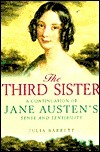
Librarian Note: There is more than one author in the Goodreads database with this name.
Julia Barrett was the pseudonym adopted by Julia Braun Kessler and British-born novelist Gabrielle Donnelly in the writing of Presumption, An Entertainment, a sequel to Jane Austen's Pride and Prejudice. Julia Braun Kessler then continued on her own (as Julia Barrett) with three more continuations of Jane Austen's works: The Third Sister, A Continuation of Sense and Sensibility, Jane Austen's Charlotte: Her Fragment of A Last Novel, Completed, and the forthcoming, Mary Crawford: or, Revisiting At Mansfield Park.
I made the mistake of reading this book straight after Sense and Sensibility! Don't do that. That only makes the differences in language and plot and character building so more obvious. Of course it is nice to hear a bit of "what happened afterwards", and the idea that hers sisters' difficult love affairs have in some way hindered Margaret's later love life is believable. But then all is said.
Last year, I read a later-written novel by this author, Mary Crawford: Revisiting Mansfield Park and I found it amazing. She caught the echo of Austen's writing and delivered a pitch perfect sequel. I was eager to pick up more of her work and happily chose The Third Sister since it, too, is a sequel that draws out the story of a minor character from an Austen novel that doesn't have so many follow up writings.
The Third Sister introduces a grown up Margaret who, at seventeen, is ready to be out. She has lived in the shadow of two older sisters and remains a little stifled in the country with only the neighbors at the big house for company. She has now encountered a pair of Mrs. Jennings' school friends and one has a handsome, outgoing son. He is engaging, but Margaret is wary because Marianne's Willoughby was exactly the same and look how that turned out.
But, it is at this point that I will pause for now. For the life of me, I can't seem to bring myself to pick this book up. I've read a few pages here and there, but happily lay it aside for other books and activities. I'm guessing it is a mood. So, yes, I lay it aside for now and hope to finish it later.
The story itself was entertaining but the writing sytle is nowhere near as good as Jane Austen's. I think the author tries to hard and ends up coming out flat. Jane Austen would never refer to someone in her books as "the heroine". The author speaks to the reader too much instead of showing them and this results in a awful ending.
The central character of this novel is Miss Margaret Dashwood, now seventeen and the right age to have suitors, yet there are no eligible young men available in Devonshire and Margaret spends most of her time playing nursemaid to the unruly Middleton children. She sees her sisters infrequently and longs for the happiness they have discovered. Visitors to Barton Park bring a new friend for Margaret and a potential suitor. Though Margaret longs to accept Mr. DuPlessy's flirtations, she can't help but remain cautious in light of what happened to Marianne. A trip to Brighton brings more new friends and another potential suitor for Margaret. She must determine whether sense or sensibility will win out. Meanwhile, Elinor and Edward Ferrars deal with domestic drama when Edward's mother pays an unexpected call and Marianne and Col. Brandon grow ever fonder of each other and try to help their family and friends the best they can. This is a slow moving novel that is supposed to be in the tradition of Jane Austen, yet I couldn't get into it. The plot borrows from Sense and Sensibility, Pride and Prejudice and Persuasion but doesn't come close to matching the charm and liveliness of the originals. Margaret never fully develops as a character and she comes across as boring and weak. There are too many subplots and too many new characters to keep track of that I found myself getting confused. I do not recommend reading this sequel.
I love to read, and can usually force myself to get through a novel no matter how awful it is. This one is so bad I couldn't even finish it. Bad writing to bad character development and it might as well have just ignored Sense & Sensibility for all the attention it payed to Austen's wisdom in character & social setup, not to mention the horrid attempt at writing in Austen's style of grammar (uselessly flowery language and superfluous words do not count as Austen-esque). Do not even bother reading, unless you're a writer and want to learn what not to do.
I have to say I love the Jane Austen continuations so I was very excited to read one for Sense and Sensibility. However, I was very disappointed. Not that it wasn't "Jane Austen" enough but it just wasn't enough. It was quite short and quite shallow. There was very little plot or story at all. I could have written it, it was so lacking in story. I was sorry to have wasted my time. I won't read her other one, Presumption. If any of you have read Presumption and liked it let me know.
Ugh. I attempted to read this because someone close to me thought I would enjoy it--being a fan of all things Austen. I think that once and for all I am done with attempted sequels. It was dull and to coin a favorite phrase of mine--full of "high-folluting mumbo jumbo."
I loved Sense and Sensibility, so I read this sequel by Julia Barrett. It started off horribly. She spends the first several paragraphs insulting Jane Austen. That seems foolish to me since people who liked Jane Austen are the ones who would be most likely to read this book. If you erase the first 5 paragraphs, that would significantly improve the book.
Getting past that, she takes a few comments on Margaret Dashwood from Sense and Sensibility and expains how she grows and changes from watching the courtships of her older sisters. The writing felt odd in a few places. It didn't quite flow, but the farther I got, the better the writing seemed. There are some great witticisms that even Jane would have been proud of. It seemed to me she copied some situations from other Austen books, but that seems reasonable since Barrett is copying her style. Despite the few rough places, the story flows and gives more depth to the original characters we already know without changing their true self from the original.
The story ended ubruptly for me, but overall, I enjoyed it.
Un sequel di Ragione e sentimento molto carino, scritto molto bene, con vari riferimenti al romanzo di Jane Austen e molte situazioni simili a quelle degli altri suoi romanzi.
Format: Real Live Book Narrated By: NA Original Publication Year: 1996 Genre(s): Historical Fiction, Series: NA Awards: None
Suggested Subtitle: How Margaret Dashwood overcomes her childhood trauma and finds an Austen ending.
I am a huge Jane Austen lover and thankfully not too much of a purist to not, from time to time, enjoy some fan fiction. They come in many shapes: retellings from different perspectives, straight continuations focused on the same characters, continuations focused on other characters, Jane Austen as a Regency era sleuth; there is something for everyone. I haven’t read a ton but I have enjoyed the Fitzwilliam Darcy series by Pamela Aidan which re-tells P&P from Darcy’s perspective and I’m a long time fan of the Jane Austen Mystery series by Stephanie Barron.
The Third Sister is the story of Margaret Dashwood from my favorite Austen book Sense and Sensibility. In Austen’s novel Margaret is young, perhaps 12 or 13, and floats on the very periphery of the story. In fact some of the TV/movie adaptations of the book drop Margaret all together. At the very beginning Barrett includes a quote from Sense and Sensibility that implies that Austen didn’t have much faith in Margaret amounting to much. Barrett attempts to revive her reputation and catches up with the Dashwoods about 5 years on from the end of Sense and Sensibility.
Barrett has decided that Margaret’s character will share a little bit from both of her elder sisters. She’s quite headstrong and outdoorsy like Marianne but she was profoundly affected by Willoughby’s betrayal of that sister and has resolved to be practical and not be taken in by any man with good looks and charm. So, when she meets just such a man who appears to be taken with her, she assumes he is not genuine or trustworthy and instead almost makes a disastrous marriage to a less charming man. It’s “Austen” so you can imagine how it ends. Barrett also gives the reader a peek into Elinor and Marianne’s married lives and tries to provide Marianne with the happy ending she doesn’t entirely get at the end of S&S.
Does it work? I was pretty pleased and enjoyed it. Like Austen, it is not action packed, focused mostly on the everyday comings and goings of Regency era society. We spend perhaps a bit too much time with the despicable Ferrars. The “lesson” for Margaret is perhaps a little too neat and the “villain” seemed closely modeled on another of Austen’s characters. The prose, though I’m no expert, seemed perhaps a little forced but as I mentioned I’m not a purist and I had no problem looking past these less than perfect imitations to get caught up in the story. I truly enjoyed Margaret as a character and I was interested to see how Marianne was doing married to the Colonel.
Final Verdict: I did not feel the sparkle that I do when reading an Austen novel but this was an enjoyable visit with some of my favorite characters.
I believe I mentioned in my other reviews of her works, that Julia Barrett is simply the best when it comes to writing “sequels” to Jane Austen novels. Her style of writing is spectacularly similar to the lovely Austen’s herself. Barrett’s wit is perfectly balanced with modesty, the type of gentle sarcasm that makes Austen’s characters so lovable.
This novel is no different than any other Barrett novel in quality. Now, Barrett has tackled “Sense and Sensibility” a story by Austen which is about the recently impoverished Dashwood sisters. S&S focuses mainly on the two eldest Dashwoods, Elinor and Marianne, and their different personalities. Barrett chooses to focus on the fortunes of the youngest, Margaret, after her sisters have settled their futures. Margaret is a blend of both Elinor and Marianne, composed of Marianne’s strength of feeling and desire for romance yet also determined to master and level herself as Elinor does.
Margaret is burdened with the heavy task of being the youngest daughter of a woman who has had a daughter marry very well and expects the same of her final child. Margaret is also cursed to be the only single young lady in a countryside where many of the other women have nothing better to do but attempt to set her up with various acquaintances, matrimonially speaking. Margaret has seen the heartbreak of both her sisters before their respective marriages, and has vowed to never suffer as they have. It is hard for her to admit she has romantic feelings for any young gentleman, and when two suitors present themselves to her above the rest, Margaret cannot seem to get a grasp on who either of them really are.
This book is vaguely reminiscent of both S&S and P&P – there are scandalous young men, proud young men, virtuous young men, and plenty of busybody older women who are dead set on Margaret marrying. However, Barrett is careful not to completely copy the storylines of either of these novels…she also focuses on the further fortunes of both Elinor and Marianne, throwing more light onto the strange woman from Colonel Brandon’s past and the fortunes of the Ferrars family.
Alors, on retrouve Margaret, l'oubliée de Sense & Sensibility, qui, comme l'auteure le souligne à plusieurs reprises a du mal à exister après Elinor la raison et notre passionnée Marianne... Et effectivement, le plus intéressant dans le roman, ce n'est pas Margaret mais bel et bien Elinor et Edward (avec la terrible Mrs Ferrars qui se cherche un héritier), Marianne et Brandon (toujours plus ou moins hantés par le fantôme de Willoughby et Eliza.... enfin surtout Marianne en fait, le colonel s'est pris un coup de jeune mdrr). Robert et Lucy (chère Miss Steele, pardon Mrs Ferrars) et bien entendu inénarrable Fanny... On retrouve donc avec plaisir tous ces personnages et on n'est pas forcément passionnés par Margaret ( somme toute fort proche d'Elinor, en tous cas plus que de Marianne, même si l'aveu de son craquage pour Willou était sympathique) On devine d'entrée de jeu que "n'est pas Willoughby celui que Margaret croit" et l'issue heureuse se voit venir à des lieux à la ronde.... Le seul personnage digne d'intérêt est la comtesse du Plessy, encore qu'elle ait des relents de Lady Catherine ^^. Cependant, ça reste dans l'esprit Jane Austen, quand bien même c'est sans surprise et fait furieusement écho à un des rebondissements de Persuasion
Ce que j'aime : Marianne, toujours et encore même si son attitude face à l'enfant d'Eliza est peu crédible
Ce que je n'aime pas : les nouveaux personnages se font manger par les anciens, l'intrigue reste sans cesse dans l'ombre de S&S
En bref : Une suite plaisante à lire mais qui ne prend pas de risques et n'a rien de transcendant
This is (at least the only one I have found) the only sequel to Jane Austen’s “Sense and Sensibility.” I thought overall it was pretty good. The most exciting parts were near the end- which is similar to most Jane Austen books. Julia Barrett had an interesting take on the heroine- Margaret Dashwood. Margaret Dashwood was almost traumatized by seeing her sisters brokenhearted by the ones that they had loved that she had resigned herself to being alone in the world, and very weary of men. There are too suitors who are interested in Ms. Dashwood in this book. Of course, one has all the appearance of goodness and the other overly open in his affections. As you can probably guess, in reality their personalities are actually quite the opposite. We do see a glimpse of the lives of Marianne Brandon and Elinor Ferris, not as much that wound satisfy me, being a huge fan of the middle sister, but at least this book contains some of that. I recommend this book to any and all fans of “Sense and Sensibility,” whether you are a fan of Margaret or not.
I dislike this so much that I'm not finishing it- I'm only half way through. Although the author writes in a manner similar to Jane Austen, she seems to not be overly well acquainted with Sense and Sensibility. She renames Colonel Brandon to be John, rather than Christopher. And apparently Margaret has been sorely neglected her whole life by her sisters, who care only for their own lives. Full of inconsistencies. So much about this is way off the mark in just the first three chapters, that I'm surprised I even made it through the twelfth chapter (having tried giving it the benefit of the doubt). I was really excited for it, because it's the only fan fiction for Sense and Sensibility that I've found that has to do with Margaret, but oh well.
I really enjoyed this book. Sense and sensibility isn't even my favorite Austen novel but I loved this sequel. It addresses Marianne's marriage, Elinor and Edward's relationship, the ferrar's bunch, some of the Dashwoods, all our familiar characters. Margaret's character is really developed and intriguing. I loved the two beaus interested in Margaret....they had me fooled for a few minutes. I really was just unsure which one was going to be the rogue. I twisted and turned directions a few times. It played on a couple different Austen novels I think. I wish the end didn't seem a little rushed. Otherwise it was very enjoyable.
Almost 4 stars. A friend went out of her way to give this to me so I felt obliged to read it when I otherwise would have passed on it. Why do people try to write sequels to classics? However I must admit that I was pleasantly surprised and enjoyed the story about Margaret--the third sister. The characters stayed true from the original and I liked the personalities of the new people too.
There was just a few parts that really annoyed me and that was when the author had a young boy around 6-8 years old speaking. I couldn't imagine any boy talking like a robotic adult the way he did and decided the author must not have had any little boys of her own.
Quite disappointed with it. As an Austen devoted fan I asumed from the first moment I decided that I was going to read a sequel to appease my anxiety, that it was not going to be near as close to Austen's writting and capacity to create marvelous characters (even the less important of them). But the thing is that not even the plot got close to make me read for hours. There was no meoldy linking the scenarios, funny and lovely Margaret was not there anymore and I was sometimes not even able to recognise Elinor and Marianne. I don't blame myself for looking for those characters again in other hands but as a first try... I haven't succed.
La autora pretendió darle a su narración el estilo de la propia Jane Austen, pero solo logró que su historia resultara dulzona y dispersa.
Me agradó la vida que les dio a Elinor y Mariane después de casadas, pero no tanto a la protagonista principal del relato, me parece que la pobre de Margaret sigue desaprovechada como personaje.
No está mal para un spin-off pero si que esperaba más, tal vez ese fue mi error.
This is a continuation of Jane Austen's Sense and Sensibility with Margaret Dashwood as the heroine. This author really stayed true to Austen's style in story and in prose. It was fun to see how things are going for Marianne and Elinor in their prospective marriages, and fun to see how Margaret has learned from her sisters and how she comes into her own.
This book follows Margaret Dashwood, the sister Jane Austen rather dismisses. The author does a fairly good job at copying Austen's style, but the story is somewhat predictable and the reader is left somehow wanting a bit more. A good rainy day book for an Austenite, but likely not a permanent part of your book collection.
Barrett can be in no way compared with Austen, but she does write well and I found myself still enjoying more of the characters I love so much and seeing how they may have evolved. Thankfully she did give us much a look at Maryanne and Elinor.
This book has the honor of being the first placed on my newly created "Could Not Finish" shelf. I picked it up about 10 separate times, but just couldn't get into it. I loved the idea of it, but something in its execution was flawed for me.
Another by this author that was a fun visit to Austen-land for me. It is quite a new focus--Marianne and Elinor don't figure in more than a handful of scenes--but Barrett still captures Jane's style of writing more closely than any other would-be sequelist.
Maybe it was just my expectations, but I was surprised to like this book. Not that the writer compares with Jane Austen on any level, but it was enjoyable. I've read a few "sequals" that were so painful I couldn't get through much at all. This was fun for a day at the beach.
So, this book was very disappointing. I guess the author's ideas for Margaret Dashwood were decent, but very poorly executed. Not at all like Jane Austen. Too bad . . .
This book I did not care for too much. Honestly, I did not finish it at all. I found it hard to stay with it. Others might like it, but for me I could have lived without it.