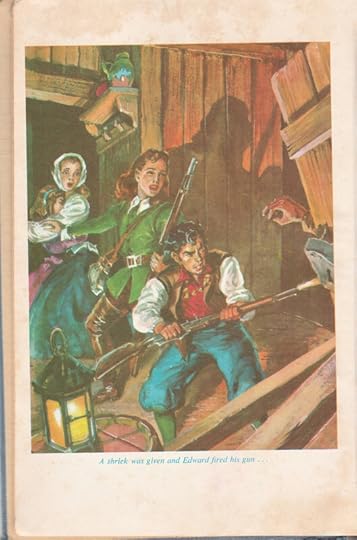
The Children of the New Forest is a children's novel published in 1847 by Frederick Marryat. It is set in the time of the English Civil War. With their father killed fighting for King Charles and their mansion home burnt down by the Roundheads, the four orphaned Beverley children find refuge with old Jacob Armitage, a forester and loyal servant of their father's. In his cottage, deep in the New Forest, the children quickly have to learn hunting, housekeeping and the crafts of living off the land. When Jacob dies, the children are left completely alone to fend for themselves but despite being at constant risk of discovery, Edward, the eldest, is determined to help restore the king and regain his own inheritance.
It is strange when there is a connection found between dissimilar things in our everyday life. While I was reading this book by Frederick Marryat, I read on a plaque on my nightly rounds at the museum that the artist Thomas Chambers used Marryat's naval writings as an inspiration for some of his seascapes. It shows how famous Marryat was back in the 1800s. Now he has been forgotten, although there is much that is sweet and charming about this story of 4 orphan children who have to make a life from scratch after their father is killed in a war between the Roundheads (those in favor of Cromwell) and the Cavaliers (who wanted to keep the monarchy in place) of England and their ancestral home is burned by the Roundheads, as their father fought for King Charles. A kind and loyal forrester of Colonel Beverley (the children's father) takes them into his forest home and they are incognito as they were thought to have perished in the conflagration. The Forrester teaches the 2 boys and 2 girls how to survive and live off of the forest. Marryat is not a great wordsmith and it is simply told, the worst errors come in the conversations between the brothers, who don't talk in a natural manner, but seem to be making lists of things to each other. The girl's characters are underdeveloped and not as interesting as the boys are so I think this would be enjoyed by boys more than by girls.
When I first read this, I adored this and thought it was pretty much perfection. I read it over and over again, until the covers fell off my copy. I had that reaction to a lot of children's books, and I can't quite find the enchantment again in this one, which makes me sad. I decided to reread it after I came across a reference to it in one of the books I read for Introduction to Children's Literature.
It isn't really a very easily accessible text in some respects: rather biased, sometimes dry, rather didactic. Historical fiction is a turn-off in itself for some people. I remember being drawn in by the characters, though -- some of them are a little too good to be true, but Edward is at least a bit of an idiot sometimes, overly impetuous and jumping to conclusions. Alice and Edith are somewhat non-characters -- indeed, so is Patience, actually -- so I'm surprised I found so much to relate to, as a child. I suppose I didn't really care about whether the characters were male or female. Now I found the story surprisingly short on everything I was more interested in, in the later part of the book -- how exactly Edward gets on in the fighting, for example, and a more satisfying way of bringing all the characters together at the end. The ending paragraph or so is quite an irritating dry summary.
Still, there is still some of the magic in learning how they become so self-sufficient, in how clever Humphrey and Pablo are, and in the forest adventures. The stuff outside of the forest doesn't ring as true, though.
This story is set at the time of the Civil Wars that raged across Britain in the seventeenth century. These wars are often referred to as "The English Civil War", as the conflict centred on the Westminster Parliament, later led by Oliver Cromwell, and the kings, Charles I and II. This book was written two centuries later, but Captain Marryat's elegant language is very dated, for today's children. As with many "Children's Classics" from former centuries, it can still be read and enjoyed by those of maturer age. I had just watched the excellent film "Cromwell" starring Richard Harris and Sir Alec Guinness, and had then come across, on Radio 4's series,"In Our Time", a programme about the Covenanters, a faction in Scotland who briefly sided with Charles II, but only for their own reasons. I felt that the traditionalist, Royalist, side of the Civil War deserved a hearing, and went back to this childhood favourite of mine. Re-reading this book in order to even up the perspectives on the Civil War fitted in well with a project of mine this year to go through my old children's books to see which are suitable for my grandchildren. Sadly, I can't see them being drawn into Captain Marryat’s old-fashioned prose, and I have to admit that there are many aspects of the book that now belong to a bygone era. The four children of a Royalist cavalier killed at Naseby narrowly escape death in their home, Arnwood, at the hands of Cromwell's troops, and take refuge in the forest, where they are taught by an old forester how to survive. Captain Marryat seems to have known a great deal about forest craft, and I loved the lessons in deerstalking, as well as the descriptions of trapping wild cattle and ponies. As the children adapt to life in the forest they are faced with increasing danger due to the worsening effects of the Civil War, and this is all lively adventure for young people, with a good measure of balance in the summing up of the historical context. In the aftermath of Charles I’s beheading, the oldest of the children, the courageous and hot-headed Edward, thinks over what has been told him by the newly appointed Parliamentary Intendant of the New Forest:
“He said that the king wished to be absolute and wrest the liberties from his subjects, and that they were justified in opposing him; I never heard that when at Arnwood. ‘If so, was it lawful to do so? ‘I think it was, but not to murder him; that I can never admit, nor does the Intendant: on the contrary, he holds his murderers in as great detestation as I do. Why, then, we do not think far apart from one another. At the commencement, the two parties were – those who supported him, not admitting that he was right, but too loyal to refuse to fight for their king – and those who opposed, hoping to force him to do right; the king for his supposed prerogatives, the people for their liberties. The king was obstinate, the people resolute, until virulent warfare inflamed both parties, and neither would listen to reason; and the people gained the upper hand, they wreaked their vengeance, instead of looking to the dictates of humanity and justice. How easy it had been to have deposed him, and sent him beyond the seas! Instead of which they detained him a prisoner and then murdered him. The punishment was greater than the offence, and dictated by malice and revenge; it was a diabolical act, and will soil the page of our nation’s history.”
The children are all very virtuous, and very pious, and I’m afraid that with my childhood march to Church every Sunday I’m a sucker for some of the more tender passages. When the old forester dies, the children bury him under the old oak behind the cottage; they fence it round, and plant it with wild flowers:
“The Sunday following the burial, the weather being fine and warm, Edward proposed that they should read the usual service, which had been selected by old Jacob, at the grave, and not in the cottage, as formerly; and this they continued afterwards to do, whenever the weather would permit; thus did old Jacob’s resting-place become their church, and overpower them with those feelings of love and devotion which give efficacy to prayer.”
It is as if Captain Marryat himself derives the greatest pleasure from writing about the children’s years of growing up in the forest; the last few pages, when they have become grown-up, feel rushed. The book's closing section is mostly concerned with a rather sketchy summary of the events leading to the Restoration. Edward by this time is a soldier in Charles II’s personal army abroad, and the last pages skim quickly over his return to England and his meeting again with his family and friends. It all ends happily – it is a children’s book! The characters are two-dimensional, and the only one that might hold interest for an adult is the Intendant. But if you happen to have a copy lying unread on your shelves, there’s plenty of historical and 'survival' material there to interest.
After this resurfaced I'm editing it to include the frontispiece, as the earlier edition was wrong:
Maybe 3.5. An enjoyable and interesting read - interesting to look at both as a children's novel and a work of historical fiction from the Victorian period. I really enjoyed the writing, though the plot fell short in a few places.
Each book I read offers a new perspective. In this post, I share my thoughts on this book in Persian and English. I hope this will be enjoyable for you :)
هر کتابی که می خوانم دریچه ای به دنیایی جدید است . تو این نوشته دیدگاه و تجربه ام از مطالعه ی این کتاب رو به دو زبان فارسی و انگلیسی با شما به اشتراک می ذارم امیدوارم خوندنش براتون لذتبخش باشه :)
Persian (فارسی)
«فرزندان نیو فارست» یکی از آثار درخشان ادبیات کلاسیک انگلیسی است که با نثری ساده اما پرمفهوم، خواننده را به دل یکی از پرآشوبترین دورههای تاریخ انگلستان میبرد. این رمان، فراتر از یک داستان کودکانه، اثری چندلایه و عمیق است که همزمان هم سرگرمکننده است و هم آموزنده.
پس زمینه ی تاریخی 📜 :
ماجرای کتاب در قرن هفدهم میلادی و در بستر جنگ داخلی انگلستان (1642–1651) روایت میشود؛ دورهای که کشور میان دو جبههی اصلی و متضاد فکری و سیاسی تقسیم شده بود: پادشاهی خواهان وفادار به چارلز اول و طرفداران پارلمان به رهبری اُلیور کرامول.ماریات با مهارت، این بستر تاریخی را به پسزمینهای زنده و ملموس برای داستان خود تبدیل میکند. او نشان میدهد که چگونه سیاستهای کلان، سرنوشت خانوادهها و کودکان را دگرگون میکند و چگونه در دل بحران، مفاهیمی چون وفاداری، شرافت و بقا معنا پیدا میکنند.
نویسندهای با سابقهی نظامی و تجربهای منحصربهفرد ⚓:
فردریک ماریات پیش از آنکه نویسنده شود، افسر نیروی دریایی سلطنتی بریتانیا بود. او در بسیاری از مأموریتهای دریایی شرکت داشت و حتی به عنوان کاپیتان کشتیای که ناپلئون بناپارت را به تبعید در جزیرهی سنت هلن میبرد، شناخته میشود. این تجربهی تاریخی و نظامی، تأثیر عمیقی بر نگاه او به مفاهیم قدرت، انضباط، و سرنوشت انسانها گذاشته است. در این کتاب این پیشزمینهی نظامی بهوضوح در توصیفهای دقیق، ساختار منظم روایت، و نگاه واقعگرایانه به خطر و بقا دیده میشود. او با نگاهی انسانی اما بیپرده، ماجراهایی را روایت میکند که هم هیجانانگیزند و هم تأملبرانگیز.
اگر علاقهمندید دربارهی این بخش از تاریخ بیشتر بدانید، شرح مفصل این ماجرا را میتوانید در کتاب خاطراتی از یک امپراتور که دربارهی تبعید ناپلئون خواندم پیدا کنید، این هم لینک نقد و بررسی ای که درمورد آن کتاب در گودریدز نوشتم 👇🏻 :
اگرچه این کتاب در دستهی ادبیات کودک و نوجوان قرار میگیرد، اما بههیچوجه محدود به این گروه سنی نیست. زبان پخته، فضای تاریخی غنی، و مفاهیم عمیق انسانی آن باعث میشود که بزرگسالان نیز از خواندنش لذت ببرند و حتی گاه بیش از کودکان، لایههای پنهان داستان را درک کنند. این اثر از آن دست کتابهاییست که میتوان آن را در هر سنی خواند و در هر بار خواندن، چیز تازهای از آن آموخت.
در این رمان ماجراجویانه، تاریخ فقط پسزمینه نیست—نفس میکشد، تصمیم میگیرد و سرنوشت میسازد. ماریات با نگاهی دقیق و انسانی، قصهای خلق کرده که در آن ماجراجویی، بلوغ، و حقیقت در هم تنیدهاند. برای وقتهایی که دلت میخواهد در یک روز، با یک داستان کوتاه و دلچسب همراه شوی و تا پایانش بروی، این کتاب خواندنی انتخابی عالیست —هم ساده، هم عمیق، هم بهیادماندنی.
English (انگلیسی)
“The Children of the New Forest” is one of the shining gems of classic English literature. With a simple yet meaningful prose style, it draws the reader into one of the most turbulent periods in England’s history. More than just a children’s story, this novel is a layered and profound work—entertaining and enlightening.
Historical Background 📜:
The story is set in the 17th century, during the English Civil War (1642–1651)—a time when the nation was divided between two opposing political and ideological camps: the Royalists loyal to King Charles I, and the Parliamentarians led by Oliver Cromwell.
Marryat skillfully transforms this historical backdrop into a vivid and tangible setting for his narrative. He shows how large-scale political upheaval reshapes the lives of families and children, and how, in the heart of crisis, values like loyalty, honor, and survival take on new meaning.
A Writer with a Naval Past and a Unique Perspective ⚓:
Before becoming an author, Frederick Marryat served as an officer in the British Royal Navy. He took part in numerous naval missions and is even known for having captained the ship that transported Napoleon Bonaparte to exile on the island of Saint Helena.
This extraordinary military and historical experience deeply influenced his perspective on power, discipline, and human destiny. In this novel, that background is clearly reflected in the precise descriptions, the structured narrative, and the realistic portrayal of danger and endurance. With a tone that is both human and unflinching, he tells stories that are as thrilling as they are thought-provoking.
If you're interested in learning more about this chapter of history, a detailed account of Napoleon’s exile can be found in the book The Last Years of Napoleon: His Captivity in St. Helena, which I read recently. Here's the link to my review of that book on Goodreads 👇🏻:
Although this novel is categorized as children's and young adult literature, it is by no means limited to that age group. Its refined language, rich historical setting, and deeply human themes make it just as enjoyable—and perhaps even more meaningful—for adult readers.
This is one of those rare books that can be read at any age, and with each rereading, it offers something new to discover. Although this novel is categorized as children's and young adult literature, it is by no means limited to that age group. Its refined language, rich historical setting, and deeply human themes make it just as enjoyable—and perhaps even more meaningful—for adult readers.
This is one of those rare books that can be read at any age, and with each rereading, it offers something new to discover.
In this adventurous novel, history isn’t just a backdrop—it breathes, it decides, and it shapes destiny. With a precise yet compassionate gaze, Marryat weaves a tale where adventure, coming-of-age, and truth are tightly interlaced. For those moments when you crave a short, satisfying story you can finish in a single day, this book is a perfect choice—simple, profound, and unforgettable.
To call this a children's book is somewhat misleading. Yes, it is about 4 children, but it is written in a style more suited to adult readers. It's still a good book. I would describe it more as a young adult, historical fiction novel. It's a bit of a history lesson about England in the mid 17th century during the English Civil War. King Charles I has been dethroned, eventually to be executed, and Oliver Cromwell has assumed leadership. The heir, Charles II has escaped to exile and will eventually become King when the civil war is over and the monarchy is restored. The four children of the story are from a wealthy and privileged family, their father a loyal colonel in the Kings army. When he is killed and their family home burned, they become orphaned. Believed dead, they are rescued by an old forester, and taken to his cottage in the New Forest to be raised under new identities. The story then proceeds with their life in the forest. It's predictable but enjoyable.
During the English Civil War, the four Beverley children are orphaned when their wealthy father is killed fighting for the restoration of King Charles. Their grand home is burnt down and they are supposed dead, so they find shelter with a kindly old forester. They each learn to hunt, harvest, and care for their little cottage, living in seclusion deep in the forest. But the oldest boy, Edward, is restless and he dreams of going to war as his father did.
The siblings encounter many dangers and perplexities, highwaymen and robbers, spies from the Parliamentary government, and a new Intendant governor over the forest who is determined to capture anyone poaching the deer in the forest. But the siblings are resourceful and brave, so they flourish in their humble cottage, acquiring farm animals and planting small fields, dreaming of the time when their inheritance will be restored to them, if ever the true King returns to England.
I loved this story of the Beverley siblings! The plot is interesting and full of action and intrigue. I really liked even the simple aspects of the story about the children learning to do household tasks like cooking, the boys learning how to hunt, and the girls keeping a dairy.
I like the formal writing style and the vivid language of this book. I wish that the girls in the story had more time in the narrative. They are sort of background characters, and don't take part in most of the action, but I liked them! I just wish there was more in-depth writing about them.
I was really touched by the siblings deep emotional attachment to each other and to the old man who takes them in. Time and again, they are shown to have noble feelings and generosity to their friends. I loved how the siblings all work and sacrifice a great deal to care for and protect each other. Their first thought in any difficult situation is, "How can I take care of my siblings?"
Usually, I get bored with historical fiction, but I loved the historical aspects of this story. The characters made the history more intimate and immediate to the reader.
2022 Update: Rereading this book for the second time was just as wonderful as the first time! This is a forever favorite!
I loved everything about this book! I appreciate stories where characters persevere, err on the side of right and honor, and make choices based on the good of the whole rather than oneself...those are the true hero stories to me. Such a refreshing read!
So yes, I have found Frederick Marryat's 1847 historical fiction novel The Children of the New Forest interesting, surprisingly readable and generally also imbued with ample textual excitement for a piece of writing penned in the mid 19th century. And most certainly and on an academic level, I thus do consider The Children of the New Forest as primarily being a book which I would label as being historical fiction on multiple different levels (as Marryat's featured text for The Children of the New Forest is not just presenting the author's take on England during the time of King Charles I and how his royalist child protagonists escape the hue and cry and must live and survive as fugitives in the New Forest, but that his 19th century writing and penmanship would generally also tend to feel historical and as such equally rather dated on many different levels for modern children, for young readers from the 20th and the 21st centuries).
But while my adult reading self has actually and in fact quite enjoyed The Children of the New Forest and has found the double edged datedness intriguing, intellectually stimulating and that I do on a descriptive and historical accuracy level also much applaud Frederick Marryat for managing to retain a very authentic and realistic feeling of textual time and place (and indeed, that The Children of the New Forest does therefore feel like I am emerging myself in King Charles I's time and the horrors and uncertainties of said era, even though I do have to admit that author writing style and attitudes are equally very much and obviously mid 19th century in scope and attitude and especially so with regard to gender and social stratification and class issues), considering that Frederick Marryat did originally pen The Children of the New Forest for children, for younger readers, my so-called inner child does feel as though textually speaking, Frederick Marryat's narrative tends to drag a bit and become just too tediously descriptive and with occasional preachiness.
And indeed, the gender stratifications and Frederick Marryat's social class musings as they are often textually encountered in The Children of the New Forest (and which would of course and in my humble opinion have made perfect sense to and for nineteenth century children and also have made total historical sense to and for me as an adult reader), these would definitely have made me not all that much enjoy The Children of the New Forest had I encountered and tried to read this book as a child or even as a teenager (and while I do understand why some consider The Children of the New Forest as being a classic of mid 19th century British children's literature, I would definitely tend to recommend this book more for adults than for children and more for academics than for actual reading pleasure).
One of our FAVS. Wow!!! The kids would literally cheer when it was time to read a chapter. We followed the AO schedule and took our time. Annie has said multiple times that she wished she could forget the story so she could read it all again! ☺️🙈 Excellent historical fiction! 👏🏼
June 2025--Read it for the second time with Lucy. Loved it all over again!
A sort of riches-to-rags-to-riches story, set in the upheaval of the Civil War. The titular children are the offspring of a prominent Cavalier general who died at Naseby, they are further orphaned by the death of their mother, and then the story starts with Roundhead troops burning down their family home and (somewhat accidentally) killing their last close relative. The children are raised in a cottage in the forest by an old retainer of their family, and much of the book centres on their adapting to forest life -- the eldest, Edward, learns to hunt, Humphrey becomes a crafty farmer and carpenter, and Alice and Edith learn to cook, milk cows and tend the hens. It's all somewhat idyllic, but eventually the plot moves on and the family get drawn into the circles of the new forest Intendant, and from there the wider affairs of the world draw out Edward to war.
It's worth keeping in mind that Marryat was about as far removed from his setting as I am from Marryat's writing. For the most part this comes through positively as distance -- Marryat has the good Royalist children initially filled with contempt for the Parliamentarians, but later mellows this with the introduction of a moderate Parliamentarian who was horrified by the regicide, and the less-than-flattering behaviour of some Cavaliers in the circumstances regarding Charles II's defeat at Worcester. Other parts are less good -- the gypsy Pablo, for example, whom the children recover from a pit, appears to be a clumsy amalgam of 19th-century racial stereotypes from several different races, and the analogy of his 'development' by the children is a little heavy-handed.
The plot has a few encounters of interest, including several episodes in which brigands are shot dead in the midst of an armed assault on good people, and a few people wandering about in disguise. It's not as a whole all that gripping or moving, but it can't be accused of being uneventful, and there are some fun scenes and a few little practical tips on poaching and farm work. There is even an awful romantic misunderstanding that leads to seven years of angst (though Marryat thankfully elides much of this angst in narration), so I suppose it qualifies as a romance.
I was pleasantly surprised by this story. I expected it to be overly descriptive and somewhat moralizing (considering when it was written), but it wasn't. Of course, I have an early edition, which I always enjoy reading more than I do a new reprint.
عن الوفاء والأخلاص تدور أحداث هذه الرواية اخلاص جندي نبيل لملكه مما أدى إلى مصرعه ومصادرة أملاكه، وأخلاص خادم عجوز لسيده فيقرر أن يصطحب أبناء الجندي إلى الغابة حيث يعيش كي يحميهم من بطش الأعداء، وأخلاص الابن الأكبر للملك فيقرر أن يتبعه في مغامرات مجنونة حتى لو كلفه ذلك حياته كعادة تلك النوعية من الروايات نجد العديد من المغامرات بعضها تم اقحامه في العمل دون مبرر درامي قوي، بالإضافة إلى قصة حب قوية ونهاية مثالية سعيدة ترضي القراء
I chose this title to fit into the category called a re-read of your favourite classic, for the 2018 Back to the Classics Challenge. I adored this book when I was in Year 9 at High School. I read it through several times, daydreamed about it, recommended it to others, and even tried to draw pictures of the main characters. But I never read it to my own kids since they strongly objected to the title and cover design. (More about their assumptions here. Throughout this review, I'll share several alternative covers I found, but I'm sure none of them would have impressed my fussy mob any more.) So this was my first read since childhood. It made me a bit nervous, as it's a sad let-down when things don't live up to our rosy memories. But I was relieved. Whew!
It begins with a huge event that draws us right in. The time period is the English Civil War, and the king's troops, known as the Cavaliers are fighting against Parliament and the supporters of Oliver Cromwell who want to overthrow the monarchy. An old park ranger named Jacob Armitage overhears a plot to burn down a gracious old mansion named Arnwood, where the fugitive King Charles is suspected to be hiding. It was the home of a deceased war hero named Colonel Beverley, whose young children will surely burn to death if nobody intervenes. Jacob sneaks them out that very night, with a plan to bring them up as his own grandchildren. So Edward, Humphrey, Alice and Edith must learn to live a rustic lifestyle and fend for themselves in the New Forest, since Jacob believes it's far too dangerous to reveal their true identities.
The bulk of the book is all about how they manage to get along after Jacob's death. It includes defending themselves against scoundrels and cutthroats, and concealing their identities when Parliament hijacks the running of the forest, which hurts their royalist hearts. The oldest boy Edward chafes against the lie he's compelled to live, and longs to strike a few blows for the king on his own behalf. It's easy to feel his frustration as he and the others grow into their latter teens.
My biggest turn-about is the brother I most admired. When I was a teenager, the restless and adventurous Edward stole my heart. But this time round, I noticed how he seems to walk around with his head in the clouds, dreaming of being a hero, while Humphrey is busy making practical improvements in the short term to keep them all alive. The younger bro seems by far the more intelligent, humble and creative of the pair. He gets ideas from books and improvises with whatever's on hand. In fact, lack of resources is just a fun challenge for him. He revolutionises the cottage, figuring things out from personal observation, trial and error. And above all, he's content to be overshadowed by his brother, and not the sort to be seduced by promises of glory. Humphrey, I've got to say, you're the man!
I was still fond of Edward though, because in all his crusader's zeal and getting people's backs up, he's so human. A couple of other reviewers commented that he's a bit of an idiot at times, which is fair enough, since even his best friends agreed. They expressed it a bit less bluntly though.
'You have been more bold than prudent, Edward.' Or, 'For these times, you are much too frank and impetuous. This is not the time for people to give vent to their feelings and opinions.' Or, 'Do you not see you do your cause more harm than good?' Or, 'Be no longer rash and careless in avowing your opinion.'
In Edward's defense though, he isn't arrogant, and is quick to recognise wise advice and take it on board, even when it comes from younger siblings or men supposedly on the other side of the political spectrum. It's written so that even if you think he's an idiot, he grows on you, and you still want the best for him. (And you can't go past the girl he falls in love with for foolishness, notably in a decision she makes towards the end. I felt like shaking her. But she's a product of her time.)
A couple of other characters they met along the way were among my favourites. The kids accidentally trap a gypsy boy named Pablo, who proves to be a staunch friend and honorary family member, and adds comic relief with his matter-of-fact comments and occasional efforts to shirk intense labour. But one of the best characters by far is Mr Heatherstone, the Parliamentarian who's been appointed superintendant of the forest. Edward and the others must learn to trust him as a friend, even though he presents as an enemy. But Heatherstone is playing a most daring and clever double agent game. It's worthy of Severus Snape, and he grows really fond of Edward as a bonus :)
I noticed that some of the most critical reviewers dissed this book based on 21st century ethics, which we could hardly expect an author from Captain Marryat's era to share. Sure, the girls tend to be sidelined by the boys, and there seems to be a fixed mindset that the quality of a person corresponds with the class into which he's born. ('Edward appeared as he was, a gentleman born, and that could not be concealed under a forester's garb.') Yet I believe it's unfair to label the author as a chauvinist or social snob, when he was probably one of the most open-hearted, generous and liberal thinkers of his time. I think the best way to get the most out of this book is to suspend our modern scruples and approach it as an eye-opening step back in time when people thought differently. Then there's all sorts of treasures to pick up.
The courteousness of everyday speech is a highlight for me. I love it that these teenagers throw around such cool words in normal conversation as importunity, assiduity and inimical, and it flows so naturally without seeming at all forced. Even when they're insulting their enemies or teasing each other, the language is just beautiful. It made me a bit sad for the woeful deterioration of young people's vocabularies. Maybe it takes reading a book like this to show how low it's sunk.
I love the simple faith of their time and place. There was evidently no church service, but Jacob's first thought was, 'I can't teach them much, but I can teach them how to fear God. We must get on how we can, and put our trust in Him who is father to the fatherless.' And the Beverley kids keep up their private devotions after his death, remaining devout in their youthful way, without being overly pious.
The parts about the four of them adapting to their rural lifestyle are fun, interesting, and arguably the best thing that could have happened to them. Learning to be self-sufficient rather than waited on by servants for all things is a great advantage. For Humphrey and Alice in particular, being self-taught opens up a whole range of fantastic talents they might never have tapped into in their old lives. The lifestyle is described in one place as 'Arcadian.' In our fast-paced digital age, reading about four teens who live a hidden, quiet life, mainly concerned with subsisting adds a perspective that's probably good for us.
There's a bit too much about acquiring venison for my personal taste. I'd obviously forgotten how many times deer and other animals were simply wounded rather than killed outright :( But overall, I couldn't put the book down when it came to the last few chapters, which is the sign of a great storyteller in any era. If a conventional handsome, strong, ambitious and plain-spoken main character like Edward isn't enough to tempt you, I'd encourage you to read it for the sake of the hidden heroes, Humphrey, Pablo and Heatherstone.
🌟🌟🌟🌟
Now, I can't resist adding a few good quotes.
Edward: You certainly were not born to be secluded in this forest. Humphrey: I rather think I have found that I was born for it.
In attempting to free ourselves from what we considered despotism, we have created for ourselves a worse despotism, and one that is less endurable. It is to be hoped that what has passed will make not only kings but subjects wiser than they have been.
ইংল্যান্ডে তখন চলছে গৃহযুদ্ধ। রাজার বাহিনী পরাজিত হলো পার্লামেন্টারিদের কাছে। রাজা আর তার বিশ্বস্ত অনুচরেরা গেলো পালিয়ে। তেমনি একজন রাজার সহযোগী কর্ণেল বিভারলি। (রাজার পক্ষে যুদ্ধ করতে যেয়ে অবশ্য মারা যান তিনি) আর্নউডে তার বাড়িতে রাজা লুকিয়ে আছে- এই অজুহাতে কর্ণেলের বাড়িটা পুড়িয়ে দিলো রাউন্ডহেড সৈন্যরা। সেই বাড়িতে থাকে কর্ণেল বিভারলির চার নাবালক বাচ্চা, এডওয়ার্ড, হামফ্রে, এডিথ, আ্যলিস আর অভিভাবক হিসেবে ওদের এক ফুপু। এখন বাড়িটা যে পুড়িয়ে দিলো কি হবে বাচ্চাগুলোর?
চার জন অনাথ ভাইবোনের কাহিনী। সামান্য কুটো ভেঙ্গে দু টুকরা না করা অভিজাত পরিবারের এই ছেলেমেয়েগুলো মুখোমুখি হলো চরম বাস্তবতার। বুড়ো জ্যাকবের সহায়তায় এ তাদের ঘুরে দাঁড়াবার কাহিনি। সাধু! সাধু!
The title "Children" of the New Forest is a little misleading. I had only skipped the blurb before reading so I thought this book would be about four little kids playing in the New Forest. Well, it wasn't. I really liked the novel anyway. It has a bit of everything in it: farming, adventure stories and a love story. I enjoyed reading it a lot, although I found the end a little hurried: Almost ten years are told in one chapter. It seemed like the author wanted to put the story the an end as soon as possible. This stood a little in contrast to the beginning of the book when it is told in all detail how wild cows and horses are captured, which I found a little boring after a certain time.
I assigned this book to my son via audiobook and wanted to listen along with him to be able to keep up with his narrations. He has really gotten engaged in the story and I can see why with Edward's hunting and Humphrey's farming in the New Forest. This historical fiction story really helped shore up my understanding of this particular era of history around the British Civil War between the Parliamentarians and the Royalists and is a very worthy read.
second reading for me (actually audio this time)- this time as a pre-read for 2024-2025 edu year.
my children always enjoy this one… probably more than me. the characters do not seem to grow much to me but I do like learning more about the time period!
From Azariah (age 8) "I really enjoyed this book. I liked all the children and how they got along really well and how they learned lots of new things about taking care of a farm and living in the forest. I really liked when Edward went out to fight; and I liked that they took care of Pablo after he got caught in Humphrey's trap."
This is an unfortunate cover because, while it is a children’s book, it’s not a childish book and it is entirely appropriate for adults. It happens in England during the time of Cromwell. The house of four orphaned children who are members of the nobility is burned by parliamentary soldiers, but the children escape and are taken in by a forest keeper who teaches them all he knows.
This book tells the story of four children - Edward, Humphrey, Alice and Edith, whose distinguished father Colonel Beverley is killed during the English Civil War while fighting the cause of King Charles and as a result, they become orphaned. An old forester, Jacob Armitage, whilst walking in the woods one days hears a group of men fighting against the king aka Roundheads forging a plan to set fire to Colonel Beverley's mansion, burning everything within, meaning that the children are in mortal danger. He immediately sets out to the grand house to warn the children's aunt and guardian, who refuses to leave the property. He manages to persuade her that he should take the children however, and raise them as his own grand-children while teaching them the ways of the forest so they may be able to provide for themselves whilst concealing their identities. This is due to the king having fled, and Cromwell having England under his thumb. If the children's identities are revealed, it could be incredibly dangerous for them. The children pass some happy years in this manner with the love and tutelage of the old man, until he dies, and the children have to learn to survive on their own.
To be honest, when I started this book, I had a bit of trouble understanding how children could enjoy it. The subject matter seemed slightly too complex, and there are not many what I call "major action sequences." In fact, not much goes on of much interest, apart from a few fairly exciting hunting expeditions. It was almost what I can imagine the children of Narnia's lives to be like minus the war, wardrobe and talking animals. There are some interesting characters, Pablo their adopted gypsy boy was quite entertaining, along with the villain of the piece whose vendetta against the Edward I quite enjoyed and the adorable old forester Jacob Armitage. Disappointedly, the female characters seem like non-entities, with not much to say for themselves which is a shame. Not that this book is all bad... the historical element is very intriguing, and I wouldn't mind learning more about this period of history. As a classic piece of children's literature however, I think there were MUCH better books written around this time.
I felt like most of the book was much too easy for the main characters. That's strange to say in a book about four children learning to survive on their own in the forest, but it's true. We never see much of their struggles, just their successes. They notice a problem, talk it over, find a solution that works, and move on. I kept waiting for the action or suspense to pick up, but it didn't until the very end (and by very end, I mean the last 2-3 chapters). There were a couple of suspenseful episodes in between, but they were very short and not nearly as dramatic as they could have been. To be clear, I don't mind sweet little stories about normal family life with no major crises. The problem with this one was that it kept acting like it wanted to be full of action and danger, but none of it ever materialized. The last chapter or two covered a lot of time in a very short space, as if the only point was to skip forward in history several years so we could get a proper ending.
Even after all that, though, I probably would have given it three stars if not for Edward's ridiculous pride in the last chapter. I had really liked seeing him become more humble, learn to take advice, and become willing to trust certain people. And then to have him come back in the last chapter, after the major misunderstanding had been cleared up, more prideful and distrusting than ever just exasperated me. Just--really, Edward? Really?
I wish I had read this as a child. It would have added greatly to the fort-making, food-finding, and hiding from the grown-ups fun.
As an adult I found it a quick and fun read. It's really more of a "how to survive in the woods/making your own farm if you start with a cottage, hunting dog and pony but not much else" with a bit of danger and excitement thrown in for good measure. Also "how to escape from the battle of Worcester once all is lost" and "how to hide your Royalist sympathies and friends in a Parliamentarian autocracy". I can see why it would have been popular in the Victorian era when it was written, though probably most kids today would find it slow-going. Maybe it could be re-written as a "Choose your own adventure" story....it would pretty much soundly trounce any one of those I ever read. "There is no one in sight besides your new-found friends and the dead Roundhead soldiers. Your friends want to swap clothes with them to travel in safety. Do you 1) agree and take off your feathered hat in a flash (turn to page 43) or 2) scorn to hide your political ideals and ride on alone, abandoning the cowards where they stand (turn to page 85) ....
It isn't a great work of literature -- the characters are mostly two-dimensional props, once the farm is happily established and the "hero" has learned a few lessons, the story wraps up a few years at light speed with Charles II returning and everyone, now grown up, getting happily married off. The End.
I started reading this book a year ago, but gave it up, it's a book you have to be in a certain mood to read... well for me anyway... but if you do find yourself putting it back on the bookshelf, remember to get it down one day when you're in need of something wholesome, historical but also exciting to read. Because this book is one of those rare things; it gets better with age. Sort of like wine, or so the saying goes. But anyway... what I'm trying to say is that it's a heavy read (it was published in 1847! Imagine that!) but it's worth it. What's quite refreshing is that Alice, the elder sister, has something of a personality, and so does Patience Heatherstone; so many times in classics like this, the girls and women are relegated to background figures, because that was just the way it was back then. And although Edward, Humphrey and Jacob are more prominent characters, the girls do get a look in, you will be pleased to know! Maybe I'm dwelling too much on that. Yes.
But anyway, I remember one year, at Center Parcs, Sherwood Forest (a great place), my auntie told me and my three cousins about the Roundheads and the Cavaliers, and we spent a frosty afternoon at the park, being Cavaliers in hiding. This book brings that fantasy to life, because while they are cooking and tending to the chickens, these children are hiding and in mortal danger, which makes for a good story in anyone's book.
Gosh this book dragged. 4 children watch their house burn down in a revolution in the UK in the mid 1600s. They then go live in a forest. The daughters tend the house (aka are not related to the plot and thus get no writing dedicated to them) whilst the oldest son sets out to help his king and country. This goes on for 239 pages and covers about a year. Then in the last 9 pages there's a war, a loss, a win, another war, some marriages, and everything is wrapped up.
There seems to be a lot of positive reviews about this book on Goodreads. I strongly suspect that I'm reading a different book. I understand that this was written in the 1800s and so the language is going to be dense, but I've written plenty of other books from the time that moved along quicker. A lot of the novel comes across as a 'how to live in the forest' guide with some extra scenes put in to create a story, but if I wanted something like that I'd rather read The Coral Island which at least has pirates.
This one seems to be in the same line of young adult fiction as Ballantyne or Stevenson (not that the writing is of Stevenson quality, just the same genre) - Stories For Boys, you know, kids out on their own, with no adult supervision, having to make their way in the world and participating on historical events in the meantime - in this case, the trouble between the Cavaliers and the Roundheads. Not a bad story, but I should have read it back when I was a teen myself. It would have hit the spot. Now? Not so much. However, I've been looking up Marryat's other books, and there are pirates and sea battles galore, so perhaps I just picked The Wrong Book this time round. YA fiction is often just as good if not better than many adult novels. Better luck next time.