

What do you think?

Cuba: A History
Competitively priced, this book is the perfect companion to the more than thirty travel guides on Cuba available today.
Beginning with the pre-Hispanic period, moving on to Cuba's struggle to maintain the revolution in the years following the collapse of the Soviet Union, and finally ending with Fidel Castro's decision to step down in 2008, this slim volume provides the reader with an overview of the history of the tiny Caribbean island that so often has been at the center of world politics.
Including a bibliography for further reading, this is a most useful introduction to Cuba's history for students, teachers, and others, as well as those visiting the island.
This book is published to coincide with the expected lifting of the US government's ban on its citizens' travel to Cuba and will be actively marketed through travel agencies, in-flight magazines, and more.
Available in both English (978-0-9804292-4-4) and Spanish (978-1-921438-60-8).
Sergio Guerra-Vilaboy, a professor at the University of Havana, obtained a doctorate in history at the University of Leipzig. He is the author of numerous books on Latin American history and is currently the executive secretary of the Association of Latin American and Caribbean Historians.
Oscar Loyola-Vega is a professor of history at the University of Havana.
Beginning with the pre-Hispanic period, moving on to Cuba's struggle to maintain the revolution in the years following the collapse of the Soviet Union, and finally ending with Fidel Castro's decision to step down in 2008, this slim volume provides the reader with an overview of the history of the tiny Caribbean island that so often has been at the center of world politics.
Including a bibliography for further reading, this is a most useful introduction to Cuba's history for students, teachers, and others, as well as those visiting the island.
This book is published to coincide with the expected lifting of the US government's ban on its citizens' travel to Cuba and will be actively marketed through travel agencies, in-flight magazines, and more.
Available in both English (978-0-9804292-4-4) and Spanish (978-1-921438-60-8).
Sergio Guerra-Vilaboy, a professor at the University of Havana, obtained a doctorate in history at the University of Leipzig. He is the author of numerous books on Latin American history and is currently the executive secretary of the Association of Latin American and Caribbean Historians.
Oscar Loyola-Vega is a professor of history at the University of Havana.
- GenresHistoryNonfictionTravel
110 pages, Paperback
First published August 1, 2010
Ratings & Reviews
Friends & Following
Create a free account to discover what your friends think of this book!
Community Reviews
Displaying 1 - 29 of 29 reviews

October 9, 2025
Nice to read a piece of a country's history that's compact yet clear, well-written, and not a massive university textbook. I’d love to have a book like this for every country!

September 24, 2023
this book was a fairly solid synopsis of the general political history of cuba, starting from colonization up until 2010, through all the independence struggles and dictatorships of their past, up until the socialist revolution, and Fidel Castro's 2006 resignation, with his replacement taken up by his brother Raul. covered some important political and legal dilemmas that took place during the revolution, and didn't just spew america propaganda which is cool. good read, not for anyone looking for an in depth history on any particular subject of cuba's past.

November 4, 2024
Uncritical, unauthoritative, heavily biased in favour of the revolution. Labels of value judgement such as "toadies" erode credibility. Glosses over many critical issues of Cuban suffering, including the "Special Period" and nationalization. Authors admire the stubborn exclusion of all economic engines other than the sugar cane industry. Less than half the book is devoted to Cuba pre 1959. Content up to that date reads like a high school essay, done reluctantly the night before the due date. Content after 1960 reads like a laundry list of victories. Lacking any academic analysis of empirical objective integrity.

June 22, 2026
From a random book I found in our Air BnB it was an informative introductory read.

June 12, 2017
This is a very short book of just 80 pages written by two Professors at the University of Havana. The authors are both committed communists so the story they tell about Fidel Castro and his brother Raul is what a wonderful job they are doing for the masses.
As you might guess, the authors assert all the many problems that Cuba has suffered are due to the U.S. not supporting the glorious revolution. Despite the biased nature of the book I give it 3 stars out of my interest in seeing the communist point of view.
The book ends in 2008 so it doesn't cover the move by Obama to drop all sanctions on Cuba in return for the promise that Cuba would end their human rights abuses. Cuba has done nothing at all as yet in this direction and we are waiting to see if Trump will reinstall the sanctions.
As you might guess, the authors assert all the many problems that Cuba has suffered are due to the U.S. not supporting the glorious revolution. Despite the biased nature of the book I give it 3 stars out of my interest in seeing the communist point of view.
The book ends in 2008 so it doesn't cover the move by Obama to drop all sanctions on Cuba in return for the promise that Cuba would end their human rights abuses. Cuba has done nothing at all as yet in this direction and we are waiting to see if Trump will reinstall the sanctions.

July 3, 2019
Me pareció un libro que el original es escrito en español y los autores tienen un español espectacular, amplio vocabulario y sin mencionar el cuidado de la redacción y la narrativa. Ahora, el libro es corto pero está bien nutrido. Lo único que me parece un poco sospechoso es la historia después de la revolución, o sea, el gobierno de Fidel Castro. A partir de ahí, solo habla de lo bueno y no de lo malo que implica vivir en un país socialista. Me hubiese gusta saber más de eso.

August 26, 2026
Rating is more like 3.5 stars, but this is a very good read. It’s concise which is this books biggest strength and weakness simultaneously. It favors the Revolution heavily, and avoids some of the negatives of the Revolution which could’ve been covered with 10-20 extra pages. At the same time, the information covered pre-Revolution is accurate and though presented in a leftist view, is truly just correct. Overall this is a great read, and good look at how Cuba is where it is at today.

February 22, 2018
A brief but decent history of Cuba, written by a Cuban for foreigners.

December 29, 2018
It is at it states... "a concise, readable history of Cuba beyond the images of salsa, cigars and classic cars."

June 21, 2019
Good to read a Cuban point of view. It is a quick history going back a good ways. The last chapter certainly feels like it is missing some parts of the story.
July 15, 2019
This book is all about the political history not much else.
May 18, 2021
A great introduction to Cuba's history, but one should already have some basic knowledge of its history to fully grasp what is told.
February 6, 2023
Good, informative book about Cuban political history. Would recommend to anyone interested in the Cold War, economics, Cuban history, socialism etc.

March 5, 2024
Very quick and easy read about the history of the island nation. Highly recommend for any looking to get a quick overview.

June 25, 2024
Good, but definitely more an introductory analysis than anything else. Still, it gives great insight and opens the door of Cuba's struggle to anyone who's willing to learn.

April 29, 2017
This little book is available in multiple languages at just about every tourist hotspot in Cuba, along with tons of stuff by or about Che Guevara and Fidel Castro. So obviously, it was written from a certain POV. Still a good, quick overview that can be read during your vacation or on the plane home.
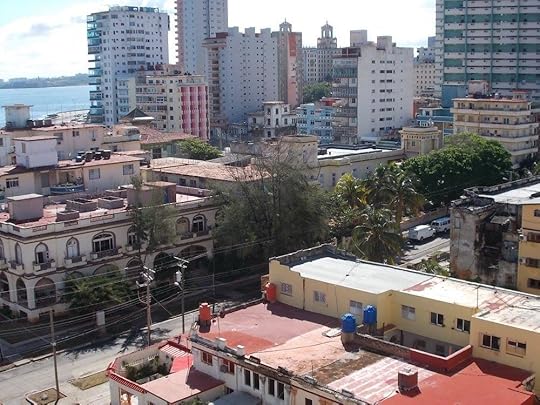
(Photo of Havana by me.)
(Photo of Havana by me.)

July 15, 2013
A nice, concise account of Cuban history. Likely for a very proud Cuban perspective, which is certainly different than the more commonly known American perspective of American-Cuban tensions. Sometimes too many names were spouted off, as an overview for an outsider there is no way I will remember more than a couple (but at least now I know who the Holguin airport is named after, as well as who is being quoted on occasional phrases!)

May 21, 2012
I liked this book because it was short--it covered a lot of territory in 108 pages. There were parts where it was difficult to follow because it was too brief, but overall I think it did a good job of painting Cuban political history in broad strokes.
Both authors have been faculty at the University of Havana.
Both authors have been faculty at the University of Havana.
February 4, 2012
Un muy buen resumen de la historia de Cuba, desde sus orígenes prehispánicos hasta sus más actuales retos. Recomendable para informarse, sin grandes pretensiones en el detalle, de la lucha de este gran país y su papel en el concierto de naciones.

March 7, 2013
This book is a great CliffsNotes for the much more complex history of Cuba. Perfect accompaniment for the long ride back from Cayo Coco to Havana or any place you have a single stretch to consume this.

September 24, 2012
Good primer for anyone interested in Cuba's history. Great supplement to online research as well.

March 16, 2013
Pocket-sized and concise. Summarizes Cuban history from first contact to present day.

January 17, 2014
It was fine, not overly in depth but that was obvious when I bought it. I was glad to get such a longstanding history of Cuba, it was helpful for me in trying to understand their past.

August 25, 2015
Thinly veiled Communist propaganda. Didn't know the commrades are still at it. Viva la revolución!

January 22, 2016
Una breve historia de Cuba. Interesante libro, para conocer más acerca de la isla.
Aun que debemos tomar en cuenta que va de lado con una idea política concreta.
Aun que debemos tomar en cuenta que va de lado con una idea política concreta.

January 8, 2017
Just got back from trip to Cuba I liked the short concise overview of Cuban history. I esp liked the overview of Fidel and the Revolution.
October 15, 2022
A view of Cuban history from the left, probably written under duress by a pair of professors at the University of Havana. So, you get what you pay for.

September 5, 2015
Краткая официальная история Кубы. Основной вопрос кубинской истории: почему мы не 51-й штат США?
Displaying 1 - 29 of 29 reviews