

What do you think?

Journal
In Newspaper, Edouard Levé’s second “novel,” the acclaimed writer, photographer, and artist made perhaps his most radical attempt to remove himself from his own work.
Consisting of fictionalized newspaper articles, arranged according to broad sections—some familiar, some not—Newspaper provides a tour of the modern world as reported by its supposedly impartial chroniclers. Much of this “news” is quite sad, some is funny. The work as a whole serves as a gory parody of the way we have been taught to see our lives and the lives of our fellow human beings.
Consisting of fictionalized newspaper articles, arranged according to broad sections—some familiar, some not—Newspaper provides a tour of the modern world as reported by its supposedly impartial chroniclers. Much of this “news” is quite sad, some is funny. The work as a whole serves as a gory parody of the way we have been taught to see our lives and the lives of our fellow human beings.
192 pages, Paperback
First published January 1, 2004
About the author
Édouard Levé
14 books281 followersLevé was self-taught as an artist and studied business at the elite École supérieure des sciences économiques et commerciales. He began painting in 1991. Levé made abstract paintings but abandoned the field (claiming to have burned most of his paintings) and took up color photography upon his return from an influential two-month trip to India in 1995.
Levé's first book, Oeuvres (2002), is an imaginary list of more than 500 books by the author, not actually written, although some of the items were taken up as the premisses of later books actually written and published by Levé (for example the photography books Amérique and Pornographie).
Levé traveled in the United States in 2002, writing Autoportrait and taking the photographs for the series Amérique, which pictures small American towns named after cities in other countries. Autoportrait consists entirely of disconnected, unparagraphed sentences of the authorial speaker's assertions and self-description, a "collection of fragments" by a "literary cubist." Zadie Smith has admired the "adolescent aesthetic" of this work, its "mixture of thoughtfulness and self-regard, honest interrogation and mere posing."
His final book, Suicide, although fictional, evokes the suicide of his childhood friend 20 years earlier, which he had also mentioned in "a shocking little addendum, tucked nonchalantly...into Autoportrait." He delivered the manuscript to his editor ten days before he took his own life at 42 years old.
Levé's first book, Oeuvres (2002), is an imaginary list of more than 500 books by the author, not actually written, although some of the items were taken up as the premisses of later books actually written and published by Levé (for example the photography books Amérique and Pornographie).
Levé traveled in the United States in 2002, writing Autoportrait and taking the photographs for the series Amérique, which pictures small American towns named after cities in other countries. Autoportrait consists entirely of disconnected, unparagraphed sentences of the authorial speaker's assertions and self-description, a "collection of fragments" by a "literary cubist." Zadie Smith has admired the "adolescent aesthetic" of this work, its "mixture of thoughtfulness and self-regard, honest interrogation and mere posing."
His final book, Suicide, although fictional, evokes the suicide of his childhood friend 20 years earlier, which he had also mentioned in "a shocking little addendum, tucked nonchalantly...into Autoportrait." He delivered the manuscript to his editor ten days before he took his own life at 42 years old.
Ratings & Reviews
Friends & Following
Create a free account to discover what your friends think of this book!
Community Reviews
Displaying 1 - 30 of 34 reviews
Read
May 26, 2025je sais vraiment pas quoi en penser ??¿? L’idée est à la fois bizarre et fancy je sais pas comment dire
mais je vous dis rien mes followers comme ça si vous le lisez un jour vous aurez la surprise 🕺🏻
mais je vous dis rien mes followers comme ça si vous le lisez un jour vous aurez la surprise 🕺🏻

February 9, 2016
Perhaps more audacious and noteworthy in form than content, here Levé sardonically reproduces a newspaper cover to cover, moving from deathly bleak vignettes of international strife on the front page into towards the absurd frivolity of celebrities, sports and job listings towards the back. In recontextualizing this format that we usually take for granted, he manages to make actual newspapers seem like awfully strange literary objects. I admit I was hoping for a bit more emergent meta-narrative than just the oddly recurring references to skiers disobeying trail markers (although this was pretty funny). Seems like there is some more untapped potential in this sort of exercise.

November 20, 2019
Tady Levé vzal krátké novinové články a bez přesných dat a konkrétních údajů o místech a osobách je našvihal za sebe. Bohužel to není to Pravé.
Peči vzal červenou tužku a napsal 3/10. Naštěstí to bylo krátký. A s Levém se i tak máme rádi. Tak já to taky tady nechám krátký tu recenzi. Protože na ptáky jsme krátký!
Peči vzal červenou tužku a napsal 3/10. Naštěstí to bylo krátký. A s Levém se i tak máme rádi. Tak já to taky tady nechám krátký tu recenzi. Protože na ptáky jsme krátký!

February 12, 2023
La idea me pareció interesante. Pero el contenido insustancial.
February 7, 2026
Some of the stories are prophetic to our current situation until you realize that time truly does repeat and these themes are not new, just our contemporary version of it.
December 1, 2025
Pas le meilleur livre de cet auteur. Auteur qui normalement me frappe par son originalité, sa bizarrerie, mais ici, bien que cela demeure un livre hors norme, ne m’a pas fait le même effet. On y retrouve une série de paragraphes/chroniques de journal, fictif ou réel, sans lien les eux. Cela produit un livre très fragmenté, mais aussi des textes desquels on se détache facilement, qui ne font pas ou très peu d’effet lors de leur lecture. Plutôt décevant. Je recommanderais de livre cet auteur, mais peut-être pas ce livre.
Read
July 29, 2026nedovedu si predstavit, ze tohle nekdy neni depka, ale cist Denik v roce 2026 skoro zavani sebeposkozovanim. moje chyba.

April 27, 2026
And now to something completely different!
This book, or maybe I should say newspaper, contains short fictional anonymized news items, like:
The anonymization of the news items has an intriguing effect too. When you get to the chapters ‘anonce’ and ‘météo’ it all becomes totally absurd:
Is this a book or is it a newspaper? Is it a conceptual work of art or a novel? If it’s a novel it’s a fragmentary novel, without a plot and with no protagonists or maybe millions of them. A timeless, universal newspaper. And it’s just like the real thing. Just like while reading my daily newspaper, I felt sick of all the violence and disasters, I wasn’t interested in the financial news, I was curious about houses being sold and culture events and I had a morbid interest in obituaries. Just imagine reading a newspaper with more than 180 pages!
Reading this book nowadays, when the term ‘fake news’ is mentioned very often, one wonders while reading this book where does the boundary between fiction and reality lie. This is all ‘fake news’ and it is lifelike! How come I read this, knowing it’s literature, while I often prefer not to read my daily newspaper? Do I prefer fiction above reality, even if they are very similar?
The anonymity of Levé’s ‘newspaper’ gives the reader the space to assign his or her own meaning to its content. This book was published in 2004 but it feels as if it was written today. What can one learn from it about our times? How will people read this book in the future? How do you read this book now, if you are at a different place than I am? A fascinating book to read and reread…
Œuvres is an inventory of ideas for novels or works of arts, forming together a portrait of Édouard Levé’s brain. Autoportrait is an inventory of information about Édouard Levé: What he likes or hates, what he does, what are his habits etc. The total is a portrait of himself. And this book? This inventory of news items is a portrait of the world, of us, of you. This is what makes this book so extraordinary and impressive!
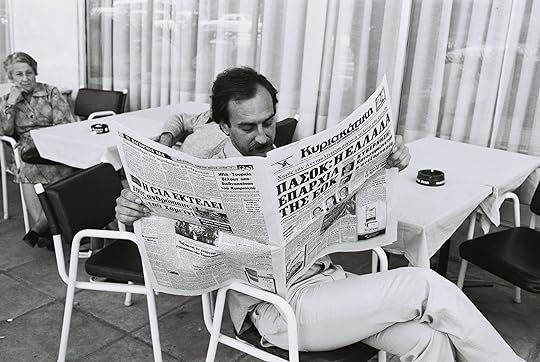
A man reading a newspaper at a café terrace soemwhere
Quotes
This book, or maybe I should say newspaper, contains short fictional anonymized news items, like:
'Dans un petit pays récemment victime de bombardements de représailles de la part d'une grande puissance, un tremblement de terre fait une cinquantaine de morts. Le programme humanitaire mondial parle de cent disparus. La grande puissance continue ses bombardements dans l'est du petit pays où se trouveraient encore des combattants rebelles. Plus de cinq mille soldats sont engagés dans l'opération.' p.20All these items are grouped according to their topic:
'Une femme, sénateur du parti libéral d'opposition, est assassinée alors qu'elle conduit sa voiture dans les rues de la capitale, une semaine avant les élections du Congrès. La police accuse les forces révolutionnaires armées. Trois autres personnes sont tuées au cours de l'attaque.' p.30
‘Terrorisme, guerre civile, guerre, dictature, catastrophe, diplomatie, politique, économie politique, agriculture, manifestation, religion, people, vie sociale, vie locale, transport, accident, medias, justice, homicide, suicide, viol, pédophilie, drogue, vol, folie, économie, entreprise, bourse, science, technologie, annonce immobilière, annonce de décès, annonce de naissance, offre d'emploi, météo, sport, littérature, art, musique, théâtre, danse, cinéma, télévision.’ (The very informative blurb of this book)The density of so many items of the same kind has a numbing effect. At a certain moment you just have enough of so many terror acts, wars and catastrophes. You read and hear about more than enough such items every day, don’t you ?
The anonymization of the news items has an intriguing effect too. When you get to the chapters ‘anonce’ and ‘météo’ it all becomes totally absurd:
'Sa femme, ses fils, sa fille et ses petits-enfants, ont la douleur d'annoncer la disparition d'un homme dont les obsèques se tiendront dans la plus stricte intimité.' p.116What’s the point of such vague texts? It reminds me the famous philosophical paradox according to which a clock that stands still is more accurate than a clock that is running 1 minute behind, because a clock that stands still shows once every 12 hours the correct time. The anonymization here is like stopping the clock: Sooner or later you’ll read something which happens here and now.
'Malgré quelques passages de nuages élevés, le soleil brille tout au long de la journée dans le Sud. Les températures de l'après-midi sont comprises entre quatorze et dix-sept degrés.' p.128
Is this a book or is it a newspaper? Is it a conceptual work of art or a novel? If it’s a novel it’s a fragmentary novel, without a plot and with no protagonists or maybe millions of them. A timeless, universal newspaper. And it’s just like the real thing. Just like while reading my daily newspaper, I felt sick of all the violence and disasters, I wasn’t interested in the financial news, I was curious about houses being sold and culture events and I had a morbid interest in obituaries. Just imagine reading a newspaper with more than 180 pages!
Reading this book nowadays, when the term ‘fake news’ is mentioned very often, one wonders while reading this book where does the boundary between fiction and reality lie. This is all ‘fake news’ and it is lifelike! How come I read this, knowing it’s literature, while I often prefer not to read my daily newspaper? Do I prefer fiction above reality, even if they are very similar?
The anonymity of Levé’s ‘newspaper’ gives the reader the space to assign his or her own meaning to its content. This book was published in 2004 but it feels as if it was written today. What can one learn from it about our times? How will people read this book in the future? How do you read this book now, if you are at a different place than I am? A fascinating book to read and reread…
Œuvres is an inventory of ideas for novels or works of arts, forming together a portrait of Édouard Levé’s brain. Autoportrait is an inventory of information about Édouard Levé: What he likes or hates, what he does, what are his habits etc. The total is a portrait of himself. And this book? This inventory of news items is a portrait of the world, of us, of you. This is what makes this book so extraordinary and impressive!
A man reading a newspaper at a café terrace soemwhere
Quotes
'Une jeune femme de vingt-quatre ans épouse un roi. Née dans un milieu modeste, elle perd sa mère à trois ans. Son père se remarie, elle est placée chez sa grand-mère qui l'élève seule. Elle réussit brillamment ses études, sort major d'une école d'informatique, option systèmes de gestion et aide à la décision. Belle et intelligente, elle est embauchée dans une holding appartenant au roi, où elle est remarquée par l'entourage du monarque, encore célibataire à trente-huit ans. Ils se rencontrent au cours d'un dîner, le mariage est annoncé quelques semaines plus tard. « Se marier, c'est parfaire sa foi. Ce qui aurait pu être un simple événement politique devient un véritable conte de fées. Notre roi est un monarque social», écrit un commentateur.' p.38-39
'Le corps égorgé d'une femme de vingt-cinq ans est retrouvé dans un box de parking en sous-sol d'un immeuble. Selon les premiers éléments de l'enquête, il pourrait s'agir d'un drame sentimental.' p.68
'Un homme de trente ans s'introduit dans un conseil municipal. Bien qu'ils ignorent sa fonction, les gardiens le laissent entrer car il est déjà venu plusieurs fois. À l'issue du conseil, vers une heure du matin, l'homme sort de son sac deux revolvers dont il décharge le contenu sur les participants. Huit personnes sont tuées et quatorze autres blessées, dont cinq très grièvement. Deux hommes épargnés parviennent à le maîtriser au moment où il s'empare de sa troisième arme. L'homme, dépressif, a tenté plusieurs fois de se suicider. Deux jours avant le drame, il envoie à ses deux seules amies une lettre dans laquelle il écrit: « Je vais me supprimer, mais avant je vais être un serial killer. >> Inscrit dans un club de tir, il détenait plusieurs armes à feu. Le médecin qui a donné le certificat nécessaire à l'autorisation de port d'armes ne connaissait pas le lourd passif psychiatrique de son patient. Au cours de son interrogatoire par la police, l'homme parvient à sauter par une fenêtre du quatrième étage, et meurt sur le coup. Le maire exige que toute la lumière soit faite par la justice.' p.70-71
'Le niveau actuel des taux d'intérêt ne constitue en aucun cas une entrave à la reprise de la croissance», déclare le président de la banque centrale.' p.87
'Depuis trente ans, la température moyenne de l'été au pôle Sud a baissé de vingt-cinq degrés, alors qu'elle augmente sur le reste de la surface terrestre. La vie s'y appauvrit.' p.111
'Vend loft 247 m² sur trois niveaux refait à neuf. Ancienne menuiserie, verrières, belle hauteur sous plafond, calme, idéal artiste.' p.114
'Une femme et son mari ont la joie d'annoncer la naissance de leur fille.' p.119
'Distributeur de bijoux piercing cherche un délégué commercial dynamique ayant une bonne base en anglais.' p.125
'Un groupe de travestis représente son pays dans un concours international de chansons de variétés, avec Only Love, interprétée en costumes d'hôtesses de l'air, gants blancs et chapeaux rouges.' p.154
'Rétrospective de cet artiste important en deux cents œuvres majeures, dont cent dix peintures, quarante sculptures, et une cinquantaine de dessins, ainsi qu'une sélection de documents inédits, provenant de collections publiques et privées de plusieurs pays.' p.171
'12.00. Journal.
12.05. Émission de divertissement.
12.15. Jeu.
13.00. Journal.
13.00. Journal.
13.45. Météo.
13.50. Série. (Rediffusion.) Un homme est découvert mort dans une cabine téléphonique. La police cherche à savoir qui la victime a contacté. L'inspecteur localise bientôt la petite amie de la victime, une jeune toxicomane, qui nie avoir reçu l'appel.
13.50. Loterie.
13.55. Feuilleton. Un homme et une femme supportent mal la défiance de leur père. Un autre homme découvre un stratagème mis au point par une femme.
13.55. Talk-show.' p.180

Read
February 27, 2017Did a review of this book here: https://youtu.be/_WTC3cBBrAo

July 5, 2015
Edourad Levé’s Newspaper offers us all the news of any major city daily, sequenced in the progression we have come to expect. He opens with international and national events before moving on to the soft news of sports and culture He ends with the weather, classifieds and TV listings. His fragmentary stories present an overload of facts, but he renders proper names and locations, the details that should give the accounts their relevance, as generalities. In the international section, terrorist attack take a “seaside resort hotel” or a “foreign country’s cultural center.” A cycle of violence continues between “two countries.” There are “ruling presidents” and “former dictators.” In the Economics section, while corporations and their leaders remain anonymous what is familiar is the audacity of their duplicitous official statements. One unnamed CEO reminds us that, “being investigated is in no way the same as being found guilty.” Levé’ fills his Sports section with an earnest blend of cliché and hyperbole that rings true in its account of comebacks, victories, and defeats. Unnamed actors, artists, and writers fill the Culture section with solemnly pronounced insights to their creative processes that are as pretentious as they are absurd.
Levé transforms the news into the drone of noise that underlies it. Reading international news can be discouraging, but here it becomes mind numbing. Frustration builds with no particular figures at which to direct one’s anger or disdain. But there is a weirdly playful quality throughout this work. For a writer it must be fun to make this stuff up. Among the international atrocities and corporate malfeasances there are stories that could be lifted directly from the news and stripped of identifying markers, but there are others too good or to horrific to be true. Or so you can only hope. Some of his most absurd turns could be true. His film listings sound like generic Hollywood offerings, but one stands out as particularly ridiculous: “…city dwellers become increasingly obsessed with spiral imagery, and eventually metamorphose into snails.” Sounds like a joke, but that’s Junji Ito’s Uzumaki. I’ve both read the manga and seen the film.
Levé’s fiction comes in quotation marks. His four prose works play complicated games with narrative and autobiography. Here he may undermine his purpose because his fidelity to the newspaper format produced in me, just as does any real newspaper, an at times irresistible urge to skim. But that effect could be a sign of his success.
(This review was made possible by an advance copy from Net Galley.)
Levé transforms the news into the drone of noise that underlies it. Reading international news can be discouraging, but here it becomes mind numbing. Frustration builds with no particular figures at which to direct one’s anger or disdain. But there is a weirdly playful quality throughout this work. For a writer it must be fun to make this stuff up. Among the international atrocities and corporate malfeasances there are stories that could be lifted directly from the news and stripped of identifying markers, but there are others too good or to horrific to be true. Or so you can only hope. Some of his most absurd turns could be true. His film listings sound like generic Hollywood offerings, but one stands out as particularly ridiculous: “…city dwellers become increasingly obsessed with spiral imagery, and eventually metamorphose into snails.” Sounds like a joke, but that’s Junji Ito’s Uzumaki. I’ve both read the manga and seen the film.
Levé’s fiction comes in quotation marks. His four prose works play complicated games with narrative and autobiography. Here he may undermine his purpose because his fidelity to the newspaper format produced in me, just as does any real newspaper, an at times irresistible urge to skim. But that effect could be a sign of his success.
(This review was made possible by an advance copy from Net Galley.)

September 13, 2022
This deconstructs the concept of the newspaper by casting these more or less believable article snippets in fiction, thus calling into the question the presentation of news. Whether it's our focus on the most brutal of crimes, the most boring of business news, the ridiculous qualifications job postings request, or the potential banality of obituaries, the weather, and sports. Works best as a conceptual piece of art, not as an entertaining or even that intellectually stimulating read. I thought the best snippets were the first few in the Arts & Culture section.

April 13, 2015
Three-and-a-half, really. More explorations of fiction and what it can do. This is a newspaper in a novel, divided into sections, made up of fabricated stories, stories that sound like what you'd see in any paper, and some articles that bring to mind other works. More to say later.
Here's the more considered approach:
http://www.winnipegreview.com/wp/2015...
Here's the more considered approach:
http://www.winnipegreview.com/wp/2015...

August 22, 2024
I keep this in my bathroom; better poop read than the NYT!
January 3, 2020
I looked at the whole back of the book thing and I don't necessarily agree with that. I did find myself drifting and thinking some things while reading. Here, in no particular order is what I thought.
These paragraphs of stories and articles defy the standard inverted triangle of news stories. It almost feels like a parody or one of those meta stories that McSweeney's or other internet sources run. Maybe this could be titled, any news story ever.
With the details removed, the articles read like plotlines. Maybe this is all there is. The same stories repeated over and over with very little change. Cynical? Maybe. But most of life is not that extraordinary and news isn't necessarily new.
The constant and almost repetitive nature of these paragraphs made me realize why I rarely read news stories. The content rarely makes a difference.
If the purpose was as the back of the book stated, then there should have been more of an attempt at showing both sides. Unless it was the author's perspective that all news serves a higher (read hegemonic) purpose then this works.
Yeah, an interesting experiment. A few of the paragraphs gave me a chuckle but I didn't love the experience. As I go back and visit writers such as Calvino and other 'experimental' writers, it makes me exasperated and impatient. I am left with asking, is this the only point? Is this experiment worth doing and is it repeatable? Are there new things to be learned by re reading this?
Sometimes, the answer is meh and no. This is a cut above it, if you haven't come across something like this on the internet already. I am guessing that you probably have. In that case, this is amusing to look at one dying medium that is exploited by another medium whose death has been greatly exaggerated.
These paragraphs of stories and articles defy the standard inverted triangle of news stories. It almost feels like a parody or one of those meta stories that McSweeney's or other internet sources run. Maybe this could be titled, any news story ever.
With the details removed, the articles read like plotlines. Maybe this is all there is. The same stories repeated over and over with very little change. Cynical? Maybe. But most of life is not that extraordinary and news isn't necessarily new.
The constant and almost repetitive nature of these paragraphs made me realize why I rarely read news stories. The content rarely makes a difference.
If the purpose was as the back of the book stated, then there should have been more of an attempt at showing both sides. Unless it was the author's perspective that all news serves a higher (read hegemonic) purpose then this works.
Yeah, an interesting experiment. A few of the paragraphs gave me a chuckle but I didn't love the experience. As I go back and visit writers such as Calvino and other 'experimental' writers, it makes me exasperated and impatient. I am left with asking, is this the only point? Is this experiment worth doing and is it repeatable? Are there new things to be learned by re reading this?
Sometimes, the answer is meh and no. This is a cut above it, if you haven't come across something like this on the internet already. I am guessing that you probably have. In that case, this is amusing to look at one dying medium that is exploited by another medium whose death has been greatly exaggerated.

March 25, 2023
"V bytovém domě v lidové čtvrti velkého města žije muž trpící průjmem. Protože tlakový kanalizační systém nefunguje, splachuje muž toaletu vodou z konve. Kontaminované cákance ulpívají na stěnách a proniknou do větracího systému. Šíří se tak do ostatních pater, znovu se spojí s vlhkostí v koupelnách a nakazí další obyvatele. Ti následně také dostanou průjem a poté, co je obnoveno fungování kanalizace, šíří se nákaza dál odpadními vodami. Během několika dní se nakazí tři sta osob a třicet pět zemře. Virus se dále šíří vzduchem."

November 2, 2023
A frustrating though not particularly time-consuming read after Autoportrait, which I loved. Part of my issue with this book is, as a journalist, the articles actually aren't written how a trained journalist would write an article. I'm not talking about the vagueness of not mentioning cities or names. It's more overwritten phrasing, stuff like "A young woman of 25" would always be "a 25-year-old woman" or "a woman, 25" etc. Oh well. Onto Suicide.
February 25, 2026
Journal reads like a newspaper issue from which the matter itself has been sucked out leaving only the structure of each news story (be it a terror attack, political scandal, scientific breakthrough, or cultural event). This results in an uncanny valley of newsreading in which each line feels familiar yet unidentifiable. The author's use of juxtaposition and non-linearity is present, but doesn't quite match the depth of Autoportrait or Suicide.

February 16, 2023
Ce journal est vraiment déstabilisant. Les différents sujets se succèdent et ils nous questionnent sur notre propre vie. Abordant des sujets forts comme la guerre, la politique, la religion, les médias, la justice, la mort, homicide, ou des sujets plus légers comme le sport, la littérature, l'art, la musique... C'était très fort.
May 14, 2024
An avant garde, darkly-comedic, deeply detached and consistently generic lampooning of the newspaper’s conventions that whiplashes between searing and amusing, yet remains a poignant portrait of a world in which the news is taken for granted by consumer and vender alike, and so is preoccupied with getting attention vs conveying genuinely pertinent information.

November 19, 2024
Never really rises much above its concept. I would have liked to have seen how it would change in impact if instead of being arrayed how a typical newspaper is there was a mixture of the different sections together. As it stands the international news section at the beginning sets a really high bar that mostly ramps down and slows down the pace after the initial barrage of reported violence.
July 9, 2020
This strange, disturbing, and amusing satire of humanity's absurdity has surprising depth, considering the seemingly gimmicky structuring and comically detached prose. Though at points grating, I was left satisfied with this bizarre little book.
July 25, 2026
J’ai cru me tuer. Je m’attendais à un journal, je me retrouve avec une énumération de faits divers odieux et d’attentats détaillés. Bref il est torturé. Comment vivre en ayant l’esprit concentré sur ça ?

July 22, 2017
I like this book a lot, I think it's "perfect"

August 3, 2017
The jacket describes it as a satire of how the media makes us see other human beings, but it reads more like a realization of how one very somber person perceives the world.

November 19, 2017
The novelty wears out fast. By the end of the first chapter, it already feels like an experiment extended too far. A first for a Levé book.

December 29, 2021
Awesome.
August 31, 2023
No es un diario, imita la estructura de un periódico. Coge noticias y las divide según las estructuras típicas de este: sociedad, sucesos, cultura... Nota mental: abrir un libro antes de comprarlo

June 29, 2016
Benedict Anderson described the newspaper as the epitome of modern temporality. Each issue, regardless of where or in what language it may be published, declares itself an archive of all that is worthy of note, anywhere and everywhere, on that day. To this end, wrote Anderson, newspapers deploy a homogeneous vocabulary that presents each ruler (be he chairman, prime minister or ayatollah) and each nation as instances of generic types. The reader is invited to experience all events everywhere as cognizable and structurally familiar, easily categorized as "Politics" or "Business" or "Arts"
With prose that is often dry to the point of affectlessness, Édouard Levé's Newspaper sets out as a phenomenology of journalistic homogeneity. However, the novel satirically dismantles the universality of newspapers, revealing the inherent banality of journalistic description and its simplistic taxonomical structure.
One settles into the reading of the novel as if indulging in the signature modern pleasure of perusing a newspaper from cover to cover. On a Sunday morning perhaps. At a breakfast table or in a municipal park or on a train. The novel provides just enough descriptive specificity to invoke the familiar comforts of the world citizen consuming the daily paper.
However, Levé never names people or places. Even specific currency becomes "monetary units." Events, technologies, artworks, tragedies all flow past in this reductio ad absurdum. As one peruses Newspaper, the presumption of simple readerly pleasure gives way to sickening unease, an emptiness at the core of pleasure. Nothing is happening anywhere in particular or to anyone in particular. The modern world, that triumph of universalism, smothers all of humanity in a deterritorializing shroud of undifferentiated form.
What Anderson describes as a fundamentally modern (and nation-bound) consciousness has become, for Levé, the anxious underside of modernity-- existential nausea and the melting of all that is solid. That core nausea, so distinct from the playful bravura of postmodern fiction, gives the novel a late modernist mouth feel, and yet its finish (to extend the wine metaphor) is thoroughly deconstructive. Overall, the newspaper, as quintessential digest of the quotidian, is revealed as anti-repository, an instrument for stripping everyday existence of significance.
With prose that is often dry to the point of affectlessness, Édouard Levé's Newspaper sets out as a phenomenology of journalistic homogeneity. However, the novel satirically dismantles the universality of newspapers, revealing the inherent banality of journalistic description and its simplistic taxonomical structure.
One settles into the reading of the novel as if indulging in the signature modern pleasure of perusing a newspaper from cover to cover. On a Sunday morning perhaps. At a breakfast table or in a municipal park or on a train. The novel provides just enough descriptive specificity to invoke the familiar comforts of the world citizen consuming the daily paper.
However, Levé never names people or places. Even specific currency becomes "monetary units." Events, technologies, artworks, tragedies all flow past in this reductio ad absurdum. As one peruses Newspaper, the presumption of simple readerly pleasure gives way to sickening unease, an emptiness at the core of pleasure. Nothing is happening anywhere in particular or to anyone in particular. The modern world, that triumph of universalism, smothers all of humanity in a deterritorializing shroud of undifferentiated form.
What Anderson describes as a fundamentally modern (and nation-bound) consciousness has become, for Levé, the anxious underside of modernity-- existential nausea and the melting of all that is solid. That core nausea, so distinct from the playful bravura of postmodern fiction, gives the novel a late modernist mouth feel, and yet its finish (to extend the wine metaphor) is thoroughly deconstructive. Overall, the newspaper, as quintessential digest of the quotidian, is revealed as anti-repository, an instrument for stripping everyday existence of significance.

June 8, 2015
Newspaper is Edouard Levé’s hard stare at contemporary newspapers, or what remains of them. Not so much newspapers as newspapers but what they represent: interests of the time about the time of interest. Unlike Kenneth Goldsmith’s Day, which exactly duplicates an entire issue of The New York Times, from left to right, top to bottom, but minus typographic signals that indicate change of subject or difference between article and advertisement—so that the rhetoric used to describe international and national events, sports, weather, and entertainment are as much of Goldsmith’s topic as the news deemed “fit to print,” Levé’s Newspaper is invented, using tropes and stereotypes common to journalism and to the type of topic covered. But by inventing his newspaper, he also parodies it and therefore comments on it as he goes along, so that the stories themselves are the point. And, yes, the stories are dreary because of their predictability (which I assume is Levé’s point, not failing): massacres abroad, corruption at home, mindless drivel served up as diversions from the massacres and corruption. Newspaper reads as an exercise in exhaustion, as a comment on a world dependable for its unswerving commitment to duplicity and destruction. Not nearly as strong as his devastating Suicide, which instead of resignation is propelled by confusion, desire (to understand), and personal (rather than generalized) sadness.

June 19, 2016
Bare bones reality is what fictions usually are fleshed out from, in most cases by layering in narrative and theme and character. Dead French dude Édouard Levé took an opposing tack in Newspaper, a parody concept novel that strips world events to the essentials of an RSS feed with all names, dates and countries of origin redacted. The creepy slim result—prophetic, cursed with perfect-pitch recall, pinned in the moment—is devoid of any reassurance that humanity can escape the sad predictability of its future, history or present.
Displaying 1 - 30 of 34 reviews