
What do you think?
Rate this book


208 pages, Hardcover
First published January 1, 2010


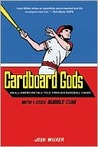 Cardboard Gods: An All-American Tale Told Through Baseball Cards by Josh Wilker
 By the final out Cardboard Gods may not have been a perfect game for everyone who reads it, but it was an absolutely perfect read for me (sorta like the Doc Ellis no-hitter that Wilker's references). Of course part of the reason this book resonated with me certainly has something to do with the fact that author Josh Wilker is the same age as me, that 95% of the baseball cards he mentions were ones that I owned and coveted, that he grew up in an alternative family situation that involved moving from house to house frequently, he had a step-father, he had a brother who is close in age, and that both Wilkers and I were UPS package handlers in the early 90s. But there are plenty of aspects of Cardboard Gods that anyone can appreciate, for instance his brilliant use of a “device of continuity” that ties the book together. Wilker starts each chapter out with a reproduction of a Topps baseball card circa 1974 to 1980 and then goes on to connect an aspect of his childhood (and/or an aspect of American culture and/or the nature of mankind) with an aspect of that card. Wilker’s observations about the poses, gestures and facial expressions of the ball players captured on the cards were especially brilliant as he insightfully wove these snapshots into the parallel narrative of his childhood in 1970s America. One great example of this was the side-by-side chapters in which Wilker juxtaposes a 1978 Bo McLaughlin card with a 1976 Steve Garvey card:

 “Everybody was going from before to after. Everybody had a look on their face like they’d just caught a whiff of a nearby landfill. Everybody was ambivalent about the length of their hair…Everybody went back and forth from having a regular job to laying on rusty lawn furniture all afternoon unemployed…Everybody began wondering how to file for divorce…Everybody was Bo McLaughlin…Everybody except Steve Garvey.”
  It was also entertaining the way that Wilker used baseball cards to say so much about people, about the trials and tribulations of childhood and about 1970s America all at the same time. As I flipped the pages from chapter to chapter, each revealing another lost treasured image of the Cardboard Gods from my childhood, I began to notice a sense of exhiliration—an exhileration that was similar to the exhiliration that (just like Wilker explained having as a kid) I also experienced in my youth every time I bought a new pack of baseball cards and then obsessively thumbed from one Cardboard God to the next. Wilker even pays homage to that lost experience of exhiliration (common to nearly every boy who ever bought a pack of baseball cards in the 70s) by opening the book with an offering (in image at least) of one of those rock hard miniature slabs of pink sugar/bubble gum that came inside every pack of Topps baseball cards from that era. Even the cover of Cardboard Gods is cleverly designed to replicate the packaging of a pack of baseball cards from the 70s era. This all resonated with me (a thrift store/garage sale junkie anyway) as Cardboard Gods displayed a rich understanding of that certain 1970s Americana vibe that only a kid growing up in that era could truly understand.


