In the Shadow of the Moon tells the story of the most exciting and challenging years in spaceflight, with two superpowers engaged in a titanic struggle to land one of their own people on the moon. While describing awe-inspiring technical achievements, the authors go beyond the missions and the competition of the space race to focus on the people who made it all possible. Their book explores the inspirations, ambitions, personalities, and experiences of the select few whose driving ambition was to fly to the moon. Drawing on interviews with astronauts, cosmonauts, their families, technicians, and scientists, as well as rarely seen Soviet and American government documents, the authors craft a remarkable story of the golden age of spaceflight as both an intimate human experience and a rollicking global adventure. From the Gemini flights to the Soyuz space program to the earliest Apollo missions, including the legendary first moon landing, their book draws a richly detailed picture of the space race as an endeavor equally endowed with personal meaning and political significance.
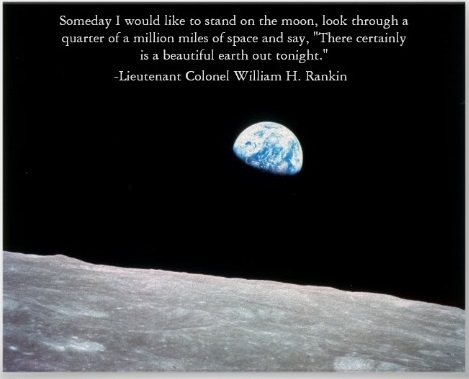
When I was in my teens, I had a poster showing Earthrise – a photo, I know now, by Bill Anders – with the quote "Someday I would like to stand on the moon, look through a quarter of a million miles of space and say There certainly is a beautiful Earth out tonight." I loved that poster; I don't know what happened to it, but to my joy I found a close facsimile online, reminded by this book to go look for it. I loved that quote – and I meant it. I was (and am) a Trekkie. I loved the shuttle program. My heart broke on January 28, 1986, and again on February 3, 1990. One of the literally happiest moments of my life was hearing that there really, truly, honestly is water on Mars. And when I look at the moon, more often than not I'm thinking not only how beautiful but about the 47-year-old footprints up there, and why the hell aren't we up there right now?
When this book's narrator, Gary Willprecht, offered In the Shadow of the Moon in the Goodreads Audiobooks group free for review, I realized how shamefully little I actually know about those early days of the space program. Apart from reading and watching The Right Stuff back in the day (from which I learned the phrase I actually use now and then, "Our rockets always blow up", and the one I have to be careful about using, "screw the pooch"), and that glorious documentary I can't remember the name of, I've never stirred myself to fix that. (I have the same issues with Civil War generals: fascinated but dumb, that's me.)
Still, I am a fan of the space program, in a big way. And I've always had to fight a hair–trigger reaction of outrage whenever I hear the time–worn complaint that "there are so many problems on earth, why do we need spend the money or risk people by sending them into space?" My first reaction is always confusion – how could you ask that?? But, growing up, I've tried to come up with a better reaction, using actual words. As I hoped, this book helped.
As they tried to launch Gemini 6, a mission set to attempt the first rendezvous in space, a certain set of variables came together on the launchpad. In the resulting situation the astronauts were supposed to, going strictly by the book, eject. "Had Schirra and Stafford ejected from the spacecraft, it would have been damaged beyond repair by the ejection–seat rockets, and the rendezvous with Gemini 7 would never have happened." Schirra had launched before; he knew what it felt like; he would have felt the liftoff through his seat. So even though the computer sent a signal to the clock in the capsule showing they had lifted off, he never felt it, so he knew he didn't need to eject. The quote in the book is "I had my butt working for me." So maybe there's my answer to the idiots uninspired folks who have asked why we need to send people into space, why not just keep sending unmanned vehicles up. Unmanned craft don't have butts.
"Individuals and the choices they made once again made the difference"… "Because of Schirra's risky decision, the mission was saved." Unmanned craft also can't make risky decisions.
And as to why the American space program has been so spotty, why it faltered in the seventies and has all but died again now … The blame is always placed on the American public. The country is fickle and easily bored, and interest wanes, so it's hard to keep it all going. Yet another thing I found sad in this book was this quote from Dick Gordon: "We had become, as a team, very complacent about the environment in which we were operating." My interest has never waned; my passion for getting our butts into space has never slackened; I find it impossible to believe that if, I were working on the space program, I would not bounce out of bed every morning and hasten to work with a song in my heart and an awed glee at the whole idea of it. I guess I'm the oddball, since even the astronauts became blasé.
I had to stop for a while about two thirds of the way into the book, because quite frankly the disillusionment and irritation became a bit too much. The fighter pilot mentality battled the scientist mindset every step of the way, and the fight wasn't pretty. The back–biting and in–fighting and petty politics among the astronauts was hard to listen to. Back–biting, bitching, bitterness, and bile – oh, and bitchiness. (Oh, and vomiting, but that would be a whole other paragraph.) Were the best possible astronauts assigned to each flight? Who knows? I'm old enough that I don't expect anything but feet of clay in my heroes – but these are our first astronauts. I projected onto them the giddy intoxication of everything about the space program to an avid Trekkie. Instead, I heard about the actual contempt from the astronauts over all the excitement among the general public about stepping onto the lunar surface, because test pilots get excited about flying, not getting out of the vehicle)… Really? Where is all that awe and glee? Was there no excitement at all in some of them about being among the first human beings to set foot on a planetary body other than Terra? It baffles me. In fact, Neil Armstrong apparently didn't understand why there was such a fuss over going to the moon. That goes beyond bafflement to complete stupefaction. It makes no sense.
I was also dismayed about the lack of dissemination of information. I understand the rabid competitiveness of the space race, but not only did the Russians not pass on any data which might have increased safety for American astronauts (or, I daresay, vice versa), Americans didn't pass on anything to Americans – they learned nearly nothing from earlier missions, made the same mistakes over and over.
And then there's the emotional blackmail used by some astronauts, or NASA (or both), in personal relationships. "If you upset me it will affect my performance in the cockpit, and I could die." There's some truth in that, of course – that's why it worked – but good lord, you can't tell me the Astronauts Wives Club knew what they were getting into.
Chapter after chapter I dreaded the story of the Apollo 1 fire. I specifically did not look up the date, because in a way it would have been harder knowing exactly when to expect it. (It was January 27, 1967… Challenger was January 28, 1986. I don't like the end of January.) Well… I don't know if it really could have been harder. It was horrible. Gus Grissom went to Grumman, the company which manufactured most if not all of the tech for the program, and went department by department throughout the company to shake each employee's hand. He wanted to meet the people involved in working on this materiel which was meant to protect and preserve his life, and he wanted them to have a face to remember as they worked, to perhaps sharpen their attention in their work. It didn't help.
While I was flailing in the grief and pain of the accident, there came this line, a quote from engineer Sam Beddingfield: "Moments later an ambulance tore past, heading for the gantry area. I could hear sirens going off near the pad, and assumed there'd been an accident somewhere. My major concern was that it might further delay my evacuation systems check with the crew". I already felt sick … as counter-irritants go, that was a powerful one.
The narration was very good, though at times a little awkward – especially the Russian–concentrated bits; new or longer Russian names sound like they were spliced in, with different sound level and timbre. And the voice in which astronaut (and other) quotes are read was a little uncomfortable.
There was a truly massive amounts of time spent on Donn Eisele's divorce – without a paper copy it's hard to judge how many pages (and listening at work means constant interruption, so it's hard to accurately clock it). But it just went on and on. It was important – it was a test flight in a whole different way, as the first divorce among a group of men who were being portrayed as the squeakiest of the squeaky clean (and really it's no wonder the disillusionment hit so hard, given the snow job perpetrated by NASA). But the level of detail was immense.
And to be honest, though I knew virtually nothing about the history of the Russian quest for the moon landing ... I was fine with that. It's part of the theme of the book – the voyage to the moon – but I wasn't expecting the Russian side, and I simply was just not interested. Maybe if it had alternated a bit more regularly with the American program it would have held my interest a bit better, but as it was there was a long chunk of the Russian program dropped in about midway, and – like Eisele's divorce – it just went on and on. Also, though it brings in the death of cosmonaut Vladimir Komarov, I still had to look him up to find out what happened. One of those interruptions might have made me miss a mention, but I didn't hear it.
Overall, it's kind of hard to separate my reaction to the content of the book (like the fact that equipment for lunar landings after Apollo 17 was already built – – and apparently either went straight into storage or was scrapped) from my reaction to the writing and narration. There were a couple of sections – while astronauts were vomiting right and left, and when the disillusionment set in – when I would have been content slapping the whole thing with two stars, whatever else happened. And there were times when the narrator's way of using slight variations on the same voice for all of the quotes in the book got on my last nerve. And I found the end of the book quite abrupt – there, done, that's (literally) all they wrote.
But the book also relayed the story of those early years quite effectively, those primitive early flights. How terrifying a loss of telemetry was. How even the most prepared astronaut or engineer could be caught off guard by the simplest thing in this brand new environment. It was fascinating to learn that Michael Collins was a bit claustrophobic; that sextants were still being used in 1968; and for the meaning of "dark-adapted eye" (also the title of a Ruth Rendell novel) to finally click in my mind. On the whole, it was quite worthwhile. Who needs illusion and idealism, anyway? Being jaded makes life much less painful. Right?
...Right?
I received a copy of this audiobook from the narrator via the Goodreads Audiobooks group – thank you.
A few more quotes:
...Humans have not returned to the moon since. ... Several things stopped it: economics, desire, and leadership. The reward to risk ratio went down. Put them all together ... There's always this controversy, too, over 'why spend all this money in space?' and all that kind of thing. Not a damn nickel has been spent in space – it's spent right here, right here on earth. I think of our advances in technology, and I think the space program has given them all to us. Our standard of living and the advances in technology have been accelerated because of our space program. The only other event that accelerates technology is war. You know which one I would choose? I think you would too. You always hear about so many social ills that this country has to take care of. I propose to you that if our social ills had been a priority back in the 1700's and 1800's, the western boundary of the United States would be Virginia's Allegheny Mountains. – astronaut Richard F. Gordon, Jr.
I am, and ever will be, a white socks, pocket protector, nerdy engineer –– born under the second law of thermodynamics, steeped in steam tables, in love with free–body diagrams, transformed by Laplace, and propelled by compressible flow. –– Neil Armstrong, February 2000 (he was from Wapokoneta, Ohio – which is where Kent Boyd of So You Think You Can Dance lived. Which has nothing to do with anything.)
But why, some say, the moon? Why choose this as our goal? And they may well ask why climb the highest mountain? Why, 35 years ago, fly the Atlantic? Why does Rice play Texas? – Kennedy
To the surprise of some, Stafford argued that [Apollo 10] shouldn't land. The commander was ruling himself out of becoming the first person to walk on the moon. The reasons he did so are sound, practical ones, and show that this crew's dedication to test piloting excellence was more important to them than personal glory.
I need to do a couple of housekeeping tasks before we get to the main review, so feel free to skip on down a couple of paragraphs if you have no interest in listening to me get on my personal soapbox and venting a bit.
First off, I’m a HUGE believer that math and science literacy in the United States should be a targeted focus for K-12 curriculums nationwide. Students in the United States suffer when compared to other countries around the world when it comes to math and science proficiency, and this gap MUST be closed if the U.S. wishes to be a leader in theoretical and practical science applications as we get further into the 21st century. One look at this graph will give you an idea as to where the U.S. currently stands compared to other industrialized nations with regards to math and science education.
As you can easily see, we have a lot of work ahead of us if we wish to once again become a scientifically literate society.
Second off, I’d like to commend The University of Nebraska Press for bringing a comprehensive history of space exploration to the masses in the form of a MASSIVE collection of books that bring the humanity and history of the “space race” to life. The “Outward Odyssey” series is written for the layman yet maintains a serious tone and doesn’t dilute the science or talk down to its audience. To my knowledge it is the only book series to present a thorough history of international space exploration from the early days of rocketry all the way to the privatization of space travel. I cannot say enough good things about this series. I’m pretty much of the belief that every American home should own a complete set of these books, much like families in the middle portions of the 20th century always seemed to have a set of encyclopedias sitting around for easy reference. At the very least every public library should own a set.
So, I think it’s safe now for me to proceed with the review. Thanks for bearing with me.
Seeing as 2019 is the 50th anniversary of the Apollo moon landings, I thought that it would be a good idea to place some reading focus on the events at hand. The first book that I decided to read is one of the volumes from the aforementioned “Outward Odyssey” series, titled “In the Shadow of the Moon: A Challenging Journey to Tranquility, 1965-1969.” This book details the Gemini and Apollo missions that led up to Apollo 11, the breathtaking final leg of the journey to the moon that saw Neil Armstrong become the first human being to set foot upon an alien landscape. Apollo 11 is only given a short history here, as the “Outward Odyssey” series devotes another volume entirely dedicated to documenting the Apollo moon missions, that being “Footprints in the Dust.” Obviously that will be another review……
Now listen, you really get your money’s worth out of any of the books in the “Outward Odyssey” series, and this is certainly no exception. Exhaustively researched and sourced, and augmented by hundreds of hours of interviews with the principals themselves, “In The Shadow of the Moon” provides an in-depth recounting of each important mission as things led up to the eventual Apollo landing. In addition, you get a number of black & white photographs that add visual punch to the narrative, though I do wish the authors had sprung for a few color reproductions here and there. That said, the knowledge base alone makes up for any slight shortcomings.
In this book you will LEARN things! Stuff like this:
Donn Eisele’s divorce was a shock to the astronaut corps and the press corps alike. The astronauts had all been groomed to be All-American Boys who stuck to the straight and narrow, but the truth of the matter was far from that. It was hardly unusual for an astronaut to give in to the temptation of what was essentially a rock star existence and have a girlfriend down at the Cape. Most of the affairs were low-key and kept hushed up, but Eisele broke that mold in a very public way, derailing his career in the process. Others would come forth in his wake, but as the first to publicly split with his wife, he was the unfortunate guinea-pig for what was essentially a life in a vacuum.
The fiery accident that claimed the lives on Ed White, Gus Grissom, and Roger Chaffee is described in detail, from the circumstances that caused the accident to the eventual aftermath, and then onto the renewed effort to make sure that future Apollo missions would be the safest that they could possibly be. Any and all room for error was eliminated by the engineers working in tandem with the astronauts, and the payoff was a hugely successful space program that allowed humans to walk the face of an alien world.
Over time, the Apollo 7 mission has been maligned as one where the crew essentially “mutinied” and has been tarnished by the idea that the astronauts hurled nothing but curses and invective at the ground crew. Though Apollo 7 was a challenging mission, the transcripts of the flight reveal a crew that was functioning at a high level and working well with the flight controllers. Gene Kranz himself is the first to admit that ground control did not stick to the established flight plan and overloaded the mission with unexpected testing and experiments. That this mission performed so well was a testament to how quickly the astronauts could adapt to new data and expectations quite literally on the fly.
There are also several sections of the book dedicated to the Russian space exploration of the era, and these are fascinating case studies in and of themselves. The untimely death of Chief Designer Sergei Korolev seems to be one of the key reasons why the Soviets were not able to keep up with the American space program. His death left a void in direction and leadership that seemed to paralyze the Russians for a significant period of time. Had he not died when he did the race for the moon might have been much closer than it ended up being.
And you know, I could go on and on, but the fact is that you need this book (and this entire series of books) if you have even a passing interest in space exploration. I was astronaut crazy as a kid, and reading these books gives me so much more insight to an era that captured my imagination, and the imaginations of millions of other kids and adults. The moon landings are still considered the technological apex of mankind’s urge to explore and conquer the unknown. “Outward Odyssey” puts you right in the action and demands that you immerse yourself in what was undeniably an exciting time in human history.
In the Shadow of the Moon delivers an extremely well researched look at the race to put man on the moon. This is done by following the Gemini program through to Apollo 11. The authors also take a look at the Soviet Union’s efforts to beat the US to the moon.
What really stood out for me was the effort the authors took in not just telling the story of those astronaut’s we all know well but also shining the light on all the astronauts that went into space before them. They step the reader through the Gemini and early Apollo flights weaving together the story from the astronauts themselves with good ole fashion facts.
I walked away from this book with a lot more knowledge on the early space program of both Superpowers as well as a unique personal view of what it was like to reach for the stars. In the Shadow of the Moon is an example of history writing at its best.
"If you really love the sky you do not retreat before difficulties." Boris Volynov
Fun fact: Volynov was the first Jewish person in space! That is just one of the many fascinating stories you'll learn about from this successor volume to Into That Silent Sea, part of Uni Nebraska's "Outward Odyssey" series. Man, these histories are good! If you love space shit, then go no further. This volume covers the Gemini and Apollo programs on the US end, and the early Soyuz missions on the Soviet side of things. Since the Soviets weren't up to much, their sections in this volume are few, but fascinating, including lots of things the layperson probably never knew about, like Volynov and the real story of Vladimir Koramov's totally preventable death. But this volume is really about Apollo. Staring with a disturbingly detailed account of the Apollo 1 disaster, you're taken through all the Apollo manned missions that you never heard about, except for maybe Apollo 8 (the one where diarrhea and vomit was floating around the command module the whole time). All of them are worth learning about, some are sadly unsung (we love you Apollo 9!) and all contributed to the lunar moneyshot, #11, whose landing ends the volume (there's a whole separate volume on the moon missions). The mission details and interviews are priceless. I never knew that urine crystals around the spacecraft obscured stellar cartography, for instance.
This is second of three books by Francis French and Colin Burgess covering the history of manned space exploration. It's an incredible book...telling an incredible story. It covers both US and Soviet space travel and provides a detailed account with comments from many of the astronauts and cosmonauts. I grew up near the Manned Spacecraft Center in Houston and knew many people who worked for NASA. I thought I knew a lot about the Gemini and Apollo programs - this book's focus. I learned so much more by reading this book.
A workmanlike look at the U.S. space program from 1965 to 1969, encompassing the Gemini program, the Apollo I tragedy and the first five flights of the Apollo program. This book is the second of a trilogy looking at the entirety of the race to the moon and its exploration by the United States.
Overall I enjoyed the book in the same way I enjoy a really well written Wikipedia entry. I get all the information I want, with the pleasure being the information itself and not so much the writing.
It was cool having such a detailed description of each Gemini mission which is often overlooked in the history of the space race. The sections that looked at the Russian program were also interesting in I had read very little about it in the past. Detailed and lengthy reflections by the Astronauts and Cosmonauts themselves was also interesting.
Where this book falls short in my opinion is in its obvious attempt to avoid any hint of controversy. Astronaut biographies read like NASA press releases, and in sections that looked at controversies that were so public they could not be ignored the authors inevitably tried to take as sunny a view of them as possible.
If you are looking for a good first book to read on this era of space history you could do worse than this book. If you are looking for a book that puts the space race into a wider political, social and economic context you should look elsewhere. A good book on this topic is …The Heavens and the Earth: A Political History of the Space Age by Walter A. McDougall.
Great book on the Apollo space program, although not the very best book of the many I have read on the subject, it is right up there near the top of the pile.
This is the first book I've read from the Outward Odisseu series. It was a pleasant surprise. Right after reading Gene Kranz autobiography this was a great follow through that described most of the same situations but from the astronauts perspective. It goes into much detail on a few of the Gemini missions (although not in so much detail.as Kranz's book) and then dives very deeply on Apollo missions 7 to 11.
I had a good idea of the historical significance of the Apollo 8 mission but was always a bit dismissive of the 7, 9 and 10 flights. This book taught me both the importance and the appeal that these flights would have for astronauts. Apollo 7 was a super risky mission, the first with a crew inside the CSM, Apollo 9 was a test pilots dream where they finally tested all the hardware and maneuvers that would be required (the thought of those 2 guys undocking from the CSM on the LM and knowing that all their chances of survival required that the crafts could re dock again raised the bar for me). and finally the importance of Apollo 10 mapping and testing all the required maneuvers in place, essentially writing the runbook for Apollo 11 to follow and succeed.
Having 2 chapters dedicated to the first Soyuz missions was a big plus.
I'm docking a star because of 2 reasons:
- I think the book spends way too much time delving on the private life of Don Eisley. It's the only astronaut that gets this treatment (because of being the first divorced astronaut) - The Russian chapters were an appetizer but I wanted more from it. Another chapter dedicated to the Soyuz Zond plans would be perfect.
Stories from the race-to-the-moon era, with lots of direct quotations from those who were there, on both the Soviet and American sides. I could have done with a little less detail on Donn Eisele’s personal life but enjoyed most of the rest of the book. I was surprised that the book ended so abruptly at Apollo 11 and treated it almost like a footnote. The author’s purpose seems to be to show how the other missions in the Apollo program led up to the first landing in a logical sequence, and to emphasize the contributions of the earlier missions.
The stories behind the first successful lunar landing still resonate five decades after the historic event. The authors deftly weave together the triumphs and tragedies along the way and frame personalities and technology in a manner which is both entrancing and accessible.
The cover of the book caught my attention to pick up from the library. The book is about the race to reach Moon.
Foreground is Moon and the crescent is the Earth. First photo of Earth from Moon. Image courtesy NASA.
It is well researched and the author has given much details about the space programs to put man on the moon, he also given the biography of each astronauts and selected cosmonauts in the space race. The vivid description of each mission is worth mentioning.
The description given for first manned flight in Gemini program Gemini III nicknamed Molly Brown and the first space walk by Ed White on June 3rd 1965 engrossed me and which let to NASA website to quench my thirst about these two missions. Below are some of the images from NASA website.
Gemini III lift off
The difficulties faced in each mission, how the astronauts coped with inside the capsule, the space walk they performed and how they mastered, docking procedures and re entry procedures are worth mentioning. We can feel how much difficulties the astronauts suffered.
The first American space walk
The failures of US and Russia are given in detailed manner. After the loss of three precious lives of Astronauts they created faultless rockets to put man on the Moon.
I enjoyed reading the book and I wanted to buy this book for my future reference.
I have a great interest in the space program, being a child of the 60's. I admit I was born in 69 on the Apollo 11 launch date, but always had the memory of my mother telling me often that she was making me watch the moon landing at the hospital. So I always had a fascination for the era which persists to this day. Listening to audiobooks on the subject, particularly the Apollo program, is a favorite pastime of mine. I was fortunate to be able to get a free copy of this from the narrator, but it was on my list of books to purchase eventually.
Of all the audiobooks on the subject I've listened too, I did find that I learnt a lot on this book on the crews that I didn't know. The book covered well the manned Gemini and Apollo mission up to the Apollo 11. I note that one of the authors (Francis French) has a separate book covering an earlier period (Into That Silent Sea), also available on Audible. This book also spends a little time on an aside covering the Soviet space program.
Primarily the focus of this book is the crews only, in often times their backstories, and their mission.I don't think that the publisher description of the book is clear enough in this regard. It did touch on other aspects, but not many. The unmanned missions weren't discussed, nor were many of the ground staff and technical and engineering aspects. It was a book about the astronauts. In that respect though I felt it did a very admirable job covering it. I would personally however love to find a book that covers the Apollo program itself in wider detail, with more stories on the engineering such as the Saturn V, the LEM development, the CSM development, etc. There might be one but I've not found it - if anyone has a recommendation, let me know!
Gary Willprecht's narration was excellent, and was easy listening. Enough differentiation was put into characters dialog to distinguish it from the text narrative of the book as well.
In all a recommended addition to the series. I'd be glad to read the next book, if the authors produce one covering the all of the missions after Apollo 11.
I’ll admit I have a lot of interest in space programs, and both the historical and current progress made in space exploration. Therefore the description of the book grabbed me right off the bat. I have read a number of space related books, both paper and audio, and this ranks high in that list. A lot of interesting facts, anecdotes, and stories that let you learn the different personalities of the mission teams, particularly the flight crews. I knew a lot of the problems encountered in the space program from the engineering side of things beforehand, but learned a lot more about them from the flight crew perspective in this book. I would love another book or if this turned into a ‘space-set’ of books covering unmanned missions and their mission control side in the same vein as this one – but I guess that shows how much I enjoyed the presentation of this book.
Narration on a book like this which includes facts, interviews, and papers can be tricky. The narrator here had, for me, the perfect voice quality, tone, intonations and pacing. There are both explanatory passages, stories, and interview excerpts throughout the book, which I had no trouble distinguishing. I especially appreciated the change in voice made when reading a quote which not only distinguished it from the rest of the section, but overall made for a very nice listening experience. I would definitely recommend listening over eye-ball reading the book.
I’d recommend to all, and especially to people interested in space, or history, or human/personality-interactions in team settings.
I received a review copy of this book for my honest opinion.
Originally rated G by Dale J. Bizub In the Shadow of the Moon tells the story of the most exciting and challenging years in spaceflight, with two superpowers engaged in a titanic struggle to land one of their own people on the moon. While describing awe-inspiring technical achievements, the authors go beyond the missions and the competition of the space race to focus on the people who made it all possible. Their book explores the inspirations, ambitions, personalities, and experiences of the select few whose driving ambition was to fly to the moon. Drawing on interviews with astronauts, cosmonauts, their families, technicians, and scientists, as well as rarely seen Soviet and American government documents, the authors craft a remarkable story of the golden age of spaceflight as both an intimate human experience and a rollicking global adventure. From the Gemini flights to the Soyuz space program to the earliest Apollo missions, including the legendary first moon landing, their book draws a richly detailed picture of the space race as an endeavor equally endowed with personal meaning and political significance.
A well written but in-depth study of early spaceflight, this book chronicles missions through the eyes of the participants. A little more of an advanced read, some high school students may find it interesting and informative. D. J. Bizub – Allderdice HS
A very good book on the history in human space flight. It is a long one considering it covers only the Gemini and early Apollo flights between 1965-1969. The events and the technicality are already well documented in many places, so the major differentiator of this book is its focus on the people. Many of its interviews look at what the astronauts went through from a personal stand point, both in the space and on earth.
I received the audiobook version for free from the narrator in exchange for a honest review. The narrator did a fine job on a 18hr non-fiction book that is very interview-centric. His tone variation enhance the listening experience. It could be difficult to voice for so many different interviewees but he handled it well.
I just realized this is the second book of a long series on human space flight (Outward Odyssey). I like the series' approach and already have my hands on the first and third books, which talk about early space flight and post-Apollo 11 era. Looking forward to read them.
Being very young when the Gemini flights were taking place, I was very interested in learning the tasks each Gemini mission set out to accomplish. We knew very little about travel in space, each mission added to our understanding of equipment needs, affects on the human body and technical know-how. Without that understanding, our men would have perished.
You can see some parallels taking place today as we set out to travel to Mars. We are sending probes to Mars to gather information about weather & terrain. We are building a new spacecraft for missions to Mars and testing the components before making the journey. We performed many of these same tasks in the 1960s before that first trip to the moon, Apollo 8.
Beyond the equipment requirements and testing, it tells the stories of the astronauts and their families, crew selection & humorous moments.
I read quite a bit of non-fiction, but I haven't read much space history before -- so the book was very interesting, and I learned a lot. This was a very long audio book with lots and lots of details. The chapters were so long that they exceeded the length of the audible chapter files. The book was presented mostly chronologically, but with each new astronaut introduced often a biography from birth to death would be given. I had a difficult time figuring out why some astronauts were given so much time and others so little. The book could have been improved by a bit more organization, as it seemed to flow, almost stream of consciousness, from the beginning to the end.
The narrator did a good job and it was an easy listen.
I received this audiobook free for an honest review.
I nicely written and researched book. Although this is a topic that I have read many accounts/vignettes of, this one added to my knowledge by digging out archives from both the US and Russia. How much new material? That's hard to say, but it's also about how different authors approach a topic. This author was different enough that I read it through without feeling that it was just another re-hash of familiar material.
A good reprise of the Apollo program and it's first successful landing on the moon. You should consider reading it.
This was my second book about the US space program, the first being Gene Cernan's autobiography, and I thoroughly enjoyed it. It was full of details, both physical and emotional, related to the missions and the astronauts that flew them. I was sort of hoping for a little more from the chapter about Apollo 11, but the rest of the chapters and stories were exceptionally well researched and written.
I thought this was a really interesting book, and I enjoyed it. I learned a lot about the space program during the '60's. I had no idea of the different problems or situations that they had in the space program. It was interesting to learn about the different personality types that become astronauts, and how they interacted. If you are interested in space, or just enjoy non-fiction, I recommend giving this book a try. I listened to the Audible version and enjoyed the narration.
Gemini and Apollo missions (up to 11) are covered in great detail in this book. Fine companion to the earlier book in the series and good stories and information throughout. What's keeping it from five stars is the fact that a lot of this material has been covered in other books as well.
An engrossing telling of the Gemini And Apollo space programmes, told through the astronauts who lived through them. This is a fascinating read and will set you off looking for more reading material on space exploration. Highly recommended.
A fascinating and well written history of the Gemini and early Apollo missions, putting together the space programme as a continuous planned project leading up to the moon landing. Recommended.
this puts all those moon missons I saw live as a kid in prospective. And explains why we should be going back to the moon and contiuing space exploration