Karen Farrington is a former journalist who has contributed to numerous publications on military history. She has also written extensively on assassinations, natural disasters, & religion.
“Suddenly there was a flash like the lighting of a huge magnesium flare. As I prostrated myself there came a terrific explosion. I was lifted two feet from the ground and I felt a strong wind pass my body… … I was enveloped in an endless cloud of dust so thick it was black. As the dust blew away and my surroundings became visible I saw what seemed to be thousands of tiny, flickering lamps all over the street and in the fields. They were little circles of flame, each about the size of a doughnut... … I looked towards the city and saw a huge, mushroom-shaped cloud rising high into the sky. It was an immense evil-looking pillar…”
Eyewitness account of Tsutomu Yamaguchi *, who was working in the Hiroshima yard of the Mitsubishi shipbuilding company, and who was on his way to work when the atomic bomb dropped more than 1 mile away.
It is hundreds of eyewitness accounts like Yamaguchi’s that make the ‘Handbook of World War II’ by Karen Farrington one of the unique books that I have read on World War II, the most colossal and complex armed conflicts in the human history. These individual voices from history let’s the reader experience the moments of trauma, depression, carnage, acts of valor and endurance associated with this Great War – a war which redefined the way wars are fought forever - in three-dimensional clarity. Even with some shortcomings in the way the information is organized, these eyewitness accounts along with the numerous rare photographs and newspaper scans make the book a worthy read for anyone interested in military history.
Karen Farrington manages to cover the entire timeline of the Second World War within this book, tracing the sowing of the seeds of war right from the days of political disorder of the 1920s to its shocking apocalyptic end in 1945, and brings each minor engagements and moments of the war to the reader through concise articles well balanced with photographic material.
The book is divided into three main parts with each of them representing battles fought in the land, in the water and in the air respectively.
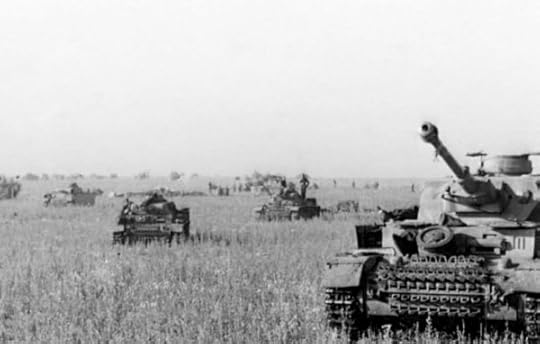
Panzer IIIs and IVs from the Battle of Kursk, one of the largest tank battle ever fought. [Source]
In ‘The Soldiers War’ such key moments of land engagements of WWII like the Blitzkrieg, Engagements in Africa, Operation Barbarossa, Engagements from The Pacific theatre, battles in Italy, Operation Overlord, fierce tank battles and the final thrust through the Nazi Germany are all covered in detail.
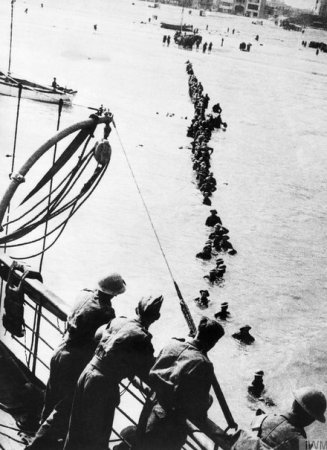
British troops evacuating Dunkirk's beaches to a waiting destroyer during Operation Dynamo [Source - Imperial War Museum]
The section ‘War at Sea’ chronicles key moments of naval warfare like the evacuation of Dunkirk, U-boat engagements in the Atlantic, Battle of Cape Matapan, The hunt for Battleship Bismarck and Battle of Midway.
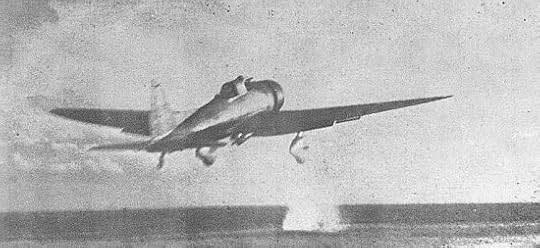
An Aichi D3A Type 99 kanbaku (dive bomber) launches from the Imperial Japanese Navy aircraft carrier Akagi to participate in the second wave during the attack on Pearl Harbor, Hawaii
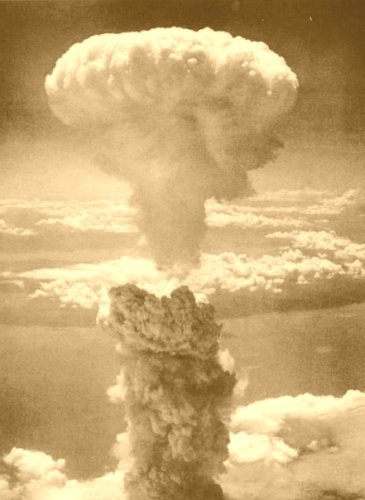
The section ‘Battle for the Skies’ describe epic moments of aerial warfare like Battle of Britain, aerial battles in the Balkans, The kamikaze warfare and Pearl Harbor and finally the atomic bombings in Hiroshima & Nagasaki.
The column of debris and dust topped by a cloud of white vapor when the Atom Bomb burst over Nagasaki – scan from my copy of Feb 1946, National Geographic Magazine
Rare photographs from various war museums along with maps, posters, newspaper cuttings and side notes enrich these narratives. The amount of information that is packed into this slim volume is amazing as the book covers a whole spectrum of theatres of conflicts. The sheer number of interviews that the author has conducted with war veterans who survived this inferno and civilians who went through the traumatic days of war adds much depth to the content. A detailed timeline of the war from March 15, 1939 to September 16, 1945 is also provided within the book.
Now to one of the key shortcomings of the ‘Handbook of World War II’: When a book that packs so much amount of information lacks any sort of index, finding details on a specific moment or topic from its pages becomes a frustrating process. If we leave out this issue, then this rather small volume is worth reading.
-Reviewed October 27, 2015 Actual Rating 3.5/5
* Tsutomu Yamaguchi is the only person to have been officially recognized by the government of Japan as surviving both the Hiroshima and Nagasaki atomic bombings. He was originally from Nagasaki and was in Hiroshima when the bomb was dropped on August 6, 1945. He survived the explosion with multiple wounds and went back to Nagasaki the next day and was at his office on August 9, 1945 when the second atomic bombing happened.
The only thing that I really liked about this book was that it included several personal accounts by people who were present during some of these events. It offered a generalized broad overview of World War II and the battles and events that took place. It was not at all what I expected it to be, and I was fairly disappointed.
This book given an overview of the event of World War 2, with a lot of "conventional wisdom." This has led to many myths and incorrect statements in the book.
World War II Handbook by Karen Farrington was first published in 2001, and draws on much of the same text and illustrations as her 1995 publication Witness to World War II. Some sections included in the original publication have been omitted, and some additional sections have been included that didn’t appear in the earlier publication. The quality of illustrations is better – whilst they are mainly the same illustrations used in the earlier work, they are reproduced far more clearly in the newer publication. Poorly worded captions and sloppy historical details are the same as before. A quick undemanding read.
This book could be really readable and enjoyable at times (as much as you can say that a book about war can be 'enjoyable'!) and then other times I really struggled to get through it. The book did teach me many new things about what happened during WWII and I enjoyed the eyewitness accounts that were dotted throughout the book as they helped me to gain a better insight into how it might have actually felt to have lived through the experience.
The book is awesome! I chose this book because World War II is my favorite war in American history. Right now I'm on page 73 "The Pacific". Each part is about six pages long. My favorite was "OVERLORD!" which wait! SPOILER ALERT!... is about The battle of Normandy and Omaha Beach. It mostly speaks of the landings and not so much of the airborne part which was more important.
This entire review has been hidden because of spoilers.
Absolutely superb! Though many a topics somewhat overlooked, but, considering such a mammoth task of covering WW2 in 250 pages, the author has done well.