Society of Illustrators 2006 Gold Medal recipient, Elisha Cooper, captures the smell, taste, and feel of the changing seasons on a farm. Society of Illustrators 2006 Gold Medal recipient, Elisha Cooper, captures the smell, taste, and feel of the changing seasons on a farm.There is so much to look at and learn about on a farm - animals, tractors, crops, and barns. And children feeding animals for morning chores! With lyrical writing and beautiful illustrations that capture the rhythms of the changing seasons, Elisha Cooper brings the farm to life.
Farm by Elisha Cooper gives a wonderful, around-the-year look at the rhythms of American farm life. Through vivid details, Cooper shows the deep sense of connectedness among family members, their community, and the animals that surround them. Each page reflects both the hard work and quiet beauty of life on a farm.
The watercolor illustrations pair perfectly with the well-written narrative, bringing warmth and atmosphere to every season. The text flows gently, inviting readers to slow down and take in the sights, sounds, and feelings of rural life.
The book is a bit long, so it may take a few sittings if you’re reading aloud with a child, but it’s well worth it—a lovely and authentic portrait of family, nature, and the cycles that shape farm life.
As a children’s librarian living in New York City, I get a really skewed view of the world. For example, a book like Christoph Niemann’s Subway will get released and all the children I see are hugely into it. For them, the subway is a part of life and that book shows them what they already know. What I have to remind myself is that Manhattan children, for all their charms, are aberrations. Lots of kids in the United States haven’t a clue what a working subway system looks or feels like. So when a book like Farm falls into my lap my brain has to do a 180 in the opposite direction. Lots of city kids have never been to a real working farm before. They understand them in the vaguest of senses. Growing up they learned that animals lived on the farm with a moo moo here and a baa baa there. Actual working farms, however, are the kinds of things you see outside your car window on your way from one part of the country to another. They are near magical places. All that land. All that sky. That’s why I’m delighted that a book like Farm even exists. It has a twofold purpose. For kids who have never experienced a farm firsthand, it provides a glimpse into a world as different and magical as any fantasy land. And for kids who already have a working knowledge of farms and the countryside, the book is a magnificent mirror that takes the practical beauty of their everyday lives and spins it into storytelling gold.
We begin in that time when spring has only started to make some headway against winter. When the days start to warm up but the fields are just a mass of brown dirt. We meet the equipment, the family, the hired hands, and the animals. We watch the tiller turn the soil, “the fields change from the color of milk chocolate to the color of dark chocolate.” We see seeds being planted, rains come, and crops grow. We meet the cats and the cows, and follow the family into town on occasion. There are summer nights and days and kids going back to school once again. To crops come in, the winter falls, and it’s all in the life of a single farm.
Kids love process. Not all kids, but a lot of them. They like to know how things are made and how things come to be. Farm, in a sense, is all about process, but it doesn’t get hung up on the concept. So you’ll learn about different kinds of farms, how tractors work, and what the various seasons resemble. But you’ll also see the downtime of the farmer and his kids. They go to town and chat with neighbors. The boy amuses himself by throwing tomatoes at birds or building forts out of straw. The girl, who is getting older, spends time reading books or staying away from home more and more often. Best of all, kids these days have a tendency to think that farming is an occupation of the past. So this book works in current technology without making it so prominent that the book will date anytime soon. A broken tractor means that a farmer has to call a neighbor on his cell to get it fixed. Much later during the harvesting “The farmer checks the corn’s yield on his computer and talks with other farmers on his cell phone.” And during a nighttime shot where the text reads, “On the farm, even when it’s dark, some animal is always awake”, in the distance is someone in the house working on a computer screen of some sort.
Cooper keeps his descriptions spare and to the point. There’s a poetry to his language here. With the shortest of sentences you know more than even he is telling you. Without saying that the boy in the story is a bit of a troublemaker, Cooper tells you as much. Without describing the fact that the girl is becoming a teenager, we get that distinct impression. And then there are passages that just take you into the story completely. After a surprise storm the book says, “Sheets of water sweep the farm, hammering roofs and rattling windows. And then it is over. The corn all bends in one direction as if to say, The storm went that way.” And if Cooper doesn’t show that image, it’s because he doesn’t have to. It’s already deeply embedded in your mind.
It took me a long time before I realized what Mr. Cooper’s style reminded me the most of. As a kid, I had a penchant for Anno’s books. These were wordless epics. Sort of proto Where’s Waldo spreads where recurring characters could crop up, disappear, and then show themselves once more. Anno had an ability to capture the complex with the simplest of lines. Cooper shares that talent. In this book, objects, people, and animals are sometimes rendered with just the barest squiggle of paint. A chicken pecking is just a single continuous line with some watercolor spotted in. A cat cleaning herself is a perfect curved angle of head against body. As for the humans themselves, in many ways they are the least detailed creatures in this book. Cooper realizes that a human brain, when reading this book, is going to make the connections necessary to recognize that this three-quarter black outline with the faintest shadings for pants and hair is, in fact, another human. Other drawings require more work because our minds are disinclined to make those connections. The roosters, for example, come off as some of the most beautifully detailed animals in the book (note the cover). So there’s definitely a logic to what Cooper does and does not detail intricately. And looking back at previous books of his like Beach, you can see he’s been perfecting the style for years.
In books like Beach, the star is the setting. That’s certainly the case for Farm as well. Only the cats, the dog, and the roosters in this book have names. The humans do not, and they are referred to in only the vaguest of terms (The Farmer, the boy, the girl, etc.). It’s the farm itself that you’re meant to focus on. Cooper allows himself a variety of sweeping panoramas at different times of year or during different weather patterns. You see the farm from a variety of different angles too, which I appreciated. And considering the sheer amount of open sky, it’s a pleasure to look at the farm when there are fast moving clouds or storm or even at night when there are just stars. In fact, if you look at the starlit scene closely, you can see that Cooper has worked in some real constellations. I could make out the Great Dipper and Orion’s Belt without any difficulty. That’s a detail that most artists wouldn’t bother with, so I am grateful to him for taking the time.
The first thing you see when you open this book are the reddish pink endpapers. They are fields from above, much as you might see while traveling in an airplane. It occurs to me that this book would make ideal airplane reading for those kids who only ever see the countryside from a height of more than 5,000 feet. I won’t say that this book is for every child out there. There’s a slow patient pace to it that may not jive with kids who need books to capture their interest every waking moment. But for the kid that is curious, that likes a title to take them into another world, or who just needs something a little more realistic than usual, Farm is a gift. There’s a beauty to it that cannot be beat. For some, this book will be loved and treasured. Remembered and put away for another generation to discover. It’s the best farm book, the best realistic farm book, I have ever read for kids.
Let me back up. This book deserves a little perspective. Lord knows Elisha Cooper has employed it - about half the pages in this yearlong portrait of a family farm are long, lean landscapes, full of sky, with an inch of flat earth at the bottom of the page.
Have you ever been out in the true Midwest? It is a marvel to me that such an astringent landscape can be so luxurious in color and texture, as if the sky has to put on a better show to compensate for the lack of earthly features. It suits Cooper's style - in books such as A Good Night Walk and Beach, his large, clean forms kept his little wiggly details from ever looking fussy, and the little wiggly details kept the large volumes from looking too austere.
A very interesting and fairly in-depth (for a picture book) look at farm life presented in an engaging way by Mr. Cooper. We follow a year in the life of a farm, both with animals and the humans, and the corn harvest. Types of farm equipment are described and much attention is given to the changes in the weather, etc. I like how much of the focus is on the barn cats and the farm dog--the humans seem more marginal. Parents should note that the book doesn't exactly glorify farm life, either for the people or the animals; and it shows some of the rougher things about nature and people co-mingling (wild animals getting run over by cars is hinted at). It is mostly lighthearted in tone, actually, and doesn't hint at any poor farm conditions for the animals but it does mention about the cattle being sent off at the end of the year (slaughter). Part of me appreciated that this was more "realistic" than most of the cutesy farm books out there for kids; and yet it also made for a slightly uncomfortable read at times though perhaps it was just me reading too much into it. With these cautions for sensitive readers, I would recommend this to the older picture book group looking for more details on family farm life.
This is a simple, yet detailed look at life on an American farm. It is an interesting story, but I recommend it for older children (grades 1-3) because it's pretty long. Our five-year-old got bored with it less than half-way through.
Elisha Cooper delivers a realistic portrait of a working farm in this lovely picture-book, describing everything from the the farm family and animals to the buildings and fields, and then the experience of living on a farm, month by month. More of an informational title, than a storybook - although the narrative does include a certain amount of sequential "happenings" (the girl goes fishing, the boy hides in the hay-loft), and some moments of genuine tension, as when a storm approaches - Farm is text-heavy, for a picture-book, and would probably work best for more advanced young readers. The sort who enjoy poring over Richard Scarry titles.
I appreciated the fact that this farm-centered picture-book, unlike so many others I have seen, treats its subject realistically, and that it is set in the here and now. The farm machinery is all current, and the farmer uses his computer and cell-phone. I also greatly appreciated the watercolor and pencil illustrations, which capture the wide-open feeling of the farm, and the individual charm of each resident, whether human or animal. I liked the squiggly little cats in particular! All in all, a sweet picture-book, well illustrated, well told, and very appealing.
This is a fascinating book filled with watercolor and pencil illustrations that show how much time the author/illustrator spent observing life on the farm. While some images such as the one on the cover are large in size, others are diminutive, very small in respect to the farm itself, which is the focus here and comprised of all those smaller elements that are featured on the book's pages. While this picture book won't appeal to everyone, I loved it for the slice of life it offers of what it might be like to call a farm home. The book takes readers through the various seasons as the farmers prepare the soil, plant and harvest crops, and then enjoy the fruit of their labors. There are so many little stories being told through the book's pages too. For instance, the family dog, Homer, romps around the farm at certain points and then waits patiently for the daughter to come home. While she might remain unnamed, the cats all have names and personalities, and the author patiently introduces them to readers. I smiled in recognition as the two roosters have names but not the hens or the cows. After all, they are likely to become meals or be sold at some point, and farmers know not to get too attached to their livestock. I also enjoyed the snippets in which the farmer heads to town to discuss prices and, presumably, the weather. All in all, if nothing else, this picture book captures in vivid fashion a way of life that seems to be going, going, gone, thus providing a nostalgic look at how many Americans once lived. As with every book created by this talented man, there is a poignancy about its pages. I'm so glad that I read it and felt enriched by its offerings. Teachers in elementary classrooms might share this one in partnership with a picture book featuring an urban area so that readers can clearly recognize what each way of life has to offer, possibly comparing and contrasting them.
Not a very interesting story-- and (unpopular opinion, I know) it is good at illustrating one of the major things that is wrong with America. Overproduction and manipulation of the environment and carelessness towards the land and animals around us.
10 January 2011 FARM by Elisha Cooper, Orchard, April 2010, 48p., ISBN: 978-0-545-07075-1
"And I called my farm 'Muscle in my Arm' But the land was sweet and good, and I did what I could." from "When I First Came to this Land" (Traditional)
"Fields lie underneath the farm. The fields are flat, stretching as far as the eye can see. There are no hills."
Growing up on Long Island in the Sixties, there were homes; there were farms (pieces of property where they had a bunch of land and grew plants or animals); there were estates (pieces of property where they had a bunch of land and grew big lawns); and there were some scattered apartment buildings.
I can remember traversing fields of pumpkins and potatoes in Commack during the fall of 1964, as I walked to a newly-constructed elementary school on Clay Pitts Road. By the following fall -- as was the case with so many other Long Island farms in the path of suburbia -- those rows of pumpkins and potatoes were just a memory, having been replaced by one more housing development.
As a grownup in California, I live on what I call a farm (because the property includes a barn and a fenced expanse of land where I pasture my goats).
"Inside the tractor, the farmer drinks coffee and listens to weather reports on the radio. Every once in a while, he turns in his seat to check the tiller. "The tiller turns the soil, preparing it for planting. Dirt pops into the air, and the fields change from the color of milk chocolate to the color of dark chocolate."
FARM by Elisha Cooper is not about the sort of little "farm" that I live on. It is not even about the sort of potato or dairy farms I'd known as a kid on Long Island. It is about a "real" American farm of today, the sort of immense farms I see when I drive a couple of hours east into the middle of California, where one can look out for miles and see row after row after endless row of crops.
"The tractor stops. The farmer stares at the engine. He calls a neighbor on his cell phone, the neighbor brings a new part, and together they fix the tractor. "It starts to rain. The tractor stops again. March is a mud month and weather must be dry for tilling. The farmer will have to wait. Weather can't be fixed."
I love how Cooper repeatedly immerses us in the smells, the sounds, and the sights of the farm, as well as the terminology. (He prefaces the story with a brief glossary of the agricultural terms he employs in the story.)
FARM by Elisha Cooper strikes a nice balance between illustrating how crops are grown on one of these gigantic farms and how there is a family living their life on this farm. At times, the story is reminiscent of the Provensen's wonderful Maple Hill Farm books of the Seventies. Cooper similarly introduces us to a number of the individual farm animals -- the dog and the cats and the pair of roosters -- and we read about the farmer's two children doing chores and occasionally goofing around. Month by month, the story spans the seasons, beginning early in the spring and ending late in the fall. In between, we learn how farming is a way of life, and we are given the means to recognize that we depend directly or indirectly upon those who choose this lifestyle.
"On the farm, even when it's dark, some animal is always awake."
It is incredibly valuable for kids to understand where their nourishment begins and to recognize the value of what might otherwise look like "empty" land or, even worse, like a place to plant another housing development. This story -- and the expansive beauty found in Elisha Cooper's illustrations -- will give meaning to what exactly is going on across these long, flat, fertile, and vital stretches of Mother Earth.
So beautiful! How this did not earn even a Caldecott honor is beyond me. It features vignettes of life on the farm with miniature, deftly simple illustrations that nevertheless suggest not only the figures and objects they are meant to represent, but leave room for the imagination to fill in the gaps between them. I love books that don't knock their subject matter over the kid reader's head. This one leaves plenty of space, literally. White space is beautifully used here, with objects scattered and yet nevertheless easy to follow from space to space. There's so much to look at, and yet the eye never becomes overwhelmed. One page-spread intruding the animals on the farm with minimal words and pictures is sheer genius. A blank growing slowly along the bottom of another spread represents Cooper's style of illustration perfectly. In another illustrator, touches like people and trucks floating below the primary illustration of the page might be whimsical. In Cooper's work, they instead suggest the way the eye moves from object to object naturally. there's no artifice here, no condescending to the child reader. Instead, this book presents the reality that we perceive, telling the story of her subject, in this case the farm, far more realistically than a detailed picture-perfect rendering could ever depict. Best for private reading or for reading with a parent or caregiver (not story times- way too detail-oriented!)
In an in-depth and descriptive view on the daily life and operations on a farm, this beautiful children’s book thoroughly describes a year in farm-life operations in a non-glorified, realistic manor. The animals are the attention of the text, some with names and some without. The barn cats and the farm dog are a great focus on farm companions. The detail given to farm life through the watercolor illustrations as well as the text composition show the detail and attention given to life on the farm. As the seasons, planting and harvesting takes place, responsibilities and expectations on the farm changes with the seasons, told through the multiple perspectives and stories of the different animals. Farm equipment, animals, and different produce harvests are examined in a realistic view of production. This picture book would be a great introduction to food production and small-scale agriculture in an honest and relatable demeanor.
I'm putting this in non-fiction because it's a story, but it's almost like an encyclopedia too. If an encyclopedia could tell a story.
We get to follow the farm through the seasons in this book. But not just the FARM, the tractor, the farmer and his family, the cats, the cows, the dog, the crops.
I can totally see children LOVING this book who love farms because there's so much information in here. But it's always playful and doesn't feel like you're being lectured.
I think the illustrations help with that too; they're watercolor and simple yet lovely. They're just enough to convey what they need to convey, and the lines are loose and free and feel alive.
Loved this book. Good for anyone who is curious about what farm life is like!
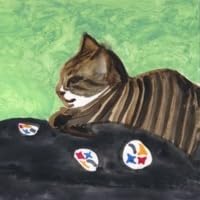
Cats & dogs, bunnies & skunks are drawn like smudges on the page. I'm always impressed by illustrations that look like they were haphazardly painted in one stroke. Wish my sad imitations at art could look that effortless and have that much character.
The scene with the thunderstorm did the best job of transporting me back to the farm where I worked for summers in college. I miss how you could watch the storms come and go and feel like you were moving with them.
Favorite Quotes:
Even the clouds seem to make sound as they bump across the sky.
I really enjoyed this book. It's a great combination of stuff to look and information about farm life. Farm is a work of fiction but it really captures what farms are all about and the kinds of work that farmers do. I loved the descriptions of the animals and the seasonal flow of the story.
While I don't expect this book to be wildly popular with students, it does a wonderful job capturing rural and farm life and the art is fabulous
I was shucking corn with my 2 year old son this summer when his eyes lit up and he shouted out; "Corn Da Da!!" He ran out of the kitchen grabbed this book from his bedroom, ran back to the kitchen, sat down on the kitchen floor and went directly to the page that includes a small illustration of a few ears of corn. He pointed to the picture, smiled up at me and said again, "Corn Da Da, Corn!!"
If I could give this more than 5 stars I would! The author did such a good job explaining exactly how a farming family lives. She talks about the animals, kids, and fields perfectly. This would be a good book to teach a kid who may not understand how a farm works. This book makes me miss being home this harvest season!
Love this- Cooper gets better with every book. Love the art, the design... and the text is lyrical, evocative and on par with the illustrations- not something I can say about many author/illustrators. All-around terrific book.
Books about farms are standard-fare for the preschool set, but this book stands apart. Beautiful watercolor and pencil illustrations and precise, descriptive prose take readers through one year on a modern farm.
A book that can show how a single place changes with the seasons and time. It is an in depth look at life on and around the farm. A good book for tying in cultural expression as well.
Reading Level: O Book Level: 3.4 Book Summary: This is a cute book about what all is on a farm and the process of farming. It's informational and tells a lot about what a farmer does throughout the seasons but also has cute story elements as well.
Mentor Book Writing Trait: This book could be used as a mentor text for the writing trait presentation. This book is a little unique in that instead of providing written definitions for words that might be unfamiliar to readers, it provides pictures to define the words instead. The first pages list what all is on a farm and there is a picture to aid every thing on the list. This is a great way to help students both build vocabulary and understand how pictures can really add to a story. After reading the story, you could give students a list of vocabulary words from the story and ask them to draw their own picture to represent each word. This book could also be used to help students learn about the process of farming. You could use it to help them learn what happens during each season and in what order they occur. After reading the story, you could create a matching game for students to play where they match the farming process with the season it occurs in and then order the list of events from beginning to end. When ordering the events, it's important to point out to students that these events are circular because they repeat every year. Instead of putting the events in a row, you could have them put them in a circle.
This children's book tells the story of what life is like on the farm. It discusses the land, animals, equipment, and people that live on the farm. It sweetly illustrates what daily life is like on the farm, for everyone!
This book was super cute, and I loved the detailed scenarios that it gave! The illustrations were precious!
This book could for sure be used in a preschool or younger elementary classroom. You could use this in a unit about animals, particularly regarding farm animals. You could have the kids play a sorting game and pick out which animals belong on a farm!
Cooper's distinctive illustrations are a treat, but it's the writing that really makes this book stand out.
The prose is evocative; reading it aloud, I feel transported to the rhythms and priorities of my farm community upbringing. Simple, matter-of-fact sentences are punctuated with moments of lyrical poetry: Everything grows in May. The corn shoots up, high as the girl's knee. The rows look like wet hair just after it's combed. The narrative is paced perfectly, too.
It's a remarkable book, worth reading no matter one's relationship to rural America.
I love Cooper's illustrations. This book gives a great explanation, at a child's level, of what is going on at a farm (feed corn, in this case) and some of the equipment during the year. Wonderful introduction for children and may lead them to learn more. As with great picture books, the story is so much more than the words and, in this case, Cooper also expands the story through words just by simple statements that spark imaginations.
This is definitely a longer picture book. Great learning on a more modern farm given that the farmer has a cell phone. I would recommend this as a read aloud with 1-3rd grade students who might be wondering how farms work. Sane author illustrator as Big Cat Little Cat which won a Caldecott I think.
In the front of the book is a glossary of 14 words that relate to the farm. The story takes the reader through the things that have to be done to grow certain crops and raise animals on a farm. Well described and illustrated. Easy to read and understand.
Love this book, except that the first page introduces a dad farmer, a mom farmer, a boy and a girl. The dad (hereafter referred to just as "the farmer"), daughter and son are all mentioned doing things on (and off) the farm, but the mother is never mentioned again. Bummer.