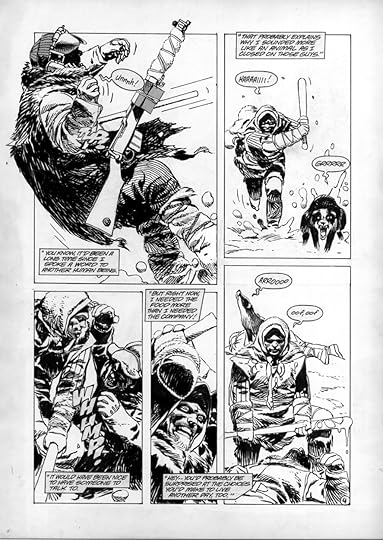
Out of print for twenty years, this brutal and suspenseful tale of survival in a frozen future by Chuck Dixon and Jorge Zaffino is one of the most influential comics works of the Eighties. Zaffino's stunning work on this story is considered his masterpiece and presented here in black and white for the first time.
Included in this deluxe, archival edition of is the never-before-published sequel WinterSea, also by Dixon and Zaffino.
Charles "Chuck" Dixon is an American comic book writer, perhaps best-known for long runs on Batman titles in the 1990s.
His earliest comics work was writing Evangeline first for Comico Comics in 1984 (then later for First Comics, who published the on-going series), on which he worked with his then-wife, the artist Judith Hunt. His big break came one year later, when editor Larry Hama hired him to write back-up stories for Marvel Comics' The Savage Sword of Conan.
In 1986, he began working for Eclipse Comics, writing Airboy with artist Tim Truman. Continuing to write for both Marvel and (mainly) Eclipse on these titles, as well as launching Strike! with artist Tom Lyle in August 1987 and Valkyrie with artist Paul Gulacy in October 1987, he began work on Carl Potts' Alien Legion series for Marvel's Epic Comics imprint, under editor Archie Goodwin. He also produced a three-issue adaptation of J. R. R. Tolkien's The Hobbit for Eclipse with artist David Wenzel between 1989 and 1990, and began writing Marc Spector: Moon Knight in June 1989.
His Punisher OGN Kingdom Gone (August, 1990) led to him working on the monthly The Punisher War Journal (and later, more monthly and occasional Punisher titles), and also brought him to the attention of DC Comics editor Denny O'Neil, who asked him to produce a Robin mini-series. The mini proved popular enough to spawn two sequels - The Joker's Wild (1991) and Cry of the Huntress (1992) - which led to both an ongoing monthly series (which Dixon wrote for 100 issues before leaving to work with CrossGen Comics), and to Dixon working on Detective Comics from #644-738 through the major Batman stories KnightFall & KnightsEnd (for which he helped create the key character of Bane), DC One Million , Contagion , Legacy , Cataclysm and No Man's Land . Much of his run was illustrated by Graham Nolan.
He was DC's most prolific Batman-writer in the mid-1990s (rivalled perhaps in history by Bill Finger and Dennis O'Neil) - in addition to writing Detective Comics he pioneered the individual series for Robin , Nightwing (which he wrote for 70 issues, and returned to briefly with 2005's #101) and Batgirl , as well as creating the team and book Birds of Prey .
While writing multiple Punisher and Batman comics (and October 1994's Punisher/Batman crossover), he also found time to launch Team 7 for Jim Lee's WildStorm/Image and Prophet for Rob Liefeld's Extreme Studios. He also wrote many issues of Catwoman and Green Arrow , regularly having about seven titles out each and every month between the years 1993 and 1998.
In March, 2002, Dixon turned his attention to CrossGen's output, salthough he co-wrote with Scott Beatty the origin of Barbara Gordon's Batgirl in 2003's Batgirl: Year One. For CrossGen he took over some of the comics of the out-going Mark Waid, taking over Sigil from #21, and Crux with #13. He launched Way of the Rat in June 2002, Brath (March '03), The Silken Ghost (June '03) and the pirate comic El Cazador (Oct '03), as well as editing Robert Rodi's non-Sigilverse The Crossovers. He also wrote the Ruse spin-off Archard's Agents one-shots in January and November '03 and April '04, the last released shortly before CrossGen's complete collapse forced the cancellation of all of its comics, before which Dixon wrote a single issue of Sojourn (May '04). Dixon's Way of the Rat #24, Brath #14 and El Cazador #6 were among the last comics released from the then-bankrupt publisher.
On June 10, 2008, Dixon announced on his forum that he was no longer "employed by DC Comics in any capacity."
Al mejor estilo Mad Max, La Carretera, Waterworld, se nos presenta un mundo apocalíptico invernal, donde la supervivencia es dura y cruel. En esta edición en blanco y negro se unen Winterworld y Wintersea, del afamado Chuck Dixon y el argentino Zaffino descollando en los lápices.
Relectura que confirma la primer impresión, una pena que no vea la luz Winter War. El dibujo de Zaffino se destaca por sobre el guión.
Irgend etwas ist gründlich schief gegangen. Zumindest große Teile Amerikas sind schnee- und eisbedeckt und die Zivilisation, wie wir sie kennen, existiert nicht mehr. In dieser lebensfeindlichen, barbarischen Umwelt ist Scully als Händler unterwegs, immer in Gefahr, ausgeraubt oder getötet zu werden. Bei einem fehlgeschlagenen Geschäft wechselt das Mädchen Wynn seinen Besitzer und zieht nun mit Scully durch die Gegend. Eigentlich will er sie schnell wieder loswerden, aber dann geraten beide in Gefangenschaft bei einem megaüblen Sklavenhändler...
Ich wünschte, ich könnte mich an einen Bruchteil der Comics erinnern, die ein ähnliches Setting haben. In den 80ern war Chuck Dixons WINTERWORLD sicherlich aus der Masse herausragend, aber rückblickend muss man das wohl relativieren. Die Handlung ist simpel und geradlinig erzählt. Sie vermittelt eine Idee davon, woher die Redewendung stammt: "Man(n) schlägt sich durch":
Selbst für heute Maßstäbe erzählt Dixon eine ungewöhnlich brutale, gewalttätige Story, in der der tägliche Überlebenskampf keinen Raum für Menschlichkeit lässt. Auch der Dachs Rahrah (zahm kann man ihn beim besten Willen nicht nennen), der Scully und Wynn aus mancher Misere rettet, ändert nichts daran, dass in dieser Graphic Novel keine sympathischen Figuren vorkommen. Auch damit mag es zusammenhängen, dass für mich keine rechte Spannung aufkam, egal wie prekär die Lage von Scully und Wynn auch war. Ich schreibe bewusst nicht "die Lage unseres Helden", denn das Zeug zum Helden geht Scully ab. Er ist nicht nur zynisch und brutal, er tötet aus dem Hinterhalt Menschen für Nahrung. Das mag seinerzeit als neu weil besonders "realistisch" durchgegangen sein, bei mir aber führt es nur dazu, dass mich Scullys Schicksal kaum noch interessiert. Dass derartige Verstöße gegen den Comic Code vielleicht erforderlich waren, um die Comics erwachsen werden zu lassen, ist davon unbenommen.
Die Schwarzweiß=Artwork von Jorge Zaffino besticht duch viele wirklich ungemein gut gemachte Panels, aber auch hier muss ich eine Kritik loswerden: In etlichen Fällen fiel es mir schwer, in den Zeichnungen zu erkennen, was eigentlich genau geschieht.
Ich denke, diese "deluxe archival edition" ist vorrangig interessant für Leser, die die Hefte in den 80ern gelesen haben und sich auf ein Wiedersehen in bester Druckqualität freuen. Mich hat WINTER WORLD nicht überzeugen können.
First part is Winterworld. I had previously read this when it originally came out from Eclipse in 1988. Doing the math, that means I'd read it 25 years ago... that's comes to half a lifetime... gezz, time sure does fly. I don't remember what I had thought of it originally, I just know that the original floppies weren't in my collection anymore. I do remember that, at the time, it had been loosely tied into Tim Truman's Scout series... don't ask me how as after reading it again I don't see where the stories connect, other than they both being post-apocalyptic stories. Actually, we don't get to know how the world got to where it is, we just know that it's in the middle of a new ice age, wether that was man-made or natural is not explained. Our "hero" is a loner wandering the icelands on a sort of snowmobile-camper, he interacts by barter with tribes of savage people. It's sort of strange that the guy has a good vocabulary seeing as he's a loner and the tribesmen are more the gutural barbaric types, he also seems to be the only guy able to read. Our "heroine" is a young slave-girl to one of the tribes and is being offered as barter for goods. What's also strange is that she's been in the tribe since she was 3 and also has a good dialect and, as per her saying, she's never been abused by her "masters". Oh, the hero also has a mean pet badger which seems to be the only way he manages to get of trouble with. For some reason, the hero feels an almost imediate bond with the girl (of about 13 years, I would guess). Anyway, they go thru a couple adventures and end up riding into the porverbial sunset. If not for the art, this would be a pretty run of the mill story. The book is re-printed in black and white, and if I remember well, 25 years ago it had been in colour, but with the printing quality of back then being what it was, I think that re-doing it in black and white was a pretty good idea, they would probably have had to re-color it anyway had they chosen to do it colour.
Second part: Wintersea We learn that the girl is part of tribe located somewhere in the isles off South America, the oceans are conveniently iced over, so no problem travelling. She also happens to be the grand daughter of the more technologically advanced tribe leader. We get to see polar bears, good to know that they've survived man's wrecking of their territories. Oh, and apparently, sharks are capable of breaking thru the ice to get to the goodies over it??? The new bad guys are sorta viking pirates riding gigantic snowmobilkes (that don't break thru the ice) on top wich they've attached 1800 sailing ships??? Also, apparently the pirates have been searching for the tribe for a long time... they manage to catch our hero but don't think about following his snow-tracks back??? well... there are a couple other things, but I won't bore you with the details. Again, the only thing saving this is the art.
This book reprints the original 3-book miniseries that was released under the same name in 1987 and adds an unpublished sequel called "Wintersea." The story is a basic post-apocalyptic survival one: the earth has frozen over into a near ice-age, and humanity only survives in small pockets of settlements. Scully is a trader who moves from settlement to settlement in a kind of snow-tank, bartering various pre-apocalypse goods (toys, candy, guns and ammo, etc.) to make a living. An ambush brings him together with a young orphaned teenage girl, whom he teams up with, only to be captured by slavers who sell them as field hands to a hothouse plantation being run in the old Houston Astrodome. He escapes, but can't leave her behind, and hatches a scheme to rescue her. In the sequel, the two travel to find her homeland, and when they find it, it's both a paradise and a prison of sorts. Then the cannibal Vikings come... Oh yeah, throughout all this, there's a ferocious overgrown badger as sidekick.
The pacing of the storytelling is great, everything moves at a nice clip and various beats click nicely into place. Which is good, because it keeps you from asking too many questions as you're reading (questions like why Scully bothers to lead the dangerous life of a trader when he has access to what is basically a treasure trove of goods that could set him up for life, or who the market is for the food and alcohol being produced at the plantation, or where anyone is getting all the gasoline needed to drive these massive machines around the frozen wastes). But none of that really matters too much, because what makes the whole thing work is the artwork. The original series appeared in color, but the publishers have wisely decided to reprint in pure black and white, thereby showcasing the work of Argentine artist Zaffino. Without the expressive inkwork of Zaffino, whose style seems very European, the story wouldn't really captivate. But his ability to create a realistic snowpocalypse and realistic characters makes the story jump off the page. Definitely worth checking out if you are interested in seeing striking artwork, or if you're really into post-apocalyptic settings.
Una muy interesante obra postapocaliptica,dónde el mundo entra en un invierno eterno lleno de penurias,hambre y la ley del más fuerte. Subsistencia en su más puro relato,dónde no hay buenos ni malos solo quienes respiran al final. Scully es un personaje bien desarrollado que sabe cómo sobrellevar la supervivencia al límite,todo mientras junto a su fiel mascota Rahrah,hacen lo imposible para que Wynn,una joven mecánica, este a salvo. Esta edición recopila tanto Winterworld como su secuela Wintersea, con un deleite gráfico de Jorge Zaffino y un guión aceptable de Chuck Dixon. Recomendado.
Beautiful black and white art by Argentinian artist Zaffino. Only in some panels things were a bit too messy to understand what was going on. The story is solid, nothing original but fun, violent and action-packed. Book was published in the late ‘80s. Not particularly clever, but also not as stupid as the average modern superhero comic book.
I can't believe this apocalypse graphic novel was out of print for 20 years! It is still a very powerful & relevant tale 20 years on. This guy has a great imagination! Too bad it's in B&W, I always prefer my comics in full colour - you hear that, Robert Kirkman?! I think WinterWorld will look very powerful with the characters standing out from a wintry background.
So the earth has become a frozen landscape, with the old world (shopping malls, streets, etc) buried under tonnes of snow. The survivors trudge about clad in winter wear and barter for trade. Scully is a trader, he travels about with his trusty bear RahRah, in a tank. As expected, the harsh conditions cause the survivors to adopt a "Me First" mentality. Some settlements are hostile & attempt to rob Scully instead of trading. Afterall, why would they trade when they could have it all by force? Interesting. In a world with no rules, would I still be compelled to act decently or may the strongest win?
Out of ignorance, some settlements name themselves after the places they live. Like the Bear People who spend their summers at Pizza Hut Village, thinking "Pizza Hut was the name of a great man who lived before the time the Earth was frozen". You might laugh at the absurdity of it all, but the author really sticks the knife in. He continues with Scully smart enough to deduce "from what I read that a 'pizza' was something to eat and the 'hut' was what you ate it in, although I'm not sure what kind of animal a 'pizza' was".
He picks up a girl called Wynn but they get enslaved at the Farm. I love the concept of the Farm, an old-world stadium with a dome where it's warm and they grow crops along the tiers. Don't like the brutal tactics of the tyrant Bossman much.
This version also includes the never-before-published sequel WinterSea, I like it more than WinterWorld cos there's a Jaws moment. They travel to a land of frozen ice and get about in a skimmer with a cute sail. They endure snowstorms that last a week, and then JAWS comes busting out of the ice to get at them. They eventually reach EarthFire where Wynn's tribe is, powered by the Fire Mountain. They even have aero-planes. But someone else wants that warm haven, a metal ship full of Viking cannibals, the ManEaters.
Interesting concepts, I bet they're still relevant 20 years from now!
Chuck Dixon é um cara controverso. Embora ele sempre faça histórias instigantes, bem engendradas, com personagens cativantes, ele possui um posicionamento político questionável e conservador. Talvez, na minha humilde opinião, seja esse posicionamento que o impeça de estar um patamar acima nos grandes escritores de quadrinhos. Embora neste Mundo Invernal, aqui e ali e traça algumas críticas ao mundo moderno, como a poluição e o efeito estufa, o que deixam uma HQ que se passa num futuro pós-apocalíptico congelado mais interessante e atual. O desenhista Jorge Zaffino, que fez as duas primeiras partes em preto e branco da HQ dá um show de narrativa. Entretanto eu preciso confessar que a parte que ADOREI dessa HQ foi a última, que é desenhada por Butch Guice. Creio que muito dessa impressão foi o desenvolvimento mais atual da narrativa e a presença de cores. As partes de Zaffino foram publicadas no final da década de 80, enquanto que as de Guice foram feitas no início dos Anos 2000. Embora a chamada da HQ chame a atenção para a cruza de histórias de O Dia Depois de Amanha e de Mad Max, eu diria que ela se parece mais com filmes de zumbi, como A Estrada e Extermínio, mas claro, SEM os zumbis, o que traz mais verossimilhança à história e um terror mais humano, ou seja, provocado pelo egoísmo e mesquinharia da nossa espécie. E é nisso o grande acerto da HQ. Sabemos que as situações de pressão fazem aflorar a extrema bondade ou a extrema maldade das pessoas, revelando sua verdadeira natureza. Um mundo pós-apocalíptico em que quase toda a Terra está sob um frio extrtemo catalisa essas situações. Recomendo a leitura.
This comic is Mad Max on ice. A lone wanderer traveling around the wasteland dealing with all the cutthroat tribes trying to survive in a brutal world. Simple, occasionally kind of dumb, but fun story. I would have liked more development of the characters and their motivations. There was untapped potential there.
The artwork started beautifully. I thought the use of stark, black and white illustrations for a story set on snow and ice was a great choice! And it works until a lot of characters get involved. Between odd framing choices, busy linework, and most characters having essentially the same silhouette, some scenes (especially action sequences) were very difficult to follow.
The art takes a weird dive in the second part, Wintersea. It had a much rougher look to it, sometimes with style and quality changing a lot from panel to panel. A lot of it looked rushed and sloppier than before.
Despite its flaws, this is the start to an interesting series. It looks like there are a few other volumes out there, and I'm curious about this cold apocalypse.
Em todo o mundo, os encadernados se “Winter World” reúnem apenas as duas primeiras histórias, produzidas por Chuck Dixon e Jorge Zaffino na década de 1980.
A edição da Mythos vai além e compila junto “La Niña”, a primeira história feita por Dixon ao retomar a série na década de 2010, dessa vez ao lado do artista Butch Guice.
As histórias mais antigas ainda se sustentam. A arte de Zaffino impressiona e o roteiro de Dixon não deixa arestas a serem aparadas. Tudo funciona. Personagens bem construídos, clichês bem utilizados, cenário bem apresentado. Não tive a oportunidade de conferir a arte colonizada de Zaffino, mas em p&b ele é brilhante. Digno de ser estudado.
Retomar uma obra décadas depois é perigoso. Podia ser uma decepção, mas Dixon mostra ainda ter tanto fôlego hoje, na aurora da vida, quanto estava no auge de sua popularidade. Inclui menção aos avanços tecnológicos, cita Al Gore e constrói uma trama instigante, que, infelizmente, termina em um cliffhanger. Sem anúncios de uma continuação por parte da editora brasileira, resta ao leitor buscar as edições originais.
Ive been wanting to read this for years and finally got around to it. I wish I hadn't waited so long.
It's a post apocalyptic story set on an Earth where winter has taken over. The reason why is never quite explained, nor is how long the planet has been frozen but it seems to have been a few centuries or so. As expected in this type of story not only is the weather and newly adapted creatures a problem, but the biggest issue comes from other humans, including the requisite cannibals.
This isn't really the most original story ever (although would have been a little moreso back in 1984 when it was originally published) but was a very good read with very nice art. The late Jorge Zaffino used to do some work on the Punisher so I was familiar with his art.
If you are a fan of post apocalyptic fiction this is definitely worth reading.
I took a look inside this book on Amazon, and it looked good enough that I had to get it and read it. The copy on the back of the book says it was out of print for twenty years, and that the art inside is considered to be artist Jorge Zaffino's masterpiece. I have to say that I thoroughly enjoyed the book, and I was not disappointed at all. Chuck Dixon's story of a post-apocalyptic world is well-written and very entertaining, but Zaffino's work is what will draw me back to this book again and again. I loved the art, and as a lifelong comics fan, I have to say this is some of the best art I have ever seen. I highly recommend this book to any fan of great comic art.
Me sorprendió muy gratamente. Ya había leído varias cosas de Chuck Dixon más recientes. Este cómic es de los 80 y se siente.Las historias son crudas como una película de ésa época, sin edulcorantes. Winterworld es un mundo cruel y los protagonistas Scully y Wynn son a veces crueles también. Las ilustraciones del artista argentino Jorge Zaffino son muy dinámicas y evocan el mundo frío, salvaje y desolado de la obra. Dos personas tratan de sobrevivir a una sociedad tribal post apocalíptica al estilo Mad Max, pero en vez del desierto, vagan por la tundra infinita del mundo congelado. Esta muy bien.
Great black and white art. An awesome bleak frozen 80s post apocalyptic adventure. Or a trudge through a terrible world. Some great stuff. Closest film would probably be The Colony. But Winterworld doesn’t have cannibal zombies. Even though it’s some pulp ideas you’ve seen plenty of times, there is something about the speed of the story and the amazing art that draws you in. I’m excited to read the much later sequels. I had some individual issues but I didn’t keep up with it because I didn’t know the back story. Worth picking up if you dig this kinda stuff.
It's not very cheery, it is set in Mad Max dystopia where everything is cold and scarce. Everyone is a scavenger and no one is to be trusted. The strong enslave the weak.
The real star is Jorge Zaffino. Is artwork is just tremendous and you can feel the cold coming off the page.
What is here is essentially a two-parter a simple story very reminiscent of Mad Max in its feel. But it is so well done, this might be my favourite piece of sequential art.
Interesante por el artista (Jorge Zaffino, que dibujaba NIPPUR DE LAGASH en tiempos idos) y el autor (Chuck Dixon, que también escribió BATMAN y THE PUNISHER) - pero la trama es básicamente una especie de Mad Max, pero en un mundo nevado.
Tiene ese aura de peli post apocalíptica de los 90 y el dibujo es una gozada. Sin embargo, las dos partes en las que se divide el comic, el argumento es exactamente el mismo y el guion deja un poco que desear.
Creepy and ahead of its time. But stark black and white art make it hard to clearly follow the action. Still, most definitely worth the read. be hard to follow.
El Mad Max de los hielos, gran relato de acción apocalíptica, ilustrada en un estilo cinematográfico por uno de los grandes dibujantes argentinos, Jorge Zaffino
Winterworld collects the three issue mini-series written by Chuck Dixon and drawn by Jorge Zaffino as well as the never before published sequel by the same creative team, Wintersea. Both stories are very similar in plot and in execution. One of them, Wintersea, is much better than the other and it's because of that second story that this book is ultimately a good read.
Comics Should Be Good's Brian Cronin once described Winterworld as Water World in comic form but, you know, in winter. It's a pretty accurate description. Chuck Dixon gives us a vaguely defined post-apocalyptic world where winter is never ending. Polar bears roam the Caribbean and cities are half engulfed in snow and ice. Many types of animals are now extinct, restaurant and retail franchises that are still standing are misunderstood as people no longer remember what they were for. Pizza Hut is either a mythological folk hero or a place where pizza is eaten. The latter of those two options is what our hero, Scully, thinks but he has no idea what kind I animal pizza could be.
Both stories involve a search for or the discovery of a warm safe haven from the harsh world of continuous winter. Scully either escapes or is cast away from those places and returns to rescue Wynn and generally destroying those special places in the process.
Both stories work as adventure stories. There are evil men, explosions, etc but in the first story Dixon's writing is unsure. Oddly enough, it’s also characterized by the confidence of a young creator. His writing improves for the second story and that’s matched by a more interesting narrative as well, even though it closely resembles the three issues of Winterworld. Zaffino’s art is very good in Winterworld but he doesn't have too many exciting things to draw other than mean looking men snow and explosions. Dixon gives him more interesting things to draw in the sequel. Dixon asks Zaffino to draw us large ships carried atop the backs of tanks rolling around on the frozen sea heading towards a utopian city located on a volcanic island. Zaffino’s art overall seems to be better in the second story and Dixon's writing is confident, too. It's a better marriage of big creator talent which results in a more entertaining comic.
IDW's Winterworld collection is a good comic. At heart it's a post-apocalyptic adventure comic with lots of action, a bit of darkness and wonderful visual spectacles. It's a Hollywood summer movie as a comic and it doesn’t try to be anything else which contributed to my enjoyment of it. It also had a cameo of Chuck and Jorge in the second last page of Wintersea and I always enjoying seeing creator cameos in comics.
"Presented in black and white for the first time" is not typically something that should be promoted on the back cover of your book. The original Winter World was a color comic book, and the art/inking was done with this distinguishing factor in mind. This book presents the art with the original thick lines with lots of blacks and no middle gray tones. It gets a little hard to read at parts.
The premise behind this post-apocalyptic is interesting enough, especially as it was created in 1987 (well before global warming became a frequent politician term), however I wish there was a little more too it. I don't feel like the authors put just an enormous amount of thought into it. Some of the science is a little shaky. And a major, life-changing event occurs to both main characters in the first story that doesn't seem to follow them into the second story (or later volumes if memory serves).
This book gets a big plus for printing the previously un-plublished Winter Sea story, even if it does not color the story.
Mais uma de muitas variações do tema futuro pós-apocalíptico tão em voga nos anos 80 e 90 do século XX. Num mundo coberto de gelo um implacável negociante percorre uma américa perigosa, onde tribos semi-selvagens de sobreviventes estabeleceram pólos de violência. Quando encontra uma jovem rapariga que diz ter vindo dos céus descobre a possibilidade de um local onde graças a um vulcão ainda há calor e a chama da civilização se mantém. Resta-lhes um périplo onde enfrentam tribos semi-selvagens e um bando de piratas de alto-mar que se deslocam sobre o gelo em veleiros equipados de lagartas. Chuck Dixon assina um argumento em tudo igual a tantos outros do género. O traço do argentino Jorge Zaffino confere a este livro uma elegância inesperada.
Great book! Solid story and gritty artwork. The artwork is outstanding! Love the relationship between the two characters. And the winter post apocalyptic story is very refreshing then the desert wasteland type. Chuck Dixon does a great job writing a tough character who is believable. The only problem with the story is the pacing, felt very rushed. I think they could have really explored this world more. The addition of winter sea was great. I really enjoyed the story and felt for the characters and there relationships. A great ending story for this series. And who doesn't love post apocalyptic viking cannibals. The is a really fun book and a fresh setting for a post apocalyptic story.
Al Gore was right and mankind is now living through a new ice age.
A loner, who makes his living excavating malls and other places buried beneath the ice and snow and selling the stuff he finds. When he takes in a young orphan girl he gets caught up in all kinds of trouble, involving bandit gangs, being captured by a tyrant and seeking the legendary 'lost people with the secrets of the ancients'.
Fun bit of sci-fi adventure. Reminds me of the kind of gritty sci-fi movies that came out in the 80's.
Strong, fantastic art and good dialogue kept me turning pages and having a hard time stopping. There were a few places where the flow of action was a little difficult to decipher, which is what kept this from being a 5, but SO glad I got the chance to read this one. Stark post-apocolyptic storytelling at its best.