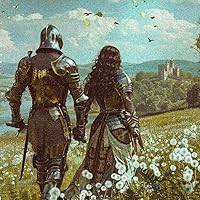
The war between Urza and Mishra is over. Brooding on the death of his brother at the hands of extraplanar forces, Urza drifts among the planes.
But the end of the Brother's War has transformed him into something greater. Deep within his heart, a spark has been kindled to a flame that cannot be quenched.
Urza has become a planeswalker.
Linked to the Urza's Saga expansion of the Magic: The Gathering trading card game.
Lynn Abbey began publishing in 1979 with the novel Daughter of the Bright Moon and the short story "The Face of Chaos," part of a Thieves World shared world anthology. She received early encouragement from Gordon R. Dickson.
In the 1980s she married Robert Asprin and became his co-editor on the Thieves World books. She also contributed to other shared world series during the 1980s, including Heroes in Hell and Merovingen Nights.
Abbey and Asprin divorced in 1993 and Abbey moved to Oklahoma City. She continued to write novels during this period, including original works as well as tie-ins to Role Playing Games for TSR. In 2002, she returned to Thieves World with the novel Sanctuary and also began editing new anthologies, beginning with Turning Points.
Urza is now a Planeswalker. And now he has some things he must do, but only after he can get to grips with himself. Urza is now tormented by the death of his brother, believing that he is the cause of it, as opposed to the Phyrexians who turned him into the monstrosity he was. He decides that Phyrexia must be taught a lesson, that they must pay for their actions and be destroyed.
The book is much different than the earlier one, and many people who have read it will tell you that. It has a lot of mixed results. Some, like myself, can't stand the book, while others say it's not all that bad. But I think collectively, it's not as highly regarded as the previous book, as the previous book is regarded as one of the best MTG novels ever written.
Much of the story is about Urza's internal conflict. He toils around trying to find out how he was responsible, how to forgive himself, etc. The story does have some points of action, though they are not nearly as good as what was in the previous book. The story itself is also not as compelling. The story also takes on some action that is brought about in this book and finished in this book.
What I have found is that for the remainder of this cycle, the books tend to bring about their own problem per book, and resolve that in the book, as it moves towards an ultimate goal: defeating Phyrexia. It's almost as if this book is not a direct sequel, in that the events from the previous book do not follow over, except the fact that the events in the previous book lead to Phyrexians on Dominaria and Urza became a Planeswalker.
I do not recommend reading this book, and it was very difficult to finish. I would recommend reading a summary online instead of reading the book. If you think you might enjoy Urza whining in his little shack, go ahead, but I sure didn't.
In a lot of ways, this book was better than The Brothers' War, the book that preceded it in the series. Unfortunately, its lore is built upon the lore of the first book, and it has no meaning without the context of the first.
As a 12-year-old boy in my first read, I found this book disappointing as it cast aside the omnipotent Urza as the series' main protagonist and replaced him with a cynical and complex female lead who had seemingly come out of nowhere. However, after the first chapter or so in my recent reading, it began to become clear that Urza Planeswalker's story was more or less complete, and Xantcha's story was far more interesting. Viewing the story through the eyes of a character who is essentially a sidekick was refreshing. And Xantcha's worldview does a much better job of characterizing both Urza and the Multiverse, not to mention offering an ironically human perspective on the events of a Planeswalker's story.
In retrospect, if this story had truly featured Urza, it would have been boring and forgettable.
This book spends its first three quarters feeling like it's building up to something, although it's unclear what. Most of the story is rather mundane, offering Xantcha's perspective on the strange world(s) she's been dragged into. However, most of her experiences are inconsequential, and in many ways the book feels like it's taking place in her head rather than the world around her. This isn't necessarily a bad thing, but the shift from external plot to the internal workings of the protagonist's mind are both jarring and, again, slow-paced. In the end, though, it does pay off, as Xantcha is far more fascinating than I first gave her credit for.
The book seems to pick up the pace in the final few chapters, and by then it has so little time left that it seems to stumble over itself to finish on time. The climax and actual goal of the story arrive suddenly, and the final scenes feel rather rushed. I found myself reading over the last chapter multiple times, trying to understand what was happening, and it feels like perhaps a deadline or a page limit may have prevented it from receiving the depth and detail it deserved. I'm left with the feeling that I'm not entirely sure how it ended, mostly due to the omission of important details (and even several words omitted erroneously from sentences). While I wish the ending had been a little more refined, though, the rest of the book more than makes up for it. Besides, the failure to explain what was happening in the final chapter is trivial in the face of the upcoming time-skip between now and the next book.
Looking back, this is easily the most underrated Magic: the Gathering story. I'm glad I gave it a second glance.
It feels as if Lynn Abbey was given the following set of instructions: "Throw together 90k words in which Urza planeswalks at least once, and somewhere in there we learn that the Phyrexians are in fact the Thran." Armed with only this, Abbey began one story (Urza's new apprentice - Xantcha - buys a slave - Ratepe - who bears a physical similarity to Mishra, hoping that they can fool Urza and somehow end his madness), grew somewhat tired of that, then began filling in the blanks of Xantcha's history with Urza. Then that grew tiresome, so random excursions begin happening, or at least get mentioned.
In the end, this is even more a mishmash than 'The Brothers' War.' Abbey has never been my favorite writer, and this only adds to the heap. I'm assuming much of the blame lies on WotC, but still, yeesh.
This was a good story and certainly well written. Urza is a frustrating character but I don't think that comes from the writer so much as his design. Fortunately though we don't have to experience the story from his perspective. Doing so would just be a confusing mess. Telling it through Xancha was well done and led to a good overall experience.
Still, it's not without its problems. I found the time skips random, confusing and not well framed. The end was also the definition of anti-climactic. I'm sensing a theme here with these novels. There's absolutely no wrap up ever. The stories climax and then just end. That's that. It leaves you feeling very dissatisfied. There's no lack of MTG novels though so I guess I haven't really been left in the dark completely.
Some are very critical of this book out of the series and criticize it's emphasis on a less significant mythos character. I disagree wholly and see it as a view through a window of a the classic Urza as he descends into madness. The understanding of the ability of planeswalkers gained from this book is extensive to fans of Magic. Following the development of Magic's number 1 protagonist as he fights against overwhelming odds (even for an immortal) is amazing and Xantcha provides a character that the reader can actually side with. Her backstory also provides a view into the metal realm of Phyrexia which remained a mystery though the proceeding book.
This was a frustrating read. The characters were uninteresting an nonsensical, as well as the plot, what little of it there was, scattered around this mess. I am rarely aware of bad writing but here it just kept stabbing at my brain. So many times I had to go back because some sort of pivot happened inside a paragraph and it was written in a way that it's easy to glance over. And the dialogue often made no sense with characters changing topics to something non-relevant for no reason. The previous book surprised me because it was so much better than I expected a MTG tie-in to be. This one surprised me because it was so much worse.
Very well written and interesting. No action romp, but an inside look into interesting characters. The whole MtG universe is great, so many more dimensions to it (ha ha) than your average unimaginative Tolkien ripoff.
The balance of epic action in the background and the internal world of the characters in the fore, really is near perfect for my tastes here.
Would have been four stars for enjoyment, but for the somewhat cliffhanger ending.
A far cry from its predecessor, Planeswalker has very little to bring to the table in terms of story. Where Brothers War felt like it could fill out a trilogy in and of itself, Planeswalker feels like it was barely stretched enough to fill out this one book. There are whole spans of chapters where truly nothing happens narratively. The book is mostly saved by having such a compelling cast. Xantcha, Ratepe, and Urza are all such good characters. It's unfortunate that the former two weren't in a better story. I think the plot intrigue about the Thran and the Phyrexians and their origins on Dominaria would've been more compelling had I not already read The Thran previously. I've made note to tell people to avoid reading The Thran before this book to achieve the best reading experience. This is all to say that Planeswalker is a middling story carried by good characters. At best, it inches the greater plot of the Phyrexian war forward, at worst it's mind numbingly boring. But I'm at least excited to be done with it, because the next book, Time Streams, is written by J. Robert King, an MTG author whose work on The Thran was extremely good. I look forward to seeing where (or when) Urza's quest for vengeance takes us next.
Ужасно. Книга по сути наполовину состоит из набора диалогов героини с Урзой и еще парой человек. Диалоги абсолютно пустые и многостраничные, похожие на теткинские телефонные разговоры, когда каждая из сторон по сто раз повторяет уже известное, лишь бы не класть трубку. А вторую половину романа занимают флешбеки из жизни героини, ни для чего не нужные, просто авторка придумала крутую героиню и хочет про нее побольше рассказать.
Урза (который и в первой книге был крайне умен, а став бессмертным, за тысячелетия явно должен был еще набраться опыта) большую часть времени откровенно тупит, а в промежутках творит разные наивные глупости.
DNF'd. extremely tiresome and rambling. couldn't make it past the halfway point despite my love of Hasbro's collectible card game Magic: The Gathering. onto the next one, I'm sure there will be a full recap of what I missed (Urza fighting some Phyrexians, probably Gix, I'm guessing)
I feel like the book is subtly good possibly great, but not for what it's dressed as. Urza being a planeswalker is what the cover seems to be selling, but I feel like it's the journey of Xantcha that is the real selling point.
Thing is, I'm not the right person to give her character the proper appreciation she deserves, but as far as I can tell, she's the first non-conforming character in terms of race, sexuality, identity, in all of magic (and possibly one of the first in fantasy genre as a whole).
Her identity is conflicted with who she was (and what everyone around her sees her as, an incompleat phyrexian newt), but she fights for the identity who she wants/feels that she is. Multiple times, people in towns think of her as a male, sometimes as a female, and it gave me a sense that her struggle to understand who she is/who the world thinks she is is the focal point of the novel. The fight between phyrexia and urza kinda pales in comparison to this story (and i'm an avid magic player). And to top it off, the development of romantic engagement with Rat was really well done.
I feel like Xantcha is the hidden gem of this novel, and i think Abbey (the author) knew that. It's brilliant that she's the focus of the novel, even though Urza steals the limelight.
All that being said, i'm sure there are better examples of identity struggle novels out there, but there aren't any good ones in this universe as far as i can tell.
Also, warning for disturbing images in the book (there's a part where Xantcha watches another newt slice off its arm and puts a shovel there to try to appease Gix, to be half-machine, for example).
I was surprised by how much I liked this book. It's not for everyone, and it's not a classic "dungeon crawl" fantasy adventure. Rather it's quite cerebral and engaging. I found myself caring about Abbey's protagonist, Xantcha. The story is much more polished than I've come to expect for MtG related fiction. Which comes as no surprise as it's written by an accomplished author and commands high prices on the secondary market. Left me want to read on in the series, as so many people rate those novels higher than this one.
In this sequel to the Artifact's series, we are about 3000 years after the brother's war. Urza is immortal and plagued by remorse and the memory of his dead brother. The war threatens again and we finally learn the truth about the Thran and Pyrexia and war that continues to span across time and space.
Being the second book in the Artifacts cycle, I can't help but compare this to the first book, The Brothers' War. I read them both for the first time about 20 years ago. What stuck out most to me was that whereas I remembered every little detail about the first book, I had forgotten almost everything but the most broad general story beats in this book. It follows Urza from newly minted planeswalker through a war of revenge against the machine demons of Phyrexia that lasts thousands of years. It's actually told through the eyes of his platonic life partner, Xantcha, a Phyrexian newt who dared to rebel and run away.
As to the good parts of the book, for a licensed fantasy novel written in 1998, it's surprisingly woke. Even though Xantcha prefers to present as female most of the time, she is at her core an nonbinary agendered creature grown from a flesh-vat. They don't make a big deal about this, either. I can't think of encountering any other non-cisgendered heroes going back that far, at least not from as big an IP as Magic: The Gathering. Also, Urza, the titular Planeswalker, struggles with mental illness throughout the entire novel. His obsessive war with the Phyrexians and his deep seated depression for failing to save his brother in the first book are some pretty major themes.
On to the bad. The plot meanders all over the place. Unlike the simple plotline of a generation long war between brothers in the first book, Planeswalker covers thousands of years of plot that feels like it just drags on and on. Xantcha recruits a teenager named Ratepe that just happens to look like Urza's brother, Mishra, hoping that it will bring him out of his obsessive depression, only to fall in love with him. This is in contrast to her relationship with Urza, which, despite lasting literal thousands of years, never blossoms into love. Whereas in the first book, he comes off as borderline autistic in his singleminded obsession with artifacts, Lynn Abbey makes him come off more as a condescending paternalist.
I think the best summation of my feelings is that after The Brothers' War, I mostly felt nostalgic and wanted to read the next installment. After Planeswalker, I just feel kind of blah. I'll probably keep reading the next book in the Artifacts Cycle, but I'm not exactly in a hurry.
This book was terrible. I just can't understand the people who like this book. The whole idea of the book makes no sense. This girl (oh no wait, she's not a girl bc she's Phyrexian and has no gender... but she is because she said so... it's pretty much the opposite of being non-binary) decides that Urza is crazy, so she tries to find someone that looks like his brother (first off how does she know what his brother looks like) and try and cure him from his craziness. Not only does the idea make no sense, but the solution makes no sense. Sometimes Urza seems nuts, but sometimes he seems sane. Both times they act like they're making progress to regain his sanity, but when he "gets it back" he really doesn't act like he does at all, and, if you know a single thing about MTG lore, he most definitely is not sane. The climax was really the only interesting part of the book and it was like, the last three chapters of the book. The entire rest of the plot made no sense. The worst part of the book was the story switching. Every other chapter they switch between Xancha's current life and Xancha's past life. Not only does this destroy the flow of the book, but the book gives you no context and you just have to GUESS which one it is after reading a few pages. It's incredibly annoying and unnecessary. Now if you haven't gotten the memo yet, I really hate this book, so you're probably wondering "then why did you give it two stars instead of one?" I have one good reason: Rath and Storm is worse. I was able to finish this book (even though it was very painful). I put Rath and Storm down after like, three chapters. That's my definition of a 1 star book. The moral of the story is, don't read this book unless you're a hardcore lore nerd who just NEEDS to absorb this information, which I get being one myself.
The Brothers War is widely believed to be the best MTG novel, and Planeswalker is its direct sequel.
The book starts with a 3000 year timeskip. Conveniently, this skips an entire ice age caused by the main characters in the previous book. The author then proceeds to retcon a lot of the characters and worldbuilding from the previous book. She provides in-universe explanations for the retcons, and some are hilarious, intentionally or not. Mishra, the leader of the ancient Fallaji empire, was known to be notoriously impulsive and prone to fits of anger, but in this book he's become charming and charismatic, thanks to history being rewritten. When Xantcha, the main character, looks for a fake (or reborn) Mishra to present to her master, she of course finds a charming, handsome one, who isn't morbidly obese and has both healthy lungs. Xantcha is the main issue with this novel. The world and characters are almost always seen through her stream of consciousness and never described directly. Xantcha has unreliable memory, but will claim that it is photographic. She will sincerely pity the childishness and mental inferiority of her master and mentor, a several-thousand year old wizard. She will claim to have no combat experience in one scene, only to spend the next night hunting down a band of mercenaries and killing them off silently one by one. She will claim she was always the victim in most events in her life, and proceed to toss a demon into boiling oil or kill an armored man with a punch, while being bare fisted. Having a compulsive liar and mild psychotic describe several fantasy worlds is certainly original but it's also hard to keep track of.
Strange, plodding, meandering, aimless. The characters have stilted conversations that don't particularly go anywhere. If a dialogue would threaten to be too interesting, it happens off-screen instead and we only get a quick summary stuffed in like a footnote to something else happening.
Very little context is given for most anything going on. Even having just finished the prior book, and being a lifelong Magic: The Gathering player, I felt rather frustratingly lost. It feels like the author had the impression she was far better at describing things or writing dialogue than she really is; it doesn't feel that we're being led along on a mystery to solve but as if she just assumes we're going to get what she's getting at.
Here's how the book went for the first two-thirds: - Present-day where Xantcha tries and fails to have a useful dialogue with someone and fails. Someone wanders off and she floats around for a while to think about how badly the conversation went. - Flashbacks where Xantcha gets dragged along as a largely passive agent through a series of scenes she doesn't understand, so we don't get to either. She tries and fails to have a useful dialogue with someone and fails. Then she gets knocked unconscious. - Glistening Oil. Glistening Oil. Glisteni-
I got bored and gave up under the assumption the last third of this book will be more of the same. I'm going to read a summary of the plot on the MTG wiki or something instead.
Planeswalker is mostly great for its character work. The relationship between Urza and Xantcha is fascinating in that it reflects very realistic abusive dynamics, and the dual narrative (past vs present) really helps flesh it out. Ratepe provides an everyman, normal human perspective to the insanity unfolding, but also serves as a character foil to Urza in a few major ways - namely in their relationships with Xantcha. While Urza is classically abusive, constantly flip-flopping between praise and denigration, Ratepe implores Xantcha to be kinder to others and to herself - and it’s this gradual shift in Xantcha’s perspective that is strongly marked by the contrast between past and present narratives.
Where the book falters is in the actual plot. It feels like a bunch of filler sequences stitched together, set in fairly-inconsequential locations. Hypothetically, in many parts of the story, you could completely change what the characters are doing and where they are, but keep their subject of conversation - and the story would pan out exactly the same way. For the most part, the setting or even what the characters are doing isn’t very interesting, which is definitely a bit of a problem.
Pacing is also wonky throughout, but gets really noticeable toward the end - I don’t think it detracts from the story too much since it felt like the story was ending soon anyway, but even just a few more pages would have really helped flesh out the ending and provide a more satisfying thematic conclusion to Xantcha’s character arc. Still, the key idea is there and done fairly well: Xantcha, after spending her whole life struggling to craft her own identity separate from Gix, from Phyrexia, from Urza, makes the choice to trust Ratepe, who tells her to trust herself. In her last moments, Xantcha overcomes her demons and is finally free.
In summary, when the characters aren’t interacting or contemplating, the story tends to drag. However, even though I’ve spent more words criticizing the book than praising it, I actually really love it and think it’s easily one of the best Magic novels out there; Planeswalker is worth reading for Xantcha’s POV alone, by a wide margin, and has some more to offer beyond that as well.
This entire review has been hidden because of spoilers.
Through a focus on Xantcha, Urza's companion, we learn more about the legend that is Urza the Planeswalker. This sequel is like the first book in the series, The Brothers' War, in that it tells you about the main character by covering the people and events revolving around those legendary characters, caught in their gravitational pull. It follows the moon so that you can learn about the sun. For some, they would rather have focused on Urza himself, but I appreciated this book. Just don't go into this book expecting to follow Urza around scene to scene. (Honestly, I find it surprising so many reviewers seemed to expect that when that's not how the first book was written either, but perhaps it is because of the title - The Brothers' War sounds like an event, Planeswalker sounds like a person.) If you can get past that, Xantcha is a novel character who is written compellingly on her own. The book is also filled with foundational lore about planeswalking and Phyrexia and the multiverse. While I enjoyed The Brothers' War more, I still enjoyed this book and recommend it, particularly if you want to better understand the lore behind Magic: the Gathering.
I hated this at 13 (I would've given it a 1/10). At 19, it suited my tastes more, but barely (4/10). In previous readings, I did not understand the writing. It was subtle and complex, in a way I did not totally get. It was less action-oriented than I was used to, focused on healing from mental illness.
In re-reading it (at 28), it still has significant flaws (Urza's dialogue is strange and wooden, and the pacing/stakes are a bit off between flashbacks vs current-day events), but it's also an emotional tale, about strange and alien immortals, struggling with grief. I also used to take Urza's views at face value, but the narrator makes it clear that he is not well or to be trusted - so what I previously thought was an issue of continuity was Urza not understanding. I also disliked the narrator, as she seemed (to me at 13) to be 'totally irrational', but I understand her better now and could empathize.
Disclaimer: I loved the first book. This one took a bit to get into but they went in super deep into Phyrexian lore and it was awesome. I think what Urza was going through is the natural progression of what someone who lives that long could go through. Full circle.
I think the thing to remember is that every book is going to be different and from a different peespective. While the story wasn't focused on Xancha it was told from her perspective and what she saw from having this "god like" friend.
I see that people are upset that it was so different but that's what made this one so unique. The Phyrexian portions are worth it alone.
This entire review has been hidden because of spoilers.
This rating is given on a Magic the Gathering scale, not a regular book scale.
It wasn't terrible. Xantcha is a fun character. Urza is sometimes an interesting character. He isn't so much in this book.
The story was. A bit hard to follow. Apparently there are flashbacks? I just got confused about what was happening.
The book took me around a year to finish. I did finish it though. I'm happy I finished it. But I wouldn't read it again. I feel like there was a lot of nothing with a sprinkle of interesting Magic lore tidbits.
this is a really odd book. if I could give a 3.5 rating I would. the book is a 3/5 in terms of its confusing pacing, and a timespan (3 000 years) which just can not be captured in 350 or so pages. it is a 4/5 in terms of some of the truly brilliant ideas it has. the main character being what I consider an "accidental trans woman" is very cool for the time, the Equilorians are really interesting and mysterious, and the realm of Serra is a fascinatingly haunting world. this book has some amazing ideas, which unfortunately haven't been done justice by the execution.
The story starts out rather slow, almost resembling a dialogue between to people, but gradually becomes a good story in its own right. It helps to establish who exactly Urza Planeswalker is, what his goals are and how far he is willing to go in order to achieve them. It further progresses the Magic: The gathering universe, helping to give insight into Phyrexia and it's inhabitants. While not quite as good as it's predecessor, it is still a great read.
I procrastinated reading the last 30 pages of this book. As bad as that may sound, it was honestly out of anticipation for the ending! This book didnt quite feel like it was really focused on Urza. However, it did a pretty good job of keeping the story line clear. While I could never have predicted how this book would end, I can say my heart is smiling over yet another wonderful read.
I like the prequel a lot, but this one was nowhere near as good, and not even the ever present rose tinted glasses of nostalgia can save this from a more critical look. It drags on, the prose is not very good, and it does not go anywhere meaningful despite the interesting premise. You will still read this though. You know who you are.
This was a bit of a letdown after the previous book. The quality of writing decreased noticeably, and the actual story was very unremarkable. Forgettable, and I'm hoping things swing back the other way with the next one.
Returning characters galore, meeting new legends, and battling old foes. Good book, easy and fun read. Perfect for MTG fans, which you probably are if you are reading this.